Japan Airbag Textile Materials Market Size & Growth Rate
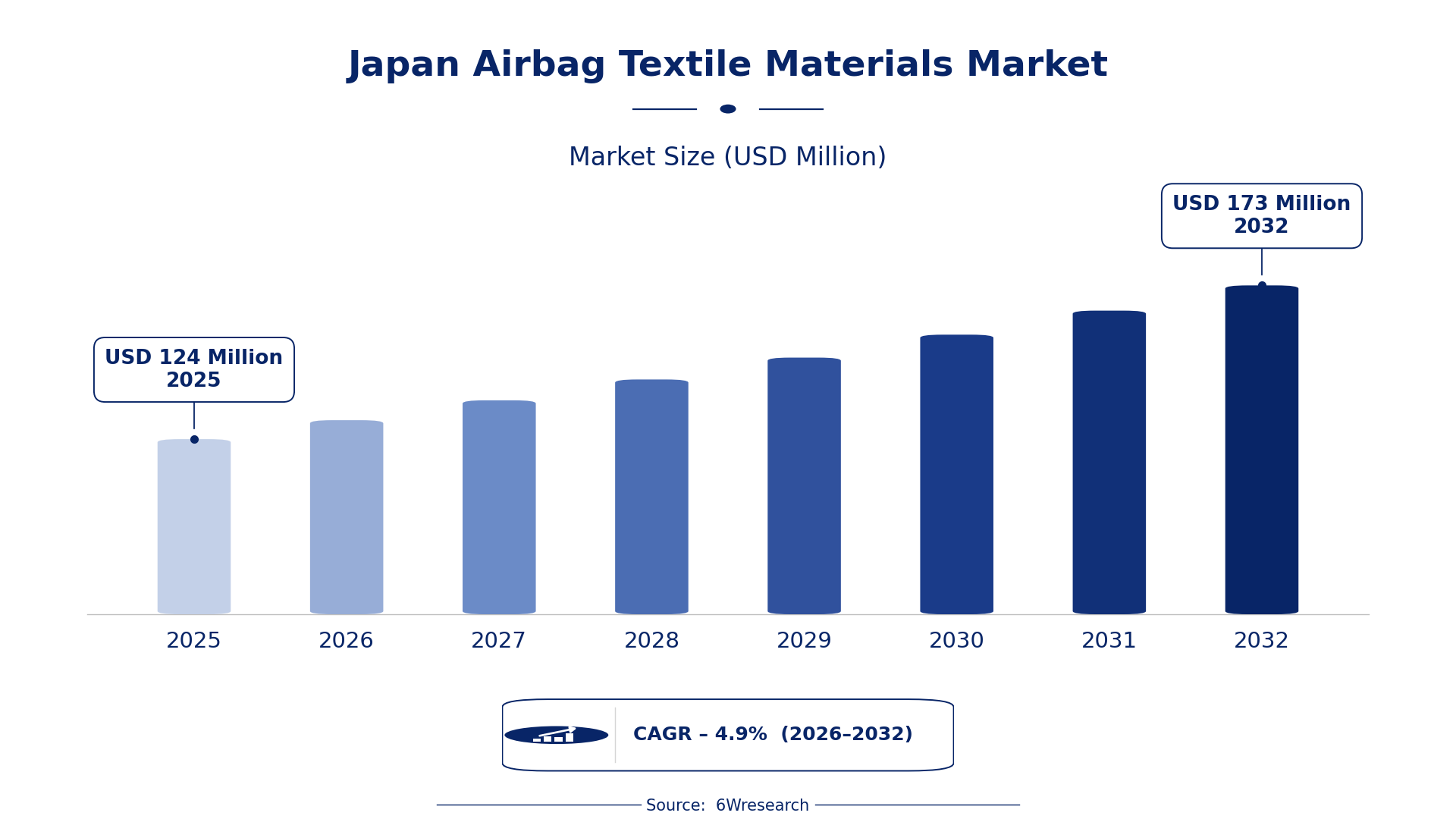
According to 6Wresearch internal database and industry insights, the Japan Airbag Textile Materials Market was valued at USD 124 Million in 2025 and is projected to reach USD 173 Million by 2032, growing at a CAGR of approximately 4.9% during 2026–2032.
Japan Airbag Textile Materials Market Highlights
| Report Metric | Details |
| Report Name | Japan Airbag Textile Materials Market (2026-2032) |
| Market Size 2025 | USD 124 Million |
| Market Size 2032 | USD 173 Million |
| Absolute Growth 2025–2032 | USD 49 Million |
| CAGR 2026–2032 | 4.9% |
| Peak Annual Growth | 5.4% in 2027 |
| Forecast Period | 2026–2032 |
| Historical Data | 2022–2025 |
| Base Year | 2025 |
| Leading Fabric Type, 2025 | Nylon 6 (48% share) |
| Leading Material Base, 2025 | Synthetic Yarn (36% share) |
| Leading Distribution Channel, 2025 | Raw Textile Suppliers (41% share) |
| Leading End User, 2025 | Airbag Module Producers (42% share) |
| Fastest-Growing Fabric Type | Nylon 66 (6.8% CAGR) |
| Fastest-Growing Material Base | High-Tenacity Yarn (7.0% CAGR) |
| Fastest-Growing Distribution Channel | Direct Yarn Distributors (6.1% CAGR) |
| Growing Sector | automotive safety |
| Key End Users | Airbag Module Producers, Automotive Textile Firms, Vehicle Safety OEMs |
Japan Airbag Textile Materials Market Year-wise Growth Rate and Key Drivers (2022–2032)
This graph illustrates the annual growth rates of the market from 2022 to 2032, highlighting a steady upward trajectory and projected market expansion over the forecast period.
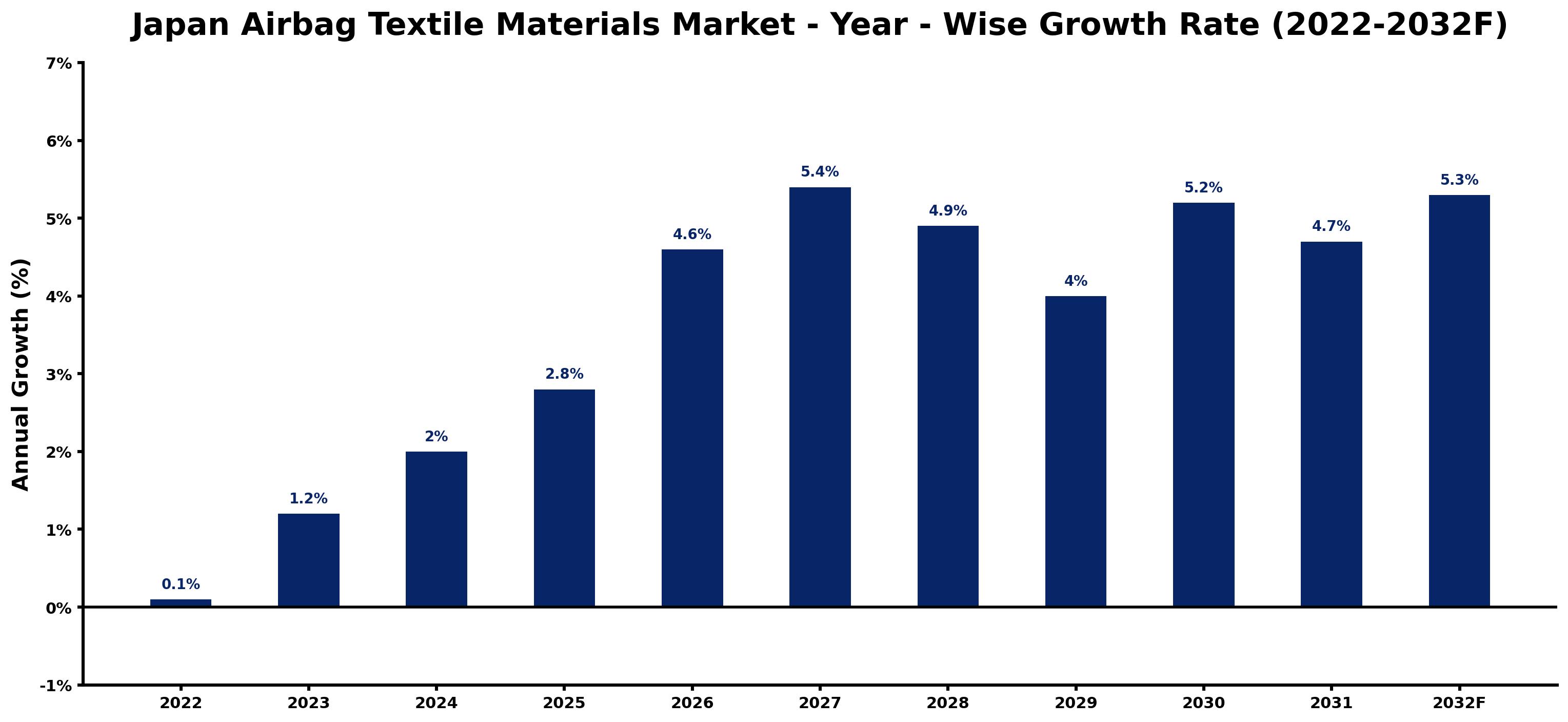
The yearly estimates that follow link every growth rate to its principal driver, so readers can see why the pace changed in each period.
| Year | Estimated Annual Growth (%) | Market Rationale |
| 2022 | 0.1 | The market experienced minimal growth due to stable demand from automotive manufacturers. |
| 2023 | 1.2 | Demand increased as automotive production ramped up following recovery from previous disruptions. |
| 2024 | 2.0 | Continued growth was driven by rising vehicle registrations and safety standards. |
| 2025 | 2.8 | Growth accelerated with heightened investments in automotive safety technologies. |
| 2026 | 4.6 | A notable rise in demand is expected as manufacturers adopt new safety materials. |
| 2027 | 5.4 | The peak growth year will see increased production of airbags in response to safety regulations. |
| 2028 | 4.9 | Growth is projected to slow slightly as the market stabilises after rapid expansion in previous years. |
| 2029 | 4.0 | A further slowdown is anticipated as manufacturers adjust to market saturation. |
| 2030 | 5.2 | Demand is expected to increase again due to new safety initiatives and vehicle model updates. |
| 2031 | 4.7 | Growth will moderate as the market begins to stabilise after several years of expansion. |
| 2032 | 5.3 | A resurgence in demand is projected as new automotive safety regulations are implemented. |
Note: Market size estimations and growth projections presented in this report are based on 6Wresearch's proprietary forecasting methodology, utilizing the latest available industry data, government publications, and primary research inputs.
Japan Airbag Textile Materials Market Synopsis
Airbag textile materials are specialized fabrics made from synthetic fibers like nylon and polyester, essential for vehicle safety systems. The Japanese automotive industry, employing over 5 million people, drives demand for these materials, supported by over 10 million registered vehicles. The Japan Airbag Textile Materials Market is expanding due to increased investments in safety technologies and compliance with stringent safety standards, reflecting a strong focus on consumer expectations and regulatory requirements.
Market Dynamics Impact Analysis (2026–2032)
| Factor | Type | Impact | Primary Segment Affected |
| Rising automotive safety standards | Driver | High | Nylon 6 |
| Increased vehicle registrations | Driver | High | Synthetic Yarn |
| Growing demand for innovative safety features | Opportunity | High | High-Tenacity Yarn |
| Expansion of automotive production facilities | Opportunity | High | Airbag Module Producers |
| High production costs for advanced textiles | Restraint | Medium | Nylon 66 |
| Compliance with stringent safety regulations | Restraint | High | Polyester |
| Supply chain disruptions affecting raw materials | Challenge | High | Raw Textile Suppliers |
| Competition from alternative safety materials | Challenge | Medium | Woven and Knitted |
Evaluation of Drivers in Japan Airbag Textile Materials Market (2026–2032)
Demand rests on the following drivers, each shown with the segment it touches most.
| Drivers | Primary Segment Affected | Why It Matters (Evidence) |
| Increased investment in automotive safety technologies | Airbag Module Producers | The automotive sector is projected to invest ¥1 trillion in safety technologies by 2025, leading to higher demand for airbag textiles. |
| Rising vehicle registrations | Synthetic Yarn | With over 10 million registered vehicles in Japan, the demand for airbag textiles continues to grow. |
| Implementation of stricter safety standards | Nylon 6 | Japan's strict safety standards (JIS) for automotive textiles drive manufacturers to source high-quality materials. |
| Technological advancements in textile production | High-Tenacity Yarn | Innovations in yarn production improve strength and performance, increasing demand from manufacturers. |
| Growing consumer awareness of vehicle safety | Polyester | As consumers prioritize safety, manufacturers are compelled to invest in high-quality airbag textiles. |
The strongest pull on demand comes from increased investment in automotive safety technologies, with the sector projected to invest ¥1 trillion by 2025. Rising vehicle registrations, exceeding 10 million in Japan, further boost demand for airbag textiles. Stricter safety standards compel manufacturers to source high-quality materials. Advancements in textile production improve strength and performance, driving demand from automotive textile firms. Consumer awareness of vehicle safety leads manufacturers to invest in superior textiles, reflecting a shift towards improved safety features in vehicles.
Evaluation of Restraints in Japan Airbag Textile Materials Market
Below are the constraints most often cited by buyers and suppliers, with the segment each affects.
| Market Restraint | Primary Segment Affected | Why It Matters (Evidence) |
| High production costs for advanced textiles | Nylon 66 | The cost of producing high-performance Nylon 66 impacts profit margins for manufacturers, limiting their ability to compete. |
| Compliance with stringent safety regulations | Polyester | Meeting Japan's strict automotive safety standards increases operational costs for textile producers, affecting pricing. |
| Supply chain disruptions affecting raw materials | Raw Textile Suppliers | Disruptions in the supply chain can delay production schedules and increase costs for suppliers. |
| Limited availability of skilled workforce | Woven and Knitted | A shortage of skilled workers in the textile industry hampers production efficiency and innovation. |
| Competition from alternative safety materials | High-Tenacity Yarn | Emerging materials may offer similar safety features at lower costs, challenging traditional textile producers. |
Japan Airbag Textile Materials Market Challenges
High production costs for airbag textile materials stem from the reliance on expensive synthetic fibres, raising manufacturing expenses for automotive producers by 15%. A shortage of skilled workers in advanced textile engineering exists due to an ageing workforce, leading to delays in product development for suppliers. Buyers face challenges in adhering to strict safety standards, as compliance with JIS regulations can extend production timelines by six months. Local producers encounter intensified competition from international markets, compelling them to reduce prices, which jeopardises the quality and safety of airbag systems.
Trends in the Japan Airbag Textile Materials Market
Below are the shifts with the largest effect on the Japan Airbag Textile Materials Market.
- Shift towards Sustainable Materials: In 2023, the Japanese automotive industry began prioritising sustainable materials for airbag textiles, targeting a 46% reduction in greenhouse gas emissions by 2030. This trend encourages suppliers to innovate and adapt their offerings.
- Transition from Traditional to Advanced Textiles: Since 2025, there has been a notable shift towards advanced textile materials like high-tenacity yarns, improving airbag performance and safety. This change is driven by evolving consumer expectations and regulatory requirements.
- Emergence of Smart Textiles: The introduction of smart textiles in airbag systems is gaining traction, with prototypes being tested in the Tokyo region. These textiles can adapt to impact conditions, improving safety outcomes.
- Increased Integration of Airbag Textiles in Vehicle Designs: As of 2025, automotive seating companies are increasingly integrating airbag textiles into their designs, reflecting a growing focus on holistic vehicle safety. This integration is expected to improve overall safety performance.
Investment Opportunities in the Japan Airbag Textile Materials Market
Several openings in the Japan Airbag Textile Materials Market merit attention from investors.
- Investment in Sustainable Textile Production: With Japan targeting a 46% cut in greenhouse gas emissions by 2030, there is an opportunity to invest in sustainable textile production methods, particularly for airbag textiles.
- Expansion of Automotive Production Facilities: The ongoing expansion of automotive production facilities in regions like Tokyo presents a timely opportunity for suppliers to establish partnerships and increase their market presence.
- Development of Airbag Technologies: The demand for advanced airbag technologies is rising, with the Japanese automotive industry projected to invest heavily in safety features, creating opportunities for specialised textile suppliers.
- Collaboration with Automotive Manufacturers: Now is the time to collaborate with automotive manufacturers focusing on safety, as they seek to improve their vehicle designs with advanced airbag textiles.
Government Initiatives in the Japan Airbag Textile Materials Market
The Chemical Substances Control Law, enacted in 1973, mandates the evaluation and control of chemical substances used in manufacturing airbag textiles. This law ensures that producers comply with safety standards, impacting their production processes and material selection. The Industrial Safety and Health Act of 1972 further enforces regulations regarding hazardous substances, compelling manufacturers to maintain safe working environments.
In 2023, the Japanese government launched a program with a budget of JPY 150 trillion aimed at improving vehicle safety standards. The Ministry of Land, Infrastructure, Transport and Tourism oversees this initiative, ensuring that automotive manufacturers adhere to updated safety regulations, which directly affects the production of airbag textiles.
Future Insight of the Japan Airbag Textile Materials Market
The establishment of new textile manufacturing facilities will enhance production capabilities by 2032, driven by significant investments in safety technologies. Decarbonisation initiatives will encourage the adoption of sustainable materials, benefiting suppliers. Stricter vehicle safety standards will increase the demand for reliable yarns essential for effective airbag systems. Buyers will experience improved product options as automotive seating designs increasingly integrate advanced airbag textiles.
Market Segmentation Analysis
Japan Airbag Textile Materials Market report covers a detailed analysis of the following market segments:
By Fabric Type – Nylon 6 Leads, Nylon 66 Expected to Grow Fastest
According to Saurav Kr Singh, Senior Research Analyst at 6Wresearch, Nylon 6 took 48% of fabric type revenue in 2025, more than any other category. Nylon 6 holds the largest share due to its extensive use in airbag production, where strength and durability are critical. This fabric is preferred by manufacturers in the Tokyo region, a key area for automotive textile production. Over 2026–2032, Nylon 66 is expected to post the fastest growth, at a CAGR of 6.8%. Nylon 66 is experiencing rapid growth because it offers superior performance in high-temperature environments, which is crucial for airbag functionality. The automotive industry's ongoing investments in safety technologies further drive this demand. Suppliers should focus on enhancing the quality and performance of Nylon 66 to capitalise on its growing popularity.
By Material Base – Synthetic Yarn Leads, High-Tenacity Yarn Expected to Grow Fastest
The largest material base category in 2025 was Synthetic Yarn, at 36% of revenue. Synthetic yarn is the primary material used in weaving airbag textiles, making it the dominant choice among manufacturers. Its widespread application is evident as it accounts for approximately 70% of materials used in airbag production. High-Tenacity Yarn is set to record the highest CAGR in this split, 7.0% over 2026–2032. High-tenacity yarn is growing quickly due to its enhanced strength, which is essential for safety applications in airbags. The increasing focus on vehicle safety standards is pushing manufacturers to adopt this material more widely. Buyers should consider sourcing high-tenacity yarn to meet evolving safety requirements and improve product reliability.
By Distribution Channel – Raw Textile Suppliers Lead, Direct Yarn Distributors Expected to Grow Fastest
With 41% of distribution channel revenue in 2025, Raw Textile Suppliers was the largest category. Raw textile suppliers dominate the market as they provide essential materials directly to manufacturers of airbag textiles. Their role is crucial in maintaining supply chain efficiency for the automotive industry. Direct Yarn Distributors are projected to grow fastest, at a CAGR of 6.1% during 2026–2032. Direct yarn distributors are witnessing rapid growth as they streamline the supply chain for textile production, ensuring timely delivery of materials. The increasing demand for airbag textiles necessitates a more efficient distribution network. Suppliers may need to strengthen partnerships with direct yarn distributors to enhance their market reach and responsiveness.
By End User – Airbag Module Producers Lead and Record the Fastest Growth
Airbag Module Producers accounted for 42% of the market by end user in 2025. Airbag module producers represent the largest share as they are the primary end-users of airbag textiles, directly integrating them into their safety systems. Their significant investment in safety technologies drives consistent demand for these materials. Its lead should widen, with a projected CAGR of 6.3% during 2026–2032, the highest in this split. The airbag module producers are also the fastest-growing segment, as their continuous innovation in safety systems requires advanced textile materials. This dual role ensures their demand for airbag textiles will keep increasing. Suppliers should align their product development with the needs of airbag module producers to capture growth opportunities in this segment.
Key Attractiveness of the Report
- 10 Years of Market Numbers
- Historical Data Starting from 2022 to 2025
- Base Year 2025
- Forecast Data until 2032
- Key Performance Indicators Impacting the Market
- Major Upcoming Developments and Projects
Key Highlights of the Report:
- Japan Airbag Textile Materials Market Outlook
- Market Size of Japan Airbag Textile Materials Market, 2025
- Forecast of Japan Airbag Textile Materials Market, 2032
- Historical Data and Forecast of Japan Airbag Textile Materials Revenues & Volume for the Period 2022-2032F
- Japan Airbag Textile Materials Market Trend Evolution
- Japan Airbag Textile Materials Market Drivers and Challenges
- Japan Airbag Textile Materials Price Trends
- Japan Airbag Textile Materials Porter's Five Forces
- Japan Airbag Textile Materials Industry Life Cycle
- Historical Data and Forecast of Japan Airbag Textile Materials Market Revenues & Volume By Fabric Type for the Period 2022-2032F
- Historical Data and Forecast of Japan Airbag Textile Materials Market Revenues & Volume By Nylon 6 for the Period 2022-2032F
- Historical Data and Forecast of Japan Airbag Textile Materials Market Revenues & Volume By Nylon 66 for the Period 2022-2032F
- Historical Data and Forecast of Japan Airbag Textile Materials Market Revenues & Volume By Polyester for the Period 2022-2032F
- Historical Data and Forecast of Japan Airbag Textile Materials Market Revenues & Volume By Silicone-Coated Nylon for the Period 2022-2032F
- Historical Data and Forecast of Japan Airbag Textile Materials Market Revenues & Volume By Material Base for the Period 2022-2032F
- Historical Data and Forecast of Japan Airbag Textile Materials Market Revenues & Volume By Synthetic Yarn for the Period 2022-2032F
- Historical Data and Forecast of Japan Airbag Textile Materials Market Revenues & Volume By High-Tenacity Yarn for the Period 2022-2032F
- Historical Data and Forecast of Japan Airbag Textile Materials Market Revenues & Volume By Woven and Knitted for the Period 2022-2032F
- Historical Data and Forecast of Japan Airbag Textile Materials Market Revenues & Volume By Heat-Resistant Finish for the Period 2022-2032F
- Historical Data and Forecast of Japan Airbag Textile Materials Market Revenues & Volume By Distribution Channel for the Period 2022-2032F
- Historical Data and Forecast of Japan Airbag Textile Materials Market Revenues & Volume By Raw Textile Suppliers for the Period 2022-2032F
- Historical Data and Forecast of Japan Airbag Textile Materials Market Revenues & Volume By Direct Yarn Distributors for the Period 2022-2032F
- Historical Data and Forecast of Japan Airbag Textile Materials Market Revenues & Volume By Industrial Textile Retailers for the Period 2022-2032F
- Historical Data and Forecast of Japan Airbag Textile Materials Market Revenues & Volume By Coated Textile Vendors for the Period 2022-2032F
- Historical Data and Forecast of Japan Airbag Textile Materials Market Revenues & Volume By End User for the Period 2022-2032F
- Historical Data and Forecast of Japan Airbag Textile Materials Market Revenues & Volume By Airbag Module Producers for the Period 2022-2032F
- Historical Data and Forecast of Japan Airbag Textile Materials Market Revenues & Volume By Automotive Textile Firms for the Period 2022-2032F
- Historical Data and Forecast of Japan Airbag Textile Materials Market Revenues & Volume By Vehicle Safety OEMs for the Period 2022-2032F
- Historical Data and Forecast of Japan Airbag Textile Materials Market Revenues & Volume By Automotive Seating Companies for the Period 2022-2032F
- Japan Airbag Textile Materials Import Export Trade Statistics
- Market Opportunity Assessment By Fabric Type
- Market Opportunity Assessment By Material Base
- Market Opportunity Assessment By Distribution Channel
- Market Opportunity Assessment By End User
- Japan Airbag Textile Materials Top Companies Market Share
- Japan Airbag Textile Materials Competitive Benchmarking By Technical and Operational Parameters
- Japan Airbag Textile Materials Company Profiles
- Japan Airbag Textile Materials Key Strategic Recommendations
Market Covered
The study includes the following segmentation.
By Fabric Type
- Nylon 6
- Nylon 66
- Polyester
- Silicone-Coated Nylon
By Material Base
- Synthetic Yarn
- High-Tenacity Yarn
- Woven and Knitted
- Heat-Resistant Finish
By Distribution Channel
- Raw Textile Suppliers
- Direct Yarn Distributors
- Industrial Textile Retailers
- Coated Textile Vendors
By End User
- Airbag Module Producers
- Automotive Textile Firms
- Vehicle Safety OEMs
- Automotive Seating Companies































