Japan Airborne Command & Control AI Market Size & Growth Rate
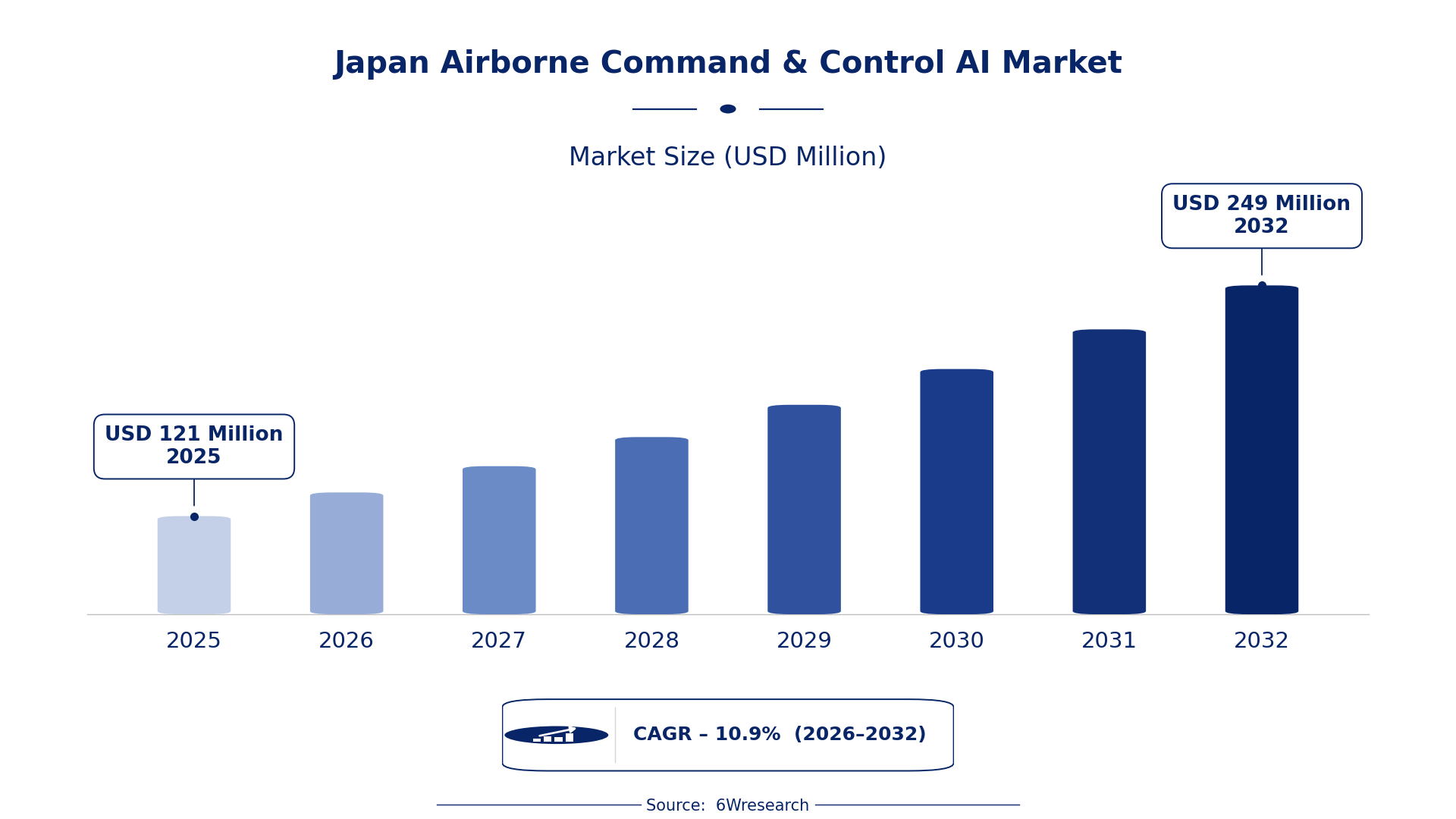
According to 6Wresearch internal database and industry insights, the Japan Airborne Command & Control AI Market was valued at USD 121 Million in 2025 and is projected to reach USD 249 Million by 2032, growing at a CAGR of approximately 10.9% during 2026–2032.
Japan Airborne Command & Control AI Market Highlights
| Report Metric | Details |
| Report Name | Japan Airborne Command & Control AI Market (2026-2032) |
| Market Size 2025 | USD 121 Million |
| Market Size 2032 | USD 249 Million |
| Absolute Growth 2025–2032 | USD 128 Million |
| CAGR 2026–2032 | 10.9% |
| Peak Annual Growth | 11.7% in 2029 |
| Forecast Period | 2026–2032 |
| Historical Data | 2022–2025 |
| Base Year | 2025 |
| Leading Platform Type, 2025 | Fixed-Wing Aircraft (39% share) |
| Leading AI Capability, 2025 | Real-Time Threat Analysis (42% share) |
| Leading Distribution Channel, 2025 | Defense Contractors (44% share) |
| Leading End User, 2025 | National Security Forces (33% share) |
| Fastest-Growing Platform Type | Drones/UAVs (15.8% CAGR) |
| Fastest-Growing AI Capability | Autonomous Coordination (14.2% CAGR) |
| Fastest-Growing Distribution Channel | Military OEM Integrators (13.3% CAGR) |
| Fastest-Growing End User | Tactical Combat Units (13.6% CAGR) |
| Growing Sector | Tactical Combat Units |
| Key End Users | National Security Forces, Tactical Combat Units, Defense Intelligence Agencies, Strategic Operations Centers |
Japan Airborne Command & Control AI Market Year-wise Growth Rate and Key Drivers (2022–2032)
This graph illustrates the annual growth rates of the market from 2022 to 2032, highlighting a steady upward trajectory and projected market expansion over the forecast period.
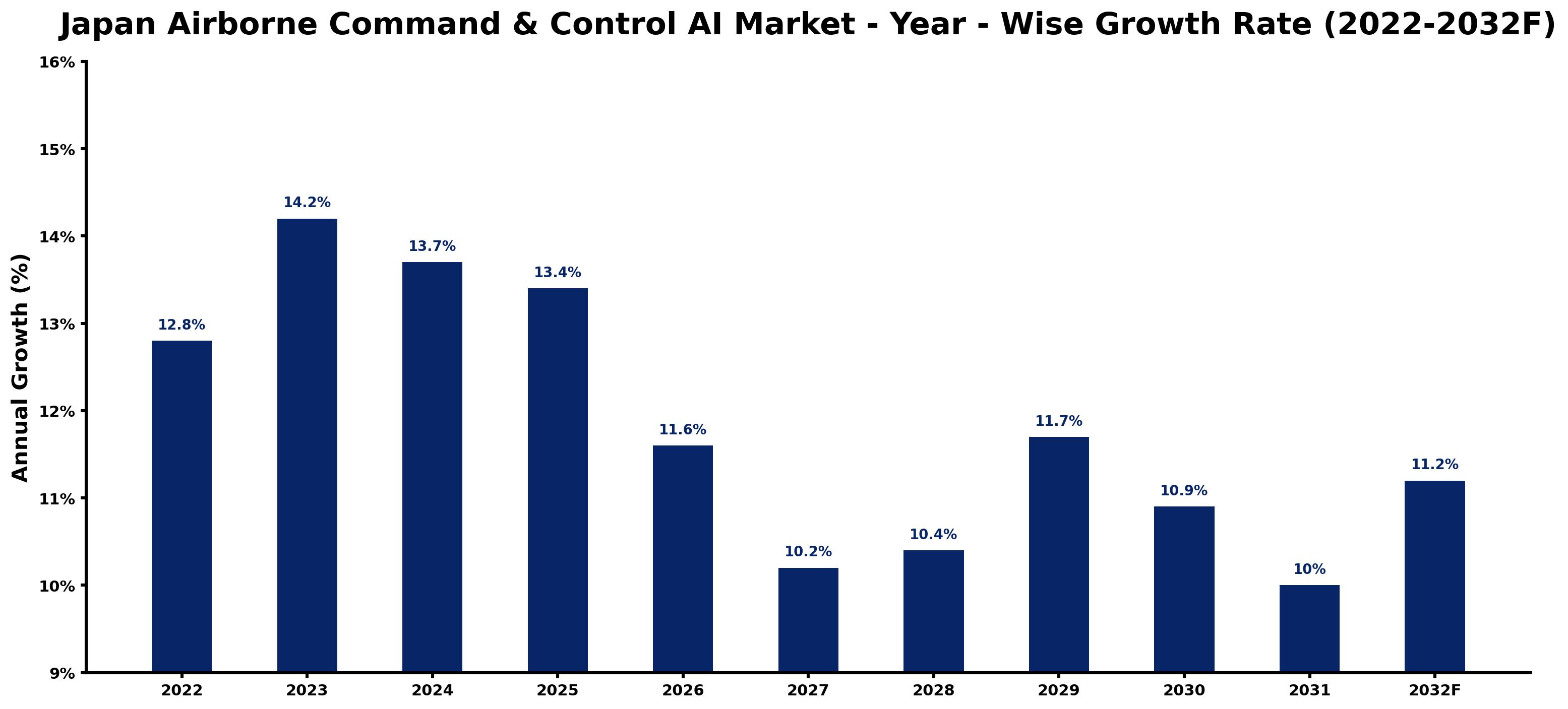
Below, each year's estimated growth is shown next to the factor that most influenced it.
| Year | Estimated Annual Growth (%) | Market Rationale |
| 2022 | 12.8 | The market showed strong performance, driven by increased military investments. |
| 2023 | 14.2 | Demand surged as the Japan Self-Defense Forces improved AI capabilities in operations. |
| 2024 | 13.7 | Growth slowed slightly due to market saturation in certain AI applications. |
| 2025 | 13.4 | The market continued to grow, supported by ongoing defense modernization efforts. |
| 2026 | 11.6 | Growth decelerated as the integration of AI technologies reached a mature phase. |
| 2027 | 10.2 | Demand slowed further as budget constraints affected procurement decisions. |
| 2028 | 10.4 | The market rebounded with renewed focus on advanced AI applications in defense. |
| 2029 | 11.7 | Growth accelerated as new strategic initiatives were implemented in military operations. |
| 2030 | 10.9 | The market growth rate slowed as the focus shifted to operational efficiency. |
| 2031 | 10.0 | Demand continued to grow but at a reduced pace due to market adjustments. |
| 2032 | 11.2 | The market is expected to grow faster as technological advancements gain traction. |
Note: Market size estimations and growth projections presented in this report are based on 6Wresearch's proprietary forecasting methodology, utilizing the latest available industry data, government publications, and primary research inputs.
Japan Airborne Command & Control AI Market Synopsis
Airborne Command & Control AI integrates advanced artificial intelligence into military operations, facilitating real-time threat assessment, strategic coordination, and communication capabilities. The Japan Airborne Command & Control AI Market is growing due to increased military investments and the integration of AI technologies. National security forces are the primary buyers, using these systems for over 75% of their operations. The Ministry of Defense's projected budget for AI technologies will reach 100 billion yen by 2025, further driving demand.
Market Dynamics Impact Analysis (2026–2032)
| Factor | Type | Impact | Primary Segment Affected |
| Increased military investments in AI technologies | Driver | High | Real-Time Threat Analysis |
| Growing reliance on drones for reconnaissance missions | Driver | High | Drones/UAVs |
| Rising demand for advanced communication systems | Opportunity | High | Satellite Communication |
| Expansion of defense contractors in the Tokyo region | Opportunity | High | Defense Contractors |
| Budget constraints affecting procurement decisions | Restraint | High | National Security Forces |
| Market saturation in certain AI applications | Restraint | Medium | Fixed-Wing Aircraft |
| High costs of integrating AI technologies | Challenge | High | Military OEM Integrators |
| Limited collaboration with international partners | Challenge | Medium | Space Defense Partners |
Evaluation of Drivers in Japan Airborne Command & Control AI Market (2026–2032)
Key forces behind demand, with the segment each one moves most, are listed below.
| Drivers | Primary Segment Affected | Why It Matters (Evidence) |
| Increased military spending | National Security Forces | Japan's defense budget is projected to reach 6 trillion yen by 2025, driving demand for advanced AI systems. |
| Improved reconnaissance capabilities | Drones/UAVs | Drones are increasingly used for real-time data collection, with over 300 units deployed by the Self-Defense Forces. |
| Growing focus on secure communications | Satellite Communication | Investment in satellite systems is rising as secure operations become a priority for military applications. |
| Integration of AI in military training | Fixed-Wing Aircraft | Regular training exercises conducted by the Self-Defense Forces increase the need for AI-equipped aircraft. |
| Expansion of defense contractor capabilities | Defense Contractors | The Tokyo region is a hub for defense contractors, fostering innovation and increasing system development. |
Volumes grow on the back of increased military spending, with Japan's defense budget projected to reach 6 trillion yen by 2025. Demand for real-time data collection is driven by improved reconnaissance capabilities from drones, which are increasingly deployed for military operations. Investment in satellite systems is rising as secure communications become a priority for military applications. The Tokyo region's defense contractors are fostering innovation and development in airborne command systems, further propelling market growth.
Evaluation of Restraints in Japan Airborne Command & Control AI Market
Several factors work against faster growth; the main ones are summarised below.
| Market Restraint | Primary Segment Affected | Why It Matters (Evidence) |
| High costs of AI integration | Military OEM Integrators | Integrating AI technologies can exceed 50 million yen per project, limiting adoption. |
| Budget constraints in defense spending | National Security Forces | Budget limitations can restrict procurement of advanced AI systems, affecting operational capabilities. |
| Market saturation in AI applications | Fixed-Wing Aircraft | As AI technologies mature, growth slows due to limited new applications in existing systems. |
| Limited collaboration with international partners | Space Defense Partners | Insufficient partnerships can hinder technological advancements and slow market growth. |
| Regulatory hurdles in technology deployment | Satellite Communication | Compliance with existing regulations can delay project timelines and increase costs. |
Japan Airborne Command & Control AI Market Challenges
Japan's defense sector faces challenges due to a limited supply of advanced AI components, which delays technology integration into airborne command systems and affects national security forces' operational readiness. Increasing costs of AI development, projected to reach 100 billion yen by 2025, put pressure on budgets for defense intelligence agencies, compelling them to prioritise essential projects over new capabilities. Heightened competition from international partners complicates procurement processes, making it harder for local suppliers to secure contracts. Strict regulations can slow deployment timelines for satellite communication systems, impacting real-time data capabilities for military operations and leading to operational inefficiencies.
Trends in the Japan Airborne Command & Control AI Market
The following changes are redrawing the Japan Airborne Command & Control AI Market.
- Shift from Traditional to AI-Driven Command Systems: Japan's defense sector is transitioning towards AI-driven command systems, with the 2023 Defense Technology Symposium highlighting advancements in airborne command technologies, reflecting a 20% increase in AI integration.
- Transition from Manual to Automated Threat Analysis: Since 2022, the Japan Self-Defense Forces have implemented automated threat analysis systems, improving response times by 30% and boosting operational efficiency in military operations.
- Emergence of Drones in Surveillance Operations: Drones have become increasingly crucial for reconnaissance, with a reported 40% rise in their deployment by the Self-Defense Forces for real-time data collection.
- Prioritisation of Satellite Communication Systems: The emphasis on satellite communication has intensified, resulting in a 25% increase in investments in secure communication technologies.
Investment Opportunities in the Japan Airborne Command & Control AI Market
The following opportunities in the Japan Airborne Command & Control AI Market pair current demand with a clear way in.
- Supply of AI Integration Services: With the defense budget projected to reach 6 trillion yen by 2025, there is a strong opportunity for AI integration services, particularly for National Security Forces aiming to modernise their operations.
- Development of Advanced Drone Technologies: The growing use of drones for reconnaissance creates a demand for advanced drone technologies, especially in the Tokyo region where defence contractors are active.
- Investment in Secure Communication Systems: The focus on secure communications is driving a 25% increase in investments, presenting opportunities for suppliers of satellite communication technologies to engage with military clients.
- Expansion of Training Facilities for AI Technologies: The upcoming establishment of advanced training facilities for AI technologies will generate demand for training services and equipment, particularly for the Self-Defense Forces.
Government Initiatives in the Japan Airborne Command & Control AI Market
The Electrical Appliance and Material Safety Act (1961) regulates the safety of electrical appliances and materials sold in Japan, ensuring that AI systems meet safety standards. The Defense Innovation Strategy launched in 2022 aims to improve AI capabilities in military applications, with a budget allocation of 100 billion yen for AI technologies by 2025, supporting the development of advanced airborne command systems.
National security forces utilise the Defense Innovation Strategy to access funding for AI integration projects, ensuring that they remain at the forefront of technological advancements. The Ministry of Defense oversees the allocation of resources for AI technologies, facilitating procurement processes and ensuring compliance with safety regulations.
Future Insight of the Japan Airborne Command & Control AI Market
The introduction of new military training programmes will improve personnel skills in AI applications by 2032, enabling more effective operations. Advancements in AI capabilities will enhance decision-making processes in operations, allowing for quicker responses to threats. Collaborations with international partners will drive progress in airborne command technologies, ensuring Japan maintains its competitive edge. The Ministry of Defense's budget for AI technologies will support ongoing improvements, facilitating more efficient military operations.
Market Segmentation Analysis
Japan Airborne Command & Control AI Market report covers a detailed analysis of the following market segments:
By Platform Type – Fixed-Wing Aircraft Leads, Drones/UAVs Expected to Grow Fastest
According to Saurav Kr Singh, Senior Research Analyst at 6Wresearch, with 39% of platform type revenue in 2025, Fixed-Wing Aircraft was the largest category. Fixed-wing aircraft serve as the primary platform for airborne command operations in Japan, with over 300 units equipped with advanced capabilities. This extensive installed base ensures that fixed-wing aircraft effectively meet the operational needs of national security forces. The quickest growth will come from Drones/UAVs, forecast to expand at a CAGR of 15.8% between 2026 and 2032. Drones and UAVs are increasingly utilised for surveillance and reconnaissance, reflecting a growing trend in military operations. Their rising deployment for real-time data collection is crucial for adapting to modern warfare requirements. Suppliers should focus on enhancing drone capabilities to align with the increasing demand from tactical units.
By AI Capability – Real-Time Threat Analysis Leads, Autonomous Coordination Expected to Grow Fastest
Real-Time Threat Analysis took 42% of ai capability revenue in 2025, more than any other category. Real-time threat analysis is vital for operational decision-making, with national security forces employing these systems for threat assessment in over 75% of their operations. This high level of utilisation underscores its critical importance in maintaining national security. Over 2026–2032, Autonomous Coordination is expected to post the fastest growth, at a CAGR of 14.2%. The swift adoption of autonomous coordination is propelled by its ability to improve operational efficiency across various military applications. As forces aim to optimise resources, this capability is expected to experience notable growth. Buyers will gain advantages by investing in autonomous coordination technologies to enhance mission effectiveness.
By Distribution Channel – Defense Contractors Lead, Military OEM Integrators Expected to Grow Fastest
In 2025, Defense Contractors led the distribution channel split with a 44% share. Defense contractors play a crucial role in the development of airborne command systems, integrating advanced technologies for military applications. Their established relationships with the Ministry of Defense solidify their leading position in the market. Military OEM Integrators are projected to grow fastest, at a CAGR of 13.3% during 2026–2032. Military OEM integrators are increasingly incorporating advanced technologies into existing platforms, responding to the demand for enhanced capabilities in military operations. This trend is expected to accelerate as integration becomes a key focus for modernisation efforts. Suppliers must collaborate with OEM integrators to ensure their solutions are effectively integrated into military systems.
By End User – National Security Forces Lead, Tactical Combat Units Expected to Grow Fastest
The largest end user category in 2025 was National Security Forces, at 33% of revenue. National security forces are the primary users of airborne command systems, relying on these technologies for comprehensive operational support. Their significant budget allocation for advanced capabilities highlights the importance of these systems in defence strategies. Tactical Combat Units are set to record the highest CAGR in this split, 13.6% over 2026–2032. Tactical combat units are rapidly adopting advanced technologies for mission planning, reflecting a shift towards more efficient operational methods. This growth signifies the increasing relevance of advanced capabilities in frontline military applications. Buyers should prioritise solutions that cater specifically to the needs of tactical units for improved mission outcomes.
Key Attractiveness of the Report
- 10 Years of Market Numbers
- Historical Data Starting from 2022 to 2025
- Base Year 2025
- Forecast Data until 2032
- Key Performance Indicators Impacting the Market
- Major Upcoming Developments and Projects
Key Highlights of the Report:
- Japan Airborne Command & Control AI Market Outlook
- Market Size of Japan Airborne Command & Control AI Market, 2025
- Forecast of Japan Airborne Command & Control AI Market, 2032
- Historical Data and Forecast of Japan Airborne Command & Control AI Revenues & Volume for the Period 2022-2032F
- Japan Airborne Command & Control AI Market Trend Evolution
- Japan Airborne Command & Control AI Market Drivers and Challenges
- Japan Airborne Command & Control AI Price Trends
- Japan Airborne Command & Control AI Porter's Five Forces
- Japan Airborne Command & Control AI Industry Life Cycle
- Historical Data and Forecast of Japan Airborne Command & Control AI Market Revenues & Volume By Platform Type for the Period 2022-2032F
- Historical Data and Forecast of Japan Airborne Command & Control AI Market Revenues & Volume By Fixed-Wing Aircraft for the Period 2022-2032F
- Historical Data and Forecast of Japan Airborne Command & Control AI Market Revenues & Volume By Drones/UAVs for the Period 2022-2032F
- Historical Data and Forecast of Japan Airborne Command & Control AI Market Revenues & Volume By Satellites for the Period 2022-2032F
- Historical Data and Forecast of Japan Airborne Command & Control AI Market Revenues & Volume By Mobile Ground Terminals for the Period 2022-2032F
- Historical Data and Forecast of Japan Airborne Command & Control AI Market Revenues & Volume By AI Capability for the Period 2022-2032F
- Historical Data and Forecast of Japan Airborne Command & Control AI Market Revenues & Volume By Real-Time Threat Analysis for the Period 2022-2032F
- Historical Data and Forecast of Japan Airborne Command & Control AI Market Revenues & Volume By Autonomous Coordination for the Period 2022-2032F
- Historical Data and Forecast of Japan Airborne Command & Control AI Market Revenues & Volume By Satellite Communication for the Period 2022-2032F
- Historical Data and Forecast of Japan Airborne Command & Control AI Market Revenues & Volume By Command Link Optimization for the Period 2022-2032F
- Historical Data and Forecast of Japan Airborne Command & Control AI Market Revenues & Volume By Distribution Channel for the Period 2022-2032F
- Historical Data and Forecast of Japan Airborne Command & Control AI Market Revenues & Volume By Defense Contractors for the Period 2022-2032F
- Historical Data and Forecast of Japan Airborne Command & Control AI Market Revenues & Volume By Military OEM Integrators for the Period 2022-2032F
- Historical Data and Forecast of Japan Airborne Command & Control AI Market Revenues & Volume By Space Defense Partners for the Period 2022-2032F
- Historical Data and Forecast of Japan Airborne Command & Control AI Market Revenues & Volume By Government Procurement for the Period 2022-2032F
- Historical Data and Forecast of Japan Airborne Command & Control AI Market Revenues & Volume By End User for the Period 2022-2032F
- Historical Data and Forecast of Japan Airborne Command & Control AI Market Revenues & Volume By National Security Forces for the Period 2022-2032F
- Historical Data and Forecast of Japan Airborne Command & Control AI Market Revenues & Volume By Tactical Combat Units for the Period 2022-2032F
- Historical Data and Forecast of Japan Airborne Command & Control AI Market Revenues & Volume By Defense Intelligence Agencies for the Period 2022-2032F
- Historical Data and Forecast of Japan Airborne Command & Control AI Market Revenues & Volume By Strategic Operations Centers for the Period 2022-2032F
- Japan Airborne Command & Control AI Import Export Trade Statistics
- Market Opportunity Assessment By Platform Type
- Market Opportunity Assessment By AI Capability
- Market Opportunity Assessment By Distribution Channel
- Market Opportunity Assessment By End User
- Japan Airborne Command & Control AI Top Companies Market Share
- Japan Airborne Command & Control AI Competitive Benchmarking By Technical and Operational Parameters
- Japan Airborne Command & Control AI Company Profiles
- Japan Airborne Command & Control AI Key Strategic Recommendations
Market Covered
This report examines the market across the segments below.
By Platform Type
- Fixed-Wing Aircraft
- Drones/UAVs
- Satellites
- Mobile Ground Terminals
By AI Capability
- Real-Time Threat Analysis
- Autonomous Coordination
- Satellite Communication
- Command Link Optimization
By Distribution Channel
- Defense Contractors
- Military OEM Integrators
- Space Defense Partners
- Government Procurement
By End User
- National Security Forces
- Tactical Combat Units
- Defense Intelligence Agencies
- Strategic Operations Centers































