Japan Airborne EO/IR Payload Market Size & Growth Rate
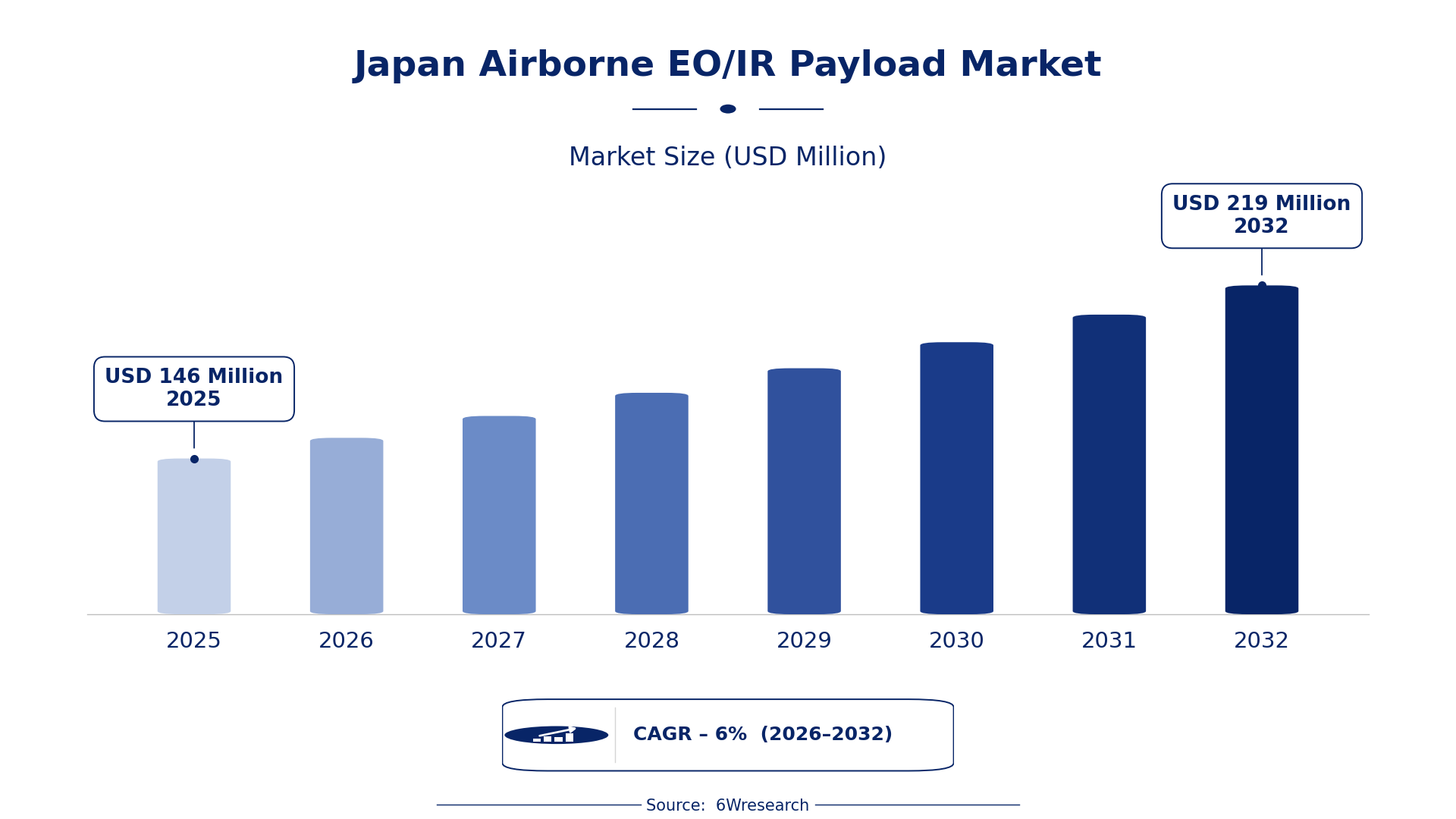
According to 6Wresearch internal database and industry insights, the Japan Airborne EO/IR Payload Market was valued at USD 146 Million in 2025 and is projected to reach USD 219 Million by 2032, growing at a CAGR of approximately 6% during 2026–2032.
Japan Airborne EO/IR Payload Market Highlights
| Report Metric | Details |
| Report Name | Japan Airborne EO/IR Payload Market (2026-2032) |
| Market Size 2025 | USD 146 Million |
| Market Size 2032 | USD 219 Million |
| Absolute Growth 2025–2032 | USD 73 Million |
| CAGR 2026–2032 | 6% |
| Peak Annual Growth | 6.8% in 2028 |
| Forecast Period | 2026–2032 |
| Historical Data | 2022–2025 |
| Base Year | 2025 |
| Leading Payload Type, 2025 | Multi-Sensor Payloads (43% share) |
| Leading Imaging Spectrum, 2025 | EO/IR Combined (46% share) |
| Leading Distribution Channel, 2025 | Government Contracts (43% share) |
| Leading End User, 2025 | Tactical UAV Manufacturers (41% share) |
| Fastest-Growing Imaging Spectrum | Thermal Imaging (7.7% CAGR) |
| Fastest-Growing Distribution Channel | Defense System Integrators (7.3% CAGR) |
| Fastest-Growing End User | High Altitude Recon Aircrafts (7.5% CAGR) |
| Growing Sector | defense technology |
| Key End Users | government agencies, tactical UAV manufacturers, maritime surveillance units, defense system integrators |
Japan Airborne EO/IR Payload Market Year-wise Growth Rate and Key Drivers (2022–2032)
This graph illustrates the annual growth rates of the market from 2022 to 2032, highlighting a steady upward trajectory and projected market expansion over the forecast period.
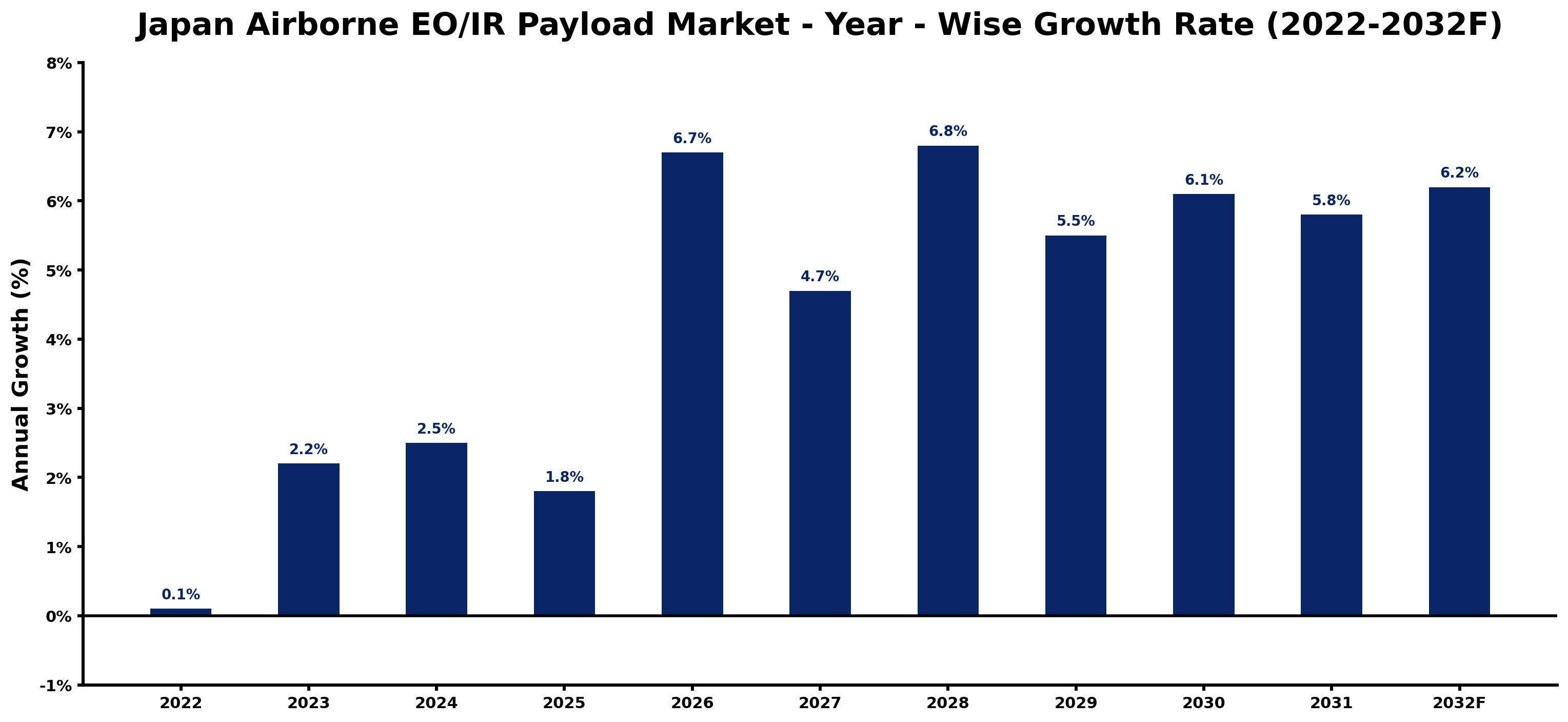
Each row of the following table gives one year's estimated growth and the event or demand shift that explains it.
| Year | Estimated Annual Growth (%) | Market Rationale |
| 2022 | 0.1 | The market showed minimal growth due to initial recovery efforts following global disruptions. |
| 2023 | 2.2 | Demand increased as the defense budget rose, enabling more investments in surveillance technologies. |
| 2024 | 2.5 | Growth accelerated with the Japan Self-Defense Forces expanding their EO/IR payload usage. |
| 2025 | 1.8 | A slight slowdown occurred as contracts for new systems were finalised and implemented. |
| 2026 | 6.7 | Demand is expected to surge as Japan invests heavily in next-generation EO/IR technologies. |
| 2027 | 4.7 | Growth is projected to decelerate as the market adjusts to increased supply capabilities. |
| 2028 | 6.8 | A peak in growth is expected as the Ministry of Defense improves reconnaissance capabilities. |
| 2029 | 5.5 | Growth will slow slightly as the market stabilises after the peak year. |
| 2030 | 6.1 | Demand is projected to rise again with new contracts for advanced systems. |
| 2031 | 5.8 | A slowdown is anticipated as the market matures and competition increases. |
| 2032 | 6.2 | Growth is expected to continue as the demand for advanced surveillance remains strong. |
Note: Market size estimations and growth projections presented in this report are based on 6Wresearch's proprietary forecasting methodology, utilizing the latest available industry data, government publications, and primary research inputs.
Japan Airborne EO/IR Payload Market Synopsis
Airborne EO/IR payloads are advanced imaging systems essential for military and civilian surveillance. In Japan, the defense budget for 2023 is approximately 6.8 trillion yen, with investments directed towards enhancing reconnaissance capabilities. The demand is primarily driven by domestic users and government contracts, creating a competitive environment for defense technology development and procurement.
Market Dynamics Impact Analysis (2026–2032)
| Factor | Type | Impact | Primary Segment Affected |
| Increased defense budget allocations | Driver | High | EO/IR Combined |
| Growing demand for multi-sensor payloads | Driver | High | Multi-Sensor Payloads |
| Expansion of tactical UAV manufacturing | Opportunity | High | Tactical UAV Manufacturers |
| Investment in next-generation EO/IR technologies | Opportunity | High | IR Sensors |
| Supply chain vulnerabilities in defense technology | Restraint | Medium | EO Cameras |
| Regulatory compliance costs for new technologies | Restraint | Medium | Multi-Sensor Payloads |
| Limited domestic production capacity | Challenge | High | Defense System Integrators |
| Increasing competition from foreign suppliers | Challenge | High | Surveillance System OEMs |
Evaluation of Drivers in Japan Airborne EO/IR Payload Market (2026–2032)
The main growth drivers and the segments they affect most are set out below.
| Drivers | Primary Segment Affected | Why It Matters (Evidence) |
| Increased defense budget allocations | EO/IR Combined | Japan's defense budget for 2023 is approximately 6.8 trillion yen, improving procurement capabilities for advanced surveillance systems. |
| Growing demand for multi-sensor payloads | Multi-Sensor Payloads | The Japan Self-Defense Forces are integrating multi-sensor payloads for enhanced surveillance, resulting in higher procurement. |
| Expansion of tactical UAV manufacturing | Tactical UAV Manufacturers | With over 1,000 tactical UAVs in Japan, manufacturers are increasing production to meet rising demand for advanced payloads. |
| Investment in next-generation EO/IR technologies | IR Sensors | The Economic Security Promotion Act is funding advancements in EO/IR technologies, prompting manufacturers to improve their offerings. |
| Collaborations in defense technology development | EO Cameras | The Japan Aerospace Exploration Agency collaborates on EO/IR payload development, driving innovation and production capacity. |
What keeps demand rising is the increased defense budget of approximately 6.8 trillion yen for 2023, which fuels procurement of advanced surveillance technologies. The Japan Self-Defense Forces' integration of multi-sensor payloads improves operational capabilities, resulting in higher procurement rates. With over 1,000 tactical UAVs in operation, manufacturers are increasing production to satisfy the growing need for advanced imaging systems.
Evaluation of Restraints in Japan Airborne EO/IR Payload Market
The main factors holding the market back are set out below.
| Market Restraint | Primary Segment Affected | Why It Matters (Evidence) |
| Supply chain vulnerabilities in defense technology | EO Cameras | Supply chain issues have delayed the availability of critical components, affecting production timelines. |
| Regulatory compliance costs for new technologies | Multi-Sensor Payloads | Compliance with standards like JIS Q 9100 increases costs for manufacturers, impacting pricing strategies. |
| Limited domestic production capacity | Defense System Integrators | Domestic producers face challenges scaling operations, resulting in reliance on imports for advanced systems. |
| Technological integration challenges | Surveillance System OEMs | Integrating new technologies into existing systems can be complex, slowing down deployment timelines. |
| Market entry barriers for new players | Tactical UAV Manufacturers | High initial investment requirements deter new entrants, restricting competition and innovation. |
Japan Airborne EO/IR Payload Market Challenges
Japan's workforce lacks sufficient expertise in advanced imaging systems, which delays EO/IR payload development for military applications. High production costs stem from reliance on imported components, inflating prices for domestic buyers by 20%. Technological advancements are trailing behind global competitors, restricting the effectiveness of surveillance capabilities for the Japan Self-Defense Forces. Budget constraints limit procurement options, resulting in missed contract opportunities for suppliers, as indicated by the 6.8 trillion yen defense budget focusing on advanced surveillance technologies.
Trends in the Japan Airborne EO/IR Payload Market
Buyers and suppliers in the Japan Airborne EO/IR Payload Market are adjusting to the following trends.
- Shift in Defense Technology Focus: Tokyo is increasingly prioritising advanced surveillance technologies, as seen in the 2023 defense budget of 6.8 trillion yen, which allocates funds for EO/IR systems.
- Transition to Multi-Sensor Payloads: The Japan Self-Defense Forces are shifting towards multi-sensor payloads, improving operational capabilities for surveillance missions, with a projected growth rate of 8.5% for this segment.
- Emergence of Tactical UAVs: The number of tactical UAVs in Japan is estimated to exceed 1,000 units, indicating a shift towards aerial surveillance capabilities in defense operations.
- Increasing Collaboration in Defense R&D: Since 2023, the Japan Aerospace Exploration Agency has collaborated on EO/IR payload development, boosting innovation and production capacity in the defense sector.
Investment Opportunities in the Japan Airborne EO/IR Payload Market
The following areas offer the clearest openings for investors and suppliers in the Japan Airborne EO/IR Payload Market.
- Government Contracts for Advanced Systems: Government contracts are projected to increase, with a defense budget of 6.8 trillion yen in 2023, creating opportunities for suppliers of EO/IR systems.
- Expansion of EO/IR Research Initiatives: The National Institute of Advanced Industrial Science and Technology supports EO/IR research, providing opportunities for collaborations and funding.
- Partnerships with Defense System Integrators: Defense System Integrators are seeking new solutions, presenting opportunities for joint ventures and partnerships to improve product offerings.
- Investment in Tactical UAV Development: With over 1,000 tactical UAVs in Japan, there is a growing need for advanced EO/IR payloads, encouraging investments in this area.
Government Initiatives in the Japan Airborne EO/IR Payload Market
The Long-Term Care Insurance Act, established in 1997, has influenced funding for various sectors, including defense. More recently, the Economic Security Promotion Act of 2022 has introduced measures to improve supply-chain resilience for critical products, including EO/IR systems, ensuring that domestic production capabilities are strengthened.
The Japan Defense Industry Association promotes collaboration among technology developers. Agencies like the Ministry of Defense are actively funding projects aimed at improving reconnaissance capabilities, with substantial investments directed towards EO/IR payload development.
Future Insight of the Japan Airborne EO/IR Payload Market
Investment in next-generation EO/IR technologies will surge, creating strong demand for advanced imaging systems. By 2032, the number of tactical UAVs is expected to exceed 1,000 units, expanding the market for EO/IR payloads. Collaboration between the Japan Aerospace Exploration Agency and private firms will accelerate development timelines. The implementation of the JIS Q 9100 standard will raise quality benchmarks, ensuring suppliers meet rigorous aerospace management requirements.
Market Segmentation Analysis
Japan Airborne EO/IR Payload Market report covers a detailed analysis of the following market segments:
By Payload Type – Multi-Sensor Payloads Lead and Record the Fastest Growth
According to Saurav Kr Singh, Senior Research Analyst at 6Wresearch, the largest payload type category in 2025 was Multi-Sensor Payloads, at 43% of revenue. Multi-sensor payloads dominate the market due to their ability to combine various imaging technologies, making them essential for comprehensive surveillance. The Japan Self-Defense Forces depend on these systems for enhanced maritime and aerial reconnaissance, showcasing their importance in national security. The same category are also set to grow fastest, at a CAGR of 8.5% during 2026–2032. The growth of multi-sensor payloads is accelerated by Japan's rising defence budget, which prioritises advanced surveillance technologies. This focus indicates that demand for these payloads will likely continue to increase as military capabilities evolve. Suppliers should concentrate on advancing multi-sensor technologies to align with government procurement trends.
By Imaging Spectrum – EO/IR Combined Leads, Thermal Imaging Expected to Grow Fastest
EO/IR Combined held 46% of the Japan Airborne EO/IR Payload Market by imaging spectrum in 2025. EO/IR combined imaging systems lead the market as they provide comprehensive situational awareness, crucial for military operations. Their widespread use within Japan's defence forces for various surveillance applications highlights their essential role in operational effectiveness. Thermal Imaging is set to record the highest CAGR in this split, 7.7% over 2026–2032. Thermal imaging is experiencing rapid growth due to its effectiveness in detecting heat signatures, particularly important for night-time operations. Increased investments in next-generation EO/IR technologies are further driving the expansion of this segment. Buyers should consider integrating thermal imaging into their systems to enhance operational effectiveness.
By Distribution Channel – Government Contracts Lead, Defense System Integrators Expected to Grow Fastest
With 43% of distribution channel revenue in 2025, Government Contracts was the largest category. Government contracts account for the largest share as they provide essential funding for defence-related projects, ensuring steady demand for airborne EO/IR payloads. The Ministry of Defense's initiatives to strengthen reconnaissance capabilities further solidify this segment's leadership. The quickest growth will come from Defense System Integrators, forecast to expand at a CAGR of 7.3% between 2026 and 2032. Defense system integrators are rapidly growing as they play a crucial role in integrating various defence technologies for military applications. Their importance is underscored by the increasing complexity of modern defence systems that require sophisticated integration. Suppliers must engage with defense system integrators to capitalise on emerging market opportunities.
By End User – Tactical UAV Manufacturers Lead, High Altitude Recon Aircrafts Expected to Grow Fastest
In 2025, Tactical UAV Manufacturers led the end user split with a 41% share. Tactical UAV manufacturers lead the market by producing drones specifically designed with EO/IR payloads, addressing the growing demand for advanced surveillance solutions. The presence of over 1,000 tactical UAVs in Japan highlights the robust market for these systems. High Altitude Recon Aircrafts are projected to grow fastest, at a CAGR of 7.5% during 2026–2032. High altitude reconnaissance aircraft are gaining traction as they employ advanced payloads for long-range missions. This growth is driven by the escalating need for improved surveillance capabilities across diverse operational scenarios. Manufacturers should focus on developing payloads tailored for high altitude reconnaissance to meet market demands.
Key Attractiveness of the Report
- 10 Years of Market Numbers
- Historical Data Starting from 2022 to 2025
- Base Year 2025
- Forecast Data until 2032
- Key Performance Indicators Impacting the Market
- Major Upcoming Developments and Projects
Key Highlights of the Report:
- Japan Airborne EO/IR Payload Market Outlook
- Market Size of Japan Airborne EO/IR Payload Market, 2025
- Forecast of Japan Airborne EO/IR Payload Market, 2032
- Historical Data and Forecast of Japan Airborne EO/IR Payload Revenues & Volume for the Period 2022-2032F
- Japan Airborne EO/IR Payload Market Trend Evolution
- Japan Airborne EO/IR Payload Market Drivers and Challenges
- Japan Airborne EO/IR Payload Price Trends
- Japan Airborne EO/IR Payload Porter's Five Forces
- Japan Airborne EO/IR Payload Industry Life Cycle
- Historical Data and Forecast of Japan Airborne EO/IR Payload Market Revenues & Volume By Payload Type for the Period 2022-2032F
- Historical Data and Forecast of Japan Airborne EO/IR Payload Market Revenues & Volume By EO Cameras for the Period 2022-2032F
- Historical Data and Forecast of Japan Airborne EO/IR Payload Market Revenues & Volume By IR Sensors for the Period 2022-2032F
- Historical Data and Forecast of Japan Airborne EO/IR Payload Market Revenues & Volume By Multi-Sensor Payloads for the Period 2022-2032F
- Historical Data and Forecast of Japan Airborne EO/IR Payload Market Revenues & Volume By Hyperspectral Payloads for the Period 2022-2032F
- Historical Data and Forecast of Japan Airborne EO/IR Payload Market Revenues & Volume By Imaging Spectrum for the Period 2022-2032F
- Historical Data and Forecast of Japan Airborne EO/IR Payload Market Revenues & Volume By Visible Light for the Period 2022-2032F
- Historical Data and Forecast of Japan Airborne EO/IR Payload Market Revenues & Volume By Thermal Imaging for the Period 2022-2032F
- Historical Data and Forecast of Japan Airborne EO/IR Payload Market Revenues & Volume By EO/IR Combined for the Period 2022-2032F
- Historical Data and Forecast of Japan Airborne EO/IR Payload Market Revenues & Volume By Extended Wavelength Range for the Period 2022-2032F
- Historical Data and Forecast of Japan Airborne EO/IR Payload Market Revenues & Volume By Distribution Channel for the Period 2022-2032F
- Historical Data and Forecast of Japan Airborne EO/IR Payload Market Revenues & Volume By Defense System Integrators for the Period 2022-2032F
- Historical Data and Forecast of Japan Airborne EO/IR Payload Market Revenues & Volume By Surveillance System OEMs for the Period 2022-2032F
- Historical Data and Forecast of Japan Airborne EO/IR Payload Market Revenues & Volume By Government Contracts for the Period 2022-2032F
- Historical Data and Forecast of Japan Airborne EO/IR Payload Market Revenues & Volume By Aerospace Defense Startups for the Period 2022-2032F
- Historical Data and Forecast of Japan Airborne EO/IR Payload Market Revenues & Volume By End User for the Period 2022-2032F
- Historical Data and Forecast of Japan Airborne EO/IR Payload Market Revenues & Volume By Tactical UAV Manufacturers for the Period 2022-2032F
- Historical Data and Forecast of Japan Airborne EO/IR Payload Market Revenues & Volume By Night Vision Drone Providers for the Period 2022-2032F
- Historical Data and Forecast of Japan Airborne EO/IR Payload Market Revenues & Volume By Maritime Surveillance Units for the Period 2022-2032F
- Historical Data and Forecast of Japan Airborne EO/IR Payload Market Revenues & Volume By High Altitude Recon Aircrafts for the Period 2022-2032F
- Japan Airborne EO/IR Payload Import Export Trade Statistics
- Market Opportunity Assessment By Payload Type
- Market Opportunity Assessment By Imaging Spectrum
- Market Opportunity Assessment By Distribution Channel
- Market Opportunity Assessment By End User
- Japan Airborne EO/IR Payload Top Companies Market Share
- Japan Airborne EO/IR Payload Competitive Benchmarking By Technical and Operational Parameters
- Japan Airborne EO/IR Payload Company Profiles
- Japan Airborne EO/IR Payload Key Strategic Recommendations
Market Covered
Segments analysed in this report are listed below.
By Payload Type
- EO Cameras
- IR Sensors
- Multi-Sensor Payloads
- Hyperspectral Payloads
By Imaging Spectrum
- Visible Light
- Thermal Imaging
- EO/IR Combined
- Extended Wavelength Range
By Distribution Channel
- Defense System Integrators
- Surveillance System OEMs
- Government Contracts
- Aerospace Defense Startups
By End User
- Tactical UAV Manufacturers
- Night Vision Drone Providers
- Maritime Surveillance Units
- High Altitude Recon Aircrafts































