Japan Airborne Imaging Radar Market Size & Growth Rate
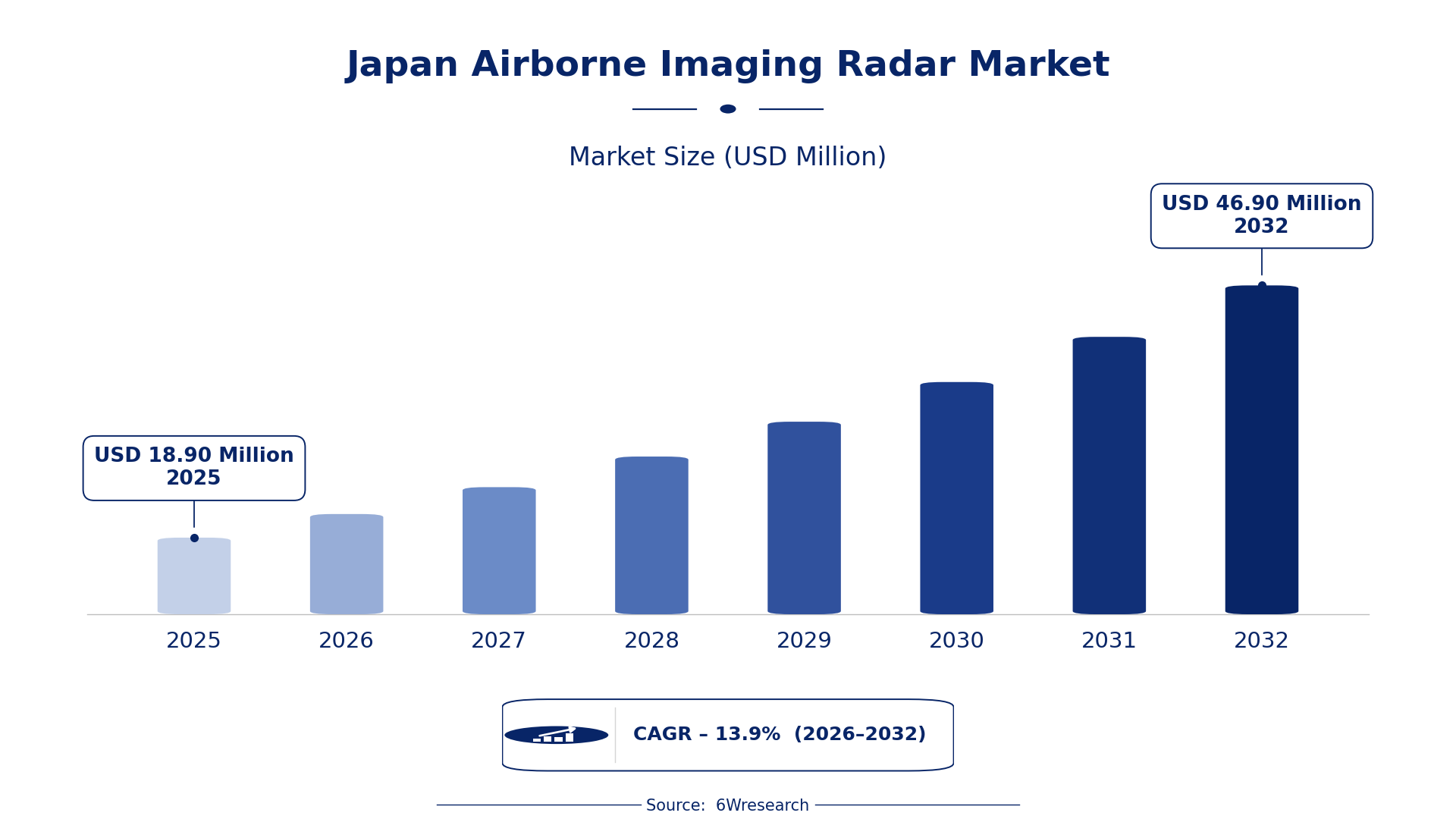
According to 6Wresearch internal database and industry insights, the Japan Airborne Imaging Radar Market was valued at USD 18.90 Million in 2025 and is projected to reach USD 46.90 Million by 2032, growing at a CAGR of approximately 13.9% during 2026–2032.
Japan Airborne Imaging Radar Market Highlights
| Report Metric | Details |
| Report Name | Japan Airborne Imaging Radar Market (2026-2032) |
| Market Size 2025 | USD 18.90 Million |
| Market Size 2032 | USD 46.90 Million |
| Absolute Growth 2025–2032 | USD 28 Million |
| CAGR 2026–2032 | 13.9% |
| Peak Annual Growth | 17.7% in 2032 |
| Forecast Period | 2026–2032 |
| Historical Data | 2022–2025 |
| Base Year | 2025 |
| Leading Radar Type, 2025 | SAR (Synthetic Aperture Radar) (42% share) |
| Leading Frequency Band, 2025 | X-band (41% share) |
| Leading Distribution Channel, 2025 | Defense Radar Suppliers (46% share) |
| Leading End User, 2025 | Military Recon Drones (47% share) |
| Fastest-Growing Radar Type | InSAR (19.9% CAGR) |
| Fastest-Growing Frequency Band | L-band (18.3% CAGR) |
| Fastest-Growing Distribution Channel | Tactical Equipment Firms (17.7% CAGR) |
| Fastest-Growing End User | Remote Sensing Labs (18.1% CAGR) |
| Growing Sector | defense and aerospace |
| Key End Users | military, border control agencies, meteorological authorities, remote sensing labs |
Japan Airborne Imaging Radar Market Year-wise Growth Rate and Key Drivers (2022–2032)
This graph illustrates the annual growth rates of the market from 2022 to 2032, highlighting a steady upward trajectory and projected market expansion over the forecast period.
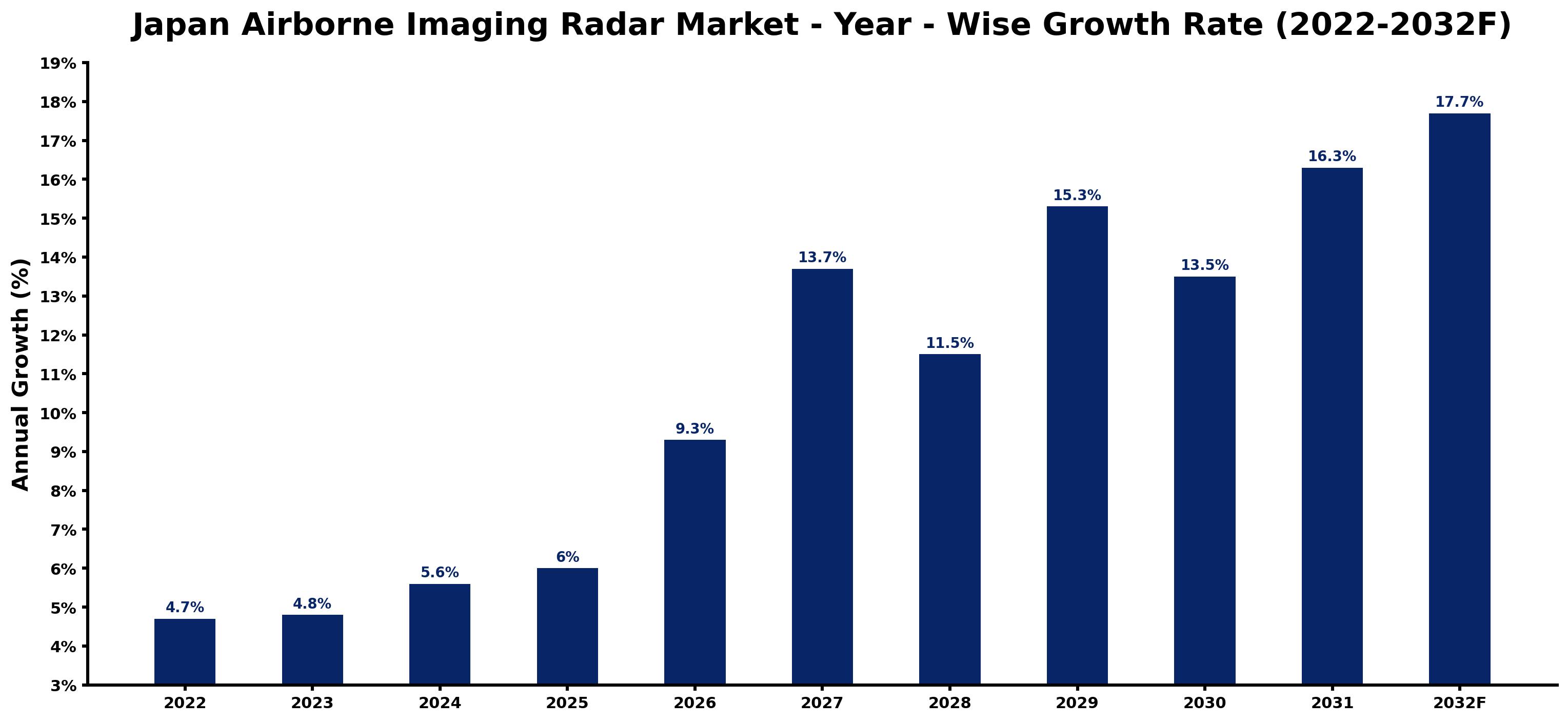
The yearly estimates that follow link every growth rate to its principal driver, so readers can see why the pace changed in each period.
| Year | Estimated Annual Growth (%) | Market Rationale |
| 2022 | 4.7 | The market experienced steady demand from the defense sector, particularly for reconnaissance applications. |
| 2023 | 4.8 | Demand increased as the Self-Defense Forces expanded their radar capabilities for surveillance. |
| 2024 | 5.6 | The introduction of advanced radar technologies stimulated further growth in military applications. |
| 2025 | 6.0 | Investment in aerospace contractors led to heightened interest in airborne imaging radar systems. |
| 2026 | 9.3 | Rising international collaborations in defense technology will drive market growth. |
| 2027 | 13.7 | Remote sensing labs will adopt new radar technologies for environmental monitoring, increasing demand. |
| 2028 | 11.5 | The growth rate is projected to slow as the market matures, but demand remains strong. |
| 2029 | 15.3 | Increased focus on border control surveillance will drive demand for imaging radar systems. |
| 2030 | 13.5 | Competition among suppliers is expected to intensify, leading to a slowdown in growth. |
| 2031 | 16.3 | Demand will rise as military reconnaissance drones become more prevalent in defense strategies. |
| 2032 | 17.7 | Funding for advanced radar systems is projected to peak as military needs escalate. |
Note: Market size estimations and growth projections presented in this report are based on 6Wresearch's proprietary forecasting methodology, utilizing the latest available industry data, government publications, and primary research inputs.
Japan Airborne Imaging Radar Market Synopsis
Airborne Imaging Radar technology employs radar signals to generate detailed images of the Earth's surface from aircraft. It plays a crucial role in military reconnaissance, border surveillance, and meteorological observations. The Japan Airborne Imaging Radar Market is growing due to heightened demand from the Self-Defense Forces and ongoing research by the Japan Aerospace Exploration Agency. Investments in radar technology and international collaborations are propelling market growth, with a projected size of USD 46.90 million by 2032.
Market Dynamics Impact Analysis (2026–2032)
| Factor | Type | Impact | Primary Segment Affected |
| Increased military spending | Driver | High | Ground Moving Target Indicator |
| Technological advancements in radar systems | Driver | High | SAR (Synthetic Aperture Radar) |
| Growing demand for environmental monitoring | Opportunity | High | InSAR |
| Expansion of border surveillance initiatives | Opportunity | High | Weather Radar Imaging |
| High development costs for advanced radar systems | Restraint | Medium | SAR (Synthetic Aperture Radar) |
| Limited domestic suppliers for specialized radar components | Restraint | Medium | Defense Radar Suppliers |
| Rising competition among suppliers | Challenge | High | Military Recon Drones |
| Stringent regulatory requirements for radar technology | Challenge | Medium | Aerospace Contractors |
Evaluation of Drivers in Japan Airborne Imaging Radar Market (2026–2032)
The table below links each growth driver to the segment it affects and the evidence for it.
| Drivers | Primary Segment Affected | Why It Matters (Evidence) |
| Increased defence budgets | Ground Moving Target Indicator | The Japan Defense Agency's budget for radar systems in 2023 is approximately 2 billion yen, driving procurement. |
| Technological advancements in radar systems | SAR (Synthetic Aperture Radar) | Research by the Japan Aerospace Exploration Agency on radar technologies supports improved imaging capabilities. |
| Demand for environmental monitoring | InSAR | Remote sensing labs in Japan are increasingly adopting SAR technology for environmental studies. |
| Expansion of border surveillance initiatives | Weather Radar Imaging | The Ministry of Internal Affairs and Communications supports radar technologies for disaster management. |
| Increased military reconnaissance missions | Military Recon Drones | The Self-Defense Forces utilise airborne imaging radar for surveillance capabilities. |
The strongest pull on demand comes from increased defence budgets, with the Japan Defense Agency allocating approximately 2 billion yen for radar systems in 2023, prompting more procurements. Technological advancements in radar systems are supported by ongoing research from the Japan Aerospace Exploration Agency, which improves imaging capabilities. Environmental monitoring demand is rising as remote sensing labs adopt SAR technology for studies. Border surveillance initiatives are expanding due to support from the Ministry of Internal Affairs and Communications for radar technologies. Military reconnaissance missions are increasing, with the Self-Defense Forces utilising airborne imaging radar for surveillance capabilities.
Evaluation of Restraints in Japan Airborne Imaging Radar Market
These are the pressures that could keep growth below its potential.
| Market Restraint | Primary Segment Affected | Why It Matters (Evidence) |
| High development costs for advanced radar systems | SAR (Synthetic Aperture Radar) | The costs associated with developing new radar technologies can deter investment and hinder market growth. |
| Limited domestic suppliers for specialized radar components | Defense Radar Suppliers | A lack of local suppliers for specific radar components can result in delays in procurement. |
| Stringent regulatory requirements for radar technology | Aerospace Contractors | Compliance with regulations can raise operational costs and delay product development. |
| Intense competition among suppliers | Military Recon Drones | Fierce competition can lead to price wars, affecting profitability for suppliers. |
| Market maturity leading to slower growth rates | Weather Radar Imaging | As the market matures, growth rates may decelerate, impacting new investments. |
Japan Airborne Imaging Radar Market Challenges
In 2023, Japan's defense budget for radar systems reached approximately 2 billion yen, highlighting intense competition among suppliers for government contracts. This competition compels producers to lower prices, which may restrict their ability to invest in advanced technologies. Buyers, including the Self-Defense Forces, encounter procurement delays due to lengthy approval processes, potentially extending project timelines by up to six months. Rising raw material costs inflate production expenses for manufacturers, leading to increased prices for end users, ultimately impacting the affordability of airborne imaging systems.
Trends in the Japan Airborne Imaging Radar Market
Several trends are reshaping the Japan Airborne Imaging Radar Market; the most important are set out below.
- Shift from Traditional to Advanced Radar Systems: Military reconnaissance missions are increasingly utilising advanced radar systems, with the Self-Defense Forces integrating new technologies. In 2023, Japan hosted the Aerospace Technology Conference focusing on radar innovations, showcasing the shift.
- Emergence of Remote Sensing Labs: Remote sensing labs are adopting SAR technology for environmental studies, reflecting a growing trend. In Japan, the number of labs utilising this technology has increased by 15% since 2022.
- Transition from C-band to X-band Radar: The preference for X-band radar systems is rising due to their high-resolution imaging capabilities. In 2025, X-band systems are expected to represent 41% of the market share.
- Growing Focus on Border Control Surveillance: Border control surveillance initiatives are gaining traction, with increased investments in radar technologies. The Ministry of Internal Affairs and Communications is funding projects to improve monitoring capabilities.
Investment Opportunities in the Japan Airborne Imaging Radar Market
Where to invest in the Japan Airborne Imaging Radar Market: the main openings are set out below.
- Rising Demand for Environmental Monitoring: This is an opportune moment for investment in SAR technology, as remote sensing labs are increasingly adopting it. The market for environmental monitoring in Japan is projected to grow substantially.
- Expansion of Border Surveillance Initiatives: With border control surveillance becoming a priority, suppliers can target the Ministry of Internal Affairs and Communications for contracts. The market gap for advanced radar systems in this sector is considerable.
- Investment in Advanced Radar Technologies: The Japan Defense Agency's budget for radar systems in 2023 is approximately 2 billion yen, creating opportunities for suppliers. Collaborations with defense contractors can facilitate market entry.
- Development of Military Recon Drones: The growing emphasis on military reconnaissance drones presents opportunities for radar suppliers. The Self-Defense Forces are actively seeking advanced imaging radar solutions.
Government Initiatives in the Japan Airborne Imaging Radar Market
The Electrical Appliance and Material Safety Act (1961) governs the safety of radar systems, ensuring compliance with safety standards. This law complements the Industrial Safety and Health Act (1972), which outlines employer responsibilities for hazardous substances, promoting safety in radar manufacturing.
In 2023, the Japan Defense Agency allocated approximately 2 billion yen for radar system procurement, overseen by the Japan Aerospace Exploration Agency. This funding supports the development of advanced radar technologies and ensures adherence to safety regulations.
Future Insight of the Japan Airborne Imaging Radar Market
Investment from the Ministry of Defense and the Japan Aerospace Exploration Agency will drive advancements in airborne imaging radar technologies, resulting in increased demand. Ongoing projects involving synthetic aperture radar will improve remote sensing capabilities. Urban planning initiatives by the Tokyo Metropolitan Government will integrate radar systems for enhanced real-time monitoring. The Ministry of Internal Affairs and Communications will support innovative radar solutions for disaster management, creating opportunities for buyers and suppliers.
Market Segmentation Analysis
Japan Airborne Imaging Radar Market report covers a detailed analysis of the following market segments:
By Radar Type – SAR (Synthetic Aperture Radar) Leads, InSAR Expected to Grow Fastest
According to Saurav Kr Singh, Senior Research Analyst at 6Wresearch, in 2025, SAR (Synthetic Aperture Radar) led the radar type split with a 42% share. SAR holds the largest share because it is essential for high-resolution imaging, particularly in military reconnaissance and environmental monitoring. The Japan Defense Agency's reliance on SAR for terrain analysis underscores its critical role in various operations. InSAR is projected to grow fastest, at a CAGR of 19.9% during 2026–2032. InSAR is rapidly growing as it is increasingly utilised for measuring ground deformation, especially in urban planning projects in Tokyo. This growth is further encouraged by ongoing research initiatives at the Japan Aerospace Exploration Agency. Suppliers should prioritise advancements in InSAR technology to meet the rising demand.
By Frequency Band – X-band Leads, L-band Expected to Grow Fastest
The largest frequency band category in 2025 was X-band, at 41% of revenue. X-band leads the market due to its prevalent use in high-resolution imaging applications, particularly within military and environmental sectors. Its ability to provide detailed imagery makes it a preferred choice among defence contractors. Over 2026–2032, L-band is expected to post the fastest growth, at a CAGR of 18.3%. L-band is experiencing swift growth as it is well-suited for longer-range applications, which are becoming increasingly important for military and environmental studies. This trend is particularly supported by initiatives from the Ministry of Internal Affairs and Communications. Buyers should consider investing in L-band systems to meet their growing need for longer-range capabilities.
By Distribution Channel – Defense Radar Suppliers Lead, Tactical Equipment Firms Expected to Grow Fastest
Defense Radar Suppliers held 46% of the Japan Airborne Imaging Radar Market by distribution channel in 2025. Defense Radar Suppliers hold the largest share due to their provision of critical components essential for military applications, particularly for the Self-Defense Forces. Their established relationships with government agencies further solidify their dominant position in the market. Tactical Equipment Firms are set to record the highest CAGR in this split, 17.7% over 2026–2032. Tactical Equipment Firms are experiencing rapid growth as they supply radar systems tailored for tactical operations, which are increasingly necessary in contemporary military strategies. The Ministry of Defense's heightened budget for radar systems is a key factor driving this growth. This trend indicates that suppliers should consider collaborations with tactical firms to leverage the expanding opportunities in this sector.
By End User – Military Recon Drones Lead, Remote Sensing Labs Expected to Grow Fastest
Military Recon Drones took 47% of end user revenue in 2025, more than any other category. Military Recon Drones constitute the largest user group as they extensively utilise imaging radar for surveillance missions critical to national security. The rising budget for advanced radar systems by the Japan Defense Agency highlights this trend. The quickest growth will come from Remote Sensing Labs, forecast to expand at a CAGR of 18.1% between 2026 and 2032. Remote Sensing Labs are growing rapidly as they increasingly adopt radar data for environmental monitoring, driven by the need for accurate data in disaster management. This growth is supported by initiatives from the Ministry of Internal Affairs and Communications. Buyers in the remote sensing sector should focus on advanced radar technologies to improve their monitoring capabilities.
Key Attractiveness of the Report
- 10 Years of Market Numbers
- Historical Data Starting from 2022 to 2025
- Base Year 2025
- Forecast Data until 2032
- Key Performance Indicators Impacting the Market
- Major Upcoming Developments and Projects
Key Highlights of the Report:
- Japan Airborne Imaging Radar Market Outlook
- Market Size of Japan Airborne Imaging Radar Market, 2025
- Forecast of Japan Airborne Imaging Radar Market, 2032
- Historical Data and Forecast of Japan Airborne Imaging Radar Revenues & Volume for the Period 2022-2032F
- Japan Airborne Imaging Radar Market Trend Evolution
- Japan Airborne Imaging Radar Market Drivers and Challenges
- Japan Airborne Imaging Radar Price Trends
- Japan Airborne Imaging Radar Porter's Five Forces
- Japan Airborne Imaging Radar Industry Life Cycle
- Historical Data and Forecast of Japan Airborne Imaging Radar Market Revenues & Volume By Radar Type for the Period 2022-2032F
- Historical Data and Forecast of Japan Airborne Imaging Radar Market Revenues & Volume By SAR (Synthetic Aperture Radar) for the Period 2022-2032F
- Historical Data and Forecast of Japan Airborne Imaging Radar Market Revenues & Volume By Ground Moving Target Indicator for the Period 2022-2032F
- Historical Data and Forecast of Japan Airborne Imaging Radar Market Revenues & Volume By InSAR for the Period 2022-2032F
- Historical Data and Forecast of Japan Airborne Imaging Radar Market Revenues & Volume By Weather Radar Imaging for the Period 2022-2032F
- Historical Data and Forecast of Japan Airborne Imaging Radar Market Revenues & Volume By Frequency Band for the Period 2022-2032F
- Historical Data and Forecast of Japan Airborne Imaging Radar Market Revenues & Volume By X-band for the Period 2022-2032F
- Historical Data and Forecast of Japan Airborne Imaging Radar Market Revenues & Volume By L-band for the Period 2022-2032F
- Historical Data and Forecast of Japan Airborne Imaging Radar Market Revenues & Volume By C-band for the Period 2022-2032F
- Historical Data and Forecast of Japan Airborne Imaging Radar Market Revenues & Volume By S-band for the Period 2022-2032F
- Historical Data and Forecast of Japan Airborne Imaging Radar Market Revenues & Volume By Distribution Channel for the Period 2022-2032F
- Historical Data and Forecast of Japan Airborne Imaging Radar Market Revenues & Volume By Defense Radar Suppliers for the Period 2022-2032F
- Historical Data and Forecast of Japan Airborne Imaging Radar Market Revenues & Volume By Tactical Equipment Firms for the Period 2022-2032F
- Historical Data and Forecast of Japan Airborne Imaging Radar Market Revenues & Volume By Aerospace Contractors for the Period 2022-2032F
- Historical Data and Forecast of Japan Airborne Imaging Radar Market Revenues & Volume By Aircraft Radar OEMs for the Period 2022-2032F
- Historical Data and Forecast of Japan Airborne Imaging Radar Market Revenues & Volume By End User for the Period 2022-2032F
- Historical Data and Forecast of Japan Airborne Imaging Radar Market Revenues & Volume By Military Recon Drones for the Period 2022-2032F
- Historical Data and Forecast of Japan Airborne Imaging Radar Market Revenues & Volume By Border Control Surveillance for the Period 2022-2032F
- Historical Data and Forecast of Japan Airborne Imaging Radar Market Revenues & Volume By Remote Sensing Labs for the Period 2022-2032F
- Historical Data and Forecast of Japan Airborne Imaging Radar Market Revenues & Volume By Meteorological Authorities for the Period 2022-2032F
- Japan Airborne Imaging Radar Import Export Trade Statistics
- Market Opportunity Assessment By Radar Type
- Market Opportunity Assessment By Frequency Band
- Market Opportunity Assessment By Distribution Channel
- Market Opportunity Assessment By End User
- Japan Airborne Imaging Radar Top Companies Market Share
- Japan Airborne Imaging Radar Competitive Benchmarking By Technical and Operational Parameters
- Japan Airborne Imaging Radar Company Profiles
- Japan Airborne Imaging Radar Key Strategic Recommendations
Market Covered
Segments analysed in this report are listed below.
By Radar Type
- SAR (Synthetic Aperture Radar)
- Ground Moving Target Indicator
- InSAR
- Weather Radar Imaging
By Frequency Band
- X-band
- L-band
- C-band
- S-band
By Distribution Channel
- Defense Radar Suppliers
- Tactical Equipment Firms
- Aerospace Contractors
- Aircraft Radar OEMs
By End User
- Military Recon Drones
- Border Control Surveillance
- Remote Sensing Labs
- Meteorological Authorities































