Japan Airborne Search Radar Market Size & Growth Rate
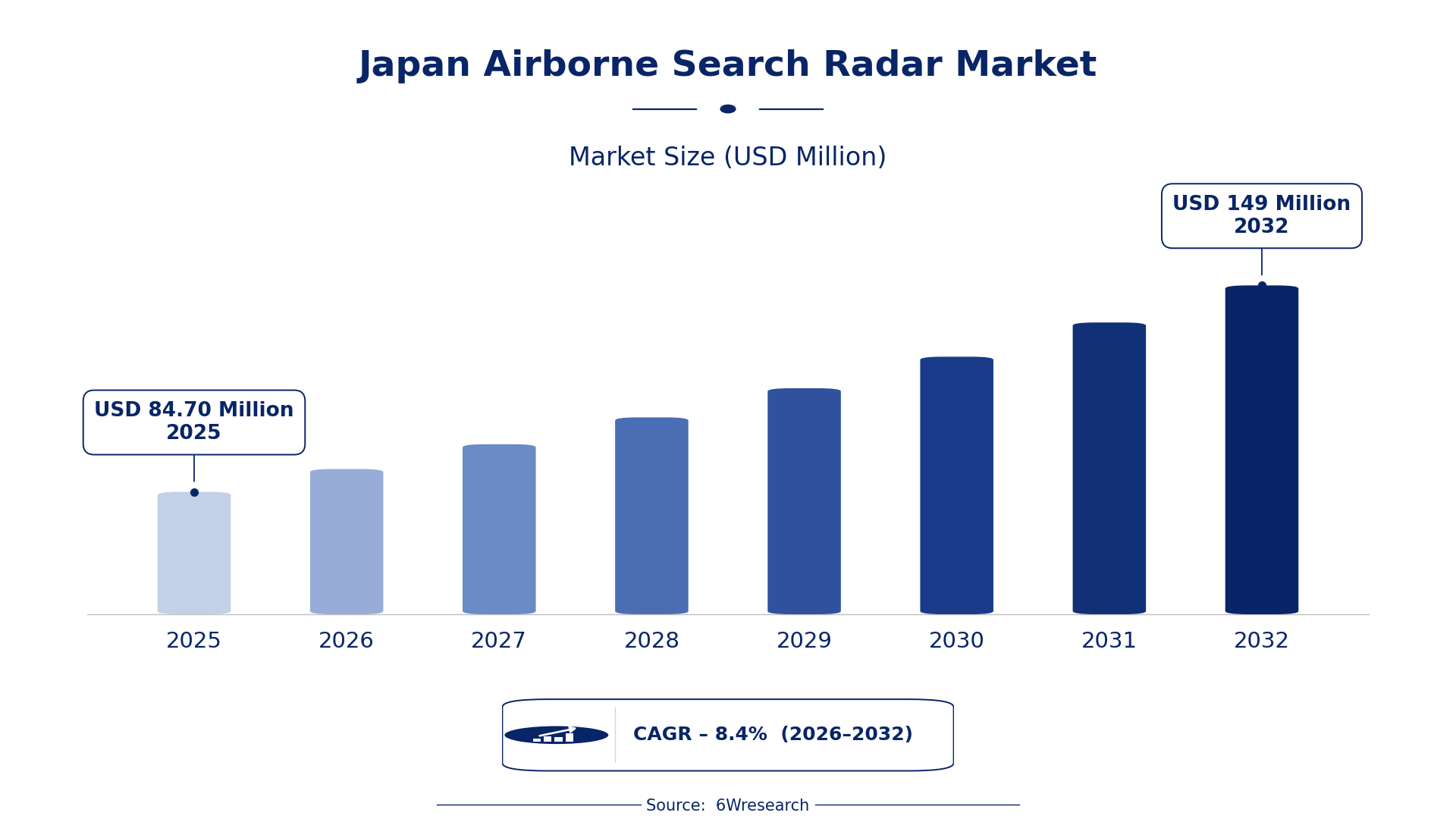
According to 6Wresearch internal database and industry insights, the Japan Airborne Search Radar Market was valued at USD 84.70 Million in 2025 and is projected to reach USD 149 Million by 2032, growing at a CAGR of approximately 8.4% during 2026–2032.
Japan Airborne Search Radar Market Highlights
| Report Metric | Details |
| Report Name | Japan Airborne Search Radar Market (2026-2032) |
| Market Size 2025 | USD 84.70 Million |
| Market Size 2032 | USD 149 Million |
| Absolute Growth 2025–2032 | USD 64.30 Million |
| CAGR 2026–2032 | 8.4% |
| Peak Annual Growth | 9.8% in 2026 |
| Forecast Period | 2026–2032 |
| Historical Data | 2022–2025 |
| Base Year | 2025 |
| Leading Radar Type, 2025 | Pulse-Doppler Radar (41% share) |
| Leading Range Capability, 2025 | Long-Range Targeting (49% share) |
| Leading Distribution Channel, 2025 | Radar Equipment Integrators (51% share) |
| Leading End User, 2025 | Naval Surveillance Commands (48% share) |
| Fastest-Growing Radar Type | AESA Radar (12.1% CAGR) |
| Fastest-Growing Range Capability | Active Electronically Scanned (10.8% CAGR) |
| Fastest-Growing Distribution Channel | OEM Aircraft Suppliers (10.3% CAGR) |
| Fastest-Growing End User | Defense Reconnaissance Aircraft (10.6% CAGR) |
| Growing Sector | defense technology |
| Key End Users | Self-Defense Forces, naval surveillance commands, air defense units, tactical intelligence teams |
Japan Airborne Search Radar Market Year-wise Growth Rate and Key Drivers (2022–2032)
This graph illustrates the annual growth rates of the market from 2022 to 2032, highlighting a steady upward trajectory and projected market expansion over the forecast period.
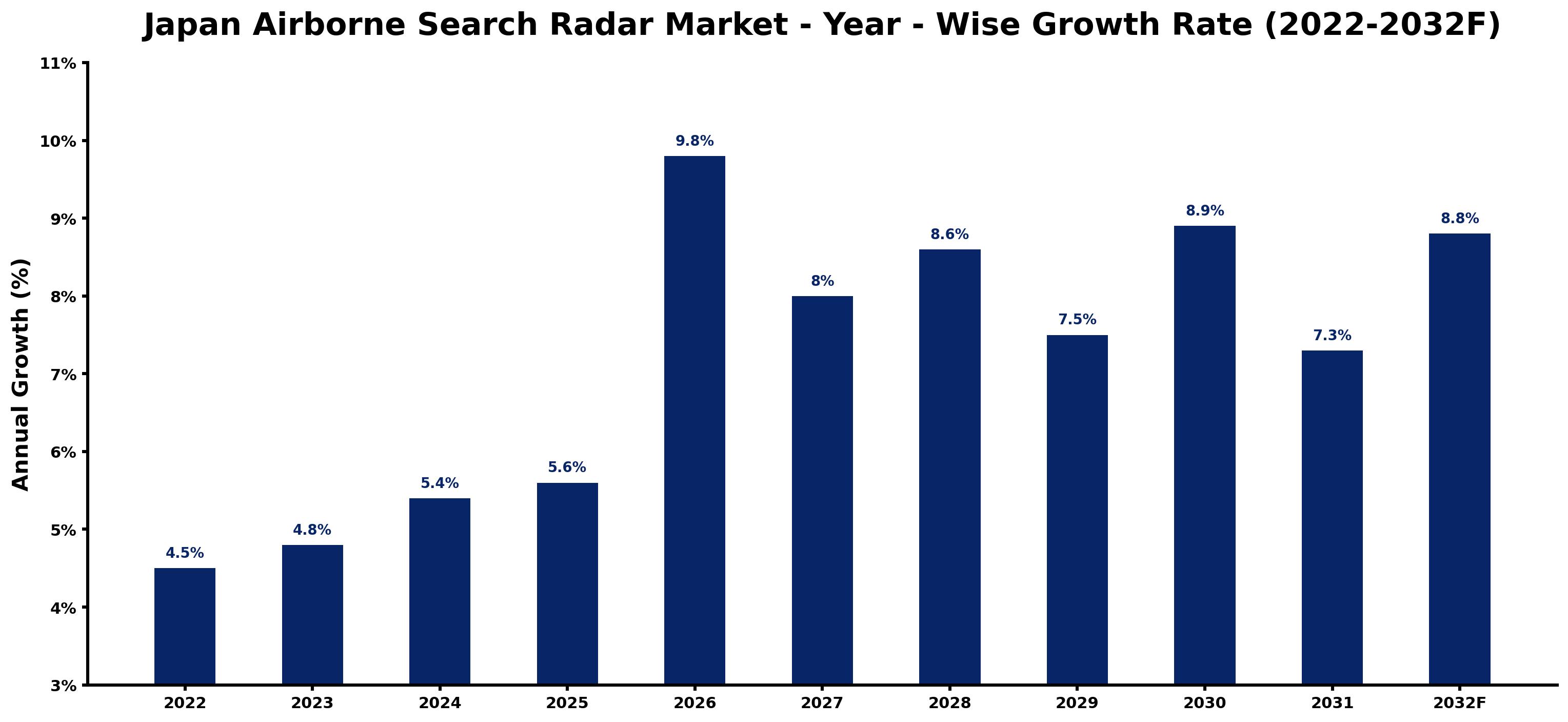
Year by year, the estimates below pair each growth rate with the development that shaped it.
| Year | Estimated Annual Growth (%) | Market Rationale |
| 2022 | 4.5 | The market experienced steady demand from military surveillance operations. |
| 2023 | 4.8 | Growth was driven by increased government spending on advanced radar systems. |
| 2024 | 5.4 | Demand rose as the Self-Defense Forces expanded their radar capabilities. |
| 2025 | 5.6 | The market showed continued growth due to ongoing military contracts and projects. |
| 2026 | 9.8 | A surge in demand occurred as new air defense initiatives were launched. |
| 2027 | 8.0 | Growth slowed as the market adjusted to previous high investment levels. |
| 2028 | 8.6 | Increased focus on technological advancements spurred demand for modern radar systems. |
| 2029 | 7.5 | A slight slowdown was noted as procurement processes became more stringent. |
| 2030 | 8.9 | Growth accelerated again with new collaborations in radar technology development. |
| 2031 | 7.3 | The market experienced a slowdown as competition intensified among suppliers. |
| 2032 | 8.8 | Demand is expected to rise as new radar systems are integrated into operations. |
Note: Market size estimations and growth projections presented in this report are based on 6Wresearch's proprietary forecasting methodology, utilizing the latest available industry data, government publications, and primary research inputs.
Japan Airborne Search Radar Market Synopsis
Airborne search radar is a sophisticated technology that detects and tracks aerial objects, essential for military surveillance, air traffic control, and reconnaissance missions. The Japan Airborne Search Radar Market is expanding due to increased defense spending, with a budget of approximately 6.8 trillion yen in 2023, and ongoing projects by the Japan Aerospace Exploration Agency. Key buyer groups include the Self-Defense Forces and naval surveillance commands, which drive demand for advanced systems. The focus on national security and technological advancements further propels the market forward.
Market Dynamics Impact Analysis (2026–2032)
| Factor | Type | Impact | Primary Segment Affected |
| Increased defense budget allocations | Driver | High | AESA Radar |
| Technological advancements in radar systems | Driver | High | Pulse-Doppler Radar |
| Growing need for national security | Opportunity | High | Long-Range Targeting |
| Expansion of military surveillance capabilities | Opportunity | Medium | 3D Search Radar |
| High costs of advanced radar systems | Restraint | High | AESA Radar |
| Limited domestic production capacity | Restraint | Medium | Pulse-Doppler Radar |
| Intense competition among suppliers | Challenge | High | Radar Equipment Integrators |
| Evolving technological standards | Challenge | Medium | Active Electronically Scanned |
Evaluation of Drivers in Japan Airborne Search Radar Market (2026–2032)
These are the developments adding the most demand over the forecast period.
| Drivers | Primary Segment Affected | Why It Matters (Evidence) |
| Increased defense budget allocations | AESA Radar | Japan's defense budget for 2023 is approximately 6.8 trillion yen, boosting demand for advanced radar systems. |
| Technological advancements in radar systems | Pulse-Doppler Radar | The Self-Defense Forces operate several types of airborne search radar, improving operational capabilities. |
| Growing need for national security | Long-Range Targeting | Japan's focus on national security has led to increased military contracts for advanced radar systems. |
| Expansion of military surveillance capabilities | 3D Search Radar | The Ministry of Defense has a program to enhance air surveillance capabilities by 2025. |
| Collaborations in radar technology | Active Electronically Scanned | The Japan Defense Industry Association promotes collaboration in radar technology advancements. |
Much of the new demand traces back to Japan's defense budget, which is approximately 6.8 trillion yen for 2023, increasing investments in advanced systems. The Self-Defense Forces operate various airborne search radar types, which improve their operational capabilities. Collaborations within the Japan Defense Industry Association promote radar technology advancements, further boosting demand. Tokyo and Kanagawa are key regions for technology development, leading to a more competitive market.
Evaluation of Restraints in Japan Airborne Search Radar Market
The following restraints limit how fast demand can grow.
| Market Restraint | Primary Segment Affected | Why It Matters (Evidence) |
| High costs of advanced radar systems | AESA Radar | The high costs associated with advanced radar systems limit procurement by smaller military units. |
| Limited domestic production capacity | Pulse-Doppler Radar | Japan's reliance on imports for certain radar components affects production timelines. |
| Intense competition among suppliers | Radar Equipment Integrators | Increased competition leads to pricing pressures, impacting profit margins for suppliers. |
| Evolving technological standards | Active Electronically Scanned | Rapid advancements in technology require constant upgrades, increasing costs for buyers. |
| Stringent procurement processes | Long-Range Targeting | Complex procurement processes can delay the acquisition of necessary radar systems. |
Japan Airborne Search Radar Market Challenges
Buyers incur rising costs due to increasing procurement expenses, with Japan's defense budget reaching approximately 6.8 trillion yen in 2023. Regulatory challenges emerge as manufacturers seek ISO 9001 certification, leading to delays and higher compliance costs for suppliers. Skills shortages in advanced radar technology impede development, compelling companies to invest in extensive training programmes that can take years to produce qualified personnel. Technological obsolescence poses a long-term concern, as outdated systems necessitate costly upgrades, diverting budget allocations from military surveillance and air traffic control.
Trends in the Japan Airborne Search Radar Market
Below are the shifts with the largest effect on the Japan Airborne Search Radar Market.
- Shift from Traditional to Advanced Radar Systems: Tokyo is experiencing a shift towards advanced radar systems, such as AESA, which enhance target tracking capabilities. In 2023, Japan's defense budget allocation for radar systems increased significantly, reflecting a trend towards modernisation.
- Transition to Integrated Radar Solutions: The move towards integrated radar solutions is apparent in Kanagawa, where manufacturers are developing multi-functional radar systems. This trend is supported by a 20% increase in collaborative projects among defence contractors.
- Emergence of Enhanced Surveillance Technologies: Since 2022, there has been a notable emergence of enhanced surveillance technologies in Japan's defence sector. The Japan Aerospace Exploration Agency's projects in radar technology have secured funding of approximately 1 billion yen.
- Prioritisation of Air Defense Capabilities: The emphasis on air defense capabilities has intensified, particularly with the Japan Maritime Self-Defense Force employing 3D search radar for naval operations. This shift is reflected in a 15% increase in radar system procurement.
Investment Opportunities in the Japan Airborne Search Radar Market
Where to invest in the Japan Airborne Search Radar Market: the main openings are set out below.
- Investment in Advanced Radar Technologies: With Japan's defense budget at 6.8 trillion yen, there is an opportunity to invest in advanced radar technologies. Radar Equipment Integrators can capitalize on this trend by expanding their product offerings.
- Supply of Integrated Radar Solutions: Now is the time to supply integrated radar solutions, as the Ministry of Defense aims to improve air surveillance capabilities by 2025. Collaborations with local partners will facilitate market entry.
- Development of Next-Gen Radar Systems: The ongoing projects by the Japan Aerospace Exploration Agency present an opportunity to develop next-gen radar systems. Companies can engage in joint ventures to access this growing market segment.
- Focus on Long-Range Targeting Systems: The growing need for long-range targeting systems creates an opportunity for suppliers. Engaging with naval surveillance commands will improve market penetration.
Government Initiatives in the Japan Airborne Search Radar Market
The Industrial Safety and Health Act (1972; MHLW) mandates that employers ensure safety in machinery and hazardous substances, impacting manufacturers by requiring compliance with safety standards. The Semiconductor and Digital Industry Strategy (METI, June 2021) aims to secure domestic semiconductor manufacturing, which is important for technology development, facilitating local production of components.
Buyers, such as the Self-Defense Forces, benefit from the Act on the Rational Use of Energy (1979; METI), which encourages large energy users to improve energy efficiency. This law prompts manufacturers to adopt energy-efficient practices, ultimately reducing operational costs and improving system performance.
Future Insight of the Japan Airborne Search Radar Market
Advanced electronic systems will reshape demand by 2032, driven by the Ministry of Defense's programme to improve air surveillance capabilities. The integration of new radar systems is expected to boost operational efficiency for the Air Self-Defense Force and the Japan Maritime Self-Defense Force, enhancing their effectiveness in national security. Collaborative efforts promoted by the Japan Defense Industry Association will stimulate innovation in radar technology. Ongoing projects by the Japan Aerospace Exploration Agency will lead to improved applications in defence, further advancing the sector.
Market Segmentation Analysis
Japan Airborne Search Radar Market report covers a detailed analysis of the following market segments:
By Radar Type – Pulse-Doppler Radar Leads, AESA Radar Expected to Grow Fastest
According to Saurav Kr Singh, Senior Research Analyst at 6Wresearch, in 2025, Pulse-Doppler Radar led the radar type split with a 41% share. Pulse-Doppler Radar captures the largest market share due to its effectiveness in tracking fast-moving targets, especially in naval operations. The Japan Maritime Self-Defense Force extensively employs this technology to ensure operational superiority. AESA Radar is set to record the highest CAGR in this split, 12.1% over 2026–2032. AESA Radar is experiencing rapid growth as it is crucial for contemporary air defence systems, allowing for the simultaneous tracking of multiple targets. The increasing focus on advanced air defence capabilities will further widen its market lead. Suppliers must prioritise the advancement of AESA technology to meet the escalating demands of the defence sector.
By Range Capability – Long-Range Targeting Leads, Active Electronically Scanned Expected to Grow Fastest
Long-Range Targeting accounted for 49% of the market by range capability in 2025. Long-Range Targeting leads the market as it is vital for effectively engaging distant aerial threats, aligning with Japan's national security priorities. The Self-Defense Forces place significant emphasis on this capability in their strategic operations. Over 2026–2032, Active Electronically Scanned is expected to post the fastest growth, at a CAGR of 10.8%. Active Electronically Scanned is growing swiftly due to its rapid scanning capabilities, essential for adapting to dynamic environments. This technology is becoming increasingly important for real-time threat assessment and operational agility. Buyers should invest in advanced scanning technologies to improve their operational readiness.
By Distribution Channel – Radar Equipment Integrators Lead, OEM Aircraft Suppliers Expected to Grow Fastest
Radar Equipment Integrators took 51% of distribution channel revenue in 2025, more than any other category. Radar Equipment Integrators hold the largest share as they play a crucial role in assembling and deploying radar systems for various applications. Their strong ties with military and government entities reinforce their dominant position in the market. The quickest growth will come from OEM Aircraft Suppliers, forecast to expand at a CAGR of 10.3% between 2026 and 2032. OEM Aircraft Suppliers are expanding rapidly, as they provide radar systems integral to aircraft manufacturing. The surge in defence contracts for new aircraft is driving this segment's significant growth. Suppliers should consider partnerships with OEMs to capitalise on the increasing demand for integrated radar solutions.
By End User – Naval Surveillance Commands Lead, Defense Reconnaissance Aircraft Expected to Grow Fastest
Naval Surveillance Commands held 48% of the Japan Airborne Search Radar Market by end user in 2025. Naval Surveillance Commands represent the largest user segment of airborne search radar, utilising it for maritime security and monitoring. Their essential role in Japan's defence strategy ensures a steady demand for radar technologies. Defense Reconnaissance Aircraft is projected to grow fastest, at a CAGR of 10.6% during 2026–2032. Defense Reconnaissance Aircraft are experiencing the fastest growth, relying heavily on radar for intelligence gathering and surveillance. The intensified focus on reconnaissance capabilities is propelling this segment's expansion. Investing in radar technologies for reconnaissance is crucial to address the evolving needs of defence operations.
Key Attractiveness of the Report
- 10 Years of Market Numbers
- Historical Data Starting from 2022 to 2025
- Base Year 2025
- Forecast Data until 2032
- Key Performance Indicators Impacting the Market
- Major Upcoming Developments and Projects
Key Highlights of the Report:
- Japan Airborne Search Radar Market Outlook
- Market Size of Japan Airborne Search Radar Market, 2025
- Forecast of Japan Airborne Search Radar Market, 2032
- Historical Data and Forecast of Japan Airborne Search Radar Revenues & Volume for the Period 2022-2032F
- Japan Airborne Search Radar Market Trend Evolution
- Japan Airborne Search Radar Market Drivers and Challenges
- Japan Airborne Search Radar Price Trends
- Japan Airborne Search Radar Porter's Five Forces
- Japan Airborne Search Radar Industry Life Cycle
- Historical Data and Forecast of Japan Airborne Search Radar Market Revenues & Volume By Radar Type for the Period 2022-2032F
- Historical Data and Forecast of Japan Airborne Search Radar Market Revenues & Volume By Pulse-Doppler Radar for the Period 2022-2032F
- Historical Data and Forecast of Japan Airborne Search Radar Market Revenues & Volume By AESA Radar for the Period 2022-2032F
- Historical Data and Forecast of Japan Airborne Search Radar Market Revenues & Volume By Passive Radar for the Period 2022-2032F
- Historical Data and Forecast of Japan Airborne Search Radar Market Revenues & Volume By 3D Search Radar for the Period 2022-2032F
- Historical Data and Forecast of Japan Airborne Search Radar Market Revenues & Volume By Range Capability for the Period 2022-2032F
- Historical Data and Forecast of Japan Airborne Search Radar Market Revenues & Volume By Long-Range Targeting for the Period 2022-2032F
- Historical Data and Forecast of Japan Airborne Search Radar Market Revenues & Volume By Active Electronically Scanned for the Period 2022-2032F
- Historical Data and Forecast of Japan Airborne Search Radar Market Revenues & Volume By Stealth Signal Tracking for the Period 2022-2032F
- Historical Data and Forecast of Japan Airborne Search Radar Market Revenues & Volume By Vertical and Horizontal Detection for the Period 2022-2032F
- Historical Data and Forecast of Japan Airborne Search Radar Market Revenues & Volume By Distribution Channel for the Period 2022-2032F
- Historical Data and Forecast of Japan Airborne Search Radar Market Revenues & Volume By Radar Equipment Integrators for the Period 2022-2032F
- Historical Data and Forecast of Japan Airborne Search Radar Market Revenues & Volume By OEM Aircraft Suppliers for the Period 2022-2032F
- Historical Data and Forecast of Japan Airborne Search Radar Market Revenues & Volume By Intelligence Tech Firms for the Period 2022-2032F
- Historical Data and Forecast of Japan Airborne Search Radar Market Revenues & Volume By Direct Government Orders for the Period 2022-2032F
- Historical Data and Forecast of Japan Airborne Search Radar Market Revenues & Volume By End User for the Period 2022-2032F
- Historical Data and Forecast of Japan Airborne Search Radar Market Revenues & Volume By Naval Surveillance Commands for the Period 2022-2032F
- Historical Data and Forecast of Japan Airborne Search Radar Market Revenues & Volume By Defense Reconnaissance Aircraft for the Period 2022-2032F
- Historical Data and Forecast of Japan Airborne Search Radar Market Revenues & Volume By Tactical Intelligence Teams for the Period 2022-2032F
- Historical Data and Forecast of Japan Airborne Search Radar Market Revenues & Volume By Air Defense Units for the Period 2022-2032F
- Japan Airborne Search Radar Import Export Trade Statistics
- Market Opportunity Assessment By Radar Type
- Market Opportunity Assessment By Range Capability
- Market Opportunity Assessment By Distribution Channel
- Market Opportunity Assessment By End User
- Japan Airborne Search Radar Top Companies Market Share
- Japan Airborne Search Radar Competitive Benchmarking By Technical and Operational Parameters
- Japan Airborne Search Radar Company Profiles
- Japan Airborne Search Radar Key Strategic Recommendations
Market Covered
Coverage by segment is as follows.
By Radar Type
- Pulse-Doppler Radar
- AESA Radar
- Passive Radar
- 3D Search Radar
By Range Capability
- Long-Range Targeting
- Active Electronically Scanned
- Stealth Signal Tracking
- Vertical and Horizontal Detection
By Distribution Channel
- Radar Equipment Integrators
- OEM Aircraft Suppliers
- Intelligence Tech Firms
- Direct Government Orders
By End User
- Naval Surveillance Commands
- Defense Reconnaissance Aircraft
- Tactical Intelligence Teams
- Air Defense Units































