Japan Airborne Surveillance Sensor Market Size & Growth Rate
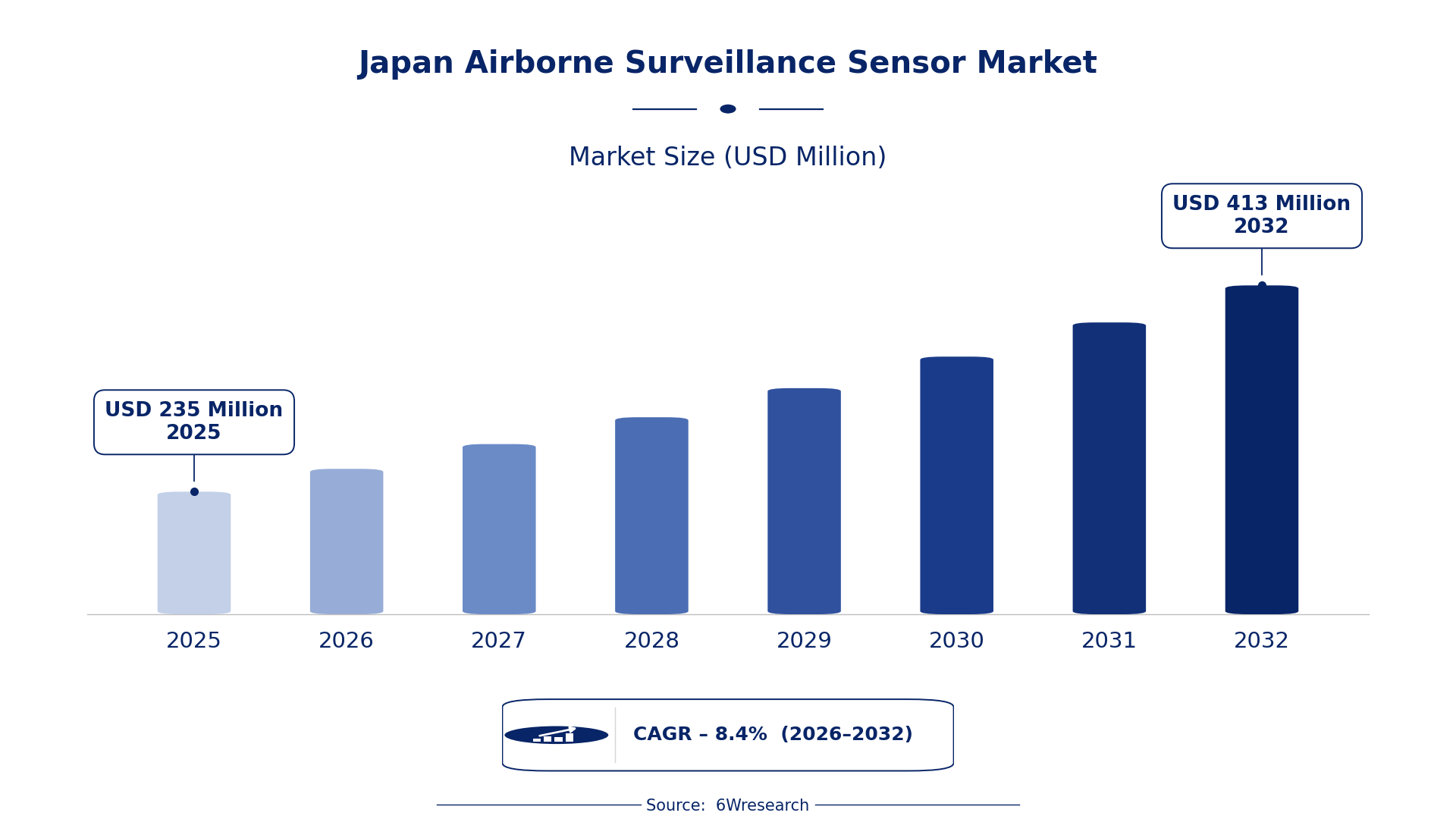
According to 6Wresearch internal database and industry insights, the Japan Airborne Surveillance Sensor Market was valued at USD 235 Million in 2025 and is projected to reach USD 413 Million by 2032, growing at a CAGR of approximately 8.4% during 2026–2032.
Japan Airborne Surveillance Sensor Market Highlights
| Report Metric | Details |
| Report Name | Japan Airborne Surveillance Sensor Market (2026-2032) |
| Market Size 2025 | USD 235 Million |
| Market Size 2032 | USD 413 Million |
| Absolute Growth 2025–2032 | USD 178 Million |
| CAGR 2026–2032 | 8.4% |
| Peak Annual Growth | 9.4% in 2026 |
| Forecast Period | 2026–2032 |
| Historical Data | 2022–2025 |
| Base Year | 2025 |
| Leading Sensor Type, 2025 | Optical Sensors (41% share) |
| Leading Monitoring Spectrum, 2025 | Day/Night Vision (40% share) |
| Leading Distribution Channel, 2025 | Military Contractors (48% share) |
| Leading End User, 2025 | Reconnaissance Aircraft Makers (40% share) |
| Fastest-Growing Sensor Type | LIDAR Sensors (12.8% CAGR) |
| Fastest-Growing Monitoring Spectrum | AI-Fused Sensor Arrays (12.1% CAGR) |
| Fastest-Growing Distribution Channel | Aerospace Tech Startups (10.6% CAGR) |
| Fastest-Growing End User | Topography Mapping Units (10.7% CAGR) |
| Growing Sector | Topography Mapping Units |
| Key End Users | Reconnaissance Aircraft Makers, Anti-Terror Surveillance Units, Strategic Military Operations, Topography Mapping Units |
Japan Airborne Surveillance Sensor Market Year-wise Growth Rate and Key Drivers (2022–2032)
This graph illustrates the annual growth rates of the market from 2022 to 2032, highlighting a steady upward trajectory and projected market expansion over the forecast period.
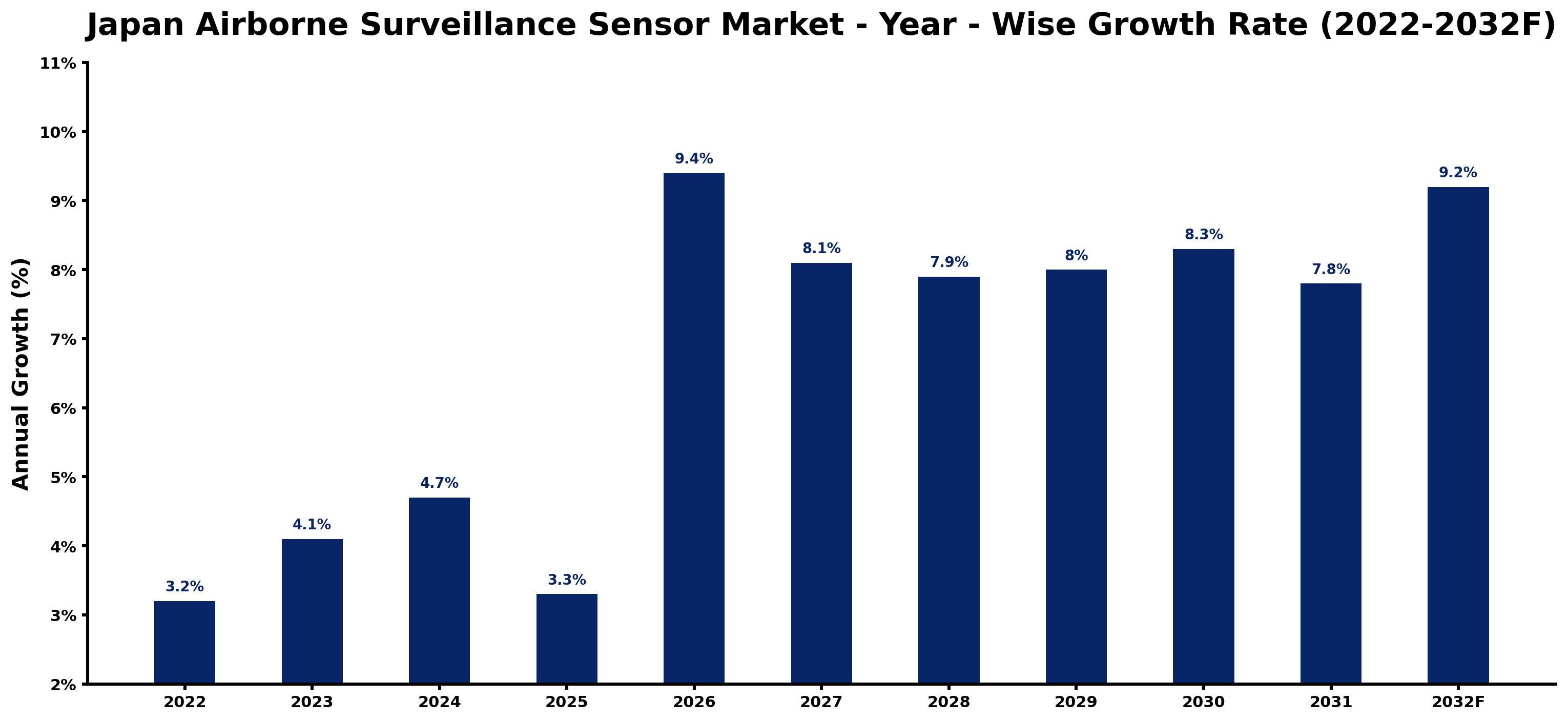
Annual growth estimates for each year appear below with the principal reason behind them, explaining the shifts that set the pace of the market.
| Year | Estimated Annual Growth (%) | Market Rationale |
| 2022 | 3.2 | The market experienced steady growth due to increased military operations. |
| 2023 | 4.1 | Demand rose as the defense budget expanded to 6.8 trillion yen. |
| 2024 | 4.7 | Technological advancements in surveillance capabilities drove further growth. |
| 2025 | 3.3 | Growth slowed as the market adjusted to previous peaks in demand. |
| 2026 | 9.4 | A surge in orders is expected to follow the new program from the Ministry of Defense. |
| 2027 | 8.1 | Growth is projected to slow as the market stabilises after the peak in 2026. |
| 2028 | 7.9 | Demand is expected to remain steady as military operations continue to evolve. |
| 2029 | 8.0 | A slight increase in growth is projected as new technologies emerge. |
| 2030 | 8.3 | Demand will continue to rise with ongoing advancements in sensor technology. |
| 2031 | 7.8 | Growth is expected to slow as the market begins to normalise after rapid expansion. |
| 2032 | 9.2 | A renewed focus on advanced surveillance capabilities will drive demand. |
Note: Market size estimations and growth projections presented in this report are based on 6Wresearch's proprietary forecasting methodology, utilizing the latest available industry data, government publications, and primary research inputs.
Japan Airborne Surveillance Sensor Market Synopsis
Airborne surveillance sensors are advanced technologies used for monitoring and reconnaissance, made from optical, infrared, and synthetic sensor technologies. The Japan Airborne Surveillance Sensor Market is growing due to increased military spending, with the defense budget reaching approximately 6.8 trillion yen in 2023. Initiatives aimed at improving reconnaissance capabilities by 2025 and ongoing collaborations with the Japan Aerospace Exploration Agency are driving demand for these systems, particularly in military applications.
Market Dynamics Impact Analysis (2026–2032)
| Factor | Type | Impact | Primary Segment Affected |
| Increased military spending | Driver | High | Optical Sensors |
| Technological advancements in sensor technologies | Driver | High | LIDAR Sensors |
| Growing demand for border security solutions | Opportunity | High | Infrared Sensors |
| Expansion of reconnaissance capabilities in military operations | Opportunity | High | Synthetic Sensors |
| High production costs for advanced sensors | Restraint | Medium | AI-Fused Sensor Arrays |
| Limited domestic manufacturing capacity for critical components | Restraint | Medium | Laser-Based Distance Sensing |
| Competition from international sensor manufacturers | Challenge | High | Military Contractors |
| Technological integration challenges in existing systems | Challenge | Medium | Technology Integrators |
Evaluation of Drivers in Japan Airborne Surveillance Sensor Market (2026–2032)
Below are the drivers that matter most for revenue growth, with supporting evidence.
| Drivers | Primary Segment Affected | Why It Matters (Evidence) |
| Increased defense budget allocations | Optical Sensors | Japan's defense budget for 2023 is approximately 6.8 trillion yen, driving demand for advanced optical surveillance capabilities. |
| Technological advancements in sensor integration | LIDAR Sensors | The program to improve reconnaissance capabilities by 2025 promotes the adoption of LIDAR technology. |
| Growing security concerns in border management | Infrared Sensors | The need for effective border security solutions is increasing, leading to higher demand for infrared sensors. |
| Expansion of military reconnaissance operations | Synthetic Sensors | The Self-Defense Forces are utilising synthetic sensors for improved situational awareness in military operations. |
| Collaboration with aerospace technology startups | AI-Fused Sensor Arrays | Aerospace tech startups are focusing on sensor innovations, increasing the availability of AI-fused sensor arrays. |
Orders keep climbing as Japan's defense budget reaches approximately 6.8 trillion yen in 2023, stimulating demand for advanced surveillance systems. The ongoing push for improved reconnaissance capabilities encourages the adoption of new technologies vital for precise distance measurement. Heightened security concerns are driving demand for infrared sensors, essential for detecting heat signatures. Military operations are increasingly utilising synthetic sensors for enhanced situational awareness, while partnerships with aerospace technology startups are increasing the availability of AI-fused sensor arrays, further boosting market growth.
Evaluation of Restraints in Japan Airborne Surveillance Sensor Market
Below are the constraints most often cited by buyers and suppliers, with the segment each affects.
| Market Restraint | Primary Segment Affected | Why It Matters (Evidence) |
| High production costs for advanced sensors | AI-Fused Sensor Arrays | Production costs for AI-fused sensor arrays are elevated, limiting affordability for military contractors. |
| Limited domestic manufacturing capacity for critical components | Laser-Based Distance Sensing | Japan's reliance on imports for critical components affects the supply chain and production timelines. |
| Regulatory hurdles in sensor certification | Infrared Sensors | Stringent certification processes delay the introduction of new infrared sensor technologies. |
| Competition from international manufacturers | Military Contractors | International manufacturers offer competitive pricing, impacting local military contractors' market share. |
| Integration challenges with existing systems | Technology Integrators | Difficulties in integrating new sensors with legacy systems slow down adoption rates. |
Japan Airborne Surveillance Sensor Market Challenges
Buyers in the defense sector face rising costs due to Japan's minimum wage increase to JPY 1,055 per hour, which raises operational expenses for military contracts. Suppliers contend with outdated sensor technologies, leading to delivery delays that can extend project timelines by up to six months for military users. The complex integration of advanced surveillance systems poses challenges for suppliers, complicating collaboration with the Self-Defense Forces and delaying critical deployments. Regulatory requirements, such as obtaining ISO 9001 certification, impose additional costs and time constraints, hindering suppliers' responsiveness to urgent military needs.
Trends in the Japan Airborne Surveillance Sensor Market
The trends below show where the Japan Airborne Surveillance Sensor Market is heading.
- Shift towards AI-Fused Sensor Technologies: Since 2021, there has been a notable shift towards AI-fused sensor technologies in Japan's defense sector. This trend is reflected in the increasing integration of AI capabilities in surveillance systems, improving data analysis and operational efficiency.
- Emergence of LIDAR Technology in Military Applications: In 2022, LIDAR technology gained traction among military contractors for its precision in distance measurement. This shift is evident in the rising adoption of LIDAR sensors for reconnaissance aircraft, improving operational capabilities.
- Growing Focus on Environmental Monitoring: The Japan Aerospace Exploration Agency has initiated programs since 2023 to incorporate airborne surveillance sensors for environmental monitoring. This initiative aims to strengthen Japan's ability to respond to natural disasters and environmental changes.
- Increased Investment in Defense Technology Startups: In 2023, funding programs from the Tokyo Metropolitan Government supported defense technology startups, leading to innovations in sensor technologies. This investment is driving advancements in airborne surveillance capabilities.
Investment Opportunities in the Japan Airborne Surveillance Sensor Market
The following areas offer the clearest openings for investors and suppliers in the Japan Airborne Surveillance Sensor Market.
- Military Contractors Seeking Advanced Sensors: Military contractors are actively looking for advanced airborne surveillance sensors, with the defense budget reaching 6.8 trillion yen in 2023. Collaborating with local manufacturers can facilitate entry into this growing market.
- Supply of LIDAR Sensors for Reconnaissance Aircraft: The rising demand for LIDAR sensors presents an opportunity for suppliers to meet the needs of reconnaissance aircraft makers. Establishing partnerships with military contractors can strengthen market presence.
- Investment in AI-Fused Sensor Technologies: With the increasing focus on AI-fused sensor arrays, there is a notable gap in supply. Collaborating with aerospace tech startups can help fill this gap and meet emerging demands.
- Expansion of Thermal Infrared Band Applications: The growing need for thermal infrared sensors in military operations highlights an investment opportunity. Engaging with anti-terror surveillance units can lead to fruitful partnerships.
Government Initiatives in the Japan Airborne Surveillance Sensor Market
The Semiconductor and Digital Industry Strategy of June 2021 sets measures to secure domestic semiconductor manufacturing, impacting buyers of airborne surveillance sensors by ensuring a stable supply of essential components. This strategy encourages local production and reduces reliance on imports, creating a more secure supply chain for military contractors.
The Japan Aerospace Exploration Agency oversees the implementation of programs to improve airborne reconnaissance capabilities, approving funding for projects that integrate advanced sensor technologies. This agency facilitates the development and deployment of new surveillance systems, ensuring that military operations are equipped with the latest advancements.
Future Insight of the Japan Airborne Surveillance Sensor Market
Military users will increasingly rely on advanced surveillance technologies by 2032, as Japan focuses on national security. The Ministry of Defense's program to improve reconnaissance capabilities will drive demand for innovative sensor solutions. Collaborations between technology startups and research agencies will accelerate advancements in sensor technologies. By 2025, Japan's defense budget is expected to allocate approximately 6.8 trillion yen to new surveillance systems, creating opportunities for suppliers to broaden their product offerings.
Market Segmentation Analysis
Japan Airborne Surveillance Sensor Market report covers a detailed analysis of the following market segments:
By Sensor Type – Optical Sensors Lead, LIDAR Sensors Expected to Grow Fastest
According to Saurav Kr Singh, Senior Research Analyst at 6Wresearch, Optical Sensors accounted for 41% of the market by sensor type in 2025. Optical sensors hold the largest market share because they are essential for visual reconnaissance, particularly in military operations. The Self-Defense Forces of Japan extensively utilise these sensors for effective national security measures. LIDAR Sensors are projected to grow fastest, at a CAGR of 12.8% during 2026–2032. LIDAR sensors are experiencing rapid growth due to their precision in distance measurement and mapping, which is increasingly vital for advanced surveillance. The Ministry of Defense's initiative to enhance airborne reconnaissance capabilities by 2025 will further support this segment's expansion. Suppliers should focus on developing LIDAR technologies to align with the growing market demand.
By Monitoring Spectrum – Day/Night Vision Leads, AI-Fused Sensor Arrays Expected to Grow Fastest
Day/Night Vision held 40% of the Japan Airborne Surveillance Sensor Market by monitoring spectrum in 2025. Day/Night vision systems dominate the market as they are crucial for operations requiring adaptability in varying lighting conditions, essential for military effectiveness. The Japan Air Self-Defense Force relies heavily on these systems for their reconnaissance missions. AI-Fused Sensor Arrays are set to record the highest CAGR in this split, 12.1% over 2026–2032. AI-fused sensor arrays are gaining traction as they significantly improve data analysis and decision-making processes, which are critical for advanced military operations. Collaborations between the Japan Aerospace Exploration Agency and sensor manufacturers are expected to further enhance this segment. Buyers should explore integrating AI-fused technologies to improve operational efficiency and decision-making.
By Distribution Channel – Military Contractors Lead, Aerospace Tech Startups Expected to Grow Fastest
Military Contractors took 48% of distribution channel revenue in 2025, more than any other category. Military contractors lead the distribution channel due to their essential role in integrating sensors into defence systems, ensuring operational readiness. Their established relationships with the Self-Defense Forces create a consistent demand for airborne surveillance sensors. The quickest growth will come from Aerospace Tech Startups, forecast to expand at a CAGR of 10.6% between 2026 and 2032. Aerospace tech startups are emerging as a rapidly growing segment, driven by their focus on sensor innovations that meet modern military needs. Their collaborations with established military contractors are likely to strengthen their market presence in the near future. Suppliers should consider partnerships with startups to maintain competitiveness in technological advancements.
By End User – Reconnaissance Aircraft Makers Lead, Topography Mapping Units Expected to Grow Fastest
With 40% of end user revenue in 2025, Reconnaissance Aircraft Makers was the largest category. Reconnaissance aircraft makers are the primary users of airborne surveillance sensors, as these technologies are essential for their operational capabilities. The Japan Air Self-Defense Force's reliance on these aircraft underscores their importance in national security. Over 2026–2032, Topography Mapping Units are expected to post the fastest growth, at a CAGR of 10.7%. Topography mapping units are rapidly adopting airborne surveillance sensors for geographical data collection, reflecting a growing interest in advanced mapping technologies. The increasing demand for accurate topographical data in various sectors is expected to drive this growth further. Suppliers should target topography mapping units to diversify their customer base and increase sales.
Key Attractiveness of the Report
- 10 Years of Market Numbers
- Historical Data Starting from 2022 to 2025
- Base Year 2025
- Forecast Data until 2032
- Key Performance Indicators Impacting the Market
- Major Upcoming Developments and Projects
Key Highlights of the Report:
- Japan Airborne Surveillance Sensor Market Outlook
- Market Size of Japan Airborne Surveillance Sensor Market, 2025
- Forecast of Japan Airborne Surveillance Sensor Market, 2032
- Historical Data and Forecast of Japan Airborne Surveillance Sensor Revenues & Volume for the Period 2022-2032F
- Japan Airborne Surveillance Sensor Market Trend Evolution
- Japan Airborne Surveillance Sensor Market Drivers and Challenges
- Japan Airborne Surveillance Sensor Price Trends
- Japan Airborne Surveillance Sensor Porter's Five Forces
- Japan Airborne Surveillance Sensor Industry Life Cycle
- Historical Data and Forecast of Japan Airborne Surveillance Sensor Market Revenues & Volume By Sensor Type for the Period 2022-2032F
- Historical Data and Forecast of Japan Airborne Surveillance Sensor Market Revenues & Volume By Optical Sensors for the Period 2022-2032F
- Historical Data and Forecast of Japan Airborne Surveillance Sensor Market Revenues & Volume By Infrared Sensors for the Period 2022-2032F
- Historical Data and Forecast of Japan Airborne Surveillance Sensor Market Revenues & Volume By LIDAR Sensors for the Period 2022-2032F
- Historical Data and Forecast of Japan Airborne Surveillance Sensor Market Revenues & Volume By Synthetic Sensors for the Period 2022-2032F
- Historical Data and Forecast of Japan Airborne Surveillance Sensor Market Revenues & Volume By Monitoring Spectrum for the Period 2022-2032F
- Historical Data and Forecast of Japan Airborne Surveillance Sensor Market Revenues & Volume By Day/Night Vision for the Period 2022-2032F
- Historical Data and Forecast of Japan Airborne Surveillance Sensor Market Revenues & Volume By Thermal Infrared Band for the Period 2022-2032F
- Historical Data and Forecast of Japan Airborne Surveillance Sensor Market Revenues & Volume By Laser-Based Distance Sensing for the Period 2022-2032F
- Historical Data and Forecast of Japan Airborne Surveillance Sensor Market Revenues & Volume By AI-Fused Sensor Arrays for the Period 2022-2032F
- Historical Data and Forecast of Japan Airborne Surveillance Sensor Market Revenues & Volume By Distribution Channel for the Period 2022-2032F
- Historical Data and Forecast of Japan Airborne Surveillance Sensor Market Revenues & Volume By Sensor OEM Suppliers for the Period 2022-2032F
- Historical Data and Forecast of Japan Airborne Surveillance Sensor Market Revenues & Volume By Military Contractors for the Period 2022-2032F
- Historical Data and Forecast of Japan Airborne Surveillance Sensor Market Revenues & Volume By Technology Integrators for the Period 2022-2032F
- Historical Data and Forecast of Japan Airborne Surveillance Sensor Market Revenues & Volume By Aerospace Tech Startups for the Period 2022-2032F
- Historical Data and Forecast of Japan Airborne Surveillance Sensor Market Revenues & Volume By End User for the Period 2022-2032F
- Historical Data and Forecast of Japan Airborne Surveillance Sensor Market Revenues & Volume By Reconnaissance Aircraft Makers for the Period 2022-2032F
- Historical Data and Forecast of Japan Airborne Surveillance Sensor Market Revenues & Volume By Anti-Terror Surveillance Units for the Period 2022-2032F
- Historical Data and Forecast of Japan Airborne Surveillance Sensor Market Revenues & Volume By Topography Mapping Units for the Period 2022-2032F
- Historical Data and Forecast of Japan Airborne Surveillance Sensor Market Revenues & Volume By Strategic Military Operations for the Period 2022-2032F
- Japan Airborne Surveillance Sensor Import Export Trade Statistics
- Market Opportunity Assessment By Sensor Type
- Market Opportunity Assessment By Monitoring Spectrum
- Market Opportunity Assessment By Distribution Channel
- Market Opportunity Assessment By End User
- Japan Airborne Surveillance Sensor Top Companies Market Share
- Japan Airborne Surveillance Sensor Competitive Benchmarking By Technical and Operational Parameters
- Japan Airborne Surveillance Sensor Company Profiles
- Japan Airborne Surveillance Sensor Key Strategic Recommendations
Market Covered
Segments analysed in this report are listed below.
By Sensor Type
- Optical Sensors
- Infrared Sensors
- LIDAR Sensors
- Synthetic Sensors
By Monitoring Spectrum
- Day/Night Vision
- Thermal Infrared Band
- Laser-Based Distance Sensing
- AI-Fused Sensor Arrays
By Distribution Channel
- Sensor OEM Suppliers
- Military Contractors
- Technology Integrators
- Aerospace Tech Startups
By End User
- Reconnaissance Aircraft Makers
- Anti-Terror Surveillance Units
- Topography Mapping Units
- Strategic Military Operations































