Japan Airborne Weather Radar Market Size & Growth Rate
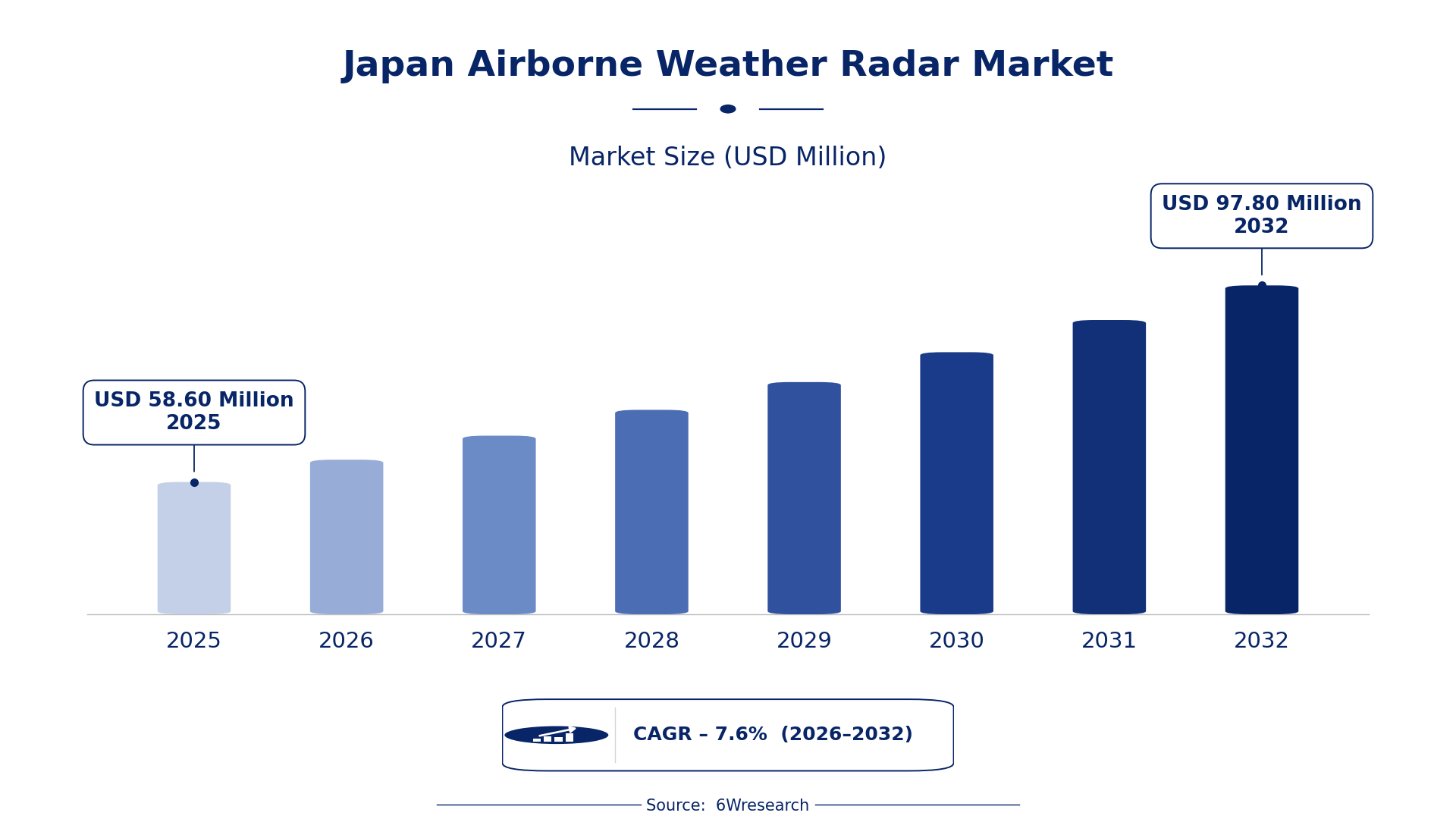
According to 6Wresearch internal database and industry insights, the Japan Airborne Weather Radar Market was valued at USD 58.60 Million in 2025 and is projected to reach USD 97.80 Million by 2032, growing at a CAGR of approximately 7.6% during 2026–2032.
Japan Airborne Weather Radar Market Highlights
| Report Metric | Details |
| Report Name | Japan Airborne Weather Radar Market (2026-2032) |
| Market Size 2025 | USD 58.60 Million |
| Market Size 2032 | USD 97.80 Million |
| Absolute Growth 2025–2032 | USD 39.20 Million |
| CAGR 2026–2032 | 7.6% |
| Peak Annual Growth | 8.5% in 2029 |
| Forecast Period | 2026–2032 |
| Historical Data | 2022–2025 |
| Base Year | 2025 |
| Leading Radar Type, 2025 | Pulse-Doppler Radar (46% share) |
| Leading Frequency Band, 2025 | C-band (41% share) |
| Leading Distribution Channel, 2025 | Radar OEMs (43% share) |
| Leading End User, 2025 | Commercial Airlines (45% share) |
| Fastest-Growing Radar Type | Dual-Polarization Radar (10.2% CAGR) |
| Fastest-Growing Distribution Channel | Aerospace Integrators (9.7% CAGR) |
| Fastest-Growing End User | Meteorological Agencies (9.4% CAGR) |
| Growing Sector | aviation |
| Key End Users | commercial airlines, meteorological agencies, defense aviation units |
Japan Airborne Weather Radar Market Year-wise Growth Rate and Key Drivers (2022–2032)
This graph illustrates the annual growth rates of the market from 2022 to 2032, highlighting a steady upward trajectory and projected market expansion over the forecast period.
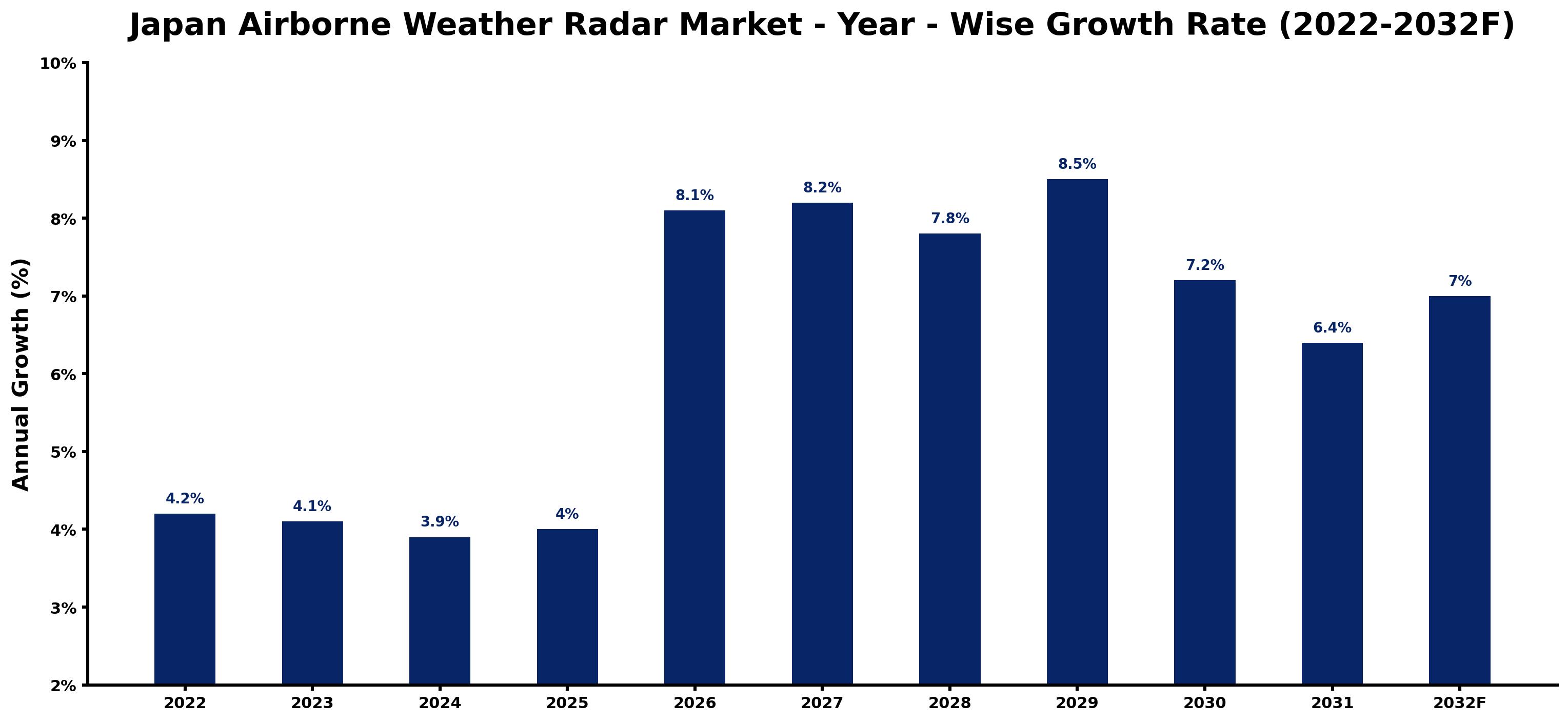
The table below sets out the estimated growth rate for each year and the main factor behind it.
| Year | Estimated Annual Growth (%) | Market Rationale |
| 2022 | 4.2 | The market exhibited steady demand supported by ongoing aviation operations. |
| 2023 | 4.1 | Demand growth slowed due to market adjustments and existing system upgrades. |
| 2024 | 3.9 | The market continued to grow as users sought to improve weather detection capabilities. |
| 2025 | 4.0 | Growth accelerated as commercial airlines increased investments in radar technology. |
| 2026 | 8.1 | Demand is expected to surge as defense units expand their radar capabilities for operational readiness. |
| 2027 | 8.2 | Growth is projected to remain strong due to heightened interest in advanced radar systems. |
| 2028 | 7.8 | The market is expected to experience a slight slowdown as growth stabilises after rapid increases. |
| 2029 | 8.5 | Demand is projected to peak as the adoption of new radar technologies reaches its height. |
| 2030 | 7.2 | Growth is expected to decelerate as the market adjusts to the peak demand levels. |
| 2031 | 6.4 | The market is projected to continue growing at a moderated pace as technology adoption matures. |
| 2032 | 7.0 | Demand is expected to rise as new applications for radar technology emerge. |
Note: Market size estimations and growth projections presented in this report are based on 6Wresearch's proprietary forecasting methodology, utilizing the latest available industry data, government publications, and primary research inputs.
Japan Airborne Weather Radar Market Synopsis
Airborne Weather Radar is a critical technology used to detect and analyse weather conditions from aircraft, ensuring flight safety and supporting meteorological research. The Japan Airborne Weather Radar Market is expanding due to over 1,000 daily commercial flights requiring advanced systems and the Japan Meteorological Agency's extensive network of over 100 weather radars.
Market Dynamics Impact Analysis (2026–2032)
| Factor | Type | Impact | Primary Segment Affected |
| Increasing number of commercial flights requiring advanced weather radar systems. | Driver | High | Pulse-Doppler Radar |
| Growing investments in defense aviation for advanced radar capabilities. | Driver | High | Phased Array Radar |
| Rising demand for accurate weather data in the aviation sector. | Opportunity | High | Dual-Polarization Radar |
| Need for reliable weather monitoring systems in meteorological agencies. | Opportunity | High | Solid-State Radar |
| High costs associated with upgrading existing radar systems. | Restraint | Medium | C-band |
| Limited availability of advanced radar technologies in the market. | Restraint | Medium | X-band |
| Challenges in integrating new radar technologies into existing systems. | Challenge | High | Aerospace Integrators |
| Regulatory compliance requirements for radar system manufacturing. | Challenge | Medium | Radar OEMs |
Evaluation of Drivers in Japan Airborne Weather Radar Market (2026–2032)
The following drivers explain most of the expected growth.
| Drivers | Primary Segment Affected | Why It Matters (Evidence) |
| Increasing air traffic leading to higher demand for weather radar. | Pulse-Doppler Radar | Japan has over 1,000 commercial flights daily, necessitating advanced radar for safety. |
| Modernization of defense systems driving radar technology adoption. | Phased Array Radar | The defense budget for radar technology in 2023 was approximately 3 billion yen. |
| Demand for precise weather forecasting in meteorological agencies. | Dual-Polarization Radar | Meteorological agencies reported a 20% increase in demand for radar upgrades in 2023. |
| Reliability and efficiency of solid-state systems increasing market appeal. | Solid-State Radar | These systems are preferred for their reliability in aviation. |
| Standardisation of radar systems under ISO 9001 improving market quality. | C-band | ISO 9001 standards are applied in the manufacturing of airborne weather radar. |
Buyers are adding capacity as Japan's aviation sector requires advanced weather radar for over 1,000 daily flights, increasing demand for Pulse-Doppler Radar systems. The defense budget allocated approximately 3 billion yen for radar technology in 2023, driving the adoption of Phased Array Radar. Solid-State Radar systems are preferred for their reliability, influencing purchasing decisions among aviation equipment vendors. The application of ISO 9001 standards in manufacturing ensures quality, further stimulating demand for C-band radar systems.
Evaluation of Restraints in Japan Airborne Weather Radar Market
The key brakes on demand, and where they bite hardest, are shown below.
| Market Restraint | Primary Segment Affected | Why It Matters (Evidence) |
| High costs associated with upgrading existing radar systems. | C-band | The financial burden of modernization can deter some buyers from investing in new technologies. |
| Limited availability of advanced radar technologies in the market. | X-band | This scarcity can restrict options for buyers seeking to improve their systems. |
| Integration challenges with existing aviation systems. | Phased Array Radar | Buyers may face difficulties in adapting new technologies to legacy systems. |
| Regulatory compliance costs for radar manufacturers. | Radar OEMs | Meeting stringent regulations can increase production costs for manufacturers. |
| Potential delays in technology adoption due to budget constraints. | Solid-State Radar | Budget limitations can slow the pace of upgrading radar systems. |
Japan Airborne Weather Radar Market Challenges
Airborne Weather Radar faces strong competition from imported systems, which pressures domestic producers to lower prices and can result in a 20% decline in market share. A shortage of skilled professionals in advanced radar technology hampers producers' innovation efforts, causing delays in product development that can extend lead times for buyers by six months. Compliance with Japan Civil Aviation Bureau regulations forces manufacturers to allocate 15% of their budgets to meet these standards, straining financial resources. Supply chain disruptions for essential components can delay production schedules, impacting buyers who rely on timely deliveries for operational safety.
Trends in the Japan Airborne Weather Radar Market
The shifts below are changing how Japan Airborne Weather Radar Market products are bought and supplied.
- Shift towards Advanced Radar Technologies in Aviation: The Tokyo region is experiencing a shift towards advanced radar technologies, with the Japan Meteorological Agency operating over 100 weather radars. This trend reflects increased demand for radar upgrades, prompting suppliers to improve their offerings.
- Transition from Traditional to Solid-State Radar Systems: The adoption of Solid-State Radar systems is increasing among defence aviation units, with reliability becoming a key factor. In 2023, these systems accounted for a notable portion of new installations, indicating a shift in preference.
- Emergence of Dual-Polarization Radar in Meteorology: Meteorological agencies are increasingly adopting Dual-Polarization Radar for detailed precipitation data. This change is evident with a notable rise in demand for radar upgrades, reflecting the need for improved forecasting capabilities.
- Commercial Airlines Prioritising Weather Safety: Commercial airlines are prioritising weather safety, leading to increased investments in advanced radar systems. With 45% of the market share in 2025, airlines are focusing on technologies that improve situational awareness during flights.
Investment Opportunities in the Japan Airborne Weather Radar Market
The following areas offer the clearest openings for investors and suppliers in the Japan Airborne Weather Radar Market.
- Investment in Advanced Weather Radar Systems: The demand for advanced weather radar systems is rising, with a 20% increase reported in 2023. Suppliers can target commercial airlines in the Tokyo region, entering through partnerships with local aviation equipment vendors.
- Supply of Dual-Polarization Radar for Meteorological Agencies: With meteorological agencies seeking detailed precipitation data, there is a strong opportunity to supply Dual-Polarization Radar systems. The current demand for upgrades presents a timely investment opportunity.
- Expansion of Solid-State Radar Offerings: The preference for Solid-State Radar systems is growing, driven by their reliability. Suppliers can capitalise on this trend by partnering with aerospace integrators to improve their product lines.
- Market for Phased Array Radar in Defense Applications: The defence sector is investing heavily in Phased Array Radar technology, with a budget of approximately 3 billion yen in 2023. Suppliers should consider joint ventures with defence contractors to meet this demand.
Government Initiatives in the Japan Airborne Weather Radar Market
The Digital Agency, established in September 2021, is leading government digital transformation and setting common system standards for radar technology. This initiative supports the development of advanced radar systems by ensuring compliance with modern technological standards, which is important for producers and buyers alike. The Ministry of Defense allocated approximately 3 billion yen for radar technology in 2023, promoting the adoption of advanced systems in defence applications.
The Japan Civil Aviation Bureau oversees regulations for airborne radar systems, ensuring that manufacturers comply with safety and performance standards. This regulatory framework benefits commercial airlines by providing assurance that the radar systems they use meet necessary operational requirements, supporting aviation safety initiatives.
Future Insight of the Japan Airborne Weather Radar Market
Solid-State Radar technology will transform demand by 2032, improving reliability and performance for aviation safety. The Ministry of Defense plans to increase funding for advanced radar systems, projected to reach 4 billion yen, which will enhance capabilities for defence applications. Collaboration between the Japan Aerospace Exploration Agency and research institutions will drive advancements in radar technology, benefiting both suppliers and buyers. The rise of online platforms for aviation supplies will improve access to advanced systems, streamlining procurement processes for all users.
Market Segmentation Analysis
Japan Airborne Weather Radar Market report covers a detailed analysis of the following market segments:
By Radar Type – Pulse-Doppler Radar Leads, Dual-Polarization Radar Expected to Grow Fastest
According to Saurav Kr Singh, Senior Research Analyst at 6Wresearch, Pulse-Doppler Radar accounted for 46% of the market by radar type in 2025. Pulse-Doppler Radar is essential for accurate weather detection and tracking, which is critical for the safety of Japan's extensive commercial flight operations. Its widespread use in both aviation and meteorology solidifies its position as the leading choice among users. Dual-Polarization Radar is projected to grow fastest, at a CAGR of 10.2% during 2026–2032. The growth of Dual-Polarization Radar is propelled by its ability to provide detailed precipitation data, which is increasingly demanded by meteorological agencies for enhanced forecasting. The reported 20% increase in demand for radar system upgrades in 2023 indicates a strong future for this technology. Suppliers should focus on enhancing Dual-Polarization capabilities to meet the growing needs of meteorological agencies.
By Frequency Band – C-band Leads and Records the Fastest Growth
C-band held 41% of the Japan Airborne Weather Radar Market by frequency band in 2025. C-band dominates the market due to its effective range capabilities, making it the preferred frequency for weather radar applications across Japan. Its reliability in various weather conditions ensures consistent performance for both commercial and meteorological users. Its lead should widen, with a projected CAGR of 9.5% during 2026–2032, the highest in this split. C-band's continued growth is attributed to its versatility and effectiveness in weather monitoring, which aligns with the increasing demand for upgraded radar systems. As the leading frequency band, its adoption will likely expand further as technology advances. Buyers should prioritise C-band systems to ensure they are equipped with the most effective radar technology available.
By Distribution Channel – Radar OEMs Lead, Aerospace Integrators Expected to Grow Fastest
In 2025, Radar OEMs led the distribution channel split with a 43% share. Radar OEMs are the primary manufacturers of radar systems tailored for aviation and meteorology, effectively addressing the needs of both sectors. Their established relationships with commercial airlines and meteorological agencies contribute to their leading market position. Aerospace Integrators are set to record the highest CAGR in this split, 9.7% over 2026–2032. Aerospace Integrators are experiencing rapid growth as they specialise in integrating radar systems into aircraft, which is vital for modern aviation operations. This trend is likely to continue as the industry increasingly relies on advanced radar technology. Suppliers need to build partnerships with Aerospace Integrators to capitalise on the expanding integration opportunities.
By End User – Commercial Airlines Lead, Meteorological Agencies Expected to Grow Fastest
With 45% of end user revenue in 2025, Commercial Airlines was the largest category. Commercial Airlines represent the largest segment as they heavily rely on radar technology for flight safety and efficient weather avoidance strategies. The high volume of daily flights in Japan necessitates dependable radar systems to ensure operational effectiveness and passenger safety. The quickest growth will come from Meteorological Agencies, forecast to expand at a CAGR of 9.4% between 2026 and 2032. Meteorological Agencies are the fastest-growing segment, driven by their crucial role in weather forecasting and research, which is becoming more vital amid changing climate conditions. Their reliance on advanced radar systems will sustain growth in this area. Suppliers should tailor their offerings to meet the specific demands of Meteorological Agencies to leverage this growth opportunity.
Key Attractiveness of the Report
- 10 Years of Market Numbers
- Historical Data Starting from 2022 to 2025
- Base Year 2025
- Forecast Data until 2032
- Key Performance Indicators Impacting the Market
- Major Upcoming Developments and Projects
Key Highlights of the Report:
- Japan Airborne Weather Radar Market Outlook
- Market Size of Japan Airborne Weather Radar Market, 2025
- Forecast of Japan Airborne Weather Radar Market, 2032
- Historical Data and Forecast of Japan Airborne Weather Radar Revenues & Volume for the Period 2022-2032F
- Japan Airborne Weather Radar Market Trend Evolution
- Japan Airborne Weather Radar Market Drivers and Challenges
- Japan Airborne Weather Radar Price Trends
- Japan Airborne Weather Radar Porter's Five Forces
- Japan Airborne Weather Radar Industry Life Cycle
- Historical Data and Forecast of Japan Airborne Weather Radar Market Revenues & Volume By Radar Type for the Period 2022-2032F
- Historical Data and Forecast of Japan Airborne Weather Radar Market Revenues & Volume By Pulse-Doppler Radar for the Period 2022-2032F
- Historical Data and Forecast of Japan Airborne Weather Radar Market Revenues & Volume By Dual-Polarization Radar for the Period 2022-2032F
- Historical Data and Forecast of Japan Airborne Weather Radar Market Revenues & Volume By Phased Array Radar for the Period 2022-2032F
- Historical Data and Forecast of Japan Airborne Weather Radar Market Revenues & Volume By Solid-State Radar for the Period 2022-2032F
- Historical Data and Forecast of Japan Airborne Weather Radar Market Revenues & Volume By Frequency Band for the Period 2022-2032F
- Historical Data and Forecast of Japan Airborne Weather Radar Market Revenues & Volume By X-band for the Period 2022-2032F
- Historical Data and Forecast of Japan Airborne Weather Radar Market Revenues & Volume By C-band for the Period 2022-2032F
- Historical Data and Forecast of Japan Airborne Weather Radar Market Revenues & Volume By S-band for the Period 2022-2032F
- Historical Data and Forecast of Japan Airborne Weather Radar Market Revenues & Volume By L-band for the Period 2022-2032F
- Historical Data and Forecast of Japan Airborne Weather Radar Market Revenues & Volume By Distribution Channel for the Period 2022-2032F
- Historical Data and Forecast of Japan Airborne Weather Radar Market Revenues & Volume By Radar OEMs for the Period 2022-2032F
- Historical Data and Forecast of Japan Airborne Weather Radar Market Revenues & Volume By Aviation Equipment Vendors for the Period 2022-2032F
- Historical Data and Forecast of Japan Airborne Weather Radar Market Revenues & Volume By Aerospace Integrators for the Period 2022-2032F
- Historical Data and Forecast of Japan Airborne Weather Radar Market Revenues & Volume By Online Aviation Suppliers for the Period 2022-2032F
- Historical Data and Forecast of Japan Airborne Weather Radar Market Revenues & Volume By End User for the Period 2022-2032F
- Historical Data and Forecast of Japan Airborne Weather Radar Market Revenues & Volume By Commercial Airlines for the Period 2022-2032F
- Historical Data and Forecast of Japan Airborne Weather Radar Market Revenues & Volume By Meteorological Agencies for the Period 2022-2032F
- Historical Data and Forecast of Japan Airborne Weather Radar Market Revenues & Volume By Defense Aviation Units for the Period 2022-2032F
- Historical Data and Forecast of Japan Airborne Weather Radar Market Revenues & Volume By Helicopter Operators for the Period 2022-2032F
- Japan Airborne Weather Radar Import Export Trade Statistics
- Market Opportunity Assessment By Radar Type
- Market Opportunity Assessment By Frequency Band
- Market Opportunity Assessment By Distribution Channel
- Market Opportunity Assessment By End User
- Japan Airborne Weather Radar Top Companies Market Share
- Japan Airborne Weather Radar Competitive Benchmarking By Technical and Operational Parameters
- Japan Airborne Weather Radar Company Profiles
- Japan Airborne Weather Radar Key Strategic Recommendations
Market Covered
The report covers the following segments.
By Radar Type
- Pulse-Doppler Radar
- Dual-Polarization Radar
- Phased Array Radar
- Solid-State Radar
By Frequency Band
- X-band
- C-band
- S-band
- L-band
By Distribution Channel
- Radar OEMs
- Aviation Equipment Vendors
- Aerospace Integrators
- Online Aviation Suppliers
By End User
- Commercial Airlines
- Meteorological Agencies
- Defense Aviation Units
- Helicopter Operators































