Japan Aircraft Assembly Automation Market Size & Growth Rate
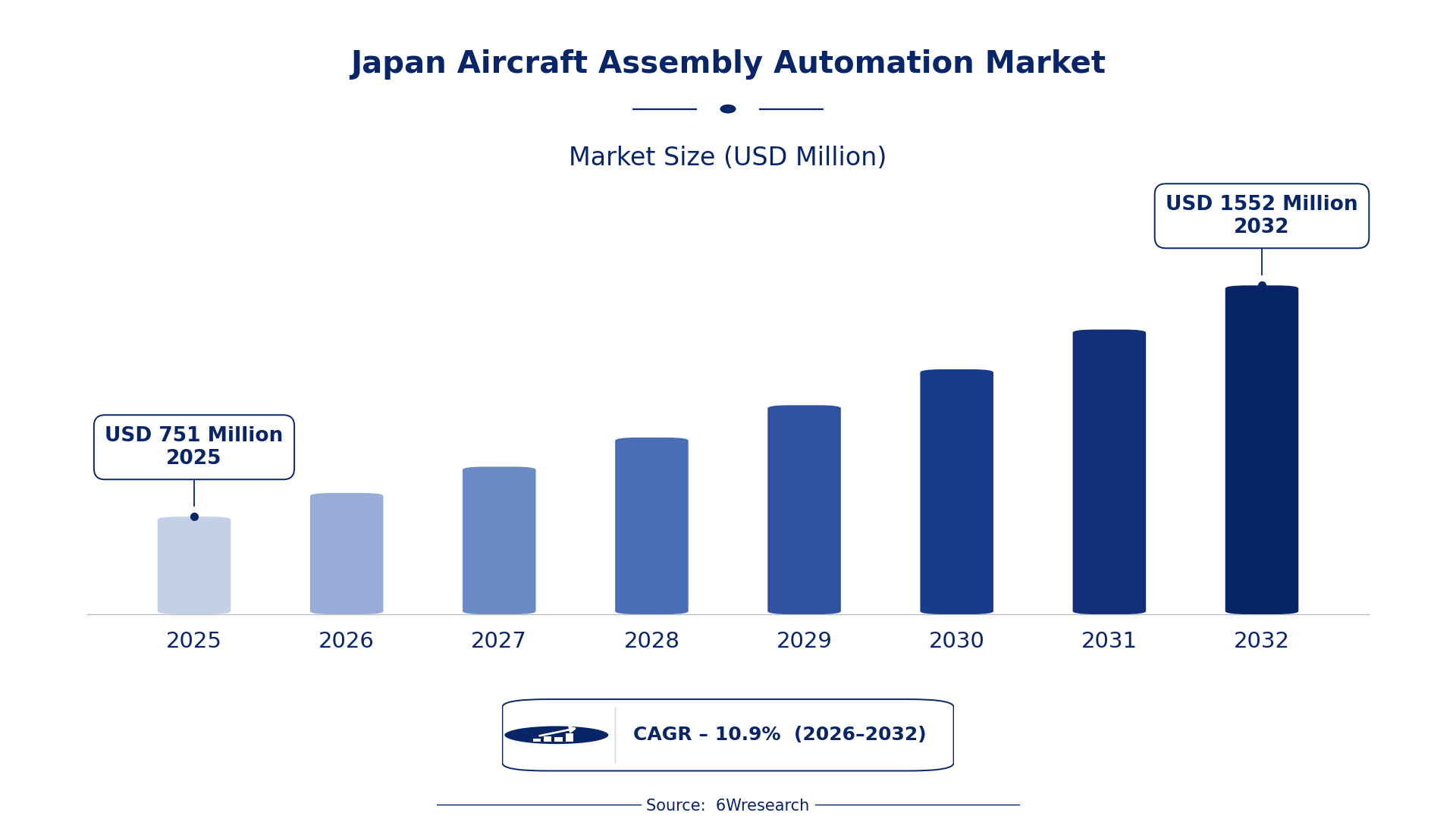
According to 6Wresearch internal database and industry insights, the Japan Aircraft Assembly Automation Market was valued at USD 751 Million in 2025 and is projected to reach USD 1,552 Million by 2032, growing at a CAGR of approximately 10.9% during 2026–2032.
Japan Aircraft Assembly Automation Market Highlights
| Report Metric | Details |
| Report Name | Japan Aircraft Assembly Automation Market (2026-2032) |
| Market Size 2025 | USD 751 Million |
| Market Size 2032 | USD 1,552 Million |
| Absolute Growth 2025–2032 | USD 801 Million |
| CAGR 2026–2032 | 10.9% |
| Peak Annual Growth | 12.6% in 2028 |
| Forecast Period | 2026–2032 |
| Historical Data | 2022–2025 |
| Base Year | 2025 |
| Leading Automation Type, 2025 | Robotic Drilling Systems (40% share) |
| Leading Technology Used, 2025 | CNC Technology (38% share) |
| Leading Distribution Channel, 2025 | Aircraft Tool Integrators (44% share) |
| Leading End User, 2025 | Commercial Aircraft OEMs (44% share) |
| Fastest-Growing Automation Type | Robotic Painting Arms (15.6% CAGR) |
| Fastest-Growing Technology Used | AI-Powered Robots (15.9% CAGR) |
| Fastest-Growing Distribution Channel | Aerospace Automation Firms (14.8% CAGR) |
| Fastest-Growing End User | Military Aircraft Manufacturers (13.6% CAGR) |
| Growing Sector | Aerospace Manufacturing |
| Key End Users | Commercial Aircraft OEMs, Military Aircraft Manufacturers, Aerospace Automation Firms |
Japan Aircraft Assembly Automation Market Year-wise Growth Rate and Key Drivers (2022–2032)
This graph illustrates the annual growth rates of the market from 2022 to 2032, highlighting a steady upward trajectory and projected market expansion over the forecast period.
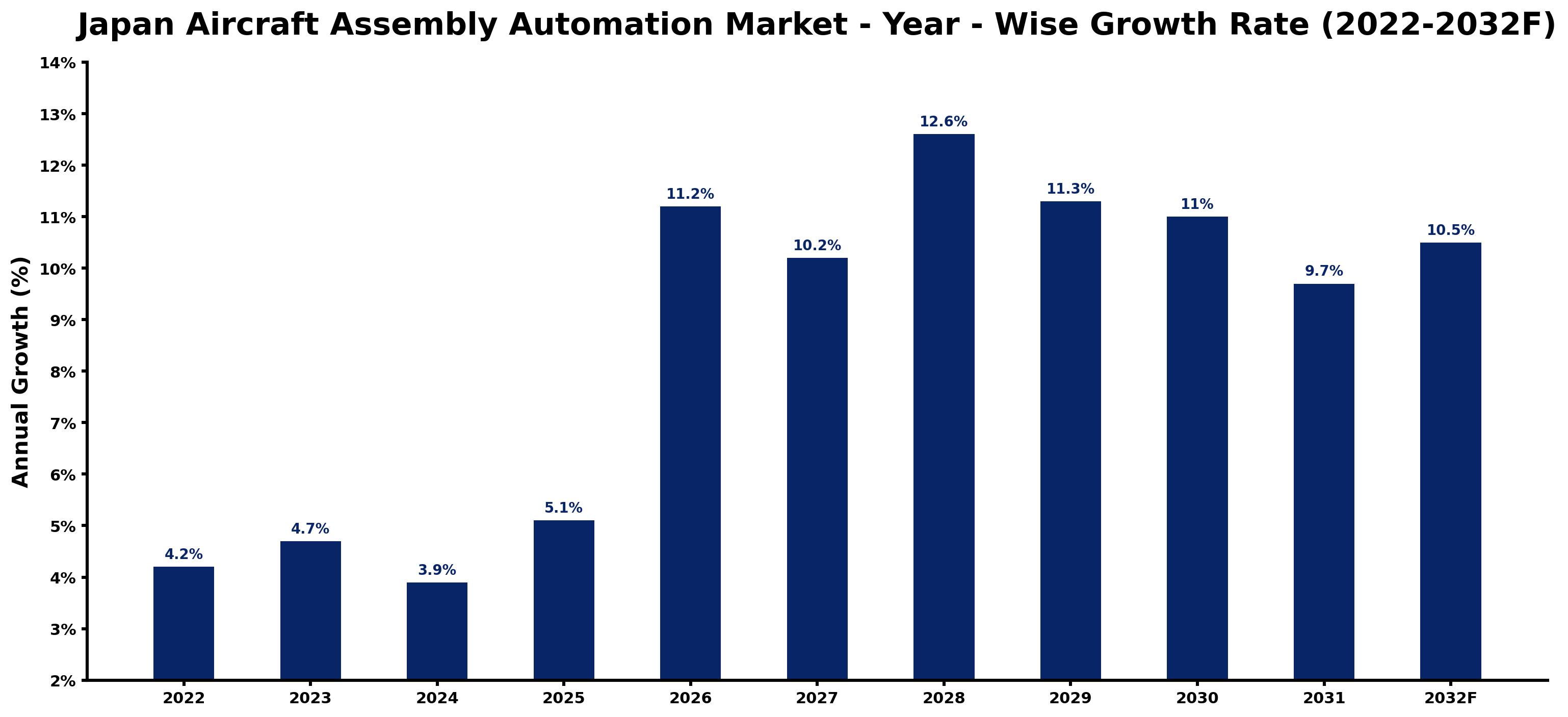
The table below sets out the estimated growth rate for each year and the main factor behind it.
| Year | Estimated Annual Growth (%) | Market Rationale |
| 2022 | 4.2 | The market experienced steady growth, supported by ongoing aerospace projects and investments. |
| 2023 | 4.7 | Demand increased as manufacturers sought to improve production efficiency through automation. |
| 2024 | 3.9 | Growth slowed due to market adjustments and a focus on refining existing technologies. |
| 2025 | 5.1 | The market saw a resurgence as new projects initiated increased automation adoption. |
| 2026 | 11.2 | Demand is expected to surge as manufacturers invest heavily in advanced automation technologies. |
| 2027 | 10.2 | Growth is projected to slow slightly as the market stabilises after rapid expansion in previous years. |
| 2028 | 12.6 | A peak in demand is anticipated due to investments in automation solutions. |
| 2029 | 11.3 | The market will continue to grow, albeit at a slower pace as saturation begins to set in. |
| 2030 | 11.0 | Growth is expected to moderate as manufacturers focus on optimising existing automation systems. |
| 2031 | 9.7 | A further slowdown is projected as the market adjusts to new operational efficiencies. |
| 2032 | 10.5 | Demand is expected to rise again as new technologies are adopted in manufacturing. |
Note: Market size estimations and growth projections presented in this report are based on 6Wresearch's proprietary forecasting methodology, utilizing the latest available industry data, government publications, and primary research inputs.
Japan Aircraft Assembly Automation Market Synopsis
Aircraft assembly automation utilises advanced technologies such as robotics, AI, and CNC systems to improve manufacturing efficiency and precision. In Japan, the aerospace industry is valued at approximately 1.5 trillion yen, with strong demand driven by both domestic manufacturers and exports. The Japan Aircraft Assembly Automation Market is expanding due to rising investments in automation technologies, supported by government initiatives and a focus on sustainability, including a target for a 46% reduction in greenhouse gas emissions by 2030. This trend reflects a broader commitment to modernising production processes and boosting competitiveness in the global aerospace sector.
Market Dynamics Impact Analysis (2026–2032)
| Factor | Type | Impact | Primary Segment Affected |
| Increasing investments in automation technologies | Driver | High | Robotic Drilling Systems |
| Demand for precision in aircraft manufacturing | Driver | High | CNC Technology |
| Growing need for efficient production processes | Opportunity | High | Aerospace Automation Firms |
| Expansion of aerospace manufacturing capabilities | Opportunity | Medium | Military Aircraft Manufacturers |
| High initial investment costs for automation systems | Restraint | High | Robotic Painting Arms |
| Limited availability of skilled workforce for advanced technologies | Restraint | Medium | Automated Inspection Tools |
| Competition from international manufacturers | Challenge | High | Commercial Aircraft OEMs |
| Rapid technological advancements requiring constant updates | Challenge | Medium | Aerospace Automation Firms |
Evaluation of Drivers in Japan Aircraft Assembly Automation Market (2026–2032)
The main growth drivers and the segments they affect most are set out below.
| Drivers | Primary Segment Affected | Why It Matters (Evidence) |
| Increased demand for precision manufacturing | CNC Technology | This technology is essential for producing high-precision aircraft parts, with a projected annual demand increase of 15% for these components. |
| Government support for aerospace technology development | Robotic Drilling Systems | Initiatives from the Ministry of Economy, Trade and Industry promote the adoption of robotic systems in manufacturing, enhancing productivity. |
| Rising focus on sustainability in manufacturing processes | Robotic Painting Arms | Japan's goal for a 46% cut in greenhouse gas emissions by 2030 drives demand for efficient painting solutions, leading to more purchases. |
| Expansion of military aircraft production | Military Aircraft Manufacturers | Increased automation adoption in military production improves operational efficiency and reduces costs, encouraging more investments in technology. |
| Growing aerospace industry investments | Aerospace Automation Firms | The industry is valued at approximately 1.5 trillion yen, prompting investments in automation technologies to meet increasing production demands. |
Much of the new demand traces back to the aerospace industry's focus on precision manufacturing and efficiency. The annual demand for automated inspection tools is projected to increase by 15%, reflecting the need for quality assurance in production. Support for aerospace technology development has led to increased investments in robotic drilling systems, essential for high-precision aircraft parts. Japan's commitment to reducing greenhouse gas emissions by 46% by 2030 is pushing manufacturers to adopt more efficient painting solutions. The military aircraft sector is also expanding, with automation improving production capabilities and reducing operational costs.
Evaluation of Restraints in Japan Aircraft Assembly Automation Market
The main factors holding the market back are set out below.
| Market Restraint | Primary Segment Affected | Why It Matters (Evidence) |
| High initial costs for automation systems | Robotic Painting Arms | The investment required for advanced painting technologies can deter smaller manufacturers from upgrading, impacting their competitiveness. |
| Shortage of skilled workforce | Automated Inspection Tools | The limited availability of trained personnel for operating advanced inspection systems hampers adoption, leading to inefficiencies. |
| Competition from international manufacturers | Commercial Aircraft OEMs | Local manufacturers face pressure from global competitors offering lower-cost solutions, affecting their market share. |
| Rapid technological changes | CNC Technology | Frequent updates to technology necessitate ongoing investment, which can strain budgets and delay projects. |
| Regulatory compliance costs | Robotic Drilling Systems | Meeting stringent quality standards increases operational costs for manufacturers, limiting their ability to invest in new technologies. |
Japan Aircraft Assembly Automation Market Challenges
High labour costs in Japan create financial strain for buyers in the aerospace sector, with the national minimum wage set to reach JPY 1,055 per hour in October 2024. Limited adoption of automation technologies arises from the slow integration of advanced robotics, causing production delays for manufacturers. Stringent regulatory standards like JIS Q 9100 require extensive compliance efforts, extending project timelines and inflating costs for suppliers. Supply chain complexities in the Nagoya region lead to inconsistent component availability, delaying assembly processes and raising operational costs for producers.
Trends in the Japan Aircraft Assembly Automation Market
The following changes are redrawing the Japan Aircraft Assembly Automation Market.
- Launch of Automation Initiatives in 2023: In 2023, Japan initiated a program to boost automation in manufacturing, targeting a 20% increase in domestic aerospace production by 2025. This initiative encourages investment in advanced technologies, benefiting suppliers and manufacturers alike.
- Shift Towards AI-Powered Robotics: The adoption of AI-powered robots is gaining traction in Japan's aerospace sector, with a projected CAGR of 15.9%. This trend is seen in military aircraft production, where automation improves efficiency and precision.
- Growing Demand for Automated Inspection Tools: The demand for automated inspection tools is rising, driven by the need for quality assurance in manufacturing. The annual demand is projected to increase by 15%, highlighting the importance of these technologies.
- Expansion of Military Aircraft Production: Military aircraft manufacturers are increasingly adopting automation, with a CAGR of 13.6% expected. This shift reflects the need for improved production capabilities and operational efficiency.
Investment Opportunities in the Japan Aircraft Assembly Automation Market
The following opportunities in the Japan Aircraft Assembly Automation Market pair current demand with a clear way in.
- Nagoya Region's Aerospace Manufacturing Hub: The Nagoya region is known for its concentration of aircraft component suppliers, creating a notable opportunity for investment in automation technologies. With over 100 certified aerospace manufacturers, this area is ripe for partnerships.
- Market Potential for Robotic Painting Arms: The market for robotic painting arms is expanding as manufacturers in the commercial aircraft sector seek efficient solutions to meet production demands. This segment is expected to grow rapidly, driven by sustainability goals.
- Timing for Investment in CNC Technology: Now is an opportune time to invest in CNC technology, as the aerospace industry values precision. The government's support for technology development further enhances this opportunity.
- Entry into Aerospace Automation Firms: Aerospace automation firms are experiencing growth, presenting a chance for new entrants. Collaborating with local partners can facilitate market entry and growth.
Government Initiatives in the Japan Aircraft Assembly Automation Market
The New Robot Strategy launched in 2015 promotes the use of robots in manufacturing and services, aiming to enhance productivity across various sectors. This strategy complements existing laws by encouraging automation, which is vital for meeting Japan's ambitious decarbonisation targets and improving manufacturing efficiency.
The AI Promotion Act established in 2025 provides a framework for AI research and development, benefiting buyers in the aerospace sector. This act supports manufacturers in adopting AI technologies, ensuring compliance with quality standards and improving operational efficiency.
Future Insight of the Japan Aircraft Assembly Automation Market
A significant shift towards sustainable technologies will transform the aerospace sector by 2032, driving suppliers to invest in advanced automation systems. The government's JPY 150 trillion decarbonisation investment will stimulate innovation in aircraft assembly processes. Domestic aerospace production is expected to increase by 20% by 2025, which will create heightened demand for automation solutions. The annual demand for automated inspection tools will rise by 15%, encouraging buyers to adopt advanced technologies in their manufacturing operations.
Market Segmentation Analysis
Japan Aircraft Assembly Automation Market report covers a detailed analysis of the following market segments:
By Automation Type – Robotic Drilling Systems Lead, Robotic Painting Arms Expected to Grow Fastest
According to Saurav Kr Singh, Senior Research Analyst at 6Wresearch, the largest automation type category in 2025 was Robotic Drilling Systems, at 40% of revenue. Robotic drilling systems hold the largest share due to their critical role in ensuring precision during aircraft assembly processes. Their prevalent use in the Tokyo metropolitan area, a major aircraft manufacturing hub, underscores their dominance in the market. Robotic Painting Arms are set to record the highest CAGR in this split, 15.6% over 2026–2032. Robotic painting arms are experiencing rapid growth driven by the increasing demand for uniform coating applications on aircraft surfaces. The adoption of these systems in various manufacturing facilities is expected to propel their market expansion significantly. Suppliers should focus on advancing robotic painting technologies to capitalise on the growing market demand.
By Technology Used – CNC Technology Leads, AI-Powered Robots Expected to Grow Fastest
CNC Technology took 38% of technology used revenue in 2025, more than any other category. CNC technology is the leading segment as it is essential for high-precision machining in the production of aircraft parts. Its widespread utilisation among Japan's certified aerospace manufacturers reinforces its dominant position in the market. The quickest growth will come from AI-Powered Robots, forecast to expand at a CAGR of 15.9% between 2026 and 2032. AI-powered robots are witnessing significant growth due to their ability to enhance automation processes in complex assembly tasks. The ongoing trend of integrating advanced technologies into manufacturing is likely to accelerate their adoption. Buyers should consider integrating advanced technologies to improve operational efficiency and maintain competitiveness.
By Distribution Channel – Aircraft Tool Integrators Lead, Aerospace Automation Firms Expected to Grow Fastest
Aircraft Tool Integrators held 44% of the Japan Aircraft Assembly Automation Market by distribution channel in 2025. Aircraft tool integrators are the primary distribution channel, providing essential tools necessary for efficient assembly operations. Their established relationships with aerospace manufacturers strengthen their leading position in the market. Over 2026–2032, Aerospace Automation Firms are expected to post the fastest growth, at a CAGR of 14.8%. Aerospace automation firms are poised for rapid growth as they specialise in delivering tailored automation solutions for the aerospace sector. The rising demand for sophisticated automation technologies is likely to boost their market share significantly. Suppliers should enhance collaborations with aerospace automation firms to expand their market reach.
By End User – Commercial Aircraft OEMs Lead, Military Aircraft Manufacturers Expected to Grow Fastest
With 44% of end user revenue in 2025, Commercial Aircraft OEMs was the largest category. Commercial aircraft OEMs represent the largest end user group, as they are the primary consumers of assembly automation technologies. Their significant investments in improving production capabilities drive the demand for advanced automation solutions. Military Aircraft Manufacturers are projected to grow fastest, at a CAGR of 13.6% during 2026–2032. Military aircraft manufacturers are increasingly adopting automation technologies, particularly for the production of defence aircraft. With rising defence budgets, this segment is projected to experience substantial growth in the near future. Suppliers must tailor their offerings to meet the specific needs of military aircraft manufacturers to seize this growth opportunity.
Key Attractiveness of the Report
- 10 Years of Market Numbers
- Historical Data Starting from 2022 to 2025
- Base Year 2025
- Forecast Data until 2032
- Key Performance Indicators Impacting the Market
- Major Upcoming Developments and Projects
Key Highlights of the Report:
- Japan Aircraft Assembly Automation Market Outlook
- Market Size of Japan Aircraft Assembly Automation Market, 2025
- Forecast of Japan Aircraft Assembly Automation Market, 2032
- Historical Data and Forecast of Japan Aircraft Assembly Automation Revenues & Volume for the Period 2022-2032F
- Japan Aircraft Assembly Automation Market Trend Evolution
- Japan Aircraft Assembly Automation Market Drivers and Challenges
- Japan Aircraft Assembly Automation Price Trends
- Japan Aircraft Assembly Automation Porter's Five Forces
- Japan Aircraft Assembly Automation Industry Life Cycle
- Historical Data and Forecast of Japan Aircraft Assembly Automation Market Revenues & Volume By Automation Type for the Period 2022-2032F
- Historical Data and Forecast of Japan Aircraft Assembly Automation Market Revenues & Volume By Robotic Drilling Systems for the Period 2022-2032F
- Historical Data and Forecast of Japan Aircraft Assembly Automation Market Revenues & Volume By Riveting Machines for the Period 2022-2032F
- Historical Data and Forecast of Japan Aircraft Assembly Automation Market Revenues & Volume By Robotic Painting Arms for the Period 2022-2032F
- Historical Data and Forecast of Japan Aircraft Assembly Automation Market Revenues & Volume By Automated Inspection Tools for the Period 2022-2032F
- Historical Data and Forecast of Japan Aircraft Assembly Automation Market Revenues & Volume By Technology Used for the Period 2022-2032F
- Historical Data and Forecast of Japan Aircraft Assembly Automation Market Revenues & Volume By AI-Powered Robots for the Period 2022-2032F
- Historical Data and Forecast of Japan Aircraft Assembly Automation Market Revenues & Volume By CNC Technology for the Period 2022-2032F
- Historical Data and Forecast of Japan Aircraft Assembly Automation Market Revenues & Volume By Vision Systems for the Period 2022-2032F
- Historical Data and Forecast of Japan Aircraft Assembly Automation Market Revenues & Volume By ML/AI Based for the Period 2022-2032F
- Historical Data and Forecast of Japan Aircraft Assembly Automation Market Revenues & Volume By Distribution Channel for the Period 2022-2032F
- Historical Data and Forecast of Japan Aircraft Assembly Automation Market Revenues & Volume By Aircraft Tool Integrators for the Period 2022-2032F
- Historical Data and Forecast of Japan Aircraft Assembly Automation Market Revenues & Volume By Industrial Equipment Dealers for the Period 2022-2032F
- Historical Data and Forecast of Japan Aircraft Assembly Automation Market Revenues & Volume By Aerospace Automation Firms for the Period 2022-2032F
- Historical Data and Forecast of Japan Aircraft Assembly Automation Market Revenues & Volume By Online Automation Vendors for the Period 2022-2032F
- Historical Data and Forecast of Japan Aircraft Assembly Automation Market Revenues & Volume By End User for the Period 2022-2032F
- Historical Data and Forecast of Japan Aircraft Assembly Automation Market Revenues & Volume By Commercial Aircraft OEMs for the Period 2022-2032F
- Historical Data and Forecast of Japan Aircraft Assembly Automation Market Revenues & Volume By Military Aircraft Manufacturers for the Period 2022-2032F
- Historical Data and Forecast of Japan Aircraft Assembly Automation Market Revenues & Volume By Helicopter Manufacturing Plants for the Period 2022-2032F
- Historical Data and Forecast of Japan Aircraft Assembly Automation Market Revenues & Volume By Quality Assurance Units for the Period 2022-2032F
- Japan Aircraft Assembly Automation Import Export Trade Statistics
- Market Opportunity Assessment By Automation Type
- Market Opportunity Assessment By Technology Used
- Market Opportunity Assessment By Distribution Channel
- Market Opportunity Assessment By End User
- Japan Aircraft Assembly Automation Top Companies Market Share
- Japan Aircraft Assembly Automation Competitive Benchmarking By Technical and Operational Parameters
- Japan Aircraft Assembly Automation Company Profiles
- Japan Aircraft Assembly Automation Key Strategic Recommendations
Market Covered
The following segment groups are covered in the report.
By Automation Type
- Robotic Drilling Systems
- Riveting Machines
- Robotic Painting Arms
- Automated Inspection Tools
By Technology Used
- AI-Powered Robots
- CNC Technology
- Vision Systems
- ML/AI Based
By Distribution Channel
- Aircraft Tool Integrators
- Industrial Equipment Dealers
- Aerospace Automation Firms
- Online Automation Vendors
By End User
- Commercial Aircraft OEMs
- Military Aircraft Manufacturers
- Helicopter Manufacturing Plants
- Quality Assurance Units































