Japan Aircraft Automation Systems Market Size & Growth Rate
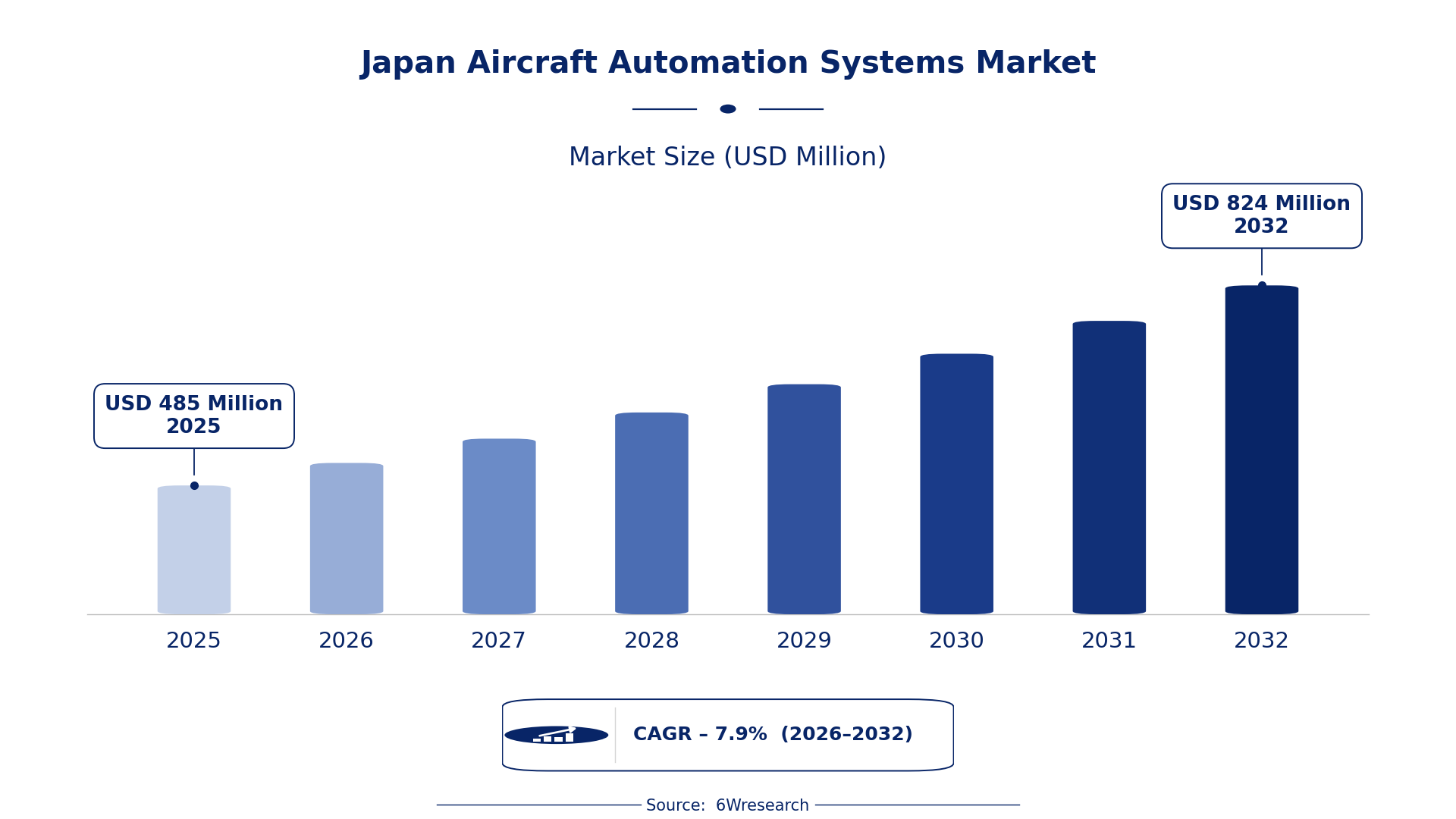
According to 6Wresearch internal database and industry insights, the Japan Aircraft Automation Systems Market was valued at USD 485 Million in 2025 and is projected to reach USD 824 Million by 2032, growing at a CAGR of approximately 7.9% during 2026–2032.
Japan Aircraft Automation Systems Market Highlights
| Report Metric | Details |
| Report Name | Japan Aircraft Automation Systems Market (2026-2032) |
| Market Size 2025 | USD 485 Million |
| Market Size 2032 | USD 824 Million |
| Absolute Growth 2025–2032 | USD 339 Million |
| CAGR 2026–2032 | 7.9% |
| Peak Annual Growth | 8.6% in 2026 |
| Forecast Period | 2026–2032 |
| Historical Data | 2022–2025 |
| Base Year | 2025 |
| Leading System Type, 2025 | Autopilot Systems (54% share) |
| Leading Technology Used, 2025 | AI/ML (40% share) |
| Leading Distribution Channel, 2025 | Aircraft System Suppliers (38% share) |
| Leading End User, 2025 | Commercial Jet Manufacturers (45% share) |
| Fastest-Growing System Type | Flight Management Systems (11.1% CAGR) |
| Fastest-Growing Technology Used | Real-Time Data (11.4% CAGR) |
| Fastest-Growing Distribution Channel | OEM Distributors (9.8% CAGR) |
| Fastest-Growing End User | Long-Haul Flight Operators (10.0% CAGR) |
| Growing Sector | aviation |
| Key End Users | military units, commercial jet manufacturers, long-haul flight operators |
Japan Aircraft Automation Systems Market Year-wise Growth Rate and Key Drivers (2022–2032)
This graph illustrates the annual growth rates of the market from 2022 to 2032, highlighting a steady upward trajectory and projected market expansion over the forecast period.
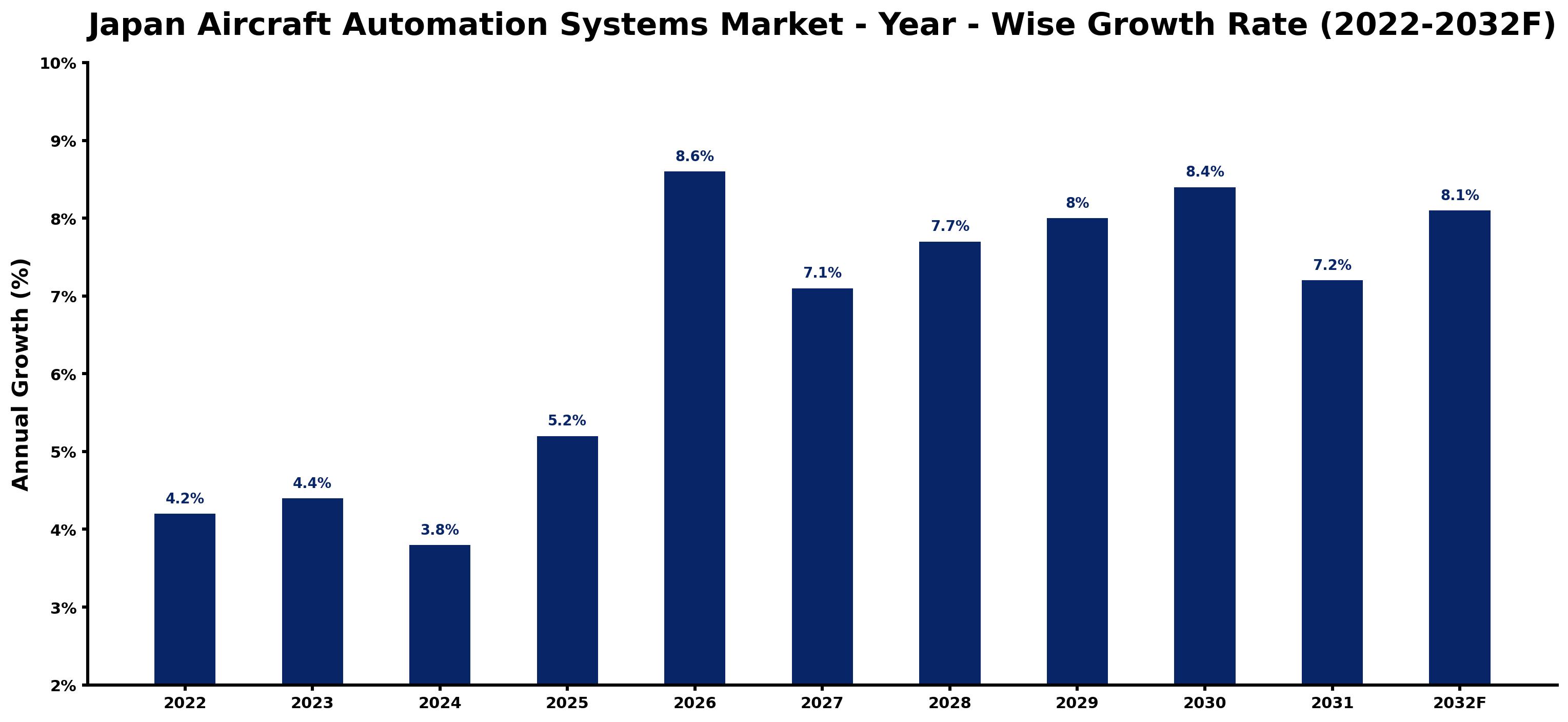
The yearly estimates that follow link every growth rate to its principal driver, so readers can see why the pace changed in each period.
| Year | Estimated Annual Growth (%) | Market Rationale |
| 2022 | 4.2 | The market showed steady growth due to ongoing demand from domestic manufacturers. |
| 2023 | 4.4 | Demand increased as military aircraft automation upgrades were funded. |
| 2024 | 3.8 | Growth slowed slightly as the market adjusted to previous years' expansions. |
| 2025 | 5.2 | The market experienced a resurgence as Flight Management Systems gained traction. |
| 2026 | 8.6 | Demand surged sharply as the industry adopted advanced automation technologies. |
| 2027 | 7.1 | Growth moderated as the market stabilised after the peak in 2026. |
| 2028 | 7.7 | A renewed interest in automation spurred growth as new technologies emerged. |
| 2029 | 8.0 | Demand continued to rise as long-haul operators sought efficiency improvements. |
| 2030 | 8.4 | The market expanded further with increased investments in AI integration. |
| 2031 | 7.2 | Growth slowed as the market began to mature and competition intensified. |
| 2032 | 8.1 | Demand picked up again as new regulations encouraged automation adoption. |
Note: Market size estimations and growth projections presented in this report are based on 6Wresearch's proprietary forecasting methodology, utilizing the latest available industry data, government publications, and primary research inputs.
Japan Aircraft Automation Systems Market Synopsis
Aircraft Automation Systems improve safety and efficiency in aviation through applications like autopilot and flight management systems. Demand arises from domestic manufacturers and military units, with a strong focus on AI integration and fault detection technologies.
Market Dynamics Impact Analysis (2026–2032)
| Factor | Type | Impact | Primary Segment Affected |
| Increased investment in military aircraft upgrades | Driver | High | Autopilot Systems |
| Growing demand for navigation accuracy in commercial aviation | Driver | High | Flight Management Systems |
| Rising need for advanced fault detection systems in aviation | Opportunity | High | Fault Detection Systems |
| The shift towards AI-enhanced aviation systems presents new avenues | Opportunity | Medium | AI/ML |
| High costs associated with R&D for advanced automation technologies | Restraint | High | Navigation & Guidance |
| Strict regulatory compliance requirements can delay product launches | Restraint | Medium | Fault Detection Systems |
| Talent shortages in AI and automation sectors hinder growth | Challenge | High | AI/ML |
| Competition from international suppliers can limit market share | Challenge | Medium | Commercial Jet Manufacturers |
Evaluation of Drivers in Japan Aircraft Automation Systems Market (2026–2032)
Demand rests on the following drivers, each shown with the segment it touches most.
| Drivers | Primary Segment Affected | Why It Matters (Evidence) |
| Increased military spending on aircraft automation upgrades | Autopilot Systems | The Ministry of Defense allocated ¥30 billion for military aircraft automation upgrades in 2023, leading to higher demand. |
| Growing reliance on Flight Management Systems for commercial flights | Flight Management Systems | Over 80% of commercial flights in Japan depend on these systems, driving purchases. |
| Need for advanced safety through Fault Detection Systems | Fault Detection Systems | The installed base of military aircraft requires advanced safety monitoring for operational effectiveness. |
| Demand for AI integration in aviation technologies | AI/ML | The government initiated a program in 2023 to boost AI integration, increasing demand for related systems. |
| Rising operational efficiency needs among long-haul flight operators | Navigation & Guidance | Long-haul operators increasingly rely on accurate navigation systems to optimise flight paths. |
Purchasing is picking up as military aircraft automation upgrades receive significant funding, driving demand for advanced automation technologies. The installed base of military aircraft necessitates advanced safety monitoring, prompting manufacturers to invest in Fault Detection Systems. Long-haul flight operators are prioritising Navigation & Guidance systems to improve efficiency and reduce costs, with a focus on optimising flight paths.
Evaluation of Restraints in Japan Aircraft Automation Systems Market
Several factors work against faster growth; the main ones are summarised below.
| Market Restraint | Primary Segment Affected | Why It Matters (Evidence) |
| High R&D costs for developing advanced automation technologies | Navigation & Guidance | Developing advanced technologies requires substantial investment, which can deter smaller firms from entering the market. |
| Regulatory compliance requirements can slow product development | Fault Detection Systems | Aviation regulations necessitate extensive testing and certification, delaying time-to-market for new products. |
| Limited skilled workforce in AI and automation sectors | AI/ML | A shortage of qualified professionals in Japan hampers the development and implementation of AI technologies. |
| Intense competition from international suppliers | Commercial Jet Manufacturers | Local manufacturers face pressure from global players, which can affect pricing and market share. |
| Market maturity may limit growth opportunities | Flight Management Systems | As the market matures, finding new growth areas becomes increasingly challenging for existing players. |
Japan Aircraft Automation Systems Market Challenges
Domestic manufacturers encounter supply chain disruptions, as dependence on specific regional suppliers can delay production schedules by up to three months, affecting timely deliveries to military units. Producers face challenges with technology integration, complicating the development of advanced systems and potentially extending project timelines by 20%. Compliance with ISO 9001 standards incurs costs of JPY 10 million annually, squeezing profit margins for manufacturers. Competition from international firms offering advanced automation solutions pressures local suppliers, possibly resulting in a market share loss of 15% for domestic producers.
Trends in the Japan Aircraft Automation Systems Market
Buyers and suppliers in the Japan Aircraft Automation Systems Market are adjusting to the following trends.
- Shift towards AI Integration in Automation Systems: The aviation sector is increasingly adopting AI technologies to improve automation. The 2023 government initiative to boost AI integration in aircraft systems involves an investment of ¥5 billion.
- Transition from Traditional Navigation to Real-Time Data Systems: The aviation industry is moving towards Real-Time Data systems for improved operational decision-making. The Tokyo region is seeing advancements in this area, with a projected growth rate of 11.4%.
- Emergence of Predictive Analytics in Aviation Maintenance: Predictive Analytics is becoming crucial for maintenance forecasting in aviation. The Japanese government supports R&D in this field, funding projects with a ¥5 billion budget.
- Commercial Jet Manufacturers Focusing on Automation: Commercial Jet Manufacturers are increasingly prioritising automation technologies to improve efficiency. Flight Management Systems are critical for over 80% of commercial flights in Japan.
Investment Opportunities in the Japan Aircraft Automation Systems Market
The following areas offer the clearest openings for investors and suppliers in the Japan Aircraft Automation Systems Market.
- Gap in Advanced Fault Detection Systems: With a projected growth of 8.1% in 2032, there is an opportunity for suppliers of advanced Fault Detection Systems. Collaborating with avionics integrators can facilitate market entry.
- Demand for AI Integration in Automation: Japan's target of net zero emissions by 2050 creates a need for AI technologies in aircraft systems. Partnering with local manufacturers can help meet this demand.
- Growth in Long-Haul Flight Operations: The long-haul flight sector is expanding, with a projected growth of 10.0%. Suppliers can enter this market by providing tailored automation solutions for efficiency.
- Investment in Navigation & Guidance Technologies: The increasing focus on accurate positioning creates a demand for Navigation & Guidance systems. Engaging with government vendors can open avenues for supply.
Government Initiatives in the Japan Aircraft Automation Systems Market
The New Robot Strategy (2015) aims to expand robot use across various sectors, including aviation. This policy encourages manufacturers to invest in automation technologies, leading to improved production efficiencies and safety standards. The Green Growth Strategy Through Achieving Carbon Neutrality in 2050, updated in 2021, identifies aviation as a key sector for decarbonisation, promoting investments in advanced automation systems.
The Japan Aerospace Exploration Agency oversees regulations and advancements in aerospace technologies. The agency supports projects that improve AI integration in aircraft systems, with a focus on enhancing operational efficiency and safety. In 2023, the government allocated funding to promote R&D in predictive analytics, further driving innovation in the sector.
Future Insight of the Japan Aircraft Automation Systems Market
By 2032, advancements in aircraft automation systems will significantly improve operational efficiency for buyers and suppliers. The government's JPY 150 trillion investment in decarbonisation will drive innovation in sustainable aviation technologies. New AI integration programmes will streamline operations and improve system reliability. Updated standards from the Japan Aircraft Industry Association will simplify compliance processes, benefiting local manufacturers and ensuring higher quality outputs.
Market Segmentation Analysis
Japan Aircraft Automation Systems Market report covers a detailed analysis of the following market segments:
By System Type – Autopilot Systems Lead, Flight Management Systems Expected to Grow Fastest
According to Saurav Kr Singh, Senior Research Analyst at 6Wresearch, the largest system type category in 2025 was Autopilot Systems, at 54% of revenue. Autopilot Systems are essential for automated flight control, making them a fundamental component of commercial aviation. Their critical role in ensuring safety and efficiency in over 80% of commercial flights in Japan underscores their leading position in the market. The quickest growth will come from Flight Management Systems, forecast to expand at a CAGR of 11.1% between 2026 and 2032. Flight Management Systems are witnessing rapid growth due to the increasing necessity for efficient flight planning and navigation. The government's initiative to enhance integration in aircraft systems is expected to further accelerate the adoption of these systems. Suppliers should focus on advancing Flight Management Systems to capitalise on the expanding market opportunities.
By Technology Used – AI/ML Leads, Real-Time Data Expected to Grow Fastest
In 2025, AI/ML led the technology used split with a 40% share. AI technologies are pivotal for enhancing the functionality of automation systems, which is crucial for improving operational performance. Their widespread application across various aircraft systems has established them as the leading technology in this market. Real-Time Data is projected to grow fastest, at a CAGR of 11.4% during 2026–2032. Real-Time Data is becoming increasingly important as it is essential for making informed operational decisions in complex flight scenarios. The emphasis on improving data analytics within aviation is driving its rapid adoption in the industry. Buyers should prioritise investments in Real-Time Data solutions to enhance their operational efficiency and decision-making capabilities.
By Distribution Channel – Aircraft System Suppliers Lead, OEM Distributors Expected to Grow Fastest
Aircraft System Suppliers took 38% of distribution channel revenue in 2025, more than any other category. Aircraft System Suppliers are vital in providing the necessary components for automation systems, ensuring that manufacturers have access to the latest technologies. Their established supply chains and expertise in the sector reinforce their dominant market position. Over 2026–2032, OEM Distributors are expected to post the fastest growth, at a CAGR of 9.8%. OEM Distributors are experiencing swift growth as they facilitate direct distribution of systems to manufacturers, enabling faster access to advanced technologies. This trend is propelled by the rising demand for efficient supply chains in aircraft production. Suppliers must enhance collaborations with OEM Distributors to improve market penetration and distribution efficiency.
By End User – Commercial Jet Manufacturers Lead, Long-Haul Flight Operators Expected to Grow Fastest
Commercial Jet Manufacturers accounted for 45% of the market by end user in 2025. Commercial Jet Manufacturers are the primary consumers of automation systems, as they require advanced technologies to comply with safety and efficiency regulations in aviation. Their substantial investments in automation technologies solidify their leading role in the market. Long-Haul Flight Operators are set to record the highest CAGR in this split, 10.0% over 2026–2032. Long-Haul Flight Operators are increasingly adopting automation to improve operational efficiency, especially as fuel costs rise and competition becomes more intense. This trend is anticipated to drive their rapid growth in the market. Manufacturers should customise their solutions to address the specific requirements of Long-Haul Flight Operators to seize this expanding segment.
Key Attractiveness of the Report
- 10 Years of Market Numbers
- Historical Data Starting from 2022 to 2025
- Base Year 2025
- Forecast Data until 2032
- Key Performance Indicators Impacting the Market
- Major Upcoming Developments and Projects
Key Highlights of the Report:
- Japan Aircraft Automation Systems Market Outlook
- Market Size of Japan Aircraft Automation Systems Market, 2025
- Forecast of Japan Aircraft Automation Systems Market, 2032
- Historical Data and Forecast of Japan Aircraft Automation Systems Revenues & Volume for the Period 2022-2032F
- Japan Aircraft Automation Systems Market Trend Evolution
- Japan Aircraft Automation Systems Market Drivers and Challenges
- Japan Aircraft Automation Systems Price Trends
- Japan Aircraft Automation Systems Porter's Five Forces
- Japan Aircraft Automation Systems Industry Life Cycle
- Historical Data and Forecast of Japan Aircraft Automation Systems Market Revenues & Volume By System Type for the Period 2022-2032F
- Historical Data and Forecast of Japan Aircraft Automation Systems Market Revenues & Volume By Autopilot Systems for the Period 2022-2032F
- Historical Data and Forecast of Japan Aircraft Automation Systems Market Revenues & Volume By Flight Management Systems for the Period 2022-2032F
- Historical Data and Forecast of Japan Aircraft Automation Systems Market Revenues & Volume By Navigation & Guidance for the Period 2022-2032F
- Historical Data and Forecast of Japan Aircraft Automation Systems Market Revenues & Volume By Fault Detection Systems for the Period 2022-2032F
- Historical Data and Forecast of Japan Aircraft Automation Systems Market Revenues & Volume By Technology Used for the Period 2022-2032F
- Historical Data and Forecast of Japan Aircraft Automation Systems Market Revenues & Volume By AI/ML for the Period 2022-2032F
- Historical Data and Forecast of Japan Aircraft Automation Systems Market Revenues & Volume By Real-Time Data for the Period 2022-2032F
- Historical Data and Forecast of Japan Aircraft Automation Systems Market Revenues & Volume By Satellite-Linked for the Period 2022-2032F
- Historical Data and Forecast of Japan Aircraft Automation Systems Market Revenues & Volume By Predictive Analytics for the Period 2022-2032F
- Historical Data and Forecast of Japan Aircraft Automation Systems Market Revenues & Volume By Distribution Channel for the Period 2022-2032F
- Historical Data and Forecast of Japan Aircraft Automation Systems Market Revenues & Volume By Aircraft System Suppliers for the Period 2022-2032F
- Historical Data and Forecast of Japan Aircraft Automation Systems Market Revenues & Volume By OEM Distributors for the Period 2022-2032F
- Historical Data and Forecast of Japan Aircraft Automation Systems Market Revenues & Volume By Government Vendors for the Period 2022-2032F
- Historical Data and Forecast of Japan Aircraft Automation Systems Market Revenues & Volume By Avionics Integrators for the Period 2022-2032F
- Historical Data and Forecast of Japan Aircraft Automation Systems Market Revenues & Volume By End User for the Period 2022-2032F
- Historical Data and Forecast of Japan Aircraft Automation Systems Market Revenues & Volume By Commercial Jet Manufacturers for the Period 2022-2032F
- Historical Data and Forecast of Japan Aircraft Automation Systems Market Revenues & Volume By Long-Haul Flight Operators for the Period 2022-2032F
- Historical Data and Forecast of Japan Aircraft Automation Systems Market Revenues & Volume By Military Aircraft Units for the Period 2022-2032F
- Historical Data and Forecast of Japan Aircraft Automation Systems Market Revenues & Volume By Cargo Aircraft Manufacturers for the Period 2022-2032F
- Japan Aircraft Automation Systems Import Export Trade Statistics
- Market Opportunity Assessment By System Type
- Market Opportunity Assessment By Technology Used
- Market Opportunity Assessment By Distribution Channel
- Market Opportunity Assessment By End User
- Japan Aircraft Automation Systems Top Companies Market Share
- Japan Aircraft Automation Systems Competitive Benchmarking By Technical and Operational Parameters
- Japan Aircraft Automation Systems Company Profiles
- Japan Aircraft Automation Systems Key Strategic Recommendations
Market Covered
The report covers the following segments.
By System Type
- Autopilot Systems
- Flight Management Systems
- Navigation & Guidance
- Fault Detection Systems
By Technology Used
- AI/ML
- Real-Time Data
- Satellite-Linked
- Predictive Analytics
By Distribution Channel
- Aircraft System Suppliers
- OEM Distributors
- Government Vendors
- Avionics Integrators
By End User
- Commercial Jet Manufacturers
- Long-Haul Flight Operators
- Military Aircraft Units
- Cargo Aircraft Manufacturers































