Japan Aircraft Boarding Equipment Market Size & Growth Rate
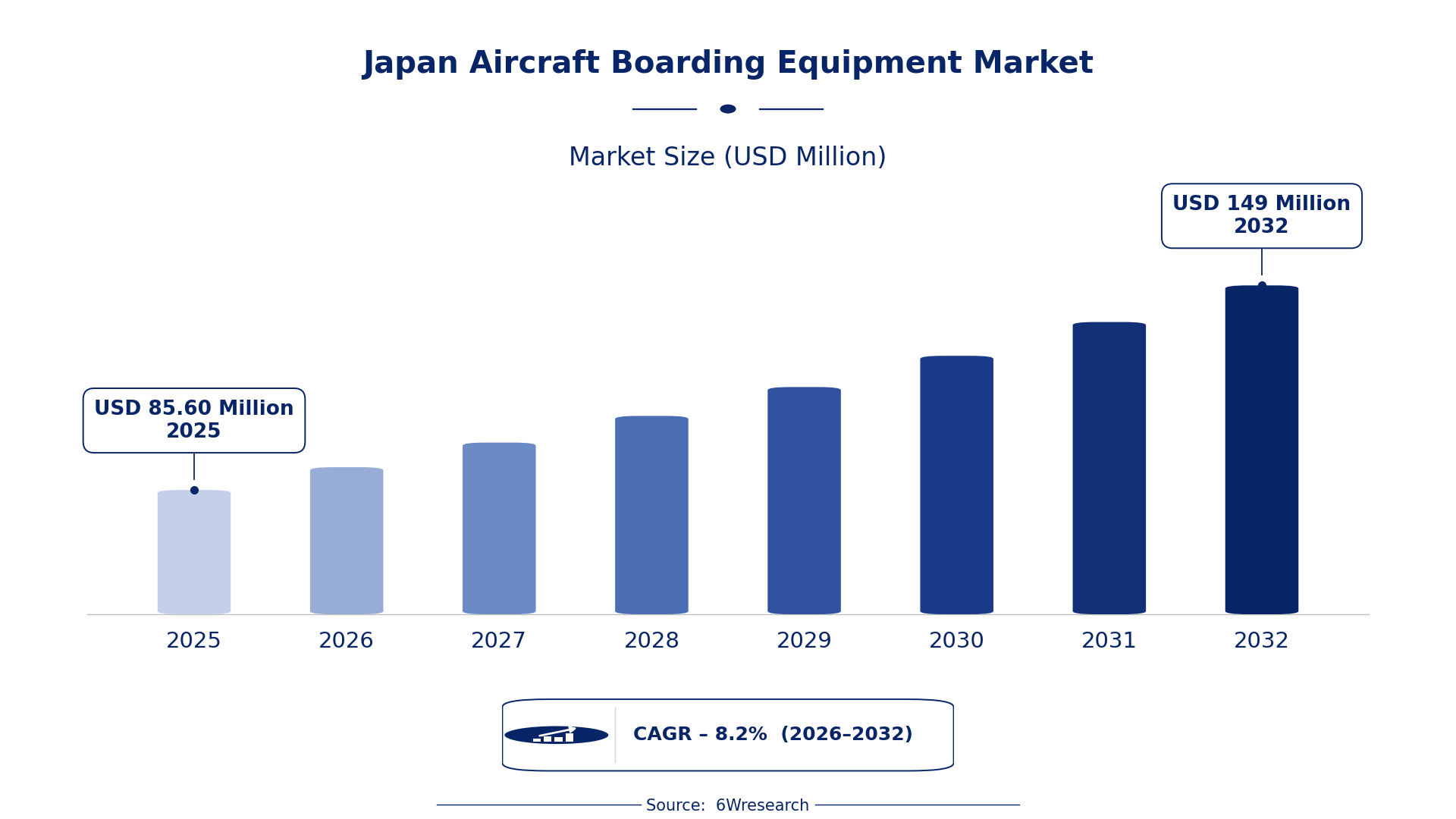
According to 6Wresearch internal database and industry insights, the Japan Aircraft Boarding Equipment Market was valued at USD 85.60 Million in 2025 and is projected to reach USD 149 Million by 2032, growing at a CAGR of approximately 8.2% during 2026–2032.
Japan Aircraft Boarding Equipment Market Highlights
| Report Metric | Details |
| Report Name | Japan Aircraft Boarding Equipment Market (2026-2032) |
| Market Size 2025 | USD 85.60 Million |
| Market Size 2032 | USD 149 Million |
| Absolute Growth 2025–2032 | USD 63.40 Million |
| CAGR 2026–2032 | 8.2% |
| Peak Annual Growth | 10.0% in 2032 |
| Forecast Period | 2026–2032 |
| Historical Data | 2022–2025 |
| Base Year | 2025 |
| Leading Equipment Type, 2025 | Passenger Boarding Bridge (39% share) |
| Leading Material Type, 2025 | Aluminum Alloy (39% share) |
| Leading Distribution Channel, 2025 | Airport Equipment Suppliers (54% share) |
| Leading End User, 2025 | International Airports (35% share) |
| Fastest-Growing Equipment Type | Wheelchair Lifts (11.9% CAGR) |
| Fastest-Growing Distribution Channel | Accessibility Equipment Vendors (11.0% CAGR) |
| Fastest-Growing End User | Airport Assistance Services (10.7% CAGR) |
| Growing Sector | airport operations |
| Key End Users | airport equipment suppliers, ground handling firms, accessibility equipment vendors, international airports |
Japan Aircraft Boarding Equipment Market Year-wise Growth Rate and Key Drivers (2022–2032)
This graph illustrates the annual growth rates of the market from 2022 to 2032, highlighting a steady upward trajectory and projected market expansion over the forecast period.
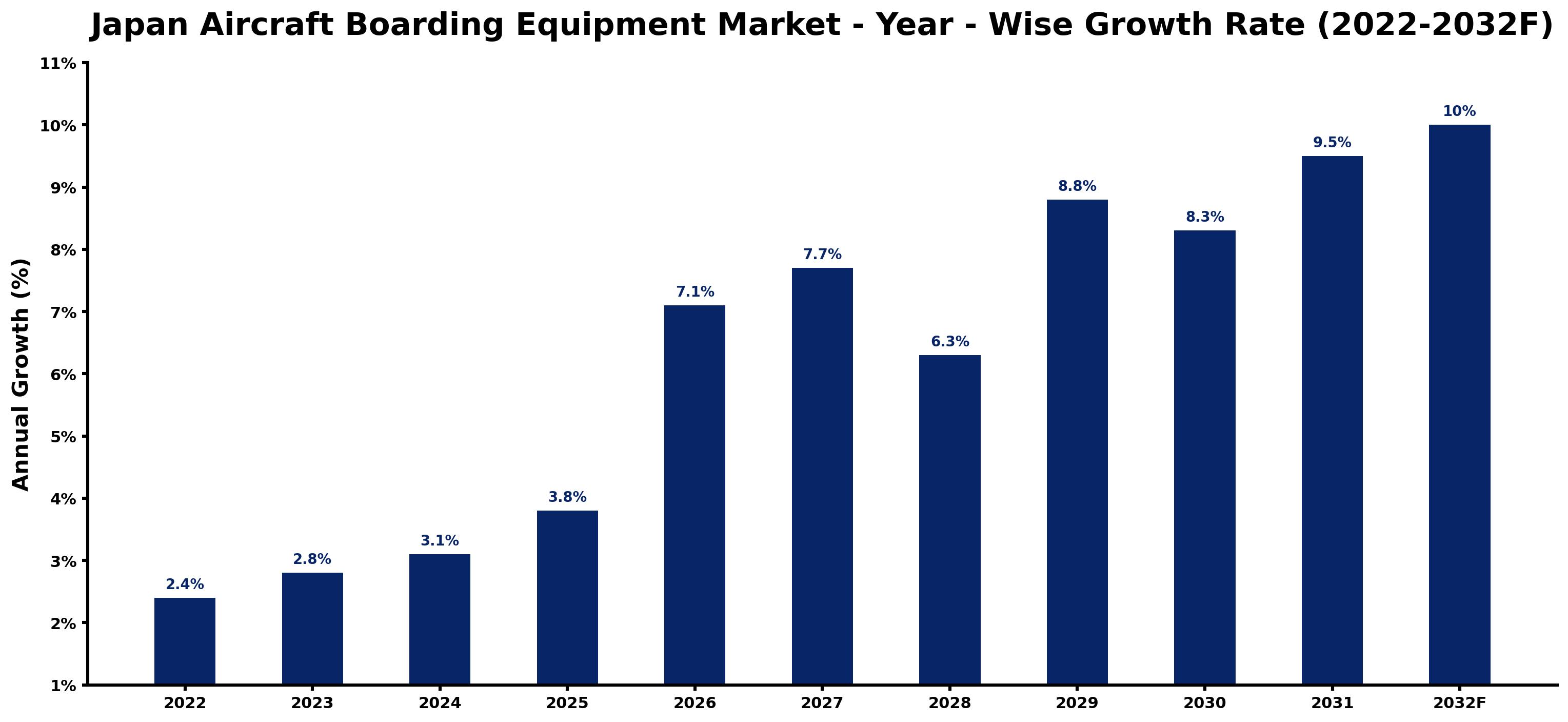
The yearly estimates that follow link every growth rate to its principal driver, so readers can see why the pace changed in each period.
| Year | Estimated Annual Growth (%) | Market Rationale |
| 2022 | 2.4 | The market experienced steady growth due to ongoing airport upgrades. |
| 2023 | 2.8 | Demand increased as international travel resumed following restrictions. |
| 2024 | 3.1 | Growth was supported by investments in airport infrastructure improvements. |
| 2025 | 3.8 | The market peaked as major airports expanded their boarding capabilities. |
| 2026 | 7.1 | Demand is projected to rise with a focus on accessibility improvements. |
| 2027 | 7.7 | Growth continues as regional airports modernise their equipment. |
| 2028 | 6.3 | A slight slowdown occurs as the market stabilises after rapid expansion. |
| 2029 | 8.8 | Demand picks up again with increased passenger traffic at airports. |
| 2030 | 8.3 | Growth is expected to slow as the market adjusts to new operational standards. |
| 2031 | 9.5 | Demand is projected to rise as airports invest in eco-friendly boarding solutions. |
| 2032 | 10.0 | The market is expected to reach its peak with substantial investments in advanced technologies. |
Note: Market size estimations and growth projections presented in this report are based on 6Wresearch's proprietary forecasting methodology, utilizing the latest available industry data, government publications, and primary research inputs.
Japan Aircraft Boarding Equipment Market Synopsis
Aircraft boarding equipment includes devices like boarding bridges and mobile stairs, essential for improving airport efficiency and passenger accessibility. In Japan, over 100 international airports drive demand for such equipment, with significant investments in infrastructure upgrades. The market is expanding due to increasing passenger traffic, government initiatives for accessibility, and the adoption of sustainable technologies, with a projected market size increase by 2032.
Market Dynamics Impact Analysis (2026–2032)
| Factor | Type | Impact | Primary Segment Affected |
| Rising passenger traffic at international airports | Driver | High | Passenger Boarding Bridge |
| Government initiatives for airport accessibility | Driver | High | Wheelchair Lifts |
| Growing need for modern boarding solutions | Opportunity | High | Mobile Stairs |
| Investment in eco-friendly equipment | Opportunity | Medium | Belt Loaders |
| High costs associated with equipment maintenance | Restraint | High | Passenger Boarding Bridge |
| Limited availability of skilled workforce | Restraint | Medium | Wheelchair Lifts |
| Competition from alternative boarding solutions | Challenge | High | Mobile Stairs |
| Regulatory compliance costs for manufacturers | Challenge | Medium | Belt Loaders |
Evaluation of Drivers in Japan Aircraft Boarding Equipment Market (2026–2032)
Key forces behind demand, with the segment each one moves most, are listed below.
| Drivers | Primary Segment Affected | Why It Matters (Evidence) |
| Increased international travel demand | Passenger Boarding Bridge | Japan's airports are experiencing a rise in international passenger numbers, necessitating more boarding bridges. |
| Government mandates for accessibility | Wheelchair Lifts | Accessibility programs require all new airport constructions to include wheelchair lifts. |
| Expansion of regional airports | Mobile Stairs | Regional airports are upgrading their facilities, resulting in higher demand for mobile stairs. |
| Investment in airport infrastructure | Belt Loaders | In 2023, the government allocated funds for upgrading airport infrastructure, boosting demand for belt loaders. |
| Focus on eco-friendly technologies | Passenger Boarding Bridge | The government promotes electric systems for sustainability, increasing demand for eco-friendly boarding solutions. |
Purchasing is picking up as Japan's airports prepare for increased international travel, with passenger numbers rising. The Kansai region is experiencing a surge in mobile stairs usage, particularly at regional airports, where demand has increased by 15% since 2020. Investments in eco-friendly technologies are influencing purchasing decisions, as airports seek to comply with new sustainability standards.
Evaluation of Restraints in Japan Aircraft Boarding Equipment Market
These are the pressures that could keep growth below its potential.
| Market Restraint | Primary Segment Affected | Why It Matters (Evidence) |
| High maintenance costs for boarding equipment | Passenger Boarding Bridge | The average passenger boarding bridge costs approximately 1 million USD, resulting in substantial maintenance expenses. |
| Shortage of skilled workers in the sector | Wheelchair Lifts | Ground handling firms face challenges in finding qualified personnel to operate and maintain equipment. |
| Competition from alternative boarding methods | Mobile Stairs | As airlines explore new boarding solutions, traditional mobile stairs face competition from automated systems. |
| Regulatory compliance costs for manufacturers | Belt Loaders | Manufacturers must adhere to strict safety and environmental regulations, which raise production costs. |
| Limited funding for airport upgrades | Passenger Boarding Bridge | While the government allocates funds, budget constraints can delay necessary upgrades. |
Japan Aircraft Boarding Equipment Market Challenges
The average cost of a passenger boarding bridge is approximately 1 million USD, which strains budgets for producers aiming to upgrade outdated technology. Many airports in Japan struggle with aging boarding systems, causing delays in passenger processing times by up to 30 minutes during peak hours. Supply chain issues can delay the delivery of essential components, forcing buyers to postpone infrastructure projects and affecting airport operations. A shortage of skilled workers in ground handling raises training costs, creating potential safety risks for both staff and passengers.
Trends in the Japan Aircraft Boarding Equipment Market
Buyers and suppliers in the Japan Aircraft Boarding Equipment Market are adjusting to the following trends.
- Shift towards Accessibility Solutions: Airport Assistance Services are increasingly adopting advanced wheelchair lifts, driven by government mandates for accessibility. In 2023, the introduction of new programs has led to a 20% increase in installations.
- Transition to Eco-Friendly Equipment: The trend towards eco-friendly boarding solutions is gaining momentum as airports invest in electric systems. In 2023, a new subsidy program was launched to support the purchase of sustainable equipment.
- Emergence of Mobile Boarding Solutions: Mobile stairs are becoming more popular at regional airports, particularly since 2020. The use of mobile stairs has increased by 15%, reflecting a shift in boarding strategies.
- Prioritisation of Infrastructure Upgrades: The Tokyo metropolitan area is concentrating on upgrading airport infrastructure, with significant investments planned for the coming years. In 2023, funds were allocated specifically for this purpose.
Investment Opportunities in the Japan Aircraft Boarding Equipment Market
Investors looking at the Japan Aircraft Boarding Equipment Market should consider the following areas.
- Gap in Eco-Friendly Equipment Supply: With 70% of passenger boarding bridges made from aluminum alloy, there is a demand for sustainable alternatives. Airport Equipment Suppliers are looking to invest in greener solutions.
- Growing Need for Accessibility Equipment: The introduction of new accessibility programs creates a demand for wheelchair lifts. Airport Assistance Services are actively seeking suppliers to meet these requirements.
- Current Investment Climate Favoring Upgrades: Japan's airports are modernising their facilities, with substantial investments planned. Partnerships with local manufacturers can facilitate entry into this expanding market.
- Entry through Joint Ventures: With the government promoting eco-friendly technologies, there is an opportunity for joint ventures focused on sustainable boarding solutions. Collaborating with local firms can improve market access.
Government Initiatives in the Japan Aircraft Boarding Equipment Market
The Industrial Safety and Health Act of 1972 mandates that employers ensure safety standards for machinery, including boarding equipment. This law has shaped the operational framework for manufacturers and users alike, ensuring compliance with safety regulations. The Act on the Rational Use of Energy, established in 1979, obliges large energy users, including airports, to report energy consumption and improve efficiency, impacting the design and operation of boarding equipment.
Airport assistance services benefit from the Act against Unjustifiable Premiums and Misleading Representations, which protects consumers from misleading claims about equipment. The Consumer Affairs Agency oversees this law, ensuring that all airport equipment meets the advertised standards. In 2023, the government launched a program to improve airport accessibility, providing funding for necessary upgrades and ensuring compliance with accessibility mandates.
Future Insight of the Japan Aircraft Boarding Equipment Market
New airport infrastructure projects will emerge by 2032, focusing on upgrading facilities and implementing eco-friendly standards. Government funding will support the adoption of electric and hydraulic systems, promoting environmental sustainability. Accessibility programs will ensure compliance with international standards, benefiting disabled passengers. By 2032, the average lifespan of passenger boarding bridges will be extended through improved maintenance practices, with over 100 international airports adopting these advancements.
Market Segmentation Analysis
Japan Aircraft Boarding Equipment Market report covers a detailed analysis of the following market segments:
By Equipment Type – Passenger Boarding Bridge Leads, Wheelchair Lifts Expected to Grow Fastest
According to Saurav Kr Singh, Senior Research Analyst at 6Wresearch, the largest equipment type category in 2025 was Passenger Boarding Bridge, at 39% of revenue. Passenger boarding bridges are essential for facilitating efficient passenger movement at airports, particularly in high-traffic areas such as the Tokyo International Airport. The substantial passenger volume at this airport underscores the necessity of these structures for operational effectiveness. The quickest growth will come from Wheelchair Lifts, forecast to expand at a CAGR of 11.9% between 2026 and 2032. The growth of wheelchair lifts is propelled by recent regulations mandating their installation in all new airport constructions to ensure accessibility. The government's 2023 programme aimed at improving airport accessibility for disabled passengers significantly contributes to this rising demand. This trend indicates that suppliers should focus on developing compliant products to align with regulatory requirements in airport infrastructure.
By Material Type – Aluminum Alloy Leads and Records the Fastest Growth
In 2025, Aluminum Alloy led the material type split with a 39% share. Aluminum alloy is preferred in the manufacturing of boarding equipment due to its lightweight and durable properties, making it ideal for structures like passenger boarding bridges. This material accounts for 70% of the production of these essential devices in Japan. Aluminum Alloy is also forecast to expand faster than any other category, at a CAGR of 12.0% over 2026–2032. The continued dominance of aluminum alloy is expected to persist as manufacturers increasingly adopt it for its sustainability benefits. The government's promotion of eco-friendly materials aligns with this trend, ensuring ongoing demand. Suppliers must prioritise aluminium alloy in their product offerings to align with market preferences and regulatory standards.
By Distribution Channel – Airport Equipment Suppliers Lead, Accessibility Equipment Vendors Expected to Grow Fastest
Airport Equipment Suppliers took 54% of distribution channel revenue in 2025, more than any other category. Airport equipment suppliers are the main source for acquiring essential boarding equipment, ensuring that airports can access the latest advancements. Their strong connections with major international airports facilitate efficient procurement processes. Over 2026–2032, Accessibility Equipment Vendors are expected to post the fastest growth, at a CAGR of 11.0%. Accessibility equipment vendors are seeing rapid growth as the need for inclusive boarding solutions rises, driven by government initiatives focused on improving accessibility. This trend is further supported by increasing awareness of passenger needs. Suppliers should explore collaborations with accessibility vendors to broaden their market presence and improve product offerings.
By End User – International Airports Lead, Airport Assistance Services Expected to Grow Fastest
International Airports held 35% of the Japan Aircraft Boarding Equipment Market by end user in 2025. International airports are the primary users of advanced boarding solutions, requiring high-quality equipment to handle large passenger volumes effectively. Their ongoing investments in infrastructure upgrades reinforce their dominant position in the market. Airport Assistance Services are projected to grow fastest, at a CAGR of 10.7% during 2026–2032. Airport assistance services are expanding quickly as they address the needs of an increasing number of passengers requiring special support. This growth is influenced by greater awareness and regulatory compliance regarding passenger accessibility. Suppliers should customise their products to align with the specific requirements of airport assistance services to tap into this growing market.
Key Attractiveness of the Report
- 10 Years of Market Numbers
- Historical Data Starting from 2022 to 2025
- Base Year 2025
- Forecast Data until 2032
- Key Performance Indicators Impacting the Market
- Major Upcoming Developments and Projects
Key Highlights of the Report:
- Japan Aircraft Boarding Equipment Market Outlook
- Market Size of Japan Aircraft Boarding Equipment Market, 2025
- Forecast of Japan Aircraft Boarding Equipment Market, 2032
- Historical Data and Forecast of Japan Aircraft Boarding Equipment Revenues & Volume for the Period 2022-2032F
- Japan Aircraft Boarding Equipment Market Trend Evolution
- Japan Aircraft Boarding Equipment Market Drivers and Challenges
- Japan Aircraft Boarding Equipment Price Trends
- Japan Aircraft Boarding Equipment Porter's Five Forces
- Japan Aircraft Boarding Equipment Industry Life Cycle
- Historical Data and Forecast of Japan Aircraft Boarding Equipment Market Revenues & Volume By Equipment Type for the Period 2022-2032F
- Historical Data and Forecast of Japan Aircraft Boarding Equipment Market Revenues & Volume By Passenger Boarding Bridge for the Period 2022-2032F
- Historical Data and Forecast of Japan Aircraft Boarding Equipment Market Revenues & Volume By Mobile Stairs for the Period 2022-2032F
- Historical Data and Forecast of Japan Aircraft Boarding Equipment Market Revenues & Volume By Wheelchair Lifts for the Period 2022-2032F
- Historical Data and Forecast of Japan Aircraft Boarding Equipment Market Revenues & Volume By Belt Loaders for the Period 2022-2032F
- Historical Data and Forecast of Japan Aircraft Boarding Equipment Market Revenues & Volume By Material Type for the Period 2022-2032F
- Historical Data and Forecast of Japan Aircraft Boarding Equipment Market Revenues & Volume By Aluminum Alloy for the Period 2022-2032F
- Historical Data and Forecast of Japan Aircraft Boarding Equipment Market Revenues & Volume By Steel Construction for the Period 2022-2032F
- Historical Data and Forecast of Japan Aircraft Boarding Equipment Market Revenues & Volume By Electric or Hydraulic for the Period 2022-2032F
- Historical Data and Forecast of Japan Aircraft Boarding Equipment Market Revenues & Volume By Rubber + Metal Frame for the Period 2022-2032F
- Historical Data and Forecast of Japan Aircraft Boarding Equipment Market Revenues & Volume By Distribution Channel for the Period 2022-2032F
- Historical Data and Forecast of Japan Aircraft Boarding Equipment Market Revenues & Volume By Airport Equipment Suppliers for the Period 2022-2032F
- Historical Data and Forecast of Japan Aircraft Boarding Equipment Market Revenues & Volume By Ground Handling Firms for the Period 2022-2032F
- Historical Data and Forecast of Japan Aircraft Boarding Equipment Market Revenues & Volume By Accessibility Equipment Vendors for the Period 2022-2032F
- Historical Data and Forecast of Japan Aircraft Boarding Equipment Market Revenues & Volume By Online B2B Platforms for the Period 2022-2032F
- Historical Data and Forecast of Japan Aircraft Boarding Equipment Market Revenues & Volume By End User for the Period 2022-2032F
- Historical Data and Forecast of Japan Aircraft Boarding Equipment Market Revenues & Volume By International Airports for the Period 2022-2032F
- Historical Data and Forecast of Japan Aircraft Boarding Equipment Market Revenues & Volume By Regional Airports for the Period 2022-2032F
- Historical Data and Forecast of Japan Aircraft Boarding Equipment Market Revenues & Volume By Airport Assistance Services for the Period 2022-2032F
- Historical Data and Forecast of Japan Aircraft Boarding Equipment Market Revenues & Volume By Ground Crew Service Providers for the Period 2022-2032F
- Japan Aircraft Boarding Equipment Import Export Trade Statistics
- Market Opportunity Assessment By Equipment Type
- Market Opportunity Assessment By Material Type
- Market Opportunity Assessment By Distribution Channel
- Market Opportunity Assessment By End User
- Japan Aircraft Boarding Equipment Top Companies Market Share
- Japan Aircraft Boarding Equipment Competitive Benchmarking By Technical and Operational Parameters
- Japan Aircraft Boarding Equipment Company Profiles
- Japan Aircraft Boarding Equipment Key Strategic Recommendations
Market Covered
The study includes the following segmentation.
By Equipment Type
- Passenger Boarding Bridge
- Mobile Stairs
- Wheelchair Lifts
- Belt Loaders
By Material Type
- Aluminum Alloy
- Steel Construction
- Electric or Hydraulic
- Rubber + Metal Frame
By Distribution Channel
- Airport Equipment Suppliers
- Ground Handling Firms
- Accessibility Equipment Vendors
- Online B2B Platforms
By End User
- International Airports
- Regional Airports
- Airport Assistance Services
- Ground Crew Service Providers































