Japan Aircraft Cabin Electronics Market Size & Growth Rate
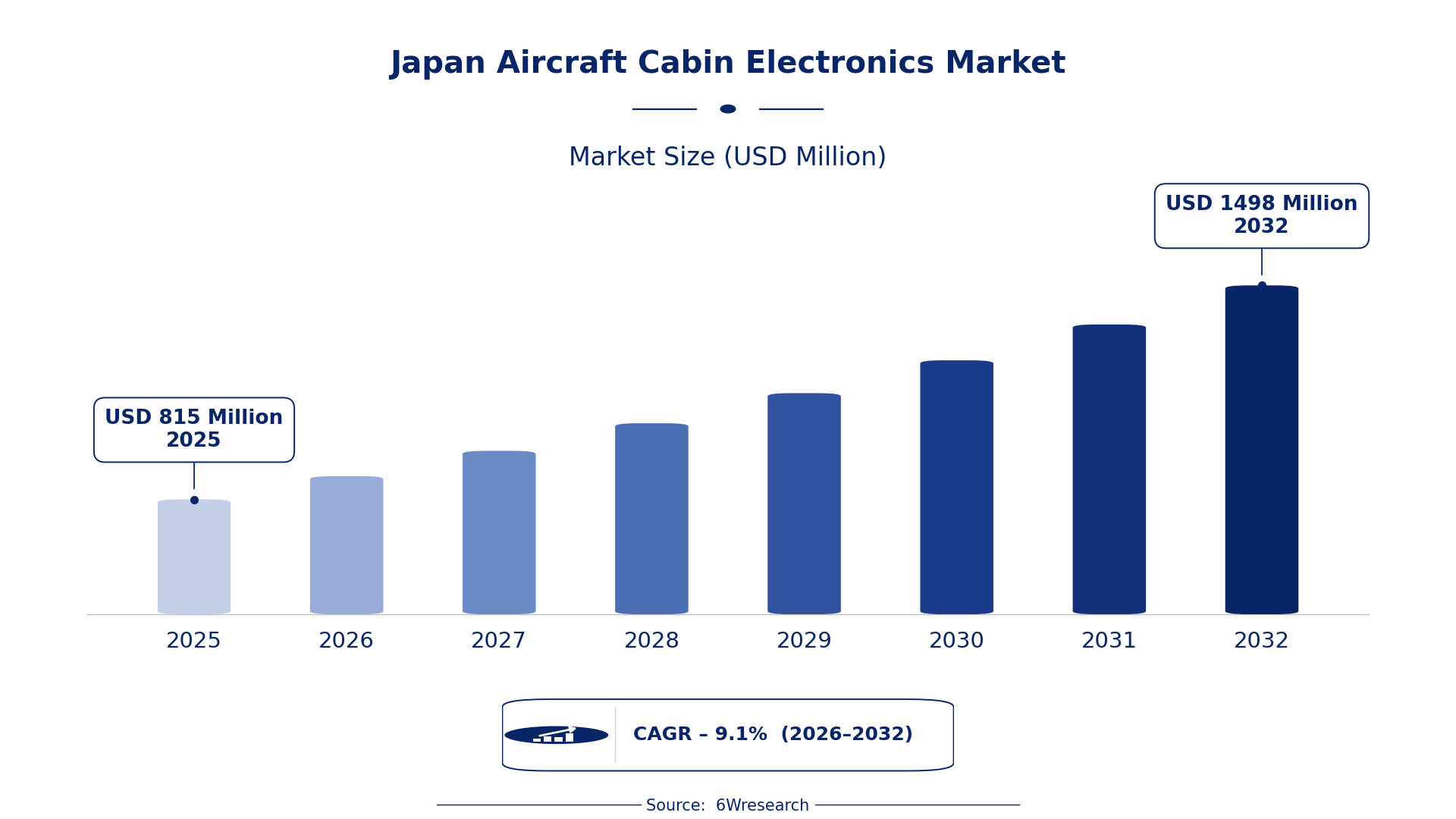
According to 6Wresearch internal database and industry insights, the Japan Aircraft Cabin Electronics Market was valued at USD 815 Million in 2025 and is projected to reach USD 1,498 Million by 2032, growing at a CAGR of approximately 9.1% during 2026–2032.
Japan Aircraft Cabin Electronics Market Highlights
| Report Metric | Details |
| Report Name | Japan Aircraft Cabin Electronics Market (2026-2032) |
| Market Size 2025 | USD 815 Million |
| Market Size 2032 | USD 1,498 Million |
| Absolute Growth 2025–2032 | USD 683 Million |
| CAGR 2026–2032 | 9.1% |
| Peak Annual Growth | 10.4% in 2032 |
| Forecast Period | 2026–2032 |
| Historical Data | 2022–2025 |
| Base Year | 2025 |
| Leading Product Type, 2025 | IFE Systems (40% share) |
| Leading Functionality, 2025 | In-Flight Entertainment (42% share) |
| Leading Distribution Channel, 2025 | Aerospace Electronics Vendors (48% share) |
| Leading End User, 2025 | Airlines (37% share) |
| Fastest-Growing Product Type | Control Panels (12.9% CAGR) |
| Fastest-Growing Functionality | Seat Adjustment/Lighting (12.3% CAGR) |
| Fastest-Growing Distribution Channel | Cabin Tech Distributors (12.1% CAGR) |
| Fastest-Growing End User | Business Jet Makers (11.9% CAGR) |
| Growing Sector | commercial aviation |
| Key End Users | airlines, aircraft interior OEMs, business jet makers, cabin tech distributors |
Japan Aircraft Cabin Electronics Market Year-wise Growth Rate and Key Drivers (2022–2032)
This graph illustrates the annual growth rates of the market from 2022 to 2032, highlighting a steady upward trajectory and projected market expansion over the forecast period.
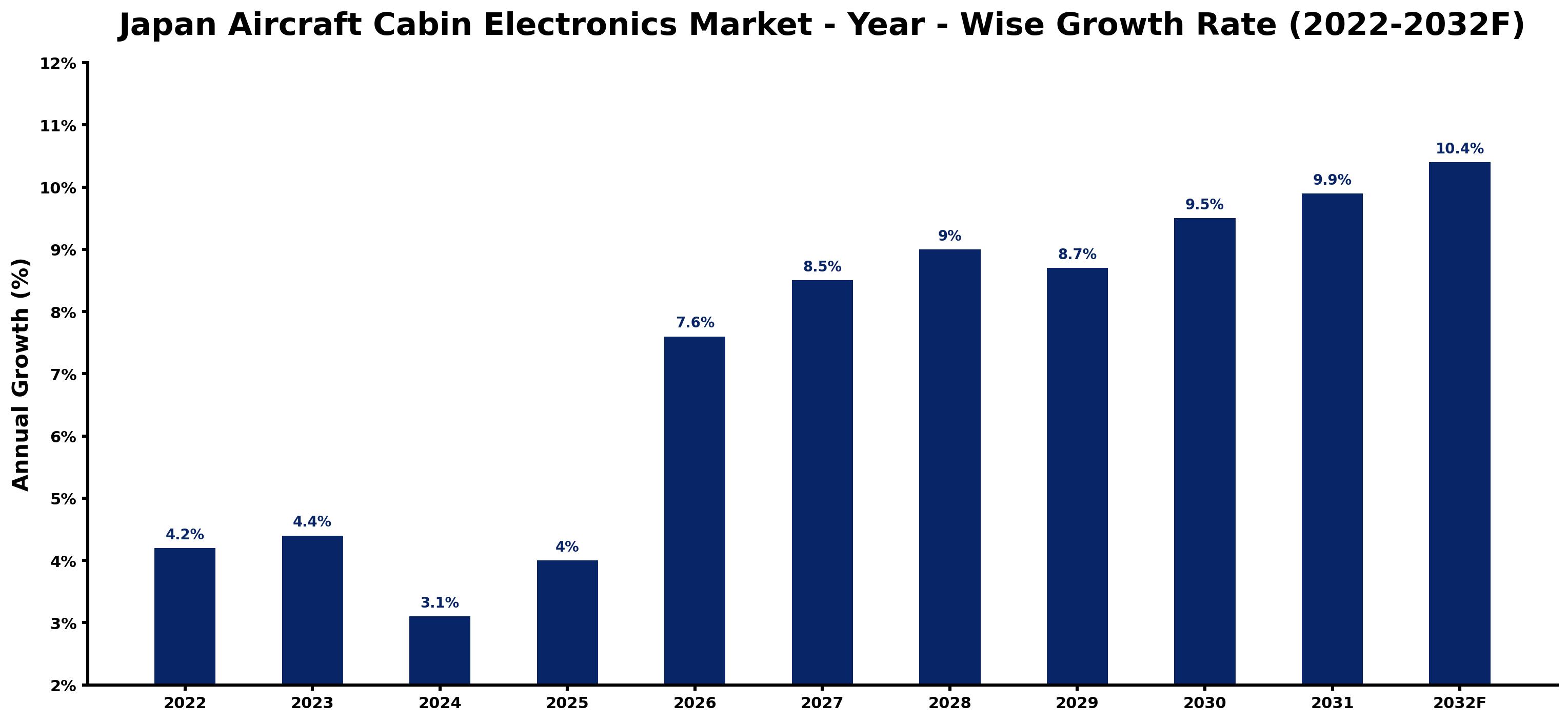
For each year, the table pairs the estimated growth rate with the leading influence on demand, showing how the drivers changed across the period.
| Year | Estimated Annual Growth (%) | Market Rationale |
| 2022 | 4.2 | The aviation market showed steady growth due to increasing passenger numbers. |
| 2023 | 4.4 | Growth accelerated as airlines upgraded their cabin electronics to improve passenger experience. |
| 2024 | 3.1 | Growth slowed as airlines focused on cost management amid rising operational expenses. |
| 2025 | 4.0 | Demand increased as new aircraft models featured advanced cabin technologies. |
| 2026 | 7.6 | The market is expected to expand as passenger expectations for in-flight entertainment rise. |
| 2027 | 8.5 | Demand will continue to rise with the introduction of more digital cabin solutions. |
| 2028 | 9.0 | Growth will be driven by the expansion of airlines and their service offerings. |
| 2029 | 8.7 | A slowdown is anticipated as market saturation begins to affect new purchases. |
| 2030 | 9.5 | The market will grow as airlines invest in sustainable cabin technologies. |
| 2031 | 9.9 | Continued investment in passenger comfort will drive demand for advanced systems. |
| 2032 | 10.4 | Growth will peak as airlines fully integrate advanced cabin solutions. |
Note: Market size estimations and growth projections presented in this report are based on 6Wresearch's proprietary forecasting methodology, utilizing the latest available industry data, government publications, and primary research inputs.
Japan Aircraft Cabin Electronics Market Synopsis
Aircraft cabin electronics encompass systems that improve passenger experience, including in-flight entertainment, control panels, and audio systems. The Japan Aircraft Cabin Electronics Market is growing due to increasing passenger expectations, airline investments, and new aircraft models equipped with advanced technologies. With over 100 million passengers anticipated annually by 2025, the demand for sophisticated cabin electronics is on the rise, especially in major hubs such as Tokyo and Osaka.
Market Dynamics Impact Analysis (2026–2032)
| Factor | Type | Impact | Primary Segment Affected |
| Increasing passenger expectations for in-flight entertainment systems | Driver | High | IFE Systems |
| Growing fleet modernization among airlines | Driver | High | Control Panels |
| Expansion of cabin tech distributors to improve supply chains | Opportunity | Medium | Cabin Tech Distributors |
| Rising demand for sustainable cabin technologies | Opportunity | High | Aerospace Electronics Vendors |
| Regulatory compliance costs impacting manufacturers | Restraint | High | Aircraft Interior OEMs |
| High competition leading to price pressures | Restraint | Medium | Business Jet Makers |
| High costs of integrating advanced technologies | Challenge | High | Aircraft Interior OEMs |
| Delays in regulatory approvals for new technologies | Challenge | Medium | Aerospace Electronics Vendors |
Evaluation of Drivers in Japan Aircraft Cabin Electronics Market (2026–2032)
Below are the drivers that matter most for revenue growth, with supporting evidence.
| Drivers | Primary Segment Affected | Why It Matters (Evidence) |
| Rising passenger numbers | IFE Systems | Japan's aviation market is projected to serve over 100 million passengers annually by 2025. |
| Investment in new aircraft models | Control Panels | The installation of passenger displays is prevalent in new aircraft models introduced in 2023. |
| Technological advancements in cabin electronics | Passenger Displays | The Japanese aviation sector is investing in sustainable cabin technologies as part of its green initiative. |
| Increased focus on passenger comfort | Audio Systems | Tokyo and Osaka are major hubs for airlines operating advanced cabin electronics. |
| Collaboration among manufacturers | Cabin Tech Distributors | The Aerospace Industries Association of Japan promotes collaboration in aircraft manufacturing. |
Buyers are adding capacity as Japan's aviation market prepares to serve over 100 million passengers annually by 2025. Investment in new aircraft models is evident, with passenger displays becoming standard in 2023. The sector is investing in sustainable cabin technologies, particularly in major hubs like Tokyo and Osaka. A heightened focus on passenger comfort drives demand for audio systems, while collaboration among manufacturers improves supply chain efficiency, ensuring timely delivery of advanced cabin electronics.
Evaluation of Restraints in Japan Aircraft Cabin Electronics Market
Below are the constraints most often cited by buyers and suppliers, with the segment each affects.
| Market Restraint | Primary Segment Affected | Why It Matters (Evidence) |
| Regulatory compliance costs | Aircraft Interior OEMs | Compliance with JIS Q 9100 standards increases production costs for manufacturers. |
| High competition among suppliers | Business Jet Makers | Intense competition leads to price pressures, affecting profit margins for manufacturers. |
| Integration costs for advanced technologies | Cabin Tech Distributors | High costs associated with integrating new technologies can deter investments, impacting growth. |
| Delays in regulatory approvals | Aerospace Electronics Vendors | Lengthy approval processes for new technologies can slow market entry, affecting supply. |
| Market saturation affecting new purchases | IFE Systems | As the market matures, airlines may delay upgrading existing systems, limiting new sales. |
Japan Aircraft Cabin Electronics Market Challenges
Producers are contending with rising costs due to delays in the supply of advanced cabin electronics, which may increase project expenses by 15% this year. Buyers are facing skills shortages in the aerospace sector, restricting the availability of qualified technicians and extending production timelines for manufacturers. Supply chain disruptions arise from the concentration of manufacturing in major hubs like Tokyo and Osaka, resulting in increased lead times by 20% for cabin tech distributors. Regulatory compliance with standards such as JIS Q 9100 necessitates extensive documentation, delaying product launches and inflating costs for manufacturers.
Trends in the Japan Aircraft Cabin Electronics Market
The shifts below are changing how Japan Aircraft Cabin Electronics Market products are bought and supplied.
- Shift towards Sustainable Cabin Technologies: Japan's aviation sector is increasingly investing in sustainable cabin technologies, focusing on reducing environmental impact. In 2023, the sector allocated resources towards these innovations, reflecting a growing commitment to sustainability.
- Growth of In-Flight Entertainment Systems: Airlines are prioritising in-flight entertainment systems to improve passenger experience, particularly in major hubs. The demand for IFE systems is expected to rise as passenger expectations increase.
- Expansion of Cabin Tech Distributors: Cabin tech distributors are expanding their networks to improve supply chain efficiency in Japan. This trend is clear as distributors increase their partnerships to meet the growing demand for advanced cabin electronics.
- Integration of Advanced Passenger Displays: The integration of advanced passenger displays is becoming standard in new aircraft models introduced in 2023. This shift enhances the overall passenger experience and provides essential information during flights.
Investment Opportunities in the Japan Aircraft Cabin Electronics Market
The opportunities below stand out in the Japan Aircraft Cabin Electronics Market for new entrants and existing suppliers.
- Investment in Sustainable Cabin Technologies: Japan's aviation sector is heavily investing in sustainable cabin technologies, with a projected investment of USD 200 million by 2025. Airlines are seeking solutions to comply with environmental standards.
- Expansion of Cabin Tech Distribution Networks: Cabin tech distributors are actively broadening their networks to enhance supply chain efficiency, particularly in urban areas. This growth offers opportunities for new partnerships and collaborations.
- Development of Advanced IFE Systems: With passenger numbers expected to exceed 100 million by 2025, airlines are keen to invest in advanced IFE systems. This demand presents opportunities for suppliers to introduce new technologies.
- Collaboration with Aerospace Manufacturers: Aerospace manufacturers are pursuing partnerships to enhance production capabilities. Collaborating with local firms can streamline operations and improve market access.
Government Initiatives in the Japan Aircraft Cabin Electronics Market
The Electrical Appliance and Material Safety Act, established in 1961, regulates the safety of electrical appliances, ensuring that all aircraft cabin electronics meet stringent safety standards. The Building Energy Efficiency Act, amended in 2022, mandates that all new buildings, including aircraft facilities, adhere to energy efficiency standards, promoting sustainability in aviation.
The Digital Agency oversees the implementation of digital transformation initiatives, including standards for cabin electronics. The Semiconductor and Digital Industry Strategy aims to secure domestic semiconductor manufacturing, which is vital for producing advanced cabin electronics.
Future Insight of the Japan Aircraft Cabin Electronics Market
New projects for sustainable cabin technologies are set to launch by 2032, aligning with global environmental standards. The introduction of advanced cabin electronics will enhance passenger satisfaction and comfort during flights. Collaborative initiatives among aerospace manufacturers will streamline production processes and improve efficiency. Japan's aviation market is projected to serve over 100 million passengers annually by 2025, driving demand for advanced cabin electronics.
Market Segmentation Analysis
Japan Aircraft Cabin Electronics Market report covers a detailed analysis of the following market segments:
By Product Type – IFE Systems Lead, Control Panels Expected to Grow Fastest
According to Saurav Kr Singh, Senior Research Analyst at 6Wresearch, IFE Systems held 40% of the Japan Aircraft Cabin Electronics Market by product type in 2025. IFE systems hold the largest share due to their essential role in providing entertainment directly to passengers during flights. With over 100 million passengers projected annually by 2025, airlines in Japan heavily rely on these systems to enhance the travel experience. Control Panels are projected to grow fastest, at a CAGR of 12.9% during 2026–2032. Control panels are experiencing rapid growth as airlines focus on improving passenger comfort through direct management of cabin functions. The introduction of new aircraft models in 2023 has significantly increased the demand for advanced control systems, further driving this segment's expansion. Suppliers should prioritise the development of control panel technologies to meet the evolving needs of airlines.
By Functionality – In-Flight Entertainment Leads, Seat Adjustment/Lighting Expected to Grow Fastest
In-Flight Entertainment took 42% of functionality revenue in 2025, more than any other category. In-flight entertainment is the leading functionality because it is crucial for enhancing the passenger experience during flights. As passenger expectations continue to rise, airlines in Japan view this feature as a key differentiator in a competitive market. Seat Adjustment/Lighting is set to record the highest CAGR in this split, 12.3% over 2026–2032. Seat adjustment and lighting functionalities are growing quickly as airlines aim to improve comfort levels for passengers. This trend is particularly evident in newly introduced aircraft models in 2023 that feature advanced comfort options. Investing in technologies that enhance seat adjustment and lighting will help buyers attract more customers.
By Distribution Channel – Aerospace Electronics Vendors Lead, Cabin Tech Distributors Expected to Grow Fastest
Aerospace Electronics Vendors accounted for 48% of the market by distribution channel in 2025. Aerospace electronics vendors dominate the distribution channel as they supply critical components that support the functionality of cabin electronics. Their established networks and expertise in the industry make them the preferred choice for airlines. The quickest growth will come from Cabin Tech Distributors, forecast to expand at a CAGR of 12.1% between 2026 and 2032. Cabin tech distributors are rapidly expanding their networks to improve supply chain efficiency, responding to the growing demand for advanced cabin electronics. This shift is essential as airlines increasingly seek streamlined solutions for their operations. Suppliers must align with cabin tech distributors to ensure efficient product delivery and meet market demands.
By End User – Airlines Lead, Business Jet Makers Expected to Grow Fastest
With 37% of end user revenue in 2025, Airlines was the largest category. Airlines are the primary end user group since they operate cabin electronics, directly impacting passenger satisfaction. The growth of Japan's aviation market has led airlines to invest heavily in these technologies to enhance their service offerings. Over 2026–2032, Business Jet Makers are expected to post the fastest growth, at a CAGR of 11.9%. Business jet makers are rapidly advancing as they cater to a niche market that demands high-quality cabin electronics. The increasing number of affluent travellers seeking luxurious experiences is driving this segment's growth. Suppliers should focus on business jet makers to capitalise on the rising demand for premium cabin electronics.
Key Attractiveness of the Report
- 10 Years of Market Numbers
- Historical Data Starting from 2022 to 2025
- Base Year 2025
- Forecast Data until 2032
- Key Performance Indicators Impacting the Market
- Major Upcoming Developments and Projects
Key Highlights of the Report:
- Japan Aircraft Cabin Electronics Market Outlook
- Market Size of Japan Aircraft Cabin Electronics Market, 2025
- Forecast of Japan Aircraft Cabin Electronics Market, 2032
- Historical Data and Forecast of Japan Aircraft Cabin Electronics Revenues & Volume for the Period 2022-2032F
- Japan Aircraft Cabin Electronics Market Trend Evolution
- Japan Aircraft Cabin Electronics Market Drivers and Challenges
- Japan Aircraft Cabin Electronics Price Trends
- Japan Aircraft Cabin Electronics Porter's Five Forces
- Japan Aircraft Cabin Electronics Industry Life Cycle
- Historical Data and Forecast of Japan Aircraft Cabin Electronics Market Revenues & Volume By Product Type for the Period 2022-2032F
- Historical Data and Forecast of Japan Aircraft Cabin Electronics Market Revenues & Volume By IFE Systems for the Period 2022-2032F
- Historical Data and Forecast of Japan Aircraft Cabin Electronics Market Revenues & Volume By Control Panels for the Period 2022-2032F
- Historical Data and Forecast of Japan Aircraft Cabin Electronics Market Revenues & Volume By Passenger Displays for the Period 2022-2032F
- Historical Data and Forecast of Japan Aircraft Cabin Electronics Market Revenues & Volume By Audio Systems for the Period 2022-2032F
- Historical Data and Forecast of Japan Aircraft Cabin Electronics Market Revenues & Volume By Functionality for the Period 2022-2032F
- Historical Data and Forecast of Japan Aircraft Cabin Electronics Market Revenues & Volume By In-Flight Entertainment for the Period 2022-2032F
- Historical Data and Forecast of Japan Aircraft Cabin Electronics Market Revenues & Volume By Seat Adjustment/Lighting for the Period 2022-2032F
- Historical Data and Forecast of Japan Aircraft Cabin Electronics Market Revenues & Volume By Information Display for the Period 2022-2032F
- Historical Data and Forecast of Japan Aircraft Cabin Electronics Market Revenues & Volume By Announcements/Intercom for the Period 2022-2032F
- Historical Data and Forecast of Japan Aircraft Cabin Electronics Market Revenues & Volume By Distribution Channel for the Period 2022-2032F
- Historical Data and Forecast of Japan Aircraft Cabin Electronics Market Revenues & Volume By Aerospace Electronics Vendors for the Period 2022-2032F
- Historical Data and Forecast of Japan Aircraft Cabin Electronics Market Revenues & Volume By Cabin Tech Distributors for the Period 2022-2032F
- Historical Data and Forecast of Japan Aircraft Cabin Electronics Market Revenues & Volume By Online B2B Portals for the Period 2022-2032F
- Historical Data and Forecast of Japan Aircraft Cabin Electronics Market Revenues & Volume By OEM Cabling Integrators for the Period 2022-2032F
- Historical Data and Forecast of Japan Aircraft Cabin Electronics Market Revenues & Volume By End User for the Period 2022-2032F
- Historical Data and Forecast of Japan Aircraft Cabin Electronics Market Revenues & Volume By Airlines for the Period 2022-2032F
- Historical Data and Forecast of Japan Aircraft Cabin Electronics Market Revenues & Volume By Business Jet Makers for the Period 2022-2032F
- Historical Data and Forecast of Japan Aircraft Cabin Electronics Market Revenues & Volume By Aircraft Interior OEMs for the Period 2022-2032F
- Historical Data and Forecast of Japan Aircraft Cabin Electronics Market Revenues & Volume By Helicopter Builders for the Period 2022-2032F
- Japan Aircraft Cabin Electronics Import Export Trade Statistics
- Market Opportunity Assessment By Product Type
- Market Opportunity Assessment By Functionality
- Market Opportunity Assessment By Distribution Channel
- Market Opportunity Assessment By End User
- Japan Aircraft Cabin Electronics Top Companies Market Share
- Japan Aircraft Cabin Electronics Competitive Benchmarking By Technical and Operational Parameters
- Japan Aircraft Cabin Electronics Company Profiles
- Japan Aircraft Cabin Electronics Key Strategic Recommendations
Market Covered
The following segment groups are covered in the report.
By Product Type
- IFE Systems
- Control Panels
- Passenger Displays
- Audio Systems
By Functionality
- In-Flight Entertainment
- Seat Adjustment/Lighting
- Information Display
- Announcements/Intercom
By Distribution Channel
- Aerospace Electronics Vendors
- Cabin Tech Distributors
- Online B2B Portals
- OEM Cabling Integrators
By End User
- Airlines
- Business Jet Makers
- Aircraft Interior OEMs
- Helicopter Builders































