Japan Aircraft Cabin Surveillance Market Size & Growth Rate
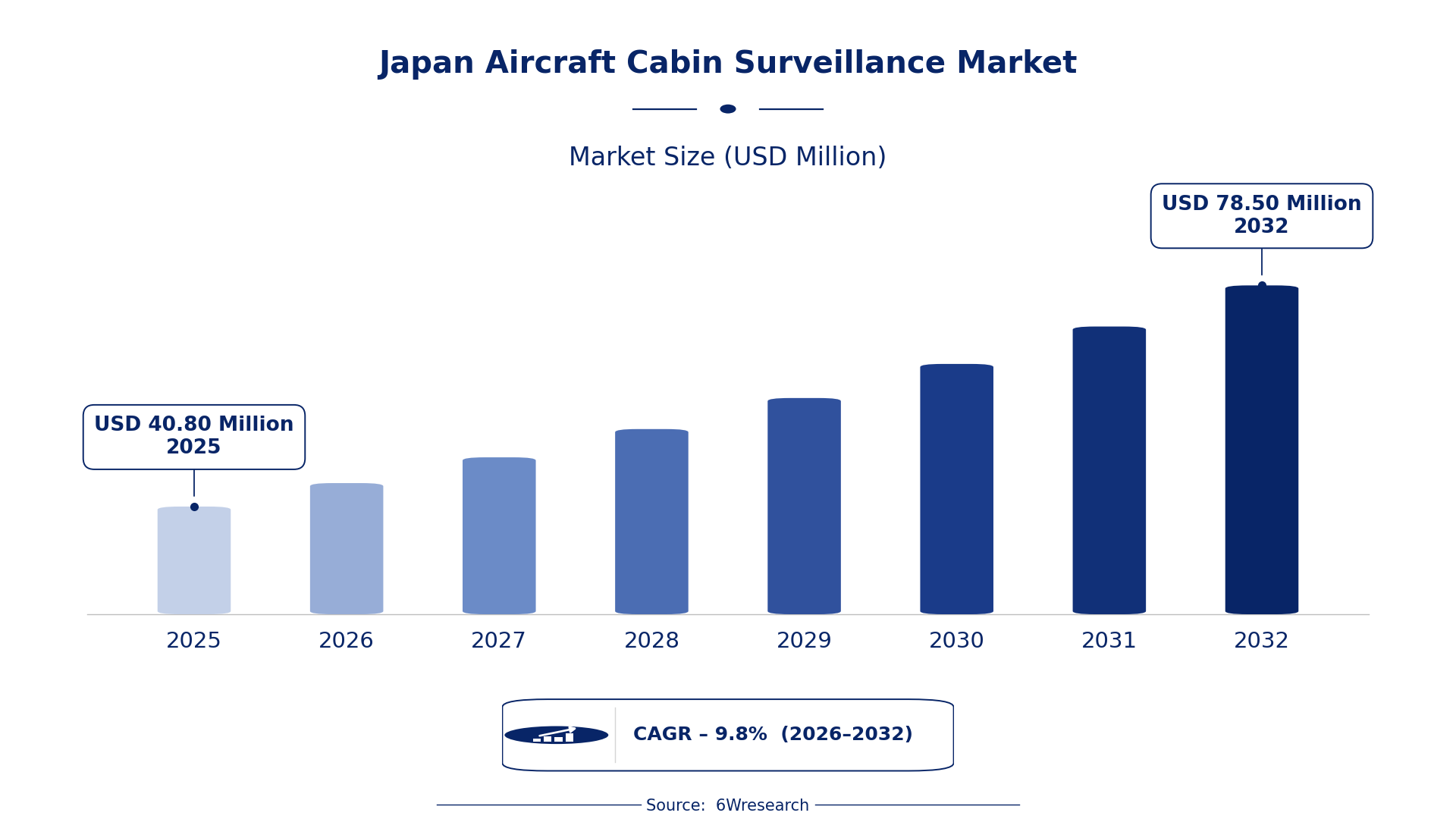
According to 6Wresearch internal database and industry insights, the Japan Aircraft Cabin Surveillance Market was valued at USD 40.80 Million in 2025 and is projected to reach USD 78.50 Million by 2032, growing at a CAGR of approximately 9.8% during 2026–2032.
Japan Aircraft Cabin Surveillance Market Highlights
| Report Metric | Details |
| Report Name | Japan Aircraft Cabin Surveillance Market (2026-2032) |
| Market Size 2025 | USD 40.80 Million |
| Market Size 2032 | USD 78.50 Million |
| Absolute Growth 2025–2032 | USD 37.70 Million |
| CAGR 2026–2032 | 9.8% |
| Peak Annual Growth | 10.8% in 2032 |
| Forecast Period | 2026–2032 |
| Historical Data | 2022–2025 |
| Base Year | 2025 |
| Leading Surveillance Type, 2025 | Passenger Monitoring (34% share) |
| Leading Camera Type, 2025 | IP Camera Systems (42% share) |
| Leading Distribution Channel, 2025 | Aerospace Security Vendors (43% share) |
| Leading End User, 2025 | Airlines (42% share) |
| Fastest-Growing Surveillance Type | Baggage Area Monitoring (13.8% CAGR) |
| Fastest-Growing Camera Type | IR & Night Vision (14.7% CAGR) |
| Fastest-Growing Distribution Channel | OEM Security Integrators (13.1% CAGR) |
| Fastest-Growing End User | Aviation Regulatory Units (12.7% CAGR) |
| Growing Sector | aviation security |
| Key End Users | airlines, aviation regulatory units, commercial aircraft OEMs, aerospace security vendors |
Japan Aircraft Cabin Surveillance Market Year-wise Growth Rate and Key Drivers (2022–2032)
This graph illustrates the annual growth rates of the market from 2022 to 2032, highlighting a steady upward trajectory and projected market expansion over the forecast period.
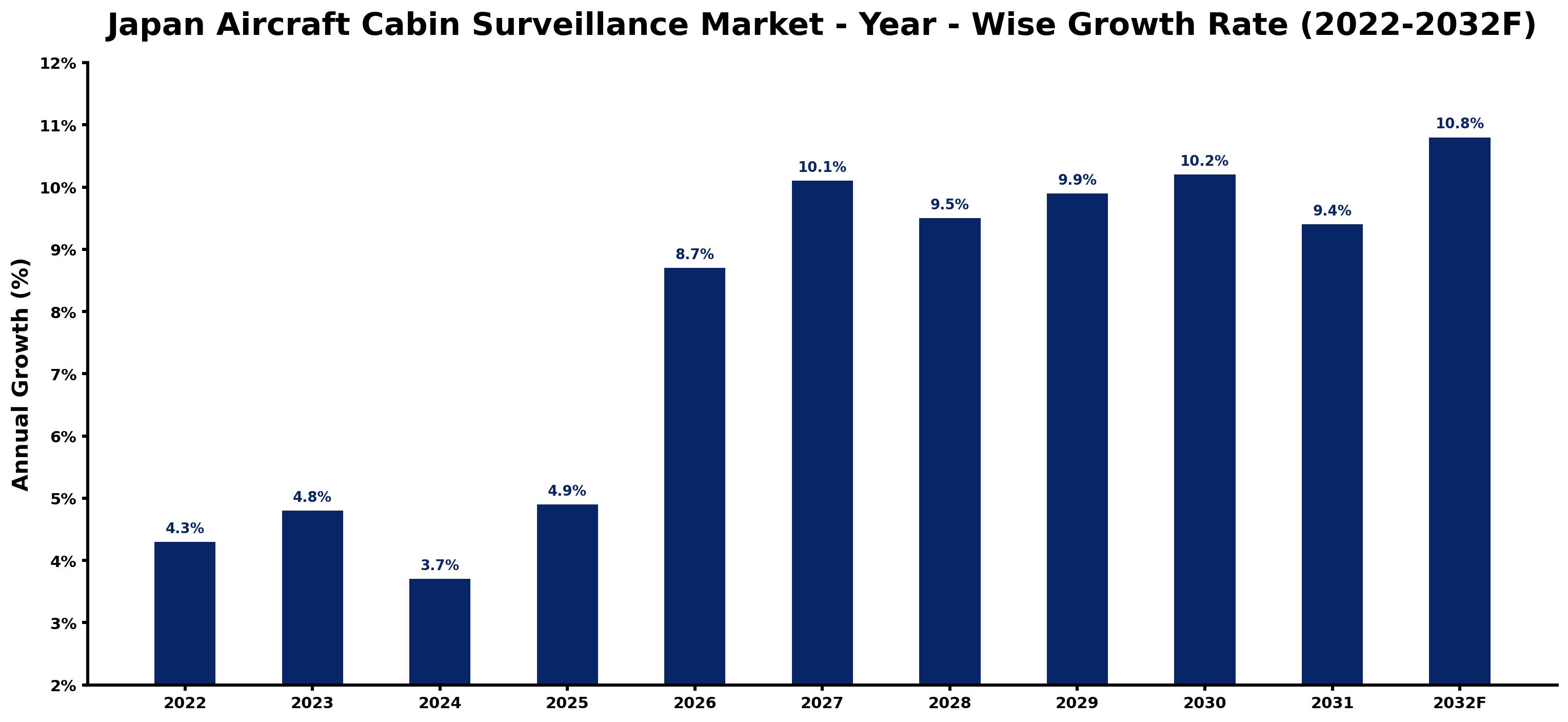
Year by year, the estimates below pair each growth rate with the development that shaped it.
| Year | Estimated Annual Growth (%) | Market Rationale |
| 2022 | 4.3 | The market exhibited steady growth due to ongoing demand from airlines and regulatory bodies. |
| 2023 | 4.8 | Demand increased as airlines sought to enhance passenger safety and comply with regulations. |
| 2024 | 3.7 | Growth slowed as airlines adjusted to new regulations and market conditions. |
| 2025 | 4.9 | The market saw a resurgence in growth as airlines invested in advanced surveillance technologies. |
| 2026 | 8.7 | Demand is expected to rise as the adoption of IP camera systems accelerates among aviation security vendors. |
| 2027 | 10.1 | Growth will continue as airlines expand their surveillance capabilities to meet regulatory requirements. |
| 2028 | 9.5 | The market is projected to experience a slight slowdown as the initial surge in investments stabilises. |
| 2029 | 9.9 | Demand is expected to pick up again as airlines recognise the importance of effective cabin surveillance. |
| 2030 | 10.2 | Growth will remain strong as advancements in surveillance technologies continue to emerge. |
| 2031 | 9.4 | The market will see a slowdown as saturation in certain segments begins to occur. |
| 2032 | 10.8 | Demand is projected to surge again as the introduction of new technologies further enhances surveillance capabilities. |
Note: Market size estimations and growth projections presented in this report are based on 6Wresearch's proprietary forecasting methodology, utilizing the latest available industry data, government publications, and primary research inputs.
Japan Aircraft Cabin Surveillance Market Synopsis
Aircraft Cabin Surveillance utilises advanced camera systems and sensors to monitor passenger safety and ensure compliance with aviation regulations. With over 100 airlines operating in Japan, demand for these systems is expected to rise. This growth is driven by new regulations from the Civil Aviation Bureau mandating enhanced surveillance measures, alongside increasing investments from airlines in advanced technologies to ensure passenger safety and security.
Market Dynamics Impact Analysis (2026–2032)
| Factor | Type | Impact | Primary Segment Affected |
| Increasing regulatory requirements for passenger safety and security measures | Driver | High | Passenger Monitoring |
| Growing investments in advanced surveillance technologies by airlines | Driver | High | IP Camera Systems |
| Rising demand for enhanced security measures in airports | Opportunity | High | Baggage Area Monitoring |
| Expansion of airport infrastructure and facilities to support advanced surveillance | Opportunity | Medium | Cockpit Surveillance |
| High costs associated with implementing advanced surveillance systems | Restraint | High | Door Access Cameras |
| Limited availability of skilled personnel for system integration and maintenance | Restraint | Medium | IR & Night Vision |
| Competition from alternative security technologies may limit market share | Challenge | High | Aerospace Security Vendors |
| Potential delays in regulatory approvals for new surveillance technologies | Challenge | Medium | Commercial Aircraft OEMs |
Evaluation of Drivers in Japan Aircraft Cabin Surveillance Market (2026–2032)
The main growth drivers and the segments they affect most are set out below.
| Drivers | Primary Segment Affected | Why It Matters (Evidence) |
| Implementation of new regulations by the Civil Aviation Bureau | Passenger Monitoring | This regulation mandates new surveillance measures, leading airlines to invest more in these systems. |
| Increasing passenger safety concerns among airlines | IP Camera Systems | Airlines are prioritising the installation of advanced camera systems to ensure compliance with safety standards. |
| Expansion of airport infrastructure in the Tokyo metropolitan area | Baggage Area Monitoring | New airport facilities are being equipped with advanced surveillance systems to improve security. |
| Growing awareness of security threats in aviation | Cockpit Surveillance | Airlines are investing in cockpit surveillance to monitor activities and ensure crew safety. |
| Rising demand for real-time monitoring capabilities | Door Access Cameras | Airlines are implementing door access cameras to control access to secure areas and improve security. |
In 2023, Japan's aviation industry, which includes over 100 airlines, recognised the need for advanced surveillance systems, resulting in increased investments. Approximately 1,000 commercial aircraft in operation necessitate these systems, leading to a surge in demand. The introduction of IP camera systems is set to increase by 15% by 2025, as airlines prioritise real-time monitoring capabilities. The expansion of airport infrastructure has prompted further investments in surveillance technologies, ensuring compliance with evolving safety standards.
Evaluation of Restraints in Japan Aircraft Cabin Surveillance Market
The main factors holding the market back are set out below.
| Market Restraint | Primary Segment Affected | Why It Matters (Evidence) |
| High costs associated with advanced surveillance system implementation | Door Access Cameras | Airlines face financial burdens when upgrading their surveillance systems to meet new regulations. |
| Limited availability of skilled personnel for system integration | IR & Night Vision | The shortage of qualified technicians can delay the implementation of advanced surveillance technologies. |
| Market saturation in certain surveillance segments | Passenger Monitoring | As more airlines adopt similar technologies, differentiation becomes challenging, impacting sales. |
| Potential regulatory delays in approving new technologies | Commercial Aircraft OEMs | Regulatory bodies may take time to evaluate and approve new surveillance systems, affecting deployment. |
| Competition from alternative security technologies | Aerospace Security Vendors | Emerging technologies may divert investments away from traditional surveillance systems. |
Japan Aircraft Cabin Surveillance Market Challenges
In 2023, Japan has approximately 1,000 commercial aircraft, all requiring advanced cabin surveillance technologies, which pressures buyers as they face rising costs for compliance with new regulations. The Civil Aviation Bureau's recent regulations complicate surveillance technology requirements, causing delays in system upgrades for importers who must adjust to these changes. Increased security measures have raised technology costs, forcing buyers to allocate additional budgets, with some reporting increases of up to 20%. Supply chain disruptions for advanced technologies hinder producers, resulting in longer lead times and potential operational risks for airlines.
Trends in the Japan Aircraft Cabin Surveillance Market
The shifts below are changing how Japan Aircraft Cabin Surveillance Market products are bought and supplied.
- Shift towards Advanced IP Camera Systems: Airlines are increasingly adopting IP camera systems for real-time monitoring, reflecting a shift in surveillance technology. In 2023, the demand for these systems is projected to rise by 15%, improving security measures across the aviation sector.
- Increased Focus on Baggage Area Monitoring: Airlines are prioritising baggage area monitoring to improve security and compliance. The segment is expected to grow at a CAGR of 13.8% from 2026 to 2032, driven by rising security concerns in airports.
- Expansion of Surveillance in Cockpit Areas: The need for cockpit surveillance is growing as airlines seek to ensure crew safety and compliance. New regulations are driving investments in this area, with significant upgrades expected in the coming years.
- Emergence of Motion Sensor-Enabled Cameras: There is a rising trend towards using motion sensor-enabled cameras in baggage areas for improved security. This shift is driven by the need for more efficient monitoring solutions and is projected to increase in adoption.
Investment Opportunities in the Japan Aircraft Cabin Surveillance Market
Investors looking at the Japan Aircraft Cabin Surveillance Market should consider the following areas.
- Airlines Seeking Advanced Security Solutions: Airlines are actively looking for advanced surveillance technologies to meet regulatory requirements. With Japan's aviation industry comprising over 100 airlines, there is a notable opportunity for suppliers to provide effective solutions.
- Collaborations with Aerospace Security Vendors: Partnering with aerospace security vendors presents an opportunity to integrate advanced surveillance systems into existing infrastructures. This approach can streamline implementation and improve overall security measures.
- Focus on Airport Infrastructure Upgrades: With the Japanese government allocating funds for upgrading airport security systems, there is a timely opportunity for suppliers to invest in advanced surveillance technologies that meet new standards.
- Emphasis on Compliance with Aviation Regulations: As aviation regulatory units push for improved safety measures, there is a growing demand for surveillance systems that comply with new regulations, presenting a lucrative opportunity for technology providers.
Government Initiatives in the Japan Aircraft Cabin Surveillance Market
In 2023, Japan's Civil Aviation Bureau implemented new regulations for cabin surveillance systems, enhancing safety compliance across the aviation sector. This regulation builds on the Economic Security Promotion Act of 2022, which supports supply-chain resilience for critical products. Together, these measures require manufacturers to invest in advanced surveillance technologies and ensure compliance with updated safety standards, ultimately improving passenger safety and operational efficiency.
The Japanese government allocated funds amounting to USD 10 million in 2023 for upgrading airport security systems, including advanced surveillance technologies. The Ministry of Land, Infrastructure, Transport and Tourism oversees these initiatives, ensuring that aviation security measures meet the latest standards. This funding aims to enhance the overall security infrastructure at major airports, such as Narita and Haneda, benefiting both producers and buyers in the aviation industry.
Future Insight of the Japan Aircraft Cabin Surveillance Market
The emergence of motion sensor-enabled cameras will reshape demand for surveillance technologies by 2032, as buyers prioritise improved safety features. Government funding for airport security upgrades will stimulate innovation in surveillance technologies, benefiting suppliers who align with new standards. Aviation security vendors are expected to boost their offerings of camera systems significantly, reflecting a shift towards more sophisticated monitoring solutions. Support from the Japan Aerospace Exploration Agency for aviation security innovations will further drive advancements in the market.
Market Segmentation Analysis
Japan Aircraft Cabin Surveillance Market report covers a detailed analysis of the following market segments:
By Surveillance Type – Passenger Monitoring Leads, Baggage Area Monitoring Expected to Grow Fastest
According to Saurav Kr Singh, Senior Research Analyst at 6Wresearch, Passenger Monitoring accounted for 34% of the market by surveillance type in 2025. Passenger Monitoring holds the largest share as it is critical for ensuring passenger safety and fulfilling regulatory requirements. The recent regulations implemented by Japan's Civil Aviation Bureau mandate these systems on all commercial aircraft, reinforcing their necessity. Over 2026–2032, Baggage Area Monitoring is expected to post the fastest growth, at a CAGR of 13.8%. Baggage Area Monitoring is growing rapidly due to increased security measures, particularly with the rise of motion sensor-enabled cameras in baggage handling areas. This growth is further supported by government initiatives focused on enhancing airport security infrastructure. Suppliers must focus on developing advanced monitoring solutions to meet the increasing demands from airlines and regulatory authorities.
By Camera Type – IP Camera Systems Lead, IR & Night Vision Expected to Grow Fastest
IP Camera Systems held 42% of the Japan Aircraft Cabin Surveillance Market by camera type in 2025. IP Camera Systems dominate the market because they are essential for real-time monitoring and are widely utilised by airlines across Japan. Their extensive use is bolstered by compliance with the ISO 9001 standard, ensuring high quality and reliability. The quickest growth will come from IR & Night Vision, forecast to expand at a CAGR of 14.7% between 2026 and 2032. IR & Night Vision cameras are seeing rapid growth due to their effectiveness in low-light conditions, which is crucial for security in various airport environments. This trend is likely to be enhanced by ongoing technological advancements supported by national aerospace initiatives. Buyers should invest in advanced camera technologies to improve their surveillance capabilities and ensure compliance with new regulations.
By Distribution Channel – Aerospace Security Vendors Lead, OEM Security Integrators Expected to Grow Fastest
In 2025, Aerospace Security Vendors led the distribution channel split with a 43% share. Aerospace Security Vendors lead the distribution channel as they provide essential surveillance solutions tailored for the aviation sector. Their established relationships with over 100 airlines in Japan ensure a steady demand for cabin surveillance systems. OEM Security Integrators are set to record the highest CAGR in this split, 13.1% over 2026–2032. OEM Security Integrators are rapidly expanding their role as they integrate advanced surveillance systems directly into aircraft, responding to the increasing regulatory requirements. Their growth is expected to align with the anticipated increase in surveillance system offerings by vendors. Suppliers must strengthen partnerships with OEMs to capture the growing market for integrated surveillance solutions.
By End User – Airlines Lead, Aviation Regulatory Units Expected to Grow Fastest
Airlines took 42% of end user revenue in 2025, more than any other category. Airlines constitute the largest segment as they are the primary users of cabin surveillance systems, motivated by the need to ensure passenger safety and adhere to regulatory standards. With around 1,000 commercial aircraft in operation, the demand for these systems is considerable. Aviation Regulatory Units are projected to grow fastest, at a CAGR of 12.7% during 2026–2032. Aviation Regulatory Units are the fastest-growing end user as they increase their oversight on compliance and safety standards, particularly following the new regulations enacted in 2023. Their heightened focus on surveillance will drive demand for advanced monitoring technologies. Suppliers should align their offerings with the requirements of regulatory bodies to ensure compliance and improve safety measures.
Key Attractiveness of the Report
- 10 Years of Market Numbers
- Historical Data Starting from 2022 to 2025
- Base Year 2025
- Forecast Data until 2032
- Key Performance Indicators Impacting the Market
- Major Upcoming Developments and Projects
Key Highlights of the Report:
- Japan Aircraft Cabin Surveillance Market Outlook
- Market Size of Japan Aircraft Cabin Surveillance Market, 2025
- Forecast of Japan Aircraft Cabin Surveillance Market, 2032
- Historical Data and Forecast of Japan Aircraft Cabin Surveillance Revenues & Volume for the Period 2022-2032F
- Japan Aircraft Cabin Surveillance Market Trend Evolution
- Japan Aircraft Cabin Surveillance Market Drivers and Challenges
- Japan Aircraft Cabin Surveillance Price Trends
- Japan Aircraft Cabin Surveillance Porter's Five Forces
- Japan Aircraft Cabin Surveillance Industry Life Cycle
- Historical Data and Forecast of Japan Aircraft Cabin Surveillance Market Revenues & Volume By Surveillance Type for the Period 2022-2032F
- Historical Data and Forecast of Japan Aircraft Cabin Surveillance Market Revenues & Volume By Passenger Monitoring for the Period 2022-2032F
- Historical Data and Forecast of Japan Aircraft Cabin Surveillance Market Revenues & Volume By Cockpit Surveillance for the Period 2022-2032F
- Historical Data and Forecast of Japan Aircraft Cabin Surveillance Market Revenues & Volume By Baggage Area Monitoring for the Period 2022-2032F
- Historical Data and Forecast of Japan Aircraft Cabin Surveillance Market Revenues & Volume By Door Access Cameras for the Period 2022-2032F
- Historical Data and Forecast of Japan Aircraft Cabin Surveillance Market Revenues & Volume By Camera Type for the Period 2022-2032F
- Historical Data and Forecast of Japan Aircraft Cabin Surveillance Market Revenues & Volume By IR & Night Vision for the Period 2022-2032F
- Historical Data and Forecast of Japan Aircraft Cabin Surveillance Market Revenues & Volume By IP Camera Systems for the Period 2022-2032F
- Historical Data and Forecast of Japan Aircraft Cabin Surveillance Market Revenues & Volume By Wide-Angle CCTV for the Period 2022-2032F
- Historical Data and Forecast of Japan Aircraft Cabin Surveillance Market Revenues & Volume By Motion Sensor Enabled for the Period 2022-2032F
- Historical Data and Forecast of Japan Aircraft Cabin Surveillance Market Revenues & Volume By Distribution Channel for the Period 2022-2032F
- Historical Data and Forecast of Japan Aircraft Cabin Surveillance Market Revenues & Volume By Aerospace Security Vendors for the Period 2022-2032F
- Historical Data and Forecast of Japan Aircraft Cabin Surveillance Market Revenues & Volume By OEM Security Integrators for the Period 2022-2032F
- Historical Data and Forecast of Japan Aircraft Cabin Surveillance Market Revenues & Volume By Direct Distributors for the Period 2022-2032F
- Historical Data and Forecast of Japan Aircraft Cabin Surveillance Market Revenues & Volume By Online Aircraft Suppliers for the Period 2022-2032F
- Historical Data and Forecast of Japan Aircraft Cabin Surveillance Market Revenues & Volume By End User for the Period 2022-2032F
- Historical Data and Forecast of Japan Aircraft Cabin Surveillance Market Revenues & Volume By Airlines for the Period 2022-2032F
- Historical Data and Forecast of Japan Aircraft Cabin Surveillance Market Revenues & Volume By Aviation Regulatory Units for the Period 2022-2032F
- Historical Data and Forecast of Japan Aircraft Cabin Surveillance Market Revenues & Volume By Commercial Aircraft OEMs for the Period 2022-2032F
- Historical Data and Forecast of Japan Aircraft Cabin Surveillance Market Revenues & Volume By Security System Integrators for the Period 2022-2032F
- Japan Aircraft Cabin Surveillance Import Export Trade Statistics
- Market Opportunity Assessment By Surveillance Type
- Market Opportunity Assessment By Camera Type
- Market Opportunity Assessment By Distribution Channel
- Market Opportunity Assessment By End User
- Japan Aircraft Cabin Surveillance Top Companies Market Share
- Japan Aircraft Cabin Surveillance Competitive Benchmarking By Technical and Operational Parameters
- Japan Aircraft Cabin Surveillance Company Profiles
- Japan Aircraft Cabin Surveillance Key Strategic Recommendations
Market Covered
This report examines the market across the segments below.
By Surveillance Type
- Passenger Monitoring
- Cockpit Surveillance
- Baggage Area Monitoring
- Door Access Cameras
By Camera Type
- IR & Night Vision
- IP Camera Systems
- Wide-Angle CCTV
- Motion Sensor Enabled
By Distribution Channel
- Aerospace Security Vendors
- OEM Security Integrators
- Direct Distributors
- Online Aircraft Suppliers
By End User
- Airlines
- Aviation Regulatory Units
- Commercial Aircraft OEMs
- Security System Integrators































