Japan Aircraft Canopy Frame Market Size & Growth Rate
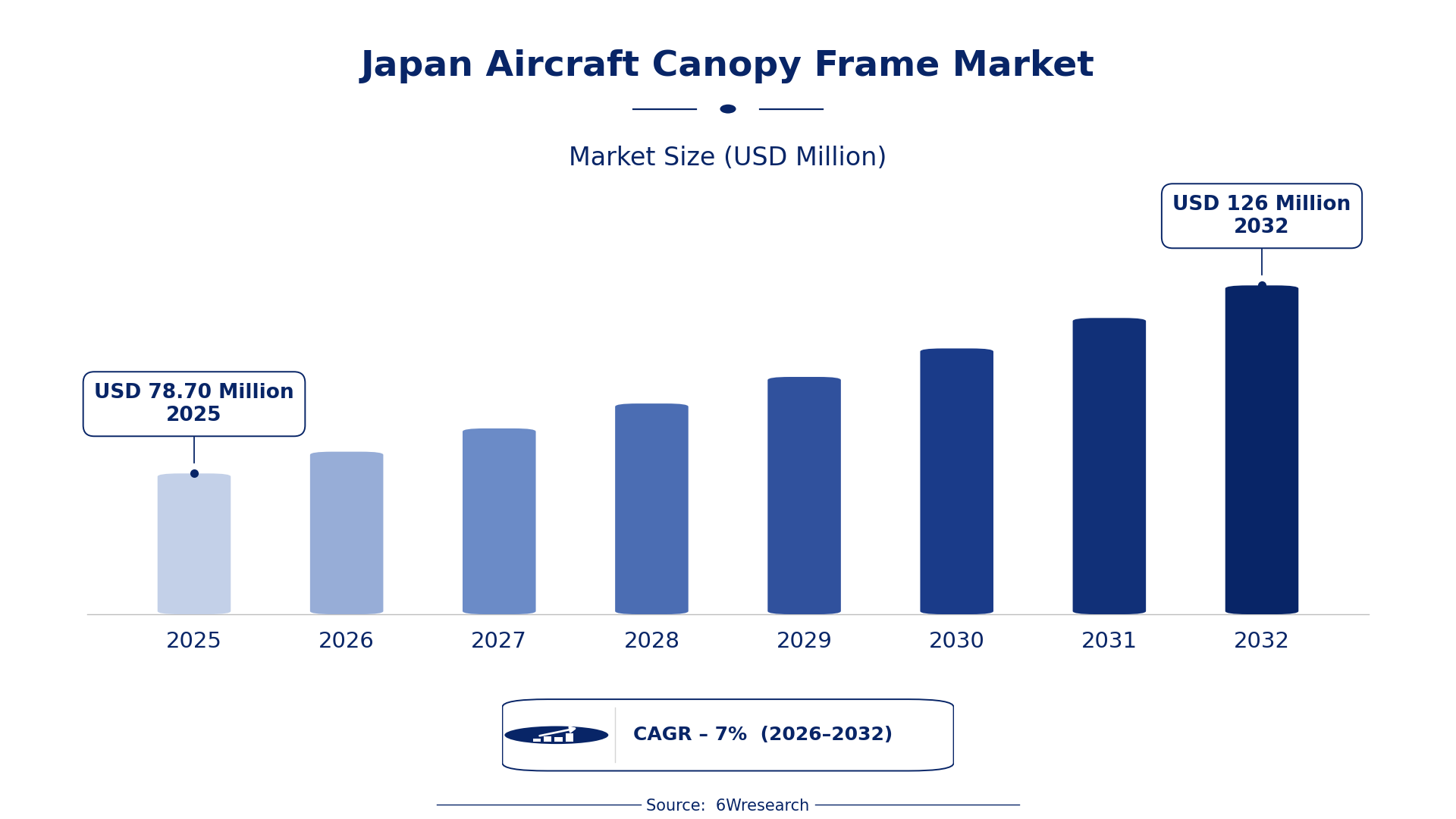
According to 6Wresearch internal database and industry insights, the Japan Aircraft Canopy Frame Market was valued at USD 78.70 Million in 2025 and is projected to reach USD 126 Million by 2032, growing at a CAGR of approximately 7% during 2026–2032.
Japan Aircraft Canopy Frame Market Highlights
| Report Metric | Details |
| Report Name | Japan Aircraft Canopy Frame Market (2026-2032) |
| Market Size 2025 | USD 78.70 Million |
| Market Size 2032 | USD 126 Million |
| Absolute Growth 2025–2032 | USD 47.30 Million |
| CAGR 2026–2032 | 7% |
| Peak Annual Growth | 7.7% in 2026 |
| Forecast Period | 2026–2032 |
| Historical Data | 2022–2025 |
| Base Year | 2025 |
| Leading Frame Type, 2025 | Fighter Jet Canopy (50% share) |
| Leading Material Type, 2025 | Titanium Alloy (46% share) |
| Leading Distribution Channel, 2025 | Defense Material Vendors (44% share) |
| Leading End User, 2025 | Military Jet OEMs (40% share) |
| Fastest-Growing Frame Type | Training Aircraft Canopy (9.6% CAGR) |
| Fastest-Growing Material Type | Carbon Fiber (9.8% CAGR) |
| Fastest-Growing Distribution Channel | Aircraft Structure Suppliers (9.0% CAGR) |
| Fastest-Growing End User | Flight School Fleet OEMs (8.8% CAGR) |
| Growing Sector | Flight School Fleet OEMs |
| Key End Users | Military Jet OEMs, Flight School Fleet OEMs, Civil Helicopter Makers, Stunt Aircraft Builders |
Japan Aircraft Canopy Frame Market Year-wise Growth Rate and Key Drivers (2022–2032)
This graph illustrates the annual growth rates of the market from 2022 to 2032, highlighting a steady upward trajectory and projected market expansion over the forecast period.
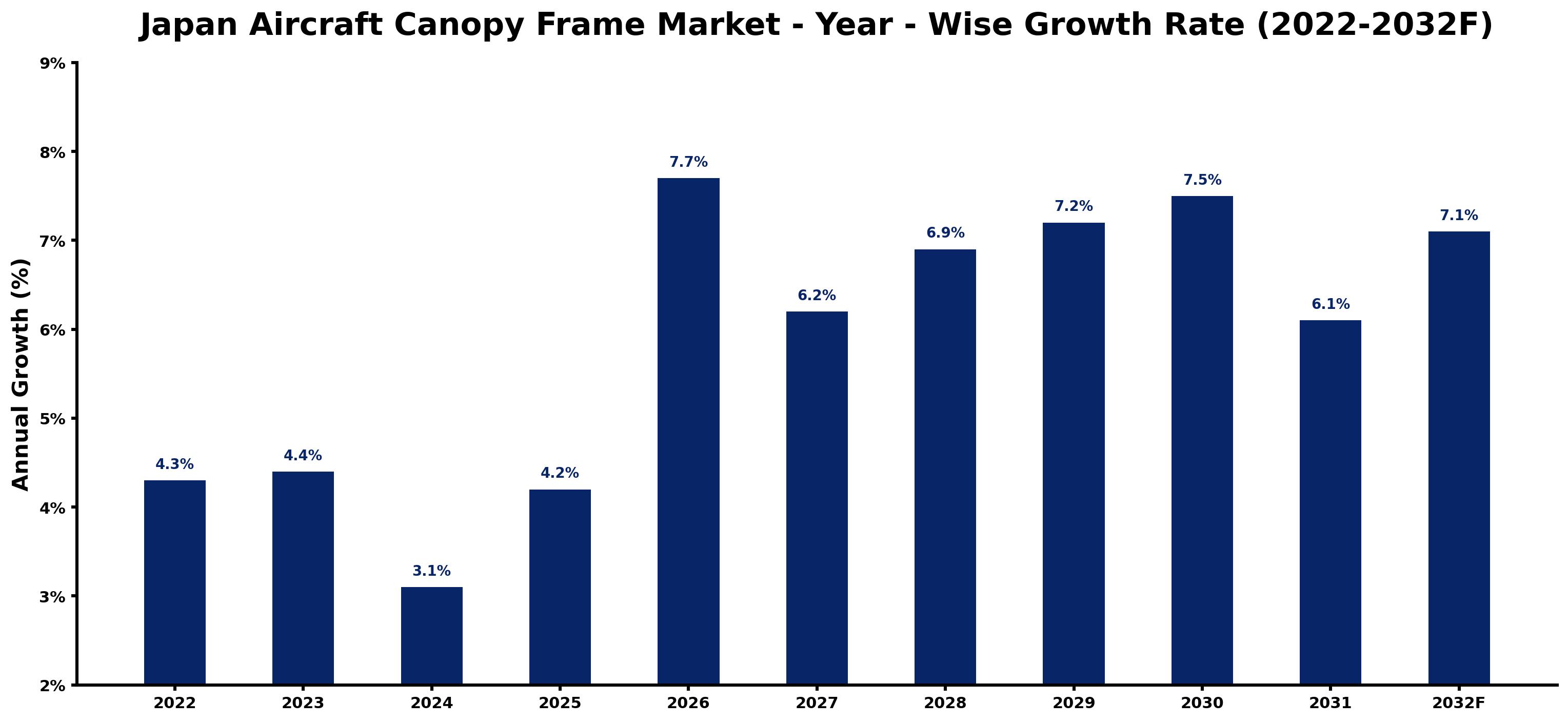
For each year, the table pairs the estimated growth rate with the leading influence on demand, showing how the drivers changed across the period.
| Year | Estimated Annual Growth (%) | Market Rationale |
| 2022 | 4.3 | The market showed steady growth due to ongoing military contracts and production activities. |
| 2023 | 4.4 | Demand increased as the military aircraft fleet expanded with new acquisitions and upgrades. |
| 2024 | 3.1 | Growth slowed as production faced temporary setbacks from supply chain issues. |
| 2025 | 4.2 | The market rebounded with renewed investments in aerospace technology and increased production. |
| 2026 | 7.7 | Demand is expected to surge as the industry capitalises on advancements in materials and design. |
| 2027 | 6.2 | Growth is projected to moderate as the market adjusts to the previous year's rapid expansion. |
| 2028 | 6.9 | Demand is anticipated to rise again with more military contracts and a focus on modernisation. |
| 2029 | 7.2 | The market is expected to continue growing, driven by increased training aircraft production. |
| 2030 | 7.5 | Growth will remain strong as military and civil sectors expand their fleets. |
| 2031 | 6.1 | The market will experience a slowdown as demand stabilises after several years of growth. |
| 2032 | 7.1 | Demand is projected to rise as new projects and contracts are initiated. |
Note: Market size estimations and growth projections presented in this report are based on 6Wresearch's proprietary forecasting methodology, utilizing the latest available industry data, government publications, and primary research inputs.
Japan Aircraft Canopy Frame Market Synopsis
Aircraft canopy frames are structural components designed to protect pilots and passengers in military jets and helicopters. The Japan Aircraft Canopy Frame Market is expanding due to the active aerospace industry, which employs over 80,000 individuals and is supported by military contracts. The Ministry of Defense allocated ¥5 billion for aerospace technology development in 2023, driving demand from military jet OEMs and training aircraft manufacturers. The Tokyo region serves as a manufacturing hub, boosting production capacity and innovation.
Market Dynamics Impact Analysis (2026–2032)
| Factor | Type | Impact | Primary Segment Affected |
| Growing military contracts for aircraft components | Driver | High | Fighter Jet Canopy |
| Increased adoption of advanced materials like carbon fiber | Driver | High | Training Aircraft Canopy |
| Expansion of military aircraft fleet | Opportunity | High | Helicopter Canopy |
| Rising demand for training aircraft due to pilot shortages | Opportunity | Medium | Training Aircraft Canopy |
| High production costs of advanced materials | Restraint | High | Titanium Alloy |
| Strict regulations on aerospace materials and standards | Restraint | Medium | Carbon Fiber |
| Limited availability of skilled workforce in aerospace manufacturing | Challenge | High | Fighter Jet Canopy |
| Dependence on government contracts for revenue stability | Challenge | Medium | Military Jet OEMs |
Evaluation of Drivers in Japan Aircraft Canopy Frame Market (2026–2032)
These are the developments adding the most demand over the forecast period.
| Drivers | Primary Segment Affected | Why It Matters (Evidence) |
| Increased military budgets for aerospace technology | Fighter Jet Canopy | The budget for aerospace technology development in 2023 is ¥5 billion, boosting demand for components. |
| Growing preference for lightweight materials | Carbon Fiber | The adoption of carbon fiber canopies is increasing, improving aircraft performance and reducing weight. |
| Expansion of training programs for pilots | Training Aircraft Canopy | Flight schools are expanding their fleets, leading to higher demand for training aircraft canopies. |
| Technological advancements in aircraft design | Helicopter Canopy | Innovations in design are driving the need for more sophisticated helicopter canopies. |
| Rising exports of aerospace components | Titanium Alloy | Japan aims to increase domestic aircraft production by 15% by 2025, boosting export opportunities. |
Several shifts outside the market lift sales. The allocation of ¥5 billion for aerospace technology development in 2023 has led to increased military budgets, boosting demand for fighter jet canopies. The expansion of flight schools has resulted in a higher need for training aircraft canopies, with a projected increase in training aircraft production. The growing preference for lightweight materials drives demand further, particularly for carbon fiber canopies. Japan's goal to increase domestic aircraft production by 15% by 2025 will expand the market for titanium alloy canopies.
Evaluation of Restraints in Japan Aircraft Canopy Frame Market
Below are the constraints most often cited by buyers and suppliers, with the segment each affects.
| Market Restraint | Primary Segment Affected | Why It Matters (Evidence) |
| High costs associated with advanced materials | Titanium Alloy | The production costs for titanium alloy canopies are higher than traditional materials, limiting widespread adoption. |
| Complex regulatory compliance requirements | Carbon Fiber | Strict regulations for aerospace materials, including ISO 9001, increase the burden on manufacturers. |
| Limited skilled workforce availability | Fighter Jet Canopy | The aerospace industry faces challenges in finding skilled workers, impacting production capabilities. |
| Dependence on government contracts for revenue | Military Jet OEMs | Reliance on government contracts creates uncertainty in revenue streams for manufacturers. |
| Supply chain disruptions affecting material availability | Training Aircraft Canopy | Global supply chain issues have resulted in delays and increased costs for essential materials. |
Japan Aircraft Canopy Frame Market Challenges
Training aircraft manufacturers face a shortage of skilled technicians, limiting production capacity and delaying deliveries for flight schools by up to three months. This skills gap arises from a lack of targeted vocational training programmes in the aerospace sector. Rising material costs, especially for carbon fiber, have increased production expenses by 15%, squeezing profit margins for producers. Competition from foreign manufacturers drives down prices, forcing local suppliers to reduce costs, which can compromise quality and reliability. Supply chain disruptions for titanium alloys have led to increased lead times, delaying projects for military contractors by up to six months.
Trends in the Japan Aircraft Canopy Frame Market
These developments are changing demand patterns in the Japan Aircraft Canopy Frame Market.
- Shift towards Lightweight Materials in Aerospace: The adoption of carbon fiber canopies is on the rise, with a notable 10% increase in usage among military jets in 2023. This trend reflects the industry's focus on improving aircraft performance and reducing weight.
- Growing Demand for Training Aircraft: The number of training aircraft in Japan is projected to increase by 15% by 2025, driven by a surge in pilot training programs. This shift highlights the need for additional training aircraft canopies.
- Expansion of Aerospace Manufacturing Hubs: The Tokyo region has experienced a 10% increase in aerospace-related startups in 2023, promoting innovation and production capacity. This growth supports the demand for various aircraft components, including canopies.
- Focus on Indigenous Production of Military Components: The Japan Defense Agency prioritises indigenous production of military aircraft components, aiming to reduce reliance on imports. This focus is expected to drive demand for locally manufactured canopy frames.
Investment Opportunities in the Japan Aircraft Canopy Frame Market
Below are the investment opportunities with the strongest case in the Japan Aircraft Canopy Frame Market.
- Supply of Advanced Composite Materials: With a projected 9.8% growth for carbon fiber canopies, suppliers can concentrate on providing advanced composite materials to military jet OEMs, capitalising on the rising need for lightweight components.
- Investment in Training Aircraft Production: Flight school fleet OEMs are expanding their operations, creating opportunities for suppliers to invest in training aircraft production, which is anticipated to grow in the coming years.
- Development of Custom Canopy Solutions: The demand for custom frame vendors is increasing, particularly for niche applications in aerobatic aircraft. This presents an opportunity for suppliers to develop tailored solutions for specialised needs.
- Expansion of Aerospace Technology Support Programs: The Tokyo Metropolitan Government's subsidies for aerospace technology development offer opportunities for investment in advanced canopy frame designs, benefiting local manufacturers.
Government Initiatives in the Japan Aircraft Canopy Frame Market
The Chemical Substances Control Law, established in 1973, mandates the evaluation and control of chemical substances used in manufacturing aircraft components. This law ensures that producers comply with safety and environmental standards, impacting the materials used in aircraft canopy frames. The Economic Security Promotion Act of 2022 supports supply-chain resilience for critical aerospace products, encouraging local production and innovation.
In 2023, the Japan Aerospace Exploration Agency (JAXA) allocated ¥2 billion to support aerospace innovation projects. The Defense Procurement Agency oversees military aircraft contracts, ensuring compliance with national standards and promoting local manufacturers. These agencies are instrumental in funding and approving projects that improve the capabilities of the aircraft canopy frame market.
Future Insight of the Japan Aircraft Canopy Frame Market
The military sector will experience improved aircraft capabilities due to advancements in aerospace technology, supported by a budget of ¥5 billion for development. By 2032, the adoption of carbon fiber canopies will rise, improving aircraft performance and reducing weight. The Tokyo region will see a surge in aerospace startups, promoting innovation and competition among suppliers. The Japan Aerospace Exploration Agency will support research initiatives, refining manufacturing processes and establishing higher standards for the industry.
Market Segmentation Analysis
Japan Aircraft Canopy Frame Market report covers a detailed analysis of the following market segments:
By Frame Type – Fighter Jet Canopy Leads, Training Aircraft Canopy Expected to Grow Fastest
According to Saurav Kr Singh, Senior Research Analyst at 6Wresearch, in 2025, Fighter Jet Canopy led the frame type split with a 50% share. The Fighter Jet Canopy holds the largest share due to its critical role in military operations, ensuring protection and visibility for pilots in combat scenarios. With over 300 fighter jets in Japan's military fleet, demand for these canopies remains consistently high. Over 2026–2032, Training Aircraft Canopy is expected to post the fastest growth, at a CAGR of 9.6%. The Training Aircraft Canopy is witnessing rapid growth as flight schools increasingly invest in advanced training solutions. This segment's expansion is driven by the rising number of training aircraft needed to effectively prepare new pilots. Suppliers should enhance their product offerings for training aircraft to capitalise on this expanding market.
By Material Type – Titanium Alloy Leads, Carbon Fiber Expected to Grow Fastest
Titanium Alloy accounted for 46% of the market by material type in 2025. Titanium Alloy leads the market owing to its exceptional strength-to-weight ratio, particularly in military applications where performance is critical. Its widespread use in various military aircraft reinforces its dominant market position. Carbon Fiber is set to record the highest CAGR in this split, 9.8% over 2026–2032. Carbon Fiber is growing rapidly due to its lightweight and strong characteristics, making it suitable for contemporary aircraft designs. The rising adoption of carbon fiber canopies indicates a shift towards advanced materials in the industry. Manufacturers need to invest in carbon fiber technology to align with the changing demands of the aerospace market.
By Distribution Channel – Defense Material Vendors Lead, Aircraft Structure Suppliers Expected to Grow Fastest
Defense Material Vendors held 44% of the Japan Aircraft Canopy Frame Market by distribution channel in 2025. Defense Material Vendors dominate the market as they are the primary suppliers for military aircraft components, ensuring a steady supply of essential materials. Their established relationships with military contractors solidify their position in the market. Aircraft Structure Suppliers are projected to grow fastest, at a CAGR of 9.0% during 2026–2032. Aircraft Structure Suppliers are experiencing swift growth as they provide crucial parts for aircraft manufacturing, aligning with the escalating production of new aircraft. Their importance in the supply chain is increasing as aircraft demand rises. Suppliers should strengthen partnerships with aircraft structure suppliers to enhance their market presence.
By End User – Military Jet OEMs Lead, Flight School Fleet OEMs Expected to Grow Fastest
Military Jet OEMs took 40% of end user revenue in 2025, more than any other category. Military Jet OEMs account for the largest share as they are the primary end users for fighter and training aircraft, driving steady demand for canopies. Their commitment to developing advanced military jets ensures a stable market for these components. The quickest growth will come from Flight School Fleet OEMs, forecast to expand at a CAGR of 8.8% between 2026 and 2032. Flight School Fleet OEMs are the fastest-growing segment as the demand for training aircraft rises to support more pilot training programmes. This growth reflects the expanding aviation sector and the necessity for skilled pilots. Suppliers should target flight school OEMs to capitalise on the increasing need for training aircraft.
Key Attractiveness of the Report
- 10 Years of Market Numbers
- Historical Data Starting from 2022 to 2025
- Base Year 2025
- Forecast Data until 2032
- Key Performance Indicators Impacting the Market
- Major Upcoming Developments and Projects
Key Highlights of the Report:
- Japan Aircraft Canopy Frame Market Outlook
- Market Size of Japan Aircraft Canopy Frame Market, 2025
- Forecast of Japan Aircraft Canopy Frame Market, 2032
- Historical Data and Forecast of Japan Aircraft Canopy Frame Revenues & Volume for the Period 2022-2032F
- Japan Aircraft Canopy Frame Market Trend Evolution
- Japan Aircraft Canopy Frame Market Drivers and Challenges
- Japan Aircraft Canopy Frame Price Trends
- Japan Aircraft Canopy Frame Porter's Five Forces
- Japan Aircraft Canopy Frame Industry Life Cycle
- Historical Data and Forecast of Japan Aircraft Canopy Frame Market Revenues & Volume By Frame Type for the Period 2022-2032F
- Historical Data and Forecast of Japan Aircraft Canopy Frame Market Revenues & Volume By Fighter Jet Canopy for the Period 2022-2032F
- Historical Data and Forecast of Japan Aircraft Canopy Frame Market Revenues & Volume By Training Aircraft Canopy for the Period 2022-2032F
- Historical Data and Forecast of Japan Aircraft Canopy Frame Market Revenues & Volume By Helicopter Canopy for the Period 2022-2032F
- Historical Data and Forecast of Japan Aircraft Canopy Frame Market Revenues & Volume By Aerobatic Canopy Frame for the Period 2022-2032F
- Historical Data and Forecast of Japan Aircraft Canopy Frame Market Revenues & Volume By Material Type for the Period 2022-2032F
- Historical Data and Forecast of Japan Aircraft Canopy Frame Market Revenues & Volume By Titanium Alloy for the Period 2022-2032F
- Historical Data and Forecast of Japan Aircraft Canopy Frame Market Revenues & Volume By Carbon Fiber for the Period 2022-2032F
- Historical Data and Forecast of Japan Aircraft Canopy Frame Market Revenues & Volume By Steel Alloy for the Period 2022-2032F
- Historical Data and Forecast of Japan Aircraft Canopy Frame Market Revenues & Volume By Aluminum for the Period 2022-2032F
- Historical Data and Forecast of Japan Aircraft Canopy Frame Market Revenues & Volume By Distribution Channel for the Period 2022-2032F
- Historical Data and Forecast of Japan Aircraft Canopy Frame Market Revenues & Volume By Defense Material Vendors for the Period 2022-2032F
- Historical Data and Forecast of Japan Aircraft Canopy Frame Market Revenues & Volume By Aircraft Structure Suppliers for the Period 2022-2032F
- Historical Data and Forecast of Japan Aircraft Canopy Frame Market Revenues & Volume By Online Aerospace Shops for the Period 2022-2032F
- Historical Data and Forecast of Japan Aircraft Canopy Frame Market Revenues & Volume By Custom Frame Vendors for the Period 2022-2032F
- Historical Data and Forecast of Japan Aircraft Canopy Frame Market Revenues & Volume By End User for the Period 2022-2032F
- Historical Data and Forecast of Japan Aircraft Canopy Frame Market Revenues & Volume By Military Jet OEMs for the Period 2022-2032F
- Historical Data and Forecast of Japan Aircraft Canopy Frame Market Revenues & Volume By Flight School Fleet OEMs for the Period 2022-2032F
- Historical Data and Forecast of Japan Aircraft Canopy Frame Market Revenues & Volume By Civil Helicopter Makers for the Period 2022-2032F
- Historical Data and Forecast of Japan Aircraft Canopy Frame Market Revenues & Volume By Stunt Aircraft Builders for the Period 2022-2032F
- Japan Aircraft Canopy Frame Import Export Trade Statistics
- Market Opportunity Assessment By Frame Type
- Market Opportunity Assessment By Material Type
- Market Opportunity Assessment By Distribution Channel
- Market Opportunity Assessment By End User
- Japan Aircraft Canopy Frame Top Companies Market Share
- Japan Aircraft Canopy Frame Competitive Benchmarking By Technical and Operational Parameters
- Japan Aircraft Canopy Frame Company Profiles
- Japan Aircraft Canopy Frame Key Strategic Recommendations
Market Covered
The study includes the following segmentation.
By Frame Type
- Fighter Jet Canopy
- Training Aircraft Canopy
- Helicopter Canopy
- Aerobatic Canopy Frame
By Material Type
- Titanium Alloy
- Carbon Fiber
- Steel Alloy
- Aluminum
By Distribution Channel
- Defense Material Vendors
- Aircraft Structure Suppliers
- Online Aerospace Shops
- Custom Frame Vendors
By End User
- Military Jet OEMs
- Flight School Fleet OEMs
- Civil Helicopter Makers
- Stunt Aircraft Builders































