Japan Aircraft Carrier Refurbishment Market Size & Growth Rate
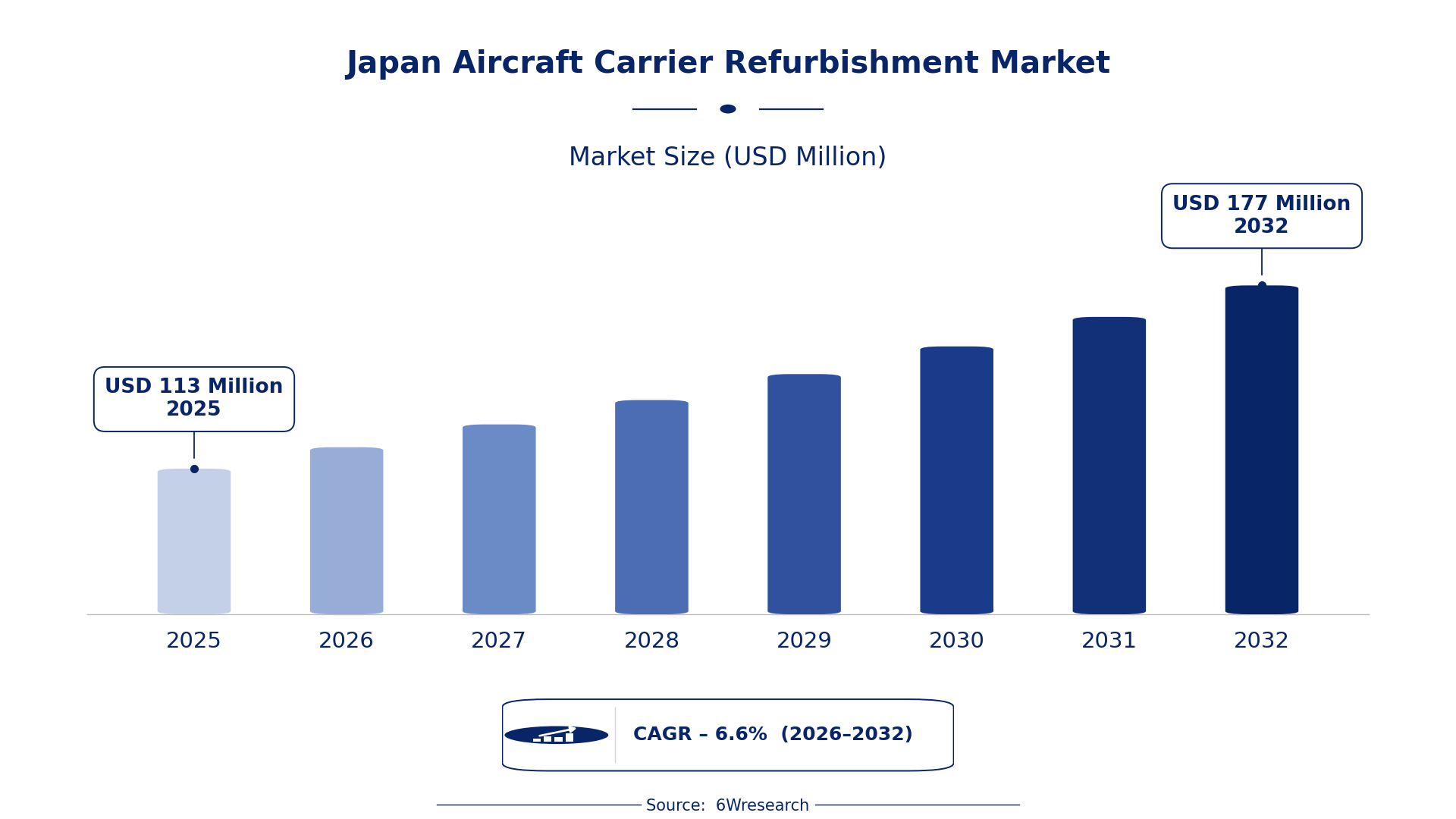
According to 6Wresearch internal database and industry insights, the Japan Aircraft Carrier Refurbishment Market was valued at USD 113 Million in 2025 and is projected to reach USD 177 Million by 2032, growing at a CAGR of approximately 6.6% during 2026–2032.
Japan Aircraft Carrier Refurbishment Market Highlights
| Report Metric | Details |
| Report Name | Japan Aircraft Carrier Refurbishment Market (2026-2032) |
| Market Size 2025 | USD 113 Million |
| Market Size 2032 | USD 177 Million |
| Absolute Growth 2025–2032 | USD 64 Million |
| CAGR 2026–2032 | 6.6% |
| Peak Annual Growth | 7.1% in 2027 |
| Forecast Period | 2026–2032 |
| Historical Data | 2022–2025 |
| Base Year | 2025 |
| Leading Service Type, 2025 | Hull Reinforcement (36% share) |
| Leading Component Focus, 2025 | Steel Plates (38% share) |
| Leading Distribution Channel, 2025 | Naval Contractors (47% share) |
| Leading End User, 2025 | Navy Commands (36% share) |
| Fastest-Growing Service Type | Electronics Overhaul (8.8% CAGR) |
| Fastest-Growing Component Focus | Radar & Comms (9.7% CAGR) |
| Fastest-Growing Distribution Channel | Defense Integrators (8.3% CAGR) |
| Fastest-Growing End User | Shipyards (8.5% CAGR) |
| Growing Sector | Naval Defence |
| Key End Users | Navy Commands, Shipyards, Maintenance Service Providers |
Japan Aircraft Carrier Refurbishment Market Year-wise Growth Rate and Key Drivers (2022–2032)
This graph illustrates the annual growth rates of the market from 2022 to 2032, highlighting a steady upward trajectory and projected market expansion over the forecast period.
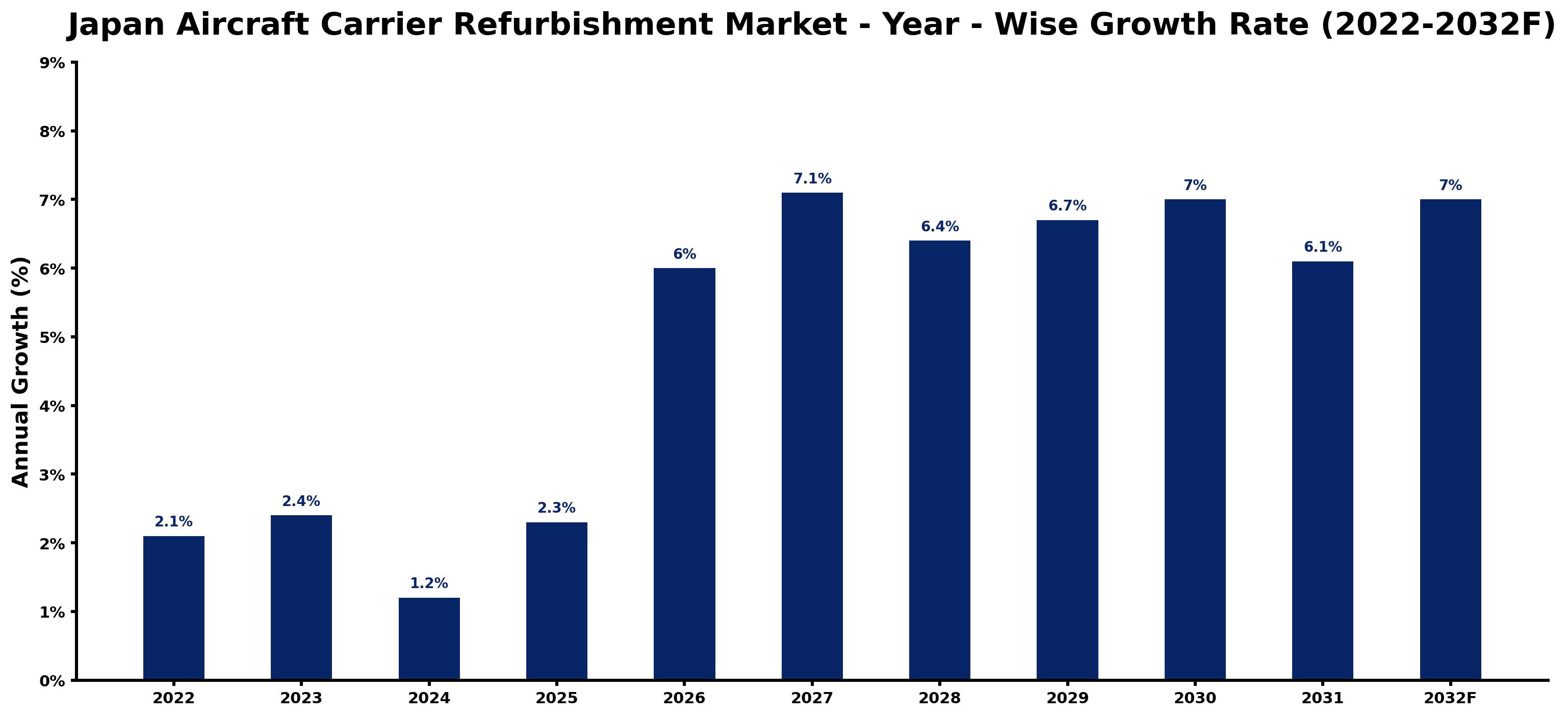
Year by year, the estimates below pair each growth rate with the development that shaped it.
| Year | Estimated Annual Growth (%) | Market Rationale |
| 2022 | 2.1 | The market showed steady growth, reflecting ongoing military investments. |
| 2023 | 2.4 | Demand increased as the Japanese Maritime Self-Defense Force focused on modernization. |
| 2024 | 1.2 | Growth slowed due to budget adjustments and project timelines. |
| 2025 | 2.3 | A renewed focus on naval capabilities led to increased refurbishment projects. |
| 2026 | 6.0 | Rising demand for advanced systems is expected to spur investment in upgrades. |
| 2027 | 7.1 | The peak growth year is driven by major naval modernization initiatives. |
| 2028 | 6.4 | Growth is projected to slow slightly as projects reach completion and budgets stabilise. |
| 2029 | 6.7 | Increased operational requirements will lead to renewed interest in refurbishment. |
| 2030 | 7.0 | Demand for enhanced capabilities is expected to drive refurbishment investments. |
| 2031 | 6.1 | A slight slowdown will occur as the market adjusts to new technologies. |
| 2032 | 7.0 | Growth will resume as new technologies are implemented in refurbishment. |
Note: Market size estimations and growth projections presented in this report are based on 6Wresearch's proprietary forecasting methodology, utilizing the latest available industry data, government publications, and primary research inputs.
Japan Aircraft Carrier Refurbishment Market Synopsis
Aircraft carrier refurbishment involves upgrading naval vessels to improve operational capabilities, including structural reinforcements and electronic system upgrades. The Japan Aircraft Carrier Refurbishment Market is expanding, driven by the Japanese Maritime Self-Defense Force's commitment to modernisation, with a defence budget allocation of ¥1.5 trillion in 2023. The focus on extending the lifespan of existing naval assets and increasing operational readiness by 20% by 2025 propels demand for these services.
Market Dynamics Impact Analysis (2026–2032)
| Factor | Type | Impact | Primary Segment Affected |
| Increased military budget allocations are driving demand for refurbishment services. | Driver | High | Hull Reinforcement |
| The need for advanced electronic systems is creating opportunities for upgrades. | Driver | High | Electronics Overhaul |
| Growing naval capabilities are creating opportunities for refurbishment projects. | Opportunity | High | Navy Commands |
| Strategic coastal areas are becoming vital hubs for refurbishment activities. | Opportunity | Medium | Shipyards |
| Limited availability of skilled labour can hinder project timelines. | Restraint | High | Maintenance Service Providers |
| Rising material costs may impact overall refurbishment budgets. | Restraint | Medium | Steel Plates |
| High costs associated with advanced technology upgrades can deter investment. | Challenge | High | Propulsion System Upgrade |
| Long lead times for critical components can delay refurbishment projects. | Challenge | Medium | Defense Repair Yards |
Evaluation of Drivers in Japan Aircraft Carrier Refurbishment Market (2026–2032)
Key forces behind demand, with the segment each one moves most, are listed below.
| Drivers | Primary Segment Affected | Why It Matters (Evidence) |
| Increased defence spending | Hull Reinforcement | The Japanese government allocated ¥1.5 trillion for defence spending in 2023, driving demand for structural upgrades. |
| Need for modern warfare capabilities | Electronics Overhaul | Radar and communication systems are upgraded every 5 years, increasing demand for electronics refurbishment. |
| Focus on naval readiness | Deck Modernization | The Japanese Navy aims to increase operational readiness by 20% by 2025, necessitating deck upgrades. |
| Environmental standards compliance | Propulsion System Upgrade | Propulsion systems are being upgraded to meet new environmental regulations, improving performance and efficiency. |
| Technological advancements in naval systems | Radar & Comms | Advancements in integrated systems are driving demand for upgrades in naval capabilities. |
This funding supports structural upgrades, as the Japanese Navy aims to boost operational readiness by 20% by 2025. The need for modern warfare capabilities drives demand for electronics overhauls, with radar and communication systems upgraded every five years. Compliance with new environmental standards necessitates propulsion system upgrades, ensuring improved performance and efficiency. Advancements in integrated systems are driving demand for upgrades in naval capabilities.
Evaluation of Restraints in Japan Aircraft Carrier Refurbishment Market
These are the pressures that could keep growth below its potential.
| Market Restraint | Primary Segment Affected | Why It Matters (Evidence) |
| Limited skilled labour availability | Maintenance Service Providers | The shortage of skilled workers in the refurbishment sector can delay project timelines, affecting delivery schedules. |
| Rising material costs | Steel Plates | Increased costs for steel plates used in refurbishments can strain budgets and impact project feasibility. |
| High costs of advanced technology upgrades | Propulsion System Upgrade | Investments in advanced technologies can deter some projects due to financial constraints faced by buyers. |
| Long lead times for critical components | Defense Repair Yards | Delays in sourcing essential components can extend refurbishment timelines, affecting operational readiness. |
| Budget adjustments impacting project timelines | Navy Commands | Changes in budget allocations can lead to project delays, affecting overall refurbishment schedules. |
Japan Aircraft Carrier Refurbishment Market Challenges
Strict adherence to JIS standards complicates refurbishment efforts, as shipyards must invest heavily in compliance, which delays projects and increases costs for the Ministry of Defense. Buyers face escalating expenses due to the ¥1.5 trillion defense budget, limiting available funds for refurbishment contracts and constraining options for naval upgrades. Intense competition among shipyards in Yokohama and Kure leads to price wars, potentially compromising quality and extending timelines for the Japanese Maritime Self-Defense Force. A shortage of skilled technicians in advanced naval technology hampers project execution, resulting in delays for maintenance service providers.
Trends in the Japan Aircraft Carrier Refurbishment Market
These developments are changing demand patterns in the Japan Aircraft Carrier Refurbishment Market.
- Shift towards Advanced Electronics: Navy Commands are increasingly focusing on upgrading electronic systems, reflecting modern warfare needs. The demand for electronics overhauls has surged, with a projected growth rate of 8.8% for this segment.
- Transition to Sustainable Propulsion Systems: The Japanese government is prioritising environmental compliance, leading to a shift towards sustainable propulsion systems. By 2026, upgrades are expected to meet new environmental standards, improving operational efficiency.
- Emergence of Integrated Naval Systems: The Japan Shipbuilding Industry Association is promoting advancements in integrated naval systems, which are becoming essential for operational effectiveness. This trend is expected to drive investments in radar and communication upgrades.
- Focus on Coastal Refurbishment Hubs: Shipyards in strategic coastal areas are becoming key refurbishment hubs, responding to increased naval activity. These locations are expected to see a rise in refurbishment projects due to their accessibility.
Investment Opportunities in the Japan Aircraft Carrier Refurbishment Market
Investors looking at the Japan Aircraft Carrier Refurbishment Market should consider the following areas.
- Investment in Yokohama Shipyards: Yokohama shipyards are set for growth, with a projected increase in refurbishment projects due to the government's focus on naval capabilities. The Japanese government allocated ¥1.5 trillion for defence spending in 2023.
- Collaboration with Naval Contractors: Now is an opportune time for partnerships with naval contractors, as they lead the market with a 47% share. Engaging in joint ventures can improve service offerings and project execution.
- Expansion of Maintenance Services: Maintenance service providers are in high demand, particularly as the Japanese Navy aims to increase operational readiness. Investment in these services can yield returns as refurbishment projects grow.
- Focus on Electronics Overhaul: With an increasing focus on modern warfare capabilities, opportunities exist in electronics overhaul services. Engaging with Navy Commands can facilitate entry into this growing segment.
Government Initiatives in the Japan Aircraft Carrier Refurbishment Market
The Building Energy Efficiency Act, amended in 2022, requires all new naval facilities to meet energy standards by April 2025. This legislation impacts refurbishment projects as producers must comply with these standards, ensuring energy-efficient upgrades in naval vessels. Additionally, the Semiconductor and Digital Industry Strategy aims to secure domestic semiconductor manufacturing, which supports the electronics overhaul segment.
The Defense Agency oversees all naval refurbishment projects, approving funding and ensuring compliance with JIS standards. In 2023, the agency allocated resources for the naval modernization program, targeting improvements in operational capabilities and supporting the refurbishment market.
Future Insight of the Japan Aircraft Carrier Refurbishment Market
Advancements in radar and communication technologies will transform refurbishment demand as new environmental standards emerge. By 2026, the Japanese Maritime Self-Defense Force aims to enhance operational readiness by 20%, driving the need for modernisation. The Ministry of Defense's naval modernization programme will streamline refurbishment processes, enabling quicker turnaround times. As domestic defense production increases by 2025, suppliers will find expanded opportunities to secure high-value contracts.
Market Segmentation Analysis
Japan Aircraft Carrier Refurbishment Market report covers a detailed analysis of the following market segments:
By Service Type – Hull Reinforcement Leads, Electronics Overhaul Expected to Grow Fastest
According to Saurav Kr Singh, Senior Research Analyst at 6Wresearch, Hull Reinforcement took 36% of service type revenue in 2025, more than any other category. Hull reinforcement plays a vital role in ensuring the structural integrity of aircraft carriers during refurbishment, which is crucial for operational readiness. This segment's importance is underscored by the Japanese Maritime Self-Defense Force's ongoing investment in maintaining their fleet's capabilities. Electronics Overhaul is projected to grow fastest, at a CAGR of 8.8% during 2026–2032. Electronics overhaul is experiencing rapid growth due to the increasing emphasis on modern warfare capabilities and advanced technology integration. The Japanese government's focus on enhancing naval effectiveness will further accelerate this segment's expansion. Suppliers must focus on developing advanced electronic systems to align with the evolving needs of naval operations.
By Component Focus – Steel Plates Lead, Radar & Comms Expected to Grow Fastest
In 2025, Steel Plates led the component focus split with a 38% share. Steel plates are critical for various refurbishment components, ensuring the durability and safety of aircraft carriers. Their broad application across multiple projects establishes this segment as the largest in the market. Over 2026–2032, Radar & Comms are expected to post the fastest growth, at a CAGR of 9.7%. Radar and communication systems are experiencing accelerated growth as they are vital for maintaining operational effectiveness and situational awareness. The routine upgrades every five years underscore the urgency for modernisation in this area. Buyers must ensure they procure high-quality radar and communication systems to fulfil operational requirements.
By Distribution Channel – Naval Contractors Lead, Defense Integrators Expected to Grow Fastest
With 47% of distribution channel revenue in 2025, Naval Contractors was the largest category. Naval contractors serve as the primary service providers for refurbishment projects, playing a critical role in the supply chain. Their established connections with the Japanese Maritime Self-Defense Force solidify their leading position in this market. Defense Integrators are set to record the highest CAGR in this split, 8.3% over 2026–2032. Defense integrators are rapidly gaining traction as they facilitate the integration of advanced technologies into naval systems. Their involvement in comprehensive defence initiatives positions them for notable growth in the upcoming years. Suppliers should consider forming alliances with defence integrators to tap into emerging opportunities within the market.
By End User – Navy Commands Lead, Shipyards Expected to Grow Fastest
Navy Commands held 36% of the Japan Aircraft Carrier Refurbishment Market by end user in 2025. Navy commands serve as the key decision-makers for refurbishment projects, directly influencing resource allocation and strategic priorities. Their commitment to enhancing operational capabilities ensures that this segment retains the largest share in the market. The quickest growth will come from Shipyards, forecast to expand at a CAGR of 8.5% between 2026 and 2032. Shipyards are experiencing notable growth as they are the facilities responsible for executing refurbishment work, driven by the rising demand for naval upgrades. Their essential role in modernisation initiatives positions them for swift expansion. Buyers should engage closely with shipyards to optimise refurbishment processes and ensure efficient project execution.
Key Attractiveness of the Report
- 10 Years of Market Numbers
- Historical Data Starting from 2022 to 2025
- Base Year 2025
- Forecast Data until 2032
- Key Performance Indicators Impacting the Market
- Major Upcoming Developments and Projects
Key Highlights of the Report:
- Japan Aircraft Carrier Refurbishment Market Outlook
- Market Size of Japan Aircraft Carrier Refurbishment Market, 2025
- Forecast of Japan Aircraft Carrier Refurbishment Market, 2032
- Historical Data and Forecast of Japan Aircraft Carrier Refurbishment Revenues & Volume for the Period 2022-2032F
- Japan Aircraft Carrier Refurbishment Market Trend Evolution
- Japan Aircraft Carrier Refurbishment Market Drivers and Challenges
- Japan Aircraft Carrier Refurbishment Price Trends
- Japan Aircraft Carrier Refurbishment Porter's Five Forces
- Japan Aircraft Carrier Refurbishment Industry Life Cycle
- Historical Data and Forecast of Japan Aircraft Carrier Refurbishment Market Revenues & Volume By Service Type for the Period 2022-2032F
- Historical Data and Forecast of Japan Aircraft Carrier Refurbishment Market Revenues & Volume By Hull Reinforcement for the Period 2022-2032F
- Historical Data and Forecast of Japan Aircraft Carrier Refurbishment Market Revenues & Volume By Electronics Overhaul for the Period 2022-2032F
- Historical Data and Forecast of Japan Aircraft Carrier Refurbishment Market Revenues & Volume By Propulsion System Upgrade for the Period 2022-2032F
- Historical Data and Forecast of Japan Aircraft Carrier Refurbishment Market Revenues & Volume By Deck Modernization for the Period 2022-2032F
- Historical Data and Forecast of Japan Aircraft Carrier Refurbishment Market Revenues & Volume By Component Focus for the Period 2022-2032F
- Historical Data and Forecast of Japan Aircraft Carrier Refurbishment Market Revenues & Volume By Steel Plates for the Period 2022-2032F
- Historical Data and Forecast of Japan Aircraft Carrier Refurbishment Market Revenues & Volume By Radar & Comms for the Period 2022-2032F
- Historical Data and Forecast of Japan Aircraft Carrier Refurbishment Market Revenues & Volume By Nuclear/Turbine for the Period 2022-2032F
- Historical Data and Forecast of Japan Aircraft Carrier Refurbishment Market Revenues & Volume By Catapults/Lift for the Period 2022-2032F
- Historical Data and Forecast of Japan Aircraft Carrier Refurbishment Market Revenues & Volume By Distribution Channel for the Period 2022-2032F
- Historical Data and Forecast of Japan Aircraft Carrier Refurbishment Market Revenues & Volume By Naval Contractors for the Period 2022-2032F
- Historical Data and Forecast of Japan Aircraft Carrier Refurbishment Market Revenues & Volume By Defense Integrators for the Period 2022-2032F
- Historical Data and Forecast of Japan Aircraft Carrier Refurbishment Market Revenues & Volume By Direct Military Suppliers for the Period 2022-2032F
- Historical Data and Forecast of Japan Aircraft Carrier Refurbishment Market Revenues & Volume By Maintenance Service Providers for the Period 2022-2032F
- Historical Data and Forecast of Japan Aircraft Carrier Refurbishment Market Revenues & Volume By End User for the Period 2022-2032F
- Historical Data and Forecast of Japan Aircraft Carrier Refurbishment Market Revenues & Volume By Navy Commands for the Period 2022-2032F
- Historical Data and Forecast of Japan Aircraft Carrier Refurbishment Market Revenues & Volume By Shipyards for the Period 2022-2032F
- Historical Data and Forecast of Japan Aircraft Carrier Refurbishment Market Revenues & Volume By Defense Repair Yards for the Period 2022-2032F
- Historical Data and Forecast of Japan Aircraft Carrier Refurbishment Market Revenues & Volume By Government Agencies for the Period 2022-2032F
- Japan Aircraft Carrier Refurbishment Import Export Trade Statistics
- Market Opportunity Assessment By Service Type
- Market Opportunity Assessment By Component Focus
- Market Opportunity Assessment By Distribution Channel
- Market Opportunity Assessment By End User
- Japan Aircraft Carrier Refurbishment Top Companies Market Share
- Japan Aircraft Carrier Refurbishment Competitive Benchmarking By Technical and Operational Parameters
- Japan Aircraft Carrier Refurbishment Company Profiles
- Japan Aircraft Carrier Refurbishment Key Strategic Recommendations
Market Covered
Segments analysed in this report are listed below.
By Service Type
- Hull Reinforcement
- Electronics Overhaul
- Propulsion System Upgrade
- Deck Modernization
By Component Focus
- Steel Plates
- Radar & Comms
- Nuclear/Turbine
- Catapults/Lift
By Distribution Channel
- Naval Contractors
- Defense Integrators
- Direct Military Suppliers
- Maintenance Service Providers
By End User
- Navy Commands
- Shipyards
- Defense Repair Yards
- Government Agencies































