Japan Aircraft De-Icing Fluid Market Size & Growth Rate
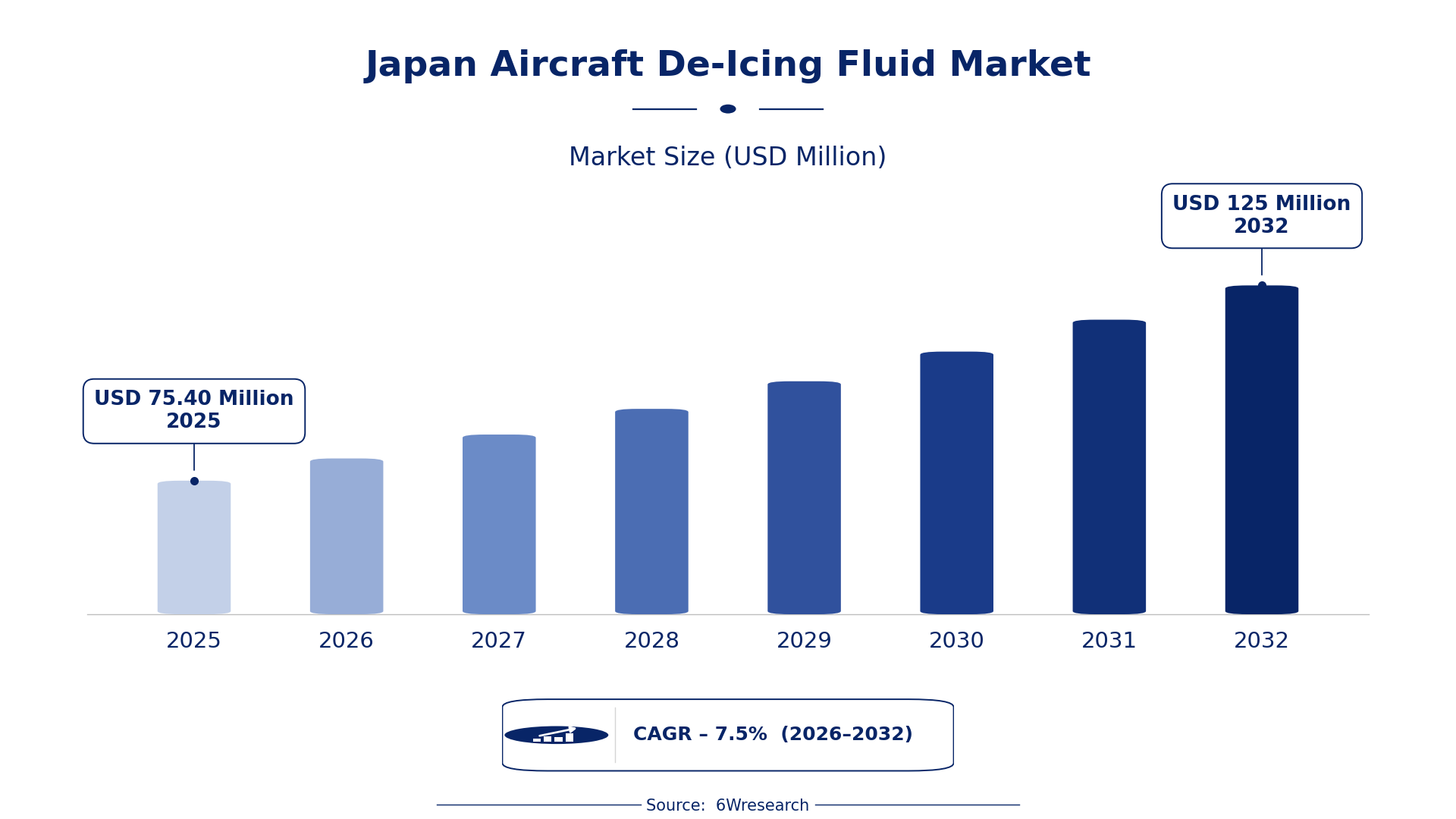
According to 6Wresearch internal database and industry insights, the Japan Aircraft De-Icing Fluid Market was valued at USD 75.40 Million in 2025 and is projected to reach USD 125 Million by 2032, growing at a CAGR of approximately 7.5% during 2026–2032.
Japan Aircraft De-Icing Fluid Market Highlights
| Report Metric | Details |
| Report Name | Japan Aircraft De-Icing Fluid Market (2026-2032) |
| Market Size 2025 | USD 75.40 Million |
| Market Size 2032 | USD 125 Million |
| Absolute Growth 2025–2032 | USD 49.60 Million |
| CAGR 2026–2032 | 7.5% |
| Peak Annual Growth | 8.3% in 2032 |
| Forecast Period | 2026–2032 |
| Historical Data | 2022–2025 |
| Base Year | 2025 |
| Leading Fluid Type, 2025 | Type I (Anti-Ice) (45% share) |
| Leading Base Chemical, 2025 | Propylene Glycol (44% share) |
| Leading Distribution Channel, 2025 | Chemical Distributors (40% share) |
| Leading End User, 2025 | Commercial Airports (42% share) |
| Fastest-Growing Fluid Type | Type II (10.4% CAGR) |
| Fastest-Growing Base Chemical | Ethylene Glycol (9.7% CAGR) |
| Fastest-Growing Distribution Channel | Aviation De-icing Vendors (9.8% CAGR) |
| Fastest-Growing End User | Ground Services Companies (9.6% CAGR) |
| Growing Sector | Aviation |
| Key End Users | Commercial Airports, Military Aviation Bases, Ground Services Companies |
Japan Aircraft De-Icing Fluid Market Year-wise Growth Rate and Key Drivers (2022–2032)
This graph illustrates the annual growth rates of the market from 2022 to 2032, highlighting a steady upward trajectory and projected market expansion over the forecast period.
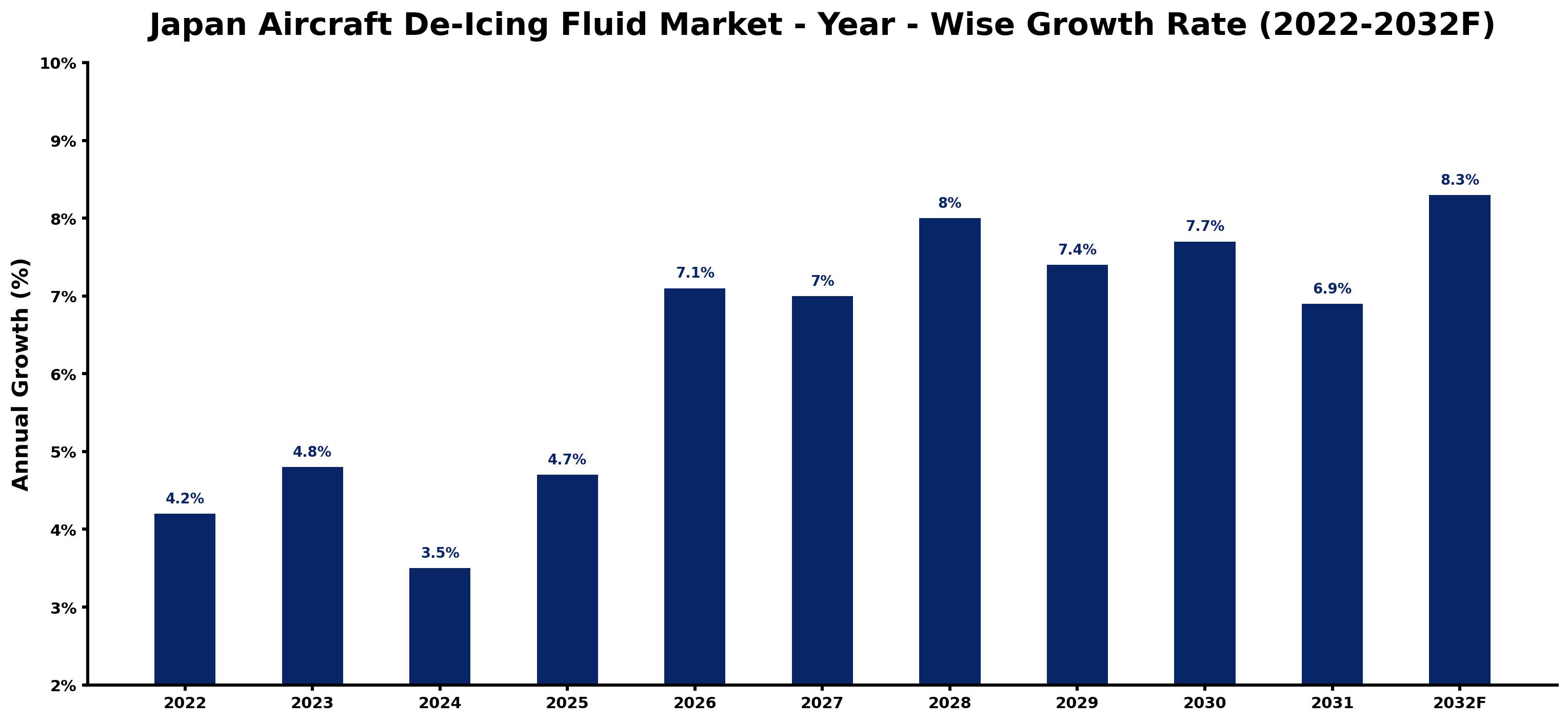
The following figures match every annual growth estimate with the main market development of that year, giving the reasoning behind each rise or slowdown.
| Year | Estimated Annual Growth (%) | Market Rationale |
| 2022 | 4.2 | Demand remained stable as winter conditions prompted regular de-icing operations. |
| 2023 | 4.8 | Increased snowfall in urban areas led to higher fluid usage across airports. |
| 2024 | 3.5 | Growth slowed as warmer weather reduced de-icing needs. |
| 2025 | 4.7 | A rise in passenger traffic contributed to increased de-icing fluid consumption. |
| 2026 | 7.1 | Investment in airport infrastructure is anticipated to drive demand for de-icing fluids. |
| 2027 | 7.0 | Growth is projected to slow slightly as the market stabilises after a period of expansion. |
| 2028 | 8.0 | A surge in winter operations is likely to boost demand. |
| 2029 | 7.4 | Demand growth is expected to slow as market conditions normalise. |
| 2030 | 7.7 | Increased adoption of Type IV fluids will support market demand. |
| 2031 | 6.9 | Growth is projected to decelerate as the market matures. |
| 2032 | 8.3 | The introduction of new technologies is likely to drive demand higher. |
Note: Market size estimations and growth projections presented in this report are based on 6Wresearch's proprietary forecasting methodology, utilizing the latest available industry data, government publications, and primary research inputs.
Japan Aircraft De-Icing Fluid Market Synopsis
Aircraft De-Icing Fluid is a chemical solution primarily made from propylene glycol or ethylene glycol, designed to prevent ice formation on aircraft surfaces. The Japan Aircraft De-Icing Fluid Market is growing due to rising air travel, especially in areas like the Tokyo metropolitan region, where winter weather creates high demand. The military aviation sector is a key consumer, using de-icing fluids to maintain operational readiness. Ongoing investments in airport infrastructure and a preference for long-lasting de-icing fluids are propelling market expansion.
Market Dynamics Impact Analysis (2026–2032)
| Factor | Type | Impact | Primary Segment Affected |
| Increased air travel and winter weather conditions drive demand for de-icing fluids. | Driver | High | Type I (Anti-Ice) |
| Investment in airport infrastructure enhances de-icing capabilities. | Driver | High | Commercial Airports |
| Growing military aviation operations create demand for specialized de-icing solutions. | Opportunity | High | Military Aviation Bases |
| Adoption of long-lasting de-icing fluids presents new market avenues. | Opportunity | High | Type IV (Long-Lasting) |
| Regulatory compliance increases operational costs for de-icing fluid producers. | Restraint | Medium | Chemical Distributors |
| Seasonal fluctuations in demand can lead to inventory challenges. | Restraint | Medium | Ground Services Companies |
| Limited supply capacity during peak winter months affects availability. | Challenge | High | Aviation De-icing Vendors |
| Competition from alternative de-icing solutions may impact market share. | Challenge | Medium | Online Aviation Suppliers |
Evaluation of Drivers in Japan Aircraft De-Icing Fluid Market (2026–2032)
Below are the drivers that matter most for revenue growth, with supporting evidence.
| Drivers | Primary Segment Affected | Why It Matters (Evidence) |
| Increased passenger traffic during winter months drives demand for de-icing fluids. | Type I (Anti-Ice) | Japan has over 100 commercial airports requiring de-icing services annually. |
| Investment in airport infrastructure improves de-icing capabilities. | Commercial Airports | The Tokyo metropolitan area has the highest demand due to frequent winter weather, necessitating better services. |
| Military aviation operations require reliable de-icing solutions for operational readiness. | Military Aviation Bases | Japan's military aviation bases utilise de-icing fluids for operational aircraft, ensuring safety during adverse conditions. |
| Adoption of Type IV fluids provides long-lasting protection during flight. | Type IV (Long-Lasting) | Type IV fluids are gaining popularity for their extended effects on aircraft surfaces, enhancing operational efficiency. |
| Ground services companies report increased usage of de-icing fluids during winter months. | Ground Services Companies | Ground services companies in Japan report a 15% increase in de-icing fluid usage during winter operations. |
Behind the steady rise in orders sits the increasing passenger traffic at airports, with over 100 commercial airports in Japan requiring de-icing services annually. Frequent winter weather conditions lead to a rise in fluid usage, prompting airports to invest in improved de-icing infrastructure. Military aviation bases require de-icing fluids for operational readiness, further driving demand. Ground services companies report a notable increase in fluid usage during winter months, highlighting the need for effective solutions. The growing preference for Type IV fluids, known for their long-lasting effects, is expected to support market growth as operational efficiency becomes a priority.
Evaluation of Restraints in Japan Aircraft De-Icing Fluid Market
The table below lists the restraints and the evidence behind each.
| Market Restraint | Primary Segment Affected | Why It Matters (Evidence) |
| Regulatory compliance increases operational costs for producers of de-icing fluids. | Chemical Distributors | Compliance with the Chemical Substances Control Law requires thorough evaluation and control of substances, raising costs. |
| Seasonal fluctuations in demand can lead to inventory challenges for suppliers. | Ground Services Companies | Demand varies with weather conditions, impacting inventory management and leading to potential shortages. |
| Limited supply capacity during peak winter months affects availability for buyers. | Aviation De-icing Vendors | High demand during winter can strain supply chains, causing delays in product availability. |
| Competition from alternative de-icing solutions may impact market share for traditional products. | Online Aviation Suppliers | Emerging alternatives could attract customers seeking cost-effective options, reducing demand for conventional fluids. |
| Rising prices of raw materials may affect production costs for de-icing fluids. | Type I (Anti-Ice) | Propylene glycol prices have fluctuated, impacting overall production costs and pricing strategies. |
Japan Aircraft De-Icing Fluid Market Challenges
Buyers of aircraft de-icing fluids are facing rising costs due to a 15% increase in usage during winter months, straining budgets particularly for airports in the Tokyo metropolitan area. Skills shortages in handling and applying these fluids lead to operational delays, affecting airlines' schedules. A lack of advanced technology in de-icing infrastructure results in inefficiencies, extending de-icing times and disrupting flight operations. Compliance with ISO 11075 standards imposes additional costs on suppliers, complicating pricing strategies for airports and potentially limiting their ability to manage expenses effectively.
Trends in the Japan Aircraft De-Icing Fluid Market
These developments are changing demand patterns in the Japan Aircraft De-Icing Fluid Market.
- Shift towards Long-Lasting De-Icing Fluids: The aviation industry is increasingly adopting Type IV de-icing fluids, known for their prolonged protection during flight. As of 2023, these fluids are gaining traction among commercial airports, improving safety and operational efficiency.
- Increase in Military Aviation Operations: The demand for de-icing fluids at military aviation bases surged since 2022, driven by heightened operational readiness requirements. This trend reflects the growing importance of maintaining aircraft safety in adverse weather conditions.
- Growing Demand in Urban Areas: Since 2023, urban airports, particularly in the Tokyo metropolitan area, have experienced a significant rise in de-icing fluid usage due to frequent winter weather. This trend underscores the need for reliable de-icing solutions in densely populated regions.
- Emergence of Specialized Suppliers: The market has seen a rise in specialized aviation de-icing vendors since 2022, catering to the unique needs of airports. This shift is likely to improve service quality and efficiency in de-icing operations.
Investment Opportunities in the Japan Aircraft De-Icing Fluid Market
The opportunities below stand out in the Japan Aircraft De-Icing Fluid Market for new entrants and existing suppliers.
- Partner with Ground Services Companies: Ground services companies are increasingly seeking reliable de-icing solutions, presenting an opportunity for partnerships. With a 15% increase in fluid usage reported, suppliers can enter this market through joint ventures.
- Focus on Commercial Airports: Commercial airports are major consumers of de-icing fluids, especially in urban areas. Suppliers can target this sector by offering specialized formulations that meet ISO 11075 standards.
- Invest in Type IV Fluid Production: The growing popularity of Type IV fluids creates an opportunity for investment in production facilities. Suppliers can enter this market by collaborating with aviation de-icing vendors to broaden product offerings.
- Approval for Specialized Formulations: There is a rising demand for specialized de-icing formulations in military aviation. Suppliers can gain market entry by obtaining necessary certifications and approvals from relevant authorities.
Government Initiatives in the Japan Aircraft De-Icing Fluid Market
The Chemical Substances Control Law (1973) mandates thorough evaluation and control of chemical substances used in production, ensuring manufacturers adhere to safety standards. This law impacts the production of de-icing fluids by enforcing stricter regulations on chemical use, which can increase operational costs. Additionally, the PRTR Law requires businesses to report on the management of designated chemical substances, influencing operational practices in the industry.
In 2023, a government initiative aimed at improving airport de-icing infrastructure was launched, overseen by the Ministry of Land, Infrastructure, Transport and Tourism. This program focuses on enhancing safety measures at airports, ensuring compliance with updated regulations and improving overall operational efficiency.
Future Insight of the Japan Aircraft De-Icing Fluid Market
Technological advancements in de-icing methods will reshape demand by 2032, particularly with the adoption of Type IV fluids for their long-lasting effects. The government's 2023 initiative to improve airport de-icing infrastructure will streamline operations. Increased snowfall in regions like Hokkaido, averaging around 600 cm annually, will drive the need for more effective solutions. The Japan Aircraft Association's updated guidelines will standardise procedures, ensuring safer operations and potentially reducing costs for airports.
Market Segmentation Analysis
Japan Aircraft De-Icing Fluid Market report covers a detailed analysis of the following market segments:
By Fluid Type – Type I (Anti-Ice) Leads, Type II Expected to Grow Fastest
According to Saurav Kr Singh, Senior Research Analyst at 6Wresearch, the largest fluid type category in 2025 was Type I (Anti-Ice), at 45% of revenue. Type I de-icing fluid commands the largest share because it is vital for safe aircraft operations at Japan's numerous commercial airports. Its primary use for initial de-icing before takeoff ensures that flights can operate on schedule during winter weather conditions. The quickest growth will come from Type II, forecast to expand at a CAGR of 10.4% between 2026 and 2032. Type II de-icing fluid is experiencing rapid growth as it is increasingly preferred for specific weather conditions, especially in areas with severe winter climates. The heightened demand in the Tokyo metropolitan region for effective de-icing solutions is a key factor in this growth. Suppliers should prioritise the promotion of Type II fluids to take advantage of this expanding market segment.
By Base Chemical – Propylene Glycol Leads, Ethylene Glycol Expected to Grow Fastest
Propylene Glycol held 44% of the Japan Aircraft De-Icing Fluid Market by base chemical in 2025. Propylene glycol dominates the market as it is the primary ingredient in approximately 70% of de-icing fluid formulations, ensuring effective ice prevention. Its established role in maintaining safe aircraft operations solidifies its leading position in the market. Ethylene Glycol is projected to grow fastest, at a CAGR of 9.7% during 2026–2032. Ethylene glycol is experiencing the fastest growth due to its versatility in various formulations, appealing to a broader range of applications. This trend indicates a diversification in the types of de-icing fluids being utilised across the industry. Buyers may benefit from exploring a wider range of formulations that include ethylene glycol to meet specific operational needs.
By Distribution Channel – Chemical Distributors Lead, Aviation De-icing Vendors Expected to Grow Fastest
In 2025, Chemical Distributors led the distribution channel split with a 40% share. Chemical distributors dominate the distribution channel as they provide de-icing fluids to a wide range of end-users, ensuring consistent product availability. Their established distribution networks are crucial for timely delivery to airports and service providers, which is essential for operational efficiency. Over 2026–2032, Aviation De-icing Vendors are expected to post the fastest growth, at a CAGR of 9.8%. Aviation de-icing vendors are rapidly growing as they offer specialised services that cater to the specific needs of airport operations. The reported increase in de-icing fluid usage during winter months highlights their critical role in the supply chain. Suppliers should explore partnerships with aviation de-icing vendors to enhance service offerings and meet the rising demand.
By End User – Commercial Airports Lead, Ground Services Companies Expected to Grow Fastest
Commercial Airports took 42% of end user revenue in 2025, more than any other category. Commercial airports are the largest consumers of de-icing fluids, driven by the need to ensure safety and operational efficiency during adverse weather. Their substantial volume of operations directly impacts the demand for reliable de-icing solutions. Ground Services Companies are set to record the highest CAGR in this split, 9.6% over 2026–2032. Ground services companies are the fastest-growing end-user segment as they are essential for managing ground operations and ensuring aircraft readiness. Their increasing reliance on de-icing fluids during peak winter months underscores their significance in the market. Suppliers must adapt their products and services to meet the specific requirements of ground services companies to capture this growing market.
Key Attractiveness of the Report
- 10 Years of Market Numbers
- Historical Data Starting from 2022 to 2025
- Base Year 2025
- Forecast Data until 2032
- Key Performance Indicators Impacting the Market
- Major Upcoming Developments and Projects
Key Highlights of the Report:
- Japan Aircraft De-Icing Fluid Market Outlook
- Market Size of Japan Aircraft De-Icing Fluid Market, 2025
- Forecast of Japan Aircraft De-Icing Fluid Market, 2032
- Historical Data and Forecast of Japan Aircraft De-Icing Fluid Revenues & Volume for the Period 2022-2032F
- Japan Aircraft De-Icing Fluid Market Trend Evolution
- Japan Aircraft De-Icing Fluid Market Drivers and Challenges
- Japan Aircraft De-Icing Fluid Price Trends
- Japan Aircraft De-Icing Fluid Porter's Five Forces
- Japan Aircraft De-Icing Fluid Industry Life Cycle
- Historical Data and Forecast of Japan Aircraft De-Icing Fluid Market Revenues & Volume By Fluid Type for the Period 2022-2032F
- Historical Data and Forecast of Japan Aircraft De-Icing Fluid Market Revenues & Volume By Type I (Anti-Ice) for the Period 2022-2032F
- Historical Data and Forecast of Japan Aircraft De-Icing Fluid Market Revenues & Volume By Type II for the Period 2022-2032F
- Historical Data and Forecast of Japan Aircraft De-Icing Fluid Market Revenues & Volume By Type III for the Period 2022-2032F
- Historical Data and Forecast of Japan Aircraft De-Icing Fluid Market Revenues & Volume By Type IV (Long-Lasting) for the Period 2022-2032F
- Historical Data and Forecast of Japan Aircraft De-Icing Fluid Market Revenues & Volume By Base Chemical for the Period 2022-2032F
- Historical Data and Forecast of Japan Aircraft De-Icing Fluid Market Revenues & Volume By Propylene Glycol for the Period 2022-2032F
- Historical Data and Forecast of Japan Aircraft De-Icing Fluid Market Revenues & Volume By Ethylene Glycol for the Period 2022-2032F
- Historical Data and Forecast of Japan Aircraft De-Icing Fluid Market Revenues & Volume By Thixotropic Fluids for the Period 2022-2032F
- Historical Data and Forecast of Japan Aircraft De-Icing Fluid Market Revenues & Volume By Alcohol-Based Mix for the Period 2022-2032F
- Historical Data and Forecast of Japan Aircraft De-Icing Fluid Market Revenues & Volume By Distribution Channel for the Period 2022-2032F
- Historical Data and Forecast of Japan Aircraft De-Icing Fluid Market Revenues & Volume By Chemical Distributors for the Period 2022-2032F
- Historical Data and Forecast of Japan Aircraft De-Icing Fluid Market Revenues & Volume By Aviation De-icing Vendors for the Period 2022-2032F
- Historical Data and Forecast of Japan Aircraft De-Icing Fluid Market Revenues & Volume By Online Aviation Suppliers for the Period 2022-2032F
- Historical Data and Forecast of Japan Aircraft De-Icing Fluid Market Revenues & Volume By OEM Consumable Suppliers for the Period 2022-2032F
- Historical Data and Forecast of Japan Aircraft De-Icing Fluid Market Revenues & Volume By End User for the Period 2022-2032F
- Historical Data and Forecast of Japan Aircraft De-Icing Fluid Market Revenues & Volume By Commercial Airports for the Period 2022-2032F
- Historical Data and Forecast of Japan Aircraft De-Icing Fluid Market Revenues & Volume By Ground Services Companies for the Period 2022-2032F
- Historical Data and Forecast of Japan Aircraft De-Icing Fluid Market Revenues & Volume By Small Aircraft Operators for the Period 2022-2032F
- Historical Data and Forecast of Japan Aircraft De-Icing Fluid Market Revenues & Volume By Military Aviation Bases for the Period 2022-2032F
- Japan Aircraft De-Icing Fluid Import Export Trade Statistics
- Market Opportunity Assessment By Fluid Type
- Market Opportunity Assessment By Base Chemical
- Market Opportunity Assessment By Distribution Channel
- Market Opportunity Assessment By End User
- Japan Aircraft De-Icing Fluid Top Companies Market Share
- Japan Aircraft De-Icing Fluid Competitive Benchmarking By Technical and Operational Parameters
- Japan Aircraft De-Icing Fluid Company Profiles
- Japan Aircraft De-Icing Fluid Key Strategic Recommendations
Market Covered
The report covers the following segments.
By Fluid Type
- Type I (Anti-Ice)
- Type II
- Type III
- Type IV (Long-Lasting)
By Base Chemical
- Propylene Glycol
- Ethylene Glycol
- Thixotropic Fluids
- Alcohol-Based Mix
By Distribution Channel
- Chemical Distributors
- Aviation De-icing Vendors
- Online Aviation Suppliers
- OEM Consumable Suppliers
By End User
- Commercial Airports
- Ground Services Companies
- Small Aircraft Operators
- Military Aviation Bases































