Japan Aircraft Electronics Market Size & Growth Rate
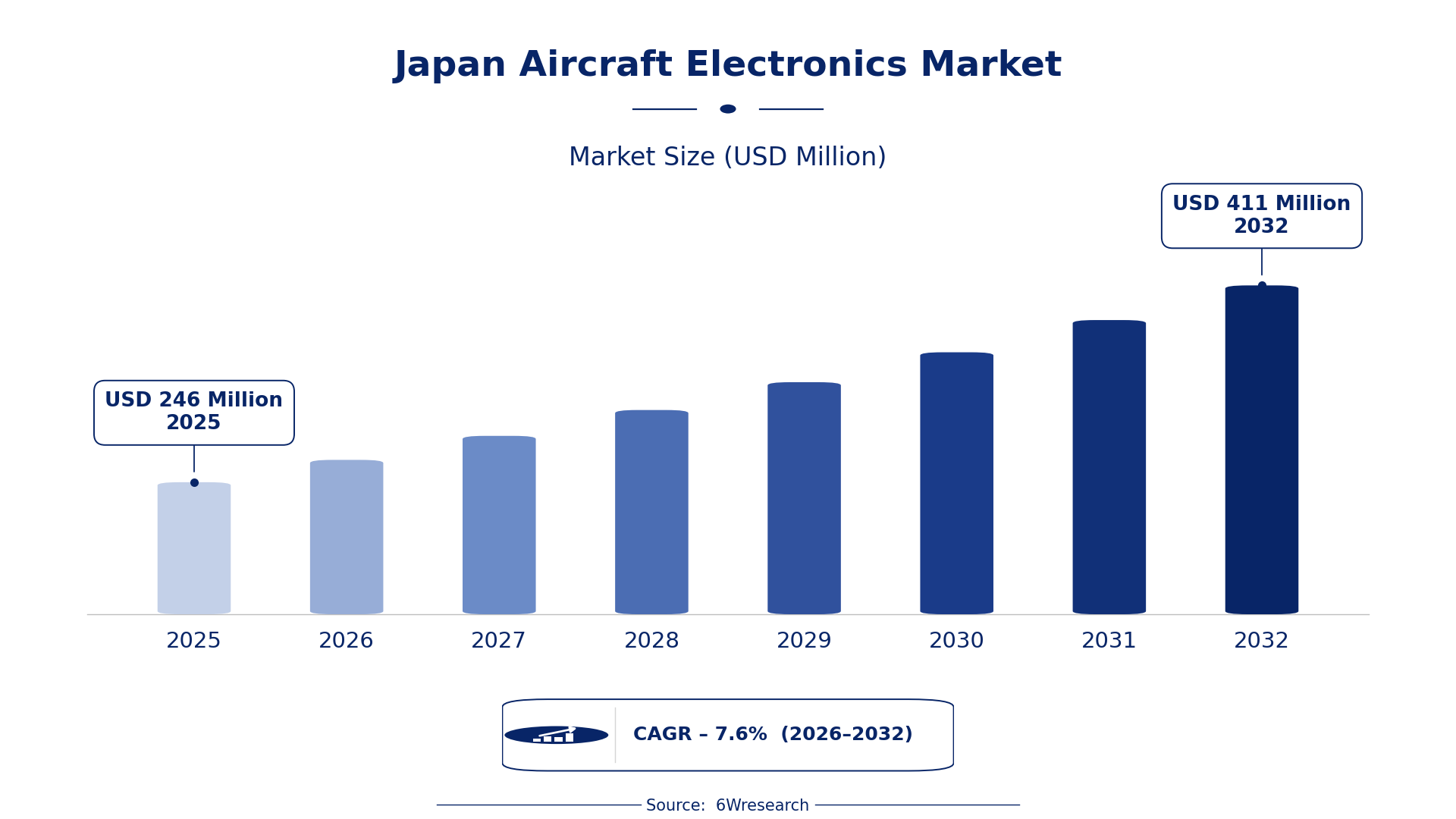
According to 6Wresearch internal database and industry insights, the Japan Aircraft Electronics Market was valued at USD 246 Million in 2025 and is projected to reach USD 411 Million by 2032, growing at a CAGR of approximately 7.6% during 2026–2032.
Japan Aircraft Electronics Market Highlights
| Report Metric | Details |
| Report Name | Japan Aircraft Electronics Market (2026-2032) |
| Market Size 2025 | USD 246 Million |
| Market Size 2032 | USD 411 Million |
| Absolute Growth 2025–2032 | USD 165 Million |
| CAGR 2026–2032 | 7.6% |
| Peak Annual Growth | 8.1% in 2031 |
| Forecast Period | 2026–2032 |
| Historical Data | 2022–2025 |
| Base Year | 2025 |
| Leading Product Type, 2025 | Flight Control Systems (41% share) |
| Leading Technology Type, 2025 | Digital Electronics (43% share) |
| Leading Distribution Channel, 2025 | Direct Sales (47% share) |
| Leading End User, 2025 | Commercial Jet OEMs (35% share) |
| Fastest-Growing Product Type | Navigation Systems (10.8% CAGR) |
| Fastest-Growing Technology Type | GPS/INS Integrated (11.1% CAGR) |
| Fastest-Growing Distribution Channel | Online Platforms (9.8% CAGR) |
| Fastest-Growing End User | Airline Operators (9.9% CAGR) |
| Growing Sector | Airline Operators |
| Key End Users | Commercial Jet OEMs, Airline Operators, Defense Contractors, Business Jet Designers |
Japan Aircraft Electronics Market Year-wise Growth Rate and Key Drivers (2022–2032)
This graph illustrates the annual growth rates of the market from 2022 to 2032, highlighting a steady upward trajectory and projected market expansion over the forecast period.
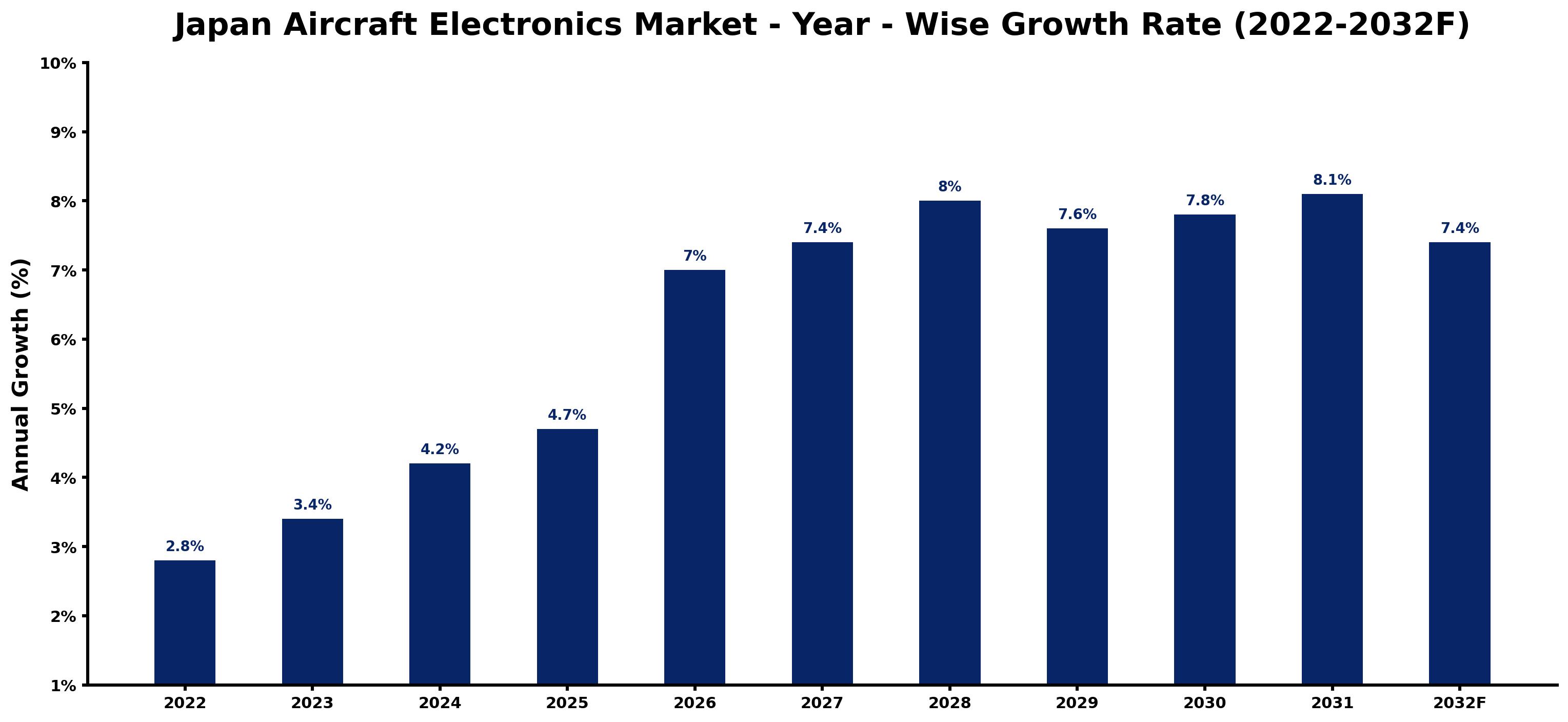
For each year, the table pairs the estimated growth rate with the leading influence on demand, showing how the drivers changed across the period.
| Year | Estimated Annual Growth (%) | Market Rationale |
| 2022 | 2.8 | The market experienced moderate growth due to steady demand from domestic users. |
| 2023 | 3.4 | Growth accelerated as air travel demand increased following recovery from previous disruptions. |
| 2024 | 4.2 | The introduction of new aircraft models boosted demand for advanced electronics. |
| 2025 | 4.7 | Investment in safety and efficiency upgrades drove further growth in the market. |
| 2026 | 7.0 | A surge in domestic aircraft production is expected to stimulate demand. |
| 2027 | 7.4 | Technological advancements in avionics are projected to create new market opportunities. |
| 2028 | 8.0 | Growing air travel demand continues to support the upward trend in the market. |
| 2029 | 7.6 | A slight slowdown occurs as growth stabilises after peak demand years. |
| 2030 | 7.8 | Increased investments in aerospace technology are anticipated to drive growth. |
| 2031 | 8.1 | The market reaches its peak growth rate as new standards are implemented. |
| 2032 | 7.4 | A gradual slowdown is expected as the market stabilises after rapid expansion. |
Note: Market size estimations and growth projections presented in this report are based on 6Wresearch's proprietary forecasting methodology, utilizing the latest available industry data, government publications, and primary research inputs.
Japan Aircraft Electronics Market Synopsis
Aircraft electronics are systems critical for flight management, navigation, communication, and monitoring in aviation. The Japan Aircraft Electronics Market is expanding due to rising air travel demand, technological advancements, and government initiatives aimed at boosting domestic production. The aerospace sector contributed approximately 1.5 trillion JPY to the economy in 2022, underscoring its significance. Demand stems from both domestic users and exports, with continuous innovation improving operational efficiency and safety in aviation.
Market Dynamics Impact Analysis (2026–2032)
| Factor | Type | Impact | Primary Segment Affected |
| Rising air travel demand | Driver | High | Communication Systems |
| Technological advancements in avionics | Driver | High | Digital Electronics |
| Investment in domestic aircraft production | Opportunity | High | Flight Control Systems |
| Growing emphasis on safety regulations | Opportunity | Medium | Navigation Systems |
| Strict regulatory compliance requirements | Restraint | High | Monitoring & Display |
| High costs associated with advanced technologies | Restraint | Medium | GPS/INS Integrated |
| Competition from international suppliers | Challenge | High | RF and Satellite-Based |
| Fluctuating raw material prices | Challenge | Medium | LCD/OLED Panels |
Evaluation of Drivers in Japan Aircraft Electronics Market (2026–2032)
These are the developments adding the most demand over the forecast period.
| Drivers | Primary Segment Affected | Why It Matters (Evidence) |
| Increased air travel | Communication Systems | The growing number of commercial flights in Japan drives demand for reliable communication systems, with over 300 commercial aircraft registered in 2023. |
| Technological advancements | Digital Electronics | Innovation in digital electronics improves aircraft functionality, leading to increased orders from manufacturers focusing on modern avionics. |
| Government support for aerospace | Flight Control Systems | The Japanese government aims to boost domestic aircraft production by 20% by 2025, creating demand for advanced flight control systems. |
| Rising safety standards | Navigation Systems | New safety regulations necessitate the integration of advanced navigation systems, prompting manufacturers to invest in these technologies. |
| Growing military applications | GPS/INS Integrated | With a 5 billion JPY budget for advanced avionics in 2023, defense contractors are increasing their demand for GPS/INS integrated systems. |
Behind the steady rise in orders sits a notable increase in air travel, with over 300 commercial aircraft registered in Japan in 2023. This surge in flights drives demand for advanced communication systems, as airlines seek reliable solutions. Technological advancements in digital electronics further improve aircraft capabilities, prompting manufacturers to invest in modern avionics. The target to increase domestic aircraft production by 20% by 2025 stimulates demand for flight control systems.
Evaluation of Restraints in Japan Aircraft Electronics Market
The table below lists the restraints and the evidence behind each.
| Market Restraint | Primary Segment Affected | Why It Matters (Evidence) |
| Regulatory compliance costs | Digital Electronics | Japan's strict regulations impose compliance costs on manufacturers, increasing expenses for suppliers by approximately 15%. |
| Limited availability of advanced systems | Communication Systems | Rising costs due to limited availability of advanced avionics systems create competition for resources among buyers. |
| International competition pressure | Flight Control Systems | Pressure from international markets reduces profit margins for local producers by approximately 10%. |
| Slow technology adoption | Navigation Systems | Many firms still rely on outdated systems, which hampers operational efficiency and raises costs for buyers seeking modern solutions. |
| High development costs | GPS/INS Integrated | The high costs associated with developing new avionics technologies can deter investment from smaller manufacturers. |
Japan Aircraft Electronics Market Challenges
Japan's strict regulations under the Civil Aeronautics Act increase compliance costs for manufacturers, raising expenses by approximately 15% for suppliers and delaying product launches. Buyers face higher prices due to limited availability of advanced avionics systems, as the Ministry of Defense's budget of 5 billion JPY for 2023 intensifies competition for resources. Domestic producers experience pressure from international competitors, leading to a 10% reduction in profit margins for local manufacturers. Many firms contend with outdated technology, which hampers operational efficiency and raises costs for buyers seeking modern solutions.
Trends in the Japan Aircraft Electronics Market
The trends below show where the Japan Aircraft Electronics Market is heading.
- Shift towards Advanced Digital Systems: Japan is experiencing a shift towards advanced digital systems in aircraft electronics, driven by the need for improved functionality. The Japan Aerospace Exploration Agency collaborates with private firms on avionics research, enhancing system capabilities.
- Increase in LCD/OLED Panel Usage: The adoption of LCD/OLED panels in cockpit displays is increasing, providing better visibility for pilots. This trend is clear as more manufacturers incorporate these technologies into their designs, improving safety and operational efficiency.
- Growth of Online Sales Channels: The distribution of aircraft electronics is shifting towards online platforms, with a 9.8% CAGR projected from 2026 to 2032. This change reflects the growing preference for digital purchasing among buyers in the aerospace sector.
- Focus on Safety Compliance Technologies: There is a growing emphasis on safety compliance technologies within the aviation sector, driven by new regulations. The Ministry of Defense's budget for advanced avionics systems in 2023 highlights this trend, ensuring safety standards are met.
Investment Opportunities in the Japan Aircraft Electronics Market
The following areas offer the clearest openings for investors and suppliers in the Japan Aircraft Electronics Market.
- Investment in Domestic Production: With the Japanese government aiming to increase domestic aircraft production by 20% by 2025, there is an opportunity for investment in local manufacturing capabilities. Collaborating with commercial jet OEMs can facilitate market entry.
- Expansion of Online Sales Channels: The rise of online platforms for aircraft electronics presents an opportunity for suppliers to reach a broader market. Establishing partnerships with electronic component dealers can enhance distribution efficiency.
- Technological Advancements: Investing in the latest digital electronics technologies can meet the rising demand for advanced avionics systems. Targeting airline operators in Japan will be crucial for capturing this growing market segment.
- Focus on Military Applications: The growing military applications for advanced avionics systems present a promising opportunity. Engaging with defense contractors can provide access to substantial budgets, such as the 5 billion JPY allocated for 2023.
Government Initiatives in the Japan Aircraft Electronics Market
The Civil Aeronautics Act establishes strict regulations for aircraft electronics, ensuring safety and compliance in manufacturing. This law has been in effect for decades, influencing production standards and practices across the industry. The Semiconductor and Digital Industry Strategy, introduced in June 2021, aims to support domestic semiconductor manufacturing, further aiding the aircraft electronics sector.
In 2023, the Ministry of Defense allocated 5 billion JPY for advanced avionics systems, enhancing the capabilities of defense contractors. The Digital Agency, established in September 2021, promotes government digital transformation and common system standards, driving innovation in the aerospace industry.
Future Insight of the Japan Aircraft Electronics Market
Airlines will require advanced avionics systems by 2032, as safety and operational efficiency become paramount. The Japanese government's goal to increase domestic aircraft production by 20% by 2025 will strengthen local manufacturing capabilities. Collaboration between the Japan Aerospace Exploration Agency and private firms will result in significant advancements in avionics research, driving innovation. As the number of commercial aircraft registered in Japan surpasses 300, suppliers must invest in new technologies to meet evolving buyer expectations.
Market Segmentation Analysis
Japan Aircraft Electronics Market report covers a detailed analysis of the following market segments:
By Product Type – Flight Control Systems Lead, Navigation Systems Expected to Grow Fastest
According to Saurav Kr Singh, Senior Research Analyst at 6Wresearch, Flight Control Systems held 41% of the Japan Aircraft Electronics Market by product type in 2025. Flight control systems are essential for aircraft safety and performance, making them a top priority for manufacturers and operators. With over 300 commercial aircraft registered in Japan, their demand is consistently high. Navigation Systems are set to record the highest CAGR in this split, 10.8% over 2026–2032. Navigation systems are rapidly growing due to the increasing need for precise flight routing in Japan's expanding air travel sector. This growth is further fuelled by technological advancements that improve navigation capabilities. Suppliers should focus on developing advanced navigation solutions to meet the rising demand from the aviation sector.
By Technology Type – Digital Electronics Leads, GPS/INS Integrated Expected to Grow Fastest
Digital Electronics took 43% of technology type revenue in 2025, more than any other category. Digital electronics serve as the foundation for modern aircraft systems, ensuring reliability and performance across various applications. The critical role of this technology is underscored by its widespread use in advanced avionics systems funded by the Ministry of Defense. The quickest growth will come from GPS/INS Integrated, forecast to expand at a CAGR of 11.1% between 2026 and 2032. GPS/INS integrated systems are essential for navigation accuracy, particularly as air travel demand continues to rise. The ongoing advancements in these systems will likely widen the lead of digital electronics due to their increasing importance in operational efficiency. Suppliers should focus on enhancing digital electronics capabilities to meet the growing demands of the aircraft electronics market.
By Distribution Channel – Direct Sales Leads, Online Platforms Expected to Grow Fastest
In 2025, Direct Sales led the distribution channel split with a 47% share. Direct sales are the primary channel for OEMs, establishing strong connections between manufacturers and their clients. This effectiveness is evident in the robust sales figures from key industrial regions like Tokyo and Nagoya, which are pivotal for aircraft electronics manufacturing. Over 2026–2032, Online Platforms are expected to post the fastest growth, at a CAGR of 9.8%. Online platforms are rapidly becoming a preferred channel for aftermarket sales, reflecting the increasing digitalisation of purchasing behaviours. This trend indicates that direct sales may continue to dominate, but online channels will complement them, enhancing overall market reach. Suppliers need to strengthen their online sales strategies to tap into the expanding digital purchasing trend in the aircraft electronics sector.
By End User – Commercial Jet OEMs Lead, Airline Operators Expected to Grow Fastest
The largest end user category in 2025 was Commercial Jet OEMs, at 35% of revenue. Commercial jet OEMs represent the largest user segment, directly impacting the demand for aircraft electronics through their extensive manufacturing activities. Their significant contribution to the aerospace sector is highlighted by the economic impact of approximately 1.5 trillion JPY in 2022. Airline Operators are projected to grow fastest, at a CAGR of 9.9% during 2026–2032. Airline operators are experiencing a surge in demand for aircraft electronics as they expand their fleets to meet the increasing number of passengers. This growth is further supported by Japan's rising air travel demand, which necessitates advanced electronic systems. Suppliers should prioritise collaborations with airline operators to align their products with the escalating demand for aircraft electronics.
Key Attractiveness of the Report
- 10 Years of Market Numbers
- Historical Data Starting from 2022 to 2025
- Base Year 2025
- Forecast Data until 2032
- Key Performance Indicators Impacting the Market
- Major Upcoming Developments and Projects
Key Highlights of the Report:
- Japan Aircraft Electronics Market Outlook
- Market Size of Japan Aircraft Electronics Market, 2025
- Forecast of Japan Aircraft Electronics Market, 2032
- Historical Data and Forecast of Japan Aircraft Electronics Revenues & Volume for the Period 2022-2032F
- Japan Aircraft Electronics Market Trend Evolution
- Japan Aircraft Electronics Market Drivers and Challenges
- Japan Aircraft Electronics Price Trends
- Japan Aircraft Electronics Porter's Five Forces
- Japan Aircraft Electronics Industry Life Cycle
- Historical Data and Forecast of Japan Aircraft Electronics Market Revenues & Volume By Product Type for the Period 2022-2032F
- Historical Data and Forecast of Japan Aircraft Electronics Market Revenues & Volume By Flight Control Systems for the Period 2022-2032F
- Historical Data and Forecast of Japan Aircraft Electronics Market Revenues & Volume By Navigation Systems for the Period 2022-2032F
- Historical Data and Forecast of Japan Aircraft Electronics Market Revenues & Volume By Communication Systems for the Period 2022-2032F
- Historical Data and Forecast of Japan Aircraft Electronics Market Revenues & Volume By Monitoring & Display for the Period 2022-2032F
- Historical Data and Forecast of Japan Aircraft Electronics Market Revenues & Volume By Technology Type for the Period 2022-2032F
- Historical Data and Forecast of Japan Aircraft Electronics Market Revenues & Volume By Digital Electronics for the Period 2022-2032F
- Historical Data and Forecast of Japan Aircraft Electronics Market Revenues & Volume By GPS/INS Integrated for the Period 2022-2032F
- Historical Data and Forecast of Japan Aircraft Electronics Market Revenues & Volume By RF and Satellite-Based for the Period 2022-2032F
- Historical Data and Forecast of Japan Aircraft Electronics Market Revenues & Volume By LCD/OLED Panels for the Period 2022-2032F
- Historical Data and Forecast of Japan Aircraft Electronics Market Revenues & Volume By Distribution Channel for the Period 2022-2032F
- Historical Data and Forecast of Japan Aircraft Electronics Market Revenues & Volume By Direct Sales for the Period 2022-2032F
- Historical Data and Forecast of Japan Aircraft Electronics Market Revenues & Volume By Online Platforms for the Period 2022-2032F
- Historical Data and Forecast of Japan Aircraft Electronics Market Revenues & Volume By Electronic Component Dealers for the Period 2022-2032F
- Historical Data and Forecast of Japan Aircraft Electronics Market Revenues & Volume By Industrial Suppliers for the Period 2022-2032F
- Historical Data and Forecast of Japan Aircraft Electronics Market Revenues & Volume By End User for the Period 2022-2032F
- Historical Data and Forecast of Japan Aircraft Electronics Market Revenues & Volume By Commercial Jet OEMs for the Period 2022-2032F
- Historical Data and Forecast of Japan Aircraft Electronics Market Revenues & Volume By Airline Operators for the Period 2022-2032F
- Historical Data and Forecast of Japan Aircraft Electronics Market Revenues & Volume By Defense Contractors for the Period 2022-2032F
- Historical Data and Forecast of Japan Aircraft Electronics Market Revenues & Volume By Business Jet Designers for the Period 2022-2032F
- Japan Aircraft Electronics Import Export Trade Statistics
- Market Opportunity Assessment By Product Type
- Market Opportunity Assessment By Technology Type
- Market Opportunity Assessment By Distribution Channel
- Market Opportunity Assessment By End User
- Japan Aircraft Electronics Top Companies Market Share
- Japan Aircraft Electronics Competitive Benchmarking By Technical and Operational Parameters
- Japan Aircraft Electronics Company Profiles
- Japan Aircraft Electronics Key Strategic Recommendations
Market Covered
The following segment groups are covered in the report.
By Product Type
- Flight Control Systems
- Navigation Systems
- Communication Systems
- Monitoring & Display
By Technology Type
- Digital Electronics
- GPS/INS Integrated
- RF and Satellite-Based
- LCD/OLED Panels
By Distribution Channel
- Direct Sales
- Online Platforms
- Electronic Component Dealers
- Industrial Suppliers
By End User
- Commercial Jet OEMs
- Airline Operators
- Defense Contractors
- Business Jet Designers































