Japan Aircraft Embedded Computer Market Size & Growth Rate
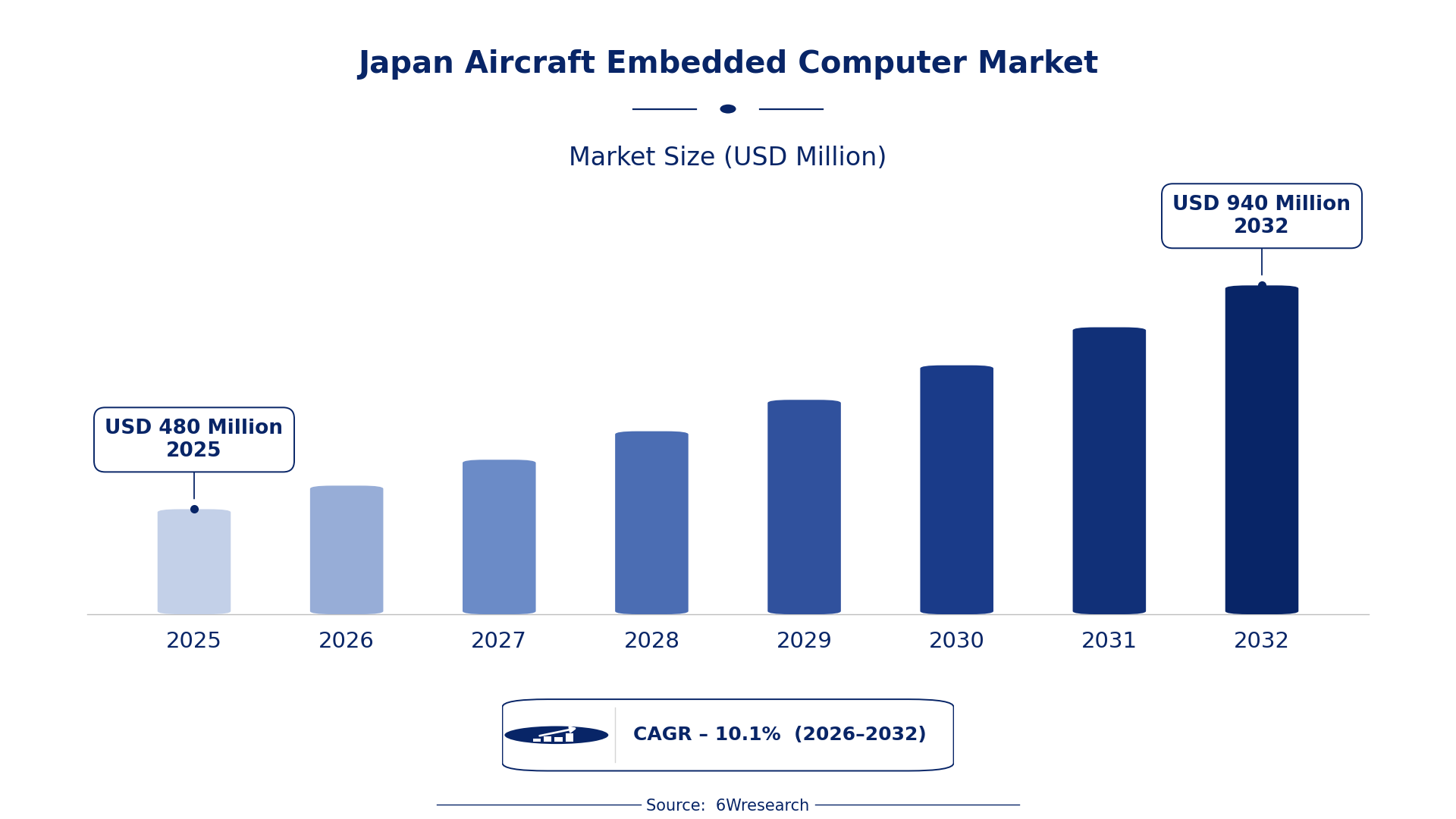
According to 6Wresearch internal database and industry insights, the Japan Aircraft Embedded Computer Market was valued at USD 480 Million in 2025 and is projected to reach USD 940 Million by 2032, growing at a CAGR of approximately 10.1% during 2026–2032.
Japan Aircraft Embedded Computer Market Highlights
| Report Metric | Details |
| Report Name | Japan Aircraft Embedded Computer Market (2026-2032) |
| Market Size 2025 | USD 480 Million |
| Market Size 2032 | USD 940 Million |
| Absolute Growth 2025–2032 | USD 460 Million |
| CAGR 2026–2032 | 10.1% |
| Peak Annual Growth | 11.8% in 2029 |
| Forecast Period | 2026–2032 |
| Historical Data | 2022–2025 |
| Base Year | 2025 |
| Leading Computer Type, 2025 | Mission Computers (33% share) |
| Leading Form Factor, 2025 | VPX-Based Systems (45% share) |
| Leading Distribution Channel, 2025 | Direct Sales (33% share) |
| Leading End User, 2025 | Military Aircraft OEMs (46% share) |
| Fastest-Growing Computer Type | Avionics Computers (13.7% CAGR) |
| Fastest-Growing Distribution Channel | Aviation System Vendors (12.7% CAGR) |
| Fastest-Growing End User | Aerospace Integrators (12.6% CAGR) |
| Growing Sector | Military Aircraft |
| Key End Users | Military Aircraft OEMs, Aerospace Integrators, MRO Facilities |
Japan Aircraft Embedded Computer Market Year-wise Growth Rate and Key Drivers (2022–2032)
This graph illustrates the annual growth rates of the market from 2022 to 2032, highlighting a steady upward trajectory and projected market expansion over the forecast period.
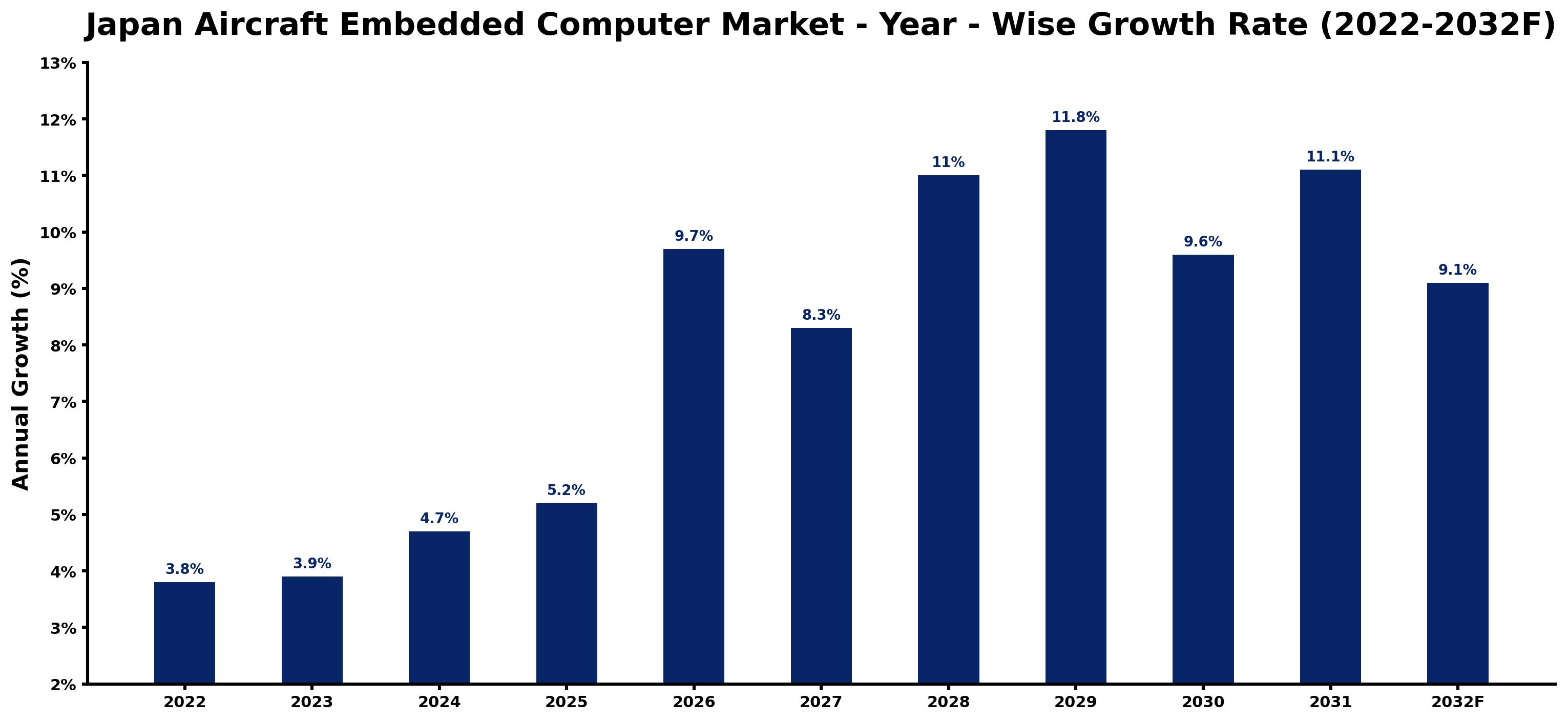
Below, each year's estimated growth is shown next to the factor that most influenced it.
| Year | Estimated Annual Growth (%) | Market Rationale |
| 2022 | 3.8 | The aerospace sector employed over 80,000 people, supporting steady growth. |
| 2023 | 3.9 | The Tokyo region's aerospace technology development spurred increased demand for embedded computers. |
| 2024 | 4.7 | The Ministry of Defense's budget for military aircraft development rose, driving growth in the sector. |
| 2025 | 5.2 | Demand from military aircraft OEMs continued to drive market expansion and innovation. |
| 2026 | 9.7 | Investment in aerospace R&D is expected to boost production capabilities significantly. |
| 2027 | 8.3 | A slowdown in growth is observed as the market stabilises after rapid expansion. |
| 2028 | 11.0 | The rising demand for avionics computers is projected to accelerate growth in the coming years. |
| 2029 | 11.8 | The peak annual growth reflects strong military aircraft procurement efforts and investments. |
| 2030 | 9.6 | A slight slowdown occurs as the market adjusts to previous highs and demand stabilises. |
| 2031 | 11.1 | Increased investment in aerospace innovation is expected to drive demand for advanced systems. |
| 2032 | 9.1 | A continued focus on military applications will sustain market growth and technological advancements. |
Note: Market size estimations and growth projections presented in this report are based on 6Wresearch's proprietary forecasting methodology, utilizing the latest available industry data, government publications, and primary research inputs.
Japan Aircraft Embedded Computer Market Synopsis
Aircraft embedded computers are specialised systems used in aircraft for flight control, navigation, and systems management. The Japan Aircraft Embedded Computer Market is expanding due to rising demand from military aircraft OEMs and aerospace integrators. Investments in aerospace R&D, alongside government support for technology exports, are driving growth.
Market Dynamics Impact Analysis (2026–2032)
| Factor | Type | Impact | Primary Segment Affected |
| Rising military aircraft procurement drives demand for avionics computers. | Driver | High | Avionics Computers |
| Increased investment in aerospace R&D enhances production capabilities. | Driver | High | Mission Computers |
| Growing demand for advanced avionics systems presents opportunities for suppliers. | Opportunity | High | Avionics Computers |
| The Tokyo region's aerospace technology development attracts new investments. | Opportunity | Medium | VPX-Based Systems |
| Strict regulations can limit the speed of new product introductions. | Restraint | High | Engine Control Units |
| High development costs may deter smaller companies from entering the market. | Restraint | Medium | Compact PCI |
| Competition from international manufacturers pressures local producers. | Challenge | High | Mission Computers |
| The need for compliance with stringent safety standards increases operational costs. | Challenge | Medium | Avionics Computers |
Evaluation of Drivers in Japan Aircraft Embedded Computer Market (2026–2032)
The factors lifting demand, and the evidence behind each, are summarised below.
| Drivers | Primary Segment Affected | Why It Matters (Evidence) |
| Increased military aircraft procurement drives demand for avionics computers. | Avionics Computers | The Ministry of Defense's budget of ¥500 billion in 2023 supports military aircraft development, boosting demand. |
| Investment in aerospace R&D boosts production capabilities. | Mission Computers | The Japanese government invested ¥200 billion in aerospace R&D in 2023, promoting technological advancements. |
| Growing demand for advanced avionics systems presents opportunities for suppliers. | Avionics Computers | The Tokyo Metropolitan Government supports aerospace startups, increasing competition and innovation in the sector. |
| The Tokyo region's aerospace technology development attracts new investments. | VPX-Based Systems | Over 15 major military aircraft OEMs in Japan drive demand for advanced systems and technologies. |
| The need for durable systems in harsh environments increases demand for rugged boards. | Rugged Boards | MRO facilities in Japan are certified under ISO 9001 standards, ensuring quality and reliability. |
A wider customer base explains much of the growth, as the Japanese government invested ¥200 billion in aerospace R&D in 2023, boosting production capabilities. The Ministry of Defense's budget of ¥500 billion for military aircraft development in 2023 supports increased procurement of avionics computers. The Tokyo region, housing over 15 major military aircraft OEMs, drives demand for advanced systems. The Tokyo Metropolitan Government's support for aerospace startups increases competition and innovation in the sector. As a result, MRO facilities certified under ISO 9001 standards ensure the durability of rugged boards, further boosting demand for reliable systems.
Evaluation of Restraints in Japan Aircraft Embedded Computer Market
These restraints slow adoption and weigh on supplier margins.
| Market Restraint | Primary Segment Affected | Why It Matters (Evidence) |
| Strict regulations can limit the speed of new product introductions. | Engine Control Units | Japan has stringent regulations for aircraft safety and performance, affecting timelines for product launches. |
| High development costs may deter smaller companies from entering the market. | Compact PCI | The aerospace sector's investment requirements can be prohibitive for new entrants, limiting competition. |
| Competition from international manufacturers pressures local producers. | Mission Computers | The presence of global players increases competitive pressure on local firms, affecting market share. |
| The need for compliance with stringent safety standards increases operational costs. | Avionics Computers | Producers must invest in testing and certification, raising overall expenses and affecting pricing. |
| Limited access to advanced materials can hinder production capabilities. | VPX-Based Systems | Dependence on imported materials may affect supply chain efficiency and production timelines. |
Japan Aircraft Embedded Computer Market Challenges
High production costs hinder buyers' access to aircraft embedded computers, stemming from the necessity for advanced materials and technology that are costly to obtain. Buyers experience delays in project timelines due to the dominance of military applications, as reliance on government contracts can lead to unpredictable revenue streams. A shortage of skilled technicians in the aerospace sector restricts suppliers' ability to meet project deadlines, resulting in potential penalties and lost contracts. Strict regulations regarding aircraft safety and performance impose additional compliance costs on suppliers, ultimately driving up prices for buyers and complicating procurement processes.
Trends in the Japan Aircraft Embedded Computer Market
The trends below show where the Japan Aircraft Embedded Computer Market is heading.
- Shift Towards Advanced Avionics Systems: Military aircraft OEMs are increasingly seeking advanced avionics systems to improve capabilities. The Ministry of Defense's budget for military aircraft development is set at ¥500 billion in 2023.
- Increased Focus on MRO Facilities: MRO facilities in Japan are prioritising ISO 9001 certification to ensure quality and compliance. This trend reflects the industry's commitment to maintaining high standards in aircraft maintenance and repair.
- Growth in Aerospace Innovation Programs: The Japanese government is investing in aerospace innovation programs, aiming to increase technology exports by 30% by 2025. This initiative is projected to stimulate demand for advanced aircraft embedded computers.
- Tokyo Region Advancing Aerospace Technology: The Tokyo region is becoming a hub for aerospace technology development, with over 80,000 people employed in the sector. This growth is supported by the Tokyo Metropolitan Government, which provides funding for aerospace startups.
Investment Opportunities in the Japan Aircraft Embedded Computer Market
The openings below show where demand in the Japan Aircraft Embedded Computer Market is visible and how suppliers can enter.
- Supply of Advanced Avionics Computers: The demand for advanced avionics computers is rising, with the Ministry of Defense's budget for military aircraft development at ¥500 billion in 2023. Suppliers can enter this market by partnering with military aircraft OEMs.
- Investment in Aerospace Startups: The Tokyo Metropolitan Government's support for aerospace startups presents a strong opportunity, with funding available for innovative projects. This initiative aims to strengthen the local supply chain and stimulate growth.
- Expansion of MRO Services: With the increasing focus on certified MRO facilities, there is a growing need for rugged boards that meet industry standards. Suppliers can target MRO facilities to meet this demand effectively.
- Development of VPX-Based Systems: The market for VPX-based systems is expanding, driven by military aircraft OEMs' need for advanced technology. Suppliers can collaborate with aerospace integrators to access this growing segment.
Government Initiatives in the Japan Aircraft Embedded Computer Market
The Electrical Appliance and Material Safety Act regulates the safety standards for electrical appliances and materials in Japan, impacting aircraft embedded computer producers. Compliance with this law ensures that products meet necessary safety criteria, which is important for buyers in the aerospace sector.
The Ministry of Economy, Trade and Industry (METI) supports aerospace innovation programs with a budget of ¥200 billion for 2023. This funding aims to improve technology exports and enhance the competitiveness of Japanese aerospace manufacturers.
Future Insight of the Japan Aircraft Embedded Computer Market
Investment in aerospace R&D will grow, creating substantial demand for aircraft embedded computers. By 2032, the Tokyo region's initiatives to support startups will foster the development of new technologies, enabling suppliers to innovate. The Japanese government's goal to increase aerospace technology exports by 30% by 2025 will facilitate access to new international markets. With over 80,000 people employed in the aerospace sector, the expansion of this workforce will enhance capabilities and drive further advancements.
Market Segmentation Analysis
Japan Aircraft Embedded Computer Market report covers a detailed analysis of the following market segments:
By Computer Type – Mission Computers Lead, Avionics Computers Expected to Grow Fastest
According to Saurav Kr Singh, Senior Research Analyst at 6Wresearch, with 33% of computer type revenue in 2025, Mission Computers was the largest category. Mission Computers are crucial for flight operations, making them indispensable for military aircraft OEMs in Japan. Their essential role in enhancing the operational capabilities of the military aircraft fleet secures their top position in the market. Avionics Computers are set to record the highest CAGR in this split, 13.7% over 2026–2032. Avionics Computers are experiencing rapid growth due to the increasing need for essential aircraft systems. The substantial ¥500 billion budget allocated by the Ministry of Defense for military aircraft development in 2023 is a significant factor propelling this segment. Suppliers should focus on expanding their avionics product lines to meet the rising market demand.
By Form Factor – VPX-Based Systems Lead and Record the Fastest Growth
In 2025, VPX-Based Systems led the form factor split with a 45% share. VPX-Based Systems lead the market as they are integral to advanced systems used in military and commercial aircraft. Their widespread adoption is driven by the necessity for high performance in challenging environments, particularly within Japan's aerospace sector. The same category are also set to grow fastest, at a CAGR of 11.7% during 2026–2032. VPX-Based Systems are anticipated to maintain their growth due to ongoing advancements in aerospace technology. The support from the Tokyo Metropolitan Government for aerospace startups further solidifies their position in the market. Suppliers must prioritise innovation within the VPX framework to capitalise on this growth opportunity.
By Distribution Channel – Direct Sales Leads, Aviation System Vendors Expected to Grow Fastest
Direct Sales accounted for 33% of the market by distribution channel in 2025. Direct Sales serves as the primary transaction method, enabling manufacturers to establish strong relationships with military aircraft OEMs. This channel's effectiveness is underscored by the high volume of sales in Japan's aerospace sector. The quickest growth will come from Aviation System Vendors, forecast to expand at a CAGR of 12.7% between 2026 and 2032. Aviation System Vendors are becoming key suppliers for systems integration, driven by the increasing complexity of aircraft technologies. Their significance is rising as the demand for advanced avionics continues to expand. Suppliers should strengthen partnerships with aviation system vendors to enhance their market reach.
By End User – Military Aircraft OEMs Lead, Aerospace Integrators Expected to Grow Fastest
Military Aircraft OEMs held 46% of the Japan Aircraft Embedded Computer Market by end user in 2025. Military Aircraft OEMs are the primary end users of embedded computers, reflecting Japan's commitment to bolstering its defence capabilities. Their substantial investments in aircraft development ensure a steady demand for mission-critical systems. Aerospace Integrators are projected to grow fastest, at a CAGR of 12.6% during 2026–2032. Aerospace Integrators are witnessing rapid growth as they play a vital role in integrating systems into aircraft, driven by the need for advanced avionics solutions. This trend aligns with the Japanese government's strategy to increase aerospace exports. Suppliers should target aerospace integrators to align with the growing integration demands in the market.
Key Attractiveness of the Report
- 10 Years of Market Numbers
- Historical Data Starting from 2022 to 2025
- Base Year 2025
- Forecast Data until 2032
- Key Performance Indicators Impacting the Market
- Major Upcoming Developments and Projects
Key Highlights of the Report:
- Japan Aircraft Embedded Computer Market Outlook
- Market Size of Japan Aircraft Embedded Computer Market, 2025
- Forecast of Japan Aircraft Embedded Computer Market, 2032
- Historical Data and Forecast of Japan Aircraft Embedded Computer Revenues & Volume for the Period 2022-2032F
- Japan Aircraft Embedded Computer Market Trend Evolution
- Japan Aircraft Embedded Computer Market Drivers and Challenges
- Japan Aircraft Embedded Computer Price Trends
- Japan Aircraft Embedded Computer Porter's Five Forces
- Japan Aircraft Embedded Computer Industry Life Cycle
- Historical Data and Forecast of Japan Aircraft Embedded Computer Market Revenues & Volume By Computer Type for the Period 2022-2032F
- Historical Data and Forecast of Japan Aircraft Embedded Computer Market Revenues & Volume By Mission Computers for the Period 2022-2032F
- Historical Data and Forecast of Japan Aircraft Embedded Computer Market Revenues & Volume By Avionics Computers for the Period 2022-2032F
- Historical Data and Forecast of Japan Aircraft Embedded Computer Market Revenues & Volume By Flight Management Systems for the Period 2022-2032F
- Historical Data and Forecast of Japan Aircraft Embedded Computer Market Revenues & Volume By Engine Control Units for the Period 2022-2032F
- Historical Data and Forecast of Japan Aircraft Embedded Computer Market Revenues & Volume By Form Factor for the Period 2022-2032F
- Historical Data and Forecast of Japan Aircraft Embedded Computer Market Revenues & Volume By Compact PCI for the Period 2022-2032F
- Historical Data and Forecast of Japan Aircraft Embedded Computer Market Revenues & Volume By VPX-Based Systems for the Period 2022-2032F
- Historical Data and Forecast of Japan Aircraft Embedded Computer Market Revenues & Volume By ARINC Platforms for the Period 2022-2032F
- Historical Data and Forecast of Japan Aircraft Embedded Computer Market Revenues & Volume By Rugged Boards for the Period 2022-2032F
- Historical Data and Forecast of Japan Aircraft Embedded Computer Market Revenues & Volume By Distribution Channel for the Period 2022-2032F
- Historical Data and Forecast of Japan Aircraft Embedded Computer Market Revenues & Volume By Direct Sales for the Period 2022-2032F
- Historical Data and Forecast of Japan Aircraft Embedded Computer Market Revenues & Volume By Online Component Stores for the Period 2022-2032F
- Historical Data and Forecast of Japan Aircraft Embedded Computer Market Revenues & Volume By Industrial Suppliers for the Period 2022-2032F
- Historical Data and Forecast of Japan Aircraft Embedded Computer Market Revenues & Volume By Aviation System Vendors for the Period 2022-2032F
- Historical Data and Forecast of Japan Aircraft Embedded Computer Market Revenues & Volume By End User for the Period 2022-2032F
- Historical Data and Forecast of Japan Aircraft Embedded Computer Market Revenues & Volume By Military Aircraft OEMs for the Period 2022-2032F
- Historical Data and Forecast of Japan Aircraft Embedded Computer Market Revenues & Volume By Aerospace Integrators for the Period 2022-2032F
- Historical Data and Forecast of Japan Aircraft Embedded Computer Market Revenues & Volume By Business Jet OEMs for the Period 2022-2032F
- Historical Data and Forecast of Japan Aircraft Embedded Computer Market Revenues & Volume By MRO Facilities for the Period 2022-2032F
- Japan Aircraft Embedded Computer Import Export Trade Statistics
- Market Opportunity Assessment By Computer Type
- Market Opportunity Assessment By Form Factor
- Market Opportunity Assessment By Distribution Channel
- Market Opportunity Assessment By End User
- Japan Aircraft Embedded Computer Top Companies Market Share
- Japan Aircraft Embedded Computer Competitive Benchmarking By Technical and Operational Parameters
- Japan Aircraft Embedded Computer Company Profiles
- Japan Aircraft Embedded Computer Key Strategic Recommendations
Market Covered
Coverage by segment is as follows.
By Computer Type
- Mission Computers
- Avionics Computers
- Flight Management Systems
- Engine Control Units
By Form Factor
- Compact PCI
- VPX-Based Systems
- ARINC Platforms
- Rugged Boards
By Distribution Channel
- Direct Sales
- Online Component Stores
- Industrial Suppliers
- Aviation System Vendors
By End User
- Military Aircraft OEMs
- Aerospace Integrators
- Business Jet OEMs
- MRO Facilities































