Japan Aircraft Engine Bearing Market Size & Growth Rate
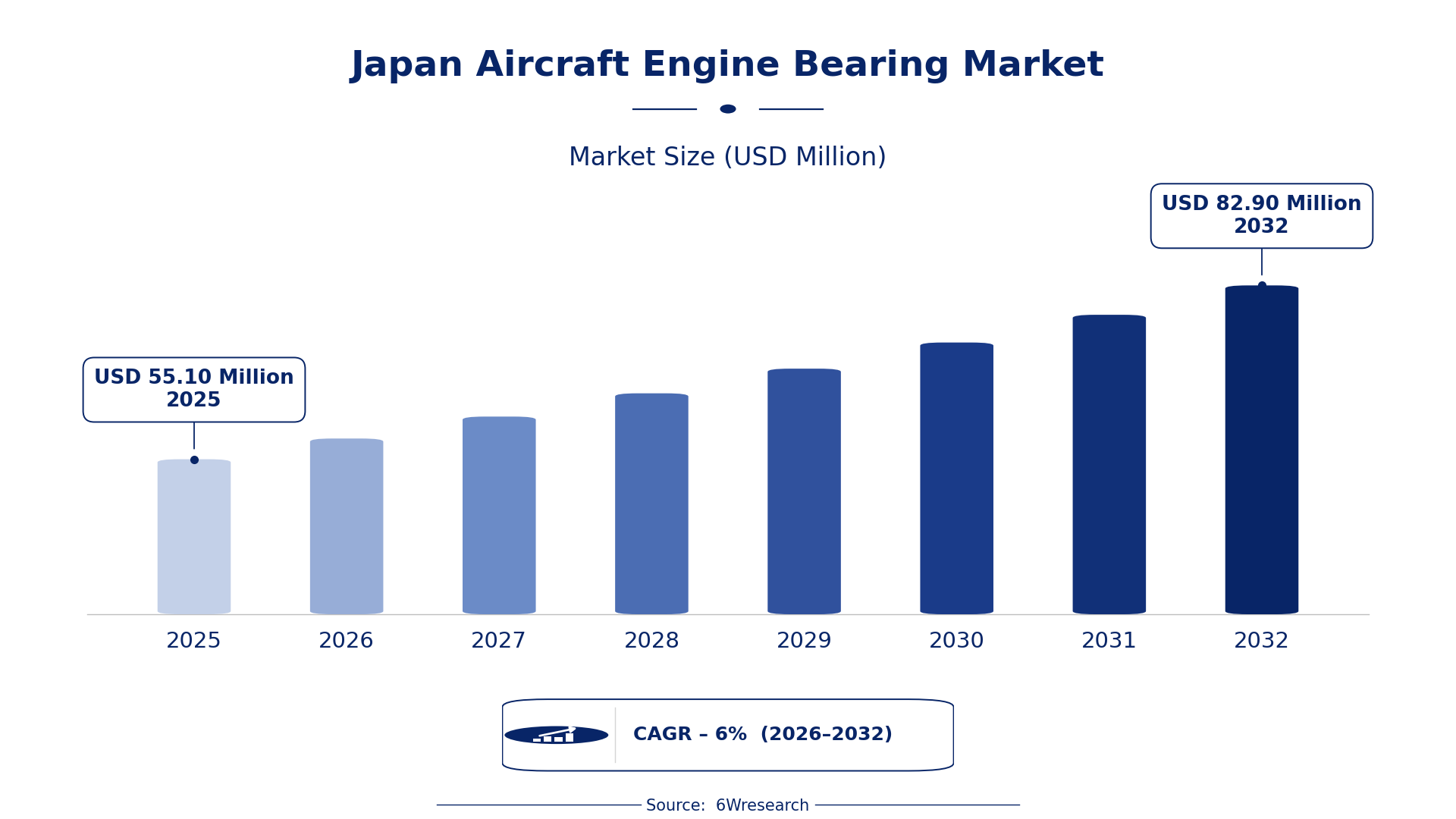
According to 6Wresearch internal database and industry insights, the Japan Aircraft Engine Bearing Market was valued at USD 55.10 Million in 2025 and is projected to reach USD 82.90 Million by 2032, growing at a CAGR of approximately 6% during 2026–2032.
Japan Aircraft Engine Bearing Market Highlights
| Report Metric | Details |
| Report Name | Japan Aircraft Engine Bearing Market (2026-2032) |
| Market Size 2025 | USD 55.10 Million |
| Market Size 2032 | USD 82.90 Million |
| Absolute Growth 2025–2032 | USD 27.80 Million |
| CAGR 2026–2032 | 6% |
| Peak Annual Growth | 7.9% in 2032 |
| Forecast Period | 2026–2032 |
| Historical Data | 2022–2025 |
| Base Year | 2025 |
| Leading Bearing Type, 2025 | Ball Bearings (43% share) |
| Leading Material Used, 2025 | High-Speed Steel (41% share) |
| Leading Distribution Channel, 2025 | Direct OEM Supplies (50% share) |
| Leading End User, 2025 | Commercial Jet Makers (36% share) |
| Fastest-Growing Bearing Type | Roller Bearings (8.5% CAGR) |
| Fastest-Growing Material Used | Chromium Steel (8.8% CAGR) |
| Fastest-Growing Distribution Channel | Industrial Distributors (8.0% CAGR) |
| Fastest-Growing End User | MRO Service Providers (7.8% CAGR) |
| Growing Sector | MRO Service Providers |
| Key End Users | Commercial Jet Makers, MRO Service Providers, Helicopter OEMs, Military Aircraft Assembly |
Japan Aircraft Engine Bearing Market Year-wise Growth Rate and Key Drivers (2022–2032)
This graph illustrates the annual growth rates of the market from 2022 to 2032, highlighting a steady upward trajectory and projected market expansion over the forecast period.
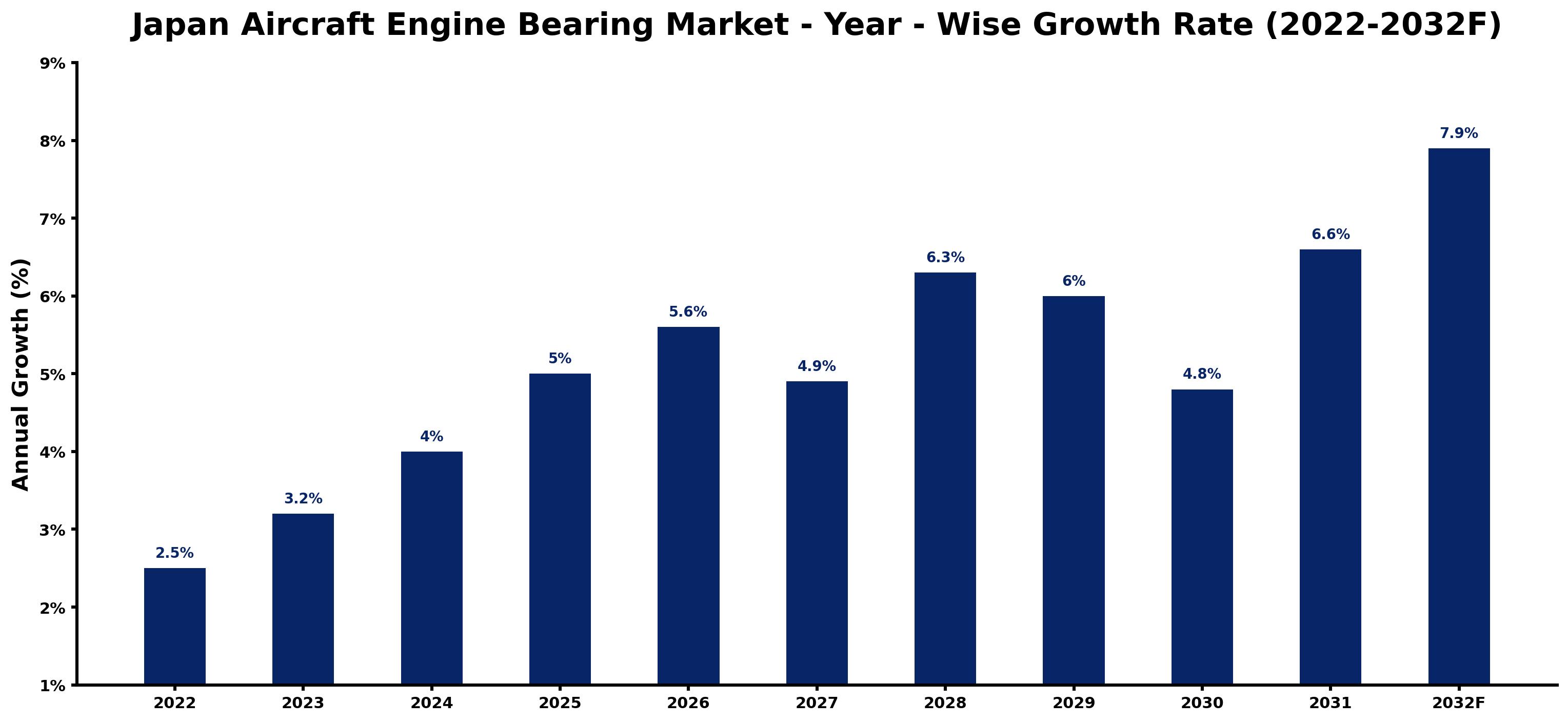
Annual growth estimates for each year appear below with the principal reason behind them, explaining the shifts that set the pace of the market.
| Year | Estimated Annual Growth (%) | Market Rationale |
| 2022 | 2.5 | The market showed steady demand from domestic manufacturers and MRO service providers. |
| 2023 | 3.2 | Growth accelerated due to increased aircraft production and maintenance activities. |
| 2024 | 4.0 | Demand continued to rise as the average age of aircraft prompted more MRO services. |
| 2025 | 5.0 | The peak growth year was driven by a surge in commercial aircraft production. |
| 2026 | 5.6 | Manufacturers are expected to adopt advanced materials for better performance, boosting demand. |
| 2027 | 4.9 | Growth is projected to slow slightly due to market saturation in some segments. |
| 2028 | 6.3 | The introduction of new aerospace technologies is expected to boost demand again. |
| 2029 | 6.0 | Growth is projected to slow as the market stabilises after previous peaks in production and maintenance. |
| 2030 | 4.8 | A slight slowdown is anticipated as manufacturers adjust to changing market conditions. |
| 2031 | 6.6 | Demand is projected to rise again as new aircraft models are introduced. |
| 2032 | 7.9 | The market is expected to peak with investments in aerospace technology and innovation. |
Note: Market size estimations and growth projections presented in this report are based on 6Wresearch's proprietary forecasting methodology, utilizing the latest available industry data, government publications, and primary research inputs.
Japan Aircraft Engine Bearing Market Synopsis
Aircraft engine bearings are precision components that support rotating shafts in engines, ensuring smooth operation and reduced friction. The Japan Aircraft Engine Bearing Market is growing as commercial jet makers and MRO service providers drive demand, supported by the production of around 1,500 commercial aircraft in 2022. Ongoing investments in aerospace innovation programs further support market growth, with assistance from the Tokyo Aerospace and Defense Industry Association through various initiatives and collaborations.
Market Dynamics Impact Analysis (2026–2032)
| Factor | Type | Impact | Primary Segment Affected |
| Rising aircraft production levels | Driver | High | Ball Bearings |
| Increasing demand for MRO services | Driver | High | Journal Bearings |
| Expansion of the aerospace sector | Opportunity | High | Commercial Jet Makers |
| Adoption of advanced materials in manufacturing | Opportunity | Medium | High-Speed Steel |
| Supply chain disruptions affecting production | Restraint | High | Roller Bearings |
| High certification costs for manufacturers | Restraint | Medium | Thrust Bearings |
| Competition from international manufacturers | Challenge | High | Chromium Steel |
| Fluctuating raw material prices | Challenge | Medium | Hybrid Ceramic |
Evaluation of Drivers in Japan Aircraft Engine Bearing Market (2026–2032)
Demand rests on the following drivers, each shown with the segment it touches most.
| Drivers | Primary Segment Affected | Why It Matters (Evidence) |
| Increased aircraft production | Ball Bearings | Japan produced approximately 1,500 commercial aircraft in 2022, boosting demand for bearings. |
| Growing MRO services | Journal Bearings | The average age of commercial aircraft in Japan is around 12 years, increasing MRO demand. |
| Investment in aerospace innovation | High-Speed Steel | The Japanese government invested ¥10 billion in aerospace technology development programs in 2023, enhancing capabilities. |
| Adoption of advanced materials | Roller Bearings | Promoting advanced materials for improved performance increases demand for high-performance bearings. |
| Rising demand from military applications | Thrust Bearings | Military aircraft assembly remains a key end-user, driving consistent demand for thrust bearings. |
Most of the extra volume comes from the production of approximately 1,500 commercial aircraft in 2022, which has increased demand for bearings. The average age of commercial aircraft in Japan is around 12 years, leading to rising needs for maintenance and repair services. The push for high-performance materials is driving demand across various segments, particularly in MRO services and military applications, as manufacturers seek to improve their product offerings.
Evaluation of Restraints in Japan Aircraft Engine Bearing Market
The key brakes on demand, and where they bite hardest, are shown below.
| Market Restraint | Primary Segment Affected | Why It Matters (Evidence) |
| Supply chain disruptions affecting production | Roller Bearings | Global supply chain issues have delayed the availability of key components, impacting production timelines by approximately three months. |
| High certification costs for manufacturers | Thrust Bearings | Manufacturers must invest in ISO 9001 certification, increasing operational costs by up to ¥500 million. |
| Limited availability of skilled workforce | Ball Bearings | A shortage of skilled workers in the aerospace sector hampers production efficiency, affecting output. |
| Fluctuating raw material prices | Chromium Steel | Volatility in raw material costs affects pricing strategies and profit margins for manufacturers. |
| Regulatory compliance requirements | Hybrid Ceramic | Manufacturers face stringent regulations that can delay product launches and increase costs. |
Japan Aircraft Engine Bearing Market Challenges
Buyers face increasing material costs as high-performance components become harder to source, leading to price hikes of 15% within a year. Compliance with regulatory standards, such as ISO 9001 certification, incurs expenses that can reach ¥500 million for manufacturers, reducing their profit margins. Production delays in the Tokyo Metropolitan Area average three months due to local supply chain issues, disrupting delivery schedules for buyers. Producers struggle with sourcing advanced materials promoted by the Japan Aerospace Exploration Agency, which hampers their ability to meet market demands effectively.
Trends in the Japan Aircraft Engine Bearing Market
The following changes are redrawing the Japan Aircraft Engine Bearing Market.
- Shift from Traditional to Advanced Materials: In 2023, there has been a notable shift towards advanced materials in aircraft engine bearings. The adoption of hybrid ceramic bearings has increased due to their lightweight properties, with a growth rate of over 10% in specialised applications.
- Transition from Direct to Digital Sales Channels: In 2022, online engine suppliers began to gain traction, with a 15% increase in sales through digital platforms. This shift allows MRO service providers to access parts more efficiently, improving supply chain responsiveness.
- Emergence of New Manufacturing Standards: The GX Promotion Act of 2023 has prompted manufacturers to adopt greener practices. As a result, companies are investing in energy-efficient production methods, aligning with sustainability goals and reducing operational costs.
- Prioritisation of Maintenance and Overhaul Services: In 2023, MRO service providers have become a focal point for aircraft manufacturers, with a 20% increase in service contracts. This trend reflects the growing emphasis on extending aircraft life cycles and optimising operational efficiency.
Investment Opportunities in the Japan Aircraft Engine Bearing Market
The following opportunities in the Japan Aircraft Engine Bearing Market pair current demand with a clear way in.
- High-Speed Steel Bearings: With the demand for high-speed steel bearings increasing, manufacturers should invest in production capabilities to meet this need. The Tokyo Metropolitan Area is a key industrial region for aircraft manufacturing, providing a strategic entry point for new suppliers.
- Direct OEM Supplies: The growing reliance on direct OEM supplies presents an opportunity for suppliers to establish partnerships. With a market share of 50% in 2025, direct OEM channels are critical for manufacturers looking to expand their reach.
- MRO Services Expansion: As the average age of commercial aircraft rises, there is a growing need for MRO services. Investing in maintenance capabilities in regions with high aircraft density can yield substantial returns for service providers.
- Investment in Aerospace Technology: With the Japanese government investing ¥10 billion in aerospace technology development programs, there is a clear opportunity for suppliers to align with these initiatives. Engaging in joint ventures with local manufacturers can facilitate market entry.
Government Initiatives in the Japan Aircraft Engine Bearing Market
The GX Promotion Act, established in 2023, encourages manufacturers to adopt sustainable practices, building on the Industrial Safety and Health Act of 1972, which set safety standards for machinery. This new framework adds compliance requirements for producers, ensuring they meet both safety and environmental standards, ultimately benefiting buyers through improved product reliability.
The Digital Agency oversees the approval of aerospace innovation programs, funding projects that improve manufacturing capabilities. In 2023, the agency allocated ¥10 billion to support technology development, directly benefiting manufacturers seeking to innovate and improve their product offerings.
Future Insight of the Japan Aircraft Engine Bearing Market
Investment in aerospace technology development is set to drive advancements in aircraft engine bearings by 2032. The shift towards lightweight materials will enhance fuel efficiency in aircraft, creating new opportunities for suppliers. As the average age of commercial aircraft remains around 12 years, the demand for maintenance, repair, and overhaul services will continue to rise. Aerospace innovation programs from the Ministry of Economy, Trade and Industry will facilitate improvements in manufacturing processes, benefiting both buyers and suppliers.
Market Segmentation Analysis
Japan Aircraft Engine Bearing Market report covers a detailed analysis of the following market segments:
By Bearing Type – Ball Bearings Lead, Roller Bearings Expected to Grow Fastest
According to Saurav Kr Singh, Senior Research Analyst at 6Wresearch, in 2025, Ball Bearings led the bearing type split with a 43% share. Ball bearings hold the largest market share due to their extensive application in various aircraft engine systems, ensuring smooth operation and reliability. Their critical role in supporting commercial aircraft production, which reached approximately 1,500 units in 2022, highlights their significance. Roller Bearings are set to record the highest CAGR in this split, 8.5% over 2026–2032. Roller bearings are rapidly gaining traction as they are essential for load-bearing applications in engines, which demand higher performance standards. The increasing focus on engine efficiency drives the adoption of roller bearings among manufacturers. Suppliers should prioritise the development of roller bearing technologies to meet the rising demand from aircraft manufacturers.
By Material Used – High-Speed Steel Leads, Chromium Steel Expected to Grow Fastest
High-Speed Steel held 41% of the Japan Aircraft Engine Bearing Market by material used in 2025. High-speed steel is a crucial material for aircraft engine bearings, valued for its strength and performance in demanding conditions. Its widespread adoption is essential for meeting the stringent reliability standards expected by manufacturers in the industry. Chromium Steel is projected to grow fastest, at a CAGR of 8.8% during 2026–2032. Chromium steel is gaining traction due to its durability, making it a preferred choice for manufacturers aiming to extend the lifespan of their products. This trend is bolstered by the industry's focus on maintaining high reliability in aircraft components. Manufacturers should prioritise advancements in chromium steel to cater to the evolving preferences of aircraft engine producers.
By Distribution Channel – Direct OEM Supplies Lead, Industrial Distributors Expected to Grow Fastest
The largest distribution channel category in 2025 was Direct OEM Supplies, at 50% of revenue. Direct OEM supplies are the main distribution channel, facilitating a direct connection between manufacturers and aircraft engine builders. This channel is crucial for ensuring the timely provision of high-quality components necessary for the production of commercial aircraft. Over 2026–2032, Industrial Distributors are expected to post the fastest growth, at a CAGR of 8.0%. Industrial distributors are swiftly increasing their influence as they enhance the supply chain for various users, offering improved flexibility and accessibility. Their growing role is indicative of the market's expansion and the need for diverse distribution options. Suppliers should focus on building partnerships with industrial distributors to broaden their market presence and enhance service delivery.
By End User – Commercial Jet Makers Lead, MRO Service Providers Expected to Grow Fastest
With 36% of end user revenue in 2025, Commercial Jet Makers was the largest category. Commercial jet makers constitute the largest end user segment for aircraft engine bearings, significantly influencing demand through their aircraft production activities. Their pivotal role is highlighted by Japan's robust aircraft manufacturing sector. The quickest growth will come from MRO Service Providers, forecast to expand at a CAGR of 7.8% between 2026 and 2032. MRO service providers are witnessing the fastest growth, driven by the average age of commercial aircraft in Japan being approximately 12 years, necessitating regular maintenance and repairs. This trend is likely to continue as the existing fleet ages further. Suppliers must adjust their approaches to effectively address the rising demands of MRO service providers to leverage this expanding segment.
Key Attractiveness of the Report
- 10 Years of Market Numbers
- Historical Data Starting from 2022 to 2025
- Base Year 2025
- Forecast Data until 2032
- Key Performance Indicators Impacting the Market
- Major Upcoming Developments and Projects
Key Highlights of the Report:
- Japan Aircraft Engine Bearing Market Outlook
- Market Size of Japan Aircraft Engine Bearing Market, 2025
- Forecast of Japan Aircraft Engine Bearing Market, 2032
- Historical Data and Forecast of Japan Aircraft Engine Bearing Revenues & Volume for the Period 2022-2032F
- Japan Aircraft Engine Bearing Market Trend Evolution
- Japan Aircraft Engine Bearing Market Drivers and Challenges
- Japan Aircraft Engine Bearing Price Trends
- Japan Aircraft Engine Bearing Porter's Five Forces
- Japan Aircraft Engine Bearing Industry Life Cycle
- Historical Data and Forecast of Japan Aircraft Engine Bearing Market Revenues & Volume By Bearing Type for the Period 2022-2032F
- Historical Data and Forecast of Japan Aircraft Engine Bearing Market Revenues & Volume By Ball Bearings for the Period 2022-2032F
- Historical Data and Forecast of Japan Aircraft Engine Bearing Market Revenues & Volume By Roller Bearings for the Period 2022-2032F
- Historical Data and Forecast of Japan Aircraft Engine Bearing Market Revenues & Volume By Thrust Bearings for the Period 2022-2032F
- Historical Data and Forecast of Japan Aircraft Engine Bearing Market Revenues & Volume By Journal Bearings for the Period 2022-2032F
- Historical Data and Forecast of Japan Aircraft Engine Bearing Market Revenues & Volume By Material Used for the Period 2022-2032F
- Historical Data and Forecast of Japan Aircraft Engine Bearing Market Revenues & Volume By High-Speed Steel for the Period 2022-2032F
- Historical Data and Forecast of Japan Aircraft Engine Bearing Market Revenues & Volume By Chromium Steel for the Period 2022-2032F
- Historical Data and Forecast of Japan Aircraft Engine Bearing Market Revenues & Volume By Hybrid Ceramic for the Period 2022-2032F
- Historical Data and Forecast of Japan Aircraft Engine Bearing Market Revenues & Volume By Titanium-Alloy Coated for the Period 2022-2032F
- Historical Data and Forecast of Japan Aircraft Engine Bearing Market Revenues & Volume By Distribution Channel for the Period 2022-2032F
- Historical Data and Forecast of Japan Aircraft Engine Bearing Market Revenues & Volume By Direct OEM Supplies for the Period 2022-2032F
- Historical Data and Forecast of Japan Aircraft Engine Bearing Market Revenues & Volume By Industrial Distributors for the Period 2022-2032F
- Historical Data and Forecast of Japan Aircraft Engine Bearing Market Revenues & Volume By Online Engine Suppliers for the Period 2022-2032F
- Historical Data and Forecast of Japan Aircraft Engine Bearing Market Revenues & Volume By Aviation Part Vendors for the Period 2022-2032F
- Historical Data and Forecast of Japan Aircraft Engine Bearing Market Revenues & Volume By End User for the Period 2022-2032F
- Historical Data and Forecast of Japan Aircraft Engine Bearing Market Revenues & Volume By Commercial Jet Makers for the Period 2022-2032F
- Historical Data and Forecast of Japan Aircraft Engine Bearing Market Revenues & Volume By MRO Service Providers for the Period 2022-2032F
- Historical Data and Forecast of Japan Aircraft Engine Bearing Market Revenues & Volume By Helicopter OEMs for the Period 2022-2032F
- Historical Data and Forecast of Japan Aircraft Engine Bearing Market Revenues & Volume By Military Aircraft Assembly for the Period 2022-2032F
- Japan Aircraft Engine Bearing Import Export Trade Statistics
- Market Opportunity Assessment By Bearing Type
- Market Opportunity Assessment By Material Used
- Market Opportunity Assessment By Distribution Channel
- Market Opportunity Assessment By End User
- Japan Aircraft Engine Bearing Top Companies Market Share
- Japan Aircraft Engine Bearing Competitive Benchmarking By Technical and Operational Parameters
- Japan Aircraft Engine Bearing Company Profiles
- Japan Aircraft Engine Bearing Key Strategic Recommendations
Market Covered
Segments analysed in this report are listed below.
By Bearing Type
- Ball Bearings
- Roller Bearings
- Thrust Bearings
- Journal Bearings
By Material Used
- High-Speed Steel
- Chromium Steel
- Hybrid Ceramic
- Titanium-Alloy Coated
By Distribution Channel
- Direct OEM Supplies
- Industrial Distributors
- Online Engine Suppliers
- Aviation Part Vendors
By End User
- Commercial Jet Makers
- MRO Service Providers
- Helicopter OEMs
- Military Aircraft Assembly































