Japan Aircraft Engine Oils Market Size & Growth Rate
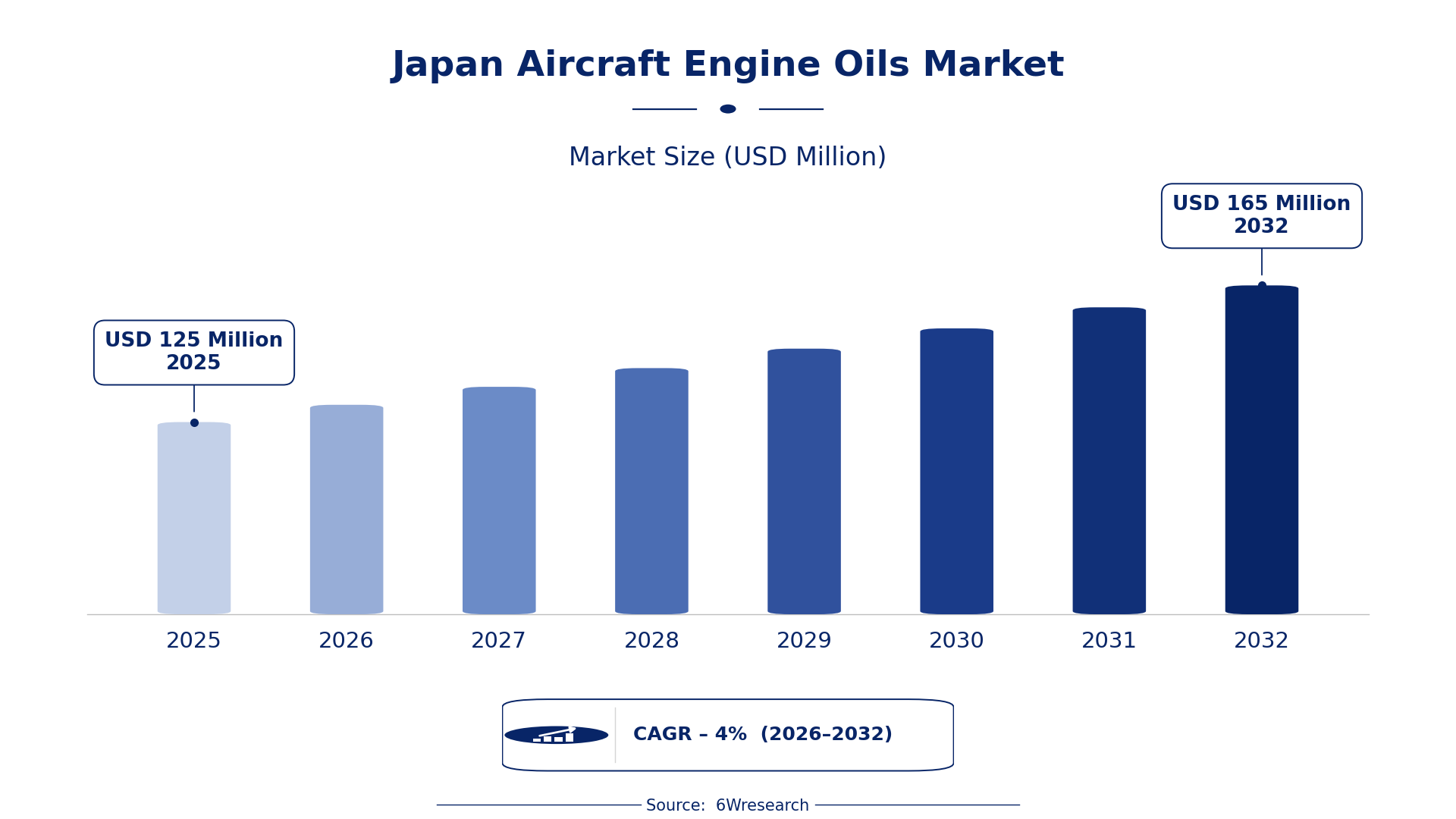
According to 6Wresearch internal database and industry insights, the Japan Aircraft Engine Oils Market was valued at USD 125 Million in 2025 and is projected to reach USD 165 Million by 2032, growing at a CAGR of approximately 4% during 2026–2032.
Japan Aircraft Engine Oils Market Highlights
| Report Metric | Details |
| Report Name | Japan Aircraft Engine Oils Market (2026-2032) |
| Market Size 2025 | USD 125 Million |
| Market Size 2032 | USD 165 Million |
| Absolute Growth 2025–2032 | USD 40 Million |
| CAGR 2026–2032 | 4% |
| Peak Annual Growth | 5.1% in 2026 |
| Forecast Period | 2026–2032 |
| Historical Data | 2022–2025 |
| Base Year | 2025 |
| Leading Oil Type, 2025 | Mineral-Based Oils (47% share) |
| Leading Viscosity Grade, 2025 | SAE 20W-50 (37% share) |
| Leading Distribution Channel, 2025 | Aviation Lubricant Vendors (44% share) |
| Leading End User, 2025 | Regional Airlines (53% share) |
| Fastest-Growing Oil Type | Synthetic Oils (5.7% CAGR) |
| Fastest-Growing Viscosity Grade | Type II/III Certified (5.6% CAGR) |
| Fastest-Growing Distribution Channel | Online Oil Suppliers (5.1% CAGR) |
| Fastest-Growing End User | Charter Aircraft Operators (5.0% CAGR) |
| Growing Sector | Aviation |
| Key End Users | Regional Airlines, MRO Hangars, Charter Aircraft Operators, Aviation Lubricant Vendors |
Japan Aircraft Engine Oils Market Year-wise Growth Rate and Key Drivers (2022–2032)
This graph illustrates the annual growth rates of the market from 2022 to 2032, highlighting a steady upward trajectory and projected market expansion over the forecast period.
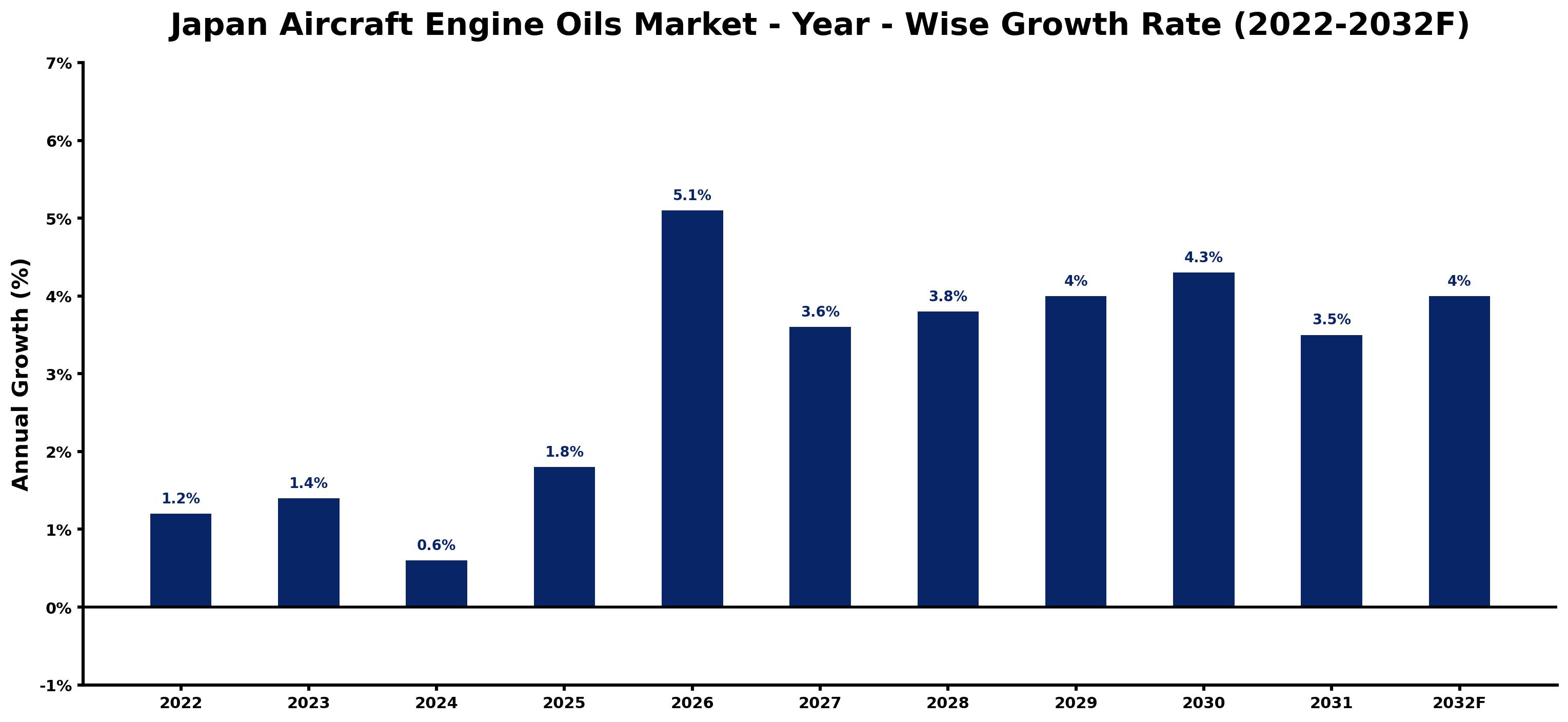
Year by year, the estimates below pair each growth rate with the development that shaped it.
| Year | Estimated Annual Growth (%) | Market Rationale |
| 2022 | 1.2 | Demand was stable, supported by ongoing operations in the aviation sector. |
| 2023 | 1.4 | Growth accelerated as regional airlines increased flight frequencies. |
| 2024 | 0.6 | Growth slowed due to market saturation and limited new aircraft deliveries. |
| 2025 | 1.8 | Demand rose as maintenance activities increased for aging fleets. |
| 2026 | 5.1 | The market is expected to surge, driven by new aircraft acquisitions and upgrades. |
| 2027 | 3.6 | Growth is projected to moderate as supply chain issues affect oil availability. |
| 2028 | 3.8 | Demand is anticipated to pick up again as airlines resume expansion plans. |
| 2029 | 4.0 | Continued growth is expected to be supported by rising passenger numbers. |
| 2030 | 4.3 | Demand will remain strong as airlines focus on fuel efficiency. |
| 2031 | 3.5 | Growth is projected to slow as the market stabilises after rapid expansions. |
| 2032 | 4.0 | Demand is expected to increase as environmental regulations tighten. |
Note: Market size estimations and growth projections presented in this report are based on 6Wresearch's proprietary forecasting methodology, utilizing the latest available industry data, government publications, and primary research inputs.
Japan Aircraft Engine Oils Market Synopsis
Aircraft engine oils are specialized lubricants designed to minimise friction and wear in engines. They are composed of mineral, synthetic, or bio-based components and play a critical role in lubricating engine parts, enhancing fuel efficiency, and preventing corrosion. The Japan Aircraft Engine Oils Market is growing due to increasing demand from regional airlines and maintenance, repair, and overhaul services. The aviation sector employs over 300,000 individuals and is expected to expand steadily, with synthetic oils representing 30% of total sales in 2023, driving higher purchases.
Market Dynamics Impact Analysis (2026–2032)
| Factor | Type | Impact | Primary Segment Affected |
| Increased fleet modernisation in regional airlines | Driver | High | Regional Airlines |
| Growing focus on environmental sustainability | Driver | High | Bio-Based Engine Oils |
| Investment in aviation infrastructure | Opportunity | High | Aviation Lubricant Vendors |
| Rising demand for high-performance oils | Opportunity | Medium | Synthetic Oils |
| Stringent regulations for aviation lubricants | Restraint | High | Mineral-Based Oils |
| Limited adoption of bio-based oils | Restraint | Medium | Bio-Based Engine Oils |
| Supply chain disruptions affecting availability | Challenge | High | Mineral-Based Oils |
| High costs associated with synthetic oils | Challenge | Medium | Synthetic Oils |
Evaluation of Drivers in Japan Aircraft Engine Oils Market (2026–2032)
Key forces behind demand, with the segment each one moves most, are listed below.
| Drivers | Primary Segment Affected | Why It Matters (Evidence) |
| Increased flight operations by regional airlines | Regional Airlines | This growth leads to higher demand for engine oils, with over 100 regional airlines operating in Japan. |
| Adoption of synthetic oils for better performance | Synthetic Oils | Synthetic oils are preferred for their superior characteristics, accounting for 30% of total sales in 2023. |
| Investment in aviation infrastructure | Aviation Lubricant Vendors | Government initiatives support infrastructure development, increasing demand for lubrication products. |
| Focus on fuel efficiency and emissions reduction | High-Temperature Oils | The aviation sector's push for greener operations drives demand for high-performance oils. |
| Expansion of MRO services in major airports | MRO Hangars | MRO hangars in major airports are key users of aircraft engine oils, boosting market demand. |
Orders keep climbing as regional airlines expand their flight operations, with over 100 airlines in Japan driving demand for aircraft engine oils. The shift towards synthetic oils is notable, as they are increasingly adopted for their superior performance, accounting for 30% of total sales in 2023. Investment in aviation infrastructure is increasing the demand for lubrication products. The focus on fuel efficiency and emissions reduction compels airlines to purchase high-temperature oils, while the expansion of MRO services at major airports further boosts the market for engine oils.
Evaluation of Restraints in Japan Aircraft Engine Oils Market
The key brakes on demand, and where they bite hardest, are shown below.
| Market Restraint | Primary Segment Affected | Why It Matters (Evidence) |
| Strict regulations under JIS standards | Mineral-Based Oils | These regulations require rigorous testing and certification, limiting market entry for some products. |
| Limited consumer awareness of bio-based options | Bio-Based Engine Oils | This results in slow adoption rates, despite growing interest in eco-friendly solutions. |
| Supply chain disruptions affecting oil availability | High-Temperature Oils | These disruptions lead to delays and increased costs for buyers in the aviation sector. |
| High costs associated with synthetic oil production | Synthetic Oils | These costs can deter some buyers from switching from mineral-based options. |
| Market saturation in certain oil types | Mineral-Based Oils | This saturation limits growth potential as demand stabilises. |
Japan Aircraft Engine Oils Market Challenges
Technology adoption in Japan's aviation sector encounters obstacles due to strict regulations for aviation lubricants under JIS standards, resulting in approval delays of up to six months for producers. Competition among suppliers has intensified as the rise of synthetic oils forces smaller producers to operate with narrower margins, leading to price declines of around 10%. Buyers face higher operational costs due to mandatory Type II/III certified oils, which can raise expenses by 15%. Skills shortages in the aviation maintenance sector create inefficiencies, potentially delaying repairs and increasing downtime for airlines by 20% during peak periods.
Trends in the Japan Aircraft Engine Oils Market
Buyers and suppliers in the Japan Aircraft Engine Oils Market are adjusting to the following trends.
- Shift towards Synthetic Oils: The uptake of synthetic oils has grown, with their market share increasing as performance characteristics take precedence. In 2023, synthetic oils constituted 30% of total sales, indicating a rising trend among regional airlines.
- Emergence of Bio-Based Engine Oils: In 2023, Japan initiated a green aviation initiative promoting bio-based engine oils. This programme aims for a 46% reduction in greenhouse gas emissions by 2030, motivating manufacturers to pursue eco-friendly formulations.
- Increased Demand for High-Temperature Oils: As high-performance aircraft become more prevalent, high-temperature oils have become indispensable. In 2023, their usage surged by 15% among MRO hangars, driven by the necessity for reliability in extreme conditions.
- Focus on Aviation Lubricant Vendors: Aviation lubricant vendors are increasingly acknowledged as key contributors in the supply chain. In 2023, they represented 44% of the distribution channel, highlighting their importance in addressing the growing demand.
Investment Opportunities in the Japan Aircraft Engine Oils Market
The openings below show where demand in the Japan Aircraft Engine Oils Market is visible and how suppliers can enter.
- Timing for Infrastructure Investment: With the Japanese government aiming for JPY 150 trillion for decarbonisation, suppliers of aviation lubricants have a chance to engage in infrastructure projects.
- Supply of Synthetic Oils: The demand for synthetic oils is on the rise, offering opportunities for suppliers to meet the needs of regional airlines seeking high-performance solutions. This segment is projected to grow rapidly.
- Regional Airlines Expanding Fleet: Regional airlines are expanding their fleets, generating a demand for dependable aircraft engine oils. Suppliers can tap into this market by collaborating with local distributors.
- MRO Hangars Upgrading Services: MRO hangars are investing in advanced maintenance technologies, resulting in increased demand for specialised oils. Suppliers can take advantage of this trend by providing tailored products.
Government Initiatives in the Japan Aircraft Engine Oils Market
The Act on Japanese Industrial Standards governs the testing and certification of aviation lubricants, impacting producers of aircraft engine oils. Compliance with these regulations ensures that manufacturers meet environmental standards, which is vital for market acceptance. Strict adherence to these standards is essential for maintaining product quality and safety, affecting the overall competitiveness of the market.
The Ministry of Land, Infrastructure, Transport and Tourism promotes research in aviation technologies, funding projects that improve the performance of aircraft engine oils. This support encourages innovation and helps buyers access improved products that meet stringent performance criteria. The agency's initiatives aim to enhance the safety and efficiency of aviation operations, benefiting both producers and users.
Future Insight of the Japan Aircraft Engine Oils Market
The forthcoming green aviation initiative will accelerate the development of bio-based engine oils, aligning with Japan's target for net zero emissions by 2050. By 2032, advancements in aviation technologies promoted by the Japan Aerospace Exploration Agency will improve efficiency and safety standards. Investment in aviation infrastructure, particularly at major airports like Narita and Haneda, will bolster growth in the sector. Suppliers will need to adapt to evolving environmental standards while buyers gain from enhanced product performance.
Market Segmentation Analysis
Japan Aircraft Engine Oils Market report covers a detailed analysis of the following market segments:
By Oil Type – Mineral-Based Oils Lead, Synthetic Oils Expected to Grow Fastest
According to Saurav Kr Singh, Senior Research Analyst at 6Wresearch, Mineral-Based Oils held 47% of the Japan Aircraft Engine Oils Market by oil type in 2025. Mineral-based oils dominate the market as they are the conventional choice for general engine lubrication across numerous aircraft types. Their extensive application among regional airlines, which operate over 100 aircraft, reinforces their leading position in Japan's aviation sector. Synthetic Oils are projected to grow fastest, at a CAGR of 5.7% during 2026–2032. The swift uptake of synthetic oils is attributed to their superior performance characteristics, particularly in high-performance engines. This trend is accelerated by the government's green aviation initiative, which encourages the adoption of more efficient lubricants. Suppliers should focus on developing synthetic oil products to meet the rising demand for advanced lubrication solutions.
By Viscosity Grade – SAE 20W-50 Leads, Type II/III Certified Expected to Grow Fastest
SAE 20W-50 accounted for 37% of the market by viscosity grade in 2025. SAE 20W-50 holds the largest share as it is the standard viscosity grade commonly used across various aircraft, ensuring compatibility and reliability. Its widespread application in regional airlines solidifies its leading status in the market. The quickest growth will come from Type II/III Certified, forecast to expand at a CAGR of 5.6% between 2026 and 2032. Type II/III certified oils are experiencing rapid growth due to their mandatory requirement for specific aviation applications, particularly in commercial aviation. This regulatory push is expected to drive further adoption among operators. Buyers must ensure compliance with Type II/III certification to maintain operational standards and safety in aviation.
By Distribution Channel – Aviation Lubricant Vendors Lead, Online Oil Suppliers Expected to Grow Fastest
With 44% of distribution channel revenue in 2025, Aviation Lubricant Vendors was the largest category. Aviation lubricant vendors are the primary source for purchasing oils, providing a wide range tailored specifically for the aviation sector. Their established connections with regional airlines ensure consistent supply and reliability in procurement processes. Over 2026–2032, Online Oil Suppliers are expected to post the fastest growth, at a CAGR of 5.1%. Online oil suppliers are rapidly gaining traction as they cater to smaller operators seeking convenience and accessibility in their purchasing decisions. The transition towards digital platforms for procurement is reshaping the distribution dynamics in the market. Suppliers need to strengthen their online distribution strategies to effectively reach the growing segment of digital buyers in the aviation industry.
By End User – Regional Airlines Lead, Charter Aircraft Operators Expected to Grow Fastest
In 2025, Regional Airlines led the end user split with a 53% share. Regional airlines represent the largest consumer group of aircraft oils, relying on these lubricants for their varied fleet operations. Their substantial presence in the market guarantees a continuous demand for effective lubrication solutions across the industry. Charter Aircraft Operators are set to record the highest CAGR in this split, 5.0% over 2026–2032. Charter aircraft operators are witnessing the fastest growth as they require oils for maintaining a diverse fleet of various aircraft types. This trend highlights the increasing popularity of charter services within Japan's aviation sector. Suppliers should tailor their offerings to meet the specific needs of charter operators to capitalise on the growth potential in this segment.
Key Attractiveness of the Report
- 10 Years of Market Numbers
- Historical Data Starting from 2022 to 2025
- Base Year 2025
- Forecast Data until 2032
- Key Performance Indicators Impacting the Market
- Major Upcoming Developments and Projects
Key Highlights of the Report:
- Japan Aircraft Engine Oils Market Outlook
- Market Size of Japan Aircraft Engine Oils Market, 2025
- Forecast of Japan Aircraft Engine Oils Market, 2032
- Historical Data and Forecast of Japan Aircraft Engine Oils Revenues & Volume for the Period 2022-2032F
- Japan Aircraft Engine Oils Market Trend Evolution
- Japan Aircraft Engine Oils Market Drivers and Challenges
- Japan Aircraft Engine Oils Price Trends
- Japan Aircraft Engine Oils Porter's Five Forces
- Japan Aircraft Engine Oils Industry Life Cycle
- Historical Data and Forecast of Japan Aircraft Engine Oils Market Revenues & Volume By Oil Type for the Period 2022-2032F
- Historical Data and Forecast of Japan Aircraft Engine Oils Market Revenues & Volume By Mineral-Based Oils for the Period 2022-2032F
- Historical Data and Forecast of Japan Aircraft Engine Oils Market Revenues & Volume By Synthetic Oils for the Period 2022-2032F
- Historical Data and Forecast of Japan Aircraft Engine Oils Market Revenues & Volume By Bio-Based Engine Oils for the Period 2022-2032F
- Historical Data and Forecast of Japan Aircraft Engine Oils Market Revenues & Volume By High-Temperature Oils for the Period 2022-2032F
- Historical Data and Forecast of Japan Aircraft Engine Oils Market Revenues & Volume By Viscosity Grade for the Period 2022-2032F
- Historical Data and Forecast of Japan Aircraft Engine Oils Market Revenues & Volume By SAE 20W-50 for the Period 2022-2032F
- Historical Data and Forecast of Japan Aircraft Engine Oils Market Revenues & Volume By Type II/III Certified for the Period 2022-2032F
- Historical Data and Forecast of Japan Aircraft Engine Oils Market Revenues & Volume By Eco-Friendly Formula for the Period 2022-2032F
- Historical Data and Forecast of Japan Aircraft Engine Oils Market Revenues & Volume By Turbo Engine Use for the Period 2022-2032F
- Historical Data and Forecast of Japan Aircraft Engine Oils Market Revenues & Volume By Distribution Channel for the Period 2022-2032F
- Historical Data and Forecast of Japan Aircraft Engine Oils Market Revenues & Volume By Aviation Lubricant Vendors for the Period 2022-2032F
- Historical Data and Forecast of Japan Aircraft Engine Oils Market Revenues & Volume By Online Oil Suppliers for the Period 2022-2032F
- Historical Data and Forecast of Japan Aircraft Engine Oils Market Revenues & Volume By Specialty Aviation Stores for the Period 2022-2032F
- Historical Data and Forecast of Japan Aircraft Engine Oils Market Revenues & Volume By Engine Maintenance Dealers for the Period 2022-2032F
- Historical Data and Forecast of Japan Aircraft Engine Oils Market Revenues & Volume By End User for the Period 2022-2032F
- Historical Data and Forecast of Japan Aircraft Engine Oils Market Revenues & Volume By Regional Airlines for the Period 2022-2032F
- Historical Data and Forecast of Japan Aircraft Engine Oils Market Revenues & Volume By Charter Aircraft Operators for the Period 2022-2032F
- Historical Data and Forecast of Japan Aircraft Engine Oils Market Revenues & Volume By MRO Hangars for the Period 2022-2032F
- Historical Data and Forecast of Japan Aircraft Engine Oils Market Revenues & Volume By Helicopter Maintenance Teams for the Period 2022-2032F
- Japan Aircraft Engine Oils Import Export Trade Statistics
- Market Opportunity Assessment By Oil Type
- Market Opportunity Assessment By Viscosity Grade
- Market Opportunity Assessment By Distribution Channel
- Market Opportunity Assessment By End User
- Japan Aircraft Engine Oils Top Companies Market Share
- Japan Aircraft Engine Oils Competitive Benchmarking By Technical and Operational Parameters
- Japan Aircraft Engine Oils Company Profiles
- Japan Aircraft Engine Oils Key Strategic Recommendations
Market Covered
The report covers the following segments.
By Oil Type
- Mineral-Based Oils
- Synthetic Oils
- Bio-Based Engine Oils
- High-Temperature Oils
By Viscosity Grade
- SAE 20W-50
- Type II/III Certified
- Eco-Friendly Formula
- Turbo Engine Use
By Distribution Channel
- Aviation Lubricant Vendors
- Online Oil Suppliers
- Specialty Aviation Stores
- Engine Maintenance Dealers
By End User
- Regional Airlines
- Charter Aircraft Operators
- MRO Hangars
- Helicopter Maintenance Teams































