Japan Airplay Wireless Display Market Size & Growth Rate
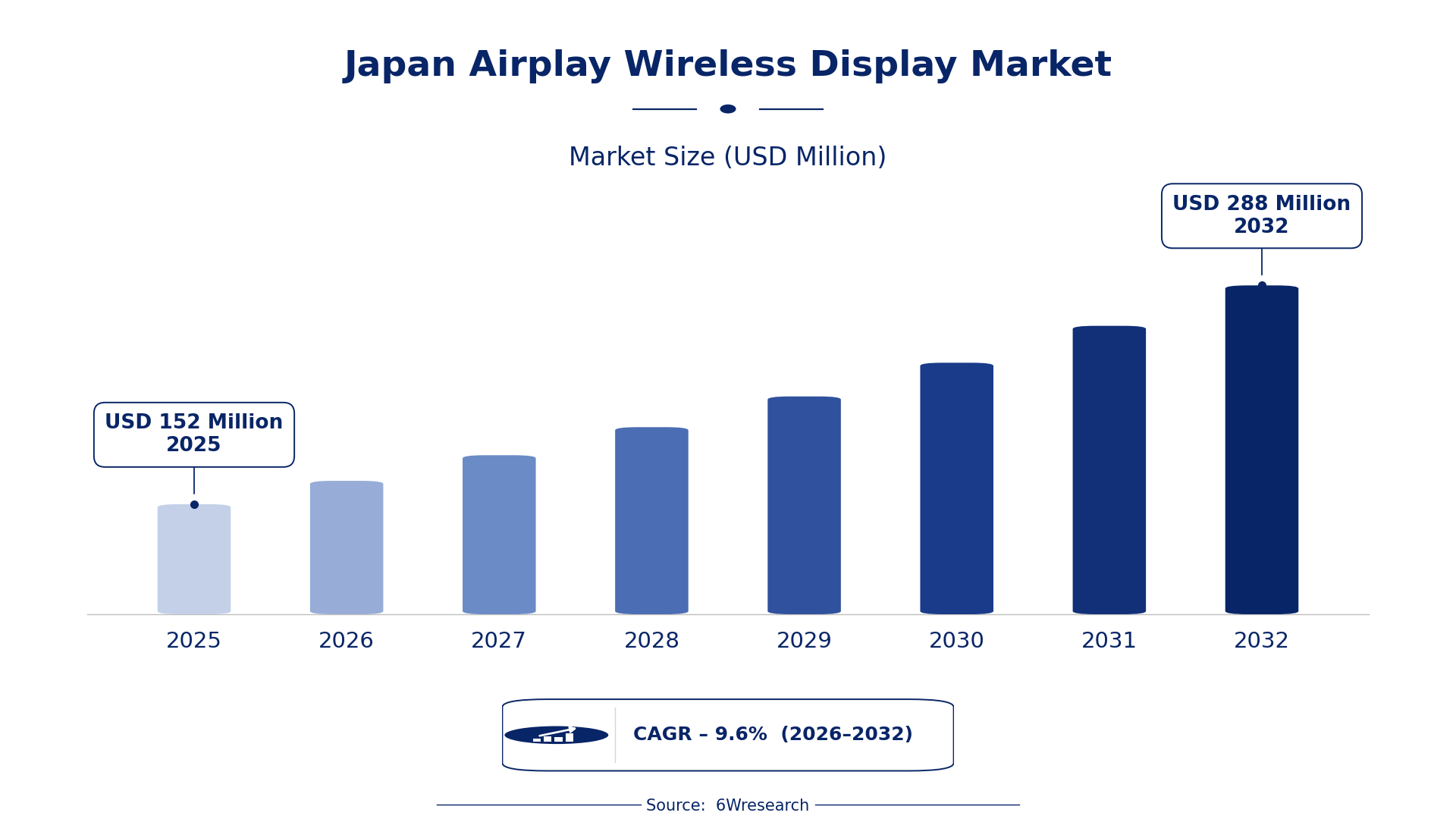
According to 6Wresearch internal database and industry insights, the Japan Airplay Wireless Display Market was valued at USD 152 Million in 2025 and is projected to reach USD 288 Million by 2032, growing at a CAGR of approximately 9.6% during 2026–2032.
Japan Airplay Wireless Display Market Highlights
| Report Metric | Details |
| Report Name | Japan Airplay Wireless Display Market (2026-2032) |
| Market Size 2025 | USD 152 Million |
| Market Size 2032 | USD 288 Million |
| Absolute Growth 2025–2032 | USD 136 Million |
| CAGR 2026–2032 | 9.6% |
| Peak Annual Growth | 10.9% in 2032 |
| Forecast Period | 2026–2032 |
| Historical Data | 2022–2025 |
| Base Year | 2025 |
| Leading Offerings, 2025 | Hardware (46% share) |
| Leading Application, 2025 | Consumers (41% share) |
| Fastest-Growing Offerings | Software (13.7% CAGR) |
| Fastest-Growing Application | Commercial (13.3% CAGR) |
| Growing Sector | Education |
| Key End Users | Consumers, Commercial, Education, Healthcare |
Japan Airplay Wireless Display Market Year-wise Growth Rate and Key Drivers (2022–2032)
This graph illustrates the annual growth rates of the market from 2022 to 2032, highlighting a steady upward trajectory and projected market expansion over the forecast period.
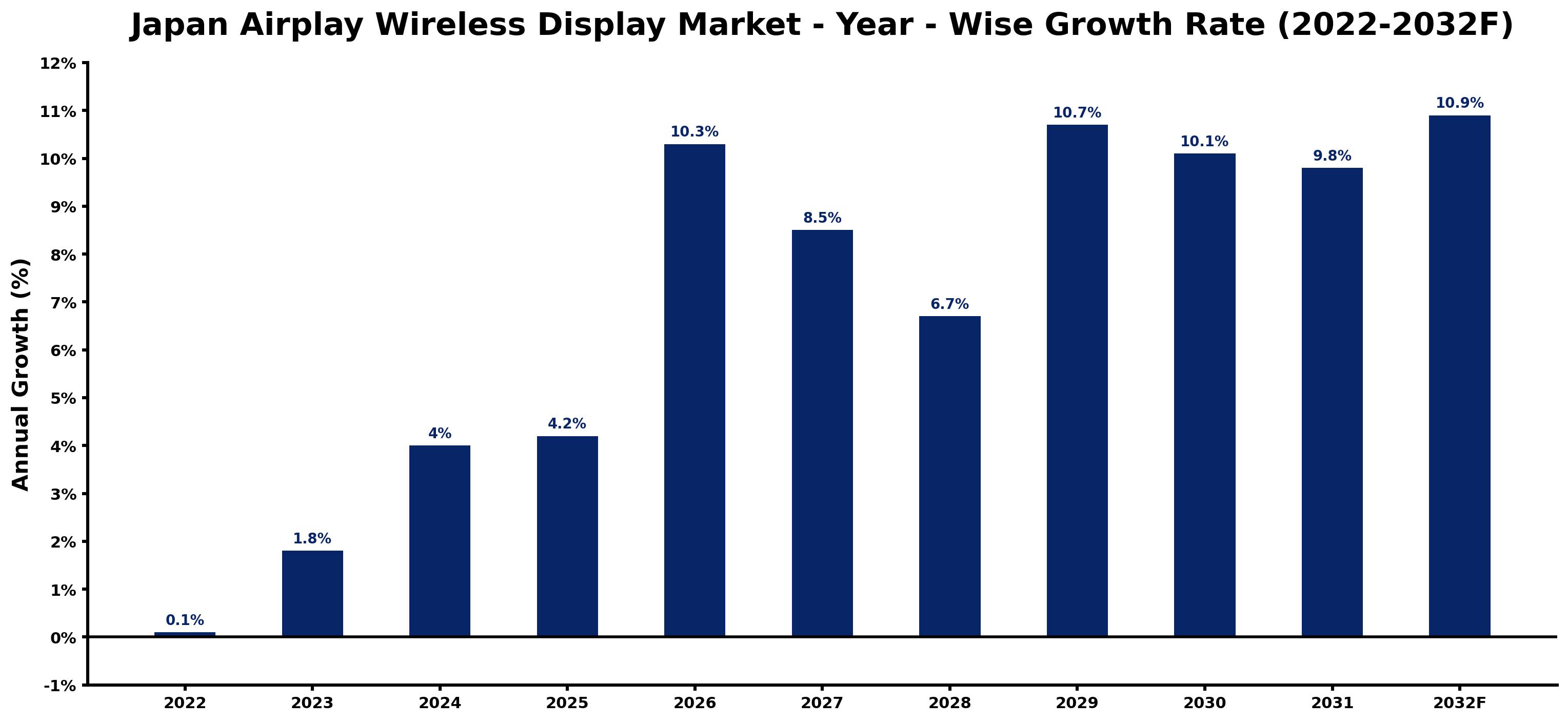
The table below sets out the estimated growth rate for each year and the main factor behind it.
| Year | Estimated Annual Growth (%) | Market Rationale |
| 2022 | 0.1 | The market showed minimal activity with early adopters of wireless display technology. |
| 2023 | 1.8 | Growth accelerated as more users embraced wireless display solutions for convenience. |
| 2024 | 4.0 | Increased adoption in commercial settings spurred faster growth compared to the previous year. |
| 2025 | 4.2 | Demand surged as businesses recognised the benefits of wireless presentations. |
| 2026 | 10.3 | Consumer interest is expected to drive growth in the market, reflecting a shift towards wireless solutions. |
| 2027 | 8.5 | Growth is projected to slow as the market reaches a more mature phase of adoption. |
| 2028 | 6.7 | Interest in educational applications will contribute to a further slowdown in growth. |
| 2029 | 10.7 | A resurgence in commercial demand is expected to lead to a faster growth rate than before. |
| 2030 | 10.1 | Growth is projected to decelerate slightly as the market stabilises after rapid expansion. |
| 2031 | 9.8 | Demand will continue to rise, but at a slower pace as the market matures. |
| 2032 | 10.9 | The market is expected to peak with strong demand from both consumers and businesses. |
Note: Market size estimations and growth projections presented in this report are based on 6Wresearch's proprietary forecasting methodology, utilizing the latest available industry data, government publications, and primary research inputs.
Japan Airplay Wireless Display Market Synopsis
Airplay Wireless Display technology enables wireless streaming of audio and video content from devices to displays, primarily through Wi-Fi integration. Its applications span personal entertainment, business presentations, and educational environments. The Japan Airplay Wireless Display Market is experiencing growth driven by rising consumer adoption in commercial sectors and government initiatives to improve digital learning tools in schools. With over 126 million people in Japan, demand for wireless display technology continues to rise, particularly in urban hubs like Tokyo.
Market Dynamics Impact Analysis (2026–2032)
| Factor | Type | Impact | Primary Segment Affected |
| Growing consumer adoption of wireless display technology | Driver | High | Consumers |
| Increased investment in digital learning tools | Driver | High | Education |
| Expansion of commercial applications in urban areas | Opportunity | High | Commercial |
| Government funding for smart classrooms | Opportunity | High | Education |
| Limited awareness of wireless display benefits | Restraint | Medium | Consumers |
| High costs associated with advanced technology integration | Restraint | Medium | Commercial |
| Competition from alternative display technologies | Challenge | High | Corporate & broadcast |
| Slow adoption in rural areas due to infrastructure issues | Challenge | Medium | Education |
Evaluation of Drivers in Japan Airplay Wireless Display Market (2026–2032)
These are the developments adding the most demand over the forecast period.
| Drivers | Primary Segment Affected | Why It Matters (Evidence) |
| Increased consumer interest in home entertainment systems | Consumers | Over 126 million people in Japan are adopting wireless display technology for streaming media. |
| Growing demand for interactive learning tools in classrooms | Education | In 2023, funding was allocated to improve digital learning tools in schools. |
| Rise in remote presentations in the corporate sector | Commercial | In 2023, the corporate sector saw a notable increase in the use of wireless display technology for presentations. |
| Investment in smart classrooms by educational institutions | Education | In 2023, funds were allocated for the promotion of smart classrooms in schools. |
| High concentration of commercial establishments in Tokyo | Commercial | Tokyo is a major hub for commercial applications of Airplay Wireless Display technology. |
Volumes increase as consumer interest in home entertainment systems rises, with many users adopting wireless display technology for streaming media. The education sector also contributes to demand, as funding was allocated in 2023 to improve digital learning tools in schools. Corporate entities are increasingly using wireless displays for remote presentations, reflecting a shift in workplace practices. A high concentration of commercial establishments in Tokyo further drives market expansion, as businesses seek effective solutions for presentations and media sharing.
Evaluation of Restraints in Japan Airplay Wireless Display Market
Several factors work against faster growth; the main ones are summarised below.
| Market Restraint | Primary Segment Affected | Why It Matters (Evidence) |
| Limited awareness of wireless display technology benefits | Consumers | Many consumers remain unaware of the advantages of wireless display technology, hindering adoption rates. |
| High costs associated with advanced technology integration | Commercial | The integration of advanced wireless display systems can be costly, deterring some businesses from investing. |
| Competition from alternative display technologies | Corporate & broadcast | Alternative technologies may offer similar functionalities, creating competitive pressures for wireless display solutions. |
| Slow adoption in rural areas due to infrastructure issues | Education | Rural areas face infrastructure challenges that limit the deployment of wireless display solutions. |
| Limited applications in niche markets | Others | Some sectors have minimal use cases for wireless display technology, restricting overall growth. |
Japan Airplay Wireless Display Market Challenges
Buyers in the education sector encounter higher costs due to compliance with JIS standards, which can raise expenses by up to 15% and delay the implementation of digital learning tools. Importers face challenges in sourcing advanced technology, leading to potential delays of up to six months in product availability for commercial users. Producers struggle to integrate wireless display systems into existing infrastructures, resulting in training costs increasing by around 10% for healthcare staff. Connectivity issues arise from reliance on Wi-Fi technology, causing disruptions for users in rural areas and affecting their operational efficiency.
Trends in the Japan Airplay Wireless Display Market
These developments are changing demand patterns in the Japan Airplay Wireless Display Market.
- Shift in Educational Tools: Educational institutions are increasingly adopting wireless display solutions to facilitate remote learning. In 2023, funding was allocated to improve digital learning tools in schools, resulting in a rise in technology adoption.
- Expansion in Corporate Presentations: The corporate sector is moving towards more interactive presentations using wireless display technology. In 2023, a notable increase in remote presentations was observed, highlighting the technology's growing importance.
- Increased Consumer Engagement: Consumers are shifting towards wireless display technology for personal entertainment. In urban areas like Tokyo, the demand for media sharing has surged, with a notable increase in potential users.
- Focus on Digital Infrastructure: The Japanese government is prioritising improvements in digital infrastructure, particularly in rural areas. In 2023, initiatives aimed at enhancing wireless display capabilities were launched, benefiting educational institutions.
Investment Opportunities in the Japan Airplay Wireless Display Market
The following areas offer the clearest openings for investors and suppliers in the Japan Airplay Wireless Display Market.
- Educational Institutions Seeking Digital Solutions: Educational institutions are investing in wireless display solutions to improve learning experiences. In 2023, funding was allocated for smart classrooms, creating a significant opportunity for suppliers.
- Commercial Establishments in Urban Areas: Tokyo's commercial establishments are looking for advanced wireless display technologies to improve presentations. With a high concentration of businesses, this urban hub presents a prime opportunity for investment.
- Healthcare Sector Exploring Telemedicine Applications: The healthcare industry is adopting wireless display technologies for telemedicine applications. As digital solutions gain traction, there is a growing need for suppliers to meet this demand.
- Rural Areas Improving Digital Infrastructure: With government initiatives aimed at enhancing digital infrastructure in rural areas, there is an opportunity for suppliers to provide wireless display solutions. The focus on connectivity is expected to drive demand.
Government Initiatives in the Japan Airplay Wireless Display Market
The Electrical Appliance and Material Safety Act (1961; METI) regulates the safety of electrical appliances, including those used for wireless display technology. Compliance with this law ensures that products meet safety standards, protecting consumers and promoting trust in the technology. The Medical Care Act (1948; MHLW) sets standards for hospitals and clinics, which include requirements for digital tools like wireless displays that improve patient communication and care.
The Ministry of Education has implemented funding schemes to support the improvement of digital learning tools in schools. In 2023, these initiatives aimed to enhance wireless display capabilities in classrooms, benefiting both educators and students. The Clinical Trials Act (2017, in force 2018; MHLW) also encourages the use of advanced technologies in healthcare settings, which can include wireless display systems for better patient engagement.
Future Insight of the Japan Airplay Wireless Display Market
Educational institutions will adopt advanced digital learning tools by 2032, driven by government funding for smart classrooms and improved digital infrastructure. The healthcare sector will increasingly utilise wireless display technologies for telemedicine, enhancing patient engagement and remote consultations. The corporate sector will see a rise in investment in wireless solutions for remote work, improving presentation capabilities. By 2032, over 60 million people in Japan are expected to benefit from enhanced wireless display systems, streamlining communication across various sectors.
Market Segmentation Analysis
Japan Airplay Wireless Display Market report covers a detailed analysis of the following market segments:
By Offerings – Hardware Leads, Software Expected to Grow Fastest
According to Sumit Sagar, AM at 6Wresearch, Hardware accounted for 46% of the market by offerings in 2025. Hardware holds the largest share as it is essential for devices that facilitate wireless streaming of content. The prevalence of various devices in Tokyo's commercial establishments highlights the importance of hardware in this market. Over 2026–2032, Software is expected to post the fastest growth, at a CAGR of 13.7%. Software is witnessing rapid growth because it is crucial for enabling advanced wireless display functionalities. The 2023 initiative by the Ministry of Education to enhance digital learning tools illustrates the increasing demand for sophisticated software solutions. This trend indicates that suppliers must focus on developing both hardware and software to meet diverse market needs.
By Application – Consumers Lead, Commercial Expected to Grow Fastest
The largest application category in 2025 was Consumers, at 41% of revenue. Consumers dominate the market as they regularly use wireless display technology for personal entertainment and media sharing. The large number of domestic users in Japan significantly contributes to this segment's strength. The quickest growth will come from Commercial, forecast to expand at a CAGR of 13.3% between 2026 and 2032. The commercial sector is growing quickly due to the rising demand for wireless display technology in business presentations and meetings. The increasing reliance on remote presentation tools in corporate settings is a significant factor propelling this growth. This suggests that suppliers should tailor their offerings to effectively meet the distinct requirements of both consumer and commercial sectors.
Key Attractiveness of the Report
- 10 Years of Market Numbers
- Historical Data Starting from 2022 to 2025
- Base Year 2025
- Forecast Data until 2032
- Key Performance Indicators Impacting the Market
- Major Upcoming Developments and Projects
Key Highlights of the Report:
- Japan Airplay Wireless Display Market Outlook
- Market Size of Japan Airplay Wireless Display Market, 2025
- Forecast of Japan Airplay Wireless Display Market, 2032
- Historical Data and Forecast of Japan Airplay Wireless Display Revenues & Volume for the Period 2022-2032
- Japan Airplay Wireless Display Market Trend Evolution
- Japan Airplay Wireless Display Market Drivers and Challenges
- Japan Airplay Wireless Display Price Trends
- Japan Airplay Wireless Display Porter's Five Forces
- Japan Airplay Wireless Display Industry Life Cycle
- Historical Data and Forecast of Japan Airplay Wireless Display Market Revenues & Volume By Offerings for the Period 2022-2032
- Historical Data and Forecast of Japan Airplay Wireless Display Market Revenues & Volume By Hardware for the Period 2022-2032
- Historical Data and Forecast of Japan Airplay Wireless Display Market Revenues & Volume By Software for the Period 2022-2032
- Historical Data and Forecast of Japan Airplay Wireless Display Market Revenues & Volume By Services for the Period 2022-2032
- Historical Data and Forecast of Japan Airplay Wireless Display Market Revenues & Volume By Application for the Period 2022-2032
- Historical Data and Forecast of Japan Airplay Wireless Display Market Revenues & Volume By Consumers for the Period 2022-2032
- Historical Data and Forecast of Japan Airplay Wireless Display Market Revenues & Volume By Commercial for the Period 2022-2032
- Historical Data and Forecast of Japan Airplay Wireless Display Market Revenues & Volume By Corporate & broadcast for the Period 2022-2032
- Historical Data and Forecast of Japan Airplay Wireless Display Market Revenues & Volume By Education for the Period 2022-2032
- Historical Data and Forecast of Japan Airplay Wireless Display Market Revenues & Volume By Healthcare for the Period 2022-2032
- Historical Data and Forecast of Japan Airplay Wireless Display Market Revenues & Volume By Others for the Period 2022-2032
- Japan Airplay Wireless Display Import Export Trade Statistics
- Market Opportunity Assessment By Offerings
- Market Opportunity Assessment By Application
- Japan Airplay Wireless Display Top Companies Market Share
- Japan Airplay Wireless Display Competitive Benchmarking By Technical and Operational Parameters
- Japan Airplay Wireless Display Company Profiles
- Japan Airplay Wireless Display Key Strategic Recommendations
Market Covered
Coverage by segment is as follows.
By Offerings
- Hardware
- Software
- Services
By Application
- Consumers
- Commercial
- Corporate & broadcast
- Education
- Healthcare
- Others































