Japan Airport Screening Equipment Market Size & Growth Rate
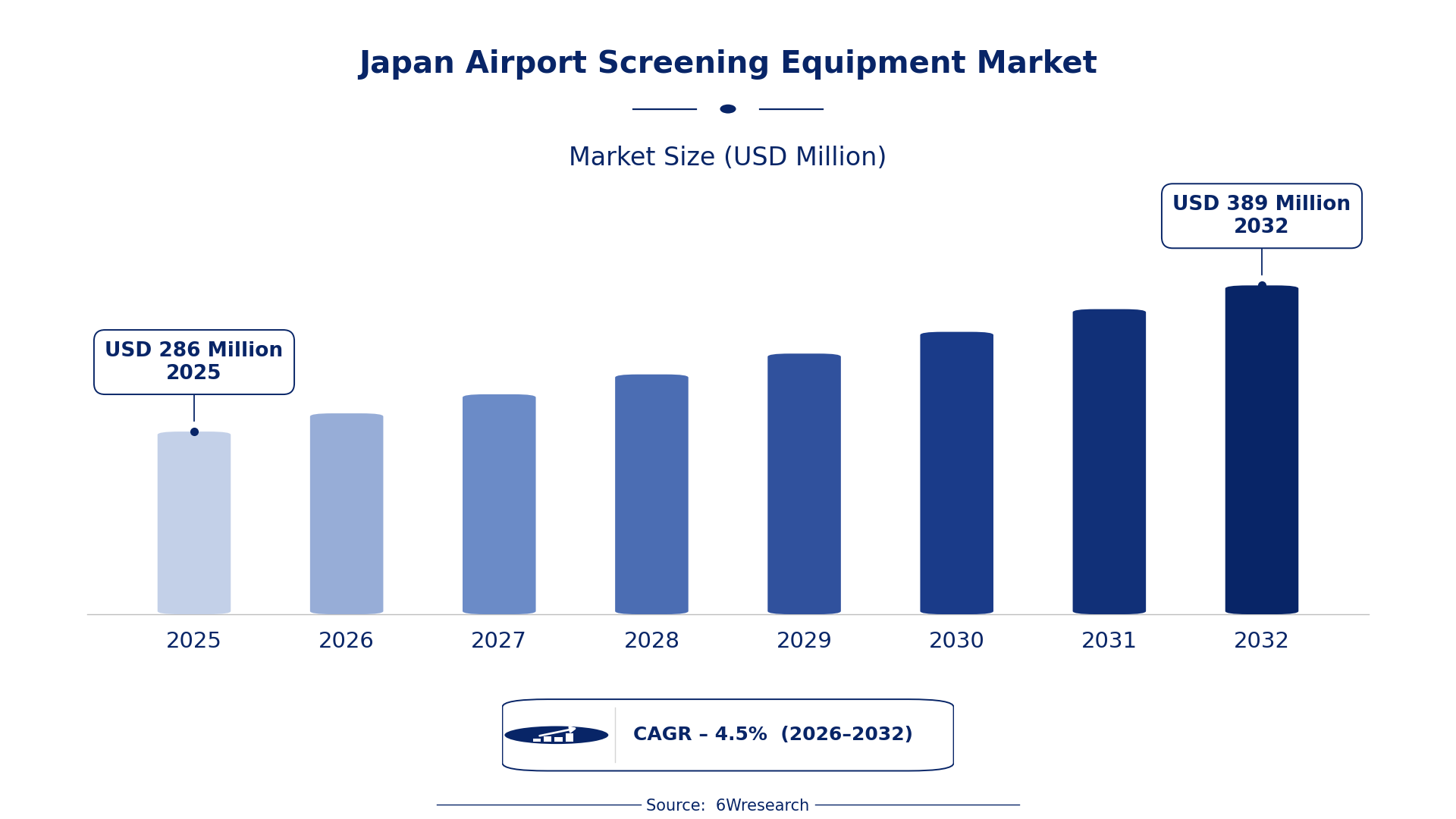
According to 6Wresearch internal database and industry insights, the Japan Airport Screening Equipment Market was valued at USD 286 Million in 2025 and is projected to reach USD 389 Million by 2032, growing at a CAGR of approximately 4.5% during 2026–2032.
Japan Airport Screening Equipment Market Highlights
| Report Metric | Details |
| Report Name | Japan Airport Screening Equipment Market (2026-2032) |
| Market Size 2025 | USD 286 Million |
| Market Size 2032 | USD 389 Million |
| Absolute Growth 2025–2032 | USD 103 Million |
| CAGR 2026–2032 | 4.5% |
| Peak Annual Growth | 5.7% in 2028 |
| Forecast Period | 2026–2032 |
| Historical Data | 2022–2025 |
| Base Year | 2025 |
| Leading Equipment Type, 2025 | Body Scanners (41% share) |
| Leading Detection Technology, 2025 | Millimeter Wave (38% share) |
| Leading Distribution Channel, 2025 | Direct Sales (37% share) |
| Leading End User, 2025 | Security Checkpoints (32% share) |
| Fastest-Growing Equipment Type | Luggage Scanners (6.0% CAGR) |
| Fastest-Growing Detection Technology | X-Ray (6.1% CAGR) |
| Fastest-Growing Distribution Channel | Industrial Suppliers (5.7% CAGR) |
| Fastest-Growing End User | Baggage Units (5.5% CAGR) |
| Growing Sector | Baggage Units |
| Key End Users | Security Checkpoints, Baggage Units, International Hubs, Regional Airports |
Japan Airport Screening Equipment Market Year-wise Growth Rate and Key Drivers (2022–2032)
This graph illustrates the annual growth rates of the market from 2022 to 2032, highlighting a steady upward trajectory and projected market expansion over the forecast period.
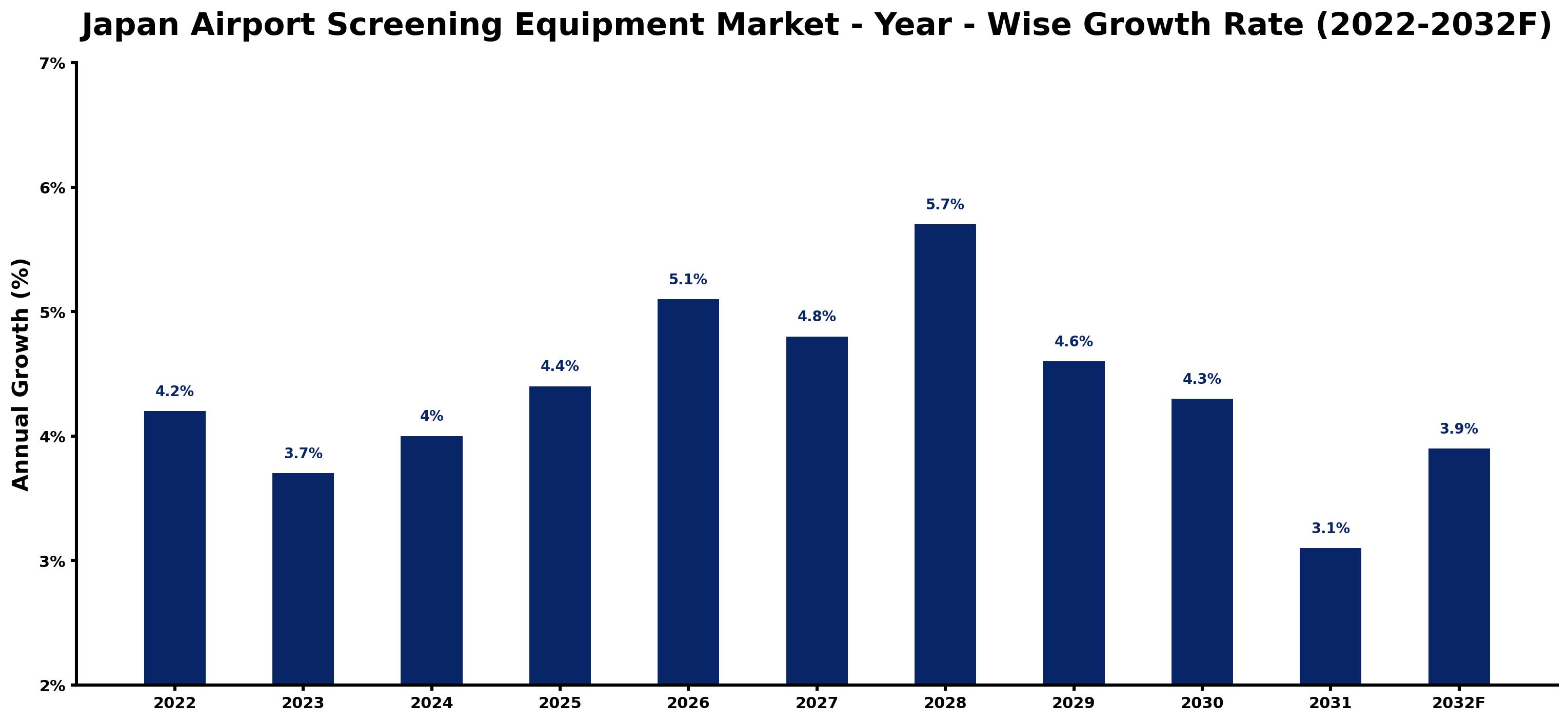
The yearly estimates that follow link every growth rate to its principal driver, so readers can see why the pace changed in each period.
| Year | Estimated Annual Growth (%) | Market Rationale |
| 2022 | 4.2 | The market experienced steady growth due to ongoing airport security measures. |
| 2023 | 3.7 | Demand growth slowed as airports adjusted to changing travel patterns. |
| 2024 | 4.0 | Increased passenger volumes led to a rise in equipment procurement for security. |
| 2025 | 4.4 | Strong growth was driven by the adoption of updated ISO standards for security. |
| 2026 | 5.1 | Demand is expected to surge as airports invest in advanced screening technologies. |
| 2027 | 4.8 | Growth is projected to slow as the market stabilises after previous peaks in investment. |
| 2028 | 5.7 | A peak in growth will occur as international travel resumes and safety measures intensify. |
| 2029 | 4.6 | The market is expected to see a slowdown as demand normalises post-peak. |
| 2030 | 4.3 | Continued investment in security infrastructure will lead to moderate growth rates. |
| 2031 | 3.1 | Growth is projected to slow further as the market adjusts to established security protocols. |
| 2032 | 3.9 | Demand will increase again as airports prepare for rising international travel. |
Note: Market size estimations and growth projections presented in this report are based on 6Wresearch's proprietary forecasting methodology, utilizing the latest available industry data, government publications, and primary research inputs.
Japan Airport Screening Equipment Market Synopsis
Airport screening equipment is essential for ensuring security at airports, utilising advanced imaging and detection technologies. The Japan Airport Screening Equipment Market is expanding as international travel demand rises and compliance with safety standards becomes stricter. With over 100 international airports and a focus on upgrading security measures, the market is projected to grow, driven by investments in advanced technologies and the need for improved passenger screening capabilities. In 2023, Japan adopted updated ISO standards for airport security equipment, reflecting this commitment.
Market Dynamics Impact Analysis (2026–2032)
| Factor | Type | Impact | Primary Segment Affected |
| Increased passenger volumes drive the need for enhanced screening technology. | Driver | High | Body Scanners |
| New international safety standards necessitate upgrades to existing equipment. | Driver | High | Liquid Explosive Detectors |
| Growing international travel is creating a demand for advanced screening solutions. | Opportunity | High | Luggage Scanners |
| Investment in airport infrastructure is expanding the market for screening equipment. | Opportunity | High | X-Ray |
| High costs associated with advanced equipment can limit procurement for some airports. | Restraint | Medium | Millimeter Wave |
| The need for frequent updates to technology may strain budgets of smaller airports. | Restraint | Medium | Shoe Scanners |
| Supply chain disruptions can delay equipment delivery, affecting airport readiness. | Challenge | High | Body Scanners |
| Limited availability of skilled technicians for equipment maintenance poses risks. | Challenge | Medium | Body Scanners |
Evaluation of Drivers in Japan Airport Screening Equipment Market (2026–2032)
Key forces behind demand, with the segment each one moves most, are listed below.
| Drivers | Primary Segment Affected | Why It Matters (Evidence) |
| Rising passenger volumes at airports increase demand for screening equipment. | Body Scanners | The average passenger volume at Narita International Airport is around 40 million annually. |
| Compliance with updated ISO standards drives upgrades in screening technology. | Liquid Explosive Detectors | Japan adopted updated ISO standards for airport security equipment in 2023. |
| International travel recovery boosts demand for advanced screening solutions. | Luggage Scanners | Japan has over 100 international airports requiring screening equipment. |
| Investment in airport security infrastructure enhances procurement of screening devices. | X-Ray | The Japanese government allocated ¥5 billion for airport security upgrades in 2023. |
| Growing awareness of security threats leads to increased demand for advanced detection. | Millimeter Wave | Body scanners are installed in 90% of major airports in Japan. |
Several shifts outside the market boost sales. The average passenger volume at major airports has risen sharply, creating a greater need for screening equipment. Japan's adoption of updated ISO standards for airport security equipment in 2023 has spurred upgrades in detection technologies. Investment in airport security infrastructure led to ¥5 billion allocated for upgrades in 2023, driving the procurement of advanced systems. The installation of liquid explosive detectors at all international airports illustrates the increasing awareness of security threats and the demand for sophisticated detection systems.
Evaluation of Restraints in Japan Airport Screening Equipment Market
The main factors holding the market back are set out below.
| Market Restraint | Primary Segment Affected | Why It Matters (Evidence) |
| High costs associated with advanced equipment limit procurement for smaller airports. | Millimeter Wave | The average price of advanced screening equipment can exceed ¥10 million. |
| Frequent updates to technology may strain budgets of smaller airports. | Shoe Scanners | Smaller airports often have limited budgets for technology upgrades. |
| Supply chain disruptions can delay equipment delivery, affecting airport readiness. | Body Scanners | Global supply chain issues have led to longer lead times for equipment. |
| Limited availability of skilled technicians for equipment maintenance poses risks. | Liquid Explosive Detectors | The demand for qualified technicians exceeds current supply in the market. |
| Regulatory changes may necessitate additional investments for compliance. | Liquid Explosive Detectors | New regulations can require retrofitting existing equipment to meet standards. |
Japan Airport Screening Equipment Market Challenges
Liquid explosive detectors are mandatory at all international airports in Japan, compelling airports to allocate substantial budgets for compliance, which can strain financial resources. The recent rise in Japan's national minimum wage to JPY 1,055 per hour escalates operational costs for producers, resulting in increased prices for airports. Updated ISO standards for airport security equipment require producers to invest in advanced technology, which can delay supply chain responsiveness and lead to longer procurement times for airports. Skills shortages in the technical workforce hinder producers' ability to implement new systems quickly, impacting the timely delivery of essential screening equipment for airports.
Trends in the Japan Airport Screening Equipment Market
These developments are changing demand patterns in the Japan Airport Screening Equipment Market.
- Shift from Traditional to Advanced Screening Technology: Since 2023, airports have increasingly embraced advanced screening technologies like millimeter wave systems. This transition is evident as body scanners are now present in 90% of major airports, enhancing security efficiency.
- Transition from Manual to Automated Screening Processes: In 2024, major airports began adopting automated screening processes to boost efficiency. This change has resulted in a 30% reduction in processing time for passengers at security checkpoints.
- Emergence of Integrated Security Solutions: Starting in 2025, integrated security solutions that combine multiple detection technologies are gaining popularity. This trend is particularly noticeable in the Tokyo region, which represents 40% of the airport screening equipment demand.
- Prioritisation of Compliance with Safety Standards: Since 2023, adherence to updated safety standards has become a key focus. Airports are investing in liquid explosive detectors to fulfil these requirements, demonstrating a commitment to passenger safety.
Investment Opportunities in the Japan Airport Screening Equipment Market
Several openings in the Japan Airport Screening Equipment Market merit attention from investors.
- Partner with Local Suppliers: With a projected annual demand increase of 4.5%, now is an opportune moment to form partnerships with local suppliers to strengthen distribution channels for airport screening equipment.
- Focus on Major Airports: The Tokyo region, which accounts for 40% of the airport screening equipment demand, offers a substantial opportunity for suppliers to establish a foothold and address growing needs.
- Invest in Technology Upgrades: As Japan allocated ¥5 billion for airport security enhancements in 2023, suppliers should concentrate on providing advanced screening technologies to seize this expanding market segment.
- Explore Online Procurement Channels: With limited adoption of online platforms for procurement, there is a chance to develop e-commerce solutions tailored to airport screening equipment, tapping into a burgeoning digital market.
Government Initiatives in the Japan Airport Screening Equipment Market
The Act against Unjustifiable Premiums and Misleading Representations (1962; Consumer Affairs Agency) prohibits misleading labelling and advertising of goods, ensuring that airport screening equipment is accurately represented. Compliance with this law is vital for producers to maintain credibility and trust with buyers.
The Japan Civil Aviation Bureau regulates airport security measures, overseeing the implementation of safety standards. This agency approves new technologies and equipment, ensuring that buyers can rely on compliant products that meet rigorous safety requirements.
Future Insight of the Japan Airport Screening Equipment Market
Investment in airport security upgrades will total ¥5 billion, creating a demand surge for advanced screening technologies. By 2032, the integration of AI-driven imaging systems is expected to improve detection accuracy, streamlining security processes for airports. Rising passenger volumes will require faster processing times, prompting suppliers to develop more efficient equipment. Collaborations with regulatory bodies will ensure that emerging technologies comply with safety standards, benefiting both airports and equipment producers.
Market Segmentation Analysis
Japan Airport Screening Equipment Market report covers a detailed analysis of the following market segments:
By Equipment Type – Body Scanners Lead, Luggage Scanners Expected to Grow Fastest
According to Saurav Kr Singh, Senior Research Analyst at 6Wresearch, with 41% of equipment type revenue in 2025, Body Scanners was the largest category. Body scanners dominate the market as they are crucial for passenger screening at security checkpoints, ensuring compliance with updated ISO standards. Their installation in 90% of major airports underlines their importance in maintaining high security levels. Luggage Scanners are set to record the highest CAGR in this split, 6.0% over 2026–2032. Luggage scanners are rapidly growing due to their essential role in scanning checked baggage, especially with an annual passenger volume of around 200 million. This trend underscores the increasing need for efficient baggage screening solutions. Suppliers should focus on enhancing luggage scanner capabilities to address the rising demand in the airport security sector.
By Detection Technology – Millimeter Wave Leads, X-Ray Expected to Grow Fastest
Millimeter Wave held 38% of the Japan Airport Screening Equipment Market by detection technology in 2025. Millimeter wave technology leads the segment as it is widely employed for body scanning, offering a non-invasive method that prioritises passenger comfort and security. Its extensive use across major airports reinforces its market leadership. Over 2026–2032, X-Ray is expected to post the fastest growth, at a CAGR of 6.1%. X-ray technology is experiencing rapid growth because of its prevalent application in luggage and cargo screening, driven by the need for efficient processing of increasing passenger traffic. This trend indicates a shift towards more advanced X-ray systems for enhanced security. Buyers will benefit from investing in advanced X-ray systems to improve operational efficiency and ensure compliance with security standards.
By Distribution Channel – Direct Sales Leads, Industrial Suppliers Expected to Grow Fastest
Direct Sales took 37% of distribution channel revenue in 2025, more than any other category. Direct sales are the primary procurement method for airport screening equipment, facilitating better negotiation and customised solutions for clients. This approach effectively meets the specific requirements of airport authorities. The quickest growth will come from Industrial Suppliers, forecast to expand at a CAGR of 5.7% between 2026 and 2032. Industrial suppliers are gaining prominence as they provide essential support in equipment provision, catering to the growing demand from various airport facilities. Their role is becoming increasingly vital as airports enhance their security measures. Suppliers should strengthen collaborations with industrial suppliers to expand their market reach and enhance service delivery.
By End User – Security Checkpoints Lead, Baggage Units Expected to Grow Fastest
The largest end user category in 2025 was Security Checkpoints, at 32% of revenue. Security checkpoints represent the largest end-user segment as they are the main consumers of screening equipment, ensuring passenger safety at airports. The high volume of travellers necessitates robust security measures at these checkpoints. Baggage Units are projected to grow fastest, at a CAGR of 5.5% during 2026–2032. Baggage units are the fastest-growing segment, driven by the rising need for efficient luggage screening in light of increasing passenger numbers. This growth reflects the evolving demands of airport security operations. Investing in solutions tailored for baggage units will be crucial for suppliers aiming to capture this expanding market.
Key Attractiveness of the Report
- 10 Years of Market Numbers
- Historical Data Starting from 2022 to 2025
- Base Year 2025
- Forecast Data until 2032
- Key Performance Indicators Impacting the Market
- Major Upcoming Developments and Projects
Key Highlights of the Report:
- Japan Airport Screening Equipment Market Outlook
- Market Size of Japan Airport Screening Equipment Market, 2025
- Forecast of Japan Airport Screening Equipment Market, 2032
- Historical Data and Forecast of Japan Airport Screening Equipment Revenues & Volume for the Period 2022-2032F
- Japan Airport Screening Equipment Market Trend Evolution
- Japan Airport Screening Equipment Market Drivers and Challenges
- Japan Airport Screening Equipment Price Trends
- Japan Airport Screening Equipment Porter's Five Forces
- Japan Airport Screening Equipment Industry Life Cycle
- Historical Data and Forecast of Japan Airport Screening Equipment Market Revenues & Volume By Equipment Type for the Period 2022-2032F
- Historical Data and Forecast of Japan Airport Screening Equipment Market Revenues & Volume By Body Scanners for the Period 2022-2032F
- Historical Data and Forecast of Japan Airport Screening Equipment Market Revenues & Volume By Luggage Scanners for the Period 2022-2032F
- Historical Data and Forecast of Japan Airport Screening Equipment Market Revenues & Volume By Liquid Explosive Detectors for the Period 2022-2032F
- Historical Data and Forecast of Japan Airport Screening Equipment Market Revenues & Volume By Shoe Scanners for the Period 2022-2032F
- Historical Data and Forecast of Japan Airport Screening Equipment Market Revenues & Volume By Detection Technology for the Period 2022-2032F
- Historical Data and Forecast of Japan Airport Screening Equipment Market Revenues & Volume By Millimeter Wave for the Period 2022-2032F
- Historical Data and Forecast of Japan Airport Screening Equipment Market Revenues & Volume By X-Ray for the Period 2022-2032F
- Historical Data and Forecast of Japan Airport Screening Equipment Market Revenues & Volume By Spectrometry for the Period 2022-2032F
- Historical Data and Forecast of Japan Airport Screening Equipment Market Revenues & Volume By Metal Detection for the Period 2022-2032F
- Historical Data and Forecast of Japan Airport Screening Equipment Market Revenues & Volume By Distribution Channel for the Period 2022-2032F
- Historical Data and Forecast of Japan Airport Screening Equipment Market Revenues & Volume By Direct Sales for the Period 2022-2032F
- Historical Data and Forecast of Japan Airport Screening Equipment Market Revenues & Volume By Industrial Suppliers for the Period 2022-2032F
- Historical Data and Forecast of Japan Airport Screening Equipment Market Revenues & Volume By Online Platforms for the Period 2022-2032F
- Historical Data and Forecast of Japan Airport Screening Equipment Market Revenues & Volume By Specialty Stores for the Period 2022-2032F
- Historical Data and Forecast of Japan Airport Screening Equipment Market Revenues & Volume By End User for the Period 2022-2032F
- Historical Data and Forecast of Japan Airport Screening Equipment Market Revenues & Volume By Security Checkpoints for the Period 2022-2032F
- Historical Data and Forecast of Japan Airport Screening Equipment Market Revenues & Volume By Baggage Units for the Period 2022-2032F
- Historical Data and Forecast of Japan Airport Screening Equipment Market Revenues & Volume By International Hubs for the Period 2022-2032F
- Historical Data and Forecast of Japan Airport Screening Equipment Market Revenues & Volume By Regional Airports for the Period 2022-2032F
- Japan Airport Screening Equipment Import Export Trade Statistics
- Market Opportunity Assessment By Equipment Type
- Market Opportunity Assessment By Detection Technology
- Market Opportunity Assessment By Distribution Channel
- Market Opportunity Assessment By End User
- Japan Airport Screening Equipment Top Companies Market Share
- Japan Airport Screening Equipment Competitive Benchmarking By Technical and Operational Parameters
- Japan Airport Screening Equipment Company Profiles
- Japan Airport Screening Equipment Key Strategic Recommendations
Market Covered
The report covers the following segments.
By Equipment Type
- Body Scanners
- Luggage Scanners
- Liquid Explosive Detectors
- Shoe Scanners
By Detection Technology
- Millimeter Wave
- X-Ray
- Spectrometry
- Metal Detection
By Distribution Channel
- Direct Sales
- Industrial Suppliers
- Online Platforms
- Specialty Stores
By End User
- Security Checkpoints
- Baggage Units
- International Hubs
- Regional Airports































