Japan Airport Security Equipment Market Size & Growth Rate
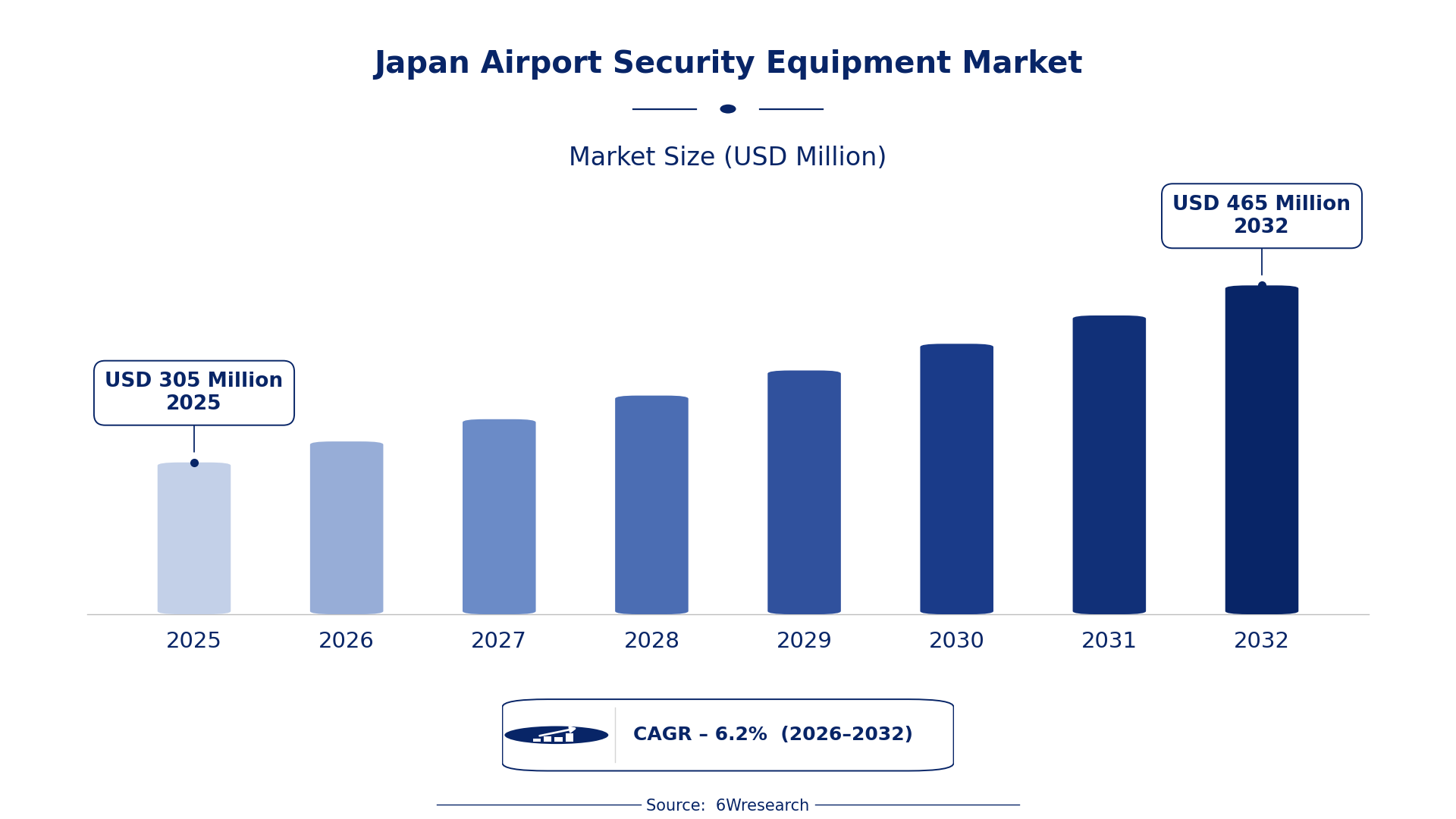
According to 6Wresearch internal database and industry insights, the Japan Airport Security Equipment Market was valued at USD 305 Million in 2025 and is projected to reach USD 465 Million by 2032, growing at a CAGR of approximately 6.2% during 2026–2032.
Japan Airport Security Equipment Market Highlights
| Report Metric | Details |
| Report Name | Japan Airport Security Equipment Market (2026-2032) |
| Market Size 2025 | USD 305 Million |
| Market Size 2032 | USD 465 Million |
| Absolute Growth 2025–2032 | USD 160 Million |
| CAGR 2026–2032 | 6.2% |
| Peak Annual Growth | 7.1% in 2026 |
| Forecast Period | 2026–2032 |
| Historical Data | 2022–2025 |
| Base Year | 2025 |
| Leading Security Equipment, 2025 | Surveillance Cameras (43% share) |
| Leading Functionality, 2025 | Night Vision / IR (38% share) |
| Leading Distribution Channel, 2025 | Direct Sales (49% share) |
| Leading End User, 2025 | Security Control Rooms (37% share) |
| Fastest-Growing Security Equipment | Biometric Systems (8.1% CAGR) |
| Fastest-Growing Functionality | Facial Recognition (8.0% CAGR) |
| Fastest-Growing Distribution Channel | Online Platforms (8.5% CAGR) |
| Fastest-Growing End User | Immigration Gates (7.8% CAGR) |
| Growing Sector | Airport Security |
| Key End Users | Airport operators, security personnel, government agencies, technology suppliers |
Japan Airport Security Equipment Market Year-wise Growth Rate and Key Drivers (2022–2032)
This graph illustrates the annual growth rates of the market from 2022 to 2032, highlighting a steady upward trajectory and projected market expansion over the forecast period.
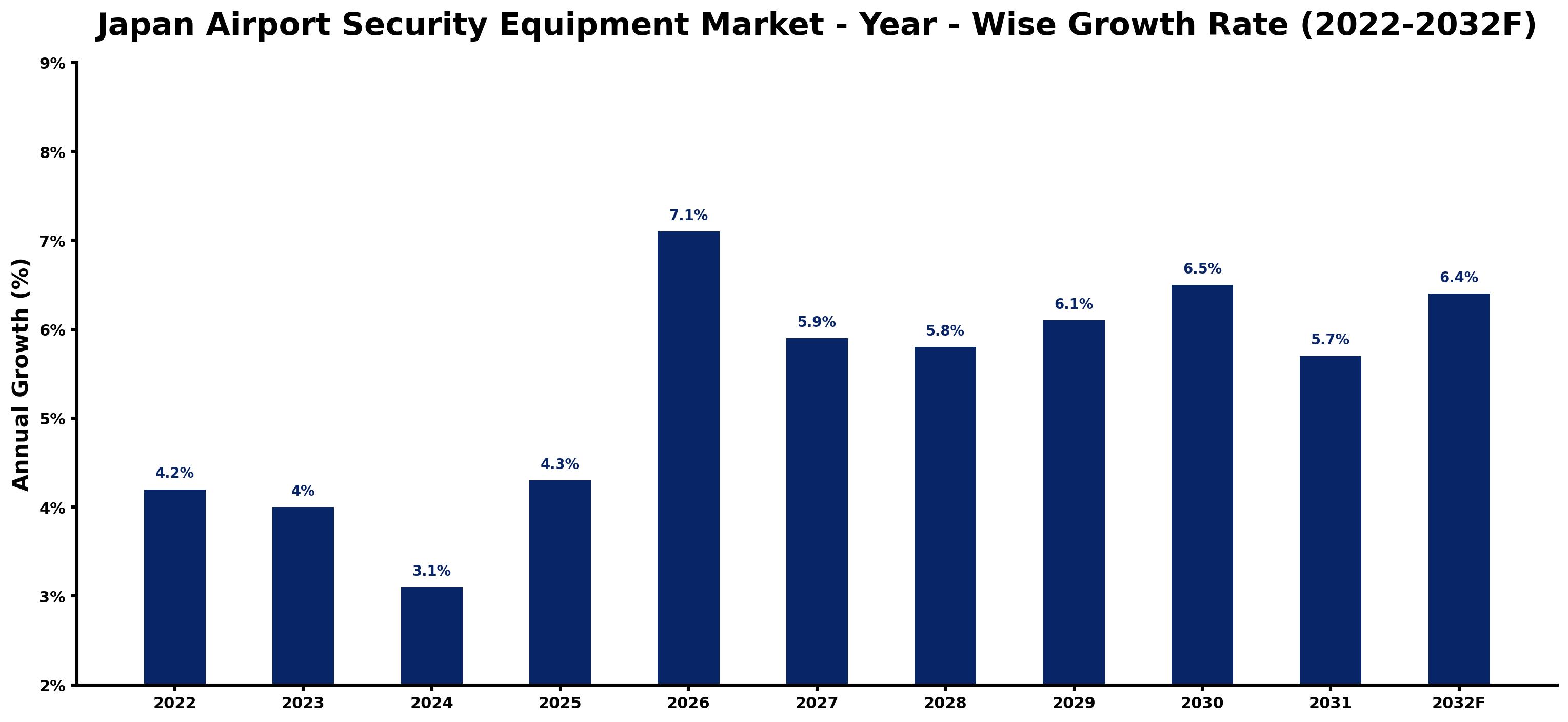
For each year, the table pairs the estimated growth rate with the leading influence on demand, showing how the drivers changed across the period.
| Year | Estimated Annual Growth (%) | Market Rationale |
| 2022 | 4.2 | The market maintained steady growth, reflecting ongoing investment in airport security. |
| 2023 | 4.0 | Demand growth slowed as airports adjusted to new operational standards and technologies. |
| 2024 | 3.1 | Market expansion continued to decelerate, influenced by budget constraints in some regions. |
| 2025 | 4.3 | Investment in security systems increased, driven by rising passenger traffic at major airports. |
| 2026 | 7.1 | Demand is expected to surge as airports upgrade systems to comply with new safety regulations. |
| 2027 | 5.9 | Growth will slow as the market stabilises after a period of rapid investment. |
| 2028 | 5.8 | Continued upgrades to security infrastructure will contribute to moderate growth rates. |
| 2029 | 6.1 | Demand for advanced security solutions will increase, reflecting heightened security awareness. |
| 2030 | 6.5 | Investment in technology integration will drive further growth in airport security systems. |
| 2031 | 5.7 | Growth will slow as the market reaches a more mature phase with established technologies. |
| 2032 | 6.4 | Demand is expected to rise as airports improve security measures for passenger safety. |
Note: Market size estimations and growth projections presented in this report are based on 6Wresearch's proprietary forecasting methodology, utilizing the latest available industry data, government publications, and primary research inputs.
Japan Airport Security Equipment Market Synopsis
Airport Security Equipment encompasses technologies for surveillance, detection, and identification, ensuring safety at airports. In 2023, Japan allocated ¥10 billion for upgrading airport security systems, underscoring the market's growth. Factors driving this expansion include increased passenger traffic, stringent safety regulations, and the integration of biometric systems into immigration gates, now utilised in 70% of major airports.
Market Dynamics Impact Analysis (2026–2032)
| Factor | Type | Impact | Primary Segment Affected |
| Increased passenger traffic at major airports drives demand for advanced security systems. | Driver | High | Baggage Scanners |
| Government regulations mandate enhanced security measures, boosting equipment purchases. | Driver | High | Biometric Systems |
| Growing investment in airport infrastructure creates opportunities for suppliers of security equipment. | Opportunity | High | Surveillance Cameras |
| Integration of advanced technologies like facial recognition opens new market avenues. | Opportunity | Medium | Facial Recognition |
| Budget constraints at some airports limit the scope for security upgrades. | Restraint | Medium | Baggage Scanners |
| The high cost of advanced security technologies can deter some airport operators. | Restraint | High | Biometric Systems |
| Competition among suppliers can lead to price wars, affecting profit margins. | Challenge | High | Surveillance Cameras |
| Rapid technological advancements require constant updates and training for security personnel. | Challenge | Medium | Handheld Detectors |
Evaluation of Drivers in Japan Airport Security Equipment Market (2026–2032)
Demand rests on the following drivers, each shown with the segment it touches most.
| Drivers | Primary Segment Affected | Why It Matters (Evidence) |
| Increased passenger traffic at airports | Baggage Scanners | The average passenger traffic at Narita International Airport is approximately 40 million annually, driving demand for efficient baggage screening. |
| Government regulations on safety standards | Biometric Systems | The Ministry of Land, Infrastructure, Transport and Tourism oversees regulations, necessitating the adoption of biometric systems for identity verification. |
| Investment in airport infrastructure upgrades | Surveillance Cameras | Japan allocated ¥10 billion in 2023 for security system upgrades, leading to increased purchases of surveillance equipment. |
| Integration of advanced technologies | Facial Recognition | Biometric systems are being integrated into 70% of immigration gates, improving passenger identification processes. |
| Growing focus on passenger safety | High-Resolution X-ray | High-resolution X-ray machines are used in 100% of baggage screening processes, ensuring thorough security checks. |
Purchasing is picking up as airports invest heavily in security systems. In 2023, Japan allocated ¥10 billion for upgrading airport security systems, increasing demand for advanced surveillance technologies. The integration of biometric systems into immigration gates is transforming identity verification processes, prompting airports to acquire more equipment. The average passenger traffic at Narita International Airport is approximately 40 million annually, driving the need for efficient baggage screening solutions. Compliance with safety protocols stimulates demand for security equipment across the sector.
Evaluation of Restraints in Japan Airport Security Equipment Market
These restraints slow adoption and weigh on supplier margins.
| Market Restraint | Primary Segment Affected | Why It Matters (Evidence) |
| Budget constraints limit security upgrades at some airports. | Baggage Scanners | With limited funding, some airports struggle to invest in necessary security technologies, impacting their operations. |
| High costs of advanced security technologies deter purchases. | Biometric Systems | The financial burden of implementing biometric systems can prevent smaller airports from upgrading. |
| Competition among suppliers leads to price wars. | Surveillance Cameras | Intense competition can drive down prices, affecting profitability for suppliers and limiting innovation. |
| Rapid technological advancements require ongoing personnel training. | Handheld Detectors | Frequent updates in technology necessitate continuous training for security staff, increasing operational costs. |
| Regulatory compliance can be complex and time-consuming. | High-Resolution X-ray | Navigating the regulatory requirements for security equipment can delay procurement processes for airports. |
Japan Airport Security Equipment Market Challenges
Airport operators experience intense competition for funding, as over 90 international airports in Japan vie for limited government resources, delaying vital upgrades to security systems. Rising prices for advanced equipment strain budgets; the ¥10 billion allocated in 2023 may not cover all necessary improvements, forcing some airports to defer critical installations. A lack of skilled technicians complicates the installation and upkeep of sophisticated systems, creating potential security risks. Disruptions in the supply chain for electronic components can postpone the deployment of new technologies, affecting the readiness of security measures at busy hubs like Tokyo's Haneda Airport.
Trends in the Japan Airport Security Equipment Market
The trends below show where the Japan Airport Security Equipment Market is heading.
- Shift towards Biometric Systems in Airports: Major airports like Tokyo's Haneda are increasingly adopting biometric systems for passenger flow management, with 70% of immigration gates now equipped. This shift improves security and streamlines processing.
- Transition from Traditional Surveillance to Advanced Technologies: The Tokyo Metropolitan Government's security enhancement program in 2023 focuses on integrating advanced surveillance technologies, resulting in a 10% increase in installations across major terminals.
- Emergence of High-Resolution X-ray Machines: High-resolution X-ray machines are now standard in baggage screening processes, ensuring thorough inspections at all major airports, reflecting a commitment to passenger safety.
- Prioritisation of Passenger Safety Measures: With increasing passenger traffic, airports are prioritising safety measures, resulting in a ¥10 billion investment in security upgrades across Japan's airport facilities.
Investment Opportunities in the Japan Airport Security Equipment Market
Below are the investment opportunities with the strongest case in the Japan Airport Security Equipment Market.
- Airports seeking advanced security solutions: Airports are increasingly looking for advanced security technologies, with a projected ¥10 billion investment in upgrades, creating opportunities for suppliers of security equipment.
- Entry through partnerships with local suppliers: Forming joint ventures with local suppliers can facilitate access to the Japanese market, particularly in the rapidly growing biometric systems segment.
- Supply of advanced surveillance technologies: There is a growing demand for advanced surveillance solutions, especially in major airports, which presents opportunities for suppliers to introduce new products.
- Focus on security control rooms: Security control rooms are critical for airport operations, with a growing need for advanced monitoring systems, making this a prime area for investment.
Government Initiatives in the Japan Airport Security Equipment Market
The Industrial Safety and Health Act (1972; MHLW) mandates that employers ensure safety standards for machinery and equipment, impacting airport security equipment producers by requiring compliance with stringent safety regulations. This law necessitates that manufacturers invest in quality assurance processes to meet safety standards, thereby improving the overall safety of airport operations.
The Japan Civil Aviation Bureau regulates security equipment standards for airports, ensuring compliance with national safety requirements. This agency oversees the approval of new technologies, which directly affects how airport operators implement security measures, ensuring that they meet the latest safety protocols.
Future Insight of the Japan Airport Security Equipment Market
By 2032, airport operators will implement advanced technology to enhance efficiency, with biometric systems expected to be integrated into all immigration gates, streamlining passenger processing. Government initiatives, such as the Tokyo Metropolitan Government's security enhancement program, will drive investment in new surveillance technologies. Stricter regulations from the Japan Civil Aviation Bureau will mandate adherence to international safety standards. The average passenger traffic at Narita International Airport is projected to rise to approximately 50 million annually, requiring upgraded security solutions to manage increased volumes.
Market Segmentation Analysis
Japan Airport Security Equipment Market report covers a detailed analysis of the following market segments:
By Security Equipment – Surveillance Cameras Lead, Biometric Systems Expected to Grow Fastest
According to Saurav Kr Singh, Senior Research Analyst at 6Wresearch, in 2025, Surveillance Cameras led the security equipment split with a 43% share. Surveillance cameras are essential for monitoring airport premises, ensuring the safety of passengers and cargo. Their presence in all major terminals across Japan's airports reinforces their leading market share. Biometric Systems are projected to grow fastest, at a CAGR of 8.1% during 2026–2032. The rapid integration of biometric systems, particularly in 70% of immigration gates, is a key factor driving their growth. This trend reflects a strong push towards advanced identity verification technologies in airports. Suppliers should focus on developing biometric solutions to meet the rising demand for enhanced security measures.
By Functionality – Night Vision / IR Leads, Facial Recognition Expected to Grow Fastest
The largest functionality category in 2025 was Night Vision / IR, at 38% of revenue. Night vision and infrared technologies are important for specific security operations, particularly in low-light environments. Their consistent use in various security scenarios helps maintain their significant market share. The quickest growth will come from Facial Recognition, forecast to expand at a CAGR of 8.0% between 2026 and 2032. Facial recognition technology is experiencing rapid growth due to its effectiveness in passenger identification and flow management. Airports are increasingly adopting this technology to improve efficiency and security simultaneously. Suppliers must invest in advanced facial recognition systems to capitalise on this growing trend.
By Distribution Channel – Direct Sales Leads, Online Platforms Expected to Grow Fastest
Direct Sales held 49% of the Japan Airport Security Equipment Market by distribution channel in 2025. Direct sales are the main channel for distributing security equipment to airports, allowing for tailored solutions that address specific operational requirements. This method ensures suppliers can provide comprehensive support to their clients. Online Platforms are set to record the highest CAGR in this split, 8.5% over 2026–2032. Online platforms are gaining traction as they facilitate easier access to information and procurement processes, appealing to tech-savvy buyers. This shift indicates a growing preference for digital solutions in the security equipment market. Suppliers need to enhance their online presence to effectively attract and serve a broader client base.
By End User – Security Control Rooms Lead, Immigration Gates Expected to Grow Fastest
With 37% of end user revenue in 2025, Security Control Rooms was the largest category. Security control rooms are crucial for airport operations, serving as the central hub for monitoring and managing security measures. Their strategic role in maintaining overall airport safety secures their leading position in the market. Over 2026–2032, Immigration Gates are expected to post the fastest growth, at a CAGR of 7.8%. Immigration gates are rapidly adopting biometric systems, underscoring the need for efficient passenger processing and enhanced security. This trend is likely to expand as airports aim to provide seamless travel experiences. Suppliers should focus on delivering integrated solutions for immigration gates to address the increasing demand for biometric technologies.
Key Attractiveness of the Report
- 10 Years of Market Numbers
- Historical Data Starting from 2022 to 2025
- Base Year 2025
- Forecast Data until 2032
- Key Performance Indicators Impacting the Market
- Major Upcoming Developments and Projects
Key Highlights of the Report:
- Japan Airport Security Equipment Market Outlook
- Market Size of Japan Airport Security Equipment Market, 2025
- Forecast of Japan Airport Security Equipment Market, 2032
- Historical Data and Forecast of Japan Airport Security Equipment Revenues & Volume for the Period 2022-2032F
- Japan Airport Security Equipment Market Trend Evolution
- Japan Airport Security Equipment Market Drivers and Challenges
- Japan Airport Security Equipment Price Trends
- Japan Airport Security Equipment Porter's Five Forces
- Japan Airport Security Equipment Industry Life Cycle
- Historical Data and Forecast of Japan Airport Security Equipment Market Revenues & Volume By Security Equipment for the Period 2022-2032F
- Historical Data and Forecast of Japan Airport Security Equipment Market Revenues & Volume By Surveillance Cameras for the Period 2022-2032F
- Historical Data and Forecast of Japan Airport Security Equipment Market Revenues & Volume By Biometric Systems for the Period 2022-2032F
- Historical Data and Forecast of Japan Airport Security Equipment Market Revenues & Volume By Baggage Scanners for the Period 2022-2032F
- Historical Data and Forecast of Japan Airport Security Equipment Market Revenues & Volume By Handheld Detectors for the Period 2022-2032F
- Historical Data and Forecast of Japan Airport Security Equipment Market Revenues & Volume By Functionality for the Period 2022-2032F
- Historical Data and Forecast of Japan Airport Security Equipment Market Revenues & Volume By Night Vision / IR for the Period 2022-2032F
- Historical Data and Forecast of Japan Airport Security Equipment Market Revenues & Volume By Facial Recognition for the Period 2022-2032F
- Historical Data and Forecast of Japan Airport Security Equipment Market Revenues & Volume By High-Resolution X-ray for the Period 2022-2032F
- Historical Data and Forecast of Japan Airport Security Equipment Market Revenues & Volume By Metal Detection for the Period 2022-2032F
- Historical Data and Forecast of Japan Airport Security Equipment Market Revenues & Volume By Distribution Channel for the Period 2022-2032F
- Historical Data and Forecast of Japan Airport Security Equipment Market Revenues & Volume By Direct Sales for the Period 2022-2032F
- Historical Data and Forecast of Japan Airport Security Equipment Market Revenues & Volume By Online Platforms for the Period 2022-2032F
- Historical Data and Forecast of Japan Airport Security Equipment Market Revenues & Volume By Industrial Suppliers for the Period 2022-2032F
- Historical Data and Forecast of Japan Airport Security Equipment Market Revenues & Volume By Specialty Stores for the Period 2022-2032F
- Historical Data and Forecast of Japan Airport Security Equipment Market Revenues & Volume By End User for the Period 2022-2032F
- Historical Data and Forecast of Japan Airport Security Equipment Market Revenues & Volume By Security Control Rooms for the Period 2022-2032F
- Historical Data and Forecast of Japan Airport Security Equipment Market Revenues & Volume By Immigration Gates for the Period 2022-2032F
- Historical Data and Forecast of Japan Airport Security Equipment Market Revenues & Volume By Security Terminals for the Period 2022-2032F
- Historical Data and Forecast of Japan Airport Security Equipment Market Revenues & Volume By Ground Security Teams for the Period 2022-2032F
- Japan Airport Security Equipment Import Export Trade Statistics
- Market Opportunity Assessment By Security Equipment
- Market Opportunity Assessment By Functionality
- Market Opportunity Assessment By Distribution Channel
- Market Opportunity Assessment By End User
- Japan Airport Security Equipment Top Companies Market Share
- Japan Airport Security Equipment Competitive Benchmarking By Technical and Operational Parameters
- Japan Airport Security Equipment Company Profiles
- Japan Airport Security Equipment Key Strategic Recommendations
Market Covered
The following segment groups are covered in the report.
By Security Equipment
- Surveillance Cameras
- Biometric Systems
- Baggage Scanners
- Handheld Detectors
By Functionality
- Night Vision / IR
- Facial Recognition
- High-Resolution X-ray
- Metal Detection
By Distribution Channel
- Direct Sales
- Online Platforms
- Industrial Suppliers
- Specialty Stores
By End User
- Security Control Rooms
- Immigration Gates
- Security Terminals
- Ground Security Teams































