Japan Airport Stands Equipment Market Size & Growth Rate
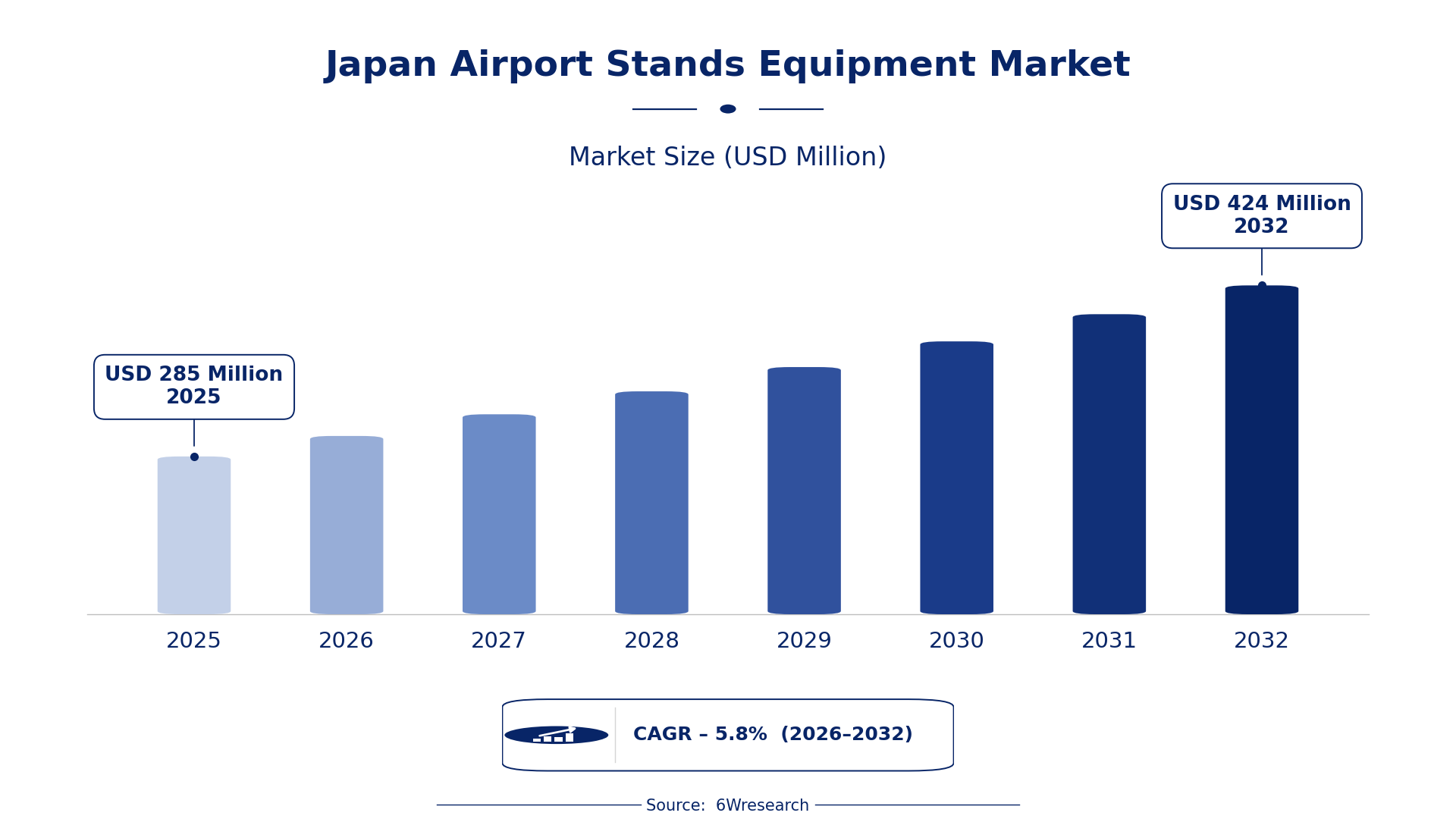
According to 6Wresearch internal database and industry insights, the Japan Airport Stands Equipment Market was valued at USD 285 Million in 2025 and is projected to reach USD 424 Million by 2032, growing at a CAGR of approximately 5.8% during 2026–2032.
Japan Airport Stands Equipment Market Highlights
| Report Metric | Details |
| Report Name | Japan Airport Stands Equipment Market (2026-2032) |
| Market Size 2025 | USD 285 Million |
| Market Size 2032 | USD 424 Million |
| Absolute Growth 2025–2032 | USD 139 Million |
| CAGR 2026–2032 | 5.8% |
| Peak Annual Growth | 6.2% in 2027 |
| Forecast Period | 2026–2032 |
| Historical Data | 2022–2025 |
| Base Year | 2025 |
| Leading Equipment TypeAir Bridges, 2025 | Steel (58% share) |
| Leading Preconditioned Air Unit, 2025 | Fixed (54% share) |
| Leading Electrical Ground Power Unit, 2025 | Fixed (57% share) |
| Fastest-Growing Equipment TypeAir Bridges | Glass (7.7% CAGR) |
| Fastest-Growing Preconditioned Air Unit | Movable (7.1% CAGR) |
| Fastest-Growing Electrical Ground Power Unit | Movable (7.8% CAGR) |
| Growing Sector | Airport Infrastructure |
| Key End Users | Airport operators, Ground handling services, Airlines |
Japan Airport Stands Equipment Market Year-wise Growth Rate and Key Drivers (2022–2032)
This graph illustrates the annual growth rates of the market from 2022 to 2032, highlighting a steady upward trajectory and projected market expansion over the forecast period.
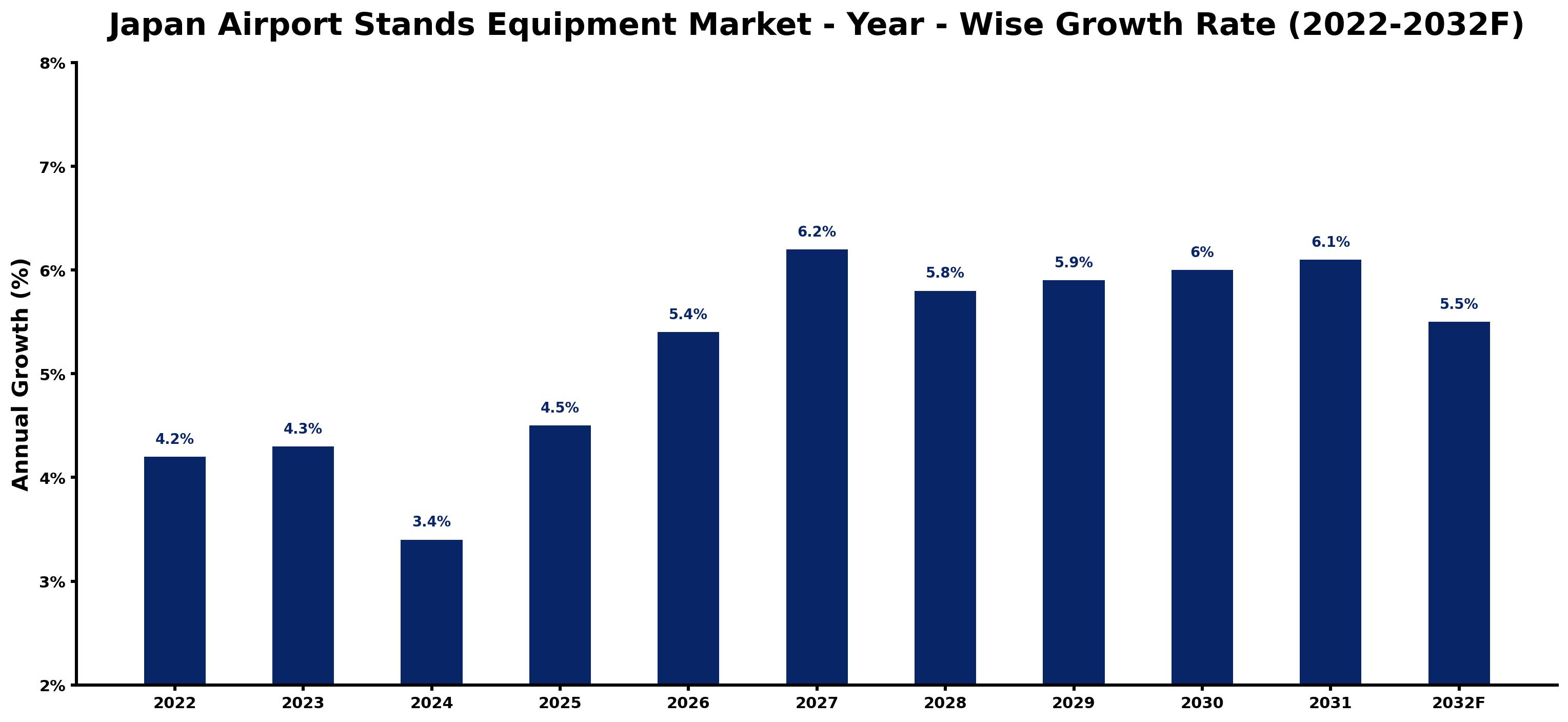
Annual growth estimates for each year appear below with the principal reason behind them, explaining the shifts that set the pace of the market.
| Year | Estimated Annual Growth (%) | Market Rationale |
| 2022 | 4.2 | The market showed steady growth due to ongoing airport upgrades and maintenance efforts. |
| 2023 | 4.3 | Demand increased as passenger traffic continued to recover following the lifting of restrictions. |
| 2024 | 3.4 | Growth slowed as some projects faced delays and budget constraints emerged. |
| 2025 | 4.5 | The market rebounded with strong investments in airport infrastructure improvements. |
| 2026 | 5.4 | Rising demand for efficient airport operations is expected to drive faster growth rates. |
| 2027 | 6.2 | The peak growth year will see heightened investments in new technologies and facilities. |
| 2028 | 5.8 | Growth is projected to slow as the market begins to stabilise after rapid expansion phases. |
| 2029 | 5.9 | Demand will rise again as airports prepare for increased air traffic volumes. |
| 2030 | 6.0 | The market will continue to grow with ongoing infrastructure projects and upgrades. |
| 2031 | 6.1 | Sustained demand for airport stands equipment will support steady growth trends. |
| 2032 | 5.5 | Growth is expected to slow as the market reaches a more mature phase. |
Note: Market size estimations and growth projections presented in this report are based on 6Wresearch's proprietary forecasting methodology, utilizing the latest available industry data, government publications, and primary research inputs.
Japan Airport Stands Equipment Market Synopsis
Airport stands equipment includes essential tools like air bridges, preconditioned air units, and ground power units, which are crucial for servicing aircraft. The Japan Airport Stands Equipment Market is expanding due to rising air traffic, with over 90 airports, including major hubs in Tokyo and Osaka. Key growth drivers include increased passenger volumes, ongoing infrastructure investments, and the adoption of JIS standards that improve manufacturing quality and operational efficiency.
Market Dynamics Impact Analysis (2026–2032)
| Factor | Type | Impact | Primary Segment Affected |
| Increased passenger traffic at airports drives demand for airport stands equipment. | Driver | High | Steel |
| Ongoing airport infrastructure improvements create opportunities for suppliers. | Driver | High | Steel |
| Growing demand for energy-efficient systems presents a market opportunity. | Opportunity | High | Steel |
| Investment in airport facilities is rising, boosting equipment needs. | Opportunity | High | Steel |
| High installation costs limit the adoption of new equipment. | Restraint | High | Steel |
| Strict compliance with JIS standards can delay equipment approvals. | Restraint | Medium | Steel |
| Rising material costs impact overall project budgets for buyers. | Challenge | High | Steel |
| Limited skilled workforce affects installation and maintenance efficiency. | Challenge | Medium | Steel |
Evaluation of Drivers in Japan Airport Stands Equipment Market (2026–2032)
Demand rests on the following drivers, each shown with the segment it touches most.
| Drivers | Primary Segment Affected | Why It Matters (Evidence) |
| Rising air traffic increases demand for airport stands equipment. | Steel | Tokyo International Airport serves approximately 45 million passengers annually, driving the need for more air bridges. |
| Infrastructure investments improve airport facilities and equipment. | Steel | The Ministry of Land, Infrastructure, Transport and Tourism allocated ¥1 billion for airport improvements in 2023. |
| Energy efficiency regulations prompt upgrades to airport equipment. | Steel | The Act on the Rational Use of Energy obliges large energy users to report energy use and improve efficiency. |
| Long lifespan of equipment necessitates timely replacements. | Steel | The average lifespan of an air bridge is around 20 years, leading to replacement demand for older units. |
| Technological advancements improve operational efficiency at airports. | Fixed | Fixed preconditioned air units are preferred for larger aircraft, enhancing service efficiency. |
Buyers are adding capacity as air traffic continues to rise, particularly at major airports across Japan. This demand is supported by recent infrastructure investments, including a ¥1 billion allocation for airport improvements in 2023. The average lifespan of an air bridge is around 20 years, prompting timely replacements and upgrades to meet growing needs.
Evaluation of Restraints in Japan Airport Stands Equipment Market
Below are the constraints most often cited by buyers and suppliers, with the segment each affects.
| Market Restraint | Primary Segment Affected | Why It Matters (Evidence) |
| High installation costs deter investment in new equipment. | Steel | The average cost of a new air bridge installation ranges from ¥100 million to ¥300 million, straining budgets. |
| Compliance with JIS standards can delay equipment approvals. | Steel | Manufacturers must adhere to stringent JIS standards, which can prolong the certification process significantly. |
| Material costs are rising, impacting project budgets. | Steel | Japan's national minimum wage rose to JPY 1,055 per hour, increasing overall labour costs for projects. |
| Limited skilled workforce affects installation efficiency. | Steel | In 2022, over 30,000 workers were employed in airport ground handling services, indicating a tight labour market. |
| Market maturity leads to slower growth rates. | Steel | As the market stabilises, growth rates are expected to normalise in the coming years. |
Japan Airport Stands Equipment Market Challenges
Air bridge installation costs range from ¥100 million to ¥300 million, straining airport budgets and delaying project timelines for operators. Outdated infrastructure limits the adoption of modern technology, resulting in inefficiencies for ground handling teams that service aircraft. JIS standards complicate the manufacturing process, creating longer approval times for suppliers and delaying equipment availability. Rising labour costs, driven by the national minimum wage increase to JPY 1,055 per hour, elevate operational expenses for buyers, squeezing profit margins and restricting investment in new equipment.
Trends in the Japan Airport Stands Equipment Market
Buyers and suppliers in the Japan Airport Stands Equipment Market are adjusting to the following trends.
- Shift towards Energy-Efficient Airport Equipment: Airports are increasingly adopting energy-efficient systems to comply with regulations, such as the Act on the Rational Use of Energy, which requires large energy users to improve efficiency. This trend is reflected in the growing preference for fixed preconditioned air units for larger aircraft.
- Transition from Fixed to Movable Equipment: Movable preconditioned air units are gaining popularity, with a projected CAGR of 7.1% from 2026 to 2032. This shift allows airports to service various aircraft types more flexibly, accommodating changing air traffic demands.
- Emergence of Smart Airport Technologies: Smart technologies are being integrated into airport stands equipment, improving operational efficiency. For instance, the adoption of automated air bridges reduces turnaround times, reflecting a broader trend towards automation in airport operations.
- Increased Focus on Passenger Experience: Airports are prioritising passenger experience, leading to investments in modern air bridges that improve accessibility and comfort. The Tokyo region, accounting for over 50% of Japan's air traffic, is at the forefront of this trend.
Investment Opportunities in the Japan Airport Stands Equipment Market
The openings below show where demand in the Japan Airport Stands Equipment Market is visible and how suppliers can enter.
- Airports seeking modernisation: Airports in Japan are investing in modern equipment to improve operational efficiency, with significant funding allocated for upgrades. The Kansai International Airport, with 30 air bridges installed, exemplifies this trend.
- Supply of energy-efficient equipment: There is a growing demand for energy-efficient airport stands equipment, driven by regulations. Suppliers can target large airports like Tokyo International, which require upgrades to meet energy standards.
- Investment in new airport facilities: The construction of new airport facilities presents opportunities for suppliers of airport stands equipment. Regions with expanding air traffic, such as the Tokyo area, are ideal for investment.
- Partnerships for technology integration: Collaborating with local manufacturers for technology integration can facilitate market entry. Joint ventures in airport equipment production can utilise local expertise and meet specific market needs.
Government Initiatives in the Japan Airport Stands Equipment Market
The Industrial Safety and Health Act (1972) mandates employers to ensure safety standards for machinery and equipment used in airports. Compliance with this act is essential for manufacturers of airport stands equipment, as it sets the groundwork for safe operations and protects workers from hazardous conditions. The Act on the Rational Use of Energy (1979) requires large energy users to report energy use and improve efficiency, directly impacting the design and operation of airport equipment and pushing for innovations that reduce energy consumption.
The Japan Airport Terminal Association oversees standards and regulations for airport operations, ensuring that equipment meets safety and efficiency criteria. The association's approval is vital for manufacturers, as it influences the marketability of their products. The association also facilitates funding for infrastructure projects, improving the operational capabilities of airports across the country, which benefits buyers by ensuring they have access to compliant and efficient equipment.
Future Insight of the Japan Airport Stands Equipment Market
By 2032, ground handling services will increasingly incorporate automation, improving efficiency and reducing labour costs for operators. Enhanced airport infrastructure from government investments will facilitate better service delivery for passengers. The shift towards advanced air bridge technology will improve safety and operational efficiency, benefiting airlines and airport operators. As the Tokyo region continues to dominate air traffic, the need for modernised stands equipment will drive innovation and upgrades throughout the sector.
Market Segmentation Analysis
Japan Airport Stands Equipment Market report covers a detailed analysis of the following market segments:
By Equipment TypeAir Bridges – Steel Leads, Glass Expected to Grow Fastest
According to Summon Dutta, Assistant Manager at 6Wresearch, Steel took 58% of equipment typeair bridges revenue in 2025, more than any other category. Steel air bridges dominate the market due to their essential role in ensuring structural integrity and safety for passengers and crew. The presence of over 30 air bridges at Kansai International Airport exemplifies the industry's reliance on durable materials for operational efficiency. Over 2026–2032, Glass is expected to post the fastest growth, at a CAGR of 7.7%. Glass air bridges are experiencing rapid growth as they enhance visibility and aesthetics, which are becoming more important in modern airport designs. The focus on improving passenger experience at high-traffic locations like Tokyo International Airport is a key factor driving this trend. This trend indicates that suppliers should focus on developing glass air bridges to meet the rising demand for aesthetically pleasing airport facilities.
By Preconditioned Air Unit – Fixed Leads, Movable Expected to Grow Fastest
The largest preconditioned air unit category in 2025 was Fixed, at 54% of revenue. Fixed preconditioned air units lead the market as they are widely used in airports for their reliable power supply to larger aircraft. Their established presence in major airports ensures a steady demand for this type of equipment. The quickest growth will come from Movable, forecast to expand at a CAGR of 7.1% between 2026 and 2032. Movable preconditioned air units are growing swiftly due to their flexibility in servicing various aircraft types, catering to the diverse needs of airports. The push for adaptable solutions in facilities like Tokyo International Airport supports this growth. Buyers may seek suppliers who offer both fixed and movable units to accommodate a range of operational requirements.
By Electrical Ground Power Unit – Fixed Leads, Movable Expected to Grow Fastest
With 57% of electrical ground power unit revenue in 2025, Fixed was the largest category. Fixed electrical ground power units hold the largest share as they provide a consistent power supply essential for aircraft operations at airports. Their widespread use in facilities across Japan ensures a strong installed base. Movable is set to record the highest CAGR in this split, 7.8% over 2026–2032. Movable electrical ground power units are growing rapidly, driven by the need for versatility in servicing different aircraft models. The increasing variety of aircraft at airports like Tokyo International Airport fuels this demand. Suppliers should consider expanding their product lines to include movable units to capture the growing market segment.
Key Attractiveness of the Report
- 10 Years of Market Numbers
- Historical Data Starting from 2022 to 2025
- Base Year 2025
- Forecast Data until 2032
- Key Performance Indicators Impacting the Market
- Major Upcoming Developments and Projects
Key Highlights of the Report:
- Japan Airport Stands Equipment Market Outlook
- Market Size of Japan Airport Stands Equipment Market, 2025
- Forecast of Japan Airport Stands Equipment Market, 2032
- Historical Data and Forecast of Japan Airport Stands Equipment Revenues & Volume for the Period 2022-2032
- Japan Airport Stands Equipment Market Trend Evolution
- Japan Airport Stands Equipment Market Drivers and Challenges
- Japan Airport Stands Equipment Price Trends
- Japan Airport Stands Equipment Porter's Five Forces
- Japan Airport Stands Equipment Industry Life Cycle
- Historical Data and Forecast of Japan Airport Stands Equipment Market Revenues & Volume By Equipment TypeAir Bridges for the Period 2022-2032
- Historical Data and Forecast of Japan Airport Stands Equipment Market Revenues & Volume By Steel for the Period 2022-2032
- Historical Data and Forecast of Japan Airport Stands Equipment Market Revenues & Volume By Glass for the Period 2022-2032
- Historical Data and Forecast of Japan Airport Stands Equipment Market Revenues & Volume By Preconditioned Air Unit for the Period 2022-2032
- Historical Data and Forecast of Japan Airport Stands Equipment Market Revenues & Volume By Fixed for the Period 2022-2032
- Historical Data and Forecast of Japan Airport Stands Equipment Market Revenues & Volume By Movable for the Period 2022-2032
- Historical Data and Forecast of Japan Airport Stands Equipment Market Revenues & Volume By Electrical Ground Power Unit for the Period 2022-2032
- Historical Data and Forecast of Japan Airport Stands Equipment Market Revenues & Volume By Fixed for the Period 2022-2032
- Historical Data and Forecast of Japan Airport Stands Equipment Market Revenues & Volume By Movable for the Period 2022-2032
- Japan Airport Stands Equipment Import Export Trade Statistics
- Market Opportunity Assessment By Equipment TypeAir Bridges
- Market Opportunity Assessment By Preconditioned Air Unit
- Market Opportunity Assessment By Electrical Ground Power Unit
- Japan Airport Stands Equipment Top Companies Market Share
- Japan Airport Stands Equipment Competitive Benchmarking By Technical and Operational Parameters
- Japan Airport Stands Equipment Company Profiles
- Japan Airport Stands Equipment Key Strategic Recommendations
Market Covered
The following segment groups are covered in the report.
By Equipment TypeAir Bridges
- Steel
- Glass
By Preconditioned Air Unit
- Fixed
- Movable
By Electrical Ground Power Unit
- Fixed
- Movable































