Japan Ammonium Thiocyanate Market Size & Growth Rate
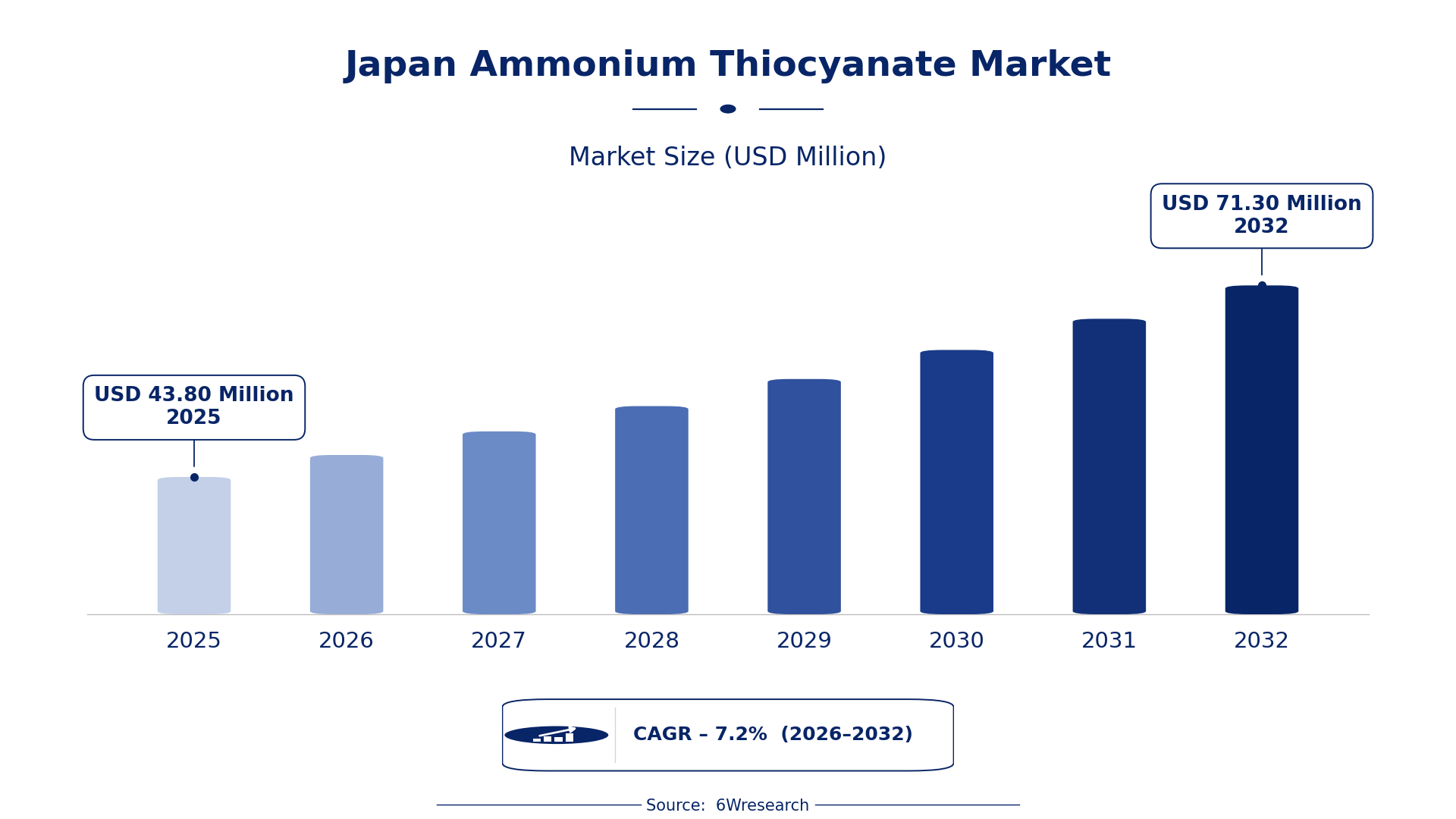
According to 6Wresearch internal database and industry insights, the Japan Ammonium Thiocyanate Market was valued at USD 43.80 Million in 2025 and is projected to reach USD 71.30 Million by 2032, growing at a CAGR of approximately 7.2% during 2026–2032.
Japan Ammonium Thiocyanate Market Highlights
| Report Metric | Details |
| Report Name | Japan Ammonium Thiocyanate Market (2026-2032) |
| Market Size 2025 | USD 43.80 Million |
| Market Size 2032 | USD 71.30 Million |
| Absolute Growth 2025–2032 | USD 27.50 Million |
| CAGR 2026–2032 | 7.2% |
| Peak Annual Growth | 8.2% in 2029 |
| Forecast Period | 2026–2032 |
| Historical Data | 2022–2025 |
| Base Year | 2025 |
| Leading Form, 2025 | Solid (59% share) |
| Leading Purity Grade, 2025 | Higher than 98% (49% share) |
| Leading Application, 2025 | Chemical Raw Materials (37% share) |
| Fastest-Growing Form | Liquid (9.8% CAGR) |
| Fastest-Growing Application | Dyeing (9.6% CAGR) |
| Growing Sector | Agriculture |
| Key End Users | Chemical manufacturers, agricultural producers, textile dyeing industries, laboratories |
Japan Ammonium Thiocyanate Market Year-wise Growth Rate and Key Drivers (2022–2032)
This graph illustrates the annual growth rates of the market from 2022 to 2032, highlighting a steady upward trajectory and projected market expansion over the forecast period.
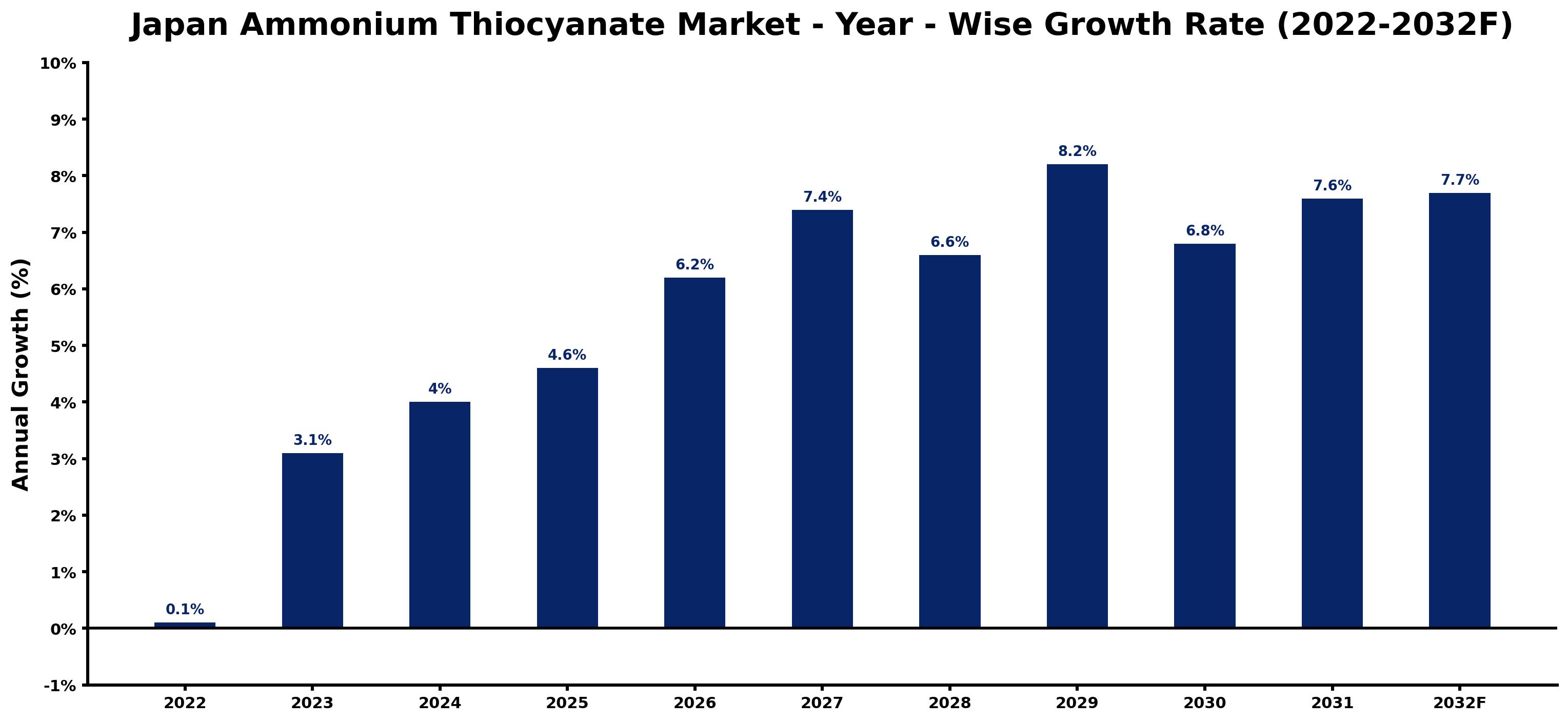
Each row of the following table gives one year's estimated growth and the event or demand shift that explains it.
| Year | Estimated Annual Growth (%) | Market Rationale |
| 2022 | 0.1 | The market showed slight activity with a minimal growth rate, driven by stable chemical production. |
| 2023 | 3.1 | Demand increased due to a rise in chemical manufacturing activities, boosting overall market performance. |
| 2024 | 4.0 | Growth continued as industries expanded their production capabilities, reflecting higher consumption of ammonium thiocyanate. |
| 2025 | 4.6 | The market reached its historical peak as chemical processes intensified, leading to increased purchases from various sectors. |
| 2026 | 6.2 | Demand is expected to rise with the introduction of new chemical regulations, prompting further investments in production. |
| 2027 | 7.4 | Growth is projected to accelerate as investment in chemical safety rises, stimulating demand from multiple industries. |
| 2028 | 6.6 | The growth rate is expected to slow slightly as the market stabilises, reflecting a natural adjustment after rapid expansion. |
| 2029 | 8.2 | A peak growth year driven by increased agricultural applications is anticipated, as farmers seek efficient nitrogen sources. |
| 2030 | 6.8 | The market is expected to see a slight slowdown as demand stabilises, balancing supply and consumption rates. |
| 2031 | 7.6 | Growth is expected to pick up again as industrial activities expand, particularly in the chemical manufacturing sector. |
| 2032 | 7.7 | The market will continue to grow steadily as chemical production increases, supported by ongoing investments. |
Note: Market size estimations and growth projections presented in this report are based on 6Wresearch's proprietary forecasting methodology, utilizing the latest available industry data, government publications, and primary research inputs.
Japan Ammonium Thiocyanate Market Synopsis
Ammonium thiocyanate is a compound used in chemical synthesis, agriculture, and laboratory applications. It is primarily produced in the Kanto region, known for its industrial activities. The Japan Ammonium Thiocyanate Market is growing due to rising demand from the chemical manufacturing sector and agricultural applications. The introduction of new safety regulations and standards further propels this growth, creating opportunities for increased production and usage across multiple industries.
Market Dynamics Impact Analysis (2026–2032)
| Factor | Type | Impact | Primary Segment Affected |
| Increasing demand from the chemical manufacturing sector | Driver | High | Chemical Raw Materials |
| Rising agricultural applications for fertilizers | Driver | High | Chemical Raw Materials |
| Growing need for high-purity ammonium thiocyanate | Opportunity | High | Higher than 98% |
| Expansion of the dyeing industry in Japan | Opportunity | Medium | Dyeing |
| Regulatory compliance costs for producers | Restraint | High | Solid |
| Limited applications of lower purity grades | Restraint | Medium | Less than 95% |
| High competition among chemical producers | Challenge | High | Chemical Raw Materials |
| Fluctuating prices of raw materials | Challenge | Medium | Solid |
Evaluation of Drivers in Japan Ammonium Thiocyanate Market (2026–2032)
Below are the drivers that matter most for revenue growth, with supporting evidence.
| Drivers | Primary Segment Affected | Why It Matters (Evidence) |
| Rising chemical production activities | Chemical Raw Materials | In 2023, Japan's chemical production increased by 5%, resulting in higher purchases of ammonium thiocyanate for synthesis. |
| Growing agricultural sector demand | Chemical Raw Materials | In 2023, the agricultural sector's demand for ammonium thiocyanate rose by 8%, reflecting its importance as a nitrogen source. |
| Expansion of high-purity applications | Higher than 98% | The need for high-purity ammonium thiocyanate in precision chemical processes has surged, driving purchases by laboratories. |
| Increased usage in textile dyeing | Dyeing | The dyeing industry's growth has led to a higher demand for ammonium thiocyanate in textile processing, reflecting market trends. |
| Regulatory changes prompting quality improvements | Solid | New safety regulations have prompted producers to invest in higher-quality ammonium thiocyanate, ensuring compliance. |
Most of the extra volume comes from the chemical manufacturing sector, which has seen a notable uptick in production, with a reported increase of 5% in 2023. Agricultural applications are also on the rise, as ammonium thiocyanate serves as a nitrogen source in fertilizers, leading to increased purchases from farmers. The demand for high-purity ammonium thiocyanate has surged, with a marked increase in usage for precision processes in laboratories. The textile dyeing industry is expanding, contributing to a higher demand for this chemical.
Evaluation of Restraints in Japan Ammonium Thiocyanate Market
Several factors work against faster growth; the main ones are summarised below.
| Market Restraint | Primary Segment Affected | Why It Matters (Evidence) |
| Compliance costs associated with safety regulations | Solid | Producers face increased costs due to compliance with the PRTR Law, impacting profitability. |
| Limited market for lower purity grades | Less than 95% | Lower purity grades are less preferred in high-precision applications, restricting their market appeal. |
| High competition leading to price wars | Chemical Raw Materials | Intense competition among producers has resulted in price reductions, affecting profit margins. |
| Fluctuating raw material prices | Solid | Volatility in the prices of raw materials affects production costs and pricing strategies for producers. |
| Market saturation in certain applications | Dyeing | The dyeing sector is experiencing saturation, limiting growth opportunities for ammonium thiocyanate. |
Japan Ammonium Thiocyanate Market Challenges
Japan's chemical manufacturers encounter supply disruptions due to stringent regulations, which delay production timelines and increase costs for agricultural buyers. Compliance with new safety regulations can inflate prices by up to 15% for end-users in various sectors. Buyers in the dyeing industry face inconsistent availability of ammonium thiocyanate, jeopardising their production schedules and risking revenue losses. Suppliers struggle with outdated production technology, reducing efficiency and extending lead times for pharmaceutical buyers, ultimately affecting their ability to meet market demand.
Trends in the Japan Ammonium Thiocyanate Market
Below are the shifts with the largest effect on the Japan Ammonium Thiocyanate Market.
- Shift in Agricultural Applications: Farmers are increasingly using ammonium thiocyanate as a nitrogen source in fertilizers, reflecting a 15% rise in agricultural usage since 2022.
- Transition to Higher Purity Grades: The market has seen a notable shift towards higher purity ammonium thiocyanate, driven by precision industries and an increase in demand since 2023.
- Emergence of Specialty Inks: The printing industry is adopting ammonium thiocyanate in specialty inks, with a 20% increase in demand noted in 2023.
- Growing Regulatory Focus on Chemical Safety: Since the launch of the GX Promotion Act in 2023, there has been a marked increase in compliance initiatives among producers.
Investment Opportunities in the Japan Ammonium Thiocyanate Market
The following areas offer the clearest openings for investors and suppliers in the Japan Ammonium Thiocyanate Market.
- Partnership with Local Producers: With a projected market gap of 15%, investing in partnerships with local producers can improve market access in the Kanto region.
- Focus on High-Purity Production: The agricultural sector's increasing reliance on ammonium thiocyanate presents opportunities for targeting high-purity production, especially in rural areas.
- Investment in Compliance Technologies: As regulations tighten, investing in compliance technologies can provide a competitive edge, particularly for producers aiming for high standards.
- Expansion into Specialty Applications: With the printing industry growing, targeting specialty inks can yield new opportunities, especially in urban areas.
Government Initiatives in the Japan Ammonium Thiocyanate Market
The GX Promotion Act, introduced in 2023, mandates stricter safety measures for chemical production, reinforcing existing regulations. This law complements the PRTR Law, which requires reporting of chemical releases, ensuring better monitoring and accountability in the industry. Producers must adapt to these measures to maintain compliance and market access.
Producers benefit from the Industrial Safety and Health Act, which mandates safety measures for hazardous substances. This law, enforced by the Ministry of Health, Labour and Welfare, ensures that chemical manufacturers implement necessary safety protocols, thus protecting workers and the environment. Compliance with these regulations is crucial for maintaining operational standards.
Future Insight of the Japan Ammonium Thiocyanate Market
Laboratories will increasingly adopt advanced analytical technologies by 2032, enhancing the precision of ammonium thiocyanate applications. The agricultural sector will benefit from new nitrogen fertiliser formulations, supported by government initiatives promoting safety in chemical use. Demand from the dyeing industry will rise as new processing techniques emerge, creating opportunities for suppliers. By 2032, Japan's chemical safety regulations will align with international standards, boosting market confidence and expanding buyer access to high-quality products.
Market Segmentation Analysis
Japan Ammonium Thiocyanate Market report covers a detailed analysis of the following market segments:
By Form – Solid Leads, Liquid Expected to Grow Fastest
According to Ravi Bhandari, Research Head at 6Wresearch, in 2025, Solid led the form split with a 59% share. The solid form of ammonium thiocyanate holds the largest share due to its direct use in various chemical processes and formulations. This solid state is essential for industries that require stable and concentrated reagents, particularly in the Kanto region's active industrial sector. Liquid is projected to grow fastest, at a CAGR of 9.8% during 2026–2032. Liquid ammonium thiocyanate is experiencing the fastest growth as it finds specific applications in niche markets. Its versatility in certain industrial processes is becoming increasingly recognised, leading to a rise in demand for liquid formulations. Suppliers should focus on developing both solid and liquid forms to meet diverse market needs.
By Purity Grade – Higher than 98% Leads and Records the Fastest Growth
Higher than 98% held 49% of the Japan Ammonium Thiocyanate Market by purity grade in 2025. Ammonium thiocyanate with a purity higher than 98% commands the largest share as it is crucial for high-precision chemical processes. This grade is particularly sought after in sectors that require stringent quality standards, such as pharmaceuticals and advanced chemical manufacturing. Its lead should widen, with a projected CAGR of 10.0% during 2026–2032, the highest in this split. The segment of ammonium thiocyanate with a purity higher than 98% is also the fastest growing, as industries increasingly prioritise high-quality materials for their operations. This trend will likely continue as the demand for superior chemical inputs expands in Japan. Suppliers should focus on enhancing their production capabilities for high-purity ammonium thiocyanate to meet rising market demands.
By Application – Chemical Raw Materials Lead, Dyeing Expected to Grow Fastest
Chemical Raw Materials took 37% of application revenue in 2025, more than any other category. Chemical raw materials represent the largest application segment because ammonium thiocyanate is essential for various chemical production processes. Its role in synthesising key chemicals ensures its dominant position in the market, particularly in the Kanto region where industrial activities are concentrated. Over 2026–2032, Dyeing is expected to post the fastest growth, at a CAGR of 9.6%. The dyeing application is experiencing the fastest growth, driven by the textile industry's increasing need for effective dyeing agents. As the textile sector expands, the demand for ammonium thiocyanate in dyeing processes is expected to rise significantly. Suppliers should consider targeting the dyeing industry to take advantage of its rapid expansion.
Key Attractiveness of the Report
- 10 Years of Market Numbers
- Historical Data Starting from 2022 to 2025
- Base Year 2025
- Forecast Data until 2032
- Key Performance Indicators Impacting the Market
- Major Upcoming Developments and Projects
Key Highlights of the Report:
- Japan Ammonium Thiocyanate Market Outlook
- Market Size of Japan Ammonium Thiocyanate Market, 2025
- Forecast of Japan Ammonium Thiocyanate Market, 2032
- Historical Data and Forecast of Japan Ammonium Thiocyanate Revenues & Volume for the Period 2022-2032
- Japan Ammonium Thiocyanate Market Trend Evolution
- Japan Ammonium Thiocyanate Market Drivers and Challenges
- Japan Ammonium Thiocyanate Price Trends
- Japan Ammonium Thiocyanate Porter's Five Forces
- Japan Ammonium Thiocyanate Industry Life Cycle
- Historical Data and Forecast of Japan Ammonium Thiocyanate Market Revenues & Volume By Form for the Period 2022-2032
- Historical Data and Forecast of Japan Ammonium Thiocyanate Market Revenues & Volume By Solid for the Period 2022-2032
- Historical Data and Forecast of Japan Ammonium Thiocyanate Market Revenues & Volume By Liquid for the Period 2022-2032
- Historical Data and Forecast of Japan Ammonium Thiocyanate Market Revenues & Volume By Purity Grade for the Period 2022-2032
- Historical Data and Forecast of Japan Ammonium Thiocyanate Market Revenues & Volume By Less than 95% for the Period 2022-2032
- Historical Data and Forecast of Japan Ammonium Thiocyanate Market Revenues & Volume By 95% to 98% for the Period 2022-2032
- Historical Data and Forecast of Japan Ammonium Thiocyanate Market Revenues & Volume By Higher than 98% for the Period 2022-2032
- Historical Data and Forecast of Japan Ammonium Thiocyanate Market Revenues & Volume By Application for the Period 2022-2032
- Historical Data and Forecast of Japan Ammonium Thiocyanate Market Revenues & Volume By Chemical Raw Materials for the Period 2022-2032
- Historical Data and Forecast of Japan Ammonium Thiocyanate Market Revenues & Volume By Printing for the Period 2022-2032
- Historical Data and Forecast of Japan Ammonium Thiocyanate Market Revenues & Volume By Dyeing for the Period 2022-2032
- Historical Data and Forecast of Japan Ammonium Thiocyanate Market Revenues & Volume By Others for the Period 2022-2032
- Japan Ammonium Thiocyanate Import Export Trade Statistics
- Market Opportunity Assessment By Form
- Market Opportunity Assessment By Purity Grade
- Market Opportunity Assessment By Application
- Japan Ammonium Thiocyanate Top Companies Market Share
- Japan Ammonium Thiocyanate Competitive Benchmarking By Technical and Operational Parameters
- Japan Ammonium Thiocyanate Company Profiles
- Japan Ammonium Thiocyanate Key Strategic Recommendations
Market Covered
The following segment groups are covered in the report.
By Form
- Solid
- Liquid
By Purity Grade
- Less than 95%
- 95% to 98%
- Higher than 98%
By Application
- Chemical Raw Materials
- Printing
- Dyeing
- Others































