Japan Antenna Market Size & Growth Rate
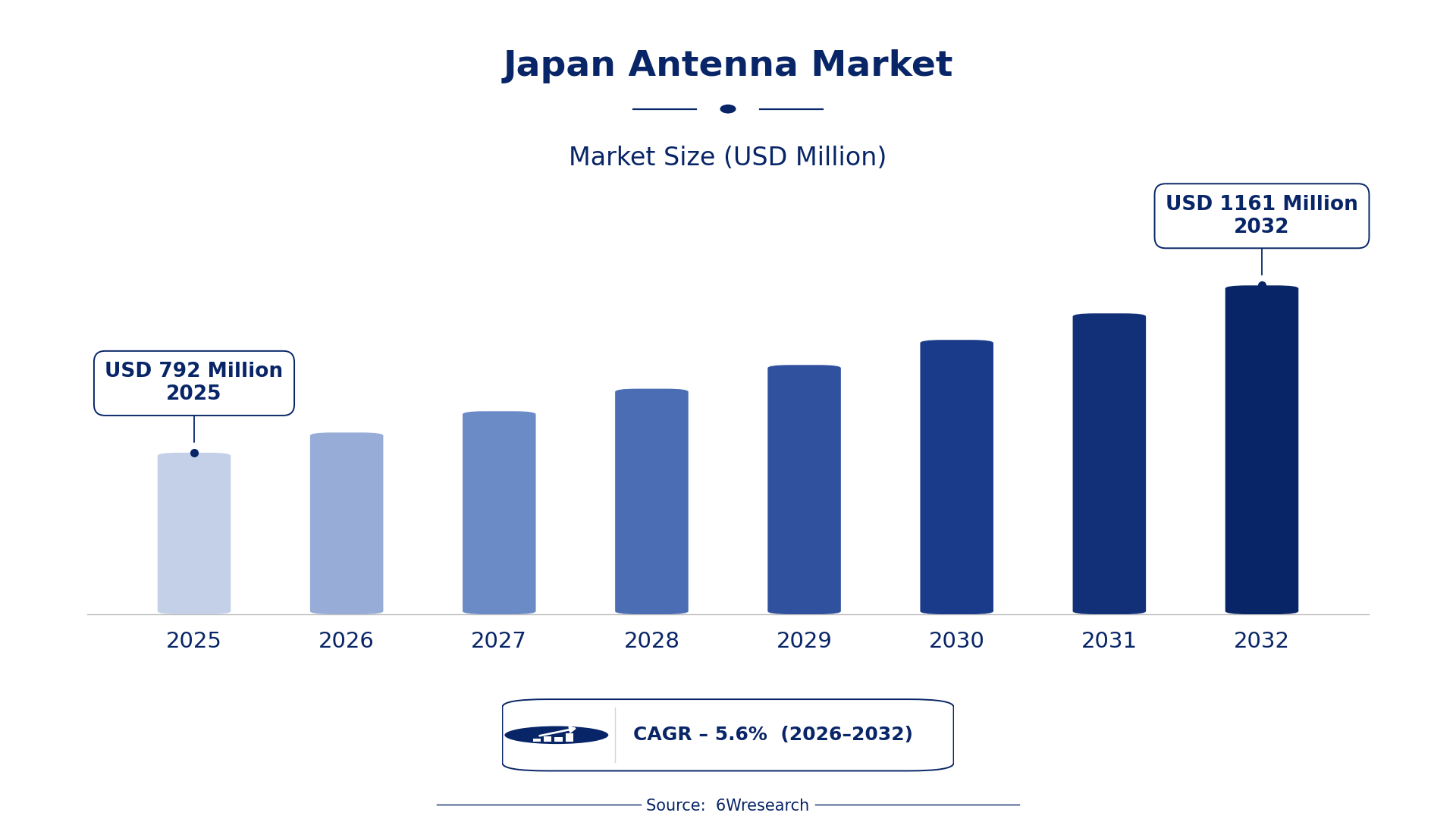
According to 6Wresearch internal database and industry insights, the Japan Antenna Market was valued at USD 792 Million in 2025 and is projected to reach USD 1,161 Million by 2032, growing at a CAGR of approximately 5.6% during 2026–2032.
Japan Antenna Market Highlights
| Report Metric | Details |
| Report Name | Japan Antenna Market (2026-2032) |
| Market Size 2025 | USD 792 Million |
| Market Size 2032 | USD 1,161 Million |
| Absolute Growth 2025–2032 | USD 369 Million |
| CAGR 2026–2032 | 5.6% |
| Peak Annual Growth | 6.7% in 2029 |
| Forecast Period | 2026–2032 |
| Historical Data | 2022–2025 |
| Base Year | 2025 |
| Leading Type, 2025 | Radio Antennas (58% share) |
| Leading Technology Type, 2025 | SIMO (48% share) |
| Leading Application, 2025 | RADAR (40% share) |
| Fastest-Growing Type | Smart Antennas (8.1% CAGR) |
| Fastest-Growing Technology Type | MIMO (7.8% CAGR) |
| Fastest-Growing Application | Satellite Communications (7.7% CAGR) |
| Growing Sector | Telecommunications |
| Key End Users | Telecommunications companies, broadcasting agencies, government agencies, technology firms |
Japan Antenna Market Year-wise Growth Rate and Key Drivers (2022–2032)
This graph illustrates the annual growth rates of the market from 2022 to 2032, highlighting a steady upward trajectory and projected market expansion over the forecast period.
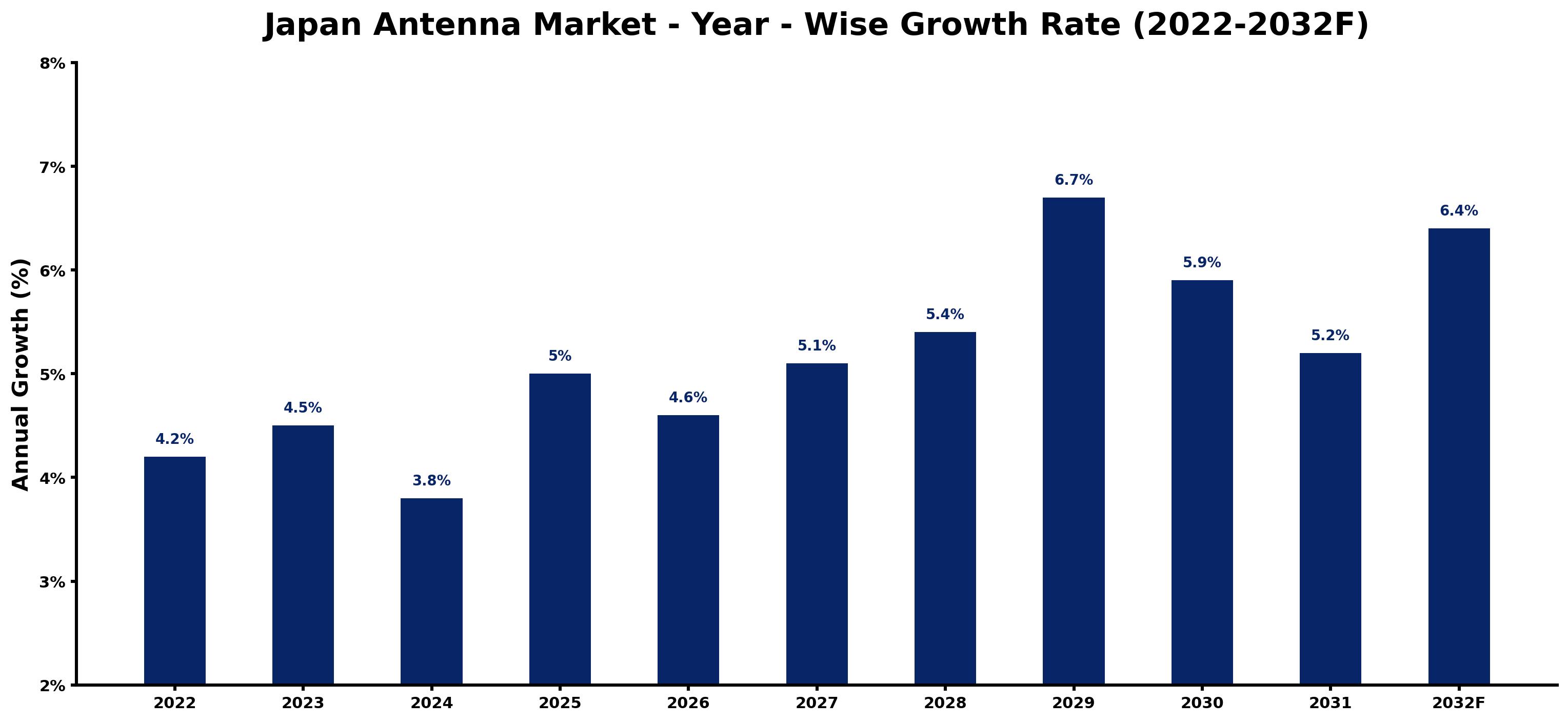
The yearly estimates that follow link every growth rate to its principal driver, so readers can see why the pace changed in each period.
| Year | Estimated Annual Growth (%) | Market Rationale |
| 2022 | 4.2 | The market experienced steady growth due to increased mobile subscriptions. |
| 2023 | 4.5 | Demand rose as investments in 5G technology accelerated across sectors. |
| 2024 | 3.8 | Growth slowed slightly as market adjustments occurred following rapid expansion. |
| 2025 | 5.0 | The market peaked with advancements in antenna technology. |
| 2026 | 4.6 | Growth is expected to slow as the market stabilises after the previous peak. |
| 2027 | 5.1 | Demand will increase as new wireless communication systems are adopted. |
| 2028 | 5.4 | The market is projected to continue growing with advancements in smart antennas. |
| 2029 | 6.7 | Growth will peak due to heightened investments in advanced antenna technologies. |
| 2030 | 5.9 | A slowdown is expected as the market adjusts to technological saturation. |
| 2031 | 5.2 | Growth will continue to slow as competition intensifies among manufacturers. |
| 2032 | 6.4 | Demand is projected to surge again as new applications for antennas emerge. |
Note: Market size estimations and growth projections presented in this report are based on 6Wresearch's proprietary forecasting methodology, utilizing the latest available industry data, government publications, and primary research inputs.
Japan Antenna Market Synopsis
Antennae are devices that transmit and receive electromagnetic waves, essential for communication systems, broadcasting, and radar applications. The Japan Antenna Market is expanding, driven by over 100 million mobile subscribers and investments in 5G technology. The Tokyo region serves as a key hub for antenna manufacturing, while the adoption of ISO/IEC 18000 standards supports growth. Technological advancements are expected to increase demand from telecommunications and broadcasting sectors, creating further opportunities for investment.
Market Dynamics Impact Analysis (2026–2032)
| Factor | Type | Impact | Primary Segment Affected |
| Increasing mobile subscriptions drive demand for cellular antennas. | Driver | High | Cellular Communications |
| Growing investments in 5G technology create a need for advanced antennas. | Driver | High | Smart Antennas |
| The need for enhanced communication capabilities presents investment opportunities. | Opportunity | High | WiFi Systems |
| The expansion of satellite communication infrastructure opens new markets. | Opportunity | Medium | Satellite Communications |
| Regulatory compliance can limit market entry for new producers. | Restraint | High | Radio Antennas |
| Technological advancements require continuous R&D investment, straining budgets. | Restraint | Medium | Smart Antennas |
| High production costs can hinder profitability for manufacturers. | Challenge | High | Radio Antennas |
| Intense competition may lead to price wars, affecting margins. | Challenge | Medium | Radio Antennas |
Evaluation of Drivers in Japan Antenna Market (2026–2032)
The main growth drivers and the segments they affect most are set out below.
| Drivers | Primary Segment Affected | Why It Matters (Evidence) |
| Rising mobile subscriptions increase demand for cellular antennas. | Cellular Communications | In 2023, Japan had over 100 million mobile subscribers, driving purchases of cellular antennas. |
| Investments in 5G technology boost demand for advanced antennas. | Smart Antennas | Japan's commitment to 5G technology drives the need for more advanced antenna solutions. |
| Expansion of smart city initiatives drives demand for WiFi systems. | WiFi Systems | Urban areas have over 80% of households connected to WiFi, increasing demand for systems. |
| Growing satellite communication needs drive demand for antennas. | Satellite Communications | Japan allocated funds for enhancing satellite communication infrastructure in 2023. |
| Technological advancements in radar applications increase antenna use. | RADAR | The Japan Radio Association promotes standards for radar antennas, boosting their market presence. |
Buyers are adding capacity as mobile subscriptions exceed 100 million, driving demand for cellular antennas. The push for smart city technologies has led to a rise in WiFi system installations, with a large portion of urban households connected. Investments in 5G technology create a strong demand for advanced antennas, as businesses seek to upgrade their communication capabilities. The promotion of radar standards also boosts the market for radar antennas, aligning with technological advancements in navigation systems.
Evaluation of Restraints in Japan Antenna Market
The main factors holding the market back are set out below.
| Market Restraint | Primary Segment Affected | Why It Matters (Evidence) |
| Regulatory compliance can limit market entry for new producers. | Radio Antennas | The Industrial Standardization Act governs product standards, complicating entry for new manufacturers. |
| Technological advancements require continuous R&D investment, straining budgets. | Smart Antennas | R&D costs can be high, limiting smaller manufacturers' competitiveness in the market. |
| High production costs can hinder profitability for manufacturers. | Radio Antennas | Manufacturers face rising material costs, impacting overall profitability and pricing strategies. |
| Limited applications for certain antenna types restrict market growth. | SIMO | SIMO antennas are less common in current communication systems, reducing their market presence. |
| Competition among manufacturers can lead to price wars, affecting margins. | Radio Antennas | Intense competition pressures prices, reducing profit margins for producers in the market. |
Japan Antenna Market Challenges
Over 100 million mobile subscribers rely on cellular antennas, yet producers face skills shortages in advanced technology, delaying product launches. Importers encounter supply chain disruptions due to strict telecommunications regulations, which can extend delivery times by up to three months for distributors. Rising material costs are forcing buyers to pay 15% more for essential components, straining their budgets. Competition from emerging markets is intensifying, compelling local producers to innovate rapidly or risk losing market share to lower-cost alternatives.
Trends in the Japan Antenna Market
The trends below show where the Japan Antenna Market is heading.
- Shift to Smart Antennas: Since 2023, Japan has seen a shift towards smart antennas, improving signal quality in wireless systems. This transition is clear as manufacturers invest in smart technologies, with a projected increase in installations by 8.1% over the next five years.
- Transition to 5G Technology: The adoption of 5G technology has accelerated since 2023, driving demand for advanced antennas. With Japan's government investing significantly in 5G infrastructure, the market for cellular antennas is set to grow substantially, reflecting a shift in communication standards.
- Emergence of Satellite Communication: Satellite communication has gained prominence since 2023, with increased funding for infrastructure. This trend is clear as the government allocated funds for enhancing satellite communication capabilities, indicating a growing reliance on satellite systems.
- Prioritisation of Urban WiFi Systems: Urban areas have prioritised WiFi systems since 2023, with a significant proportion of households connected. This trend highlights the rising demand for reliable wireless internet connectivity, prompting investments in WiFi infrastructure.
Investment Opportunities in the Japan Antenna Market
The following areas offer the clearest openings for investors and suppliers in the Japan Antenna Market.
- Timing for Investment in Smart Antennas: With the market growing at 8.1%, now is the time to invest in smart antennas. Telecommunications companies in urban areas are seeking advanced solutions to improve signal quality.
- Gap in Advanced Cellular Antennas: The market for advanced cellular antennas is expanding, with a projected growth of 5.6%. Companies can supply products to meet the demand from mobile network providers.
- Investment in Satellite Communication Infrastructure: The government allocated funds for satellite communication infrastructure, indicating a growing market. Suppliers can enter by partnering with local telecommunications firms to provide necessary technologies.
- Entry into WiFi System Supply: With a large percentage of urban households connected to WiFi, the demand for systems is high. New entrants can establish joint ventures with local tech firms to supply WiFi solutions.
Government Initiatives in the Japan Antenna Market
The Act against Unjustifiable Premiums and Misleading Representations prohibits misleading advertising, ensuring that antenna manufacturers provide accurate information about their products. This law protects consumers and promotes fair competition in the antenna market, building trust among buyers and producers. The government allocated JPY 150 billion for public-private decarbonisation investment over ten years, which includes support for technological advancements in the antenna sector.
The Ministry of Internal Affairs and Communications oversees telecommunications regulations, ensuring compliance with standards. This agency's role is vital for manufacturers as they must adhere to regulations to market their products effectively, impacting their operational strategies. The agency approved over 200 projects in the last year to improve communication infrastructure, benefiting both producers and consumers.
Future Insight of the Japan Antenna Market
Investment in 5G technology will drive demand for advanced antennas, creating a projected production capacity increase of 20% by 2032. Enhanced satellite communication infrastructure will improve connectivity options across urban and rural areas. The adoption of ISO/IEC 18000 standards for RFID antennas will streamline manufacturing processes, benefiting suppliers. Smart city technology initiatives will further integrate antennas into everyday applications, expanding their relevance across various sectors.
Market Segmentation Analysis
Japan Antenna Market report covers a detailed analysis of the following market segments:
By Type – Radio Antennas Lead, Smart Antennas Expected to Grow Fastest
According to Summon Dutta, Assistant Manager at 6Wresearch, with 58% of type revenue in 2025, Radio Antennas was the largest category. Radio antennas are crucial for communication and broadcasting in Japan, making them the preferred choice among users. The extensive installed base is highlighted by the high mobile subscriber count, which exceeds 100 million, demonstrating significant demand. Smart Antennas are set to record the highest CAGR in this split, 8.1% over 2026–2032. Smart antennas are experiencing rapid growth due to the rising need for enhanced signal quality in wireless systems, especially as Japan progresses with 5G technology. This momentum indicates that radio antennas will maintain their lead while smart antennas further optimise existing networks. Suppliers should focus on advancing smart antenna technologies to meet the increasing demand for improved wireless communication.
By Technology Type – SIMO Leads, MIMO Expected to Grow Fastest
SIMO accounted for 48% of the market by technology type in 2025. SIMO technology is commonly used in various communication systems, providing a reliable option for users. Its established presence in the market ensures a steady demand for this type of antenna. MIMO is projected to grow fastest, at a CAGR of 7.8% during 2026–2032. MIMO technology is gaining traction due to its critical role in modern wireless communication systems, particularly as the country advances towards 5G implementation. This technology's efficiency in handling multiple signals simultaneously is driving its rapid adoption. Buyers should consider investing in MIMO technology to future-proof their communication systems.
By Application – RADAR Leads, Satellite Communications Expected to Grow Fastest
RADAR held 40% of the Japan Antenna Market by application in 2025. RADAR applications are vital for navigation and detection systems, establishing their prominence in Japan's antenna market. The essential nature of RADAR in various sectors ensures consistent demand and a strong market presence. The quickest growth will come from Satellite Communications, forecast to expand at a CAGR of 7.7% between 2026 and 2032. Satellite communications are growing quickly, driven by their critical role in global communication networks, especially with government investments aimed at improving satellite infrastructure. This trend suggests a shift towards greater reliance on satellite technology for connectivity. Suppliers need to prioritise satellite communication solutions to capitalise on the expanding opportunities within this segment.
Key Attractiveness of the Report
- 10 Years of Market Numbers
- Historical Data Starting from 2022 to 2025
- Base Year 2025
- Forecast Data until 2032
- Key Performance Indicators Impacting the Market
- Major Upcoming Developments and Projects
Key Highlights of the Report:
- Japan Antenna Market Outlook
- Market Size of Japan Antenna Market, 2025
- Forecast of Japan Antenna Market, 2032
- Historical Data and Forecast of Japan Antenna Revenues & Volume for the Period 2022-2032
- Japan Antenna Market Trend Evolution
- Japan Antenna Market Drivers and Challenges
- Japan Antenna Price Trends
- Japan Antenna Porter's Five Forces
- Japan Antenna Industry Life Cycle
- Historical Data and Forecast of Japan Antenna Market Revenues & Volume By Type for the Period 2022-2032
- Historical Data and Forecast of Japan Antenna Market Revenues & Volume By Radio Antennas for the Period 2022-2032
- Historical Data and Forecast of Japan Antenna Market Revenues & Volume By Smart Antennas for the Period 2022-2032
- Historical Data and Forecast of Japan Antenna Market Revenues & Volume By Technology Type for the Period 2022-2032
- Historical Data and Forecast of Japan Antenna Market Revenues & Volume By SIMO for the Period 2022-2032
- Historical Data and Forecast of Japan Antenna Market Revenues & Volume By MIMO for the Period 2022-2032
- Historical Data and Forecast of Japan Antenna Market Revenues & Volume By MISO for the Period 2022-2032
- Historical Data and Forecast of Japan Antenna Market Revenues & Volume By Others for the Period 2022-2032
- Historical Data and Forecast of Japan Antenna Market Revenues & Volume By Application for the Period 2022-2032
- Historical Data and Forecast of Japan Antenna Market Revenues & Volume By RADAR for the Period 2022-2032
- Historical Data and Forecast of Japan Antenna Market Revenues & Volume By Satellite Communications for the Period 2022-2032
- Historical Data and Forecast of Japan Antenna Market Revenues & Volume By Cellular Communications for the Period 2022-2032
- Historical Data and Forecast of Japan Antenna Market Revenues & Volume By WiFi Systems for the Period 2022-2032
- Historical Data and Forecast of Japan Antenna Market Revenues & Volume By WiMax Systems for the Period 2022-2032
- Historical Data and Forecast of Japan Antenna Market Revenues & Volume By Others for the Period 2022-2032
- Japan Antenna Import Export Trade Statistics
- Market Opportunity Assessment By Type
- Market Opportunity Assessment By Technology Type
- Market Opportunity Assessment By Application
- Japan Antenna Top Companies Market Share
- Japan Antenna Competitive Benchmarking By Technical and Operational Parameters
- Japan Antenna Company Profiles
- Japan Antenna Key Strategic Recommendations
Market Covered
The report covers the following segments.
By Type
- Radio Antennas
- Smart Antennas
By Technology Type
- SIMO
- MIMO
- MISO
- Others
By Application
- RADAR
- Satellite Communications
- Cellular Communications
- WiFi Systems
- WiMax Systems
- Others































