Japan Anti-Lock Braking System Market Size & Growth Rate
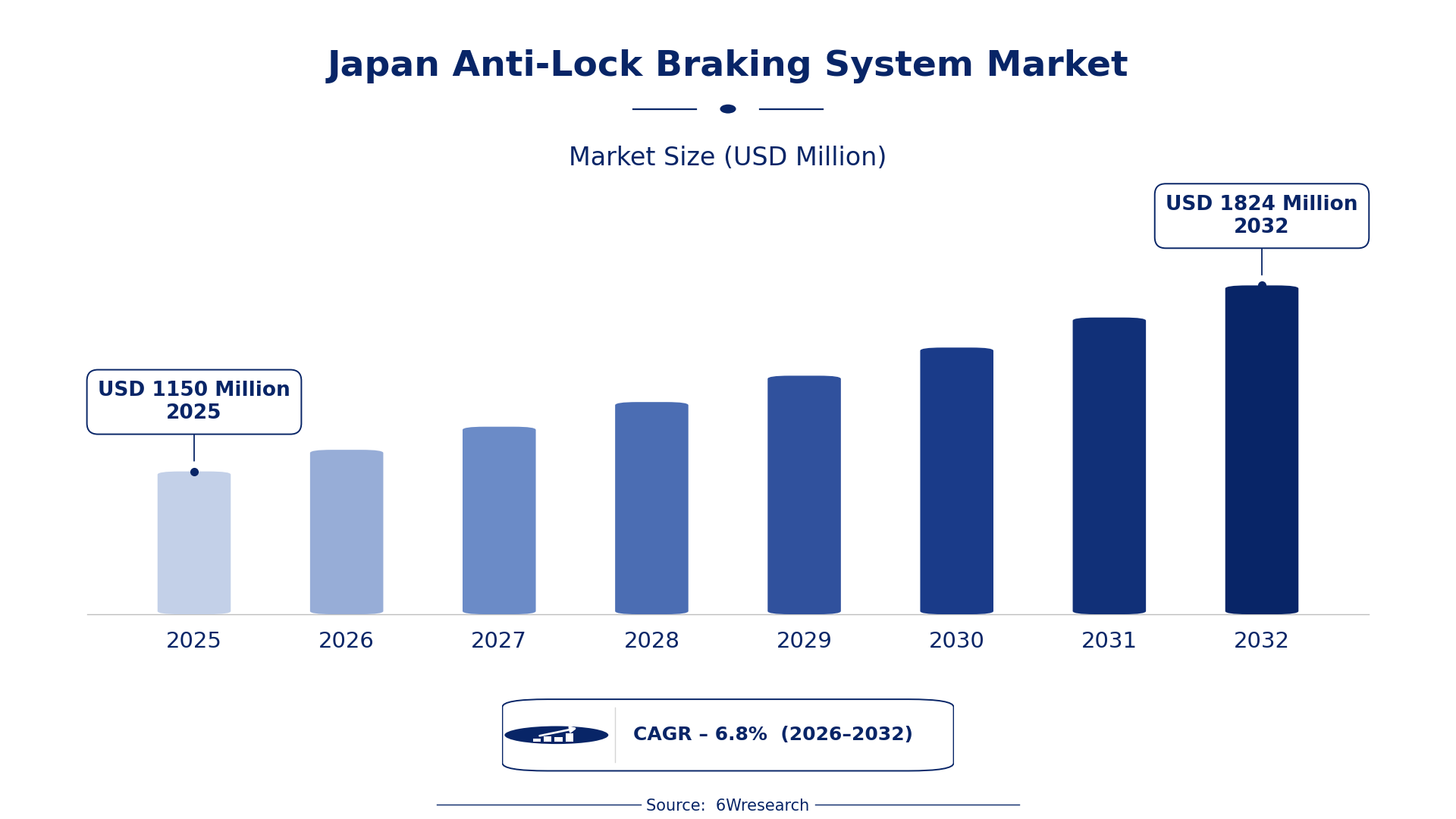
According to 6Wresearch internal database and industry insights, the Japan Anti-Lock Braking System Market was valued at USD 1,150 Million in 2025 and is projected to reach USD 1,824 Million by 2032, growing at a CAGR of approximately 6.8% during 2026–2032.
Japan Anti-Lock Braking System Market Highlights
| Report Metric | Details |
| Report Name | Japan Anti-Lock Braking System Market (2026-2032) |
| Market Size 2025 | USD 1,150 Million |
| Market Size 2032 | USD 1,824 Million |
| Absolute Growth 2025–2032 | USD 674 Million |
| CAGR 2026–2032 | 6.8% |
| Peak Annual Growth | 7.6% in 2029 |
| Forecast Period | 2026–2032 |
| Historical Data | 2022–2025 |
| Base Year | 2025 |
| Leading System Type, 2025 | Hydraulic ABS (41% share) |
| Leading Application, 2025 | Passenger Cars (38% share) |
| Leading End User, 2025 | Automotive Industry (39% share) |
| Fastest-Growing System Type | Pneumatic ABS (9.2% CAGR) |
| Fastest-Growing Application | Commercial Vehicles (8.8% CAGR) |
| Fastest-Growing End User | Trucking Companies (8.5% CAGR) |
| Growing Sector | Automotive Industry |
| Key End Users | Automotive Manufacturers, Trucking Companies, Motorcycle Manufacturers |
Japan Anti-Lock Braking System Market Year-wise Growth Rate and Key Drivers (2022–2032)
This graph illustrates the annual growth rates of the market from 2022 to 2032, highlighting a steady upward trajectory and projected market expansion over the forecast period.
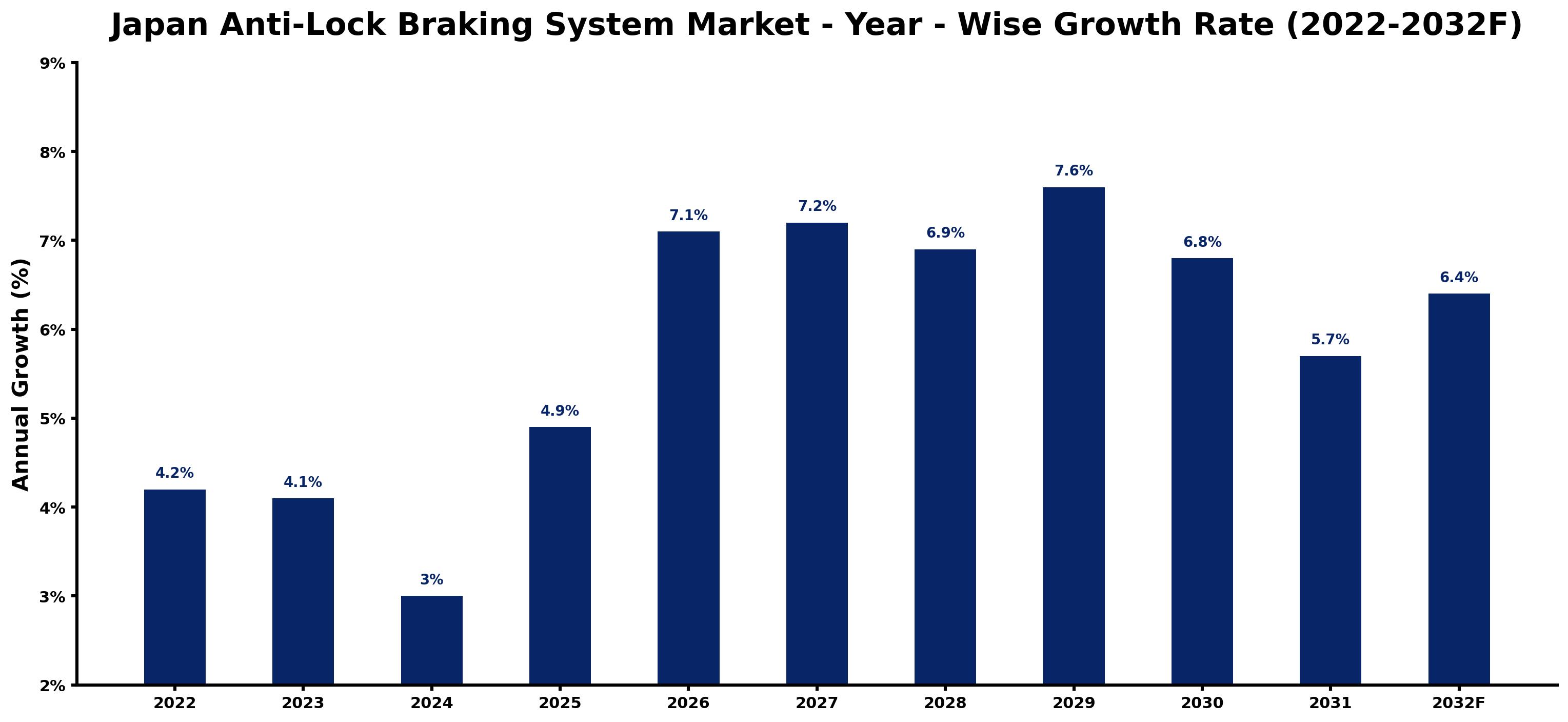
The yearly estimates that follow link every growth rate to its principal driver, so readers can see why the pace changed in each period.
| Year | Estimated Annual Growth (%) | Market Rationale |
| 2022 | 4.2 | The market experienced steady growth due to strong automotive production figures. |
| 2023 | 4.1 | Manufacturers adjusted to changing consumer preferences, leading to slightly slower growth. |
| 2024 | 3.0 | Demand stabilised amidst economic uncertainties, contributing to a further slowdown. |
| 2025 | 4.9 | Vehicle production rebounded and safety standards strengthened, accelerating growth. |
| 2026 | 7.1 | Investment in automotive safety technologies is expected to drive demand sharply. |
| 2027 | 7.2 | Manufacturers will expand ABS adoption in new models, sustaining growth. |
| 2028 | 6.9 | Competition among suppliers is projected to slow growth in this year. |
| 2029 | 7.6 | The introduction of advanced safety features in vehicles will surge demand. |
| 2030 | 6.8 | Market saturation is expected to moderate growth as new vehicle sales slow. |
| 2031 | 5.7 | Rising safety awareness among consumers will continue to support market growth. |
| 2032 | 6.4 | New technologies are projected to enhance ABS functionalities, increasing demand. |
Note: Market size estimations and growth projections presented in this report are based on 6Wresearch's proprietary forecasting methodology, utilizing the latest available industry data, government publications, and primary research inputs.
Japan Anti-Lock Braking System Market Synopsis
Anti-Lock Braking Systems (ABS) are safety technologies that prevent wheel lock-up during braking, utilising hydraulic, pneumatic, or electronic components to improve vehicle control. The Japan Anti-Lock Braking System Market is growing due to the automotive industry's production of approximately 8.3 million vehicles in 2022. Factors such as rising consumer demand for safer vehicles and government initiatives promoting advanced safety technologies are driving this growth, with about 70% of new passenger cars equipped with ABS technology.
Market Dynamics Impact Analysis (2026–2032)
| Factor | Type | Impact | Primary Segment Affected |
| Rising vehicle production | Driver | High | Passenger Cars |
| Growing safety regulations | Driver | High | Automotive Industry |
| Investment in safety technologies | Opportunity | High | Commercial Vehicles |
| Increasing ABS adoption in motorcycles | Opportunity | Medium | Motorcycles |
| High costs of advanced systems | Restraint | High | Heavy Machinery |
| Limited awareness of ABS benefits | Restraint | Medium | Pneumatic ABS |
| Supply chain disruptions | Challenge | High | Automotive Industry |
| Technological compliance costs | Challenge | Medium | Passenger Cars |
Evaluation of Drivers in Japan Anti-Lock Braking System Market (2026–2032)
The factors lifting demand, and the evidence behind each, are summarised below.
| Drivers | Primary Segment Affected | Why It Matters (Evidence) |
| Increased vehicle production | Passenger Cars | Japan's automotive industry produced approximately 8.3 million vehicles in 2022, driving demand for ABS. |
| Stricter safety regulations | Automotive Industry | The Japan Automobile Manufacturers Association promotes safety standards, increasing ABS adoption in new vehicles. |
| Investment in automotive safety technologies | Commercial Vehicles | Investment in safety technologies reached over 200 billion yen in 2023, boosting demand for ABS. |
| Rising consumer safety awareness | Motorcycles | With approximately 4.5 million registered motorcycles, the demand for ABS is increasing for rider safety. |
| Technological advancements in ABS | Electronic ABS | Modern vehicles increasingly feature electronic ABS, improving safety and control during braking. |
Behind the steady rise in orders sits the strong performance of Japan's automotive industry, which produced approximately 8.3 million vehicles in 2022. Investment in automotive safety technologies reached over 200 billion yen in 2023, further driving demand for ABS. The growing number of registered motorcycles, around 4.5 million, is pushing for more ABS adoption to enhance rider safety. Additionally, technological advancements in ABS are contributing to market growth as manufacturers focus on improving vehicle control features.
Evaluation of Restraints in Japan Anti-Lock Braking System Market
The table below lists the restraints and the evidence behind each.
| Market Restraint | Primary Segment Affected | Why It Matters (Evidence) |
| High costs of advanced ABS systems | Heavy Machinery | The costs associated with advanced ABS technology limit adoption in heavy machinery applications. |
| Limited awareness of ABS benefits | Pneumatic ABS | Many consumers remain unaware of the advantages of ABS, hindering its adoption in certain vehicle types. |
| Supply chain disruptions | Automotive Industry | Recent global supply chain challenges have delayed the production of ABS components, impacting availability. |
| Technological compliance costs | Passenger Cars | Compliance with evolving safety standards increases costs for manufacturers, affecting pricing strategies. |
| Market saturation in passenger vehicles | Passenger Cars | The high penetration of ABS in new vehicles leads to slower growth as the market matures. |
Japan Anti-Lock Braking System Market Challenges
Approximately 70% of new passenger cars in Japan are equipped with ABS technology, yet buyers encounter high costs for the latest features, limiting access to advanced safety systems. Regulatory standards like JIS D 1111 create lengthy approval processes, delaying suppliers in bringing new ABS models to market and costing them valuable time. Rising production costs, driven by over 200 billion yen invested in automotive safety technologies in 2023, pressure suppliers to increase prices, ultimately affecting buyers. Intense competition forces suppliers to cut prices, risking the quality of ABS components and potentially compromising vehicle control during emergencies.
Trends in the Japan Anti-Lock Braking System Market
The following changes are redrawing the Japan Anti-Lock Braking System Market.
- Shift from Hydraulic to Electronic ABS: The automotive industry is increasingly adopting electronic ABS over hydraulic systems, with about 70% of new passenger cars equipped with this technology in 2022. This shift reflects a growing emphasis on improved vehicle control.
- Growing Adoption of ABS in Motorcycles: The integration of ABS in motorcycles is gaining momentum, as approximately 4.5 million registered motorcycles in Japan are now being equipped with this safety feature. This trend improves rider safety and is expected to drive further demand.
- Increased Focus on Advanced Safety Features: The automotive sector is prioritising advanced safety technologies, including ABS, to meet consumer expectations. The government's 2023 initiative to promote vehicle safety technologies supports this trend, aiming to improve overall safety standards.
- Expansion of ABS in Commercial Vehicles: Commercial vehicles are increasingly adopting ABS to improve safety standards. This segment is projected to grow at a CAGR of 8.8% from 2026 to 2032, reflecting a strong demand for safety features.
Investment Opportunities in the Japan Anti-Lock Braking System Market
The openings below show where demand in the Japan Anti-Lock Braking System Market is visible and how suppliers can enter.
- Partnership with local manufacturers: Collaborating with local automotive manufacturers can facilitate entry into the Japanese market, which produced 8.3 million vehicles in 2022, creating demand for ABS.
- Supply of advanced ABS technologies: There is an opportunity to supply advanced ABS technologies, particularly in the commercial vehicle sector, which is expanding rapidly with increasing safety requirements.
- Targeting trucking companies: Trucking companies are increasingly focusing on safety features, creating a demand for ABS. This market gap presents an opportunity for suppliers to enter.
- Investment in safety technology: With over 200 billion yen invested in automotive safety technologies in 2023, there is a strong opportunity for suppliers to provide effective ABS solutions.
Government Initiatives in the Japan Anti-Lock Braking System Market
The 2023 initiative to promote advanced vehicle safety technologies adds to existing regulations by incentivising manufacturers to adopt improved safety features. This initiative complements the JIS D 1111 standard for ABS, ensuring vehicles meet high safety standards. The program aims to enhance overall vehicle safety and performance across the industry.
The Ministry of Land, Infrastructure, Transport and Tourism oversees vehicle safety regulations and approves safety technologies, ensuring compliance with national standards. This agency plays a key role in funding initiatives that improve vehicle safety and support manufacturers in meeting regulatory requirements.
Future Insight of the Japan Anti-Lock Braking System Market
Technological advancements in ABS will reshape demand for braking systems by 2032, as buyers seek improved safety features. The government's 2023 initiative to promote advanced vehicle safety technologies will stimulate innovation in ABS design and manufacturing. As Japan's population remains stable, the number of registered vehicles is expected to rise, increasing the need for effective safety solutions. Investment in automotive safety technologies will likely grow, providing suppliers with opportunities to develop high-performance ABS that meets stringent safety standards.
Market Segmentation Analysis
Japan Anti-Lock Braking System Market report covers a detailed analysis of the following market segments:
By System Type – Hydraulic ABS Leads, Pneumatic ABS Expected to Grow Fastest
According to Bhawna Singh, Assistant Manager at 6Wresearch, Hydraulic ABS held 41% of the Japan Anti-Lock Braking System Market by system type in 2025. Hydraulic ABS holds the largest share due to its widespread application across various vehicle types, ensuring reliable braking performance. This system is particularly common in passenger cars, which accounted for a significant portion of the 8.3 million vehicles produced in Japan in 2022. Pneumatic ABS is projected to grow fastest, at a CAGR of 9.2% during 2026–2032. Pneumatic ABS is rapidly growing as it finds more applications in specialised settings, particularly within commercial vehicles. The government's initiative to promote advanced vehicle safety technologies, with over 200 billion yen invested in 2023, significantly contributes to this segment's growth. Suppliers should focus on enhancing hydraulic ABS offerings while also exploring pneumatic solutions to meet evolving market demands.
By Application – Passenger Cars Lead, Commercial Vehicles Expected to Grow Fastest
In 2025, Passenger Cars led the application split with a 38% share. Passenger Cars dominate the market since they represent the majority of vehicles on the road, with around 70% of new models incorporating ABS technology. This high adoption rate underscores the critical role of ABS in enhancing safety for everyday drivers. Commercial Vehicles are set to record the highest CAGR in this split, 8.8% over 2026–2032. Commercial Vehicles are witnessing the fastest growth owing to their essential requirement for safety in heavy-duty operations, particularly in trucking. The increasing emphasis on safety regulations by authorities is a major factor driving this segment's rapid expansion. Buyers in the commercial sector should prioritise acquiring ABS-equipped vehicles to ensure compliance with safety standards and improve operational safety.
By End User – Automotive Industry Leads, Trucking Companies Expected to Grow Fastest
With 39% of end user revenue in 2025, Automotive Industry was the largest category. The Automotive Industry is the leading end user of ABS technology, reflecting its status as the largest market segment for vehicle safety solutions. The substantial production capacity of this sector, including approximately 8.3 million vehicles in 2022, highlights the critical need for advanced braking systems. Over 2026–2032, Trucking Companies are expected to post the fastest growth, at a CAGR of 8.5%. Trucking Companies represent the fastest-growing end user segment as they increasingly adopt ABS to improve safety in freight transport. The rise in logistics sector regulations and standards is a key driver of this growth. Suppliers must tailor their offerings to address the specific safety requirements of trucking companies as this segment continues to expand.
Key Attractiveness of the Report
- 10 Years of Market Numbers
- Historical Data Starting from 2022 to 2025
- Base Year 2025
- Forecast Data until 2032
- Key Performance Indicators Impacting the Market
- Major Upcoming Developments and Projects
Key Highlights of the Report:
- Japan Anti-Lock Braking System Market Outlook
- Market Size of Japan Anti-Lock Braking System Market, 2025
- Forecast of Japan Anti-Lock Braking System Market, 2032
- Historical Data and Forecast of Japan Anti-Lock Braking System Revenues & Volume for the Period 2022-2032
- Japan Anti-Lock Braking System Market Trend Evolution
- Japan Anti-Lock Braking System Market Drivers and Challenges
- Japan Anti-Lock Braking System Price Trends
- Japan Anti-Lock Braking System Porter's Five Forces
- Japan Anti-Lock Braking System Industry Life Cycle
- Historical Data and Forecast of Japan Anti-Lock Braking System Market Revenues & Volume By System Type for the Period 2022-2032
- Historical Data and Forecast of Japan Anti-Lock Braking System Market Revenues & Volume By Hydraulic ABS for the Period 2022-2032
- Historical Data and Forecast of Japan Anti-Lock Braking System Market Revenues & Volume By Pneumatic ABS for the Period 2022-2032
- Historical Data and Forecast of Japan Anti-Lock Braking System Market Revenues & Volume By Electronic ABS for the Period 2022-2032
- Historical Data and Forecast of Japan Anti-Lock Braking System Market Revenues & Volume By Vacuum ABS for the Period 2022-2032
- Historical Data and Forecast of Japan Anti-Lock Braking System Market Revenues & Volume By Application for the Period 2022-2032
- Historical Data and Forecast of Japan Anti-Lock Braking System Market Revenues & Volume By Passenger Cars for the Period 2022-2032
- Historical Data and Forecast of Japan Anti-Lock Braking System Market Revenues & Volume By Commercial Vehicles for the Period 2022-2032
- Historical Data and Forecast of Japan Anti-Lock Braking System Market Revenues & Volume By Motorcycles for the Period 2022-2032
- Historical Data and Forecast of Japan Anti-Lock Braking System Market Revenues & Volume By Heavy Machinery for the Period 2022-2032
- Historical Data and Forecast of Japan Anti-Lock Braking System Market Revenues & Volume By End User for the Period 2022-2032
- Historical Data and Forecast of Japan Anti-Lock Braking System Market Revenues & Volume By Automotive Industry for the Period 2022-2032
- Historical Data and Forecast of Japan Anti-Lock Braking System Market Revenues & Volume By Trucking Companies for the Period 2022-2032
- Historical Data and Forecast of Japan Anti-Lock Braking System Market Revenues & Volume By Motorcycle Manufacturers for the Period 2022-2032
- Historical Data and Forecast of Japan Anti-Lock Braking System Market Revenues & Volume By Construction for the Period 2022-2032
- Japan Anti-Lock Braking System Import Export Trade Statistics
- Market Opportunity Assessment By System Type
- Market Opportunity Assessment By Application
- Market Opportunity Assessment By End User
- Japan Anti-Lock Braking System Top Companies Market Share
- Japan Anti-Lock Braking System Competitive Benchmarking By Technical and Operational Parameters
- Japan Anti-Lock Braking System Company Profiles
- Japan Anti-Lock Braking System Key Strategic Recommendations
Market Covered
Coverage by segment is as follows.
By System Type
- Hydraulic ABS
- Pneumatic ABS
- Electronic ABS
- Vacuum ABS
By Application
- Passenger Cars
- Commercial Vehicles
- Motorcycles
- Heavy Machinery
By End User
- Automotive Industry
- Trucking Companies
- Motorcycle Manufacturers
- Construction






































