Japan Artificial Intelligence (AI) Shopping Assistant Market Size & Growth Rate
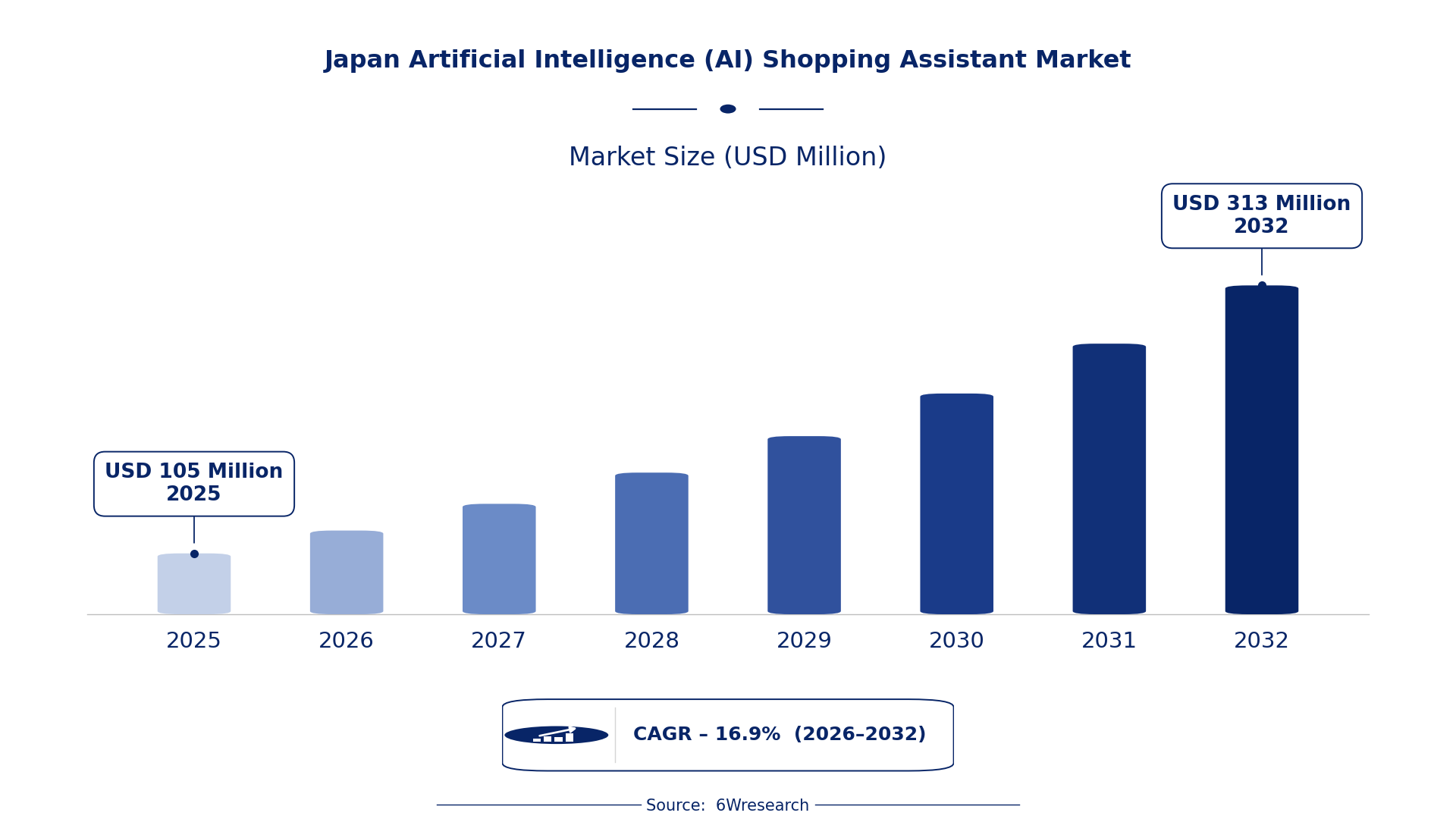
According to 6Wresearch internal database and industry insights, the Japan Artificial Intelligence (AI) Shopping Assistant Market was valued at USD 105 Million in 2025 and is projected to reach USD 313 Million by 2032, growing at a CAGR of approximately 16.9% during 2026–2032.
Japan Artificial Intelligence (AI) Shopping Assistant Market Highlights
| Report Metric | Details |
| Report Name | Japan Artificial Intelligence (AI) Shopping Assistant Market (2026-2032) |
| Market Size 2025 | USD 105 Million |
| Market Size 2032 | USD 313 Million |
| Absolute Growth 2025–2032 | USD 208 Million |
| CAGR 2026–2032 | 16.9% |
| Peak Annual Growth | 18.9% in 2026 |
| Forecast Period | 2026–2032 |
| Historical Data | 2022–2025 |
| Base Year | 2025 |
| Leading Technology Type, 2025 | Chatbot AI (39% share) |
| Leading Functionality, 2025 | Customer Assistance (44% share) |
| Leading Application Area, 2025 | E-commerce (40% share) |
| Leading Distribution Channel, 2025 | SaaS Platforms (39% share) |
| Leading End User, 2025 | Retailers (45% share) |
| Fastest-Growing Technology Type | Voice-enabled AI (19.6% CAGR) |
| Fastest-Growing Functionality | Personal Shopper (21.3% CAGR) |
| Fastest-Growing Application Area | Mobile Apps (20.5% CAGR) |
| Fastest-Growing Distribution Channel | Online Platforms (21.5% CAGR) |
| Fastest-Growing End User | Consumers (22.3% CAGR) |
| Growing Sector | E-commerce |
| Key End Users | Retailers, E-commerce Companies, Consumers, Retail Chains |
Japan Artificial Intelligence (AI) Shopping Assistant Market Year-wise Growth Rate and Key Drivers (2022–2032)
This graph illustrates the annual growth rates of the market from 2022 to 2032, highlighting a steady upward trajectory and projected market expansion over the forecast period.
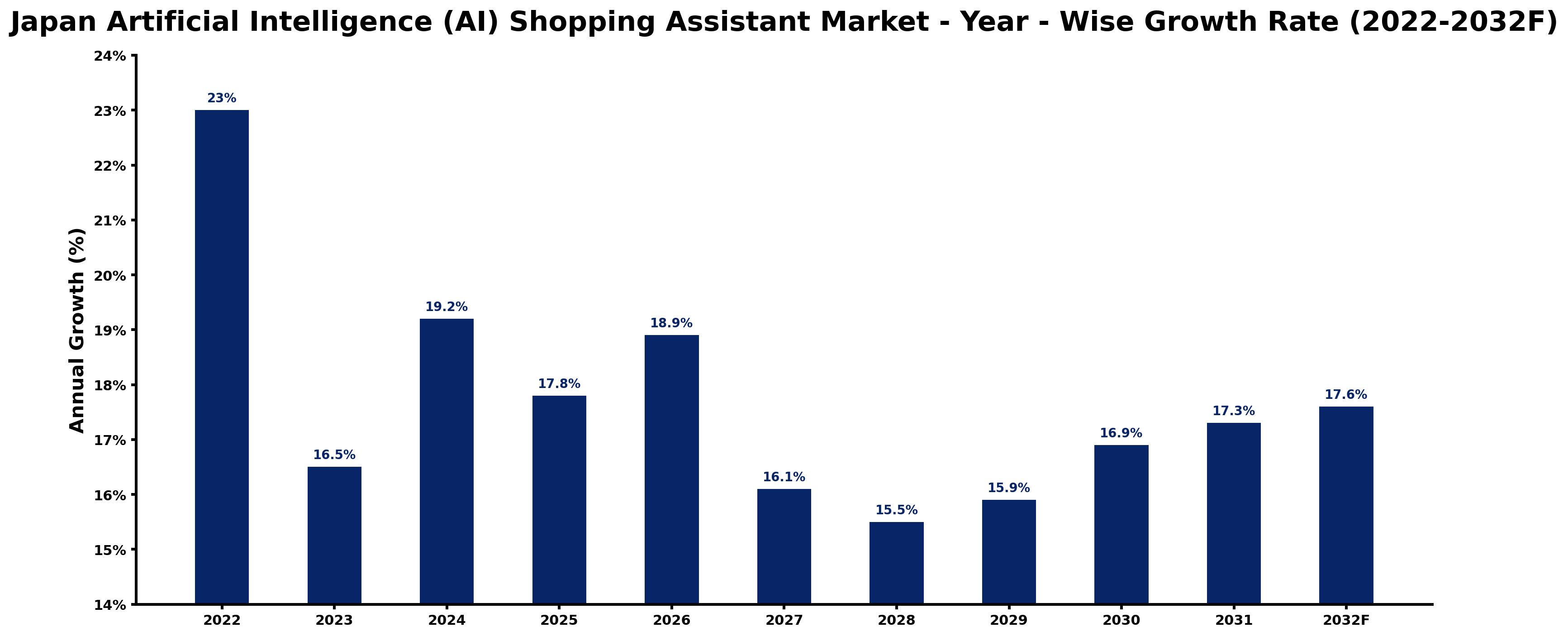
Year by year, the estimates below pair each growth rate with the development that shaped it.
| Year | Estimated Annual Growth (%) | Market Rationale |
| 2022 | 23.0 | The market experienced strong demand as e-commerce activities surged. |
| 2023 | 16.5 | Growth slowed due to market saturation and increased competition among platforms. |
| 2024 | 19.2 | An uptick in AI adoption by retailers drove faster growth this year. |
| 2025 | 17.8 | Growth slowed again as retailers adjusted strategies to integrate AI solutions. |
| 2026 | 18.9 | The introduction of new AI technologies is expected to lead to a spike in demand. |
| 2027 | 16.1 | Growth is projected to decelerate as the market begins to stabilise after rapid expansion. |
| 2028 | 15.5 | A continued focus on user experience is expected to keep demand steady, albeit slower. |
| 2029 | 15.9 | Growth is anticipated to accelerate again as more retailers embrace AI-driven solutions. |
| 2030 | 16.9 | Increased consumer engagement through AI tools is projected to spur further growth. |
| 2031 | 17.3 | The market is expected to maintain a positive trajectory as new technologies emerge. |
| 2032 | 17.6 | Sustained investment in AI technologies will continue to drive market expansion. |
Note: Market size estimations and growth projections presented in this report are based on 6Wresearch's proprietary forecasting methodology, utilizing the latest available industry data, government publications, and primary research inputs.
Japan Artificial Intelligence (AI) Shopping Assistant Market Synopsis
Artificial Intelligence (AI) Shopping Assistants are software applications that improve online shopping through automation and data analysis. They assist customers in product discovery, provide personalised recommendations, and analyse shopping behaviours. The Japan Artificial Intelligence (AI) Shopping Assistant Market is expanding due to the thriving e-commerce sector, with strong demand from both domestic users and international imports. The Japanese e-commerce market was valued at approximately 19 trillion JPY in 2022, and over 70% of consumers regularly use online shopping platforms, creating ample opportunities for AI integration in retail.
Market Dynamics Impact Analysis (2026–2032)
| Factor | Type | Impact | Primary Segment Affected |
| Growing e-commerce activities fuel demand for AI shopping assistants. | Driver | High | E-commerce |
| Retailers increasingly seek personalised shopping experiences for consumers. | Driver | High | Customer Assistance |
| The rise of mobile app usage creates a need for AI integration. | Opportunity | High | Mobile Apps |
| Retail chains are investing in AI to enhance customer engagement. | Opportunity | High | Retail Chains |
| Competition among AI providers may limit market entry for new players. | Restraint | Medium | SaaS Platforms |
| Consumer concerns about data privacy can hinder AI adoption. | Restraint | Medium | Analytics-driven AI |
| Limited awareness of AI capabilities may restrict retailer investment. | Challenge | Medium | Recommendation AI |
| High initial investment costs can deter smaller retailers from adopting AI. | Challenge | Medium | Chatbot AI |
Evaluation of Drivers in Japan Artificial Intelligence (AI) Shopping Assistant Market (2026–2032)
The table below links each growth driver to the segment it affects and the evidence for it.
| Drivers | Primary Segment Affected | Why It Matters (Evidence) |
| Increased investment in AI technologies by retailers drives demand for shopping assistants. | E-commerce | The Japanese e-commerce market was valued at approximately 19 trillion JPY in 2022, prompting retailers to adopt AI solutions. |
| Growing consumer expectations for personalised shopping experiences fuel AI adoption. | Customer Assistance | More than 70% of consumers in Japan use online shopping platforms regularly, increasing demand for tailored experiences. |
| The rise of mobile app users boosts the need for AI shopping assistants. | Mobile Apps | The number of mobile app users in Japan reached 81 million in 2023, creating a larger market for AI integration. |
| AI-driven product recommendations can increase sales for retailers. | Recommendation AI | AI-driven product recommendations can boost sales by up to 30%, encouraging retailers to invest in this technology. |
| Retail chains are integrating AI to improve customer engagement across multiple locations. | Retail Chains | Retail chains are increasingly adopting AI to improve customer experiences, resulting in higher sales and customer loyalty. |
A wider customer base explains much of the growth, as the Japanese e-commerce market was valued at approximately 19 trillion JPY in 2022, prompting retailers to adopt AI solutions. Consumer expectations for personalised shopping experiences are rising, leading to a higher demand for tailored interactions. The number of mobile app users in Japan reached 81 million in 2023, creating a larger market for AI integration. AI-driven product recommendations can boost sales by up to 30%, motivating retailers to invest in this technology. Retail chains are increasingly integrating AI to improve customer engagement, resulting in higher sales and customer loyalty.
Evaluation of Restraints in Japan Artificial Intelligence (AI) Shopping Assistant Market
The following restraints limit how fast demand can grow.
| Market Restraint | Primary Segment Affected | Why It Matters (Evidence) |
| Competition among AI providers may limit market entry for new players. | SaaS Platforms | The presence of established players creates barriers for new entrants, restricting market growth. |
| Consumer concerns about data privacy can hinder AI adoption. | Analytics-driven AI | Data privacy issues may create reluctance in implementing AI solutions, affecting sales. |
| Limited awareness of AI capabilities may restrict retailer investment. | Recommendation AI | Many retailers may not fully understand the benefits of AI, resulting in underinvestment. |
| High initial investment costs can deter smaller retailers from adopting AI. | Chatbot AI | Smaller retailers may find it challenging to allocate budgets for AI technologies, limiting growth. |
| Integration complexities can slow down AI implementation in retail. | Customer Assistance | Retailers may face technical challenges when integrating AI into existing systems, delaying adoption. |
Japan Artificial Intelligence (AI) Shopping Assistant Market Challenges
High development costs for AI shopping assistants burden producers, as initial investments can reach up to 19 trillion JPY. Skills shortages in machine learning and data analysis hinder producers' ability to innovate, delaying product launches for up to six months. Compliance with regulatory standards, such as ISO/IEC 27001, imposes additional costs on distributors, which can lead to increased prices for buyers. Technology integration issues affect buyers, as 40% of major retailers face challenges in implementing AI tools, resulting in lost sales opportunities and reduced customer satisfaction.
Trends in the Japan Artificial Intelligence (AI) Shopping Assistant Market
Buyers and suppliers in the Japan Artificial Intelligence (AI) Shopping Assistant Market are adjusting to the following trends.
- Shift towards Mobile AI Integration: In 2023, mobile app usage in Japan reached 81 million, driving the integration of AI shopping assistants. This trend is expected to increase AI adoption in mobile applications by 20% by 2026, improving user experiences.
- Surge in Personalised Shopping Experiences: The demand for personalised shopping experiences has surged, with 30% of retailers adopting AI-driven recommendations. This shift reflects changing consumer preferences, motivating retailers to invest in AI technologies.
- Growth of Voice-Enabled Shopping: Voice-enabled shopping is gaining traction, with 25% of consumers using it in 2023. This trend indicates a shift towards hands-free shopping experiences, prompting retailers to improve AI capabilities.
- Increased Focus on Data Security Standards: The adoption of ISO/IEC 27001 is becoming essential for AI systems in retail. This standard ensures data security and builds consumer trust, which is important for AI shopping assistants.
Investment Opportunities in the Japan Artificial Intelligence (AI) Shopping Assistant Market
Where to invest in the Japan Artificial Intelligence (AI) Shopping Assistant Market: the main openings are set out below.
- Gap in AI Integration for Retailers: With the Japanese e-commerce market valued at approximately 19 trillion JPY, there is a gap in AI integration. Retailers can invest in AI solutions to improve customer experiences and drive sales.
- Growing Demand for Mobile AI Solutions: The rise of mobile app users presents an opportunity for AI integration. Retailers can supply AI shopping assistants to enhance mobile shopping experiences, tapping into the 81 million mobile app users.
- Investment in AI-Driven Analytics Tools: Retailers are increasingly looking for analytics-driven AI tools to optimise offerings. This presents an opportunity for suppliers to develop and provide tailored AI solutions for the retail sector.
- Expansion of AI in Retail Chains: Retail chains are investing heavily in AI technologies to improve customer engagement. Suppliers can enter this market by partnering with retail chains to provide AI solutions.
Government Initiatives in the Japan Artificial Intelligence (AI) Shopping Assistant Market
The Digital Agency, established in September 2021, leads government digital transformation efforts and promotes AI adoption in retail. It oversees initiatives that improve the integration of AI technologies, ensuring that retailers can use these tools effectively. The agency allocated 5 billion JPY for AI technology development in retail in 2023, supporting various projects aimed at improving customer experiences through AI.
The Ministry of Economy, Trade and Industry promotes best practices in online retail through the Japan E-commerce Association. This agency oversees initiatives that encourage the adoption of AI technologies, ensuring that retailers comply with standards such as ISO/IEC 27001 for information security management. By funding training and development programs, the ministry aims to improve the capabilities of retailers in utilising AI shopping assistants.
Future Insight of the Japan Artificial Intelligence (AI) Shopping Assistant Market
The Japan AI Strategy will drive the rollout of AI technologies in retail by 2025, transforming customer interactions. By 2026, AI usage in mobile applications will grow by 20%, allowing suppliers to offer more customised services. Government funding of 5 billion JPY for AI development will encourage advancements in the sector. Buyers will experience improved shopping experiences and personalised recommendations, leading to greater engagement with online platforms.
Market Segmentation Analysis
Japan Artificial Intelligence (AI) Shopping Assistant Market report covers a detailed analysis of the following market segments:
By Technology Type – Chatbot AI Leads, Voice-enabled AI Expected to Grow Fastest
According to Ayushi Shukla, Senior Research Analyst at 6Wresearch, the largest technology type category in 2025 was Chatbot AI, at 39% of revenue. Chatbot technology holds the largest share due to its widespread adoption among retailers, providing automated customer support that enhances user engagement. For instance, over 60% of online retailers in Japan employ this technology to streamline customer interactions. Voice-enabled AI is projected to grow fastest, at a CAGR of 19.6% during 2026–2032. Voice-enabled technology is rapidly gaining traction as more consumers embrace hands-free shopping experiences, with 25% of users engaging with this feature in 2023. The integration of voice capabilities with existing technologies will further solidify the lead of chatbot solutions. Suppliers should focus on developing advanced chatbot solutions that incorporate voice functionalities to meet evolving consumer preferences.
By Functionality – Customer Assistance Leads, Personal Shopper Expected to Grow Fastest
Customer Assistance took 44% of functionality revenue in 2025, more than any other category. Customer Assistance is the leading functionality as it directly addresses customer inquiries and support needs, making it essential for retailers to improve service quality. This aligns with the high demand for automated solutions in the retail sector. Over 2026–2032, Personal Shopper is expected to post the fastest growth, at a CAGR of 21.3%. Personal Shopper functionality is experiencing rapid growth as it enhances user experience through tailored shopping assistance, appealing to consumers seeking personalised interactions. This growth complements existing customer assistance services, driving overall market expansion. Retailers must invest in personal shopper capabilities to attract and retain customers looking for customised shopping experiences.
By Application Area – E-commerce Leads, Mobile Apps Expected to Grow Fastest
E-commerce held 40% of the Japan Artificial Intelligence (AI) Shopping Assistant Market by application area in 2025. E-commerce is the dominant application area, utilising AI shopping assistants extensively to improve online shopping experiences, which is critical given the sector's valuation of approximately 19 trillion JPY in 2022. This sector is also supported by various government initiatives promoting AI adoption. Mobile Apps are set to record the highest CAGR in this split, 20.5% over 2026–2032. Mobile Apps are rapidly gaining traction as more consumers engage in shopping via their smartphones, with 81 million mobile app users recorded in 2023. The growth in mobile app usage will further drive the demand for AI integration in e-commerce. Developers should prioritise mobile app solutions that incorporate AI to capitalise on the increasing number of mobile shoppers.
By Distribution Channel – SaaS Platforms Lead, Online Platforms Expected to Grow Fastest
With 39% of distribution channel revenue in 2025, SaaS Platforms was the largest category. SaaS Platforms lead the distribution channel as they provide scalable solutions to retailers, facilitating easy integration into existing systems. This model allows retailers to access advanced technology without significant upfront investment. The quickest growth will come from Online Platforms, forecast to expand at a CAGR of 21.5% between 2026 and 2032. Online Platforms are witnessing the fastest growth as they host shopping assistants for various retailers, making it easier for consumers to access these technologies. The increasing number of online shoppers will further accelerate this trend. Retailers should consider partnerships with online platforms to enhance their offerings and reach a broader audience.
By End User – Retailers Lead, Consumers Expected to Grow Fastest
In 2025, Retailers led the end user split with a 45% share. Retailers represent the largest end-user group, as they directly implement shopping assistants to improve customer service and operational efficiency. This demand is driven by the competitive nature of the retail sector in Japan. Consumers are projected to grow fastest, at a CAGR of 22.3% during 2026–2032. Consumers are the fastest-growing end-user segment, benefiting from enhanced shopping experiences through advanced technologies. As retailers focus on customer satisfaction, the gap between retailer and consumer adoption will continue to narrow. Retailers must prioritise consumer feedback to refine solutions that meet their needs and preferences.
Key Attractiveness of the Report
- 10 Years of Market Numbers
- Historical Data Starting from 2022 to 2025
- Base Year 2025
- Forecast Data until 2032
- Key Performance Indicators Impacting the Market
- Major Upcoming Developments and Projects
Key Highlights of the Report:
- Japan Artificial Intelligence (AI) Shopping Assistant Market Outlook
- Market Size of Japan Artificial Intelligence (AI) Shopping Assistant Market, 2025
- Forecast of Japan Artificial Intelligence (AI) Shopping Assistant Market, 2032
- Historical Data and Forecast of Japan Artificial Intelligence (AI) Shopping Assistant Market Revenues & Volume for the Period 2022-2032F
- Japan Artificial Intelligence (AI) Shopping Assistant Market Trend Evolution
- Japan Artificial Intelligence (AI) Shopping Assistant Market Drivers and Challenges
- Japan Artificial Intelligence (AI) Shopping Assistant Market Price Trends
- Japan Artificial Intelligence (AI) Shopping Assistant Market Porter's Five Forces
- Japan Artificial Intelligence (AI) Shopping Assistant Market Industry Life Cycle
- Historical Data and Forecast of Japan Artificial Intelligence (AI) Shopping Assistant Market Revenues & Volume By Technology Type for the Period 2022-2032F
- Historical Data and Forecast of Japan Artificial Intelligence (AI) Shopping Assistant Market Revenues & Volume By Chatbot AI for the Period 2022-2032F
- Historical Data and Forecast of Japan Artificial Intelligence (AI) Shopping Assistant Market Revenues & Volume By Voice-enabled AI for the Period 2022-2032F
- Historical Data and Forecast of Japan Artificial Intelligence (AI) Shopping Assistant Market Revenues & Volume By Recommendation AI for the Period 2022-2032F
- Historical Data and Forecast of Japan Artificial Intelligence (AI) Shopping Assistant Market Revenues & Volume By Analytics-driven AI for the Period 2022-2032F
- Historical Data and Forecast of Japan Artificial Intelligence (AI) Shopping Assistant Market Revenues & Volume By Functionality for the Period 2022-2032F
- Historical Data and Forecast of Japan Artificial Intelligence (AI) Shopping Assistant Market Revenues & Volume By Customer Assistance for the Period 2022-2032F
- Historical Data and Forecast of Japan Artificial Intelligence (AI) Shopping Assistant Market Revenues & Volume By Personal Shopper for the Period 2022-2032F
- Historical Data and Forecast of Japan Artificial Intelligence (AI) Shopping Assistant Market Revenues & Volume By Product Suggestions for the Period 2022-2032F
- Historical Data and Forecast of Japan Artificial Intelligence (AI) Shopping Assistant Market Revenues & Volume By User Insights for the Period 2022-2032F
- Historical Data and Forecast of Japan Artificial Intelligence (AI) Shopping Assistant Market Revenues & Volume By Application Area for the Period 2022-2032F
- Historical Data and Forecast of Japan Artificial Intelligence (AI) Shopping Assistant Market Revenues & Volume By E-commerce for the Period 2022-2032F
- Historical Data and Forecast of Japan Artificial Intelligence (AI) Shopping Assistant Market Revenues & Volume By Mobile Apps for the Period 2022-2032F
- Historical Data and Forecast of Japan Artificial Intelligence (AI) Shopping Assistant Market Revenues & Volume By Online Stores for the Period 2022-2032F
- Historical Data and Forecast of Japan Artificial Intelligence (AI) Shopping Assistant Market Revenues & Volume By Shopping Behavior for the Period 2022-2032F
- Historical Data and Forecast of Japan Artificial Intelligence (AI) Shopping Assistant Market Revenues & Volume By Distribution Channel for the Period 2022-2032F
- Historical Data and Forecast of Japan Artificial Intelligence (AI) Shopping Assistant Market Revenues & Volume By SaaS Platforms for the Period 2022-2032F
- Historical Data and Forecast of Japan Artificial Intelligence (AI) Shopping Assistant Market Revenues & Volume By Online Platforms for the Period 2022-2032F
- Historical Data and Forecast of Japan Artificial Intelligence (AI) Shopping Assistant Market Revenues & Volume By Cloud Services for the Period 2022-2032F
- Historical Data and Forecast of Japan Artificial Intelligence (AI) Shopping Assistant Market Revenues & Volume By Enterprise Resellers for the Period 2022-2032F
- Historical Data and Forecast of Japan Artificial Intelligence (AI) Shopping Assistant Market Revenues & Volume By End User for the Period 2022-2032F
- Historical Data and Forecast of Japan Artificial Intelligence (AI) Shopping Assistant Market Revenues & Volume By Retailers for the Period 2022-2032F
- Historical Data and Forecast of Japan Artificial Intelligence (AI) Shopping Assistant Market Revenues & Volume By Consumers for the Period 2022-2032F
- Historical Data and Forecast of Japan Artificial Intelligence (AI) Shopping Assistant Market Revenues & Volume By Retail Chains for the Period 2022-2032F
- Historical Data and Forecast of Japan Artificial Intelligence (AI) Shopping Assistant Market Revenues & Volume By E-commerce Companies for the Period 2022-2032F
- Japan Artificial Intelligence (AI) Shopping Assistant Market Import Export Trade Statistics
- Market Opportunity Assessment By Technology Type
- Market Opportunity Assessment By Functionality
- Market Opportunity Assessment By Application Area
- Market Opportunity Assessment By Distribution Channel
- Market Opportunity Assessment By End User
- Japan Artificial Intelligence (AI) Shopping Assistant Market Top Companies Market Share
- Japan Artificial Intelligence (AI) Shopping Assistant Market Competitive Benchmarking By Technical and Operational Parameters
- Japan Artificial Intelligence (AI) Shopping Assistant Market Company Profiles
- Japan Artificial Intelligence (AI) Shopping Assistant Market Key Strategic Recommendations
Market Covered
Segments analysed in this report are listed below.
By Technology Type
- Chatbot AI
- Voice-enabled AI
- Recommendation AI
- Analytics-driven AI
By Functionality
- Customer Assistance
- Personal Shopper
- Product Suggestions
- User Insights
By Application Area
- E-commerce
- Mobile Apps
- Online Stores
- Shopping Behavior
By Distribution Channel
- SaaS Platforms
- Online Platforms
- Cloud Services
- Enterprise Resellers
By End User
- Retailers
- Consumers
- Retail Chains
- E-commerce Companies































