Japan Artificial Intelligence - Based Magnetic Resonance Imaging (MRI) Market Size & Growth Rate
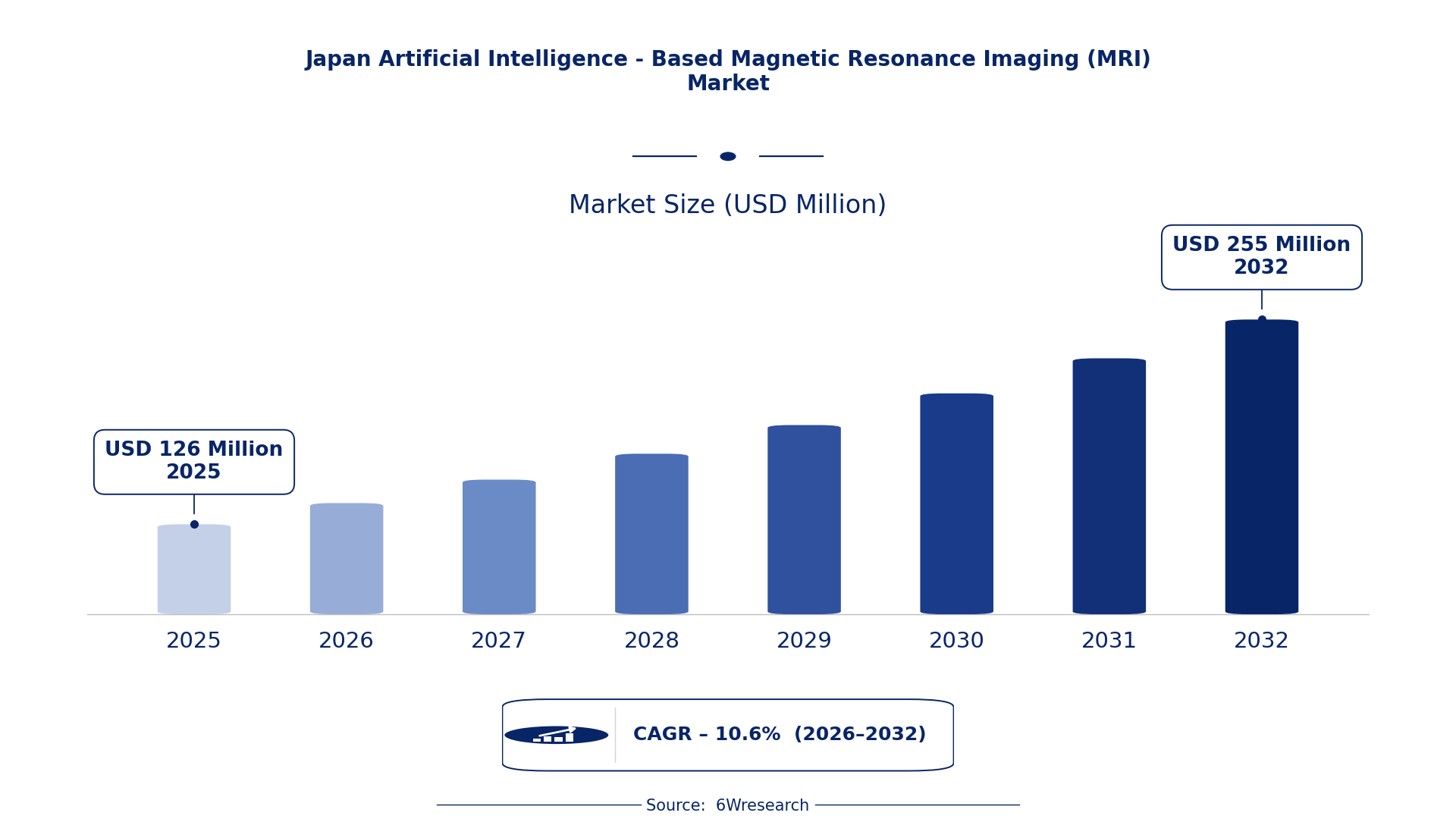
According to 6Wresearch internal database and industry insights, the Japan Artificial Intelligence - Based Magnetic Resonance Imaging (MRI) Market was valued at USD 126 Million in 2025 and is projected to reach USD 255 Million by 2032, growing at a CAGR of approximately 10.6% during 2026–2032.
Japan Artificial Intelligence - Based Magnetic Resonance Imaging (MRI) Market Highlights
| Report Metric | Details |
| Report Name | Japan Artificial Intelligence - Based Magnetic Resonance Imaging (MRI) Market (2026-2032) |
| Market Size 2025 | USD 126 Million |
| Market Size 2032 | USD 255 Million |
| Absolute Growth 2025–2032 | USD 129 Million |
| CAGR 2026–2032 | 10.6% |
| Peak Annual Growth | 12.0% in 2032 |
| Forecast Period | 2026–2032 |
| Historical Data | 2022–2025 |
| Base Year | 2025 |
| Leading Solution, 2025 | Hardware (48% share) |
| Leading Technology, 2025 | Speech Recognition (40% share) |
| Leading End User, 2025 | Hospitals (45% share) |
| Leading Deployment Type, 2025 | On-Premise (61% share) |
| Leading Clinical Application, 2025 | Breast (37% share) |
| Fastest-Growing Solution | Software (14.2% CAGR) |
| Fastest-Growing Technology | Querying Method (15.2% CAGR) |
| Fastest-Growing End User | Pharmaceutical Organizations (13.8% CAGR) |
| Fastest-Growing Deployment Type | Cloud (15.3% CAGR) |
| Fastest-Growing Clinical Application | Lung (15.0% CAGR) |
| Growing Sector | Healthcare |
| Key End Users | Hospitals, Diagnostic Centers, Clinics, Pharmaceutical Organizations |
Japan Artificial Intelligence - Based Magnetic Resonance Imaging (MRI) Market Year-wise Growth Rate and Key Drivers (2022–2032)
This graph illustrates the annual growth rates of the market from 2022 to 2032, highlighting a steady upward trajectory and projected market expansion over the forecast period.
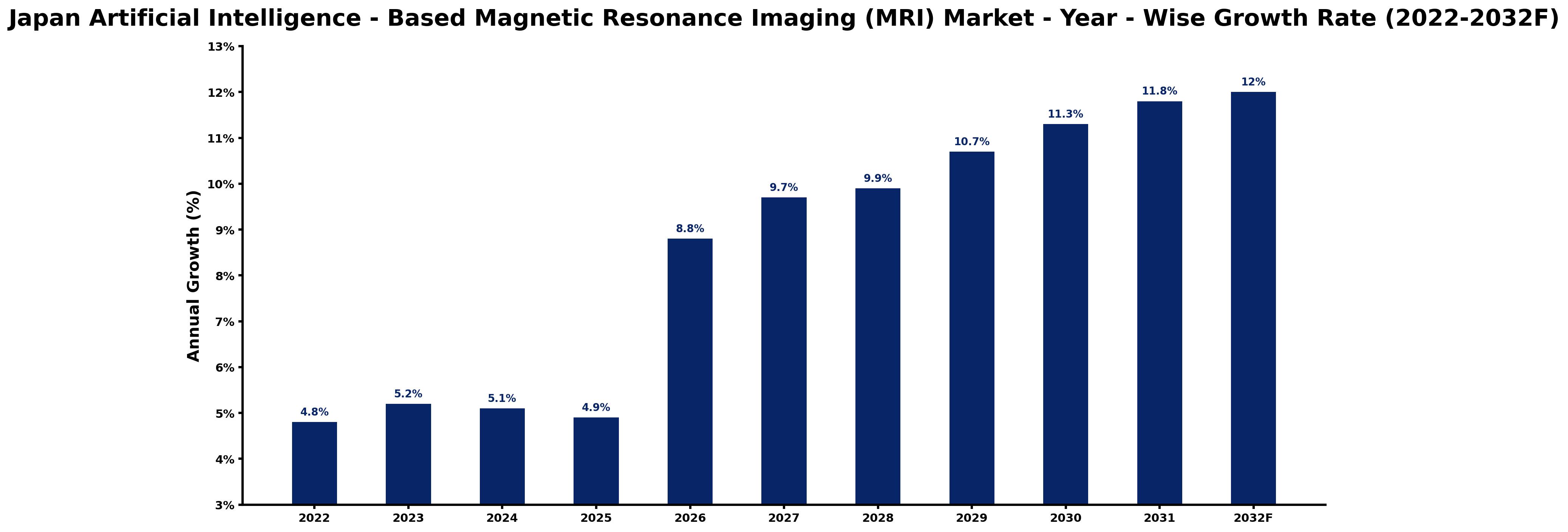
Year by year, the estimates below pair each growth rate with the development that shaped it.
| Year | Estimated Annual Growth (%) | Market Rationale |
| 2022 | 4.8 | The market showed steady growth due to ongoing investments in healthcare technology. |
| 2023 | 5.2 | Growth was faster than the previous year, driven by increased MRI usage in hospitals. |
| 2024 | 5.1 | Growth slowed slightly as facilities adjusted to new AI technologies and standards. |
| 2025 | 4.9 | A further slowdown occurred as market saturation began to impact new installations. |
| 2026 | 8.8 | Growth is expected to accelerate as healthcare facilities expand AI integration in imaging. |
| 2027 | 9.7 | Demand will continue to rise with advancements in diagnostic capabilities and technology. |
| 2028 | 9.9 | Growth is projected to remain strong as AI applications in MRI become more widespread. |
| 2029 | 10.7 | The market will see increased adoption of AI-based systems, improving diagnostic accuracy. |
| 2030 | 11.3 | Growth will continue as hospitals upgrade to newer MRI technologies and software. |
| 2031 | 11.8 | Demand is expected to rise further due to ongoing improvements in AI algorithms and imaging quality. |
| 2032 | 12.0 | The market is projected to peak in growth as AI-based MRI systems become standard in facilities. |
Note: Market size estimations and growth projections presented in this report are based on 6Wresearch's proprietary forecasting methodology, utilizing the latest available industry data, government publications, and primary research inputs.
Japan Artificial Intelligence - Based Magnetic Resonance Imaging (MRI) Market Synopsis
Artificial Intelligence-based Magnetic Resonance Imaging (MRI) utilises advanced algorithms integrated with traditional MRI hardware to improve diagnostic processes, particularly in neurology and oncology. The Japan Artificial Intelligence - Based Magnetic Resonance Imaging (MRI) Market is expanding due to substantial investments in advanced imaging technologies, with the healthcare sector investing 1.5 billion JPY in 2023. The Tokyo region accounts for 30% of MRI usage, reflecting strong demand from hospitals and diagnostic centres.
Market Dynamics Impact Analysis (2026–2032)
| Factor | Type | Impact | Primary Segment Affected |
| Increasing investment in advanced imaging technologies | Driver | High | Hardware |
| Growing adoption of AI in diagnostics | Driver | High | Software |
| Emerging demand for AI-enhanced diagnostic tools | Opportunity | High | Services |
| Expansion of certified diagnostic centers | Opportunity | High | Diagnostic Centers |
| High costs associated with AI integration | Restraint | High | Software |
| Limited availability of skilled professionals | Restraint | Medium | Services |
| Compliance with stringent medical device regulations | Challenge | High | Hardware |
| Capacity constraints in existing healthcare facilities | Challenge | Medium | Hospitals |
Evaluation of Drivers in Japan Artificial Intelligence - Based Magnetic Resonance Imaging (MRI) Market (2026–2032)
The main growth drivers and the segments they affect most are set out below.
| Drivers | Primary Segment Affected | Why It Matters (Evidence) |
| Increased healthcare spending | Hardware | Japan's healthcare sector invested 1.5 billion JPY in advanced imaging technologies in 2023. |
| Rising demand for accurate diagnostics | Software | AI-based MRI technology is expected to improve diagnostic accuracy by 25% by 2025. |
| Growing number of MRI scans performed | Services | Over 2 million MRI scans were reported annually in Japan's healthcare system in 2023. |
| Expansion of AI applications in diagnostics | Diagnostic Centers | There are 150 certified diagnostic centers using AI-based MRI in Japan as of 2023. |
| Technological advancements in MRI systems | Hardware | Machine Learning algorithms are used in 60% of new MRI systems introduced in Japan. |
The strongest pull on demand comes from hospitals seeking improved diagnostic capabilities, with over 2 million MRI scans performed annually in Japan. The healthcare sector's investment of 1.5 billion JPY in advanced imaging technologies in 2023 demonstrates a commitment to improving patient outcomes. AI-based MRI technology is projected to improve diagnostic accuracy by 25% by 2025, prompting healthcare facilities to adopt these systems. The presence of 150 certified diagnostic centers using AI-based MRI contributes to demand, as does the integration of advanced algorithms in new MRI systems. This combination of factors drives hospitals to invest in advanced MRI solutions to meet patient needs.
Evaluation of Restraints in Japan Artificial Intelligence - Based Magnetic Resonance Imaging (MRI) Market
Several factors work against faster growth; the main ones are summarised below.
| Market Restraint | Primary Segment Affected | Why It Matters (Evidence) |
| High costs of AI integration | Software | The integration of AI technologies into MRI systems requires substantial financial investment, limiting adoption. |
| Shortage of skilled professionals | Services | The limited availability of trained personnel in AI and imaging technologies hampers service delivery. |
| Compliance with medical device regulations | Hardware | Strict regulations necessitate extensive testing and certification, delaying product availability. |
| Maintenance costs for advanced systems | Diagnostic Centers | Ongoing maintenance for AI-based MRI systems can be costly, affecting operational budgets. |
| Market saturation in urban areas | Hospitals | In densely populated regions, existing facilities may limit new installations, slowing growth. |
Japan Artificial Intelligence - Based Magnetic Resonance Imaging (MRI) Market Challenges
Strict adherence to ISO 13485 complicates the manufacturing process for MRI systems, resulting in delays in product availability for suppliers. Buyers face high costs as the average wait time for an MRI scan in urban areas is currently two weeks, potentially worsening patient outcomes. Technology adoption is uneven; only 40% of AI-based MRI systems utilise Natural Language Processing, which restricts diagnostic efficiency for clinics. Intense competition exists with over 800 MRI machines installed, leading to pricing pressures that can erode profit margins for producers.
Trends in the Japan Artificial Intelligence - Based Magnetic Resonance Imaging (MRI) Market
Below are the shifts with the largest effect on the Japan Artificial Intelligence - Based Magnetic Resonance Imaging (MRI) Market.
- Shift Towards AI-Driven Diagnostics: Hospitals are increasingly adopting AI-driven MRI systems, with 150 certified diagnostic centers using this technology in Japan. This shift is driven by the need for improved diagnostic accuracy, with AI expected to improve it by 25% by 2025.
- Growing Use of Machine Learning in MRI: Machine Learning algorithms are now integrated into 60% of new MRI systems introduced in Japan. This trend reflects the industry's focus on adopting AI to improve imaging capabilities and diagnostic processes.
- Expansion of AI Applications in Healthcare: The Tokyo Medical University is conducting research on AI applications in MRI diagnostics, highlighting a growing focus on integrating AI in medical imaging. This research supports the increasing adoption of AI technologies across the healthcare sector.
- Increase in MRI Scan Volume: In 2023, Japan's healthcare system reported over 2 million MRI scans performed annually, indicating a rising demand for MRI services. This trend underscores the importance of investing in advanced imaging technologies.
Investment Opportunities in the Japan Artificial Intelligence - Based Magnetic Resonance Imaging (MRI) Market
Where to invest in the Japan Artificial Intelligence - Based Magnetic Resonance Imaging (MRI) Market: the main openings are set out below.
- Partnerships for AI Integration: Now is an ideal time for joint ventures focusing on AI integration in MRI systems, as Japan's healthcare sector invested 1.5 billion JPY in advanced imaging technologies in 2023. Collaborating with hospitals can facilitate market entry.
- Investment in Diagnostic Centers: With 150 certified diagnostic centres using AI-based MRI, there is a strong opportunity for investment in these facilities. Establishing partnerships with local healthcare providers can enhance service offerings.
- Focus on Cloud-Based Solutions: The emerging trend of cloud deployment in MRI systems presents an opportunity, with a projected growth rate of 15.3% for cloud solutions. This shift allows for better data management and accessibility in hospitals.
- Enhancing AI Capabilities: The growing demand for AI-driven diagnostic tools creates an opportunity to invest in software development. The Economic Security Promotion Act aims to support AI integration in medical imaging by 2024.
Government Initiatives in the Japan Artificial Intelligence - Based Magnetic Resonance Imaging (MRI) Market
The Long-Term Care Insurance Act, in force since 2000, supports funding for nursing care and services for the elderly, impacting the demand for advanced imaging technologies in healthcare facilities. Additionally, the Economic Security Promotion Act, adopted in 2022, promotes supply-chain resilience for critical healthcare products, which includes MRI systems.
The Ministry of Health, Labour and Welfare oversees the implementation of the Economic Security Promotion Act, which encourages hospitals to adopt AI technologies. This program has allocated 500 million JPY for AI healthcare initiatives in 2024, enabling healthcare providers to improve their imaging capabilities.
Future Insight of the Japan Artificial Intelligence - Based Magnetic Resonance Imaging (MRI) Market
The 'AI Health Strategy' program will facilitate the integration of AI in imaging technologies, creating new opportunities for suppliers and improving access for buyers. By 2032, AI-based MRI technology is expected to improve diagnostic accuracy by 25%, streamlining processes for healthcare facilities. The Japanese government's allocation of 500 million JPY for AI healthcare initiatives in 2024 will drive technological advancements. Research initiatives from Tokyo Medical University will contribute to the development of innovative practices in MRI diagnostics.
Market Segmentation Analysis
Japan Artificial Intelligence - Based Magnetic Resonance Imaging (MRI) Market report covers a detailed analysis of the following market segments:
By Solution – Hardware Leads, Software Expected to Grow Fastest
According to Vasudha, AM at 6Wresearch, Hardware accounted for 48% of the market by solution in 2025. The hardware segment dominates the market as it is essential for MRI operations, with over 800 MRI machines installed across Japan's healthcare facilities. This extensive installed base ensures a steady demand for hardware components necessary for effective imaging processes. Software is set to record the highest CAGR in this split, 14.2% over 2026–2032. Software is experiencing rapid growth due to its critical role in enhancing diagnostic processes, with 150 certified diagnostic centers utilising advanced imaging technologies. This trend indicates a growing reliance on software solutions to improve imaging quality and efficiency. Suppliers should focus on developing advanced software solutions to meet the increasing demand for integration in MRI systems.
By Technology – Speech Recognition Leads, Querying Method Expected to Grow Fastest
The largest technology category in 2025 was Speech Recognition, at 40% of revenue. Speech recognition technology leads the market, primarily used in specific applications within MRI diagnostics, demonstrating its established presence in the sector. Its integration into existing systems enhances operational efficiency across various healthcare facilities. Over 2026–2032, Querying Method is expected to post the fastest growth, at a CAGR of 15.2%. The querying method is witnessing the fastest growth as it supports efficient data retrieval, which is crucial for improving workflows in healthcare environments. This method's adoption aligns with the rising necessity for streamlined data access in medical imaging. Providers of querying solutions should target the growing demand for efficient data management in MRI applications.
By End User – Hospitals Lead, Pharmaceutical Organizations Expected to Grow Fastest
Hospitals took 45% of end user revenue in 2025, more than any other category. Hospitals are the primary users of MRI technology, accounting for the majority of over 2 million MRI scans performed annually in Japan. Their significant investment in advanced imaging technologies drives the demand for AI-based MRI solutions. Pharmaceutical Organizations are projected to grow fastest, at a CAGR of 13.8% during 2026–2032. Pharmaceutical organizations are the fastest-growing end user segment, leveraging MRI for research purposes, which is increasingly vital in drug development. This trend reflects a broader shift towards integrating imaging technologies within pharmaceutical research. Suppliers should consider targeting pharmaceutical organizations to expand their market reach and explore new revenue opportunities.
By Deployment Type – On-Premise Leads, Cloud Expected to Grow Fastest
On-Premise held 61% of the Japan Artificial Intelligence - Based Magnetic Resonance Imaging (MRI) Market by deployment type in 2025. On-premise deployment leads the market as it is the most common setup in hospitals, providing direct control over MRI operations and data management. This preference is driven by the need for immediate access to imaging capabilities within healthcare facilities. The quickest growth will come from Cloud, forecast to expand at a CAGR of 15.3% between 2026 and 2032. Cloud deployment is emerging as the fastest-growing type, offering scalable data storage solutions that align with the increasing volume of imaging data generated. This shift indicates a trend towards more flexible and accessible data management options in healthcare. Vendors should invest in cloud-based solutions to meet the rising demand for scalable and efficient data storage in the MRI sector.
By Clinical Application – Breast Leads, Lung Expected to Grow Fastest
In 2025, Breast led the clinical application split with a 37% share. The breast application leads the clinical segment due to its specific focus on breast imaging, a critical area in diagnostics. This targeted approach has resulted in strong demand for enhanced MRI capabilities in this field. Lung is set to record the highest CAGR in this split, 15.0% over 2026–2032. Lung applications are growing the fastest, reflecting a heightened emphasis on lung health and early disease detection, such as lung cancer. This trend is supported by ongoing research and advancements in imaging technologies that focus on lung diagnostics. Suppliers should prioritise the development of solutions tailored for lung imaging to capitalise on this expanding clinical focus.
Key Attractiveness of the Report
- 10 Years of Market Numbers
- Historical Data Starting from 2022 to 2025
- Base Year 2025
- Forecast Data until 2032
- Key Performance Indicators Impacting the Market
- Major Upcoming Developments and Projects
Key Highlights of the Report:
- Japan Artificial Intelligence - Based Magnetic Resonance Imaging (MRI) Market Outlook
- Market Size of Japan Artificial Intelligence - Based Magnetic Resonance Imaging (MRI) Market, 2025
- Forecast of Japan Artificial Intelligence - Based Magnetic Resonance Imaging (MRI) Market, 2032
- Historical Data and Forecast of Japan Artificial Intelligence - Based Magnetic Resonance Imaging (MRI) Revenues & Volume for the Period 2022-2032
- Japan Artificial Intelligence - Based Magnetic Resonance Imaging (MRI) Market Trend Evolution
- Japan Artificial Intelligence - Based Magnetic Resonance Imaging (MRI) Market Drivers and Challenges
- Japan Artificial Intelligence - Based Magnetic Resonance Imaging (MRI) Price Trends
- Japan Artificial Intelligence - Based Magnetic Resonance Imaging (MRI) Porter's Five Forces
- Japan Artificial Intelligence - Based Magnetic Resonance Imaging (MRI) Industry Life Cycle
- Historical Data and Forecast of Japan Artificial Intelligence - Based Magnetic Resonance Imaging (MRI) Market Revenues & Volume By Solution for the Period 2022-2032
- Historical Data and Forecast of Japan Artificial Intelligence - Based Magnetic Resonance Imaging (MRI) Market Revenues & Volume By Hardware for the Period 2022-2032
- Historical Data and Forecast of Japan Artificial Intelligence - Based Magnetic Resonance Imaging (MRI) Market Revenues & Volume By Software for the Period 2022-2032
- Historical Data and Forecast of Japan Artificial Intelligence - Based Magnetic Resonance Imaging (MRI) Market Revenues & Volume By Services for the Period 2022-2032
- Historical Data and Forecast of Japan Artificial Intelligence - Based Magnetic Resonance Imaging (MRI) Market Revenues & Volume By Technology for the Period 2022-2032
- Historical Data and Forecast of Japan Artificial Intelligence - Based Magnetic Resonance Imaging (MRI) Market Revenues & Volume By Speech Recognition for the Period 2022-2032
- Historical Data and Forecast of Japan Artificial Intelligence - Based Magnetic Resonance Imaging (MRI) Market Revenues & Volume By Querying Method for the Period 2022-2032
- Historical Data and Forecast of Japan Artificial Intelligence - Based Magnetic Resonance Imaging (MRI) Market Revenues & Volume By Natural Language Processing for the Period 2022-2032
- Historical Data and Forecast of Japan Artificial Intelligence - Based Magnetic Resonance Imaging (MRI) Market Revenues & Volume By Machine Learning for the Period 2022-2032
- Historical Data and Forecast of Japan Artificial Intelligence - Based Magnetic Resonance Imaging (MRI) Market Revenues & Volume By Context Aware Processing for the Period 2022-2032
- Historical Data and Forecast of Japan Artificial Intelligence - Based Magnetic Resonance Imaging (MRI) Market Revenues & Volume By End User for the Period 2022-2032
- Historical Data and Forecast of Japan Artificial Intelligence - Based Magnetic Resonance Imaging (MRI) Market Revenues & Volume By Hospitals for the Period 2022-2032
- Historical Data and Forecast of Japan Artificial Intelligence - Based Magnetic Resonance Imaging (MRI) Market Revenues & Volume By Pharmaceutical Organizations for the Period 2022-2032
- Historical Data and Forecast of Japan Artificial Intelligence - Based Magnetic Resonance Imaging (MRI) Market Revenues & Volume By Diagnostic Centers for the Period 2022-2032
- Historical Data and Forecast of Japan Artificial Intelligence - Based Magnetic Resonance Imaging (MRI) Market Revenues & Volume By Clinics for the Period 2022-2032
- Historical Data and Forecast of Japan Artificial Intelligence - Based Magnetic Resonance Imaging (MRI) Market Revenues & Volume By Deployment Type for the Period 2022-2032
- Historical Data and Forecast of Japan Artificial Intelligence - Based Magnetic Resonance Imaging (MRI) Market Revenues & Volume By On-Premise for the Period 2022-2032
- Historical Data and Forecast of Japan Artificial Intelligence - Based Magnetic Resonance Imaging (MRI) Market Revenues & Volume By Cloud for the Period 2022-2032
- Historical Data and Forecast of Japan Artificial Intelligence - Based Magnetic Resonance Imaging (MRI) Market Revenues & Volume By Clinical Application for the Period 2022-2032
- Historical Data and Forecast of Japan Artificial Intelligence - Based Magnetic Resonance Imaging (MRI) Market Revenues & Volume By Breast for the Period 2022-2032
- Historical Data and Forecast of Japan Artificial Intelligence - Based Magnetic Resonance Imaging (MRI) Market Revenues & Volume By Lung for the Period 2022-2032
- Historical Data and Forecast of Japan Artificial Intelligence - Based Magnetic Resonance Imaging (MRI) Market Revenues & Volume By Neurology for the Period 2022-2032
- Historical Data and Forecast of Japan Artificial Intelligence - Based Magnetic Resonance Imaging (MRI) Market Revenues & Volume By Cardiovascular for the Period 2022-2032
- Historical Data and Forecast of Japan Artificial Intelligence - Based Magnetic Resonance Imaging (MRI) Market Revenues & Volume By Liver for the Period 2022-2032
- Historical Data and Forecast of Japan Artificial Intelligence - Based Magnetic Resonance Imaging (MRI) Market Revenues & Volume By Prostate for the Period 2022-2032
- Historical Data and Forecast of Japan Artificial Intelligence - Based Magnetic Resonance Imaging (MRI) Market Revenues & Volume By Colon for the Period 2022-2032
- Japan Artificial Intelligence - Based Magnetic Resonance Imaging (MRI) Import Export Trade Statistics
- Market Opportunity Assessment By Solution
- Market Opportunity Assessment By Technology
- Market Opportunity Assessment By End User
- Market Opportunity Assessment By Deployment Type
- Market Opportunity Assessment By Clinical Application
- Japan Artificial Intelligence - Based Magnetic Resonance Imaging (MRI) Top Companies Market Share
- Japan Artificial Intelligence - Based Magnetic Resonance Imaging (MRI) Competitive Benchmarking By Technical and Operational Parameters
- Japan Artificial Intelligence - Based Magnetic Resonance Imaging (MRI) Company Profiles
- Japan Artificial Intelligence - Based Magnetic Resonance Imaging (MRI) Key Strategic Recommendations
Market Covered
The following segment groups are covered in the report.
By Solution
- Hardware
- Software
- Services
By Technology
- Speech Recognition
- Querying Method
- Natural Language Processing
- Machine Learning
- Context Aware Processing
By End User
- Hospitals
- Pharmaceutical Organizations
- Diagnostic Centers
- Clinics
By Deployment Type
- On-Premise
- Cloud
By Clinical Application
- Breast
- Lung
- Neurology
- Cardiovascular
- Liver
- Prostate
- Colon































