Japan Artificial Intelligence in Military Market Size & Growth Rate
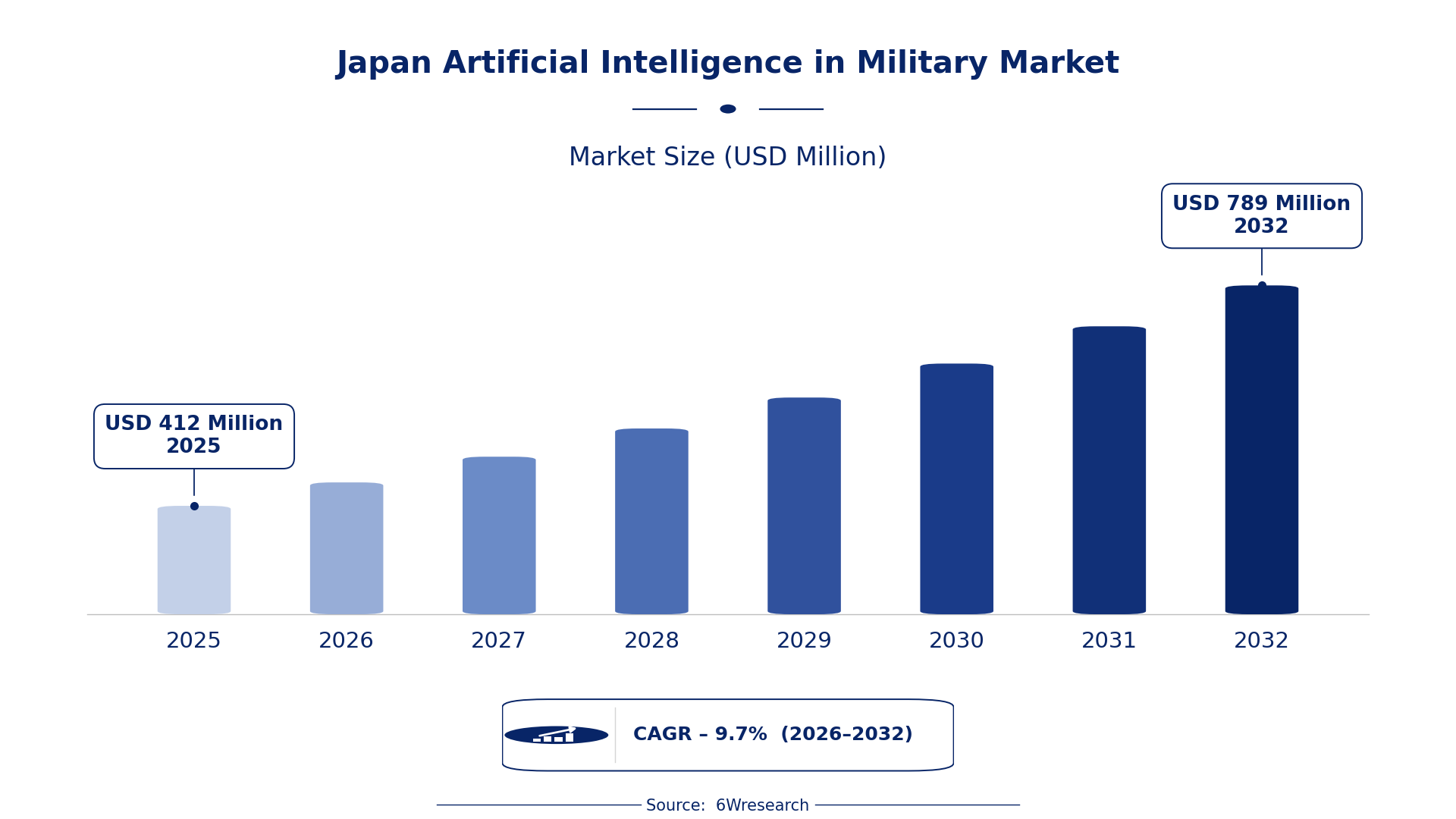
According to 6Wresearch internal database and industry insights, the Japan Artificial Intelligence in Military Market was valued at USD 412 Million in 2025 and is projected to reach USD 789 Million by 2032, growing at a CAGR of approximately 9.7% during 2026–2032.
Japan Artificial Intelligence in Military Market Highlights
| Report Metric | Details |
| Report Name | Japan Artificial Intelligence in Military Market (2026-2032) |
| Market Size 2025 | USD 412 Million |
| Market Size 2032 | USD 789 Million |
| Absolute Growth 2025–2032 | USD 377 Million |
| CAGR 2026–2032 | 9.7% |
| Peak Annual Growth | 11.1% in 2029 |
| Forecast Period | 2026–2032 |
| Historical Data | 2022–2025 |
| Base Year | 2025 |
| Leading Offering, 2025 | Software (47% share) |
| Leading Technology, 2025 | Machine Learning (60% share) |
| Leading Installation, 2025 | New Procurement (58% share) |
| Leading Application, 2025 | Warfare Platform (41% share) |
| Fastest-Growing Offering | Hardware (13.3% CAGR) |
| Fastest-Growing Technology | Computer vision (12.8% CAGR) |
| Fastest-Growing Installation | Upgradation (11.8% CAGR) |
| Fastest-Growing Application | Cyber Security (13.5% CAGR) |
| Growing Sector | defense technology |
| Key End Users | government agencies, military contractors, defense technology firms |
Japan Artificial Intelligence in Military Market Year-wise Growth Rate and Key Drivers (2022–2032)
This graph illustrates the annual growth rates of the market from 2022 to 2032, highlighting a steady upward trajectory and projected market expansion over the forecast period.
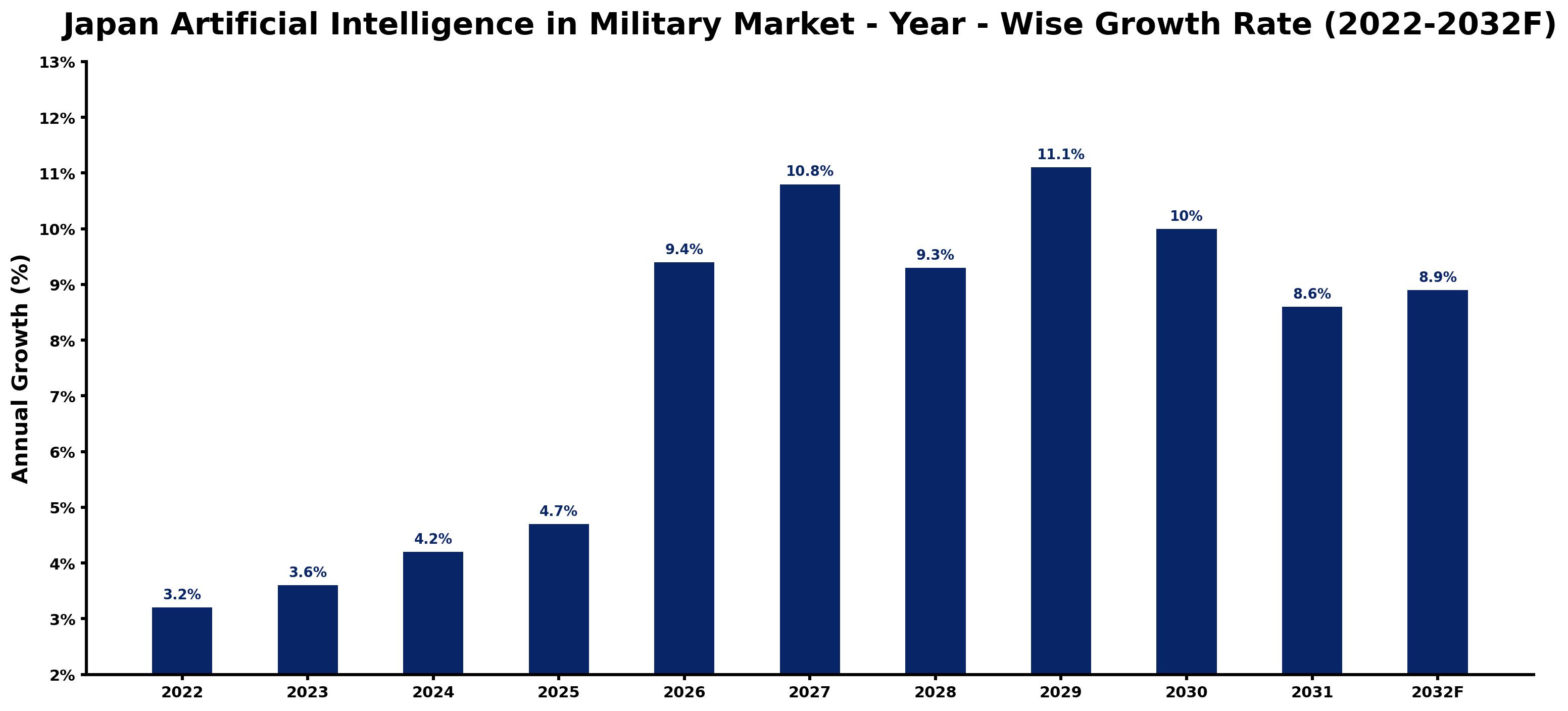
For each year, the table pairs the estimated growth rate with the leading influence on demand, showing how the drivers changed across the period.
| Year | Estimated Annual Growth (%) | Market Rationale |
| 2022 | 3.2 | The market showed steady growth as military operations continued to modernise. |
| 2023 | 3.6 | Demand increased due to heightened investments in technological advancements. |
| 2024 | 4.2 | Growth accelerated as the government initiated new AI integration programmes. |
| 2025 | 4.7 | The market peaked historically as defence budgets expanded. |
| 2026 | 9.4 | Demand is expected to rise sharply with the focus on logistics integration. |
| 2027 | 10.8 | Growth is projected to continue as military applications of AI gain traction in various sectors. |
| 2028 | 9.3 | The market experiences a slowdown as growth rates normalise after rapid expansion. |
| 2029 | 11.1 | A peak annual growth is anticipated as new technologies are adopted widely. |
| 2030 | 10.0 | Growth slows slightly as market conditions stabilise after peak years. |
| 2031 | 8.6 | Demand continues to rise, driven by ongoing investments in military AI. |
| 2032 | 8.9 | The market is set to grow as AI capabilities in defence applications advance. |
Note: Market size estimations and growth projections presented in this report are based on 6Wresearch's proprietary forecasting methodology, utilizing the latest available industry data, government publications, and primary research inputs.
Japan Artificial Intelligence in Military Market Synopsis
Artificial Intelligence in Military involves the application of advanced algorithms and machine learning to improve military operations, including decision-making, surveillance, and logistics. The Japan Artificial Intelligence in Military Market is expanding due to increased defence budgets, which reached approximately ¥6.8 trillion in 2023, and government initiatives aimed at modernising military capabilities. The Ministry of Defense's programme to integrate AI in logistics by 2025 reflects the growing demand for AI technologies in the military sector, indicating a commitment to improving operational efficiency and effectiveness.
Market Dynamics Impact Analysis (2026–2032)
| Factor | Type | Impact | Primary Segment Affected |
| Increased defence budget allocations drive demand for advanced technologies. | Driver | High | New Procurement |
| Growing reliance on AI for surveillance and reconnaissance enhances operational efficiency. | Driver | High | Surveillance & Situational Awareness |
| Emerging opportunities in AI-driven cybersecurity solutions attract investments. | Opportunity | High | Cyber Security |
| The rising need for advanced training simulations presents a gap in the market. | Opportunity | Medium | Simulation & Training |
| High costs associated with AI implementation can deter smaller defence contractors. | Restraint | High | Services |
| Limited availability of skilled personnel in AI technologies hinders growth. | Restraint | Medium | Software |
| Compliance with stringent cybersecurity regulations can complicate procurement processes. | Challenge | High | Hardware |
| Capacity constraints in domestic production may delay technology adoption. | Challenge | Medium | Machine Learning |
Evaluation of Drivers in Japan Artificial Intelligence in Military Market (2026–2032)
The factors lifting demand, and the evidence behind each, are summarised below.
| Drivers | Primary Segment Affected | Why It Matters (Evidence) |
| Increased defence spending supports technology procurement. | New Procurement | Japan's defence budget for 2023 is approximately ¥6.8 trillion, driving demand for advanced military technologies. |
| AI improves operational efficiency in surveillance. | Surveillance & Situational Awareness | Investments in AI for surveillance operations improve intelligence gathering capabilities for the Self-Defense Forces. |
| The government aims to boost AI capabilities by 2025. | Services | The Ministry of Defense's programme to integrate AI in logistics by 2025 drives demand for implementation services. |
| Machine learning is vital for predictive analytics. | Machine Learning | Applications in battlefield simulations are essential for training military personnel effectively. |
| Cybersecurity measures are important for military data protection. | Cyber Security | ISO/IEC 27001 is a standard relevant for cybersecurity measures in military applications, driving demand for compliance. |
Several shifts outside the market lift sales. Japan's defence budget for 2023 is approximately ¥6.8 trillion, which supports technology procurement and drives demand for advanced military capabilities. Investment in AI for surveillance operations improves intelligence gathering. Applications in battlefield simulations are vital for training personnel, reflecting a commitment to operational readiness. Compliance with ISO/IEC 27001 standards for cybersecurity measures drives demand for AI solutions in military applications.
Evaluation of Restraints in Japan Artificial Intelligence in Military Market
Several factors work against faster growth; the main ones are summarised below.
| Market Restraint | Primary Segment Affected | Why It Matters (Evidence) |
| High implementation costs deter smaller contractors from entering the market. | Services | The cost of adopting AI technologies can be prohibitive for smaller defence contractors, limiting market participation. |
| Limited skilled workforce hampers AI technology adoption. | Software | The shortage of skilled personnel in AI technologies restricts the capacity to implement advanced solutions. |
| Stringent cybersecurity regulations complicate procurement processes. | Hardware | Compliance with regulations such as ISO/IEC 27001 can delay the acquisition of necessary technologies. |
| Capacity constraints in domestic production may slow technology adoption. | Machine Learning | Limited production capabilities can hinder the timely implementation of AI technologies in military applications. |
| Market entry barriers exist due to high initial investment requirements. | New Procurement | The need for substantial upfront investments can deter new entrants from pursuing opportunities in the market. |
Japan Artificial Intelligence in Military Market Challenges
Japan's military operations face supply chain issues as local producers struggle to provide advanced AI technologies, delaying projects and increasing costs for defence agencies. Limited technological infrastructure hampers the integration of AI in logistics, pushing back the Ministry of Defense's 2025 target and affecting operational readiness. Buyers encounter difficulties in sourcing reliable AI solutions, resulting in procurement processes that can extend project timelines by up to six months. Foreign competition raises costs for local buyers, forcing them to navigate complex supply chains and impacting their ability to modernise effectively.
Trends in the Japan Artificial Intelligence in Military Market
The trends below show where the Japan Artificial Intelligence in Military Market is heading.
- Shift from Traditional to AI-Driven Surveillance: In 2023, the Self-Defense Forces began integrating AI into surveillance operations, improving real-time intelligence gathering. This shift is expected to increase operational efficiency, supported by a projected budget of ¥6.8 trillion for defence.
- Emergence of AI in Logistics: Starting in 2025, the Ministry of Defense's programme to integrate AI in logistics is transforming supply chain management. This initiative aims to streamline operations, supported by a budget allocation of approximately ¥6.8 trillion.
- Growing Focus on Cybersecurity in Military: The establishment of the Cyber Defense Unit in 2020 marked a critical shift towards prioritising cybersecurity measures. This unit protects military data, aligning with ISO/IEC 27001 standards for compliance.
- Increased Investment in AI Training Simulations: The National Institute of Defense Studies has been utilising machine learning for battlefield simulations since 2023. This investment supports effective training for military personnel, reflecting a commitment to advanced operational readiness.
Investment Opportunities in the Japan Artificial Intelligence in Military Market
Where to invest in the Japan Artificial Intelligence in Military Market: the main openings are set out below.
- Collaborative Ventures for AI Implementation: Forming partnerships with local technology firms can bridge the gap in AI implementation. With Japan's defence budget at approximately ¥6.8 trillion, there is an opportunity for collaborations in the military sector.
- Growing Market for Cybersecurity Solutions: The rising need for AI-driven cybersecurity solutions creates a market gap. With the Cyber Defense Unit established in 2020, there is a growing demand for advanced cybersecurity measures in military applications.
- Investment in AI Training Simulations: Now is the time to invest in AI-driven training simulations, as military readiness is a priority. The National Institute of Defense Studies' focus on machine learning presents opportunities for suppliers.
- Exploring New Procurement Opportunities: The ongoing modernisation of military capabilities creates opportunities for new procurement. With a defence budget of ¥6.8 trillion, suppliers can enter the market through joint ventures or local partnerships.
Government Initiatives in the Japan Artificial Intelligence in Military Market
The Long-Term Care Insurance Act (1997) and the Industrial Safety and Health Act (1972) set the framework for funding and safety regulations in military operations. These measures require producers to adhere to strict guidelines, ensuring that AI technologies meet safety and operational standards.
The Cyber Defense Unit, established in 2020, supports projects that improve military cybersecurity capabilities, ensuring that buyers can access advanced protective measures. The Ministry of Defense oversees various funding initiatives that facilitate the integration of AI in military applications.
Future Insight of the Japan Artificial Intelligence in Military Market
By 2032, the integration of AI in logistics will significantly improve operational efficiency, driven by the Ministry of Defense's programme. Cybersecurity measures from the Cyber Defense Unit will safeguard sensitive data. Research facilities in Tokyo will collaborate with startups to innovate AI applications for surveillance. Funding for AI research will facilitate the development of advanced technologies, leading to improved decision-making processes and more effective strategies.
Market Segmentation Analysis
Japan Artificial Intelligence in Military Market report covers a detailed analysis of the following market segments:
By Offering – Software Leads, Hardware Expected to Grow Fastest
According to Shubham Deep, Research Manager at 6Wresearch, with 47% of offering revenue in 2025, Software was the largest category. Software holds the largest share as it is crucial for data analysis and operational efficiency in military contexts. The government's initiative to integrate AI in logistics by 2025 exemplifies the importance of software in modernising military operations. The quickest growth will come from Hardware, forecast to expand at a CAGR of 13.3% between 2026 and 2032. Hardware is experiencing rapid growth due to its essential role in supporting advanced military technologies. The Self-Defense Forces' investment in AI for surveillance operations highlights the increasing demand for hardware solutions. Suppliers should prioritise developing hardware that aligns with software advancements to cater to the evolving military landscape.
By Technology – Machine Learning Leads, Computer vision Expected to Grow Fastest
Machine Learning held 60% of the Japan Artificial Intelligence in Military Market by technology in 2025. Machine Learning leads this segment as it is essential for predictive analytics and automation in military applications. The National Institute of Defense Studies' focus on machine learning for strategic research underscores its significance in enhancing military effectiveness. Over 2026–2032, Computer vision is expected to post the fastest growth, at a CAGR of 12.8%. Computer vision is growing rapidly due to its critical application in surveillance and reconnaissance within military operations. The establishment of dedicated units for cyber defence indicates a heightened focus on visual data processing capabilities. Buyers should consider investing in computer vision technologies to improve their surveillance and reconnaissance capabilities.
By Installation – New Procurement Leads, Upgradation Expected to Grow Fastest
The largest installation category in 2025 was New Procurement, at 58% of revenue. New Procurement dominates this segment as it is vital for acquiring advanced military technologies necessary for effective operations. The Japanese government's emphasis on technological advancements in its defence budget underscores the importance of new procurement initiatives. Upgradation is projected to grow fastest, at a CAGR of 11.8% during 2026–2032. Upgradation is the fastest-growing segment as it is key to enhancing existing military systems and capabilities. The ongoing integration of advanced technologies highlights the necessity for upgrading current military assets. Suppliers must offer solutions that enable seamless upgrades to existing military systems to meet evolving requirements.
By Application – Warfare Platform Leads, Cyber Security Expected to Grow Fastest
In 2025, Warfare Platform led the application split with a 41% share. Warfare Platform is the leading application area as it is integral to contemporary military strategies and operations. The focus on enhancing warfare capabilities reflects the critical role of this segment in improving operational effectiveness. Cyber Security is set to record the highest CAGR in this split, 13.5% over 2026–2032. Cyber Security is the fastest-growing application due to its essential function in safeguarding military data and infrastructure from cyber threats. The government's initiatives to strengthen military cyber capabilities further fuel this growth. Buyers should prioritise robust cyber security solutions to protect military operations and ensure data integrity.
Key Attractiveness of the Report
- 10 Years of Market Numbers
- Historical Data Starting from 2022 to 2025
- Base Year 2025
- Forecast Data until 2032
- Key Performance Indicators Impacting the Market
- Major Upcoming Developments and Projects
Key Highlights of the Report:
- Japan Artificial Intelligence in Military Market Outlook
- Market Size of Japan Artificial Intelligence in Military Market, 2025
- Forecast of Japan Artificial Intelligence in Military Market, 2032
- Historical Data and Forecast of Japan Artificial Intelligence in Military Revenues & Volume for the Period 2022-2032
- Japan Artificial Intelligence in Military Market Trend Evolution
- Japan Artificial Intelligence in Military Market Drivers and Challenges
- Japan Artificial Intelligence in Military Price Trends
- Japan Artificial Intelligence in Military Porter's Five Forces
- Japan Artificial Intelligence in Military Industry Life Cycle
- Historical Data and Forecast of Japan Artificial Intelligence in Military Market Revenues & Volume By Offering for the Period 2022-2032
- Historical Data and Forecast of Japan Artificial Intelligence in Military Market Revenues & Volume By Software for the Period 2022-2032
- Historical Data and Forecast of Japan Artificial Intelligence in Military Market Revenues & Volume By Hardware for the Period 2022-2032
- Historical Data and Forecast of Japan Artificial Intelligence in Military Market Revenues & Volume By Services for the Period 2022-2032
- Historical Data and Forecast of Japan Artificial Intelligence in Military Market Revenues & Volume By Technology for the Period 2022-2032
- Historical Data and Forecast of Japan Artificial Intelligence in Military Market Revenues & Volume By Machine Learning for the Period 2022-2032
- Historical Data and Forecast of Japan Artificial Intelligence in Military Market Revenues & Volume By Computer vision for the Period 2022-2032
- Historical Data and Forecast of Japan Artificial Intelligence in Military Market Revenues & Volume By Installation for the Period 2022-2032
- Historical Data and Forecast of Japan Artificial Intelligence in Military Market Revenues & Volume By New Procurement for the Period 2022-2032
- Historical Data and Forecast of Japan Artificial Intelligence in Military Market Revenues & Volume By Upgradation for the Period 2022-2032
- Historical Data and Forecast of Japan Artificial Intelligence in Military Market Revenues & Volume By Application for the Period 2022-2032
- Historical Data and Forecast of Japan Artificial Intelligence in Military Market Revenues & Volume By Warfare Platform for the Period 2022-2032
- Historical Data and Forecast of Japan Artificial Intelligence in Military Market Revenues & Volume By Cyber Security for the Period 2022-2032
- Historical Data and Forecast of Japan Artificial Intelligence in Military Market Revenues & Volume By Logistics & Transportation for the Period 2022-2032
- Historical Data and Forecast of Japan Artificial Intelligence in Military Market Revenues & Volume By Surveillance & Situational Awareness for the Period 2022-2032
- Historical Data and Forecast of Japan Artificial Intelligence in Military Market Revenues & Volume By Command & Control for the Period 2022-2032
- Historical Data and Forecast of Japan Artificial Intelligence in Military Market Revenues & Volume By Battlefield Healthcare for the Period 2022-2032
- Historical Data and Forecast of Japan Artificial Intelligence in Military Market Revenues & Volume By Simulation & Training for the Period 2022-2032
- Japan Artificial Intelligence in Military Import Export Trade Statistics
- Market Opportunity Assessment By Offering
- Market Opportunity Assessment By Technology
- Market Opportunity Assessment By Installation
- Market Opportunity Assessment By Application
- Japan Artificial Intelligence in Military Top Companies Market Share
- Japan Artificial Intelligence in Military Competitive Benchmarking By Technical and Operational Parameters
- Japan Artificial Intelligence in Military Company Profiles
- Japan Artificial Intelligence in Military Key Strategic Recommendations
Market Covered
The report covers the following segments.
By Offering
- Software
- Hardware
- Services
By Technology
- Machine Learning
- Computer vision
By Installation
- New Procurement
- Upgradation
By Application
- Warfare Platform
- Cyber Security
- Logistics & Transportation
- Surveillance & Situational Awareness
- Command & Control
- Battlefield Healthcare
- Simulation & Training































