Japan Artificial Photosynthesis Market Size & Growth Rate
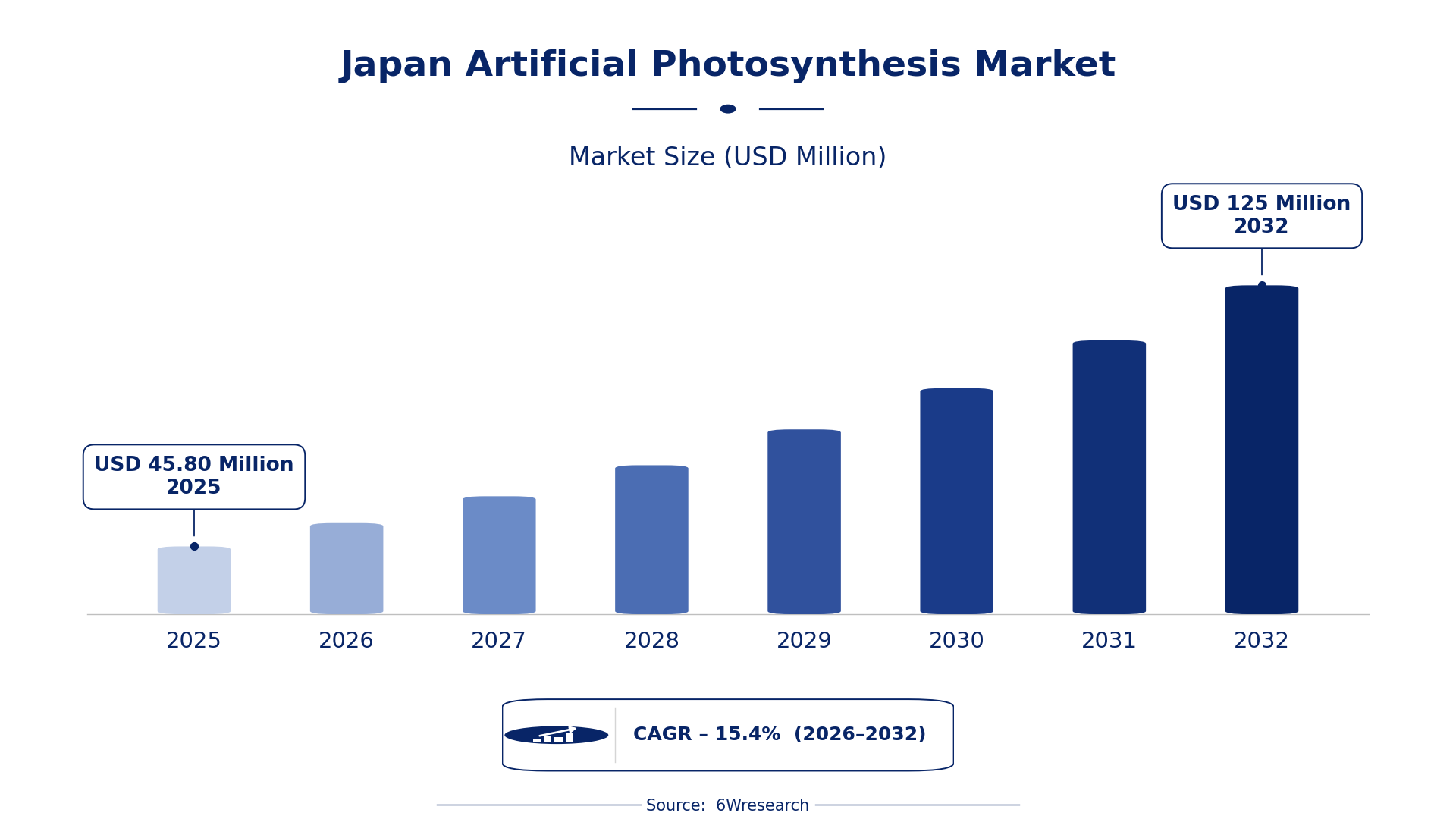
According to 6Wresearch internal database and industry insights, the Japan Artificial Photosynthesis Market was valued at USD 45.80 Million in 2025 and is projected to reach USD 125 Million by 2032, growing at a CAGR of approximately 15.4% during 2026–2032.
Japan Artificial Photosynthesis Market Highlights
| Report Metric | Details |
| Report Name | Japan Artificial Photosynthesis Market (2026-2032) |
| Market Size 2025 | USD 45.80 Million |
| Market Size 2032 | USD 125 Million |
| Absolute Growth 2025–2032 | USD 79.20 Million |
| CAGR 2026–2032 | 15.4% |
| Peak Annual Growth | 16.3% in 2026 |
| Forecast Period | 2026–2032 |
| Historical Data | 2022–2025 |
| Base Year | 2025 |
| Leading Application, 2025 | Hydrocarbon (45% share) |
| Leading Technology, 2025 | Co-Electrolysis (45% share) |
| Fastest-Growing Application | Hydrogen (20.3% CAGR) |
| Fastest-Growing Technology | Photo-Electro Catalysis (21.8% CAGR) |
| Growing Sector | Hydrogen |
| Key End Users | Hydrocarbon, Hydrogen, Chemicals |
Japan Artificial Photosynthesis Market Year-wise Growth Rate and Key Drivers (2022–2032)
This graph illustrates the annual growth rates of the market from 2022 to 2032, highlighting a steady upward trajectory and projected market expansion over the forecast period.
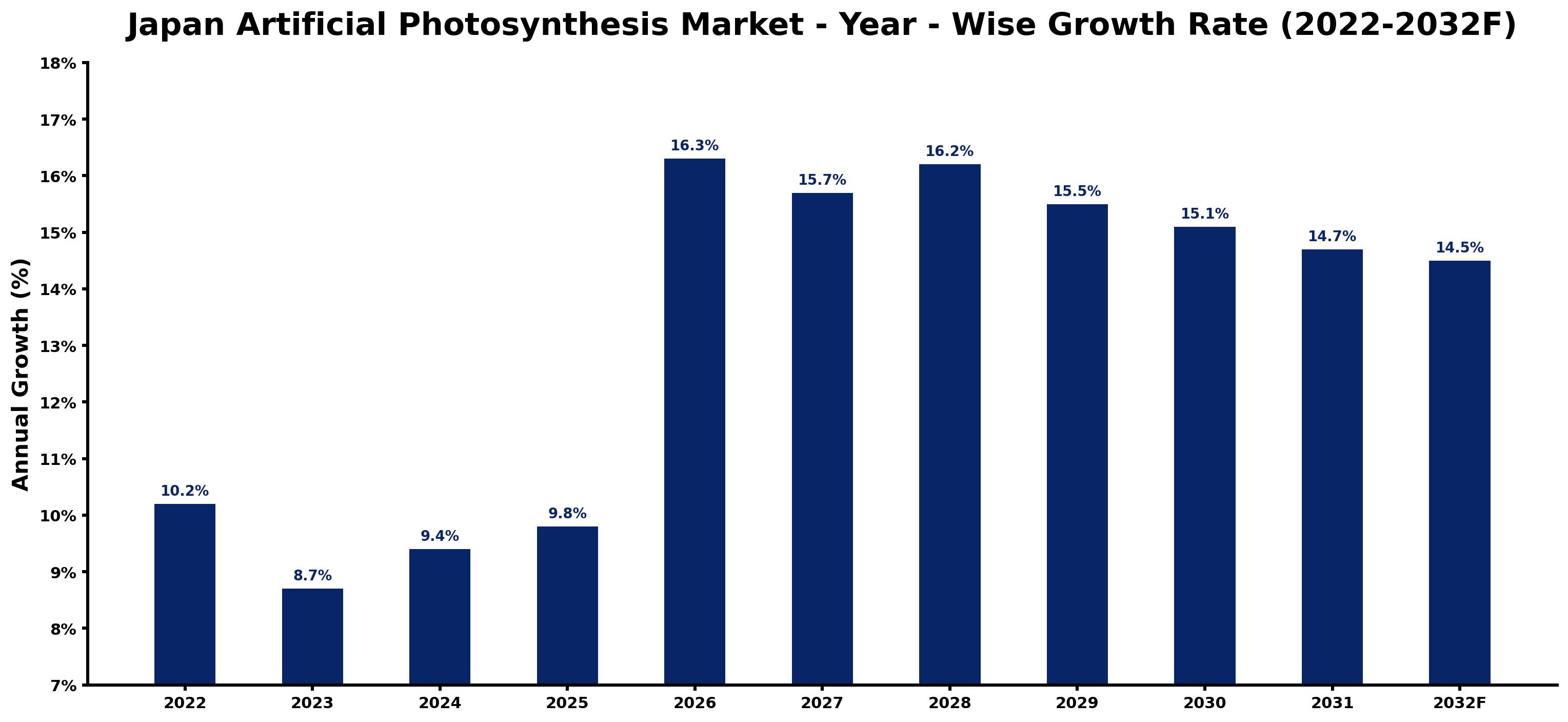
The table below sets out the estimated growth rate for each year and the main factor behind it.
| Year | Estimated Annual Growth (%) | Market Rationale |
| 2022 | 10.2 | The market experienced strong growth due to increased research funding and interest in sustainable technologies. |
| 2023 | 8.7 | Growth slowed as some projects faced delays, but interest in carbon-neutral technologies remained high. |
| 2024 | 9.4 | Demand rose as more companies adopted artificial photosynthesis for energy solutions and sustainability. |
| 2025 | 9.8 | The market continued to expand, driven by advancements in technology and increased investment in renewable energy. |
| 2026 | 16.3 | A surge in demand is expected as the carbon neutrality strategy gains momentum and funding. |
| 2027 | 15.7 | Growth is projected to slow slightly as the market adjusts to new technologies and competitive pressures emerge. |
| 2028 | 16.2 | Demand is expected to increase again as innovations in photo-electro catalysis attract more investments and projects. |
| 2029 | 15.5 | The market is projected to see a slowdown in growth as some projects face challenges in implementation and scaling. |
| 2030 | 15.1 | Growth is expected to continue slowing as the market matures, but the push for hydrogen production remains strong. |
| 2031 | 14.7 | A further slowdown is projected as the market stabilises, with ongoing investments in renewable technologies. |
| 2032 | 14.5 | The market is projected to maintain steady growth as Japan approaches its hydrogen production targets. |
Note: Market size estimations and growth projections presented in this report are based on 6Wresearch's proprietary forecasting methodology, utilizing the latest available industry data, government publications, and primary research inputs.
Japan Artificial Photosynthesis Market Synopsis
Artificial photosynthesis mimics natural processes to convert sunlight, water, and carbon dioxide into hydrocarbons and hydrogen, primarily through co-electrolysis and photo-electro catalysis. The Japan Artificial Photosynthesis Market is expanding, driven by the country's commitment to carbon neutrality by 2050 and the goal to produce 1 million tons of hydrogen by 2030. Key demand sources include the energy and chemical sectors, with investments of ¥10 billion in renewable technologies supporting this expansion.
Market Dynamics Impact Analysis (2026–2032)
| Factor | Type | Impact | Primary Segment Affected |
| Increased investment in renewable energy technologies | Driver | High | Hydrogen |
| Growing demand for sustainable energy solutions | Driver | High | Hydrocarbon |
| Rising interest in hydrogen production technologies | Opportunity | High | Hydrogen |
| Expansion of research initiatives in artificial photosynthesis | Opportunity | High | Photo-Electro Catalysis |
| High initial investment costs for technology development | Restraint | High | Co-Electrolysis |
| Limited awareness among potential users about benefits | Restraint | Medium | Hydrogen |
| Competition from established energy sources | Challenge | High | Hydrocarbon |
| Technological challenges in scaling production | Challenge | Medium | Photo-Electro Catalysis |
Evaluation of Drivers in Japan Artificial Photosynthesis Market (2026–2032)
The factors lifting demand, and the evidence behind each, are summarised below.
| Drivers | Primary Segment Affected | Why It Matters (Evidence) |
| National strategy for carbon neutrality by 2050 | Hydrogen | The strategy promotes hydrogen technologies, aiming for 1 million tons of production by 2030, driving investments. |
| Investment in renewable energy technologies | Co-Electrolysis | The ¥10 billion investment in 2022 supports advancements in co-electrolysis, boosting production capabilities. |
| Research initiatives at leading institutions | Photo-Electro Catalysis | Research at the Tokyo Institute of Technology increases efficiency in photo-electro catalysis technologies. |
| Growing chemical sector demand | Chemicals | The chemical sector's size drives the need for innovative processes, boosting artificial photosynthesis applications. |
| Government support for CO2 utilization | Hydrocarbon | The Ministry of the Environment's projects promote CO2 utilization, encouraging hydrocarbon production through artificial photosynthesis. |
A wider customer base explains much of the growth, as demand for artificial photosynthesis technologies rises in the energy and chemical sectors. In 2023, Japan's commitment to carbon neutrality is expected to drive investments, with a target of producing 1 million tons of hydrogen by 2030. The chemical sector's size, being one of the largest in Asia, fuels demand for innovative processes, pushing more companies to adopt artificial photosynthesis solutions. As a result, investment in renewable technologies is anticipated to increase, further expanding the market.
Evaluation of Restraints in Japan Artificial Photosynthesis Market
The table below lists the restraints and the evidence behind each.
| Market Restraint | Primary Segment Affected | Why It Matters (Evidence) |
| High input costs due to reliance on imports | Hydrogen | Producers face costs inflated by up to 15% for buyers, limiting market competitiveness. |
| Competition among domestic firms | Co-Electrolysis | Intense competition causes delays in innovation, lasting up to two years for suppliers. |
| Skills shortages in advanced engineering | Photo-Electro Catalysis | An estimated 20% of positions remain unfilled in key research institutions, hindering progress. |
| Rising operational costs | Chemicals | Investments in renewable technologies can consume over 30% of budgets for smaller firms. |
| Challenges in scaling projects | Hydrocarbon | Some projects face implementation issues, delaying market entry and growth. |
Japan Artificial Photosynthesis Market Challenges
Buyers face high input costs due to Japan's reliance on imported materials for artificial photosynthesis, which can inflate prices by up to 15%. Domestic competition intensifies as firms innovate, resulting in delays of up to two years for suppliers striving to meet evolving market demands. Skills shortages in advanced engineering create bottlenecks, with around 20% of critical positions unfilled in research institutions. Rising operational costs, linked to investments in renewable technologies, can consume over 30% of budgets for smaller firms, restricting their ability to scale effectively.
Trends in the Japan Artificial Photosynthesis Market
These developments are changing demand patterns in the Japan Artificial Photosynthesis Market.
- Shift from Traditional Energy Sources to Artificial Photosynthesis: Japan is increasingly adopting artificial photosynthesis as a sustainable energy solution, with a target of producing 1 million tons of hydrogen by 2030. This shift is reflected in the growing number of research projects funded by the Ministry of the Environment.
- Transition from Conventional Fuels to Hydrogen Production: Since 2023, the emphasis on hydrogen production has intensified, guided by the carbon neutrality strategy. The chemical sector is adapting to this change, with investments in hydrogen technologies reaching notable levels.
- Photo-Electro Catalysis Gaining Prominence: The year 2026 marked a pivotal moment for photo-electro catalysis, with advancements attracting increased funding. Research institutions are prioritising this technology to improve efficiency in energy conversion.
- Increased Collaboration in Research and Development: Collaboration between universities and industry has become more prevalent since 2022, driving innovation in artificial photosynthesis. This trend is supported by substantial investments in renewable energy technologies.
Investment Opportunities in the Japan Artificial Photosynthesis Market
Where to invest in the Japan Artificial Photosynthesis Market: the main openings are set out below.
- Emerging Demand for Hydrogen Production: With Japan aiming to produce 1 million tons of hydrogen by 2030, there is a notable opportunity for suppliers of hydrogen technologies. Collaborating with research institutions, such as the Tokyo Institute of Technology, can facilitate market entry.
- Investment in Co-Electrolysis Technologies: The ¥10 billion investment in renewable energy technologies presents an opportunity for companies to supply co-electrolysis solutions. Targeting the chemical sector, which is one of the largest in Asia, can strengthen market presence.
- Expansion of Chemical Applications: The growing chemical sector is creating demand for new processes, including artificial photosynthesis. Companies can enter this market by partnering with local firms in Japan's industrial hubs.
- Utilisation of CO2 in Hydrocarbon Production: The Ministry of the Environment's projects for CO2 utilisation offer a chance for investment in hydrocarbon production technologies. Engaging with government initiatives can provide a pathway for market entry.
Government Initiatives in the Japan Artificial Photosynthesis Market
The Chemical Substances Control Law, enacted in 1973, mandates the evaluation and control of new and existing chemical substances in manufacture and import, ensuring safety in production processes. The Hydrogen Society Promotion Act, enacted in 2024, supports low-carbon hydrogen supply chains, ensuring a stable market for hydrogen production and guiding investments in artificial photosynthesis.
The Ministry of the Environment promotes projects for CO2 utilisation, including artificial photosynthesis, which helps buyers access advanced technologies. The New Energy and Industrial Technology Development Organization (NEDO) funds research initiatives, enabling advancements in artificial photosynthesis and supporting the transition to sustainable energy solutions.
Future Insight of the Japan Artificial Photosynthesis Market
Japan's commitment to carbon neutrality will stimulate a wave of artificial photosynthesis projects by 2032, motivated by national strategies and substantial funding in renewable technologies. Buyers will benefit from improved hydrogen production standards under JIS, enhancing product consistency. Research initiatives at the Tokyo Institute of Technology will refine photo-electro catalysis methods, increasing overall efficiency. As the chemical sector embraces these advancements, suppliers will shift towards more sustainable energy solutions, aligning with international clean energy goals.
Market Segmentation Analysis
Japan Artificial Photosynthesis Market report covers a detailed analysis of the following market segments:
By Application – Hydrocarbon Leads, Hydrogen Expected to Grow Fastest
According to Dhaval Chaurasia, Assistant Manager at 6Wresearch, with 45% of application revenue in 2025, Hydrocarbon was the largest category. The hydrocarbon segment holds the largest share as it is directly utilised for fuel production from CO2 and sunlight, which is crucial for Japan's energy strategy. This segment benefits from established standards and government initiatives, ensuring a robust presence in the energy sector. Hydrogen is set to record the highest CAGR in this split, 20.3% over 2026–2032. The hydrogen segment is set for rapid growth as Japan targets the production of 1 million tons of hydrogen by 2030, highlighting its role in energy storage and fuel cells. This commitment to hydrogen aligns with national carbon neutrality objectives, driving further investments and advancements. Suppliers must prioritise the development of hydrogen technologies to meet the rising demand from the energy sector.
By Technology – Co-Electrolysis Leads, Photo-Electro Catalysis Expected to Grow Fastest
Co-Electrolysis took 45% of technology revenue in 2025, more than any other category. Co-electrolysis commands the largest share as it is essential for converting CO2 and water into hydrocarbons, a key process for Japan's energy goals. The technology's strong support from leading research institutions solidifies its dominant position in the market. The quickest growth will come from Photo-Electro Catalysis, forecast to expand at a CAGR of 21.8% between 2026 and 2032. Photo-electro catalysis is the fastest-growing technology, driven by its vital role in solar energy conversion, which is necessary for achieving Japan's renewable energy targets. The increase in investments in this technology suggests a promising trajectory for its advancement. Buyers should consider advanced photo-electro catalysis solutions to maintain competitiveness in the evolving energy sector.
Key Attractiveness of the Report
- 10 Years of Market Numbers
- Historical Data Starting from 2022 to 2025
- Base Year 2025
- Forecast Data until 2032
- Key Performance Indicators Impacting the Market
- Major Upcoming Developments and Projects
Key Highlights of the Report:
- Japan Artificial Photosynthesis Market Outlook
- Market Size of Japan Artificial Photosynthesis Market, 2025
- Forecast of Japan Artificial Photosynthesis Market, 2032
- Historical Data and Forecast of Japan Artificial Photosynthesis Revenues & Volume for the Period 2022-2032
- Japan Artificial Photosynthesis Market Trend Evolution
- Japan Artificial Photosynthesis Market Drivers and Challenges
- Japan Artificial Photosynthesis Price Trends
- Japan Artificial Photosynthesis Porter's Five Forces
- Japan Artificial Photosynthesis Industry Life Cycle
- Historical Data and Forecast of Japan Artificial Photosynthesis Market Revenues & Volume By Application for the Period 2022-2032
- Historical Data and Forecast of Japan Artificial Photosynthesis Market Revenues & Volume By Hydrocarbon for the Period 2022-2032
- Historical Data and Forecast of Japan Artificial Photosynthesis Market Revenues & Volume By Hydrogen for the Period 2022-2032
- Historical Data and Forecast of Japan Artificial Photosynthesis Market Revenues & Volume By Chemicals for the Period 2022-2032
- Historical Data and Forecast of Japan Artificial Photosynthesis Market Revenues & Volume By Technology for the Period 2022-2032
- Historical Data and Forecast of Japan Artificial Photosynthesis Market Revenues & Volume By Co-Electrolysis for the Period 2022-2032
- Historical Data and Forecast of Japan Artificial Photosynthesis Market Revenues & Volume By Photo-Electro Catalysis for the Period 2022-2032
- Historical Data and Forecast of Japan Artificial Photosynthesis Market Revenues & Volume By Nanotechnology for the Period 2022-2032
- Historical Data and Forecast of Japan Artificial Photosynthesis Market Revenues & Volume By Hybrid Process for the Period 2022-2032
- Japan Artificial Photosynthesis Import Export Trade Statistics
- Market Opportunity Assessment By Application
- Market Opportunity Assessment By Technology
- Japan Artificial Photosynthesis Top Companies Market Share
- Japan Artificial Photosynthesis Competitive Benchmarking By Technical and Operational Parameters
- Japan Artificial Photosynthesis Company Profiles
- Japan Artificial Photosynthesis Key Strategic Recommendations
Market Covered
The report covers the following segments.
By Application
- Hydrocarbon
- Hydrogen
- Chemicals
By Technology
- Co-Electrolysis
- Photo-Electro Catalysis
- Nanotechnology
- Hybrid Process































