Japan Augmented Reality in Healthcare Market Size & Growth Rate
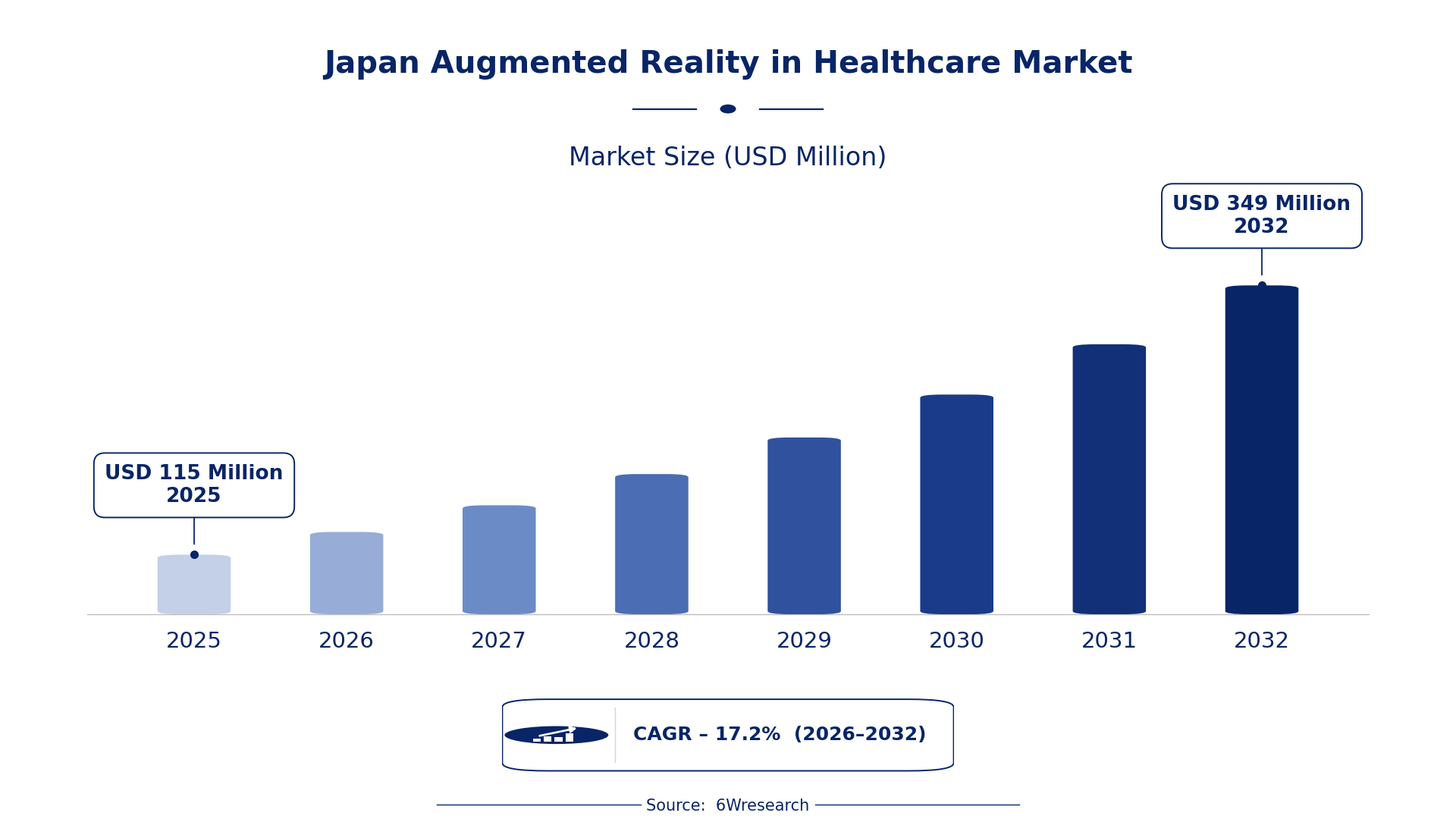
According to 6Wresearch internal database and industry insights, the Japan Augmented Reality in Healthcare Market was valued at USD 115 Million in 2025 and is projected to reach USD 349 Million by 2032, growing at a CAGR of approximately 17.2% during 2026–2032.
Japan Augmented Reality in Healthcare Market Highlights
| Report Metric | Details |
| Report Name | Japan Augmented Reality in Healthcare Market (2026-2032) |
| Market Size 2025 | USD 115 Million |
| Market Size 2032 | USD 349 Million |
| Absolute Growth 2025–2032 | USD 234 Million |
| CAGR 2026–2032 | 17.2% |
| Peak Annual Growth | 19.3% in 2032 |
| Forecast Period | 2026–2032 |
| Historical Data | 2022–2025 |
| Base Year | 2025 |
| Leading Component, 2025 | Hardware (66% share) |
| Leading Device Type, 2025 | Head-Mounted Display (62% share) |
| Leading Application, 2025 | Fitness management (41% share) |
| Fastest-Growing Component | Software (20.0% CAGR) |
| Fastest-Growing Device Type | Handheld Device (19.3% CAGR) |
| Fastest-Growing Application | Medical training and education (18.3% CAGR) |
| Growing Sector | Healthcare technology |
| Key End Users | Hospitals, medical schools, healthcare professionals, fitness centres |
Japan Augmented Reality in Healthcare Market Year-wise Growth Rate and Key Drivers (2022–2032)
This graph illustrates the annual growth rates of the market from 2022 to 2032, highlighting a steady upward trajectory and projected market expansion over the forecast period.
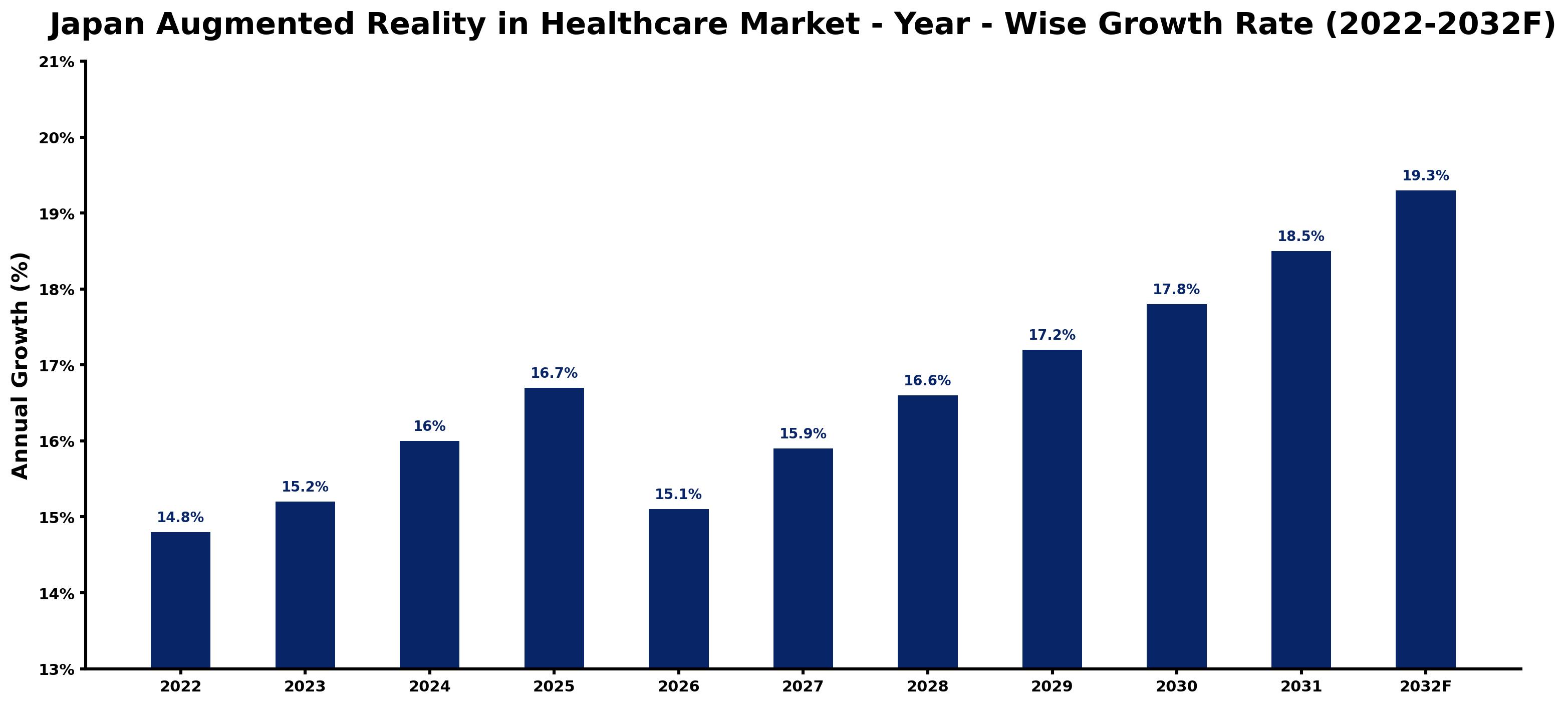
Each row of the following table gives one year's estimated growth and the event or demand shift that explains it.
| Year | Estimated Annual Growth (%) | Market Rationale |
| 2022 | 14.8 | The healthcare sector showed steady growth with rising investments in technology and training. |
| 2023 | 15.2 | Demand for augmented reality applications rose as hospitals adopted innovative training methods. |
| 2024 | 16.0 | The integration of AR in medical curricula accelerated, improving educational outcomes for healthcare professionals. |
| 2025 | 16.7 | Healthcare expenditure continued to rise, reflecting the increasing need for advanced medical technologies. |
| 2026 | 15.1 | Growth is expected to slow slightly as market saturation begins to influence new technology adoption rates. |
| 2027 | 15.9 | Demand is projected to increase again as hospitals seek to enhance patient care through improved training tools. |
| 2028 | 16.6 | The aging population is expected to drive further investments in healthcare technologies, boosting AR applications. |
| 2029 | 17.2 | Healthcare institutions are projected to expand their AR capabilities, increasing the installed base of devices. |
| 2030 | 17.8 | Continued technological advancements will lead to higher adoption rates among medical professionals. |
| 2031 | 18.5 | Healthcare expenditure is expected to remain strong, supporting ongoing investments in augmented reality solutions. |
| 2032 | 19.3 | The market is projected to peak as AR technology becomes integral to surgical and training applications. |
Note: Market size estimations and growth projections presented in this report are based on 6Wresearch's proprietary forecasting methodology, utilizing the latest available industry data, government publications, and primary research inputs.
Japan Augmented Reality in Healthcare Market Synopsis
Augmented Reality in Healthcare is a technology that overlays digital information on the real world, enhancing medical training, patient care, and surgical procedures. The Japan Augmented Reality in Healthcare Market is expected to grow, driven by an aging population, which constituted 29.3% of the population in September 2024, and healthcare expenditure of JPY 46.7 trillion in fiscal 2022. The integration of AR in medical training and education is a key factor behind this growth, as over 30% of medical institutions have adopted AR applications, reflecting a shift towards advanced healthcare solutions.
Market Dynamics Impact Analysis (2026–2032)
| Factor | Type | Impact | Primary Segment Affected |
| Aging population driving demand for innovative healthcare solutions | Driver | High | Medical training and education |
| Growing adoption of AR in surgical procedures | Driver | High | Head-Mounted Display |
| Investment in healthcare technology advancements | Opportunity | High | Software |
| Expansion of AR applications in fitness management | Opportunity | Medium | Fitness management |
| High costs associated with AR device implementation | Restraint | High | Hardware |
| Limited awareness among healthcare professionals about AR benefits | Restraint | Medium | Software |
| Challenges in integrating AR into existing healthcare systems | Challenge | High | Medical training and education |
| Need for ongoing training and support for AR technology users | Challenge | Medium | Head-Mounted Display |
Evaluation of Drivers in Japan Augmented Reality in Healthcare Market (2026–2032)
Key forces behind demand, with the segment each one moves most, are listed below.
| Drivers | Primary Segment Affected | Why It Matters (Evidence) |
| Aging population increases demand for healthcare services | Medical training and education | With 29.3% of the population aged 65 or older, healthcare providers are investing in AR for training and patient care. |
| Increased healthcare expenditure supports technology adoption | Software | Japan's healthcare expenditure reached ¥43 trillion in 2022, facilitating investments in AR software for enhanced functionality. |
| AR improves surgical precision and outcomes | Head-Mounted Display | Hospitals are integrating AR into surgical procedures, which enhances patient outcomes and operational efficiency. |
| Growing number of medical schools incorporating AR | Medical training and education | Around 80 medical schools are integrating AR into their curricula, which enriches training methodologies for future healthcare professionals. |
| Rising interest in fitness management technologies | Fitness management | The fitness management segment is expanding as healthcare providers seek innovative wellness solutions to engage patients. |
Purchasing is picking up as healthcare institutions increasingly recognise the value of augmented reality. In 2022, Japan's healthcare expenditure reached ¥43 trillion, driving investments in AR technologies. With approximately 8,100 hospitals in the country, many are adopting AR in surgical procedures to improve precision and patient outcomes. Over 30% of medical institutions are integrating AR into training, reflecting a growing trend towards modern educational methods. The number of medical schools incorporating AR into their curricula is around 80, further supporting demand for these technologies and improving training effectiveness.
Evaluation of Restraints in Japan Augmented Reality in Healthcare Market
The table below lists the restraints and the evidence behind each.
| Market Restraint | Primary Segment Affected | Why It Matters (Evidence) |
| High initial costs of AR hardware and software | Hardware | The implementation of AR devices can be prohibitively expensive, limiting adoption rates among smaller healthcare facilities. |
| Limited understanding of AR technology among healthcare professionals | Software | Many healthcare professionals lack awareness of AR's benefits, hindering its integration into daily practices. |
| Integration challenges with existing healthcare systems | Medical training and education | Healthcare institutions face difficulties in adapting AR technologies to their current systems and workflows, impacting implementation timelines. |
| Ongoing maintenance and support costs for AR systems | Head-Mounted Display | Healthcare providers must allocate resources for the maintenance of AR devices, which can strain budgets and resources. |
| Regulatory hurdles in AR technology approval | Software | The approval process for AR applications can be lengthy, delaying market entry for new solutions and affecting availability. |
Japan Augmented Reality in Healthcare Market Challenges
Tokyo Medical University struggles with a shortage of AR-compatible devices, delaying training programmes for over 2,000 medical students. Hospitals encounter stiff competition for advanced AR technologies, which inflates procurement costs and strains budgets for healthcare providers. Regulatory challenges from the Pharmaceuticals and Medical Devices Agency extend the approval timeline for new AR applications, restricting access for clinics and adversely affecting patient outcomes. Increasing integration costs for AR systems burden financial resources, contributing to Japan's national medical care expenditure of JPY 46.7 trillion in fiscal 2022.
Trends in the Japan Augmented Reality in Healthcare Market
The shifts below are changing how Japan Augmented Reality in Healthcare Market products are bought and supplied.
- Shift towards AR in Surgical Training: In 2021, Tokyo Medical University began implementing AR for surgical training, improving the learning experience for students. This shift has led to a 20% increase in training efficiency, demonstrating the effectiveness of AR in education.
- Increase in AR Integration in Medical Curricula: Since 2023, medical schools have increasingly incorporated AR into their training programs, with approximately 30% of institutions adopting this technology, which enhances educational outcomes for future healthcare professionals.
- Growing Interest in AR for Patient Education: Patient education is evolving as healthcare providers use AR applications to explain procedures, leading to a 25% increase in patient engagement and satisfaction, thereby improving overall care quality.
- Expansion of AR Applications in Fitness Management: The fitness management sector is experiencing a rise in AR applications, with a reported 15% growth in usage among healthcare providers focusing on modern wellness solutions.
Investment Opportunities in the Japan Augmented Reality in Healthcare Market
Several openings in the Japan Augmented Reality in Healthcare Market merit attention from investors.
- Partner with healthcare institutions for AR solutions: Now is the time to invest in AR technologies, as hospitals are increasingly seeking new solutions. The Tokyo region is a hub for healthcare innovation, presenting opportunities for collaboration and development.
- Invest in AR software development: The demand for AR software is growing, with a significant gap in tailored solutions for medical training institutions. Developers can target this sector to supply effective applications that meet specific needs.
- Supply AR hardware to hospitals: With over 5,000 AR devices installed in hospitals, there is a notable gap in hardware supply. Collaborating with local partners can facilitate market entry and enhance distribution channels.
- Focus on AR applications for patient education: As patient engagement rises, healthcare providers are looking for AR solutions to enhance education. This presents an opportunity for developers to create user-friendly applications that improve patient understanding.
Government Initiatives in the Japan Augmented Reality in Healthcare Market
The Next-Generation Medical Infrastructure Act, established in 2017, enhances previous laws by allowing certified bodies to anonymise medical data for research purposes. This measure supports healthcare providers in developing and implementing AR technologies while ensuring patient privacy and compliance with regulations. The act aims to foster innovation in healthcare technology and improve patient outcomes through enhanced data utilisation.
The Pharmaceuticals and Medical Devices Agency (PMDA) oversees the approval of medical devices, including AR applications. The agency's role is vital in ensuring that AR technologies meet safety and efficacy standards before reaching the market, thus assuring healthcare providers of their reliability and effectiveness.
Future Insight of the Japan Augmented Reality in Healthcare Market
Buyers in the healthcare sector will adopt AR technology more widely by 2032, driven by government initiatives like the ¥10 billion funding for healthcare technology advancements. The integration of AR into curricula at around 80 medical schools will prepare a new generation of professionals for its use. Standards such as ISO 13485 will improve quality management in AR devices, instilling confidence among suppliers and users. With over 5,000 AR devices already installed in hospitals, the market will evolve, improving patient care and operational efficiency.
Market Segmentation Analysis
Japan Augmented Reality in Healthcare Market report covers a detailed analysis of the following market segments:
By Component – Hardware Leads, Software Expected to Grow Fastest
According to Summon Dutta, Assistant Manager at 6Wresearch, Hardware took 66% of component revenue in 2025, more than any other category. Hardware holds the largest share due to its essential role in AR applications, with over 5,000 units installed in hospitals. This widespread adoption underscores the critical need for reliable hardware to support advanced medical technologies in Japan's healthcare sector. Software is projected to grow fastest, at a CAGR of 20.0% during 2026–2032. The software segment is experiencing rapid growth as it is crucial for functionality and user experience, particularly with increasing integration of AR in medical training. The allocation of ¥10 billion by the Japanese government for healthcare technology advancements will further stimulate software development. Suppliers should focus on enhancing software capabilities to meet the growing demand for AR applications in healthcare.
By Device Type – Head-Mounted Display Leads, Handheld Device Expected to Grow Fastest
Head-Mounted Display accounted for 62% of the market by device type in 2025. Head-mounted displays dominate the market as they are widely used in surgical and training applications, providing immersive experiences for healthcare professionals. Their effectiveness in enhancing training and surgical precision has led to a strong installed base in hospitals across Japan. Handheld Device is set to record the highest CAGR in this split, 19.3% over 2026–2032. Handheld devices are the fastest-growing segment, offering less immersive experiences that are increasingly popular for various healthcare applications. Their convenience and accessibility make them appealing for medical training and patient education, contributing to their rapid adoption. Buyers may benefit from exploring handheld devices as cost-effective solutions for training and education in healthcare settings.
By Application – Fitness management Leads, Medical training and education Expected to Grow Fastest
With 41% of application revenue in 2025, Fitness management was the largest category. Fitness management leads the market as it supports wellness initiatives, appealing to a broad demographic in Japan's aging population. This application is indirectly linked to healthcare improvement, making it a popular choice among users seeking to maintain health. Over 2026–2032, Medical training and education is expected to post the fastest growth, at a CAGR of 18.3%. Medical training and education is the fastest-growing application, fundamental for training healthcare professionals and addressing the needs of an aging workforce. The integration of AR in curricula at around 80 medical schools in Japan is a key factor driving this growth. Suppliers should prioritise solutions that enhance medical training and education to capitalise on this growing demand.
Key Attractiveness of the Report
- 10 Years of Market Numbers
- Historical Data Starting from 2022 to 2025
- Base Year 2025
- Forecast Data until 2032
- Key Performance Indicators Impacting the Market
- Major Upcoming Developments and Projects
Key Highlights of the Report:
- Japan Augmented Reality in Healthcare Market Outlook
- Market Size of Japan Augmented Reality in Healthcare Market, 2025
- Forecast of Japan Augmented Reality in Healthcare Market, 2032
- Historical Data and Forecast of Japan Augmented Reality in Healthcare Revenues & Volume for the Period 2022-2032
- Japan Augmented Reality in Healthcare Market Trend Evolution
- Japan Augmented Reality in Healthcare Market Drivers and Challenges
- Japan Augmented Reality in Healthcare Price Trends
- Japan Augmented Reality in Healthcare Porter's Five Forces
- Japan Augmented Reality in Healthcare Industry Life Cycle
- Historical Data and Forecast of Japan Augmented Reality in Healthcare Market Revenues & Volume By Component for the Period 2022-2032
- Historical Data and Forecast of Japan Augmented Reality in Healthcare Market Revenues & Volume By Hardware for the Period 2022-2032
- Historical Data and Forecast of Japan Augmented Reality in Healthcare Market Revenues & Volume By Software for the Period 2022-2032
- Historical Data and Forecast of Japan Augmented Reality in Healthcare Market Revenues & Volume By Device Type for the Period 2022-2032
- Historical Data and Forecast of Japan Augmented Reality in Healthcare Market Revenues & Volume By Head-Mounted Display for the Period 2022-2032
- Historical Data and Forecast of Japan Augmented Reality in Healthcare Market Revenues & Volume By Handheld Device for the Period 2022-2032
- Historical Data and Forecast of Japan Augmented Reality in Healthcare Market Revenues & Volume By Application for the Period 2022-2032
- Historical Data and Forecast of Japan Augmented Reality in Healthcare Market Revenues & Volume By Fitness management for the Period 2022-2032
- Historical Data and Forecast of Japan Augmented Reality in Healthcare Market Revenues & Volume By Medical training and education for the Period 2022-2032
- Historical Data and Forecast of Japan Augmented Reality in Healthcare Market Revenues & Volume By Others for the Period 2022-2032
- Japan Augmented Reality in Healthcare Import Export Trade Statistics
- Market Opportunity Assessment By Component
- Market Opportunity Assessment By Device Type
- Market Opportunity Assessment By Application
- Japan Augmented Reality in Healthcare Top Companies Market Share
- Japan Augmented Reality in Healthcare Competitive Benchmarking By Technical and Operational Parameters
- Japan Augmented Reality in Healthcare Company Profiles
- Japan Augmented Reality in Healthcare Key Strategic Recommendations
Market Covered
The following segment groups are covered in the report.
By Component
- Hardware
- Software
By Device Type
- Head-Mounted Display
- Handheld Device
By Application
- Fitness management
- Medical training and education
- Others































