Japan Augmented Reality & Virtual Reality Market Size & Growth Rate
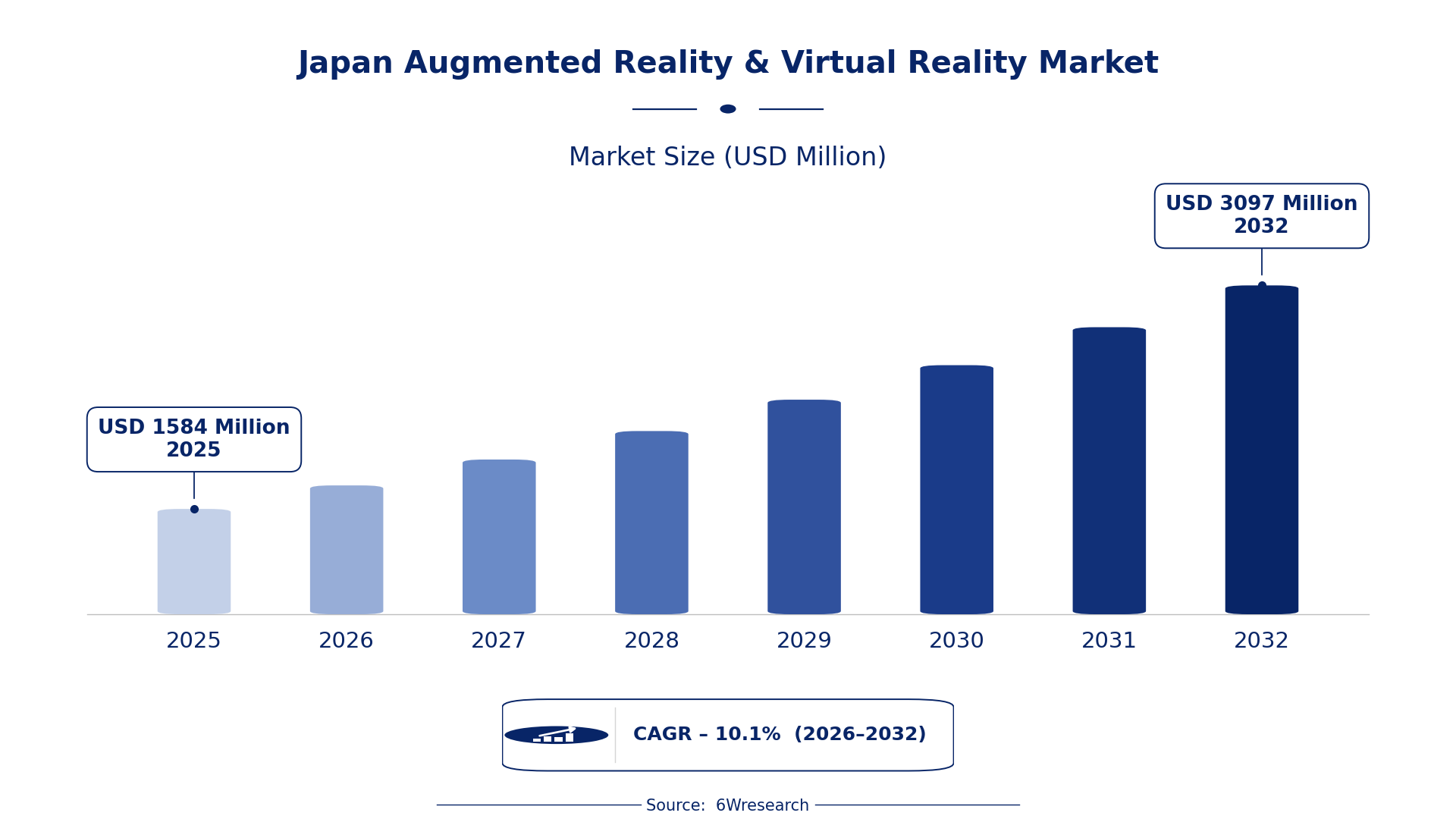
According to 6Wresearch internal database and industry insights, the Japan Augmented Reality & Virtual Reality Market was valued at USD 1,584 Million in 2025 and is projected to reach USD 3,097 Million by 2032, growing at a CAGR of approximately 10.1% during 2026–2032.
Japan Augmented Reality & Virtual Reality Market Highlights
| Report Metric | Details |
| Report Name | Japan Augmented Reality & Virtual Reality Market (2026-2032) |
| Market Size 2025 | USD 1,584 Million |
| Market Size 2032 | USD 3,097 Million |
| Absolute Growth 2025–2032 | USD 1,513 Million |
| CAGR 2026–2032 | 10.1% |
| Peak Annual Growth | 11.6% in 2032 |
| Forecast Period | 2026–2032 |
| Historical Data | 2022–2025 |
| Base Year | 2025 |
| Leading Component, 2025 | Software (55% share) |
| Leading Technology, 2025 | Augmented Reality (48% share) |
| Fastest-Growing Component | Services (14.6% CAGR) |
| Growing Sector | education and training |
| Key End Users | educational institutions, healthcare providers, gaming companies, retail businesses |
Japan Augmented Reality & Virtual Reality Market Year-wise Growth Rate and Key Drivers (2022–2032)
This graph illustrates the annual growth rates of the market from 2022 to 2032, highlighting a steady upward trajectory and projected market expansion over the forecast period.
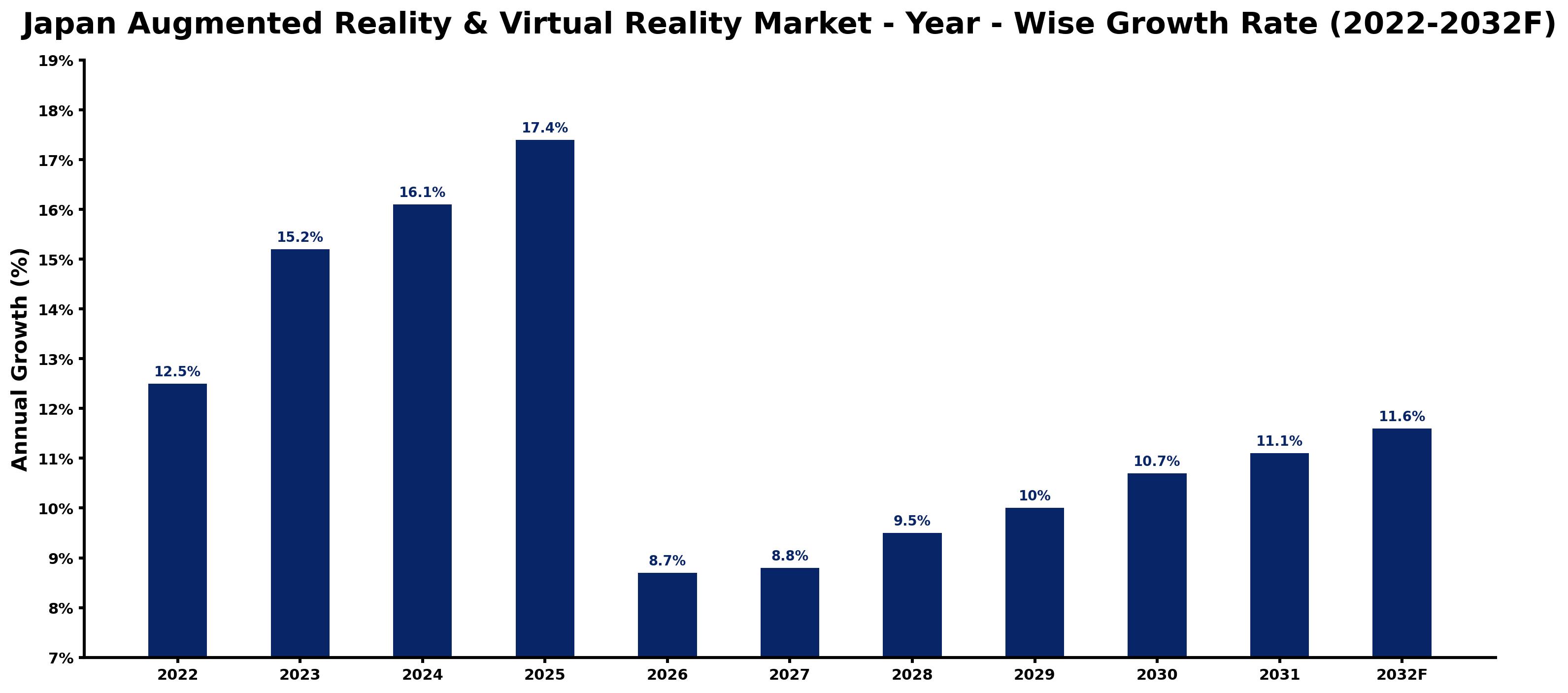
For each year, the table pairs the estimated growth rate with the leading influence on demand, showing how the drivers changed across the period.
| Year | Estimated Annual Growth (%) | Market Rationale |
| 2022 | 12.5 | The market experienced steady growth, driven by increasing technology adoption across various sectors. |
| 2023 | 15.2 | Demand surged as educational institutions integrated AR technology into their curricula. |
| 2024 | 16.1 | Growth accelerated due to rising investments in AR/VR applications across healthcare and gaming. |
| 2025 | 17.4 | The peak growth year saw advancements in VR gaming technologies and applications. |
| 2026 | 8.7 | Growth is expected to slow as the market stabilises after rapid expansion in previous years. |
| 2027 | 8.8 | A slight increase in growth is projected as new applications in training simulations emerge. |
| 2028 | 9.5 | Continued interest in immersive technologies will lead to further growth in educational applications. |
| 2029 | 10.0 | Demand is expected to increase as more healthcare facilities adopt VR for medical training and therapy. |
| 2030 | 10.7 | Growth will continue as the entertainment sector expands its use of AR/VR technologies. |
| 2031 | 11.1 | The market is projected to experience a steady rise, supported by ongoing innovation in hardware and software. |
| 2032 | 11.6 | The market is expected to peak with strong demand from both gaming and educational sectors. |
Note: Market size estimations and growth projections presented in this report are based on 6Wresearch's proprietary forecasting methodology, utilizing the latest available industry data, government publications, and primary research inputs.
Japan Augmented Reality & Virtual Reality Market Synopsis
Augmented Reality and Virtual Reality are immersive technologies that create simulated environments or overlay digital information on the real world. The Japan Augmented Reality & Virtual Reality Market, valued at approximately 600 billion yen in 2022, is growing due to rising demand from educational institutions and healthcare providers. Government initiatives and investments in research are driving further expansion, particularly in gaming and training applications.
Market Dynamics Impact Analysis (2026–2032)
| Factor | Type | Impact | Primary Segment Affected |
| Growing adoption of AR in education | Driver | High | Augmented Reality |
| Increased investment in VR gaming technologies | Driver | High | Virtual Reality |
| Expansion of AR applications in retail | Opportunity | High | Augmented Reality |
| Rising demand for VR in healthcare training | Opportunity | High | Virtual Reality |
| High development costs for AR/VR applications | Restraint | Medium | Hardware |
| Limited awareness among potential users | Restraint | Medium | Software |
| Intense competition among technology providers | Challenge | High | Services |
| Rapid technological changes requiring constant updates | Challenge | Medium | Hardware |
Evaluation of Drivers in Japan Augmented Reality & Virtual Reality Market (2026–2032)
The factors lifting demand, and the evidence behind each, are summarised below.
| Drivers | Primary Segment Affected | Why It Matters (Evidence) |
| Increased Adoption of AR in Education | Augmented Reality | The integration of AR technology in over 200 educational institutions enhances interactive learning, driving demand for AR solutions. |
| Growing Interest in VR for Gaming | Virtual Reality | The rising popularity of gaming applications boosts demand for VR headsets and software, with significant investments from consumers. |
| Healthcare Integration of VR | Virtual Reality | The expected incorporation of VR in medical training by 2025 increases demand for VR solutions among healthcare providers. |
| Retailers Leveraging AR for Engagement | Augmented Reality | Retailers are using AR to enhance customer experiences, leading to higher adoption rates and increased demand for AR applications. |
| Expansion of AR/VR Research Funding | Services | The government's 5 billion yen budget for AR/VR research initiatives supports the development of new solutions, driving demand for related services. |
Buyers are increasing capacity as the education sector adopts AR technology, with over 200 institutions integrating it for interactive learning. In 2023, investments in VR technologies are on the rise due to heightened interest in gaming applications. The healthcare sector is expected to incorporate VR into medical training by 2025, boosting demand for VR solutions. Retailers are employing AR to enhance customer engagement, resulting in higher adoption rates.
Evaluation of Restraints in Japan Augmented Reality & Virtual Reality Market
Several factors work against faster growth; the main ones are summarised below.
| Market Restraint | Primary Segment Affected | Why It Matters (Evidence) |
| High development costs for AR/VR applications | Hardware | The cost of advanced hardware and software development can exceed 100 million yen, limiting smaller players' entry. |
| Limited awareness among potential users | Software | Many businesses remain unaware of the benefits of AR/VR, hindering market expansion and adoption. |
| Complexity of integrating AR/VR solutions | Services | The integration process can be lengthy and costly, often deterring companies from adopting these technologies. |
| Regulatory compliance requirements | Hardware | Producers must adhere to ISO 9241 standards, complicating product development and increasing costs. |
| Short product life cycles | Software | Rapid technological advancements lead to frequent updates, requiring continuous investment from developers. |
Japan Augmented Reality & Virtual Reality Market Challenges
A lack of high-quality AR/VR components limits production capabilities, as local manufacturers depend heavily on imports for essential parts. This situation arises from Japan's focus on domestic innovation rather than raw material sourcing, causing delays for producers who face lead times extending up to six months. Strong competition from international markets pressures local firms to reduce prices, which can cut profit margins for suppliers by around 15%. Compliance with ISO 9241 standards adds extra costs and complexities for producers, leading to higher prices for buyers and potential delays in product launches by several weeks.
Trends in the Japan Augmented Reality & Virtual Reality Market
Buyers and suppliers in the Japan Augmented Reality & Virtual Reality Market are adjusting to the following trends.
- Shift from Traditional to Interactive Learning: Educational institutions are increasingly adopting AR technology for interactive learning experiences, improving student engagement. Over 200 schools in Japan now utilise AR, reflecting a shift in teaching methodologies.
- Emergence of VR in Healthcare Training: The integration of VR in medical training is gaining traction, with widespread adoption expected by 2025. This trend will transform training methods in healthcare facilities across Japan.
- Growing Use of AR in Retail: Retailers are implementing AR solutions to improve customer experiences, with many stores adopting AR for interactive product displays. This trend is expected to boost sales and customer satisfaction.
- Expansion of VR Gaming Technologies: The gaming industry is rapidly evolving with the introduction of new VR technologies, showcased annually at major events. This trend highlights the growing consumer interest in immersive gaming experiences.
Investment Opportunities in the Japan Augmented Reality & Virtual Reality Market
Investors looking at the Japan Augmented Reality & Virtual Reality Market should consider the following areas.
- Collaborate with Educational Institutions: Now is the time to partner with schools and universities, as over 200 institutions are adopting AR technology for interactive learning. Establishing partnerships can facilitate entry into the educational market.
- Develop Healthcare VR Solutions: With the government's aim for VR integration in medical training by 2025, there is an opportunity to create VR training solutions for medical professionals. Target healthcare facilities in urban areas for partnerships.
- Create Retail AR Applications: The retail sector is increasingly adopting AR to improve customer engagement, creating opportunities for software developers. Collaborate with retail chains to develop tailored AR solutions that enhance shopping experiences.
- Engage with Government Research Funding: The 5 billion yen budget for AR/VR research initiatives presents a timely opportunity for technology firms. Work with government agencies to secure funding for projects in AR/VR.
Government Initiatives in the Japan Augmented Reality & Virtual Reality Market
The Digital Agency, established in September 2021, leads the government's digital transformation efforts, including the integration of AR/VR technologies. This agency oversees standards and funding for digital initiatives, ensuring that AR/VR producers comply with regulations and benefit from government support. The AI Promotion Act, set for 2025, will create a framework for AI research, indirectly influencing AR/VR development by encouraging innovation.
Healthcare providers are adopting VR technologies to improve training for medical professionals. This initiative aims for widespread VR adoption in healthcare by 2025, with funding allocated to support these efforts, improving patient care and training efficiency.
Future Insight of the Japan Augmented Reality & Virtual Reality Market
Buyers in healthcare will experience a transformation as VR integration in medical training becomes prevalent by 2032. The government's 5 billion yen budget for AR/VR research initiatives will stimulate advancements, enabling suppliers to develop new solutions. The establishment of the Digital Agency will support the integration of AR/VR in public services, improving efficiency. Additionally, the Tokyo Game Show will continue to showcase cutting-edge technologies, driving consumer interest and engagement in immersive experiences.
Market Segmentation Analysis
Japan Augmented Reality & Virtual Reality Market report covers a detailed analysis of the following market segments:
By Component – Software Leads, Services Expected to Grow Fastest
According to Summon Dutta, Assistant Manager at 6Wresearch, Software held 55% of the Japan Augmented Reality & Virtual Reality Market by component in 2025. Software holds the largest market share because it is crucial for creating AR and VR applications that drive user engagement. The integration of software in over 200 educational institutions across Japan highlights its importance in enhancing interactive learning experiences. Services are projected to grow fastest, at a CAGR of 14.6% during 2026–2032. Services are growing quickly as they provide essential support for the development and integration of AR and VR solutions. The emergence of numerous startups in Tokyo illustrates the increasing demand for these services, which will likely continue to rise. This trend indicates that suppliers should focus on expanding their service capabilities to meet the growing market demand.
By Technology – Augmented Reality Leads and Records the Fastest Growth
Augmented Reality accounted for 48% of the market by technology in 2025. Augmented Reality dominates the market as it is widely adopted in sectors such as retail and education, where immersive experiences are vital. The substantial adoption rates in these areas underscore its importance and widespread usage. The same category is also set to grow fastest, at a CAGR of 11.2% during 2026–2032. Augmented Reality is also the fastest-growing segment, with its applications in retail and education driving ongoing innovation and user engagement. This strong position as both leader and fastest will likely further solidify its market dominance. Buyers should focus on investing in Augmented Reality solutions to maintain a competitive edge in their industries.
Key Attractiveness of the Report
- 10 Years of Market Numbers
- Historical Data Starting from 2022 to 2025
- Base Year 2025
- Forecast Data until 2032
- Key Performance Indicators Impacting the Market
- Major Upcoming Developments and Projects
Key Highlights of the Report:
- Japan Augmented Reality & Virtual Reality Market Outlook
- Market Size of Japan Augmented Reality & Virtual Reality Market, 2025
- Forecast of Japan Augmented Reality & Virtual Reality Market, 2032
- Historical Data and Forecast of Japan Augmented Reality & Virtual Reality Revenues & Volume for the Period 2022-2032
- Japan Augmented Reality & Virtual Reality Market Trend Evolution
- Japan Augmented Reality & Virtual Reality Market Drivers and Challenges
- Japan Augmented Reality & Virtual Reality Price Trends
- Japan Augmented Reality & Virtual Reality Porter's Five Forces
- Japan Augmented Reality & Virtual Reality Industry Life Cycle
- Historical Data and Forecast of Japan Augmented Reality & Virtual Reality Market Revenues & Volume By Component for the Period 2022-2032
- Historical Data and Forecast of Japan Augmented Reality & Virtual Reality Market Revenues & Volume By Hardware for the Period 2022-2032
- Historical Data and Forecast of Japan Augmented Reality & Virtual Reality Market Revenues & Volume By Software for the Period 2022-2032
- Historical Data and Forecast of Japan Augmented Reality & Virtual Reality Market Revenues & Volume By Services for the Period 2022-2032
- Historical Data and Forecast of Japan Augmented Reality & Virtual Reality Market Revenues & Volume By Technology for the Period 2022-2032
- Historical Data and Forecast of Japan Augmented Reality & Virtual Reality Market Revenues & Volume By Augmented Reality for the Period 2022-2032
- Historical Data and Forecast of Japan Augmented Reality & Virtual Reality Market Revenues & Volume By Virtual Reality for the Period 2022-2032
- Historical Data and Forecast of Japan Augmented Reality & Virtual Reality Market Revenues & Volume By Pain Distraction for the Period 2022-2032
- Japan Augmented Reality & Virtual Reality Import Export Trade Statistics
- Market Opportunity Assessment By Component
- Market Opportunity Assessment By Technology
- Japan Augmented Reality & Virtual Reality Top Companies Market Share
- Japan Augmented Reality & Virtual Reality Competitive Benchmarking By Technical and Operational Parameters
- Japan Augmented Reality & Virtual Reality Company Profiles
- Japan Augmented Reality & Virtual Reality Key Strategic Recommendations
Market Covered
The report covers the following segments.
By Component
- Hardware
- Software
- Services
By Technology
- Augmented Reality
- Virtual Reality
- Pain Distraction































