Japan Automated Access Control Doors Market Size & Growth Rate
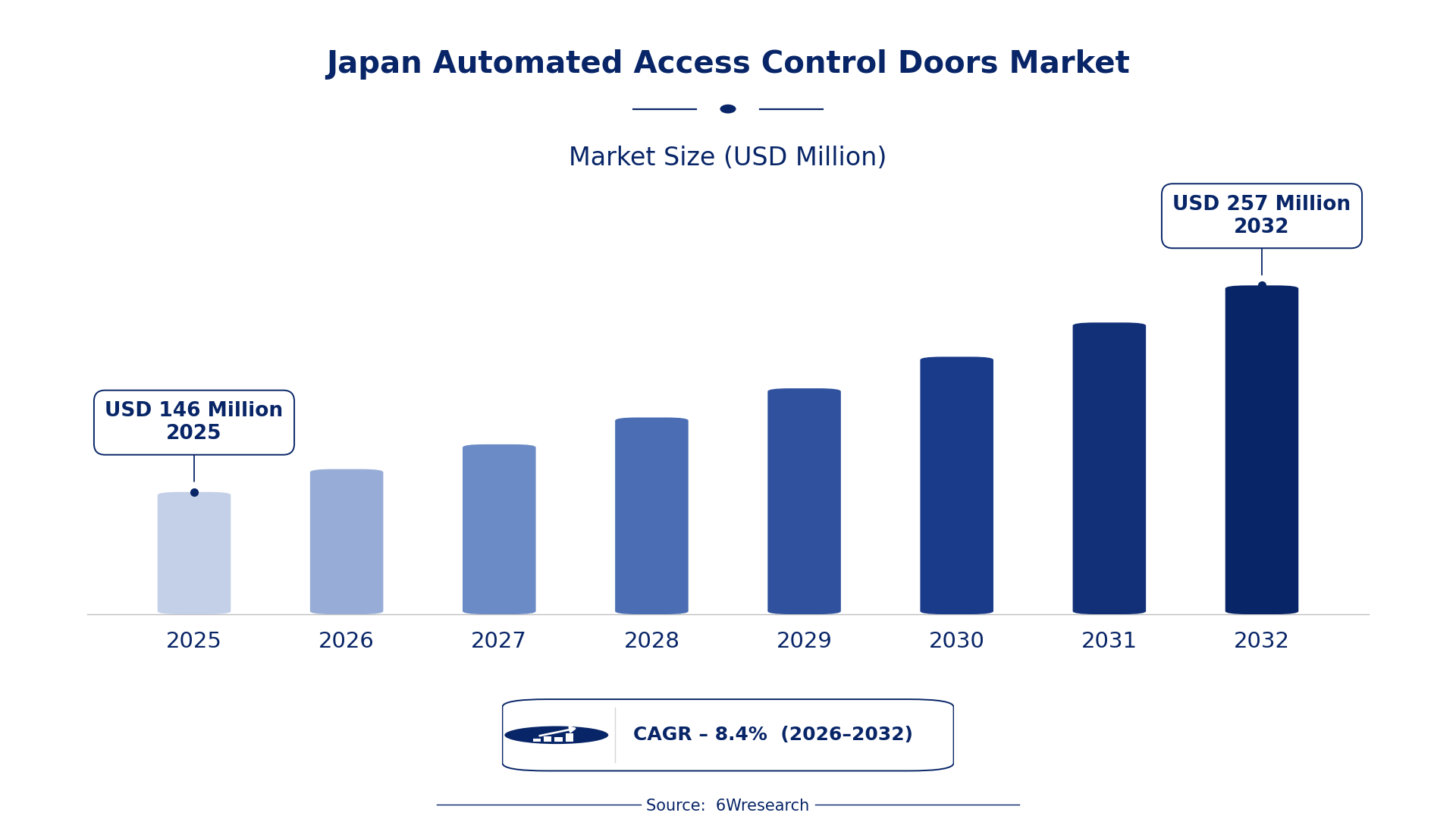
According to 6Wresearch internal database and industry insights, the Japan Automated Access Control Doors Market was valued at USD 146 Million in 2025 and is projected to reach USD 257 Million by 2032, growing at a CAGR of approximately 8.4% during 2026–2032.
Japan Automated Access Control Doors Market Highlights
| Report Metric | Details |
| Report Name | Japan Automated Access Control Doors Market (2026-2032) |
| Market Size 2025 | USD 146 Million |
| Market Size 2032 | USD 257 Million |
| Absolute Growth 2025–2032 | USD 111 Million |
| CAGR 2026–2032 | 8.4% |
| Peak Annual Growth | 10.1% in 2032 |
| Forecast Period | 2026–2032 |
| Historical Data | 2022–2025 |
| Base Year | 2025 |
| Leading Door Type, 2025 | Swing/Sliding Doors (49% share) |
| Leading Access Technology, 2025 | RFID/Proximity (55% share) |
| Leading Building Use Case, 2025 | Office Buildings (47% share) |
| Leading Distribution Channel, 2025 | Direct Sales (36% share) |
| Leading End User, 2025 | Corporate Campuses (37% share) |
| Fastest-Growing Door Type | Cleanroom Doors (12.2% CAGR) |
| Fastest-Growing Access Technology | Biometric Locking (12.5% CAGR) |
| Fastest-Growing Building Use Case | Labs/Pharma (11.7% CAGR) |
| Fastest-Growing Distribution Channel | Online Platforms (11.3% CAGR) |
| Fastest-Growing End User | Pharmaceutical Plants (10.9% CAGR) |
| Growing Sector | Corporate Campuses |
| Key End Users | Corporate Campuses, Government Facilities, Pharmaceutical Plants, Laboratories |
Japan Automated Access Control Doors Market Year-wise Growth Rate and Key Drivers (2022–2032)
This graph illustrates the annual growth rates of the market from 2022 to 2032, highlighting a steady upward trajectory and projected market expansion over the forecast period.
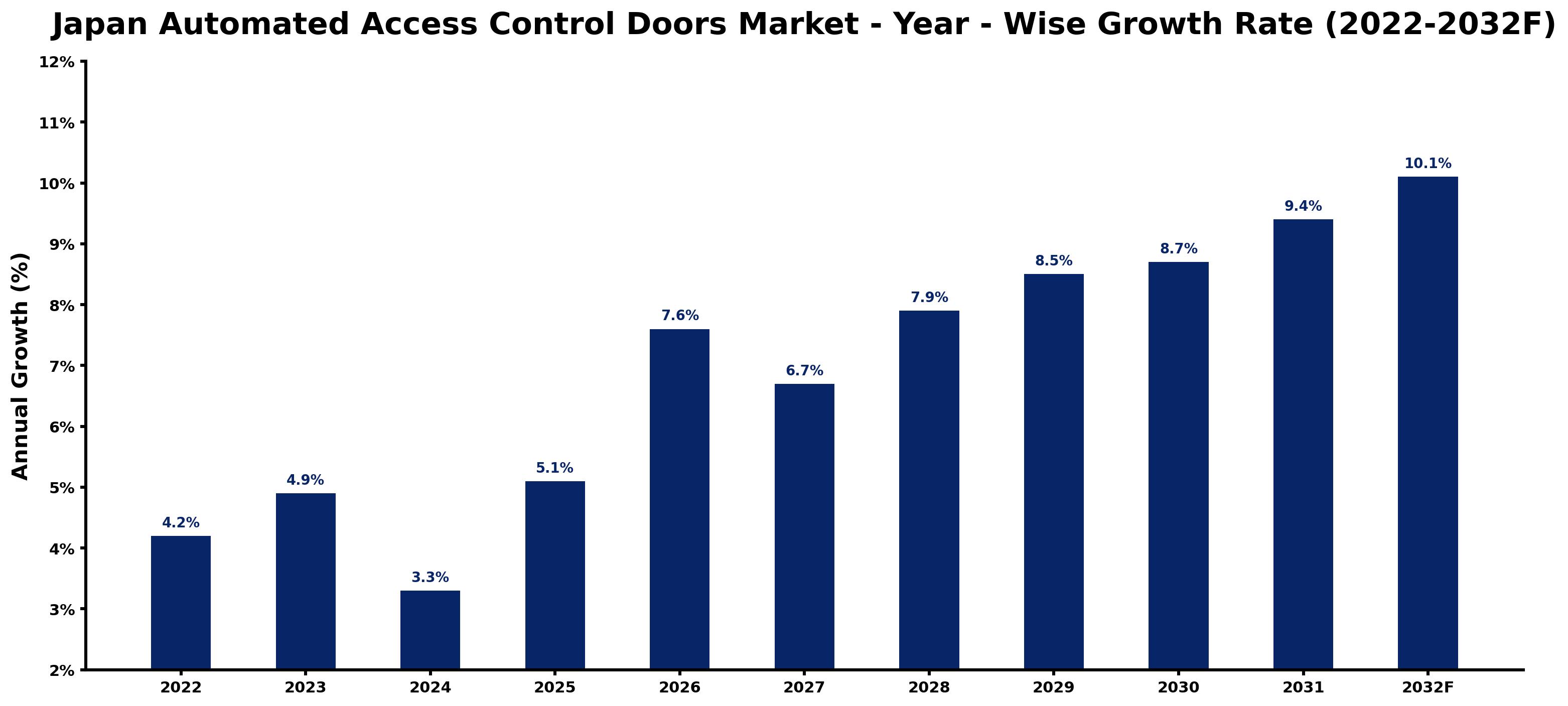
The table below sets out the estimated growth rate for each year and the main factor behind it.
| Year | Estimated Annual Growth (%) | Market Rationale |
| 2022 | 4.2 | The market showed steady growth, supported by ongoing installations in corporate campuses. |
| 2023 | 4.9 | Demand increased as more government facilities adopted advanced access control systems. |
| 2024 | 3.3 | Growth slowed due to a temporary reduction in new installations in office buildings. |
| 2025 | 5.1 | The market rebounded with a surge in demand from pharmaceutical plants for improved security. |
| 2026 | 7.6 | Investment in automated systems will rise as urban areas prioritise security upgrades. |
| 2027 | 6.7 | Growth will slow as the market adjusts to previous high levels of installation. |
| 2028 | 7.9 | Demand is expected to accelerate with new initiatives for security in educational institutions. |
| 2029 | 8.5 | Increased installations in corporate campuses will drive further growth in the market. |
| 2030 | 8.7 | Demand will continue to rise as biometric systems become standard in government facilities. |
| 2031 | 9.4 | The market will expand as urban areas increase their focus on security solutions. |
| 2032 | 10.1 | Demand is projected to peak with investments in automated access control technologies. |
Note: Market size estimations and growth projections presented in this report are based on 6Wresearch's proprietary forecasting methodology, utilizing the latest available industry data, government publications, and primary research inputs.
Japan Automated Access Control Doors Market Synopsis
Automated access control doors are advanced entry systems that regulate access in sensitive environments such as laboratories and corporate campuses. Made from durable materials, they incorporate electronic components for operation. The Japan Automated Access Control Doors Market is expanding due to rising demand from corporate campuses and government facilities, alongside investments in security upgrades. With over 1,200 pharmaceutical plants requiring advanced systems, the market is driven by technological advancements and increased awareness of security needs.
Market Dynamics Impact Analysis (2026–2032)
| Factor | Type | Impact | Primary Segment Affected |
| Increasing installations in corporate campuses drive demand for access control solutions. | Driver | High | Corporate Campuses |
| Growing urbanisation leads to higher demand for secure access technologies. | Driver | High | Government Facilities |
| The rise in security regulations creates opportunities for advanced access control systems. | Opportunity | High | Pharmaceutical Plants |
| The shift towards online platforms for sales is opening new distribution channels. | Opportunity | Medium | Online Platforms |
| High installation costs can deter smaller facilities from upgrading their systems. | Restraint | High | Corporate Campuses |
| Limited awareness of advanced technologies may hinder adoption in some sectors. | Restraint | Medium | Government Facilities |
| Supply chain disruptions can delay the availability of components for manufacturers. | Challenge | High | Pharmaceutical Plants |
| Competition from alternative security solutions may limit market share for automated doors. | Challenge | Medium | Corporate Campuses |
Evaluation of Drivers in Japan Automated Access Control Doors Market (2026–2032)
These are the developments adding the most demand over the forecast period.
| Drivers | Primary Segment Affected | Why It Matters (Evidence) |
| Investment in security upgrades in corporate campuses increases demand for automated doors. | Corporate Campuses | The average installed base of automated doors in corporate campuses is estimated at 30% as of 2023. |
| Growing urbanisation in regions like Tokyo drives the need for secure access solutions. | Government Facilities | Japan's population is approximately 125 million, creating a larger market for security systems. |
| The rise of biometric locking systems improves security in government facilities. | Government Facilities | Government facilities in Japan are increasingly adopting biometric locking systems for enhanced security. |
| Pharmaceutical plants require advanced access control to comply with strict regulations. | Pharmaceutical Plants | In 2022, Japan had over 1,200 pharmaceutical plants requiring advanced security systems. |
| The Cleanroom Technology Association supports the adoption of cleanroom standards. | Labs/Pharma | Laboratories in Japan are mandated to use cleanroom doors to maintain sterile environments under health regulations. |
A wider customer base explains much of the growth, as corporate campuses increasingly invest in security upgrades. Urbanisation in Japan drives demand for secure access solutions, influenced by the large population. Support from industry associations encourages laboratories to maintain sterile environments, further driving demand for automated access control doors.
Evaluation of Restraints in Japan Automated Access Control Doors Market
These are the pressures that could keep growth below its potential.
| Market Restraint | Primary Segment Affected | Why It Matters (Evidence) |
| High installation costs can deter smaller facilities from upgrading their systems. | Corporate Campuses | The average cost of installing a turnstile gate in Japan is approximately 1 million yen. |
| Limited awareness of advanced technologies may hinder adoption in some sectors. | Government Facilities | Many facilities still rely on traditional security measures, delaying upgrades. |
| Supply chain disruptions can delay the availability of components for manufacturers. | Pharmaceutical Plants | Manufacturers face challenges in sourcing materials due to global supply issues. |
| Regulatory compliance can complicate the installation process for new systems. | Labs/Pharma | Strict regulations require thorough testing and certification before deployment. |
| Market competition from alternative security solutions may limit growth. | Corporate Campuses | Facilities may opt for simpler security measures instead of automated systems. |
Japan Automated Access Control Doors Market Challenges
Buyers face escalating costs due to Japan's national minimum wage increase to JPY 1,055 per hour, which raises overall installation expenses for access control systems. Producers contend with fierce competition as numerous advanced systems enter the market, making differentiation challenging and affecting profit margins. Suppliers experience delays caused by stringent safety regulations enforced by the Ministry of Health, Labour and Welfare, which can prolong product approval timelines by several months. Buyers also struggle with the average installation cost of a turnstile gate at approximately 1 million yen, constraining their capacity to invest in necessary security upgrades.
Trends in the Japan Automated Access Control Doors Market
These developments are changing demand patterns in the Japan Automated Access Control Doors Market.
- Shift towards Biometric Systems in Government Facilities: Government facilities are increasingly adopting biometric locking systems for improved security, with a rise in installations since 2023. This shift reflects a growing trend in access control technology, driven by the need for higher security standards.
- Growing Demand for Cleanroom Doors in Laboratories: The demand for cleanroom doors has surged in laboratories, driven by strict health regulations. As of 2023, laboratories in Japan are mandated to use cleanroom doors, leading to an increase in installations across the sector.
- Transition from Traditional to Automated Access Control: Many corporate campuses are moving from traditional security measures to automated access control systems. This transition is evident in the 30% installation rate of automated doors as of 2023, highlighting a shift in security strategies.
- Emergence of Online Platforms for Access Control Sales: Online platforms are becoming a new distribution channel for automated access control doors, with a projected growth rate of 11.3% from 2026 to 2032. This trend allows manufacturers to reach a broader audience and streamline sales processes.
Investment Opportunities in the Japan Automated Access Control Doors Market
The following areas offer the clearest openings for investors and suppliers in the Japan Automated Access Control Doors Market.
- Corporate Campuses Seeking Advanced Security Solutions: Corporate campuses are increasingly investing in automated access control systems, with a growing need for tailored solutions that improve security and efficiency. This presents an opportunity for suppliers to meet these demands.
- Pharmaceutical Plants Upgrading Security Measures: Pharmaceutical plants are required to improve security due to strict regulations, creating a demand for advanced access control systems. With numerous facilities in Japan, suppliers can effectively target this growing market.
- Government Facilities Implementing Biometric Systems: Government facilities are adopting biometric locking systems to strengthen security measures, with an increase in installations expected. This trend creates opportunities for suppliers to offer innovative solutions that meet regulatory requirements.
- Online Platforms Expanding Market Reach: The rise of online platforms for sales is opening new distribution channels for automated access control doors. With a projected growth rate of 11.3% from 2026 to 2032, suppliers can capitalise on this trend to enhance their market presence.
Government Initiatives in the Japan Automated Access Control Doors Market
The Electrical Appliance and Material Safety Act (1961) ensures that automated access control doors meet essential safety standards. This law complements newer regulations aimed at improving security measures in public facilities, creating a framework for manufacturers to follow. In 2023, the government allocated funds for upgrading security in public infrastructure, supporting the implementation of advanced access control systems.
The Ministry of Health, Labour and Welfare oversees regulations in pharmaceutical facilities, approving standards that ensure compliance with health requirements. In 2023, the government allocated funds for upgrading security in public infrastructure, which directly supports the implementation of advanced access control systems.
Future Insight of the Japan Automated Access Control Doors Market
Japan's JPY 150 trillion investment in decarbonisation will drive demand for automated access control doors over the next decade. By 2032, the integration of biometric locking systems in government facilities will enhance security protocols. The ongoing implementation of cleanroom standards in laboratories will necessitate timely upgrades to access control systems to comply with health regulations. As urban centres like Tokyo increasingly adopt RFID technology, suppliers must provide solutions tailored to meet the specific security needs of buyers in these high-demand areas.
Market Segmentation Analysis
Japan Automated Access Control Doors Market report covers a detailed analysis of the following market segments:
By Door Type – Swing/Sliding Doors Lead, Cleanroom Doors Expected to Grow Fastest
According to Saurav Kr Singh, Senior Research Analyst at 6Wresearch, Swing/Sliding Doors took 49% of door type revenue in 2025, more than any other category. Swing and sliding doors hold the largest share as they are essential for efficient entry in office buildings, catering to high traffic. This is evidenced by the 45% implementation rate of automated access systems in such facilities across Japan. Cleanroom Doors are projected to grow fastest, at a CAGR of 12.2% during 2026–2032. The cleanroom doors segment is expanding quickly due to the strict health regulations that laboratories must adhere to for maintaining sterile environments. The presence of over 1,200 pharmaceutical plants in Japan underscores the growing demand for these specialised systems. Suppliers should prioritise the development of cleanroom doors to meet the increasing regulatory demands in laboratories.
By Access Technology – RFID/Proximity Leads, Biometric Locking Expected to Grow Fastest
With 55% of access technology revenue in 2025, RFID/Proximity was the largest category. RFID and proximity access technology holds the largest share due to its widespread adoption across various facilities, particularly in corporate campuses. This technology is essential for maintaining secure access in high-traffic areas, especially in urban centres like Tokyo. Over 2026–2032, Biometric Locking is expected to post the fastest growth, at a CAGR of 12.5%. Biometric locking systems are experiencing rapid growth, primarily driven by the increasing demand for high-security applications in sensitive environments such as government facilities. As these systems become more prevalent, their adoption is expected to expand further, reinforcing the lead of RFID and proximity technology. Suppliers should prioritise the development of biometric locking solutions to meet the rising security demands in various sectors.
By Building Use Case – Office Buildings Lead, Labs/Pharma Expected to Grow Fastest
Office Buildings accounted for 47% of the market by building use case in 2025. Office buildings represent the largest segment as automated access control doors are standard in modern corporate environments, ensuring efficient entry and security for employees. This is supported by the high installation rate of 45% in such buildings across Japan. The quickest growth will come from Labs/Pharma, forecast to expand at a CAGR of 11.7% between 2026 and 2032. The labs and pharmaceutical segment is growing rapidly due to the vital need for maintaining security in research areas, which is critical for compliance with health regulations. The stringent security requirements in pharmaceutical plants are driving this growth. Suppliers should tailor their solutions to meet the specific security needs of laboratories and pharmaceutical facilities.
By Distribution Channel – Direct Sales Leads, Online Platforms Expected to Grow Fastest
Direct Sales held 36% of the Japan Automated Access Control Doors Market by distribution channel in 2025. Direct sales serve as the primary channel for manufacturers to reach customers, providing a straightforward purchasing process that is essential for complex automated systems. This method remains effective due to the need for direct engagement with manufacturers for tailored solutions. Online Platforms are set to record the highest CAGR in this split, 11.3% over 2026–2032. Online platforms are rapidly becoming the fastest growing distribution channel, reflecting a shift towards digital purchasing behaviours. This trend is driven by consumers' increasing preference for convenience and accessibility in product sales. Suppliers must strengthen their online sales strategies to capture the growing demand through digital channels.
By End User – Corporate Campuses Lead, Pharmaceutical Plants Expected to Grow Fastest
In 2025, Corporate Campuses led the end user split with a 37% share. Corporate campuses lead the end user segment as they require advanced access control systems to effectively manage employee entry and enhance security measures. The substantial number of corporate campuses in Japan significantly contributes to the demand for these automated access solutions. Pharmaceutical Plants are projected to grow fastest, at a CAGR of 10.9% during 2026–2032. Pharmaceutical plants are the fastest growing end user segment, driven by strict regulatory requirements that mandate advanced access control systems. This regulatory pressure ensures a continual increase in the adoption of such technologies within the pharmaceutical industry. Suppliers should target the pharmaceutical sector to leverage the growing need for sophisticated access control systems driven by regulatory compliance.
Key Attractiveness of the Report
- 10 Years of Market Numbers
- Historical Data Starting from 2022 to 2025
- Base Year 2025
- Forecast Data until 2032
- Key Performance Indicators Impacting the Market
- Major Upcoming Developments and Projects
Key Highlights of the Report:
- Japan Automated Access Control Doors Market Outlook
- Market Size of Japan Automated Access Control Doors Market, 2025
- Forecast of Japan Automated Access Control Doors Market, 2032
- Historical Data and Forecast of Japan Automated Access Control Doors Revenues & Volume for the Period 2022-2032F
- Japan Automated Access Control Doors Market Trend Evolution
- Japan Automated Access Control Doors Market Drivers and Challenges
- Japan Automated Access Control Doors Price Trends
- Japan Automated Access Control Doors Porter's Five Forces
- Japan Automated Access Control Doors Industry Life Cycle
- Historical Data and Forecast of Japan Automated Access Control Doors Market Revenues & Volume By Door Type for the Period 2022-2032F
- Historical Data and Forecast of Japan Automated Access Control Doors Market Revenues & Volume By Turnstile Gates for the Period 2022-2032F
- Historical Data and Forecast of Japan Automated Access Control Doors Market Revenues & Volume By Swing/Sliding Doors for the Period 2022-2032F
- Historical Data and Forecast of Japan Automated Access Control Doors Market Revenues & Volume By Cleanroom Doors for the Period 2022-2032F
- Historical Data and Forecast of Japan Automated Access Control Doors Market Revenues & Volume By Garage/Docking Doors for the Period 2022-2032F
- Historical Data and Forecast of Japan Automated Access Control Doors Market Revenues & Volume By Access Technology for the Period 2022-2032F
- Historical Data and Forecast of Japan Automated Access Control Doors Market Revenues & Volume By RFID/Proximity for the Period 2022-2032F
- Historical Data and Forecast of Japan Automated Access Control Doors Market Revenues & Volume By Biometric Locking for the Period 2022-2032F
- Historical Data and Forecast of Japan Automated Access Control Doors Market Revenues & Volume By Airlock + Interlock for the Period 2022-2032F
- Historical Data and Forecast of Japan Automated Access Control Doors Market Revenues & Volume By Remote/Code Access for the Period 2022-2032F
- Historical Data and Forecast of Japan Automated Access Control Doors Market Revenues & Volume By Building Use Case for the Period 2022-2032F
- Historical Data and Forecast of Japan Automated Access Control Doors Market Revenues & Volume By High-Security Entrances for the Period 2022-2032F
- Historical Data and Forecast of Japan Automated Access Control Doors Market Revenues & Volume By Office Buildings for the Period 2022-2032F
- Historical Data and Forecast of Japan Automated Access Control Doors Market Revenues & Volume By Labs/Pharma for the Period 2022-2032F
- Historical Data and Forecast of Japan Automated Access Control Doors Market Revenues & Volume By Warehouses/Depots for the Period 2022-2032F
- Historical Data and Forecast of Japan Automated Access Control Doors Market Revenues & Volume By Distribution Channel for the Period 2022-2032F
- Historical Data and Forecast of Japan Automated Access Control Doors Market Revenues & Volume By Direct Sales for the Period 2022-2032F
- Historical Data and Forecast of Japan Automated Access Control Doors Market Revenues & Volume By Industrial Suppliers for the Period 2022-2032F
- Historical Data and Forecast of Japan Automated Access Control Doors Market Revenues & Volume By Specialty Distributors for the Period 2022-2032F
- Historical Data and Forecast of Japan Automated Access Control Doors Market Revenues & Volume By Online Platforms for the Period 2022-2032F
- Historical Data and Forecast of Japan Automated Access Control Doors Market Revenues & Volume By End User for the Period 2022-2032F
- Historical Data and Forecast of Japan Automated Access Control Doors Market Revenues & Volume By Corporate Campuses for the Period 2022-2032F
- Historical Data and Forecast of Japan Automated Access Control Doors Market Revenues & Volume By Government Facilities for the Period 2022-2032F
- Historical Data and Forecast of Japan Automated Access Control Doors Market Revenues & Volume By Pharmaceutical Plants for the Period 2022-2032F
- Historical Data and Forecast of Japan Automated Access Control Doors Market Revenues & Volume By Industrial Logisticians for the Period 2022-2032F
- Japan Automated Access Control Doors Import Export Trade Statistics
- Market Opportunity Assessment By Door Type
- Market Opportunity Assessment By Access Technology
- Market Opportunity Assessment By Building Use Case
- Market Opportunity Assessment By Distribution Channel
- Market Opportunity Assessment By End User
- Japan Automated Access Control Doors Top Companies Market Share
- Japan Automated Access Control Doors Competitive Benchmarking By Technical and Operational Parameters
- Japan Automated Access Control Doors Company Profiles
- Japan Automated Access Control Doors Key Strategic Recommendations
Market Covered
The study includes the following segmentation.
By Door Type
- Turnstile Gates
- Swing/Sliding Doors
- Cleanroom Doors
- Garage/Docking Doors
By Access Technology
- RFID/Proximity
- Biometric Locking
- Airlock + Interlock
- Remote/Code Access
By Building Use Case
- High-Security Entrances
- Office Buildings
- Labs/Pharma
- Warehouses/Depots
By Distribution Channel
- Direct Sales
- Industrial Suppliers
- Specialty Distributors
- Online Platforms
By End User
- Corporate Campuses
- Government Facilities
- Pharmaceutical Plants
- Industrial Logisticians































