Japan Automated Bookkeeping AI Market Size & Growth Rate
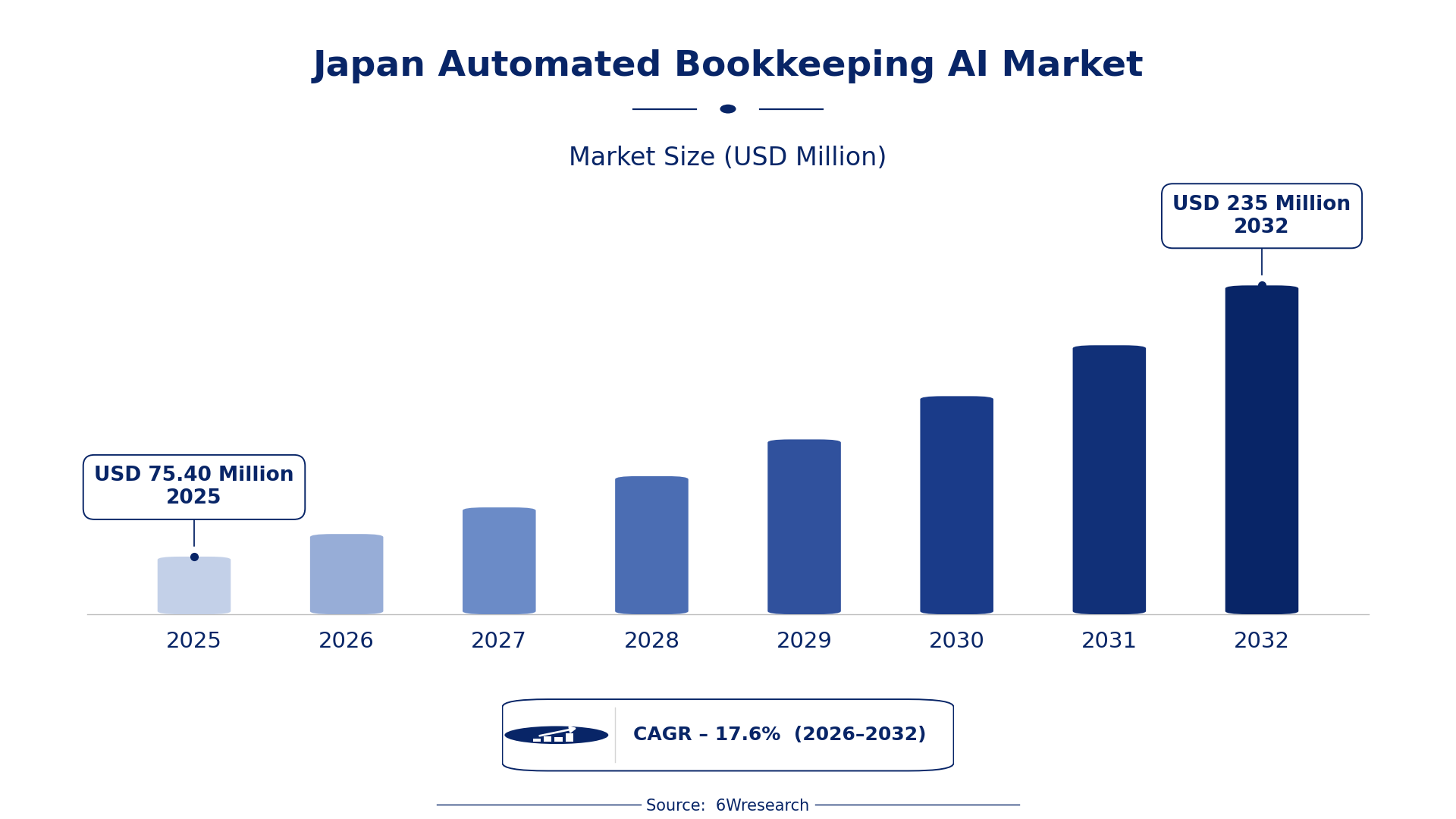
According to 6Wresearch internal database and industry insights, the Japan Automated Bookkeeping AI Market was valued at USD 75.40 Million in 2025 and is projected to reach USD 235 Million by 2032, growing at a CAGR of approximately 17.6% during 2026–2032.
Japan Automated Bookkeeping AI Market Highlights
| Report Metric | Details |
| Report Name | Japan Automated Bookkeeping AI Market (2026-2032) |
| Market Size 2025 | USD 75.40 Million |
| Market Size 2032 | USD 235 Million |
| Absolute Growth 2025–2032 | USD 159.60 Million |
| CAGR 2026–2032 | 17.6% |
| Peak Annual Growth | 18.5% in 2029 |
| Forecast Period | 2026–2032 |
| Historical Data | 2022–2025 |
| Base Year | 2025 |
| Leading Application Area, 2025 | Invoice Processing (40% share) |
| Leading Automation Feature, 2025 | OCR + NLP Extraction (43% share) |
| Leading Deployment Mode, 2025 | Cloud-Based SaaS (46% share) |
| Leading Distribution Channel, 2025 | Online Platforms (44% share) |
| Leading End User, 2025 | SMBs & Accounting Firms (45% share) |
| Fastest-Growing Application Area | Expense Reconciliation (22.5% CAGR) |
| Fastest-Growing Automation Feature | Pattern Matching AI (19.1% CAGR) |
| Fastest-Growing Deployment Mode | Web/App Platforms (19.0% CAGR) |
| Fastest-Growing Distribution Channel | Direct Sales (23.0% CAGR) |
| Fastest-Growing End User | Startups & Freelancers (23.1% CAGR) |
| Growing Sector | Accounting and Financial Services |
| Key End Users | SMBs, Accounting Firms, Tax Professionals, Startups |
Japan Automated Bookkeeping AI Market Year-wise Growth Rate and Key Drivers (2022–2032)
This graph illustrates the annual growth rates of the market from 2022 to 2032, highlighting a steady upward trajectory and projected market expansion over the forecast period.
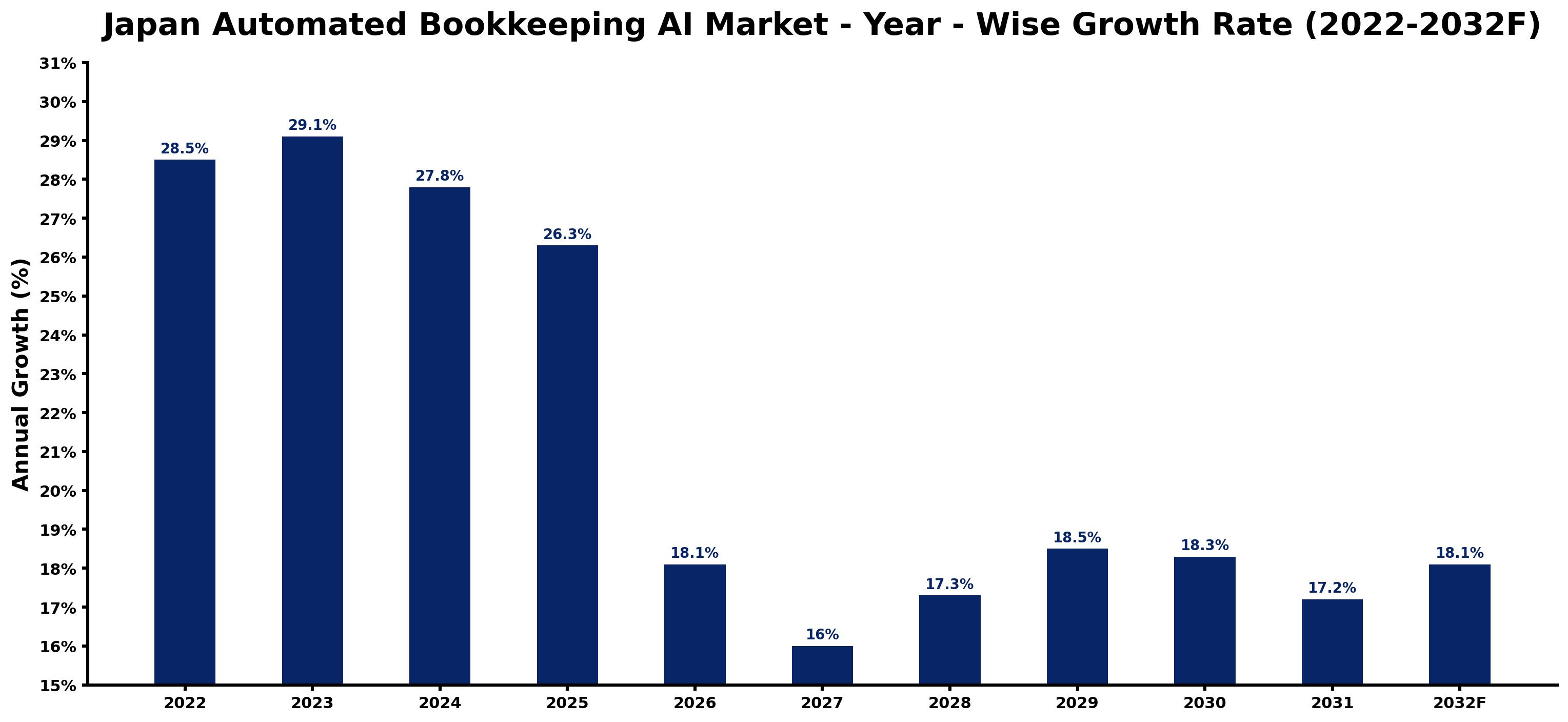
The yearly estimates that follow link every growth rate to its principal driver, so readers can see why the pace changed in each period.
| Year | Estimated Annual Growth (%) | Market Rationale |
| 2022 | 28.5 | The market was characterised by strong demand from small and medium-sized enterprises. |
| 2023 | 29.1 | Growth accelerated due to increased adoption of AI technologies among accounting firms. |
| 2024 | 27.8 | The pace of growth slowed as market saturation began to set in. |
| 2025 | 26.3 | Demand continued to rise but at a slower rate as firms adjusted to new technologies. |
| 2026 | 18.1 | A further slowdown is expected as the market stabilises amid competitive pressures. |
| 2027 | 16.0 | Growth will remain steady as businesses focus on refining their AI implementations. |
| 2028 | 17.3 | Demand is projected to pick up again as firms seek to improve efficiency through automation. |
| 2029 | 18.5 | The market is expected to experience a peak in growth driven by technological advancements. |
| 2030 | 18.3 | Growth will slow slightly as the market begins to mature and consolidate. |
| 2031 | 17.2 | The pace of growth is expected to slow as competition increases. |
| 2032 | 18.1 | Demand is projected to rise again as new applications of AI emerge. |
Note: Market size estimations and growth projections presented in this report are based on 6Wresearch's proprietary forecasting methodology, utilizing the latest available industry data, government publications, and primary research inputs.
Japan Automated Bookkeeping AI Market Synopsis
Automated Bookkeeping AI is a technology that streamlines financial record-keeping through machine learning and natural language processing. In 2023, over 4 million small and medium-sized enterprises in Japan could benefit from these solutions, driving demand. The Japan Automated Bookkeeping AI Market is expanding due to digital transformation initiatives launched by the Ministry of Economy, Trade and Industry, alongside the increasing adoption of AI technologies by accounting firms, which reduces manual effort and errors.
Market Dynamics Impact Analysis (2026–2032)
| Factor | Type | Impact | Primary Segment Affected |
| Growing adoption of AI technologies in accounting practices | Driver | High | Invoice Processing |
| Increased focus on digital transformation among SMBs | Driver | High | Expense Reconciliation |
| Rising demand for automation in tax filing processes | Opportunity | High | Tax Filing Automation |
| Expansion of the startup ecosystem in Japan | Opportunity | Medium | General Ledger AI Tools |
| Concerns over data security and compliance regulations | Restraint | High | OCR + NLP Extraction |
| Limited awareness of AI benefits among traditional firms | Restraint | Medium | Pattern Matching AI |
| High competition among AI solution providers | Challenge | High | Rule-Based AI |
| Challenges in integrating AI with existing systems | Challenge | Medium | ML-Based Categorization |
Evaluation of Drivers in Japan Automated Bookkeeping AI Market (2026–2032)
Demand rests on the following drivers, each shown with the segment it touches most.
| Drivers | Primary Segment Affected | Why It Matters (Evidence) |
| Increased digital transformation initiatives | Expense Reconciliation | The Ministry of Economy, Trade and Industry's 2023 initiative supports SMBs in adopting AI tools, leading to higher demand for automation. |
| Growing number of accounting firms adopting AI | Tax Filing Automation | The demand for efficient tax filing solutions has surged, prompting more firms to invest in AI technologies. |
| Rising complexity of financial regulations | General Ledger AI Tools | As regulations evolve, firms require automated solutions to maintain compliance, boosting demand for AI tools. |
| Increased focus on operational efficiency | Invoice Processing | The average annual tax filing in Japan drives firms to seek automation to streamline processes. |
| Expansion of the startup ecosystem | OCR + NLP Extraction | With 10,000 startups in Japan, there is a growing need for automated solutions to manage financial records efficiently. |
In Japan, the demand for automated solutions for expense reconciliation has surged. The average annual tax filing for individuals is around 10 million, prompting firms to invest in tax filing automation to improve efficiency. The number of startups in Japan is also rising, increasing the demand for OCR and NLP extraction technologies to manage financial records effectively.
Evaluation of Restraints in Japan Automated Bookkeeping AI Market
The following restraints limit how fast demand can grow.
| Market Restraint | Primary Segment Affected | Why It Matters (Evidence) |
| Concerns over data security and compliance issues | OCR + NLP Extraction | The implementation of the JIS Q 15001 standard raises concerns about data handling, affecting adoption rates among firms. |
| Limited understanding of AI benefits among traditional firms | Pattern Matching AI | Many traditional firms lack awareness of AI advantages, hindering their willingness to invest in new technologies. |
| High initial investment costs for AI solutions | Rule-Based AI | The upfront costs associated with implementing AI tools deter some businesses from adopting these technologies. |
| Integration challenges with existing systems | ML-Based Categorization | Many firms face difficulties in integrating AI solutions with their current financial systems, slowing down adoption. |
| Regulatory compliance pressures | General Ledger AI Tools | Evolving regulations require firms to invest heavily in compliance, limiting funds available for AI adoption. |
Japan Automated Bookkeeping AI Market Challenges
In 2023, over 4 million SMBs in Japan struggle with outdated financial processes, resulting in compliance issues that can incur penalties and increase operational costs. Strict regulations, such as the JIS Q 15001 standard for information security management, challenge many firms, leading to potential legal fees for those unable to comply. Competition intensifies as accounting firms adopting AI technologies gain market share, forcing others to risk losing clients and revenue. A shortage of skilled professionals in AI and bookkeeping technologies hampers suppliers, delaying product launches and raising costs for SMBs seeking advanced solutions.
Trends in the Japan Automated Bookkeeping AI Market
These developments are changing demand patterns in the Japan Automated Bookkeeping AI Market.
- Rise of Direct Sales Channels: Direct sales channels are becoming more prominent in the automated bookkeeping AI market, with a projected growth rate of 23% from 2026 to 2032. This shift allows providers to offer tailored solutions directly to businesses, improving customer relationships.
- Increased Adoption by Startups and Freelancers: Startups and freelancers are increasingly adopting automated bookkeeping solutions to streamline their financial processes. This trend reflects the growing demand for efficiency in managing finances, with a CAGR of 23.1%.
- Shift towards Cloud-Based Solutions: The Tokyo region is seeing a rise in SMBs adopting cloud-based automated bookkeeping solutions for flexibility and scalability. In 2023, Cloud-Based SaaS solutions accounted for 46% of the market, indicating a strong preference for accessible technologies.
- Emergence of AI Standards in Accounting: The Japan Institute of Certified Public Accountants published guidelines for AI use in accounting, starting in 2023. This initiative aims to standardise practices and build trust in AI technologies, encouraging more firms to adopt these solutions.
Investment Opportunities in the Japan Automated Bookkeeping AI Market
Where to invest in the Japan Automated Bookkeeping AI Market: the main openings are set out below.
- Tokyo Region as a Hub for AI Adoption: The Tokyo region, with its high concentration of accounting firms, presents an opportunity for AI solution providers. In 2023, there are over 4 million SMBs that could benefit from these technologies, making it a prime market for investment.
- Supply of Tax Filing Automation Tools: There is a growing need for tax filing automation tools among tax professionals in Japan. With approximately 1.2 million tax professionals, suppliers can enter this market by forming partnerships with local firms.
- Investment in Compliance-Driven Solutions: As regulatory pressures increase, there is an opportunity to invest in compliance-driven AI solutions. The accounting industry is projected to invest heavily in AI technologies over the next five years, creating demand for innovative products.
- Partnerships with Startups: Collaborating with startups can provide access to innovative ideas and technologies in the automated bookkeeping space. This approach can help established firms expand their offerings and reach new customer segments.
Government Initiatives in the Japan Automated Bookkeeping AI Market
The AI Promotion Act, enacted in 2025, provides a national framework for AI research and development, improving the regulatory environment for AI technologies. This law complements existing measures by offering clearer guidelines for AI implementation in various sectors, including finance, ensuring that producers meet compliance standards while promoting innovation. The Ministry of Economy, Trade and Industry has allocated significant funding to support these initiatives, aiming for a 30% increase in digital adoption among SMBs by 2025.
The AI Promotion Act is supported by funding initiatives aimed at increasing digital adoption among SMBs. In 2023, a digital transformation initiative was launched targeting a 30% increase in digital adoption by 2025, benefiting many businesses seeking to modernise their operations. This support helps accounting firms adopt automated bookkeeping solutions, enhancing their operational efficiency.
Future Insight of the Japan Automated Bookkeeping AI Market
Japan's commitment to a 46% reduction in greenhouse-gas emissions by 2030 will stimulate advancements in AI bookkeeping solutions, aligning with broader sustainability efforts. The anticipated JPY 150 trillion investment in decarbonisation will empower accounting firms to introduce innovative services that address environmental concerns. As startups increasingly adopt AI tools, buyers will benefit from customised solutions that improve efficiency. The Ministry of Economy, Trade and Industry's digital transformation initiative will facilitate AI integration, creating a more competitive landscape for accounting services.
Market Segmentation Analysis
Japan Automated Bookkeeping AI Market report covers a detailed analysis of the following market segments:
By Application Area – Invoice Processing Leads, Expense Reconciliation Expected to Grow Fastest
According to Saurav Kr Singh, Senior Research Analyst at 6Wresearch, with 40% of application area revenue in 2025, Invoice Processing was the largest category. Invoice processing holds the largest share in the market due to its critical role in automating the extraction and processing of invoice data, which many businesses rely on. The Tokyo region, with its high concentration of accounting firms, exemplifies the demand for efficient invoice management solutions. The quickest growth will come from Expense Reconciliation, forecast to expand at a CAGR of 22.5% between 2026 and 2032. Expense reconciliation is experiencing rapid growth as it streamlines accounting workflows by matching expenses with receipts, a necessary function for many enterprises. The surge in the number of startups, reaching 10,000 in 2023, drives this demand as they increasingly adopt efficient financial management tools. This means suppliers should focus on developing features that improve expense reconciliation to capitalise on this growing market segment.
By Automation Feature – OCR + NLP Extraction Leads, Pattern Matching AI Expected to Grow Fastest
OCR + NLP Extraction accounted for 43% of the market by automation feature in 2025. OCR + NLP extraction is the leading feature as it allows for the conversion of scanned documents into editable formats, making it indispensable for financial processes. This technology is particularly beneficial for the high volume of invoices processed by over 4 million SMBs in Japan. Pattern Matching AI is projected to grow fastest, at a CAGR of 19.1% during 2026–2032. Pattern matching AI is the fastest-growing feature because it identifies patterns in financial transactions to flag anomalies, which is increasingly vital for compliance and accuracy. As the Japanese accounting industry invests heavily in AI technologies, this feature's relevance will continue to rise. Buyers should prioritise solutions that integrate advanced pattern matching capabilities to stay ahead in compliance and efficiency.
By Deployment Mode – Cloud-Based SaaS Lead, Web/App Platforms Expected to Grow Fastest
Cloud-Based SaaS held 46% of the Japan Automated Bookkeeping AI Market by deployment mode in 2025. Cloud-based SaaS is the dominant deployment mode as it provides easy access and scalability, essential for businesses looking to streamline their operations. This model is particularly attractive to the Tokyo region, which has the highest concentration of accounting firms utilising AI technologies. Web/App Platforms are set to record the highest CAGR in this split, 19.0% over 2026–2032. Web/app platforms are growing rapidly due to their convenience, allowing users to access services via mobile and web applications. The increasing digital adoption target set by the Japanese government will further accelerate this trend. Suppliers should ensure their solutions are optimised for web and mobile access to meet the evolving preferences of users.
By Distribution Channel – Online Platforms Lead, Direct Sales Expected to Grow Fastest
The largest distribution channel category in 2025 was Online Platforms, at 44% of revenue. Online platforms are the leading distribution channel as they provide extensive reach and accessibility for automated bookkeeping solutions. This method aligns well with the digital transformation initiative introduced by the Ministry of Economy, Trade and Industry in 2023, promoting wider adoption of technology. Over 2026–2032, Direct Sales is expected to post the fastest growth, at a CAGR of 23.0%. Direct sales are experiencing swift growth as they offer customised solutions that cater to specific business requirements, particularly for small and medium-sized enterprises. This trend highlights the increasing preference for personalised service in the marketplace. Suppliers need to establish strong direct sales strategies to effectively meet the distinct needs of their clients.
By End User – SMBs & Accounting Firms Lead, Startups & Freelancers Expected to Grow Fastest
SMBs & Accounting Firms took 45% of end user revenue in 2025, more than any other category. SMBs and accounting firms dominate the end user segment due to their reliance on automated bookkeeping for efficiency and accuracy in financial management. With over 4 million SMBs in Japan, this group represents a substantial market for these solutions. The quickest growth will come from Startups & Freelancers, forecast to expand at a CAGR of 23.1% between 2026 and 2032. Startups and freelancers are rapidly adopting automated bookkeeping solutions as they seek to optimise their financial processes with limited resources. The surge in startups, reaching 10,000 in 2023, underscores the growing importance of this segment. Suppliers should tailor their offerings to meet the specific needs of startups and freelancers to capture this expanding market.
Key Attractiveness of the Report
- 10 Years of Market Numbers
- Historical Data Starting from 2022 to 2025
- Base Year 2025
- Forecast Data until 2032
- Key Performance Indicators Impacting the Market
- Major Upcoming Developments and Projects
Key Highlights of the Report:
- Japan Automated Bookkeeping AI Market Outlook
- Market Size of Japan Automated Bookkeeping AI Market, 2025
- Forecast of Japan Automated Bookkeeping AI Market, 2032
- Historical Data and Forecast of Japan Automated Bookkeeping AI Revenues & Volume for the Period 2022-2032F
- Japan Automated Bookkeeping AI Market Trend Evolution
- Japan Automated Bookkeeping AI Market Drivers and Challenges
- Japan Automated Bookkeeping AI Price Trends
- Japan Automated Bookkeeping AI Porter's Five Forces
- Japan Automated Bookkeeping AI Industry Life Cycle
- Historical Data and Forecast of Japan Automated Bookkeeping AI Market Revenues & Volume By Application Area for the Period 2022-2032F
- Historical Data and Forecast of Japan Automated Bookkeeping AI Market Revenues & Volume By Invoice Processing for the Period 2022-2032F
- Historical Data and Forecast of Japan Automated Bookkeeping AI Market Revenues & Volume By Expense Reconciliation for the Period 2022-2032F
- Historical Data and Forecast of Japan Automated Bookkeeping AI Market Revenues & Volume By Tax Filing Automation for the Period 2022-2032F
- Historical Data and Forecast of Japan Automated Bookkeeping AI Market Revenues & Volume By General Ledger AI Tools for the Period 2022-2032F
- Historical Data and Forecast of Japan Automated Bookkeeping AI Market Revenues & Volume By Automation Feature for the Period 2022-2032F
- Historical Data and Forecast of Japan Automated Bookkeeping AI Market Revenues & Volume By OCR + NLP Extraction for the Period 2022-2032F
- Historical Data and Forecast of Japan Automated Bookkeeping AI Market Revenues & Volume By Pattern Matching AI for the Period 2022-2032F
- Historical Data and Forecast of Japan Automated Bookkeeping AI Market Revenues & Volume By Rule-Based AI for the Period 2022-2032F
- Historical Data and Forecast of Japan Automated Bookkeeping AI Market Revenues & Volume By ML-Based Categorization for the Period 2022-2032F
- Historical Data and Forecast of Japan Automated Bookkeeping AI Market Revenues & Volume By Deployment Mode for the Period 2022-2032F
- Historical Data and Forecast of Japan Automated Bookkeeping AI Market Revenues & Volume By Cloud-Based SaaS for the Period 2022-2032F
- Historical Data and Forecast of Japan Automated Bookkeeping AI Market Revenues & Volume By Web/App Platforms for the Period 2022-2032F
- Historical Data and Forecast of Japan Automated Bookkeeping AI Market Revenues & Volume By API-Integrated Tools for the Period 2022-2032F
- Historical Data and Forecast of Japan Automated Bookkeeping AI Market Revenues & Volume By Plug-ins for ERP Systems for the Period 2022-2032F
- Historical Data and Forecast of Japan Automated Bookkeeping AI Market Revenues & Volume By Distribution Channel for the Period 2022-2032F
- Historical Data and Forecast of Japan Automated Bookkeeping AI Market Revenues & Volume By Online Platforms for the Period 2022-2032F
- Historical Data and Forecast of Japan Automated Bookkeeping AI Market Revenues & Volume By Direct Sales for the Period 2022-2032F
- Historical Data and Forecast of Japan Automated Bookkeeping AI Market Revenues & Volume By Industrial Suppliers for the Period 2022-2032F
- Historical Data and Forecast of Japan Automated Bookkeeping AI Market Revenues & Volume By Specialty Distributors for the Period 2022-2032F
- Historical Data and Forecast of Japan Automated Bookkeeping AI Market Revenues & Volume By End User for the Period 2022-2032F
- Historical Data and Forecast of Japan Automated Bookkeeping AI Market Revenues & Volume By SMBs & Accounting Firms for the Period 2022-2032F
- Historical Data and Forecast of Japan Automated Bookkeeping AI Market Revenues & Volume By Startups & Freelancers for the Period 2022-2032F
- Historical Data and Forecast of Japan Automated Bookkeeping AI Market Revenues & Volume By Tax Professionals for the Period 2022-2032F
- Historical Data and Forecast of Japan Automated Bookkeeping AI Market Revenues & Volume By Large Enterprises for the Period 2022-2032F
- Japan Automated Bookkeeping AI Import Export Trade Statistics
- Market Opportunity Assessment By Application Area
- Market Opportunity Assessment By Automation Feature
- Market Opportunity Assessment By Deployment Mode
- Market Opportunity Assessment By Distribution Channel
- Market Opportunity Assessment By End User
- Japan Automated Bookkeeping AI Top Companies Market Share
- Japan Automated Bookkeeping AI Competitive Benchmarking By Technical and Operational Parameters
- Japan Automated Bookkeeping AI Company Profiles
- Japan Automated Bookkeeping AI Key Strategic Recommendations
Market Covered
Coverage by segment is as follows.
By Application Area
- Invoice Processing
- Expense Reconciliation
- Tax Filing Automation
- General Ledger AI Tools
By Automation Feature
- OCR + NLP Extraction
- Pattern Matching AI
- Rule-Based AI
- ML-Based Categorization
By Deployment Mode
- Cloud-Based SaaS
- Web/App Platforms
- API-Integrated Tools
- Plug-ins for ERP Systems
By Distribution Channel
- Online Platforms
- Direct Sales
- Industrial Suppliers
- Specialty Distributors
By End User
- SMBs & Accounting Firms
- Startups & Freelancers
- Tax Professionals
- Large Enterprises































