Japan Automated Garage Doors Market Size & Growth Rate
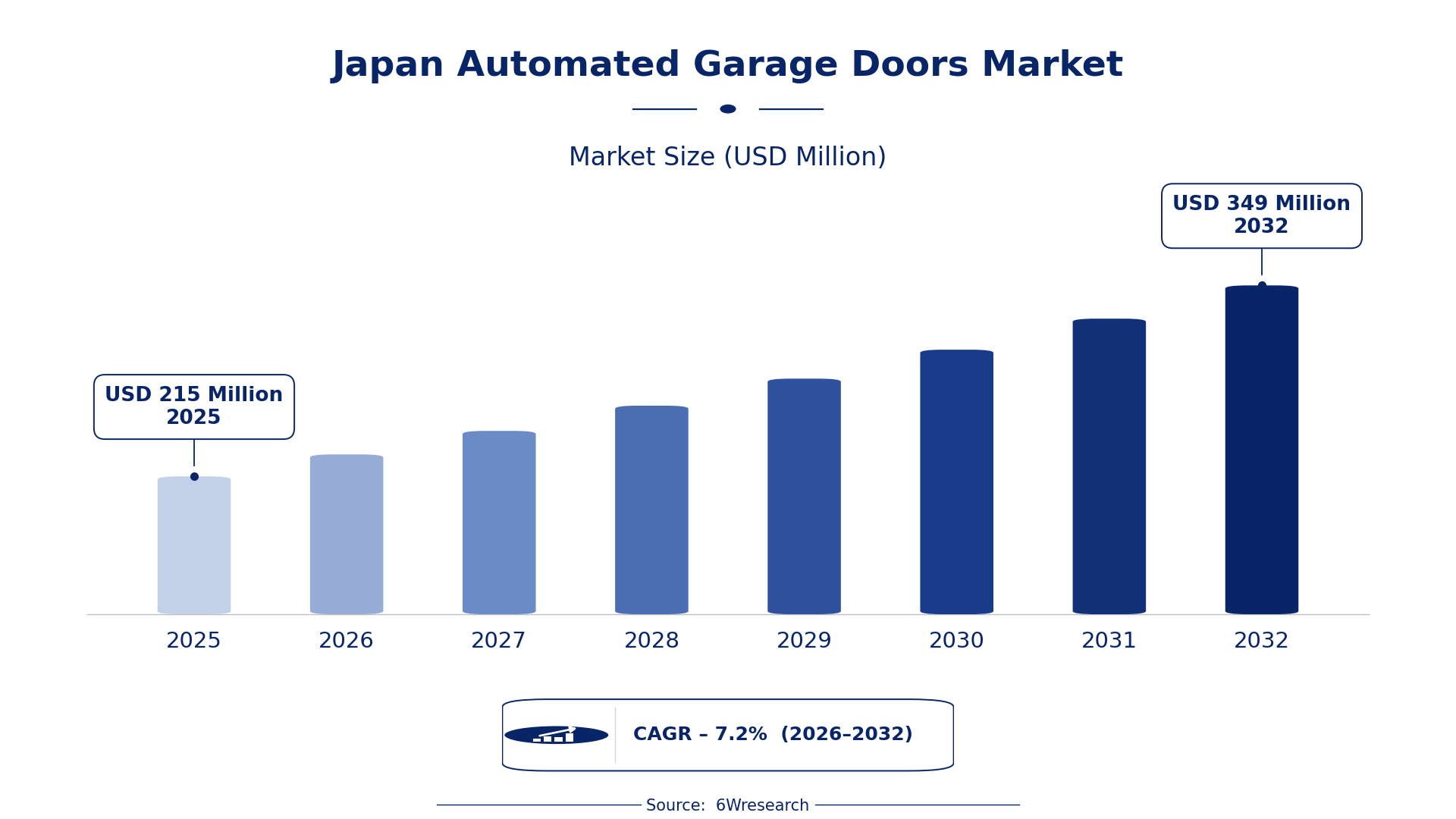
According to 6Wresearch internal database and industry insights, the Japan Automated Garage Doors Market was valued at USD 215 Million in 2025 and is projected to reach USD 349 Million by 2032, growing at a CAGR of approximately 7.2% during 2026–2032.
Japan Automated Garage Doors Market Highlights
| Report Metric | Details |
| Report Name | Japan Automated Garage Doors Market (2026-2032) |
| Market Size 2025 | USD 215 Million |
| Market Size 2032 | USD 349 Million |
| Absolute Growth 2025–2032 | USD 134 Million |
| CAGR 2026–2032 | 7.2% |
| Peak Annual Growth | 8.0% in 2028 |
| Forecast Period | 2026–2032 |
| Historical Data | 2022–2025 |
| Base Year | 2025 |
| Leading Door Type, 2025 | Residential Roll-up (51% share) |
| Leading Opening Method, 2025 | Remote Control (35% share) |
| Leading Connectivity, 2025 | Wi-Fi/Smart Home (51% share) |
| Leading Distribution Channel, 2025 | Direct Sales (48% share) |
| Leading End User, 2025 | Homeowners & Builders (35% share) |
| Fastest-Growing Door Type | Commercial Sectional (10.5% CAGR) |
| Fastest-Growing Opening Method | Sensor/Remote (10.4% CAGR) |
| Fastest-Growing Connectivity | RFID / Wi-Fi Security (10.0% CAGR) |
| Fastest-Growing Distribution Channel | Online Platforms (9.5% CAGR) |
| Fastest-Growing End User | Warehouses & Commercial Facilities (9.7% CAGR) |
| Growing Sector | Residential sector |
| Key End Users | Homeowners, Builders, Commercial Facilities, Industrial Users |
Japan Automated Garage Doors Market Year-wise Growth Rate and Key Drivers (2022–2032)
This graph illustrates the annual growth rates of the market from 2022 to 2032, highlighting a steady upward trajectory and projected market expansion over the forecast period.
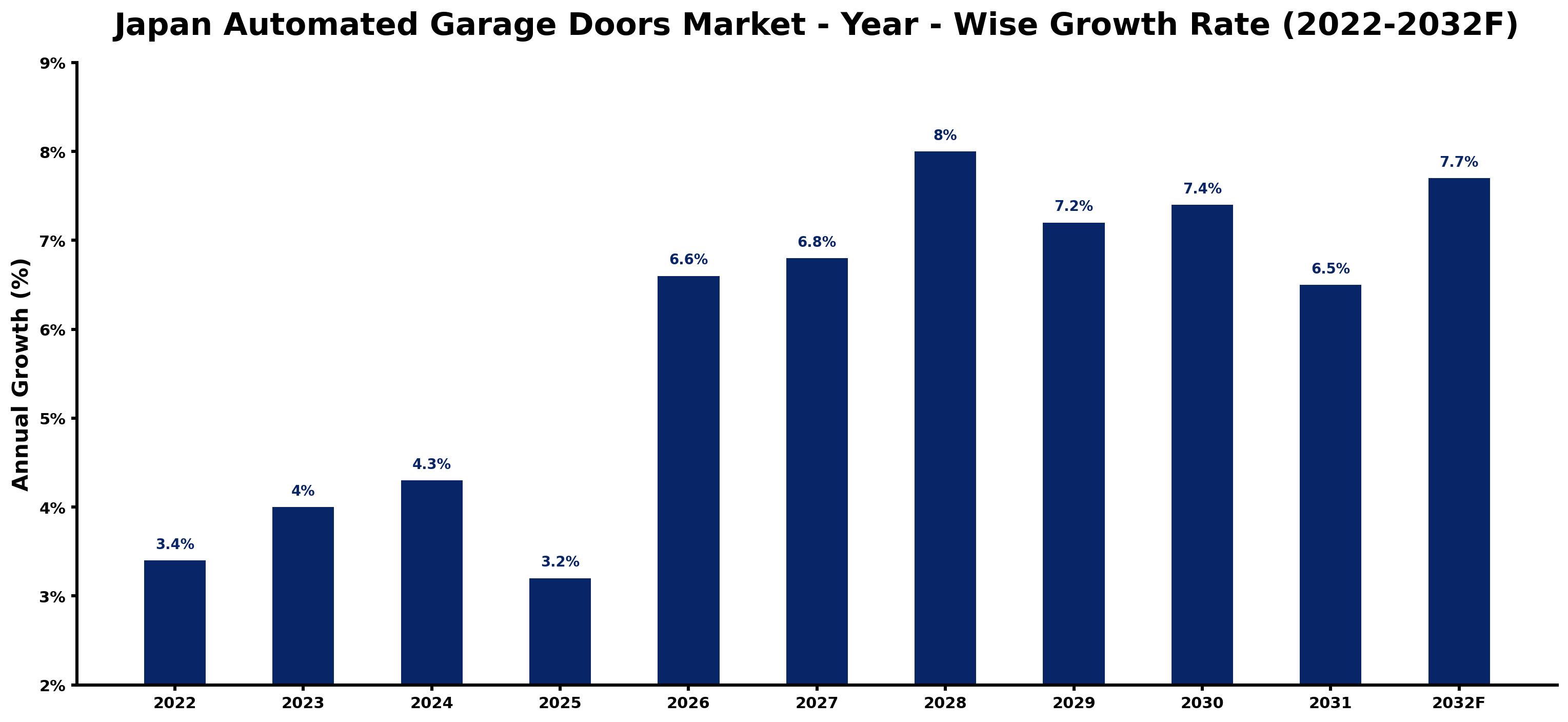
Annual growth estimates for each year appear below with the principal reason behind them, explaining the shifts that set the pace of the market.
| Year | Estimated Annual Growth (%) | Market Rationale |
| 2022 | 3.4 | Demand for automated garage doors was stable, reflecting ongoing construction activity. |
| 2023 | 4.0 | Growth accelerated due to increased installations in residential projects. |
| 2024 | 4.3 | Demand continued to rise as more homeowners opted for automated solutions. |
| 2025 | 3.2 | Growth slowed slightly as market saturation began to affect new installations. |
| 2026 | 6.6 | Demand is expected to surge with a renewed focus on smart home technologies. |
| 2027 | 6.8 | The trend towards automation in homes is projected to continue driving growth. |
| 2028 | 8.0 | Peak growth is expected as urban areas increasingly adopt automated doors. |
| 2029 | 7.2 | A slight slowdown is projected as the market matures and competition intensifies. |
| 2030 | 7.4 | Demand is expected to rise again as new construction projects are initiated. |
| 2031 | 6.5 | Growth is projected to moderate as the market stabilises after rapid expansion. |
| 2032 | 7.7 | An increase in retrofitting older homes is expected to spur further demand. |
Note: Market size estimations and growth projections presented in this report are based on 6Wresearch's proprietary forecasting methodology, utilizing the latest available industry data, government publications, and primary research inputs.
Japan Automated Garage Doors Market Synopsis
Automated garage doors are mechanical systems designed for residential and commercial use, providing security and convenience. In Japan, more than 1 million units are sold each year, with the Tokyo metropolitan area representing 30% of demand. The Japan Automated Garage Doors Market is growing due to increased installations in new homes, where over 60% now feature automated systems as of 2023, alongside a rising interest in smart home technologies and ongoing construction projects.
Market Dynamics Impact Analysis (2026–2032)
| Factor | Type | Impact | Primary Segment Affected |
| Rising installations in new residential buildings | Driver | High | Residential Roll-up |
| Increased demand for energy-efficient solutions | Driver | High | Commercial Sectional |
| Growing urbanisation in metropolitan areas | Opportunity | High | Industrial High-Speed |
| Rising interest in smart home technologies | Opportunity | High | Smart Retrofit Kits |
| Market saturation in urban regions | Restraint | Medium | Residential Roll-up |
| High installation costs for commercial doors | Restraint | Medium | Commercial Sectional |
| Supply chain disruptions affecting deliveries | Challenge | High | Industrial High-Speed |
| Competition from alternative door technologies | Challenge | Medium | Smart Retrofit Kits |
Evaluation of Drivers in Japan Automated Garage Doors Market (2026–2032)
The main growth drivers and the segments they affect most are set out below.
| Drivers | Primary Segment Affected | Why It Matters (Evidence) |
| Increased urban construction projects | Residential Roll-up | Over 60% of new homes in Japan are equipped with automated garage doors, driving demand for installations. |
| Focus on energy efficiency in buildings | Commercial Sectional | Government initiatives aim to reduce energy consumption in buildings by 20% by 2030, boosting demand for efficient solutions. |
| Growth in online sales channels | Smart Retrofit Kits | Online sales channels for automated garage doors have grown by 25% in the last year, reflecting changing buying habits. |
| Rising disposable incomes | Industrial High-Speed | The construction sector employs around 5 million workers, contributing to increased purchasing power for industrial facilities. |
| Technological advancements in automation | Sensor/Remote | Standards like JIS B 8501 ensure safety, encouraging the adoption of advanced automated door technologies. |
A wider customer base explains much of the growth, as over 1 million automated garage doors are sold annually in Japan. The Tokyo metropolitan area accounts for 30% of total demand, driven by ongoing urban construction projects. The construction sector employs around 5 million workers, contributing to increased purchasing power for homeowners and builders. The average price of residential roll-up doors is approximately ¥200,000, making them an attractive investment for new home buyers. The rising trend of smart home technologies is expected to further boost demand for automated solutions, particularly in urban areas where convenience is paramount.
Evaluation of Restraints in Japan Automated Garage Doors Market
Below are the constraints most often cited by buyers and suppliers, with the segment each affects.
| Market Restraint | Primary Segment Affected | Why It Matters (Evidence) |
| Market saturation in urban areas | Residential Roll-up | With over 60% of new homes already equipped, further growth in urban areas faces limitations. |
| High installation costs for commercial doors | Commercial Sectional | The average installation cost for commercial sectional doors is around ¥500,000, limiting adoption. |
| Supply chain disruptions affecting deliveries | Industrial High-Speed | Recent global supply chain issues have delayed the delivery of essential components. |
| Competition from alternative door technologies | Smart Retrofit Kits | Emerging technologies are providing alternatives, impacting the demand for retrofit kits. |
| Limited awareness of smart technologies | Sensor/Remote | Many consumers remain unaware of the benefits of smart automation, hindering market growth. |
Japan Automated Garage Doors Market Challenges
While over 1 million automated garage doors are sold annually, a skills shortage in the construction sector, which employs around 5 million workers, delays installation timelines for producers. Rising demand in the Tokyo metropolitan area, which accounts for 30% of total demand, puts pressure on supply chains, leading to longer lead times for buyers. Compliance with standards like JIS B 8501 complicates manufacturing processes, resulting in higher costs that are often passed on to consumers. The average installation time for automated garage doors is 4 hours, inflating labour costs for clinics and smaller businesses.
Trends in the Japan Automated Garage Doors Market
These developments are changing demand patterns in the Japan Automated Garage Doors Market.
- Shift towards Smart Garage Doors: The trend towards smart garage doors began in 2023, with over 60% of new homes now equipped with automated systems. This shift reflects increased consumer interest in home automation, improving convenience and security.
- Transition to Online Sales Platforms: Since 2022, there has been a noticeable shift towards online platforms for purchasing automated garage doors, with sales growing by 25% last year. This change reflects consumer preferences for convenience and accessibility.
- Emergence of Retrofit Solutions: The use of smart retrofit kits has increased by 40% among homeowners in urban areas since 2023. This trend indicates a growing interest in upgrading existing systems to integrate smart technology.
- Demand for Energy-Efficient Solutions: Japan's goal of reducing greenhouse gas emissions by 46% by 2030 has led to a rise in energy-efficient automated garage doors. This initiative is influencing consumer choices towards more sustainable options.
Investment Opportunities in the Japan Automated Garage Doors Market
The following opportunities in the Japan Automated Garage Doors Market pair current demand with a clear way in.
- Timing for Smart Home Integration: With Japan targeting JPY 150 trillion in decarbonisation investment over 10 years, there is a clear opportunity for suppliers of smart home technologies. Homeowners are increasingly seeking to integrate automated systems into their residences.
- Focus on Urban Construction Projects: The Tokyo metropolitan area, accounting for 30% of demand, offers a prime opportunity for automated garage door suppliers. Collaborating with local builders can facilitate market entry and boost sales.
- Entry through Online Sales Channels: As online sales for automated garage doors have grown by 25%, suppliers should explore partnerships with e-commerce platforms to reach a broader audience and increase their sales figures.
- Investment in Energy-Efficient Technologies: With government initiatives aiming for a 20% reduction in energy consumption by 2030, there is a notable opportunity for investment in energy-efficient automated door technologies.
Government Initiatives in the Japan Automated Garage Doors Market
The regulatory environment for automated garage doors includes the New Robot Strategy (2015) and the Green Growth Strategy, which encourage the adoption of automation and energy-efficient technologies. These measures require producers to innovate and comply with safety standards, creating a more competitive market.
In 2023, a new subsidy program allocated ¥10 billion to support smart home upgrades, administered by the Ministry of Land, Infrastructure, Transport and Tourism. This funding aims to promote the integration of automated systems in residential buildings, benefiting both producers and consumers.
Future Insight of the Japan Automated Garage Doors Market
Homeowners will increasingly adopt smart home technologies, supported by government initiatives promoting energy efficiency and a new subsidy program for upgrades. By 2032, automated garage doors will see a surge in demand due to the projected 150 trillion yen investment in decarbonisation, prompting buyers to seek energy-efficient solutions. The integration of advanced technologies will improve convenience for users. Construction projects will increasingly incorporate automated systems, with over 60% of new homes already equipped with such doors.
Market Segmentation Analysis
Japan Automated Garage Doors Market report covers a detailed analysis of the following market segments:
By Door Type – Residential Roll-up Leads, Commercial Sectional Expected to Grow Fastest
According to Saurav Kr Singh, Senior Research Analyst at 6Wresearch, the largest door type category in 2025 was Residential Roll-up, at 51% of revenue. Residential roll-up doors dominate the market due to their compact design, making them ideal for space-limited homes. With over 1 million units sold annually, they cater to homeowners prioritising convenience and security. Commercial Sectional is projected to grow fastest, at a CAGR of 10.5% during 2026–2032. The commercial sectional doors segment is expanding rapidly as businesses focus on improving operational efficiency. The average installation cost of around ¥500,000 reflects the commitment to enhancing functionality in commercial spaces, ensuring sustained growth. Suppliers should consider expanding their product lines for commercial sectional doors to capture the increasing demand.
By Opening Method – Remote Control Leads, Sensor/Remote Expected to Grow Fastest
Remote Control held 35% of the Japan Automated Garage Doors Market by opening method in 2025. Remote control systems are prevalent as they provide easy access for users, establishing themselves as a standard feature in automated garage doors. Their widespread use indicates a strong consumer preference for convenience in both residential and commercial applications. The quickest growth will come from Sensor/Remote, forecast to expand at a CAGR of 10.4% between 2026 and 2032. Sensor/remote systems are gaining traction due to their ability to significantly enhance security and user convenience. This growth is driven by rising consumer awareness of the benefits of smart technology in garage door operations. Buyers may find value in exploring sensor/remote options to improve security and convenience in their automated garage door systems.
By Connectivity – Wi-Fi/Smart Home Leads, RFID / Wi-Fi Security Expected to Grow Fastest
Wi-Fi/Smart Home accounted for 51% of the market by connectivity in 2025. Wi-Fi/smart home connectivity leads this segment as it integrates seamlessly into modern smart home setups, appealing to tech-savvy consumers. This trend underscores the growing demand for connected solutions in Japanese households. Over 2026–2032, RFID / Wi-Fi Security is expected to post the fastest growth, at a CAGR of 10.0%. RFID/Wi-Fi security is emerging as a rapidly growing segment, catering to specific applications that require enhanced security measures. The increasing emphasis on home automation and security is propelling this segment's growth. Suppliers should consider developing more RFID/Wi-Fi security options to address the rising demand for advanced security features.
By Distribution Channel – Direct Sales Leads, Online Platforms Expected to Grow Fastest
Direct Sales took 48% of distribution channel revenue in 2025, more than any other category. Direct sales remain the primary distribution channel, facilitating consumer purchases through established relationships with buyers. This method allows for improved customer service and tailored solutions to effectively meet client needs. Online Platforms are set to record the highest CAGR in this split, 9.5% over 2026–2032. Online platforms are experiencing substantial growth, with a 25% increase in the last year, as consumers seek convenience in purchasing automated garage doors. This trend signifies a shift in consumer preference towards digital shopping experiences. Suppliers must enhance their online presence to capitalise on the growing trend of consumers preferring online purchasing options.
By End User – Homeowners & Builders Lead, Warehouses & Commercial Facilities Expected to Grow Fastest
In 2025, Homeowners & Builders led the end user split with a 35% share. Homeowners and builders represent the largest consumer segment, driving demand for automated garage doors in residential projects. Their emphasis on convenience and security in homes is a key factor propelling this market segment. Warehouses & Commercial Facilities are projected to grow fastest, at a CAGR of 9.7% during 2026–2032. Warehouses and commercial facilities are becoming the fastest-growing end user segment as they require multiple automated doors for operational efficiency. The increasing logistics activities across Japan are supporting this trend, indicating a robust demand. Suppliers should tailor their offerings to meet the specific needs of warehouses and commercial facilities to capitalise on this growth.
Key Attractiveness of the Report
- 10 Years of Market Numbers
- Historical Data Starting from 2022 to 2025
- Base Year 2025
- Forecast Data until 2032
- Key Performance Indicators Impacting the Market
- Major Upcoming Developments and Projects
Key Highlights of the Report:
- Japan Automated Garage Doors Market Outlook
- Market Size of Japan Automated Garage Doors Market, 2025
- Forecast of Japan Automated Garage Doors Market, 2032
- Historical Data and Forecast of Japan Automated Garage Doors Revenues & Volume for the Period 2022-2032F
- Japan Automated Garage Doors Market Trend Evolution
- Japan Automated Garage Doors Market Drivers and Challenges
- Japan Automated Garage Doors Price Trends
- Japan Automated Garage Doors Porter's Five Forces
- Japan Automated Garage Doors Industry Life Cycle
- Historical Data and Forecast of Japan Automated Garage Doors Market Revenues & Volume By Door Type for the Period 2022-2032F
- Historical Data and Forecast of Japan Automated Garage Doors Market Revenues & Volume By Residential Roll-up for the Period 2022-2032F
- Historical Data and Forecast of Japan Automated Garage Doors Market Revenues & Volume By Commercial Sectional for the Period 2022-2032F
- Historical Data and Forecast of Japan Automated Garage Doors Market Revenues & Volume By Industrial High-Speed for the Period 2022-2032F
- Historical Data and Forecast of Japan Automated Garage Doors Market Revenues & Volume By Smart Retrofit Kits for the Period 2022-2032F
- Historical Data and Forecast of Japan Automated Garage Doors Market Revenues & Volume By Opening Method for the Period 2022-2032F
- Historical Data and Forecast of Japan Automated Garage Doors Market Revenues & Volume By Remote Control for the Period 2022-2032F
- Historical Data and Forecast of Japan Automated Garage Doors Market Revenues & Volume By Sensor/Remote for the Period 2022-2032F
- Historical Data and Forecast of Japan Automated Garage Doors Market Revenues & Volume By Motor Driven for the Period 2022-2032F
- Historical Data and Forecast of Japan Automated Garage Doors Market Revenues & Volume By App-Controlled for the Period 2022-2032F
- Historical Data and Forecast of Japan Automated Garage Doors Market Revenues & Volume By Connectivity for the Period 2022-2032F
- Historical Data and Forecast of Japan Automated Garage Doors Market Revenues & Volume By Wi-Fi/Smart Home for the Period 2022-2032F
- Historical Data and Forecast of Japan Automated Garage Doors Market Revenues & Volume By RFID / Wi-Fi Security for the Period 2022-2032F
- Historical Data and Forecast of Japan Automated Garage Doors Market Revenues & Volume By PLC / Building Management for the Period 2022-2032F
- Historical Data and Forecast of Japan Automated Garage Doors Market Revenues & Volume By Bluetooth/Wi-Fi for the Period 2022-2032F
- Historical Data and Forecast of Japan Automated Garage Doors Market Revenues & Volume By Distribution Channel for the Period 2022-2032F
- Historical Data and Forecast of Japan Automated Garage Doors Market Revenues & Volume By Direct Sales for the Period 2022-2032F
- Historical Data and Forecast of Japan Automated Garage Doors Market Revenues & Volume By Online Platforms for the Period 2022-2032F
- Historical Data and Forecast of Japan Automated Garage Doors Market Revenues & Volume By Industrial Suppliers for the Period 2022-2032F
- Historical Data and Forecast of Japan Automated Garage Doors Market Revenues & Volume By Specialty Distributors for the Period 2022-2032F
- Historical Data and Forecast of Japan Automated Garage Doors Market Revenues & Volume By End User for the Period 2022-2032F
- Historical Data and Forecast of Japan Automated Garage Doors Market Revenues & Volume By Homeowners & Builders for the Period 2022-2032F
- Historical Data and Forecast of Japan Automated Garage Doors Market Revenues & Volume By Warehouses & Commercial Facilities for the Period 2022-2032F
- Historical Data and Forecast of Japan Automated Garage Doors Market Revenues & Volume By Cold Storage & Manufacturing Units for the Period 2022-2032F
- Historical Data and Forecast of Japan Automated Garage Doors Market Revenues & Volume By Retrofit Installation Providers for the Period 2022-2032F
- Japan Automated Garage Doors Import Export Trade Statistics
- Market Opportunity Assessment By Door Type
- Market Opportunity Assessment By Opening Method
- Market Opportunity Assessment By Connectivity
- Market Opportunity Assessment By Distribution Channel
- Market Opportunity Assessment By End User
- Japan Automated Garage Doors Top Companies Market Share
- Japan Automated Garage Doors Competitive Benchmarking By Technical and Operational Parameters
- Japan Automated Garage Doors Company Profiles
- Japan Automated Garage Doors Key Strategic Recommendations
Market Covered
The study includes the following segmentation.
By Door Type
- Residential Roll-up
- Commercial Sectional
- Industrial High-Speed
- Smart Retrofit Kits
By Opening Method
- Remote Control
- Sensor/Remote
- Motor Driven
- App-Controlled
By Connectivity
- Wi-Fi/Smart Home
- RFID / Wi-Fi Security
- PLC / Building Management
- Bluetooth/Wi-Fi
By Distribution Channel
- Direct Sales
- Online Platforms
- Industrial Suppliers
- Specialty Distributors
By End User
- Homeowners & Builders
- Warehouses & Commercial Facilities
- Cold Storage & Manufacturing Units
- Retrofit Installation Providers































