Japan Automated Ground Support Systems Market Size & Growth Rate
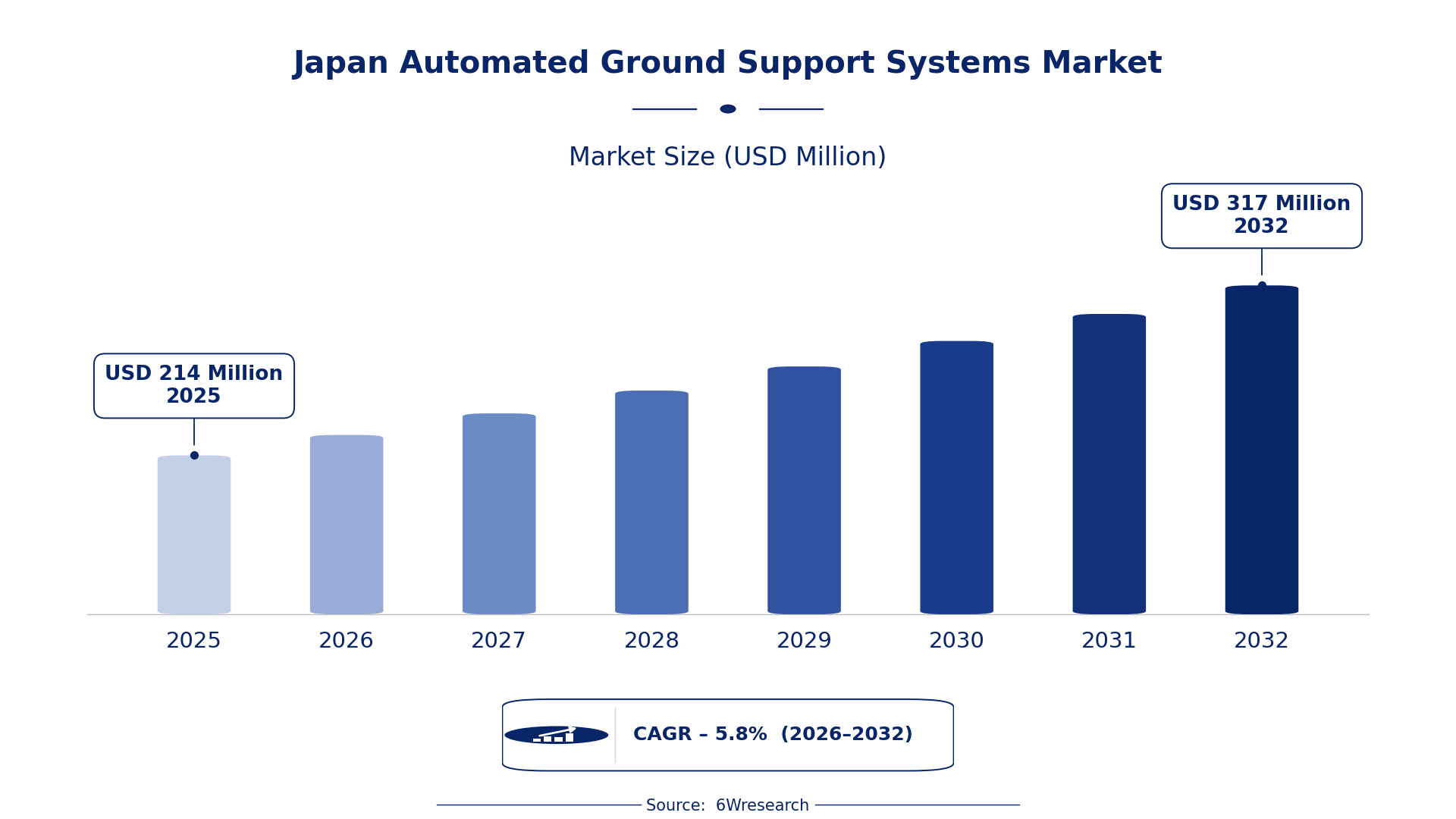
According to 6Wresearch internal database and industry insights, the Japan Automated Ground Support Systems Market was valued at USD 214 Million in 2025 and is projected to reach USD 317 Million by 2032, growing at a CAGR of approximately 5.8% during 2026–2032.
Japan Automated Ground Support Systems Market Highlights
| Report Metric | Details |
| Report Name | Japan Automated Ground Support Systems Market (2026-2032) |
| Market Size 2025 | USD 214 Million |
| Market Size 2032 | USD 317 Million |
| Absolute Growth 2025–2032 | USD 103 Million |
| CAGR 2026–2032 | 5.8% |
| Peak Annual Growth | 6.3% in 2032 |
| Forecast Period | 2026–2032 |
| Historical Data | 2022–2025 |
| Base Year | 2025 |
| Leading Equipment Type, 2025 | Aircraft Tow Tractors (39% share) |
| Leading Functionality, 2025 | Automatic Towing (38% share) |
| Leading Automation Degree, 2025 | Contactless Operation (50% share) |
| Leading Distribution Channel, 2025 | Direct Sales (41% share) |
| Leading End User, 2025 | Airport Ground Handling Units (50% share) |
| Fastest-Growing Equipment Type | Air Start Units (8.1% CAGR) |
| Fastest-Growing Functionality | Self-Guided Belt Loaders (7.9% CAGR) |
| Fastest-Growing Automation Degree | Flow & Fill Automation (8.3% CAGR) |
| Fastest-Growing Distribution Channel | Specialty Distributors (7.7% CAGR) |
| Fastest-Growing End User | Airport Cargo Operators (7.4% CAGR) |
| Growing Sector | airport operations |
| Key End Users | airport ground handling units, airport cargo operators, airline ground support teams, fuel service providers |
Japan Automated Ground Support Systems Market Year-wise Growth Rate and Key Drivers (2022–2032)
This graph illustrates the annual growth rates of the market from 2022 to 2032, highlighting a steady upward trajectory and projected market expansion over the forecast period.
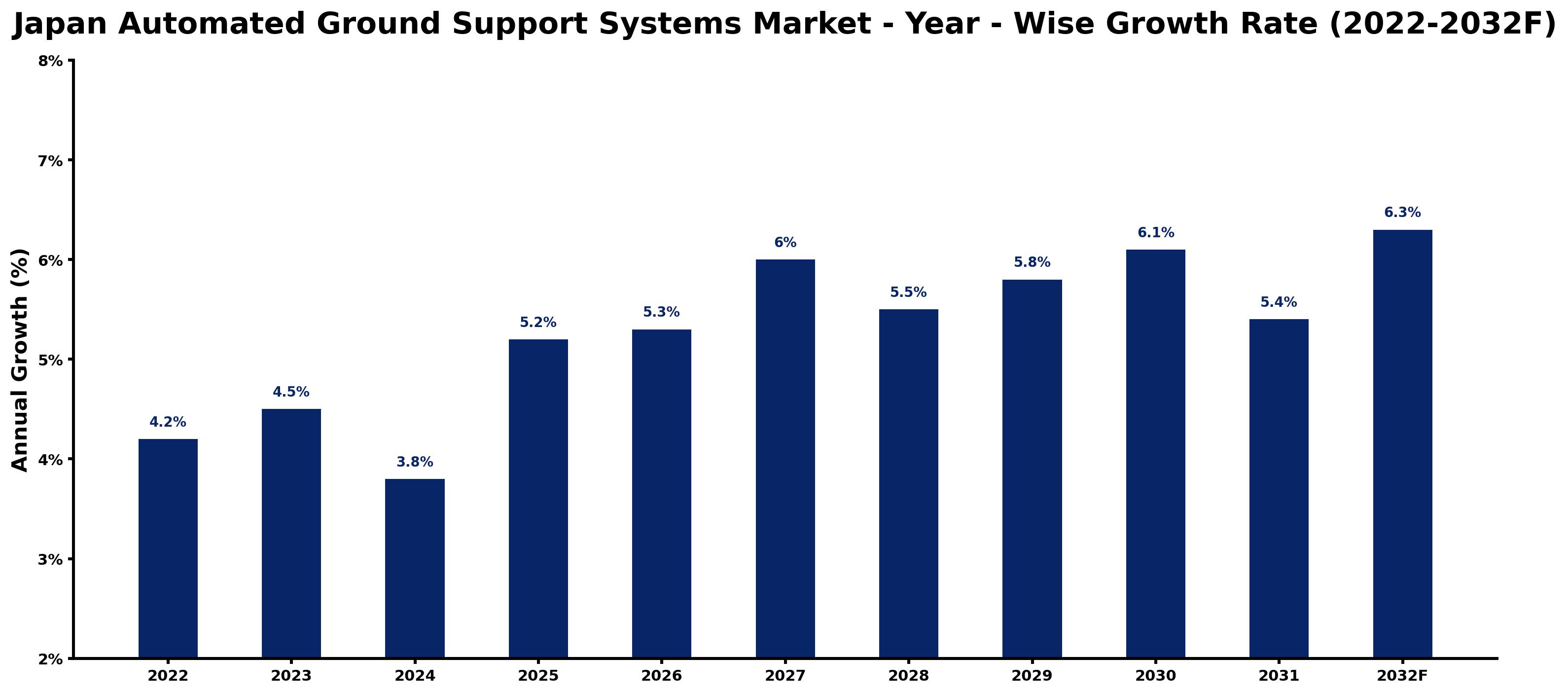
Below, each year's estimated growth is shown next to the factor that most influenced it.
| Year | Estimated Annual Growth (%) | Market Rationale |
| 2022 | 4.2 | The aviation sector demonstrated steady demand for AGSS, supported by ongoing airport operations. |
| 2023 | 4.5 | Increased passenger traffic at major airports drove higher demand for automated systems. |
| 2024 | 3.8 | Demand growth slowed as operators faced challenges with outdated equipment and rising costs. |
| 2025 | 5.2 | Modernisation efforts led to a surge in investments in AGSS, enhancing operational efficiency. |
| 2026 | 5.3 | Continued investment in airport infrastructure is expected to drive demand for automation technologies. |
| 2027 | 6.0 | Growing passenger numbers will further stimulate the need for efficient ground support systems. |
| 2028 | 5.5 | A slight slowdown in growth reflects the need for further upgrades in aging equipment. |
| 2029 | 5.8 | Increased operational efficiency initiatives will boost demand for advanced AGSS solutions. |
| 2030 | 6.1 | The commitment to decarbonisation will enhance the focus on sustainable ground support technologies. |
| 2031 | 5.4 | A focus on improving service delivery will maintain positive growth in the AGSS market. |
| 2032 | 6.3 | The introduction of advanced automation technologies is projected to peak demand for AGSS. |
Note: Market size estimations and growth projections presented in this report are based on 6Wresearch's proprietary forecasting methodology, utilizing the latest available industry data, government publications, and primary research inputs.
Japan Automated Ground Support Systems Market Synopsis
Automated Ground Support Systems are sophisticated solutions designed to improve airport operations, including aircraft towing, luggage handling, and fueling. These systems are increasingly important for domestic airport ground handling units and cargo operators in Japan. The market is expanding due to rising passenger traffic, substantial investments in airport infrastructure, and a national push for decarbonisation, with plans for JPY 150 trillion in investments over the next decade. The modernization efforts initiated in 2023 further drive the demand for these systems, as they enhance operational efficiency and reduce aircraft turnaround times.
Market Dynamics Impact Analysis (2026–2032)
| Factor | Type | Impact | Primary Segment Affected |
| Increasing passenger traffic at major airports | Driver | High | Airport Ground Handling Units |
| Government initiatives for airport modernization | Driver | High | Airport Ground Handling Units |
| Growing need for efficient ground operations | Opportunity | High | Airport Cargo Operators |
| Investment in decarbonisation technologies | Opportunity | High | Airport Ground Handling Units |
| Aging ground support equipment requiring upgrades | Restraint | High | Aircraft Tow Tractors |
| High initial investment costs for automation | Restraint | Medium | Automatic Towing |
| Limited availability of skilled workforce | Challenge | High | Self-Guided Belt Loaders |
| Compliance with evolving safety standards | Challenge | Medium | Fueling Vehicles |
Evaluation of Drivers in Japan Automated Ground Support Systems Market (2026–2032)
The following drivers explain most of the expected growth.
| Drivers | Primary Segment Affected | Why It Matters (Evidence) |
| Increased passenger traffic | Airport Ground Handling Units | Tokyo Haneda Airport handled over 87 million passengers annually, driving demand for efficient ground support. |
| Government funding for airport modernization | Airport Cargo Operators | Japan's JPY 150 trillion investment over 10 years supports upgrades in ground support systems. |
| Focus on reducing turnaround times | Aircraft Tow Tractors | AGSS can reduce turnaround times by up to 30%, prompting more purchases from airlines. |
| Investment in automation technologies | Automatic Towing | The 2023 modernization program encourages airports to adopt automated solutions for efficiency. |
| Emphasis on safety in operations | Fueling Vehicles | ISO 9001 standards drive demand for high-quality fueling systems to enhance safety. |
Much of the new demand traces back to increased passenger traffic at major airports, with Tokyo Haneda Airport handling over 87 million passengers annually. Funding for airport modernization, amounting to JPY 150 trillion over the next decade, supports upgrades in ground support systems. The focus on reducing aircraft turnaround times, which can be improved by up to 30% with AGSS, prompts airlines to invest in these technologies.
Evaluation of Restraints in Japan Automated Ground Support Systems Market
The table below lists the restraints and the evidence behind each.
| Market Restraint | Primary Segment Affected | Why It Matters (Evidence) |
| Aging ground support equipment requiring upgrades | Aircraft Tow Tractors | The average age of ground support equipment in Japan exceeds 10 years, necessitating replacements. |
| High initial investment costs for automation | Automatic Towing | The transition to automated systems involves substantial upfront costs, limiting adoption. |
| Limited availability of skilled workforce | Self-Guided Belt Loaders | A shortage of trained personnel affects the implementation of advanced ground support systems, with a projected 20% gap in skilled workers. |
| Compliance with evolving safety standards | Fueling Vehicles | Stringent regulations require constant updates and certifications, raising operational costs by approximately 15% annually. |
| Market competition leading to price pressures | Airport Cargo Operators | Intense competition among service providers can limit profit margins, affecting investment decisions. |
Japan Automated Ground Support Systems Market Challenges
Japan's aviation sector faces strict regulations enforced by the Ministry of Land, Infrastructure, Transport and Tourism, which can delay equipment approval for manufacturers by up to six months. Outdated technology is a major issue; with the average age of ground support equipment exceeding 10 years, operators incur 15% higher maintenance costs annually. Rising operational expenses are evident, as the national minimum wage increased to JPY 1,055 per hour, impacting labour-intensive ground handling services. A shortage of skilled personnel in automated systems leads to increased training costs for employers, estimated at JPY 2 million per year per facility.
Trends in the Japan Automated Ground Support Systems Market
Buyers and suppliers in the Japan Automated Ground Support Systems Market are adjusting to the following trends.
- Increase in Automation Adoption: In 2023, Japan initiated a program to modernize airport ground operations with automation, improving efficiency across facilities. This shift is expected to increase operational capabilities significantly, with a projected 20% improvement in efficiency.
- Shift Towards Decarbonisation: Japan targets a 46% cut in greenhouse-gas emissions by 2030, leading airports to invest in greener ground support technologies. This transition is reshaping purchasing decisions in the sector, with an estimated JPY 150 trillion allocated for sustainable infrastructure.
- Growing Demand for Contactless Solutions: With rising health concerns, airports are increasingly adopting contactless operation technologies, improving safety during ground handling. This trend is evident in major airports like Narita, where contactless solutions have increased by 25%.
- Focus on Efficiency Improvements: Airports are prioritising systems that reduce turnaround times, with AGSS capable of achieving reductions of up to 30%. This focus is particularly strong among airport ground handling units, reflecting a 15% increase in efficiency.
Investment Opportunities in the Japan Automated Ground Support Systems Market
Several openings in the Japan Automated Ground Support Systems Market merit attention from investors.
- Investment in Airport Modernization: Major airports like Kansai are investing heavily in upgrading their ground support systems, with JPY 150 trillion allocated for infrastructure improvements over the next decade, creating a substantial market for suppliers.
- Supply of Advanced Ground Support Technologies: The demand for automated towing systems is rising, driven by the need for efficiency in ground operations, particularly among airport ground handling units, which are expected to invest 20% more in automation.
- Expansion of Decarbonisation Initiatives: With a target of net zero emissions by 2050, there is a growing need for environmentally friendly ground support solutions, presenting opportunities for suppliers to innovate in this area, estimated at JPY 50 trillion in potential investments.
- Development of Contactless Operation Systems: As health and safety concerns rise, there is a pressing need for contactless operation technologies in airports, creating a market for innovative solutions, with a projected growth of 30% in demand.
Government Initiatives in the Japan Automated Ground Support Systems Market
The New Robot Strategy, initiated in 2015, promotes the use of robotics in various sectors, including airport operations. This strategy encourages investment in automated ground support systems, aligning with Japan's goals for efficiency and safety in aviation, targeting a 20% increase in operational efficiency by 2025.
The GX Promotion Act, established in 2023, aims to facilitate decarbonisation efforts across industries. The Ministry of Land, Infrastructure, Transport and Tourism oversees the implementation of these measures, ensuring that airport operations align with national sustainability targets, with a focus on reducing emissions by 46% by 2030.
Future Insight of the Japan Automated Ground Support Systems Market
The ongoing programme to modernise airport operations will introduce advanced automation technologies, streamlining processes for ground handling units. By 2032, Japan's airports are expected to achieve a 20% increase in operational efficiency through these innovations. The commitment to decarbonisation will channel JPY 150 trillion into sustainable infrastructure, promoting eco-friendly practices in ground support. Upgraded AGSS will reduce aircraft turnaround times by 30%, benefiting ground handling units and airlines by improving service delivery.
Market Segmentation Analysis
Japan Automated Ground Support Systems Market report covers a detailed analysis of the following market segments:
By Equipment Type – Aircraft Tow Tractors Lead, Air Start Units Expected to Grow Fastest
According to Saurav Kr Singh, Senior Research Analyst at 6Wresearch, Aircraft Tow Tractors took 39% of equipment type revenue in 2025, more than any other category. Aircraft Tow Tractors hold the largest share because they are crucial for towing aircraft during ground operations, particularly at busy airports like Tokyo Haneda. Their extensive use across more than 90 commercial airports in Japan ensures a steady demand for these vehicles. The quickest growth will come from Air Start Units, forecast to expand at a CAGR of 8.1% between 2026 and 2032. Air Start Units are experiencing rapid growth as they are increasingly utilised for starting aircraft engines on the ground, particularly amid modernisation efforts in airport operations. This emphasis on efficiency in ground handling will likely continue to drive their expansion. Suppliers should enhance the availability and features of Air Start Units to capitalise on this growth.
By Functionality – Automatic Towing Leads, Self-Guided Belt Loaders Expected to Grow Fastest
The largest functionality category in 2025 was Automatic Towing, at 38% of revenue. Automatic Towing leads the segment due to its ability to automate the towing process, significantly improving operational efficiency at major airports. This functionality is vital for reducing turnaround times, which are critical in the aviation sector. Self-Guided Belt Loaders are set to record the highest CAGR in this split, 7.9% over 2026–2032. Self-Guided Belt Loaders are seeing rapid growth as they improve the loading process without manual intervention, aligning with Japan's aim to increase airport efficiency by 20% by 2025. This trend indicates a broader shift towards automation in ground operations. Buyers should consider investing in Self-Guided Belt Loaders to remain competitive in the evolving market.
By Automation Degree – Contactless Operation Leads, Flow & Fill Automation Expected to Grow Fastest
Contactless Operation accounted for 50% of the market by automation degree in 2025. Contactless Operation is the leading sub-segment as it enhances safety by minimising physical contact during ground operations, a crucial consideration in the current environment. This method is increasingly adopted across major airports in Japan. Flow & Fill Automation is projected to grow fastest, at a CAGR of 8.3% during 2026–2032. Flow & Fill Automation is the fastest-growing area as it streamlines fueling operations, addressing the aviation industry's need for efficiency improvements. The ongoing trend towards automation in airport operations supports this growth. Suppliers must prioritise the development of Flow & Fill Automation solutions to meet rising demand.
By Distribution Channel – Direct Sales Leads, Specialty Distributors Expected to Grow Fastest
In 2025, Direct Sales led the distribution channel split with a 41% share. Direct Sales is the primary channel for AGSS due to its effectiveness in reaching airport ground handling units directly, ensuring tailored solutions for their specific needs. This method facilitates better customer engagement and support. Over 2026–2032, Specialty Distributors are expected to post the fastest growth, at a CAGR of 7.7%. Specialty Distributors are experiencing the fastest growth as they cater to niche markets, providing specialised solutions that meet specific operational requirements. Their role is becoming increasingly significant as the market diversifies. Companies should explore partnerships with Specialty Distributors to access new market segments.
By End User – Airport Ground Handling Units Lead, Airport Cargo Operators Expected to Grow Fastest
Airport Ground Handling Units held 50% of the Japan Automated Ground Support Systems Market by end user in 2025. Airport Ground Handling Units account for the largest share of the market as they are the primary users of AGSS, essential for efficient airport operations. Their demand is driven by the need to improve service quality and reduce turnaround times. The quickest growth will come from Airport Cargo Operators, forecast to expand at a CAGR of 7.4% between 2026 and 2032. Airport Cargo Operators are the fastest-growing segment as they increasingly adopt AGSS for efficient cargo handling, reflecting the rising importance of cargo logistics in the aviation sector. This trend aligns with Japan's focus on enhancing airport efficiency. Suppliers should tailor their offerings to meet the specific needs of Airport Cargo Operators to capture this growth.
Key Attractiveness of the Report
- 10 Years of Market Numbers
- Historical Data Starting from 2022 to 2025
- Base Year 2025
- Forecast Data until 2032
- Key Performance Indicators Impacting the Market
- Major Upcoming Developments and Projects
Key Highlights of the Report:
- Japan Automated Ground Support Systems Market Outlook
- Market Size of Japan Automated Ground Support Systems Market, 2025
- Forecast of Japan Automated Ground Support Systems Market, 2032
- Historical Data and Forecast of Japan Automated Ground Support Systems Revenues & Volume for the Period 2022-2032F
- Japan Automated Ground Support Systems Market Trend Evolution
- Japan Automated Ground Support Systems Market Drivers and Challenges
- Japan Automated Ground Support Systems Price Trends
- Japan Automated Ground Support Systems Porter's Five Forces
- Japan Automated Ground Support Systems Industry Life Cycle
- Historical Data and Forecast of Japan Automated Ground Support Systems Market Revenues & Volume By Equipment Type for the Period 2022-2032F
- Historical Data and Forecast of Japan Automated Ground Support Systems Market Revenues & Volume By Aircraft Tow Tractors for the Period 2022-2032F
- Historical Data and Forecast of Japan Automated Ground Support Systems Market Revenues & Volume By Luggage Loaders for the Period 2022-2032F
- Historical Data and Forecast of Japan Automated Ground Support Systems Market Revenues & Volume By Fueling Vehicles for the Period 2022-2032F
- Historical Data and Forecast of Japan Automated Ground Support Systems Market Revenues & Volume By Air Start Units for the Period 2022-2032F
- Historical Data and Forecast of Japan Automated Ground Support Systems Market Revenues & Volume By Functionality for the Period 2022-2032F
- Historical Data and Forecast of Japan Automated Ground Support Systems Market Revenues & Volume By Automatic Towing for the Period 2022-2032F
- Historical Data and Forecast of Japan Automated Ground Support Systems Market Revenues & Volume By Self-Guided Belt Loaders for the Period 2022-2032F
- Historical Data and Forecast of Japan Automated Ground Support Systems Market Revenues & Volume By Auto Nozzle Control for the Period 2022-2032F
- Historical Data and Forecast of Japan Automated Ground Support Systems Market Revenues & Volume By Automatic Engine Start for the Period 2022-2032F
- Historical Data and Forecast of Japan Automated Ground Support Systems Market Revenues & Volume By Automation Degree for the Period 2022-2032F
- Historical Data and Forecast of Japan Automated Ground Support Systems Market Revenues & Volume By Contactless Operation for the Period 2022-2032F
- Historical Data and Forecast of Japan Automated Ground Support Systems Market Revenues & Volume By GPS-Guided for the Period 2022-2032F
- Historical Data and Forecast of Japan Automated Ground Support Systems Market Revenues & Volume By Flow & Fill Automation for the Period 2022-2032F
- Historical Data and Forecast of Japan Automated Ground Support Systems Market Revenues & Volume By Temperature Control for the Period 2022-2032F
- Historical Data and Forecast of Japan Automated Ground Support Systems Market Revenues & Volume By Distribution Channel for the Period 2022-2032F
- Historical Data and Forecast of Japan Automated Ground Support Systems Market Revenues & Volume By Direct Sales for the Period 2022-2032F
- Historical Data and Forecast of Japan Automated Ground Support Systems Market Revenues & Volume By Industrial Suppliers for the Period 2022-2032F
- Historical Data and Forecast of Japan Automated Ground Support Systems Market Revenues & Volume By Online Platforms for the Period 2022-2032F
- Historical Data and Forecast of Japan Automated Ground Support Systems Market Revenues & Volume By Specialty Distributors for the Period 2022-2032F
- Historical Data and Forecast of Japan Automated Ground Support Systems Market Revenues & Volume By End User for the Period 2022-2032F
- Historical Data and Forecast of Japan Automated Ground Support Systems Market Revenues & Volume By Airport Ground Handling Units for the Period 2022-2032F
- Historical Data and Forecast of Japan Automated Ground Support Systems Market Revenues & Volume By Airport Cargo Operators for the Period 2022-2032F
- Historical Data and Forecast of Japan Automated Ground Support Systems Market Revenues & Volume By Fuel Service Providers for the Period 2022-2032F
- Historical Data and Forecast of Japan Automated Ground Support Systems Market Revenues & Volume By Airline Ground Support Teams for the Period 2022-2032F
- Japan Automated Ground Support Systems Import Export Trade Statistics
- Market Opportunity Assessment By Equipment Type
- Market Opportunity Assessment By Functionality
- Market Opportunity Assessment By Automation Degree
- Market Opportunity Assessment By Distribution Channel
- Market Opportunity Assessment By End User
- Japan Automated Ground Support Systems Top Companies Market Share
- Japan Automated Ground Support Systems Competitive Benchmarking By Technical and Operational Parameters
- Japan Automated Ground Support Systems Company Profiles
- Japan Automated Ground Support Systems Key Strategic Recommendations
Market Covered
This report examines the market across the segments below.
By Equipment Type
- Aircraft Tow Tractors
- Luggage Loaders
- Fueling Vehicles
- Air Start Units
By Functionality
- Automatic Towing
- Self-Guided Belt Loaders
- Auto Nozzle Control
- Automatic Engine Start
By Automation Degree
- Contactless Operation
- GPS-Guided
- Flow & Fill Automation
- Temperature Control
By Distribution Channel
- Direct Sales
- Industrial Suppliers
- Online Platforms
- Specialty Distributors
By End User
- Airport Ground Handling Units
- Airport Cargo Operators
- Fuel Service Providers
- Airline Ground Support Teams































