Japan Automation Components Market Size & Growth Rate
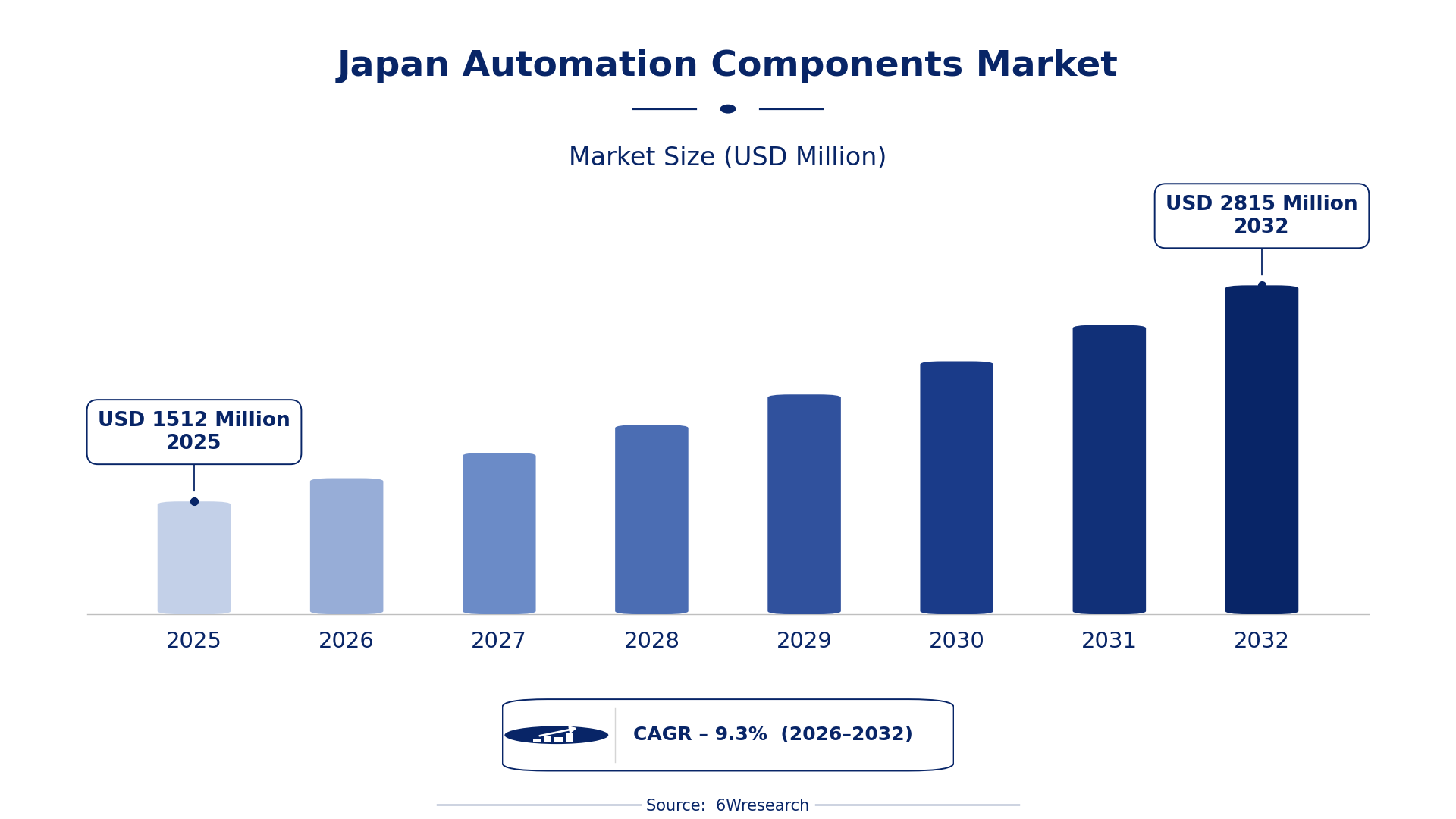
According to 6Wresearch internal database and industry insights, the Japan Automation Components Market was valued at USD 1,512 Million in 2025 and is projected to reach USD 2,815 Million by 2032, growing at a CAGR of approximately 9.3% during 2026–2032.
Japan Automation Components Market Highlights
| Report Metric | Details |
| Report Name | Japan Automation Components Market (2026-2032) |
| Market Size 2025 | USD 1,512 Million |
| Market Size 2032 | USD 2,815 Million |
| Absolute Growth 2025–2032 | USD 1,303 Million |
| CAGR 2026–2032 | 9.3% |
| Peak Annual Growth | 10.4% in 2028 |
| Forecast Period | 2026–2032 |
| Historical Data | 2022–2025 |
| Base Year | 2025 |
| Leading Product Type, 2025 | Automation Parts (56% share) |
| Leading End User, 2025 | Manufacturing (56% share) |
| Leading Application, 2025 | Assembly Line (61% share) |
| Leading Technology, 2025 | Control Components (58% share) |
| Fastest-Growing Product Type | Control Systems (13.0% CAGR) |
| Fastest-Growing End User | Logistics (11.5% CAGR) |
| Fastest-Growing Application | Material Handling (12.0% CAGR) |
| Fastest-Growing Technology | Automated Machinery (13.2% CAGR) |
| Growing Sector | Manufacturing |
| Key End Users | Manufacturers, logistics providers, automotive industry, technology developers |
Japan Automation Components Market Year-wise Growth Rate and Key Drivers (2022–2032)
This graph illustrates the annual growth rates of the market from 2022 to 2032, highlighting a steady upward trajectory and projected market expansion over the forecast period.
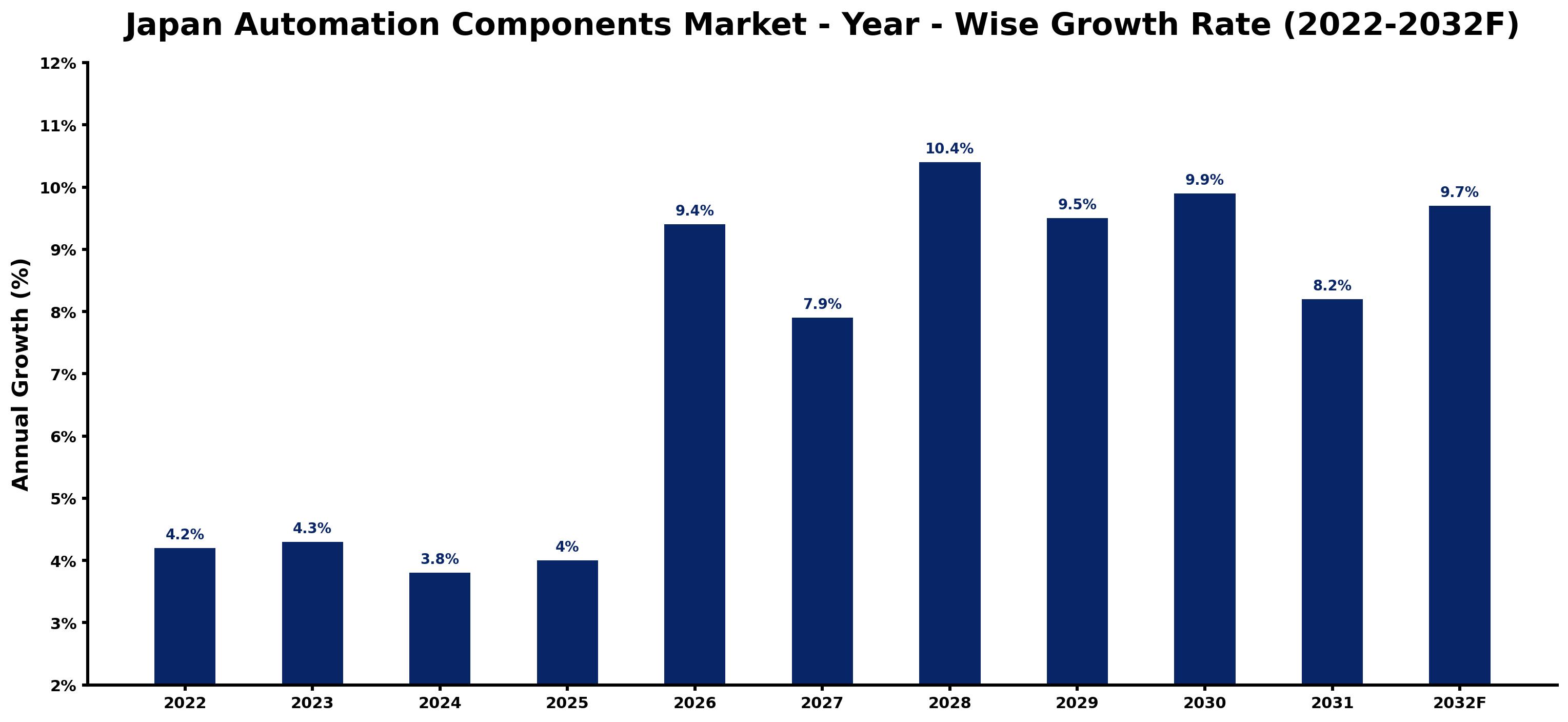
Below, each year's estimated growth is shown next to the factor that most influenced it.
| Year | Estimated Annual Growth (%) | Market Rationale |
| 2022 | 4.2 | The market experienced steady growth with increasing adoption of automation technologies. |
| 2023 | 4.3 | Demand rose as manufacturers focused on improving operational efficiency through automation. |
| 2024 | 3.8 | Growth slowed slightly as market saturation began to affect new investments. |
| 2025 | 4.0 | Manufacturers continued to invest in automation, leading to a rebound in growth rates. |
| 2026 | 9.4 | A surge in demand for advanced control systems is expected to drive market expansion. |
| 2027 | 7.9 | Growth is projected to slow as supply chain challenges begin to impact production capabilities. |
| 2028 | 10.4 | The market is expected to peak as new technologies and investments in automation surge. |
| 2029 | 9.5 | Demand growth is projected to slow slightly as the market stabilises after peak levels. |
| 2030 | 9.9 | Continued investments in automation technologies will support further growth. |
| 2031 | 8.2 | Growth is expected to decelerate as the market approaches maturity and competition intensifies. |
| 2032 | 9.7 | Demand is expected to rise again as new applications for automation emerge. |
Note: Market size estimations and growth projections presented in this report are based on 6Wresearch's proprietary forecasting methodology, utilizing the latest available industry data, government publications, and primary research inputs.
Japan Automation Components Market Synopsis
Automation components are devices and systems that facilitate automated processes in industries, manufactured through advanced engineering techniques. The Japan Automation Components Market is growing due to strong demand from domestic manufacturers and logistics providers. The sector benefits from a focus on operational efficiency, with over 60% of logistics companies adopting automation technologies. Japan's commitment to decarbonisation drives investment in automation solutions, targeting JPY 150 trillion over the next decade, creating opportunities for suppliers.
Market Dynamics Impact Analysis (2026–2032)
| Factor | Type | Impact | Primary Segment Affected |
| Increasing adoption of automation technologies in manufacturing processes | Driver | High | Automation Parts |
| Growing demand for advanced control systems for automated operations | Driver | High | Control Systems |
| Rising investment in automation technology initiatives | Opportunity | High | Manufacturing |
| Expansion of logistics companies adopting automation solutions | Opportunity | Medium | Logistics |
| Supply chain disruptions affecting component availability | Restraint | High | Control Systems |
| High costs associated with automation technology implementation | Restraint | Medium | Automation Parts |
| Limited skilled workforce for advanced automation technologies | Challenge | High | Manufacturing |
| Competition from international automation technology providers | Challenge | Medium | Logistics |
Evaluation of Drivers in Japan Automation Components Market (2026–2032)
Key forces behind demand, with the segment each one moves most, are listed below.
| Drivers | Primary Segment Affected | Why It Matters (Evidence) |
| Demand for efficiency in manufacturing processes | Automation Parts | Manufacturers are investing in automation to improve productivity, with over 8 million people employed in the sector. |
| Increased investment in advanced control systems | Control Systems | The robotics market is projected to reach ¥1 trillion by 2025, driving demand for control solutions. |
| Government initiatives supporting automation adoption | Manufacturing | The Ministry of Economy, Trade and Industry promotes smart manufacturing through its 'Monozukuri' initiative. |
| Technological advancements in automation components | Control Components | Control systems governed by JIS B 8395 standards are essential for modern manufacturing. |
| Growth in logistics sector adopting automation technologies | Logistics | Over 60% of logistics companies in Japan utilise automation components to improve efficiency. |
Several shifts outside the market boost sales. The manufacturing sector, employing over 8 million people, drives demand for automation parts to improve productivity. The Aichi Prefecture, known for its automotive manufacturing, is increasingly adopting automation technologies, with over 60% of logistics companies utilising such components to improve efficiency.
Evaluation of Restraints in Japan Automation Components Market
Below are the constraints most often cited by buyers and suppliers, with the segment each affects.
| Market Restraint | Primary Segment Affected | Why It Matters (Evidence) |
| Supply chain disruptions affecting availability of automation components | Control Systems | Supply chain issues have led to delays in component delivery, impacting production timelines for manufacturers. |
| High costs associated with implementing automation technologies | Automation Parts | The initial investment for automation systems can be prohibitive for smaller manufacturers, limiting their adoption. |
| Limited availability of skilled workforce for advanced automation | Manufacturing | A shortage of qualified personnel hampers manufacturers' ability to fully utilise automation technologies. |
| Regulatory compliance costs for automation systems | Control Systems | Compliance with JIS B 8395 standards can increase operational costs for manufacturers. |
| Competition from international automation technology providers | Logistics | Local companies face challenges from foreign competitors offering advanced automation solutions at lower prices. |
Japan Automation Components Market Challenges
Japan's stringent emissions regulations require compliance with various standards, which can delay product development and raise costs for manufacturers. A lack of skilled workers in automation technology limits suppliers' ability to meet rising demand, potentially resulting in a 20% slowdown in project timelines for logistics companies. Intense competition among local manufacturers drives prices down, eroding profit margins for suppliers and hindering their investment in new technologies. Rising operational costs, exacerbated by an increase in the minimum wage to JPY 1,055 per hour, challenge producers' pricing strategies and profitability.
Trends in the Japan Automation Components Market
The trends below show where the Japan Automation Components Market is heading.
- Logistics Companies Increasing Automation Adoption: Logistics companies in Japan are adopting automation technologies to improve efficiency, with over 60% already utilising such components. This trend reflects a growing focus on operational excellence in the sector.
- Shift Towards Advanced Control Systems: The demand for advanced control systems is rising as manufacturers seek to optimise automated operations. This shift is clear in the projected growth of the robotics market, expected to reach ¥1 trillion by 2025.
- Growing Focus on Smart Manufacturing: Since the launch of the 'Monozukuri' initiative in 2023, manufacturers are prioritising smart manufacturing solutions. This initiative aims to improve productivity and efficiency across the manufacturing sector.
- Increased Investment in Decarbonisation Technologies: Japan's GX Basic Policy aims for JPY 150 trillion in decarbonisation investment over ten years, driving demand for automation components that support sustainable manufacturing practices.
Investment Opportunities in the Japan Automation Components Market
Below are the investment opportunities with the strongest case in the Japan Automation Components Market.
- Investment Gap in Automation Technology: With Japan targeting a 46% cut in greenhouse-gas emissions by 2030, there is a growing need for automation solutions. Manufacturers can invest in automation parts to meet these targets.
- Expansion of Control Systems in Manufacturing: Manufacturers are increasingly seeking advanced control systems to optimise production processes. The Aichi Prefecture, known for automotive manufacturing, presents a prime opportunity for suppliers.
- Growing Logistics Sector Seeking Efficiency Improvements: Logistics companies are actively looking for automation solutions to improve operational efficiency. Suppliers can enter this market by forming partnerships with local logistics providers.
- Investment in Automated Machinery for Manufacturing: As the robotics market grows, there is a significant opportunity to supply automated machinery. The manufacturing sector's demand for efficiency creates a promising market for new solutions.
Government Initiatives in the Japan Automation Components Market
The New Robot Strategy established in 2015 aims to expand robot use across various sectors, including manufacturing and services. This policy has led to increased investment in automation technologies, with the government allocating ¥100 billion in 2023 to support these initiatives, benefiting manufacturers by improving their production capabilities.
In 2023, the Japanese government launched a program to support SMEs in adopting automation technologies. The Ministry of Economy, Trade and Industry oversees this program, which aims to enhance the competitiveness of small and medium enterprises in the automation sector, providing essential resources and funding to strengthen their capabilities.
Future Insight of the Japan Automation Components Market
Japan's investment in automation technology initiatives is projected to exceed ¥100 billion by 2032, generating substantial demand for automation components. The robotics market is expected to grow, driving efficiency improvements across multiple sectors. Government support for SMEs in adopting automation technologies will boost industry productivity and innovation. As the population ages, the need for advanced solutions will push suppliers to develop new products, ensuring competitiveness in a changing market.
Market Segmentation Analysis
Japan Automation Components Market report covers a detailed analysis of the following market segments:
By Product Type – Automation Parts Lead, Control Systems Expected to Grow Fastest
According to Bhawna Singh, Assistant Manager at 6Wresearch, with 56% of product type revenue in 2025, Automation Parts was the largest category. Automation Parts hold the largest share due to their essential role in automation processes across various industries. Their widespread application in manufacturing facilities, particularly in the Aichi Prefecture, highlights their critical importance in ensuring operational efficiency. The quickest growth will come from Control Systems, forecast to expand at a CAGR of 13.0% between 2026 and 2032. Control Systems are growing rapidly as they are vital for managing automated operations, especially in sectors embracing smart manufacturing. The significant government investment in automation technology initiatives is likely to further propel this segment's expansion. Suppliers should enhance their offerings in Control Systems to meet the increasing market demand.
By End User – Manufacturing Leads, Logistics Expected to Grow Fastest
Manufacturing held 56% of the Japan Automation Components Market by end user in 2025. Manufacturing is the leading end user of automation components, accounting for the majority of demand due to its extensive reliance on these technologies for production efficiency. With over 8 million people employed in this sector, the scale of operations necessitates advanced automation solutions. Logistics is set to record the highest CAGR in this split, 11.5% over 2026–2032. Logistics is the fastest-growing end user segment, driven by the need for efficiency in operations, particularly as over 60% of logistics companies in Japan adopt automation components. This trend indicates a shift towards more automated processes in the logistics industry. Buyers in the logistics sector should consider investing in automation components to improve operational efficiency.
By Application – Assembly Line Leads, Material Handling Expected to Grow Fastest
In 2025, Assembly Line led the application split with a 61% share. The Assembly Line application leads the market because it plays a crucial role in ensuring production efficiency across various manufacturing processes. Its key function in optimising workflows makes it a central focus for manufacturers aiming to increase output. Material Handling is projected to grow fastest, at a CAGR of 12.0% during 2026–2032. Material Handling is the fastest-growing application, driven by the increasing need for efficient movement of goods within facilities. As industries continue to expand, the demand for advanced material handling solutions is expected to rise significantly. Suppliers should prioritise the development of advanced material handling solutions to cater to the growing market needs.
By Technology – Control Components Lead, Automated Machinery Expected to Grow Fastest
The largest technology category in 2025 was Control Components, at 58% of revenue. Control Components dominate the market as they are essential for the effective functionality of automation systems across different sectors. Their extensive adoption in manufacturing processes underscores their importance in maintaining reliable operational performance. Over 2026–2032, Automated Machinery is expected to post the fastest growth, at a CAGR of 13.2%. Automated Machinery is witnessing rapid growth due to its crucial role in modern manufacturing processes, particularly as companies aim to enhance productivity through automation. This trend aligns with government initiatives promoting smart manufacturing. Manufacturers should consider investing in automated machinery to remain competitive in the changing market.
Key Attractiveness of the Report
- 10 Years of Market Numbers
- Historical Data Starting from 2022 to 2025
- Base Year 2025
- Forecast Data until 2032
- Key Performance Indicators Impacting the Market
- Major Upcoming Developments and Projects
Key Highlights of the Report:
- Japan Automation Components Market Outlook
- Market Size of Japan Automation Components Market, 2025
- Forecast of Japan Automation Components Market, 2032
- Historical Data and Forecast of Japan Automation Components Revenues & Volume for the Period 2022-2032
- Japan Automation Components Market Trend Evolution
- Japan Automation Components Market Drivers and Challenges
- Japan Automation Components Price Trends
- Japan Automation Components Porter's Five Forces
- Japan Automation Components Industry Life Cycle
- Historical Data and Forecast of Japan Automation Components Market Revenues & Volume By Product Type for the Period 2022-2032
- Historical Data and Forecast of Japan Automation Components Market Revenues & Volume By Automation Parts for the Period 2022-2032
- Historical Data and Forecast of Japan Automation Components Market Revenues & Volume By Control Systems for the Period 2022-2032
- Historical Data and Forecast of Japan Automation Components Market Revenues & Volume By End User for the Period 2022-2032
- Historical Data and Forecast of Japan Automation Components Market Revenues & Volume By Manufacturing for the Period 2022-2032
- Historical Data and Forecast of Japan Automation Components Market Revenues & Volume By Logistics for the Period 2022-2032
- Historical Data and Forecast of Japan Automation Components Market Revenues & Volume By Application for the Period 2022-2032
- Historical Data and Forecast of Japan Automation Components Market Revenues & Volume By Assembly Line for the Period 2022-2032
- Historical Data and Forecast of Japan Automation Components Market Revenues & Volume By Material Handling for the Period 2022-2032
- Historical Data and Forecast of Japan Automation Components Market Revenues & Volume By Technology for the Period 2022-2032
- Historical Data and Forecast of Japan Automation Components Market Revenues & Volume By Control Components for the Period 2022-2032
- Historical Data and Forecast of Japan Automation Components Market Revenues & Volume By Automated Machinery for the Period 2022-2032
- Japan Automation Components Import Export Trade Statistics
- Market Opportunity Assessment By Product Type
- Market Opportunity Assessment By End User
- Market Opportunity Assessment By Application
- Market Opportunity Assessment By Technology
- Japan Automation Components Top Companies Market Share
- Japan Automation Components Competitive Benchmarking By Technical and Operational Parameters
- Japan Automation Components Company Profiles
- Japan Automation Components Key Strategic Recommendations
Market Covered
The following segment groups are covered in the report.
By Product Type
- Automation Parts
- Control Systems
By End User
- Manufacturing
- Logistics
By Application
- Assembly Line
- Material Handling
By Technology
- Control Components
- Automated Machinery































