Japan Automotive Brake Fluid Market Size & Growth Rate
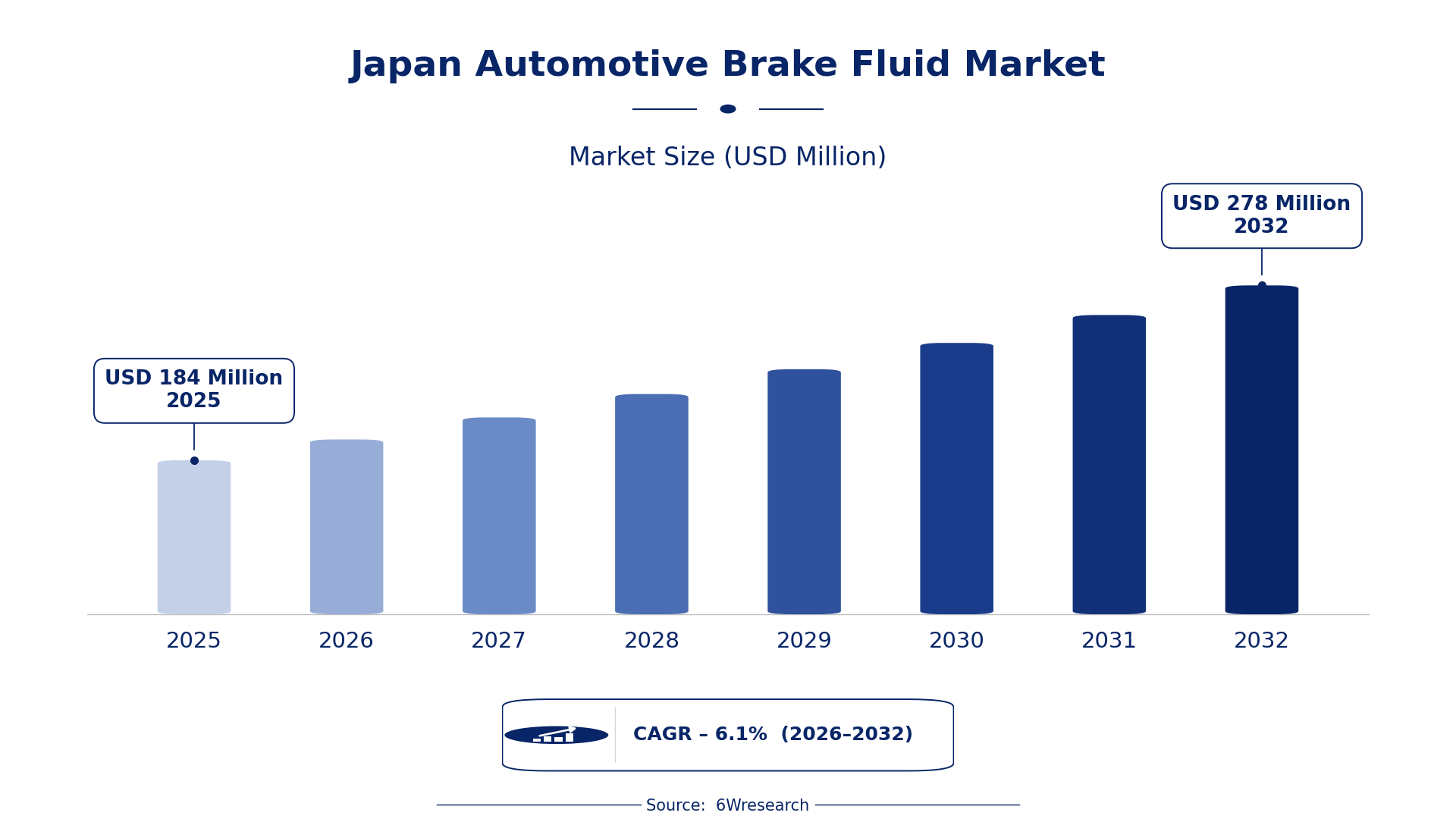
According to 6Wresearch internal database and industry insights, the Japan Automotive Brake Fluid Market was valued at USD 184 Million in 2025 and is projected to reach USD 278 Million by 2032, growing at a CAGR of approximately 6.1% during 2026–2032.
Japan Automotive Brake Fluid Market Highlights
| Report Metric | Details |
| Report Name | Japan Automotive Brake Fluid Market (2026-2032) |
| Market Size 2025 | USD 184 Million |
| Market Size 2032 | USD 278 Million |
| Absolute Growth 2025–2032 | USD 94 Million |
| CAGR 2026–2032 | 6.1% |
| Peak Annual Growth | 6.5% in 2028 |
| Forecast Period | 2026–2032 |
| Historical Data | 2022–2025 |
| Base Year | 2025 |
| Leading Fluid Type, 2025 | Petroleum Fluid (57% share) |
| Leading Vehicle Type, 2025 | Passenger Vehicles (PVs) (52% share) |
| Leading Product Type, 2025 | DOT 3 (42% share) |
| Leading Sales Channel, 2025 | Original Equipment Manufacturing (OEM) (66% share) |
| Fastest-Growing Fluid Type | Non-Petroleum Fluid (8.0% CAGR) |
| Fastest-Growing Vehicle Type | Commercial Vehicles (CVs) (8.3% CAGR) |
| Fastest-Growing Product Type | DOT 4 (8.4% CAGR) |
| Fastest-Growing Sales Channel | Aftermarket (7.3% CAGR) |
| Growing Sector | Aftermarket |
| Key End Users | Original Equipment Manufacturing (OEM), Aftermarket |
Japan Automotive Brake Fluid Market Year-wise Growth Rate and Key Drivers (2022–2032)
This graph illustrates the annual growth rates of the market from 2022 to 2032, highlighting a steady upward trajectory and projected market expansion over the forecast period.
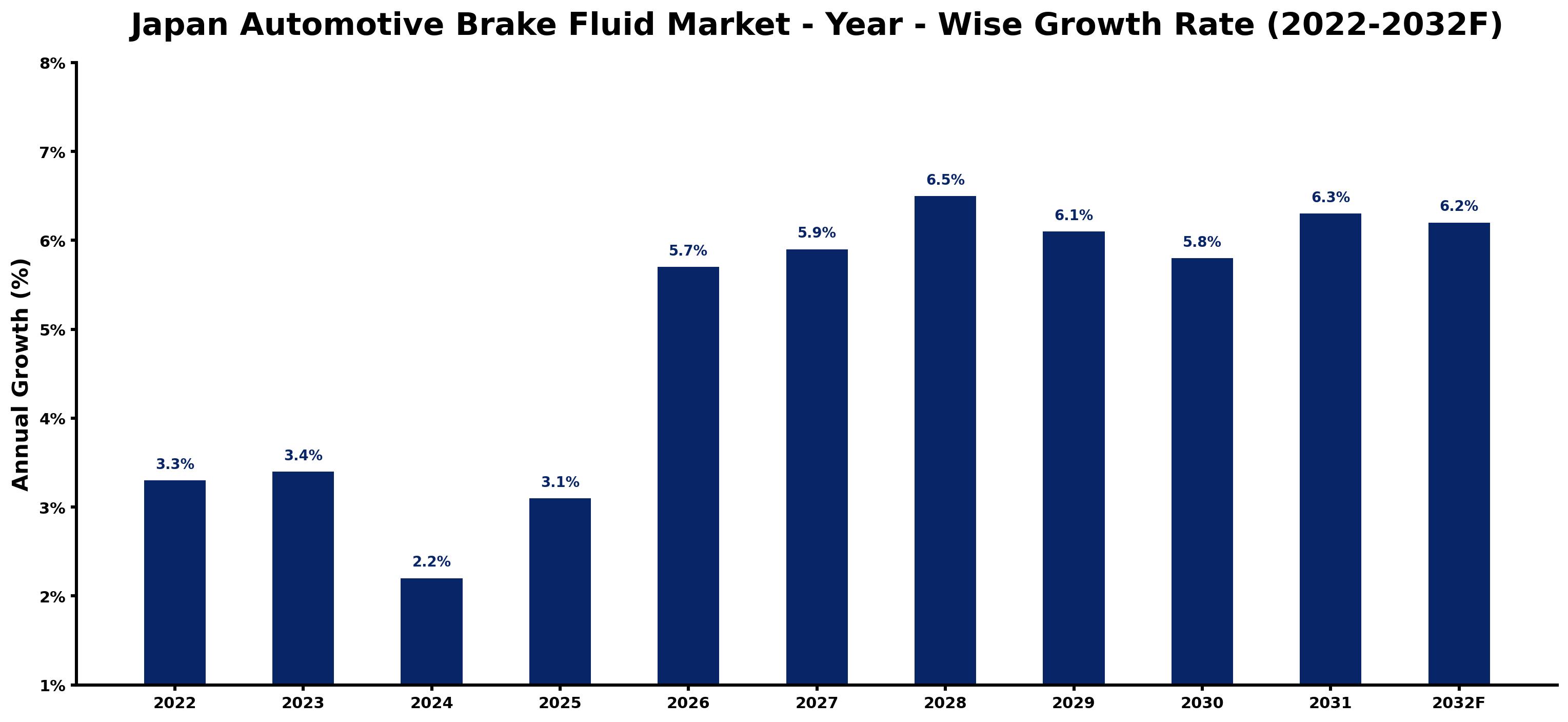
The following figures match every annual growth estimate with the main market development of that year, giving the reasoning behind each rise or slowdown.
| Year | Estimated Annual Growth (%) | Market Rationale |
| 2022 | 3.3 | Demand remained stable, reflecting ongoing activity in the automotive sector. |
| 2023 | 3.4 | Growth accelerated due to increased vehicle production and maintenance needs. |
| 2024 | 2.2 | Market growth slowed as demand stabilised after previous increases. |
| 2025 | 3.1 | A resurgence in vehicle registrations contributed to faster growth. |
| 2026 | 5.7 | Consumer interest in eco-friendly options is expected to influence purchasing. |
| 2027 | 5.9 | Demand will continue to rise as more vehicles enter the market. |
| 2028 | 6.5 | Investments in vehicle safety initiatives will peak growth this year. |
| 2029 | 6.1 | Growth will slow slightly as the market begins to normalise after rapid expansion. |
| 2030 | 5.8 | Sustained interest in sustainable products will moderate growth rates. |
| 2031 | 6.3 | Demand will surge again as more consumers opt for high-performance fluids. |
| 2032 | 6.2 | Growth will slow as the market reaches a more stable phase. |
Note: Market size estimations and growth projections presented in this report are based on 6Wresearch's proprietary forecasting methodology, utilizing the latest available industry data, government publications, and primary research inputs.
Japan Automotive Brake Fluid Market Synopsis
Automotive brake fluid serves as a hydraulic fluid crucial for vehicle braking systems, primarily composed of glycol ethers or mineral oil. The Japan Automotive Brake Fluid Market is expanding, driven by rising vehicle production, with approximately 4 million passenger vehicles manufactured in 2022. The increasing preference for non-petroleum fluids, shaped by environmental regulations, further stimulates demand. The automotive aftermarket, valued at over 10 trillion yen annually, plays a key part in this growth.
Market Dynamics Impact Analysis (2026–2032)
| Factor | Type | Impact | Primary Segment Affected |
| Increasing vehicle production and registrations | Driver | High | Passenger Vehicles (PVs) |
| Growing demand for eco-friendly brake fluids | Driver | High | Non-Petroleum Fluid |
| Rising aftermarket sales driven by vehicle maintenance | Opportunity | High | Aftermarket |
| Expansion of vehicle safety initiatives enhancing fluid requirements | Opportunity | Medium | Commercial Vehicles (CVs) |
| Environmental regulations limiting petroleum fluid usage | Restraint | High | Petroleum Fluid |
| Market saturation in older vehicle segments | Restraint | Medium | DOT 3 |
| Competition from alternative braking technologies | Challenge | High | Petroleum Fluid |
| Fluctuating raw material prices affecting production costs | Challenge | Medium | Petroleum Fluid |
Evaluation of Drivers in Japan Automotive Brake Fluid Market (2026–2032)
Below are the drivers that matter most for revenue growth, with supporting evidence.
| Drivers | Primary Segment Affected | Why It Matters (Evidence) |
| Rising vehicle production | Passenger Vehicles (PVs) | Japan produced approximately 4 million passenger vehicles in 2022, increasing brake fluid demand. |
| Growing preference for eco-friendly options | Non-Petroleum Fluid | Non-petroleum brake fluids are gaining traction, with a 15% increase in usage among eco-conscious consumers. |
| Expansion of the automotive aftermarket | Aftermarket | The automotive aftermarket in Japan is valued at over 10 trillion yen annually. |
| Increased vehicle safety initiatives | Commercial Vehicles (CVs) | In 2023, a vehicle safety initiative was launched, enhancing fluid requirements. |
| Technological advancements in brake systems | DOT 4 | DOT 4 is the most commonly used brake fluid type in Japan, reflecting modern vehicle needs. |
Orders continue to rise as Japan's automotive sector produced approximately 4 million passenger vehicles in 2022, boosting demand for brake fluid. The automotive aftermarket, valued at over 10 trillion yen, greatly contributes to fluid purchases as vehicle maintenance needs increase. Non-petroleum fluids are becoming more popular, prompting consumers to seek eco-friendly options. Manufacturers are responding by increasing production capacity for high-performance fluids to accommodate these changes.
Evaluation of Restraints in Japan Automotive Brake Fluid Market
Below are the constraints most often cited by buyers and suppliers, with the segment each affects.
| Market Restraint | Primary Segment Affected | Why It Matters (Evidence) |
| Environmental regulations limiting petroleum fluid usage | Petroleum Fluid | Japan's push for a 46% cut in greenhouse-gas emissions by 2030 restricts petroleum fluid use. |
| Market saturation in older vehicle segments | DOT 3 | The average age of passenger vehicles in Japan exceeds 10 years, limiting new fluid sales. |
| Competition from alternative braking technologies | Petroleum Fluid | Emerging technologies in braking systems challenge traditional fluid markets. |
| Rising costs of raw materials affecting production costs | Petroleum Fluid | Fluctuating raw material prices can increase production costs by up to 15%. |
| Consumer preference for established brands | Petroleum Fluid | Established brands dominate the market, making it difficult for new entrants to gain traction. |
Japan Automotive Brake Fluid Market Challenges
Producers allocate up to 15% of their budgets to meet stringent environmental regulations, significantly raising production costs. Distributors encounter fierce competition from non-petroleum brake fluids, which could lead to a 10% revenue decline as they lower prices to retain market share. Supply chain disruptions for key raw materials can postpone production timelines by several weeks, affecting distributors' ability to fulfil orders and meet customer demand. Rapid technological advancements necessitate heavy investment in R&D, diverting resources from other critical operations and limiting capacity for innovation.
Trends in the Japan Automotive Brake Fluid Market
The trends below show where the Japan Automotive Brake Fluid Market is heading.
- Shift towards Non-Petroleum Brake Fluids: Non-petroleum brake fluids are gaining traction due to environmental concerns, with a notable increase in usage among eco-conscious consumers. In 2022, non-petroleum fluid adoption rose by 15%.
- Increase in Vehicle Safety Standards: The 2023 vehicle safety initiative has resulted in stricter standards for braking systems, necessitating higher-quality fluids. This initiative is projected to drive demand for premium brake fluids by 2025.
- Growing Demand for High-Performance Fluids: As performance vehicles become more popular, there is a noticeable shift towards high-performance brake fluids. DOT 5.1 is increasingly preferred, with a 10% rise in sales reported in 2022.
- Expansion of Aftermarket Services: The aftermarket segment is rapidly expanding, driven by increased vehicle maintenance needs. In 2022, the aftermarket was valued at over 10 trillion yen, reflecting a growing trend.
Investment Opportunities in the Japan Automotive Brake Fluid Market
The following areas offer the clearest openings for investors and suppliers in the Japan Automotive Brake Fluid Market.
- Non-Petroleum Brake Fluids: The demand for non-petroleum brake fluids is increasing due to environmental regulations. With a projected growth rate of 8% annually, suppliers can target eco-conscious consumers in urban areas like Tokyo.
- Aftermarket Services Expansion: With the automotive aftermarket valued at over 10 trillion yen, there is an opportunity to supply maintenance products. Targeting independent workshops can provide entry points for new suppliers.
- High-Performance Brake Fluids: The rising popularity of high-performance vehicles creates a demand for specialised brake fluids. Suppliers can focus on premium products to meet the needs of performance vehicle owners.
- Vehicle Safety Initiatives: The 2023 vehicle safety initiative opens avenues for suppliers to provide compliant brake fluids. Collaborating with local manufacturers can facilitate market entry and compliance.
Government Initiatives in the Japan Automotive Brake Fluid Market
Japan's regulatory framework impacts automotive brake fluid producers. The JIS K 2234 standard ensures that all brake fluids meet safety and performance criteria, while the GX Promotion Act (2023) supports the transition to eco-friendly products. These measures compel manufacturers to invest in compliance and innovation, aligning with Japan's decarbonisation goals.
The vehicle safety initiative launched by the Ministry of Land, Infrastructure, Transport and Tourism mandates higher standards for brake fluids. This initiative encourages the use of advanced fluids, ensuring that consumers receive safer products. The Japan Automobile Manufacturers Association oversees compliance, ensuring that manufacturers adhere to these updated standards.
Future Insight of the Japan Automotive Brake Fluid Market
Japan's JPY 150 trillion investment in decarbonisation by 2032 will stimulate demand for advanced brake fluid technologies, particularly non-petroleum options. The push for net zero emissions will compel suppliers to innovate and meet evolving environmental standards. Vehicle safety initiatives will enforce stricter compliance, driving buyers to demand higher-quality products that adhere to updated regulations. As the average age of passenger vehicles exceeds 10 years, the aftermarket will expand, creating opportunities for suppliers to introduce tailored solutions that cater to this growing segment.
Market Segmentation Analysis
Japan Automotive Brake Fluid Market report covers a detailed analysis of the following market segments:
By Fluid Type – Petroleum Fluid Leads, Non-Petroleum Fluid Expected to Grow Fastest
According to Shubham Padhi, Research Analyst at 6Wresearch, the largest fluid type category in 2025 was Petroleum Fluid, at 57% of revenue. Petroleum fluid dominates the market as it is extensively used in conventional brake systems, which are prevalent across Japan's automotive sector. The familiarity of consumers with petroleum-based products and the existing infrastructure further reinforce its leading position. The quickest growth will come from Non-Petroleum Fluid, forecast to expand at a CAGR of 8.0% between 2026 and 2032. Non-petroleum fluid is rapidly gaining traction due to rising environmental regulations that encourage eco-friendly alternatives, appealing to a growing base of environmentally conscious consumers. The increasing availability of non-petroleum options from manufacturers is a clear response to this demand. Suppliers should prioritise the development of non-petroleum options to align with regulatory trends and consumer preferences.
By Vehicle Type – Passenger Vehicles (PVs) Leads, Commercial Vehicles (CVs) Expected to Grow Fastest
Passenger Vehicles (PVs) accounted for 52% of the market by vehicle type in 2025. Passenger vehicles dominate brake fluid consumption, supported by Japan's production of approximately 4 million passenger vehicles in 2022. The high concentration of registered passenger vehicles in metropolitan areas like Tokyo solidifies this segment's leading position. Commercial Vehicles (CVs) is projected to grow fastest, at a CAGR of 8.3% during 2026–2032. Commercial vehicles are experiencing rapid growth due to their critical role in heavy-duty braking systems, essential for logistics and transportation. The increasing demand for commercial vehicles in urban settings significantly contributes to this segment's expansion. Suppliers should focus on developing products tailored for commercial vehicles to capitalise on this growth opportunity.
By Product Type – DOT 3 Leads, DOT 4 Expected to Grow Fastest
DOT 3 held 42% of the Japan Automotive Brake Fluid Market by product type in 2025. DOT 3 holds the largest share as it is extensively used in older vehicles, which make up a considerable portion of Japan's automotive fleet. Its compatibility with a wide range of existing braking systems ensures consistent demand from vehicle owners and service providers. DOT 4 is set to record the highest CAGR in this split, 8.4% over 2026–2032. DOT 4 is growing quickly as it is the standard for modern vehicles, which are increasingly prevalent in the market. The shift towards newer vehicle models that require DOT 4 fluid is a key factor driving its growth. Suppliers need to prioritise the production and distribution of DOT 4 to meet the demands of the modern vehicle market.
By Sales Channel – Original Equipment Manufacturing (OEM) Leads, Aftermarket Expected to Grow Fastest
With 66% of sales channel revenue in 2025, Original Equipment Manufacturing (OEM) was the largest category. Original equipment manufacturing is the primary source for new vehicles, generating consistent demand for brake fluid from manufacturers. The strong ties between this channel and automotive producers reinforce its leading role in the market. Over 2026–2032, Aftermarket is expected to post the fastest growth, at a CAGR of 7.3%. The aftermarket segment is expanding rapidly as vehicle maintenance becomes crucial for owners of older vehicles, which are common in Japan. The automotive aftermarket's valuation of over 10 trillion yen annually highlights its growing importance. Suppliers must refine their aftermarket strategies to effectively address the increasing demand for maintenance-related products.
Key Attractiveness of the Report
- 10 Years of Market Numbers
- Historical Data Starting from 2022 to 2025
- Base Year 2025
- Forecast Data until 2032
- Key Performance Indicators Impacting the Market
- Major Upcoming Developments and Projects
Key Highlights of the Report:
- Japan Automotive Brake Fluid Market Outlook
- Market Size of Japan Automotive Brake Fluid Market, 2025
- Forecast of Japan Automotive Brake Fluid Market, 2032
- Historical Data and Forecast of Japan Automotive Brake Fluid Revenues & Volume for the Period 2022-2032
- Japan Automotive Brake Fluid Market Trend Evolution
- Japan Automotive Brake Fluid Market Drivers and Challenges
- Japan Automotive Brake Fluid Price Trends
- Japan Automotive Brake Fluid Porter's Five Forces
- Japan Automotive Brake Fluid Industry Life Cycle
- Historical Data and Forecast of Japan Automotive Brake Fluid Market Revenues & Volume By Fluid Type for the Period 2022-2032
- Historical Data and Forecast of Japan Automotive Brake Fluid Market Revenues & Volume By Petroleum Fluid for the Period 2022-2032
- Historical Data and Forecast of Japan Automotive Brake Fluid Market Revenues & Volume By Non-Petroleum Fluid for the Period 2022-2032
- Historical Data and Forecast of Japan Automotive Brake Fluid Market Revenues & Volume By Vehicle Type for the Period 2022-2032
- Historical Data and Forecast of Japan Automotive Brake Fluid Market Revenues & Volume By Passenger Vehicles (PVs) for the Period 2022-2032
- Historical Data and Forecast of Japan Automotive Brake Fluid Market Revenues & Volume By Commercial Vehicles (CVs) for the Period 2022-2032
- Historical Data and Forecast of Japan Automotive Brake Fluid Market Revenues & Volume By Off-Road Vehicles for the Period 2022-2032
- Historical Data and Forecast of Japan Automotive Brake Fluid Market Revenues & Volume By Product Type for the Period 2022-2032
- Historical Data and Forecast of Japan Automotive Brake Fluid Market Revenues & Volume By DOT 3 for the Period 2022-2032
- Historical Data and Forecast of Japan Automotive Brake Fluid Market Revenues & Volume By DOT 4 for the Period 2022-2032
- Historical Data and Forecast of Japan Automotive Brake Fluid Market Revenues & Volume By DOT 5 for the Period 2022-2032
- Historical Data and Forecast of Japan Automotive Brake Fluid Market Revenues & Volume By DOT 5.1 for the Period 2022-2032
- Historical Data and Forecast of Japan Automotive Brake Fluid Market Revenues & Volume By Sales Channel for the Period 2022-2032
- Historical Data and Forecast of Japan Automotive Brake Fluid Market Revenues & Volume By Original Equipment Manufacturing (OEM) for the Period 2022-2032
- Historical Data and Forecast of Japan Automotive Brake Fluid Market Revenues & Volume By Aftermarket for the Period 2022-2032
- Japan Automotive Brake Fluid Import Export Trade Statistics
- Market Opportunity Assessment By Fluid Type
- Market Opportunity Assessment By Vehicle Type
- Market Opportunity Assessment By Product Type
- Market Opportunity Assessment By Sales Channel
- Japan Automotive Brake Fluid Top Companies Market Share
- Japan Automotive Brake Fluid Competitive Benchmarking By Technical and Operational Parameters
- Japan Automotive Brake Fluid Company Profiles
- Japan Automotive Brake Fluid Key Strategic Recommendations
Market Covered
The study includes the following segmentation.
By Fluid Type
- Petroleum Fluid
- Non-Petroleum Fluid
By Vehicle Type
- Passenger Vehicles (PVs)
- Commercial Vehicles (CVs)
- Off-Road Vehicles
By Product Type
- DOT 3
- DOT 4
- DOT 5
- DOT 5.1
By Sales Channel
- Original Equipment Manufacturing (OEM)
- Aftermarket































