Japan Automotive Dealership Market Size & Growth Rate
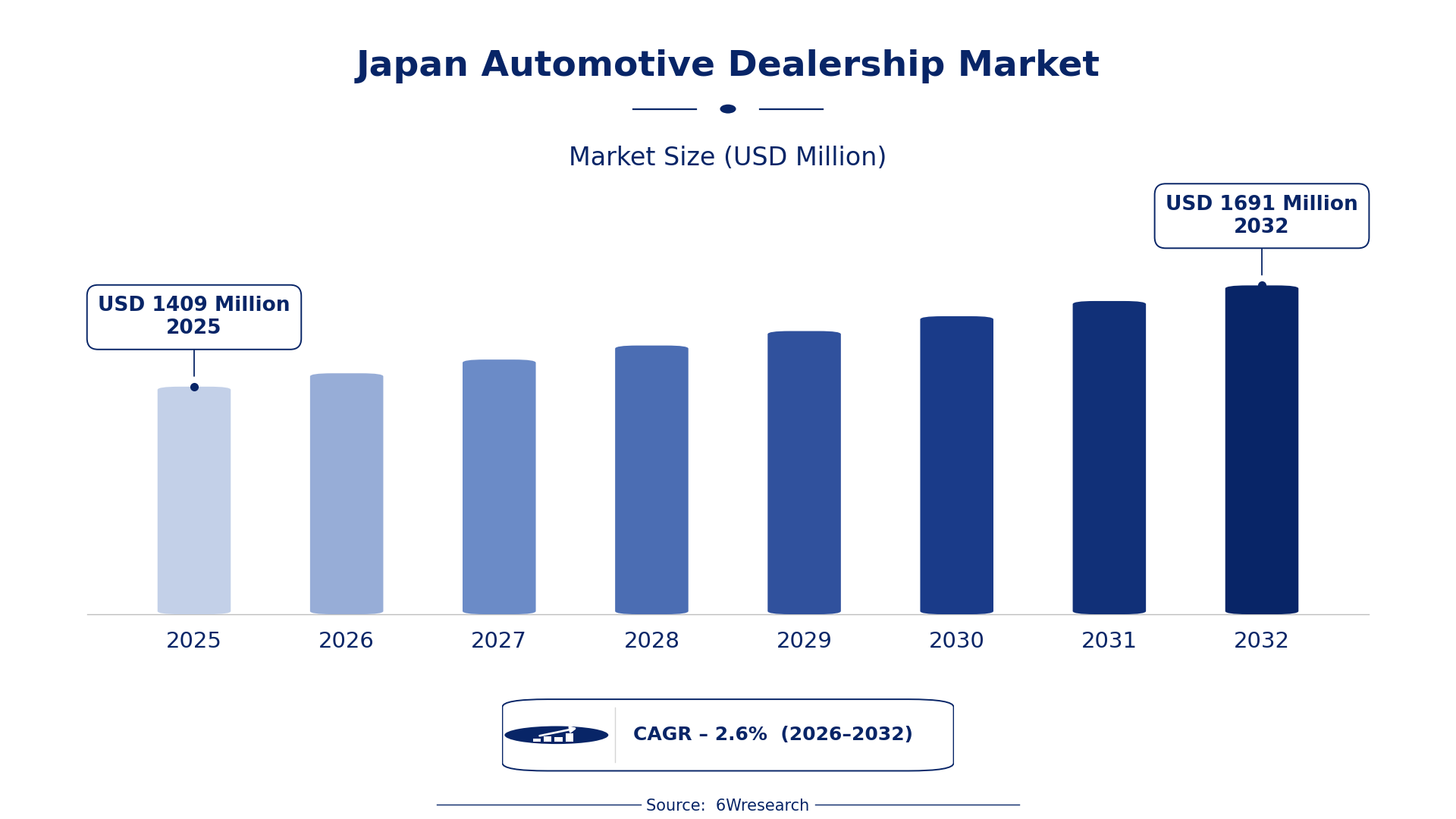
According to 6Wresearch internal database and industry insights, the Japan Automotive Dealership Market was valued at USD 1,409 Million in 2025 and is projected to reach USD 1,691 Million by 2032, growing at a CAGR of approximately 2.6% during 2026–2032.
Japan Automotive Dealership Market Highlights
| Report Metric | Details |
| Report Name | Japan Automotive Dealership Market (2026-2032) |
| Market Size 2025 | USD 1,409 Million |
| Market Size 2032 | USD 1,691 Million |
| Absolute Growth 2025–2032 | USD 282 Million |
| CAGR 2026–2032 | 2.6% |
| Peak Annual Growth | 4.3% in 2032 |
| Forecast Period | 2026–2032 |
| Historical Data | 2022–2025 |
| Base Year | 2025 |
| Leading Type, 2025 | New Vehicle Dealership (39% share) |
| Leading Retailer, 2025 | Franchised Retailer (64% share) |
| Leading Vehicle Type, 2025 | Passenger Cars (64% share) |
| Fastest-Growing Type | Used Vehicle Dealership (3.8% CAGR) |
| Fastest-Growing Retailer | Non-Franchised Retailer (3.6% CAGR) |
| Fastest-Growing Vehicle Type | Commercial Vehicles (4.0% CAGR) |
| Growing Sector | automotive services |
| Key End Users | consumers, businesses, automotive service providers |
Japan Automotive Dealership Market Year-wise Growth Rate and Key Drivers (2022–2032)
This graph illustrates the annual growth rates of the market from 2022 to 2032, highlighting a steady upward trajectory and projected market expansion over the forecast period.
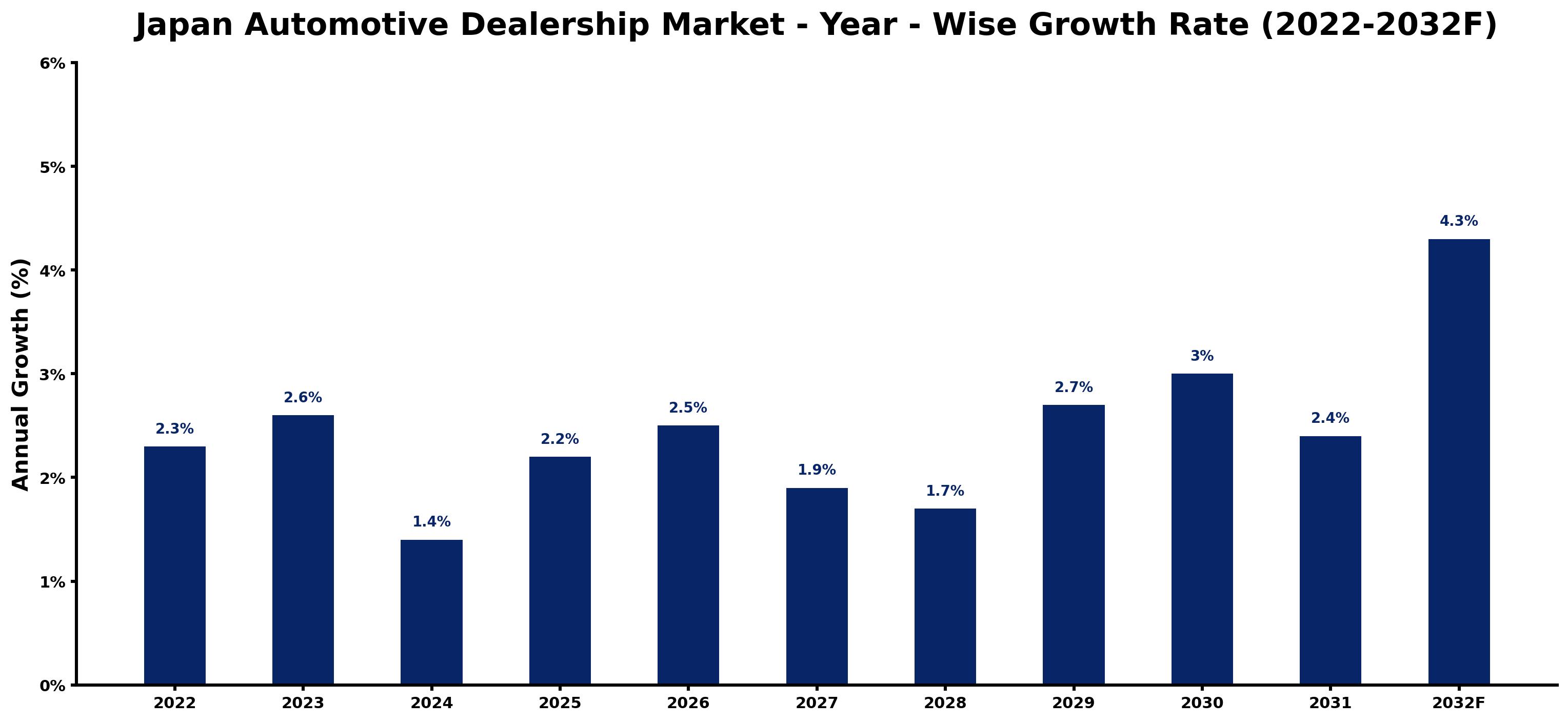
The following figures match every annual growth estimate with the main market development of that year, giving the reasoning behind each rise or slowdown.
| Year | Estimated Annual Growth (%) | Market Rationale |
| 2022 | 2.3 | The market experienced steady growth due to strong consumer demand for vehicles. |
| 2023 | 2.6 | Growth accelerated as the market adapted to changing consumer preferences for new models. |
| 2024 | 1.4 | Growth slowed as economic factors influenced consumer purchasing decisions. |
| 2025 | 2.2 | Renewed interest in vehicle purchases emerged as financing options improved. |
| 2026 | 2.5 | Demand is expected to increase as dealerships expand their service offerings and financing solutions. |
| 2027 | 1.9 | Growth is projected to slow due to rising competition and market saturation among dealerships. |
| 2028 | 1.7 | The market will continue to grow, albeit at a slower pace, as consumer habits evolve. |
| 2029 | 2.7 | Demand is expected to rise as more consumers opt for used vehicles, driven by budget considerations. |
| 2030 | 3.0 | Growth will pick up as electric vehicle sales gain traction in the market. |
| 2031 | 2.4 | The market is projected to experience a slowdown as economic uncertainties affect consumer confidence. |
| 2032 | 4.3 | Demand is expected to surge as the market embraces new technologies and sustainable practices. |
Note: Market size estimations and growth projections presented in this report are based on 6Wresearch's proprietary forecasting methodology, utilizing the latest available industry data, government publications, and primary research inputs.
Japan Automotive Dealership Market Synopsis
The Japan Automotive Dealership Market includes businesses that sell new and used vehicles, offer parts, services, and financing options. The market is growing due to robust domestic demand, especially in the used vehicle segment, which made up about 60% of total sales in 2022. Government initiatives to promote electric vehicles are propelling growth, alongside substantial investments in decarbonisation projected at JPY 150 trillion over the next decade. This combination of elements is shaping a vibrant market.
Market Dynamics Impact Analysis (2026–2032)
| Factor | Type | Impact | Primary Segment Affected |
| Growing consumer preference for used vehicles | Driver | High | Used Vehicle Dealership |
| Expansion of electric vehicle offerings | Driver | High | New Vehicle Dealership |
| Increasing demand for vehicle maintenance services | Opportunity | Medium | Parts and Services |
| Rising interest in financing options for vehicle purchases | Opportunity | Medium | Finance and Insurance |
| Economic uncertainties affecting consumer spending | Restraint | High | New Vehicle Dealership |
| Intense competition among dealerships | Restraint | Medium | Used Vehicle Dealership |
| Regulatory changes impacting dealership operations | Challenge | High | Franchised Retailer |
| Shifts in consumer preferences towards sustainability | Challenge | Medium | New Vehicle Dealership |
Evaluation of Drivers in Japan Automotive Dealership Market (2026–2032)
The factors lifting demand, and the evidence behind each, are summarised below.
| Drivers | Primary Segment Affected | Why It Matters (Evidence) |
| Strong domestic demand for vehicles | New Vehicle Dealership | In 2022, over 5 million vehicles were sold, driving dealership sales. |
| Increasing popularity of electric vehicles | New Vehicle Dealership | The government launched a program in 2023 to promote electric vehicle sales. |
| High demand for used vehicles | Used Vehicle Dealership | The used vehicle market accounted for about 60% of total vehicle sales in 2022. |
| Growth in automotive service market | Parts and Services | The automotive service market is valued at approximately 3 trillion JPY annually. |
| Expansion of financing options | Finance and Insurance | Dealerships are increasingly offering diverse financing solutions to attract buyers. |
The strongest pull on demand comes from the high volume of vehicle sales, with over 5 million units sold in 2022, indicating strong consumer interest. The used vehicle market accounted for approximately 60% of total sales, reflecting budget-conscious consumer behaviour. The automotive service market, valued at around 3 trillion JPY annually, supports ongoing maintenance needs, further boosting dealership revenues. Diverse financing options are attracting more buyers, contributing to overall market growth.
Evaluation of Restraints in Japan Automotive Dealership Market
The following restraints limit how fast demand can grow.
| Market Restraint | Primary Segment Affected | Why It Matters (Evidence) |
| Economic uncertainties affecting consumer purchasing power | New Vehicle Dealership | Economic fluctuations have led to a decline in consumer confidence, impacting vehicle sales. |
| Intense competition leading to price wars | Used Vehicle Dealership | Increased competition among dealerships has resulted in reduced profit margins. |
| Regulatory changes affecting dealership operations | Franchised Retailer | New regulations require dealerships to adapt their business models, increasing operational costs. |
| Shifts in consumer preferences towards sustainability | New Vehicle Dealership | Consumers are increasingly favouring eco-friendly options, impacting traditional vehicle sales. |
| Market saturation in urban areas | Used Vehicle Dealership | High dealership density in urban regions limits growth opportunities for individual retailers. |
Japan Automotive Dealership Market Challenges
Intense competition among dealerships drives down profit margins, as many struggle to differentiate themselves in a crowded market. Rapid technological advancements require significant investments in digital platforms, which can burden smaller independent dealers lacking financial resources. Stringent regulations from the Ministry of Land, Infrastructure, Transport and Tourism complicate compliance, resulting in delays and increased costs for maintaining standards like ISO 9001. Supply chain disruptions for vehicle parts can delay service offerings, forcing dealerships to turn away customers and potentially lose revenue, particularly in the automotive service market valued at approximately 3 trillion JPY annually.
Trends in the Japan Automotive Dealership Market
Below are the shifts with the largest effect on the Japan Automotive Dealership Market.
- Shift towards Electric Vehicles: In 2023, the automotive market has experienced a shift towards electric vehicles, driven by government initiatives. This trend is underscored by a new programme aimed at increasing electric vehicle sales, contributing to a growing segment of the market.
- Increase in Used Vehicle Sales: Since 2022, the used vehicle market has gained momentum, reflecting changing consumer preferences. With about 60% of total vehicle sales attributed to used cars, dealerships are adjusting their strategies to cater to this demand.
- Expansion of Automotive Services: The automotive service market has grown considerably, valued at approximately 3 trillion JPY annually. This expansion is fuelled by the rising need for vehicle maintenance and repair services, benefiting dealerships that provide comprehensive service packages.
- Rising Financing Options for Consumers: The availability of diverse financing options has increased since 2022, making vehicle purchases more attainable. Dealerships are responding by enhancing their financing services, which has resulted in higher sales volumes.
Investment Opportunities in the Japan Automotive Dealership Market
The following areas offer the clearest openings for investors and suppliers in the Japan Automotive Dealership Market.
- Automotive Service Expansion: With the automotive service market valued at approximately 3 trillion JPY, there is an opportunity to invest in service offerings. Dealerships in urban areas can improve their service capabilities to attract more customers.
- Electric Vehicle Sales Growth: The government's push for electric vehicles creates a timely opportunity for dealerships to expand their electric vehicle inventories. With over 5 million vehicle sales in 2022, there is a growing market for eco-friendly options.
- Financing Solutions Development: The increasing demand for financing solutions presents an opportunity to develop tailored financial products. Dealerships can partner with financial institutions to provide competitive financing options to attract budget-conscious buyers.
- Used Vehicle Market Investment: The used vehicle market accounted for about 60% of total sales, indicating a need for investment in this segment. Dealerships can focus on expanding their used vehicle inventories to meet growing consumer demand.
Government Initiatives in the Japan Automotive Dealership Market
The GX Promotion Act (2023) serves as the legal foundation for promoting decarbonisation within the automotive sector. This act encourages dealerships to invest in sustainable practices and technologies, aligning with Japan's commitment to achieving net-zero emissions by 2050. The government aims for about JPY 150 trillion of public and private investment over 10 years to support this transition.
Dealerships are utilizing the Battery Industry Strategy (METI, August 2022) to improve their offerings in electric vehicles. This strategy aims to boost domestic battery manufacturing capacity, enabling dealerships to provide more electric vehicle options to consumers.
Future Insight of the Japan Automotive Dealership Market
The rollout of electric vehicle sales programmes will reshape dealership inventories by 2032, prompting dealers to adapt their stock accordingly. Advanced digital platforms will improve customer interactions, increasing sales efficiency and service delivery. As Japan targets a 46% reduction in greenhouse-gas emissions, dealerships will focus on promoting sustainable vehicle options, influencing buyer preferences. With the used vehicle market accounting for about 60% of total vehicle sales, suppliers will experience growing demand for eco-friendly vehicles and related services.
Market Segmentation Analysis
Japan Automotive Dealership Market report covers a detailed analysis of the following market segments:
By Type – New Vehicle Dealership Leads, Used Vehicle Dealership Expected to Grow Fastest
According to Vasudha, AM at 6Wresearch, New Vehicle Dealership accounted for 39% of the market by type in 2025. The new vehicle dealership segment leads the market as it serves as the primary channel for new vehicle sales, with approximately 4,500 dealerships operating across Japan. This segment benefits from strong consumer interest, particularly in urban centres like Tokyo, where demand for new vehicles remains high. Over 2026–2032, Used Vehicle Dealership is expected to post the fastest growth, at a CAGR of 3.8%. The used vehicle dealership segment is experiencing rapid growth as budget-conscious consumers increasingly seek affordable alternatives, with used vehicles accounting for about 60% of total vehicle sales in 2022. This trend indicates that the demand for used vehicles will likely continue to rise as economic conditions fluctuate. Suppliers should focus on the used vehicle segment to effectively capture the growing interest among consumers.
By Retailer – Franchised Retailer Leads, Non-Franchised Retailer Expected to Grow Fastest
Franchised Retailer held 64% of the Japan Automotive Dealership Market by retailer in 2025. Franchised retailers dominate the market as they are authorised to sell specific brands, ensuring a steady supply of popular vehicles. With franchised dealers responsible for around 70% of new vehicle sales, they play a crucial role in maintaining brand loyalty and customer trust. Non-Franchised Retailer is set to record the highest CAGR in this split, 3.6% over 2026–2032. Non-franchised retailers are experiencing notable growth as they cater to consumers seeking used vehicles without brand affiliation, allowing for more competitive pricing. This segment's rise reflects a shift in consumer preferences towards greater flexibility in purchasing options. Buyers may benefit from a wider range of vehicle choices and more competitive pricing as non-franchised retailers expand their market share.
By Vehicle Type – Passenger Cars Lead, Commercial Vehicles Expected to Grow Fastest
With 64% of vehicle type revenue in 2025, Passenger Cars was the largest category. Passenger cars hold the largest market share, representing the majority of vehicle sales and aligning with consumer preferences for personal transportation. The average transaction price for a new car is approximately 3 million JPY, indicating strong demand in this category. The quickest growth will come from Commercial Vehicles, forecast to expand at a CAGR of 4.0% between 2026 and 2032. Commercial vehicles are witnessing increased demand as businesses focus on enhancing their operational capabilities, despite lower sales volumes compared to passenger cars. This growth suggests an economy that prioritises investment in business resources and logistics. Suppliers should adjust their offerings to meet the specific needs of commercial vehicle buyers to capitalise on this growth opportunity.
Key Attractiveness of the Report
- 10 Years of Market Numbers
- Historical Data Starting from 2022 to 2025
- Base Year 2025
- Forecast Data until 2032
- Key Performance Indicators Impacting the Market
- Major Upcoming Developments and Projects
Key Highlights of the Report:
- Japan Automotive Dealership Market Outlook
- Market Size of Japan Automotive Dealership Market, 2025
- Forecast of Japan Automotive Dealership Market, 2032
- Historical Data and Forecast of Japan Automotive Dealership Revenues & Volume for the Period 2022-2032
- Japan Automotive Dealership Market Trend Evolution
- Japan Automotive Dealership Market Drivers and Challenges
- Japan Automotive Dealership Price Trends
- Japan Automotive Dealership Porter's Five Forces
- Japan Automotive Dealership Industry Life Cycle
- Historical Data and Forecast of Japan Automotive Dealership Market Revenues & Volume By Type for the Period 2022-2032
- Historical Data and Forecast of Japan Automotive Dealership Market Revenues & Volume By New Vehicle Dealership for the Period 2022-2032
- Historical Data and Forecast of Japan Automotive Dealership Market Revenues & Volume By Used Vehicle Dealership for the Period 2022-2032
- Historical Data and Forecast of Japan Automotive Dealership Market Revenues & Volume By Parts and Services for the Period 2022-2032
- Historical Data and Forecast of Japan Automotive Dealership Market Revenues & Volume By Finance and Insurance for the Period 2022-2032
- Historical Data and Forecast of Japan Automotive Dealership Market Revenues & Volume By Retailer for the Period 2022-2032
- Historical Data and Forecast of Japan Automotive Dealership Market Revenues & Volume By Franchised Retailer for the Period 2022-2032
- Historical Data and Forecast of Japan Automotive Dealership Market Revenues & Volume By Non-Franchised Retailer for the Period 2022-2032
- Historical Data and Forecast of Japan Automotive Dealership Market Revenues & Volume By Vehicle Type for the Period 2022-2032
- Historical Data and Forecast of Japan Automotive Dealership Market Revenues & Volume By Passenger Cars for the Period 2022-2032
- Historical Data and Forecast of Japan Automotive Dealership Market Revenues & Volume By Commercial Vehicles for the Period 2022-2032
- Japan Automotive Dealership Import Export Trade Statistics
- Market Opportunity Assessment By Type
- Market Opportunity Assessment By Retailer
- Market Opportunity Assessment By Vehicle Type
- Japan Automotive Dealership Top Companies Market Share
- Japan Automotive Dealership Competitive Benchmarking By Technical and Operational Parameters
- Japan Automotive Dealership Company Profiles
- Japan Automotive Dealership Key Strategic Recommendations
Market Covered
Coverage by segment is as follows.
By Type
- New Vehicle Dealership
- Used Vehicle Dealership
- Parts and Services
- Finance and Insurance
By Retailer
- Franchised Retailer
- Non-Franchised Retailer
By Vehicle Type
- Passenger Cars
- Commercial Vehicles































