Japan Automotive Diagnostics Market Size & Growth Rate
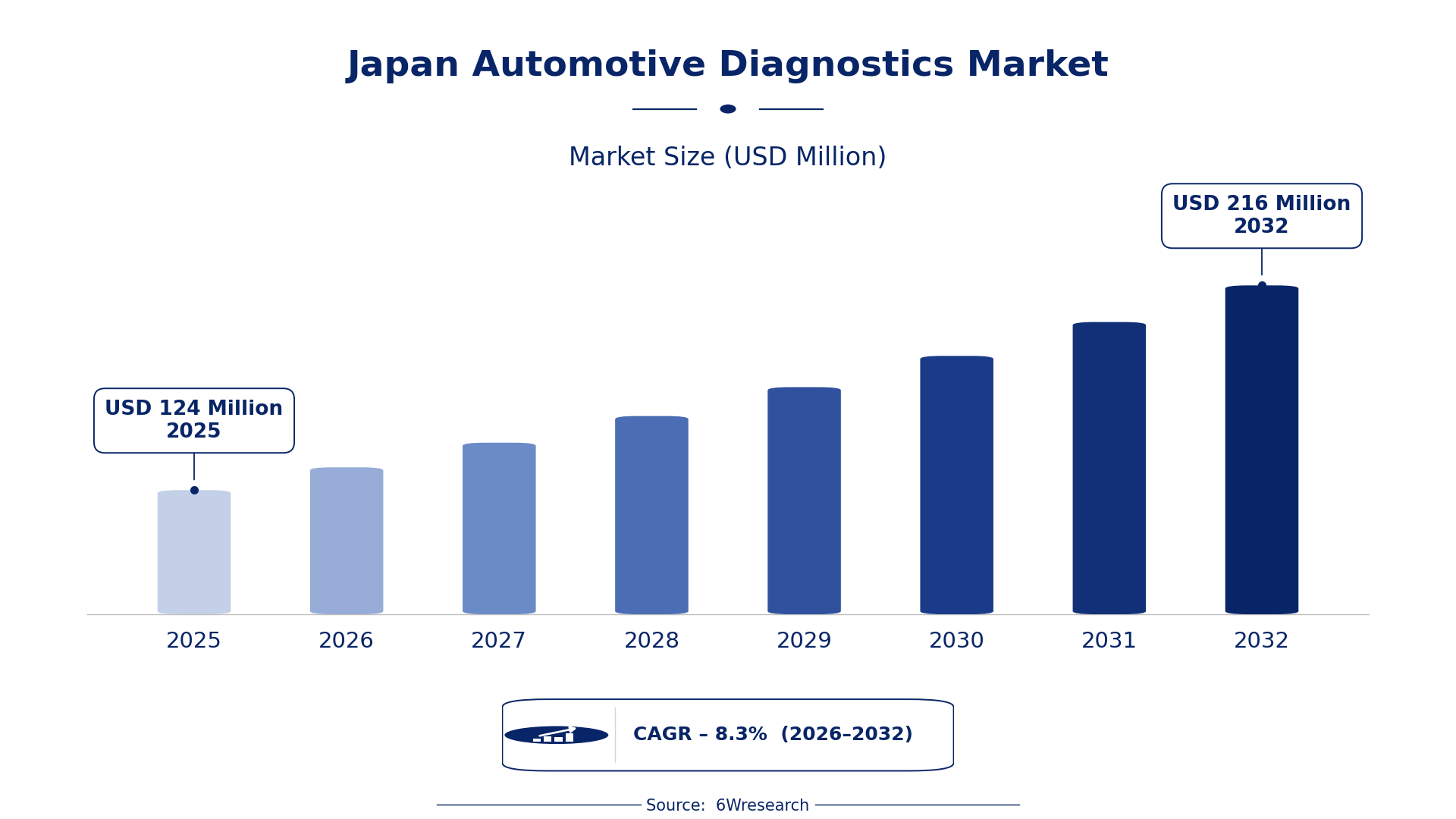
According to 6Wresearch internal database and industry insights, the Japan Automotive Diagnostics Market was valued at USD 124 Million in 2025 and is projected to reach USD 216 Million by 2032, growing at a CAGR of approximately 8.3% during 2026–2032.
Japan Automotive Diagnostics Market Highlights
| Report Metric | Details |
| Report Name | Japan Automotive Diagnostics Market (2026-2032) |
| Market Size 2025 | USD 124 Million |
| Market Size 2032 | USD 216 Million |
| Absolute Growth 2025–2032 | USD 92 Million |
| CAGR 2026–2032 | 8.3% |
| Peak Annual Growth | 9.2% in 2031 |
| Forecast Period | 2026–2032 |
| Historical Data | 2022–2025 |
| Base Year | 2025 |
| Leading Technology, 2025 | OBD-II (43% share) |
| Leading Application, 2025 | Engine Diagnostics (45% share) |
| Leading Vehicle Type, 2025 | Passenger Cars (39% share) |
| Fastest-Growing Technology | AI-Driven (12.2% CAGR) |
| Fastest-Growing Application | Predictive Maintenance (11.7% CAGR) |
| Fastest-Growing Vehicle Type | Electric Vehicles (12.1% CAGR) |
| Growing Sector | automotive diagnostics |
| Key End Users | automotive service centres, fleet operators, vehicle manufacturers |
Japan Automotive Diagnostics Market Year-wise Growth Rate and Key Drivers (2022–2032)
This graph illustrates the annual growth rates of the market from 2022 to 2032, highlighting a steady upward trajectory and projected market expansion over the forecast period.
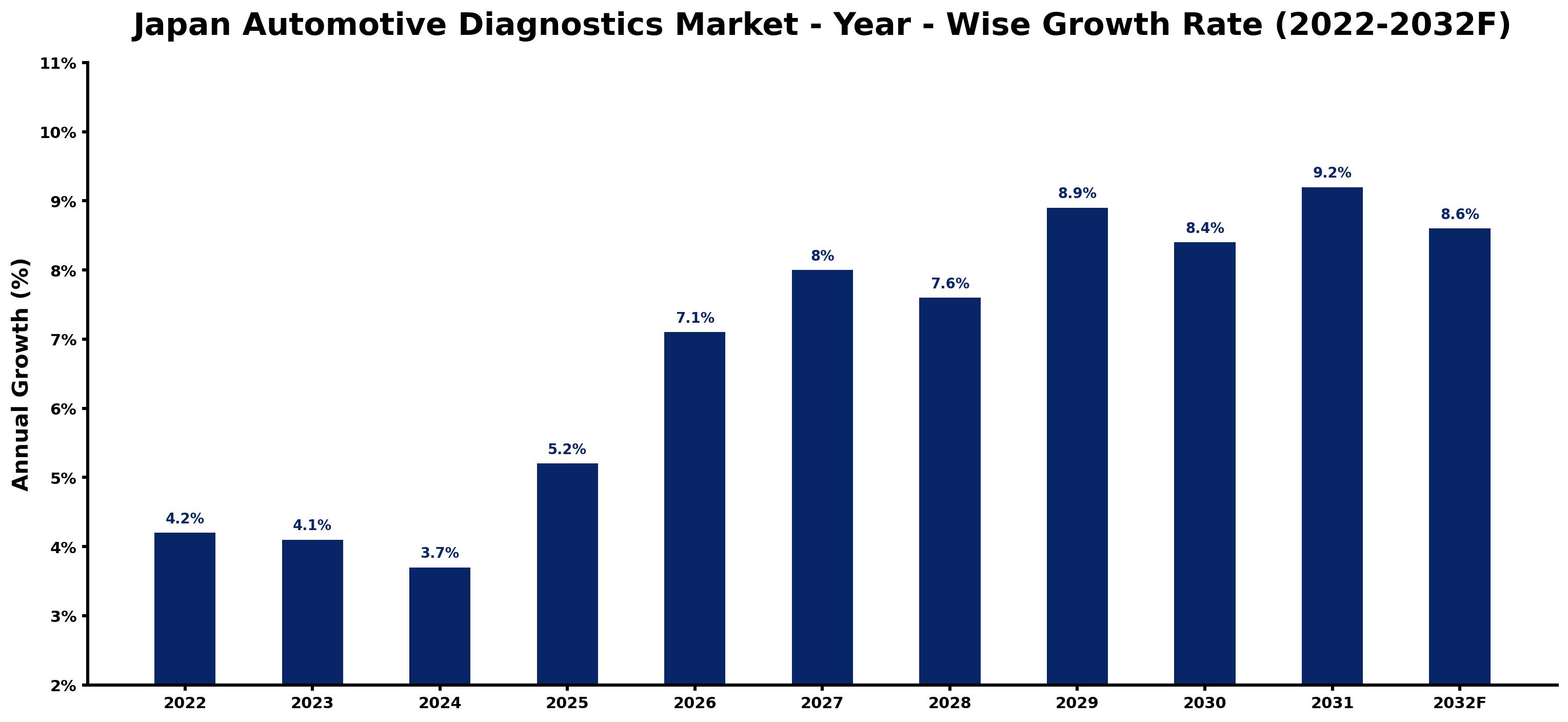
For each year, the table pairs the estimated growth rate with the leading influence on demand, showing how the drivers changed across the period.
| Year | Estimated Annual Growth (%) | Market Rationale |
| 2022 | 4.2 | The market showed steady growth, driven by the increasing number of registered vehicles. |
| 2023 | 4.1 | Demand growth slowed slightly as fewer new vehicle registrations occurred. |
| 2024 | 3.7 | The market continued to experience a slowdown as demand stabilised amid economic uncertainties. |
| 2025 | 5.2 | Growth accelerated as new standards for vehicle emissions diagnostics were introduced. |
| 2026 | 7.1 | The market is expected to grow faster as investments in advanced diagnostics technologies increase. |
| 2027 | 8.0 | Demand is expected to rise as automotive service centres adopt more sophisticated diagnostic tools. |
| 2028 | 7.6 | Growth is projected to slow as the market matures and competition intensifies. |
| 2029 | 8.9 | The market is expected to grow faster due to rising interest in electric vehicle diagnostics. |
| 2030 | 8.4 | Growth is anticipated to slow as the market adapts to new technologies and standards. |
| 2031 | 9.2 | The market will peak as demand for advanced diagnostics technologies reaches its highest point. |
| 2032 | 8.6 | Growth is projected to slow as the market stabilises after reaching peak demand. |
Note: Market size estimations and growth projections presented in this report are based on 6Wresearch's proprietary forecasting methodology, utilizing the latest available industry data, government publications, and primary research inputs.
Japan Automotive Diagnostics Market Synopsis
Automotive diagnostics encompasses technologies and tools for assessing vehicle performance and identifying issues, primarily through software and hardware integration. The Japan Automotive Diagnostics Market is growing due to rising demand from over 5 million registered passenger cars and a strong focus on electric vehicles. The introduction of new standards for vehicle emissions diagnostics and the increasing adoption of advanced technologies are driving market growth, particularly in the Tokyo region, which accounts for 30% of demand.
Market Dynamics Impact Analysis (2026–2032)
| Factor | Type | Impact | Primary Segment Affected |
| Rising focus on electric vehicles | Driver | High | Electric Vehicles |
| Adoption of advanced diagnostics technologies | Driver | High | AI-Driven |
| Integration of remote monitoring systems in vehicles | Opportunity | High | Wireless Diagnostics |
| Growing demand for predictive maintenance solutions | Opportunity | Medium | Predictive Maintenance |
| Market saturation in traditional diagnostics tools | Restraint | High | Engine Diagnostics |
| High costs associated with advanced diagnostics tools | Restraint | Medium | Cloud-Based |
| Limited awareness of new technologies among service centres | Challenge | High | Remote Monitoring |
| Competition from emerging diagnostics solutions | Challenge | Medium | Smart Safety Features |
Evaluation of Drivers in Japan Automotive Diagnostics Market (2026–2032)
These are the developments adding the most demand over the forecast period.
| Drivers | Primary Segment Affected | Why It Matters (Evidence) |
| Increase in registered passenger cars | Engine Diagnostics | With over 5 million registered vehicles, demand for engine diagnostics services remains strong. |
| Government standards for emissions diagnostics | OBD-II | The mandatory OBD-II standard for vehicles manufactured after 2000 drives consistent demand for diagnostics. |
| Investment in advanced technologies | AI-Driven | The Japan Automobile Manufacturers Association promotes AI technologies, improving predictive maintenance capabilities. |
| Growth of electric vehicles | Electric Vehicles | The introduction of new standards for electric vehicle diagnostics is increasing demand for related tools. |
| Expansion of automotive service centres | Cloud-Based | With approximately 1,200 service centres equipped with advanced tools, demand for cloud-based diagnostics is rising. |
The strongest pull on demand comes from the increasing number of registered passenger cars, exceeding 5 million, leading to a higher need for engine diagnostics services. The mandatory OBD-II standard for vehicles manufactured post-2000 creates stable demand for diagnostics tools. The growth of electric vehicles is also noteworthy, as new standards for electric vehicle diagnostics are expected to drive demand for specialised tools. The expansion of automotive service centres is further driving demand for cloud-based diagnostics solutions and advanced tools.
Evaluation of Restraints in Japan Automotive Diagnostics Market
These restraints slow adoption and weigh on supplier margins.
| Market Restraint | Primary Segment Affected | Why It Matters (Evidence) |
| Market saturation in traditional diagnostics tools | Engine Diagnostics | As the market matures, demand for conventional diagnostics tools is declining due to saturation. |
| High costs associated with advanced diagnostics tools | Cloud-Based | The investment required for advanced cloud-based diagnostics tools can deter smaller service centres. |
| Limited awareness of new technologies among service centres | Remote Monitoring | Many service centres lack knowledge about the latest remote monitoring technologies, hindering adoption. |
| Competition from emerging diagnostics solutions | Smart Safety Features | New entrants offering advanced diagnostics solutions are intensifying competition in the market. |
| Regulatory compliance challenges | AI-Driven | Meeting stringent regulatory requirements for AI-driven diagnostics can be complex and costly. |
Japan Automotive Diagnostics Market Challenges
Buyers in the automotive diagnostics market face intense competition from global manufacturers, which pressures local prices and reduces profit margins. Service centres often rely on outdated diagnostic equipment, resulting in repair delays that can extend service times by up to 30%. A lack of skilled technicians hampers the adoption of modern diagnostic technologies, leading to increased operational costs for service centres and longer wait times for customers. New emissions regulations introduced in 2023 require substantial investment for compliance, straining the budgets of smaller service providers and risking operational disruptions.
Trends in the Japan Automotive Diagnostics Market
Four trends stand out in the Japan Automotive Diagnostics Market.
- Introduction of New Emissions Diagnostics Standards: In 2023, the Ministry of Land, Infrastructure, Transport and Tourism introduced new standards for vehicle emissions diagnostics, improving compliance and performance evaluation. This shift is expected to drive demand for advanced diagnostics tools across the industry.
- Rise of Advanced Diagnostics: The adoption of advanced diagnostics is increasing, particularly among automotive service centres. With a projected CAGR of 12.2% for this segment, it is transforming how diagnostics are performed and improving predictive maintenance capabilities.
- Shift Towards Remote Monitoring Systems: Remote monitoring systems are becoming more prevalent, with expectations that they will be integrated into 20% of new vehicles by 2025. This trend is reshaping fleet management and diagnostics practices, enhancing efficiency.
- Growing Focus on Electric Vehicle Diagnostics: As electric vehicles gain popularity, the demand for specialised diagnostics tools is rising. The introduction of new standards for electric vehicle diagnostics reflects a significant shift in the automotive diagnostics market.
Investment Opportunities in the Japan Automotive Diagnostics Market
Where to invest in the Japan Automotive Diagnostics Market: the main openings are set out below.
- Tokyo as a Hub for Automotive Innovations: The Tokyo region, accounting for 30% of automotive diagnostics demand, presents opportunities for suppliers of advanced diagnostics tools. With a growing market size, investment in local partnerships can facilitate entry.
- Fleet Operators Seeking Advanced Solutions: Fleet operators are increasingly looking for advanced diagnostics solutions to optimise maintenance. The expected integration of remote monitoring systems into 20% of new vehicles by 2025 highlights this demand.
- Investment in Advanced Technologies: With a projected CAGR of 12.2% for advanced diagnostics, there is an opportunity for investment in this technology. Automotive service centres are key buyers, seeking to improve their service offerings.
- Growth of Electric Vehicle Diagnostics: New standards for electric vehicle diagnostics aim to improve capabilities by 2025, creating opportunities for suppliers of specialised tools. Collaborating with local manufacturers can facilitate market entry.
Government Initiatives in the Japan Automotive Diagnostics Market
The Clinical Trials Act (2017) sets guidelines for the conduct and disclosure of clinical research, impacting automotive diagnostics by ensuring that new technologies meet safety and efficacy standards. This law complements existing regulations, enhancing the overall framework for automotive diagnostics in Japan.
In 2023, the government allocated ¥1 billion for research on automotive safety technologies, administered by the Ministry of Land, Infrastructure, Transport and Tourism. This funding supports the development of advanced diagnostics tools and technologies, ensuring compliance with new standards.
Future Insight of the Japan Automotive Diagnostics Market
By 2032, advancements in technology will reshape automotive diagnostics. The integration of remote monitoring systems into 20% of new vehicles will enhance real-time diagnostics capabilities. New standards for vehicle emissions diagnostics will spur innovation in compliance technologies, providing suppliers with growth opportunities. With the government committing ¥150 trillion to decarbonisation efforts over the next decade, suppliers will likely focus on developing improved safety features, which will offer buyers greater vehicle reliability and performance.
Market Segmentation Analysis
Japan Automotive Diagnostics Market report covers a detailed analysis of the following market segments:
By Technology – OBD-II Leads, AI-Driven Expected to Grow Fastest
According to Ravi Bhandari, Research Head at 6Wresearch, in 2025, OBD-II led the technology split with a 43% share. The OBD-II standard is vital for vehicle diagnostics and emissions testing, making it a primary choice among service centres. With over 5 million registered passenger cars in Japan, the extensive adoption of OBD-II ensures a solid foundation for its widespread use. Over 2026–2032, AI-Driven is expected to post the fastest growth, at a CAGR of 12.2%. The integration of advanced diagnostics tools is gaining traction as they significantly improve vehicle maintenance efficiency, appealing to service centres. The government's backing for research on automotive safety technologies indicates a promising growth trajectory for this segment. Suppliers should prioritise OBD-II compliant solutions to align with the strong demand for automotive diagnostics.
By Application – Engine Diagnostics Lead, Predictive Maintenance Expected to Grow Fastest
Engine Diagnostics accounted for 45% of the market by application in 2025. Engine diagnostics are essential for assessing vehicle performance, making them the most critical application in the automotive diagnostics market. The high volume of vehicles requiring regular performance assessments underscores the significance of this segment. Predictive Maintenance is projected to grow fastest, at a CAGR of 11.7% during 2026–2032. Predictive maintenance is rapidly gaining traction as it effectively minimises downtime and repair costs, which is attractive to both consumers and service centres. The increasing number of service centres equipped with advanced diagnostics tools supports this upward trend. Buyers will increasingly favour solutions that provide predictive maintenance capabilities to enhance vehicle reliability and reduce expenses.
By Vehicle Type – Passenger Cars Lead, Electric Vehicles Expected to Grow Fastest
The largest vehicle type category in 2025 was Passenger Cars, at 39% of revenue. Passenger cars dominate the automotive diagnostics market, accounting for the majority of diagnostic applications due to their prevalence in the market. This segment's large share is reinforced by the extensive number of registered passenger vehicles in Japan. Electric Vehicles are set to record the highest CAGR in this split, 12.1% over 2026–2032. Electric vehicles are emerging as a rapidly expanding segment with distinct diagnostic requirements, driven by initiatives aimed at enhancing EV diagnostics capabilities. As consumer interest in electric vehicles rises, demand for specialised diagnostics will continue to increase. Suppliers must tailor their products to meet the unique diagnostic needs of electric vehicles to capitalise on this growth opportunity.
Key Attractiveness of the Report
- 10 Years of Market Numbers
- Historical Data Starting from 2022 to 2025
- Base Year 2025
- Forecast Data until 2032
- Key Performance Indicators Impacting the Market
- Major Upcoming Developments and Projects
Key Highlights of the Report:
- Japan Automotive Diagnostics Market Outlook
- Market Size of Japan Automotive Diagnostics Market, 2025
- Forecast of Japan Automotive Diagnostics Market, 2032
- Historical Data and Forecast of Japan Automotive Diagnostics Revenues & Volume for the Period 2022-2032
- Japan Automotive Diagnostics Market Trend Evolution
- Japan Automotive Diagnostics Market Drivers and Challenges
- Japan Automotive Diagnostics Price Trends
- Japan Automotive Diagnostics Porter's Five Forces
- Japan Automotive Diagnostics Industry Life Cycle
- Historical Data and Forecast of Japan Automotive Diagnostics Market Revenues & Volume By Technology for the Period 2022-2032
- Historical Data and Forecast of Japan Automotive Diagnostics Market Revenues & Volume By OBD-II for the Period 2022-2032
- Historical Data and Forecast of Japan Automotive Diagnostics Market Revenues & Volume By Cloud-Based for the Period 2022-2032
- Historical Data and Forecast of Japan Automotive Diagnostics Market Revenues & Volume By AI-Driven for the Period 2022-2032
- Historical Data and Forecast of Japan Automotive Diagnostics Market Revenues & Volume By Wireless Diagnostics for the Period 2022-2032
- Historical Data and Forecast of Japan Automotive Diagnostics Market Revenues & Volume By Application for the Period 2022-2032
- Historical Data and Forecast of Japan Automotive Diagnostics Market Revenues & Volume By Engine Diagnostics for the Period 2022-2032
- Historical Data and Forecast of Japan Automotive Diagnostics Market Revenues & Volume By Remote Monitoring for the Period 2022-2032
- Historical Data and Forecast of Japan Automotive Diagnostics Market Revenues & Volume By Predictive Maintenance for the Period 2022-2032
- Historical Data and Forecast of Japan Automotive Diagnostics Market Revenues & Volume By Smart Safety Features for the Period 2022-2032
- Historical Data and Forecast of Japan Automotive Diagnostics Market Revenues & Volume By Vehicle Type for the Period 2022-2032
- Historical Data and Forecast of Japan Automotive Diagnostics Market Revenues & Volume By Passenger Cars for the Period 2022-2032
- Historical Data and Forecast of Japan Automotive Diagnostics Market Revenues & Volume By Commercial Vehicles for the Period 2022-2032
- Historical Data and Forecast of Japan Automotive Diagnostics Market Revenues & Volume By Electric Vehicles for the Period 2022-2032
- Historical Data and Forecast of Japan Automotive Diagnostics Market Revenues & Volume By Luxury Vehicles for the Period 2022-2032
- Japan Automotive Diagnostics Import Export Trade Statistics
- Market Opportunity Assessment By Technology
- Market Opportunity Assessment By Application
- Market Opportunity Assessment By Vehicle Type
- Japan Automotive Diagnostics Top Companies Market Share
- Japan Automotive Diagnostics Competitive Benchmarking By Technical and Operational Parameters
- Japan Automotive Diagnostics Company Profiles
- Japan Automotive Diagnostics Key Strategic Recommendations
Market Covered
The report covers the following segments.
By Technology
- OBD-II
- Cloud-Based
- AI-Driven
- Wireless Diagnostics
By Application
- Engine Diagnostics
- Remote Monitoring
- Predictive Maintenance
- Smart Safety Features
By Vehicle Type
- Passenger Cars
- Commercial Vehicles
- Electric Vehicles
- Luxury Vehicles































