Japan Automotive Door Hinges Market Size & Growth Rate
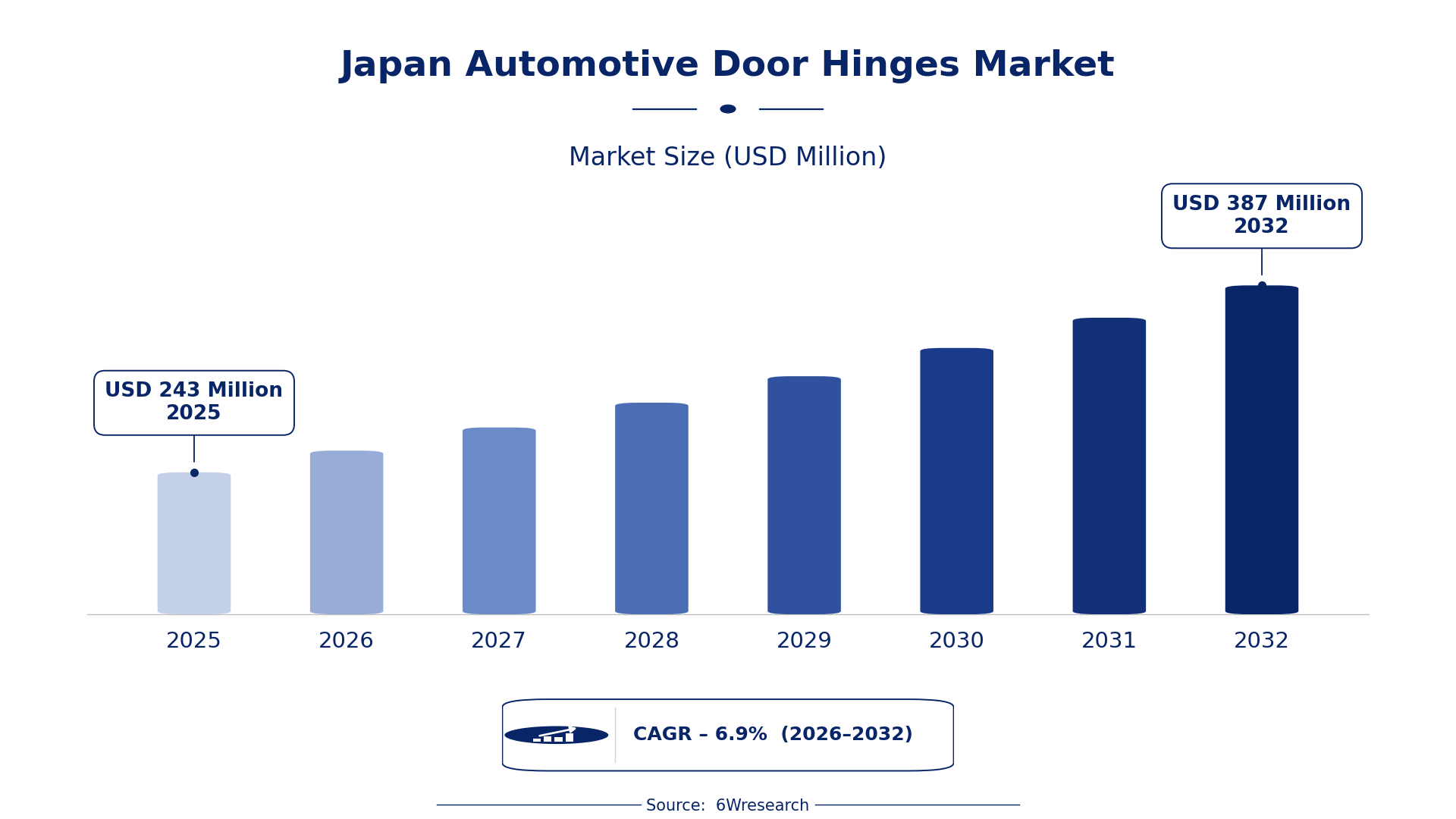
According to 6Wresearch internal database and industry insights, the Japan Automotive Door Hinges Market was valued at USD 243 Million in 2025 and is projected to reach USD 387 Million by 2032, growing at a CAGR of approximately 6.9% during 2026–2032.
Japan Automotive Door Hinges Market Highlights
| Report Metric | Details |
| Report Name | Japan Automotive Door Hinges Market (2026-2032) |
| Market Size 2025 | USD 243 Million |
| Market Size 2032 | USD 387 Million |
| Absolute Growth 2025–2032 | USD 144 Million |
| CAGR 2026–2032 | 6.9% |
| Peak Annual Growth | 7.9% in 2026 |
| Forecast Period | 2026–2032 |
| Historical Data | 2022–2025 |
| Base Year | 2025 |
| Leading Product Type, 2025 | Front & Rear Automotive Door hinges (62% share) |
| Leading Vehicle Type, 2025 | Passenger Car (42% share) |
| Leading Sales Channel, 2025 | OEM (56% share) |
| Leading Material, 2025 | Steel (52% share) |
| Fastest-Growing Product Type | Tailgate Hinges/ Bonnet Hinges (9.4% CAGR) |
| Fastest-Growing Vehicle Type | LCV (9.2% CAGR) |
| Fastest-Growing Sales Channel | After Market (8.1% CAGR) |
| Fastest-Growing Material | Aluminium (9.5% CAGR) |
| Growing Sector | Aluminium |
| Key End Users | Steel, Aluminium, Brass/Bronze/Composite Material |
Japan Automotive Door Hinges Market Year-wise Growth Rate and Key Drivers (2022–2032)
This graph illustrates the annual growth rates of the market from 2022 to 2032, highlighting a steady upward trajectory and projected market expansion over the forecast period.
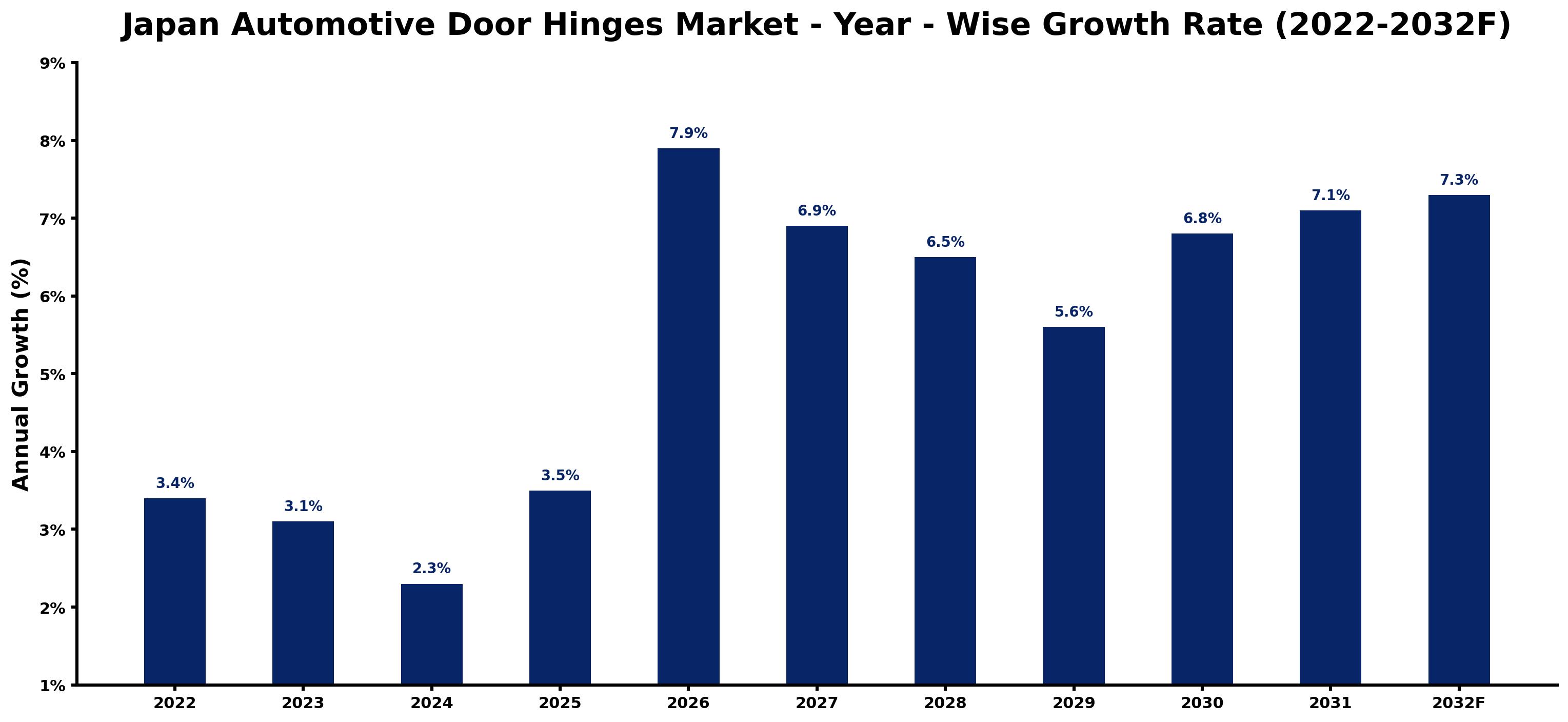
The following figures match every annual growth estimate with the main market development of that year, giving the reasoning behind each rise or slowdown.
| Year | Estimated Annual Growth (%) | Market Rationale |
| 2022 | 3.4 | The market showed stable growth, reflecting ongoing demand for automotive components. |
| 2023 | 3.1 | Growth slowed slightly due to market saturation and increased competition among manufacturers. |
| 2024 | 2.3 | The market continued to slow as manufacturers adjusted to changing consumer preferences. |
| 2025 | 3.5 | Growth accelerated as production levels increased in response to rising vehicle sales. |
| 2026 | 7.9 | The market is expected to peak as demand surges for new automotive designs and lightweight materials. |
| 2027 | 6.9 | Growth is projected to slow as manufacturers face challenges in sourcing materials and meeting standards. |
| 2028 | 6.5 | The market will experience a further slowdown as competition intensifies among suppliers. |
| 2029 | 5.6 | Growth is expected to decelerate as manufacturers focus on efficiency and cost reduction. |
| 2030 | 6.8 | Growth will rebound as new technologies and materials gain traction in vehicle production. |
| 2031 | 7.1 | The market is projected to experience renewed growth driven by increased investment in new designs. |
| 2032 | 7.3 | Growth is expected to stabilise as the market adjusts to evolving consumer demands and sustainability goals. |
Note: Market size estimations and growth projections presented in this report are based on 6Wresearch's proprietary forecasting methodology, utilizing the latest available industry data, government publications, and primary research inputs.
Japan Automotive Door Hinges Market Synopsis
Automotive door hinges are critical mechanical components that connect doors to vehicle frames, ensuring their functionality and safety. These hinges are primarily made from steel or aluminum, with a focus on lightweight materials to improve vehicle performance. The Japan Automotive Door Hinges Market is expanding due to rising automotive production, which reached 8.3 million units in 2022, and a growing emphasis on reducing vehicle weight by 30% by 2030. Demand is driven by passenger car manufacturers and the increasing adoption of lightweight materials in automotive design, supported by the GX Basic Policy aiming for substantial decarbonisation investment.
Market Dynamics Impact Analysis (2026–2032)
| Factor | Type | Impact | Primary Segment Affected |
| Rising automotive production levels | Driver | High | Passenger Car |
| Growing emphasis on lightweight materials | Driver | High | Tailgate Hinges/ Bonnet Hinges |
| Expansion of the aftermarket segment | Opportunity | Medium | After Market |
| Increasing demand for aluminium hinges | Opportunity | Medium | Aluminium |
| Material sourcing challenges | Restraint | High | Steel |
| Competition from alternative fastening solutions | Restraint | Medium | Front & Rear Automotive Door hinges |
| High production costs for advanced materials | Challenge | High | Aluminium |
| Regulatory compliance costs | Challenge | Medium | Tailgate Hinges/ Bonnet Hinges |
Evaluation of Drivers in Japan Automotive Door Hinges Market (2026–2032)
The main growth drivers and the segments they affect most are set out below.
| Drivers | Primary Segment Affected | Why It Matters (Evidence) |
| Increased vehicle production | Passenger Car | Japan's automotive production reached 8.3 million units in 2022, driving demand for door hinges. |
| Focus on lightweight materials | Aluminium | The government aims for a 30% reduction in vehicle weight by 2030, leading to higher aluminium usage. |
| Growth of the aftermarket segment | After Market | The average lifespan of automotive door hinges is about 10-15 years, increasing replacement demand. |
| Technological advancements in manufacturing | Tailgate Hinges/ Bonnet Hinges | Innovations in production techniques improve hinge performance, attracting more buyers. |
| Rising exports of vehicles | Front & Rear Automotive Door hinges | Japan exported 4.5 million vehicles in 2022, boosting hinge demand for international markets. |
Much of the new demand traces back to Japan's automotive production, which reached 8.3 million units in 2022, prompting manufacturers to increase hinge output. The target for a 30% reduction in vehicle weight by 2030 has led to a growing focus on lightweight materials, particularly aluminium, projected to see a 9.5% CAGR. The average lifespan of automotive door hinges is about 10-15 years, driving replacement demand in the aftermarket segment. Innovations in manufacturing processes are improving hinge performance, attracting more buyers. Japan's exports of vehicles have increased demand for high-quality door hinges in international markets, creating further opportunities for suppliers.
Evaluation of Restraints in Japan Automotive Door Hinges Market
The main factors holding the market back are set out below.
| Market Restraint | Primary Segment Affected | Why It Matters (Evidence) |
| Intense competition among manufacturers | Front & Rear Automotive Door hinges | Producers face pressure to invest heavily in new materials and processes, costing millions in R&D. |
| Rising costs for lightweight materials | Aluminium | Buyers experience increased production expenses as they seek lightweight hinges to comply with new standards. |
| Skills shortages in advanced manufacturing | Tailgate Hinges/ Bonnet Hinges | Shortages hinder production efficiency, leading to delays in deliveries for manufacturers. |
| Supply chain disruptions | After Market | Global events can lead to a 20% increase in procurement costs for producers, impacting pricing for end-users. |
| Regulatory compliance costs | Passenger Car | Manufacturers must invest in compliance with evolving standards, raising operational costs. |
Japan Automotive Door Hinges Market Challenges
Producers encounter fierce competition as Japan's automotive industry adapts to stringent emissions targets, necessitating substantial investments in new technologies. Such investments can elevate production costs by 15%, which buyers must absorb, thereby squeezing their profit margins. Buyers are also facing rising prices due to increased pricing pressures from producers striving to meet these regulations. Skills shortages in advanced manufacturing techniques result in longer lead times for producers, delaying deliveries for buyers. Supply chain disruptions can inflate procurement costs by 20% for producers, ultimately raising prices for end-users.
Trends in the Japan Automotive Door Hinges Market
Four trends stand out in the Japan Automotive Door Hinges Market.
- Shift Towards Lightweight Materials: The automotive industry is increasingly adopting lightweight materials, as the government targets a 30% reduction in vehicle weight by 2030. This trend is visible in the Tokyo region, where manufacturers are prioritising aluminium for door hinges.
- Growing Aftermarket Demand: The aftermarket segment is witnessing significant growth as vehicle owners seek replacements for aging components. This trend is highlighted by the average lifespan of automotive door hinges being around 10-15 years, prompting increased sales.
- Focus on Sustainability Standards: The introduction of JIS B 1001 standards for automotive hinges is shaping the market by ensuring higher quality and safety. This initiative aligns with Japan's broader strategy to promote sustainable automotive design.
- Expansion of Automotive Production Facilities: The Tokyo region continues to expand its automotive production facilities, reflecting the industry's growth. In 2022, Japan's automotive production reached 8.3 million units, indicating strong demand for components like door hinges.
Investment Opportunities in the Japan Automotive Door Hinges Market
Below are the investment opportunities with the strongest case in the Japan Automotive Door Hinges Market.
- Investment in Lightweight Material Technologies: The Tokyo region offers opportunities for suppliers of lightweight materials, with a projected market growth of 9.5% for aluminium. Collaborating with local manufacturers can facilitate entry into this expanding market.
- Expansion in the Aftermarket Sector: Aftermarket suppliers can take advantage of the rising demand for replacement parts, driven by the average lifespan of automotive door hinges. Targeting passenger car owners in urban areas can improve market penetration.
- Development of Advanced Manufacturing Techniques: Investing in advanced manufacturing technologies can boost production efficiency for hinge manufacturers. The growing emphasis on quality and performance in the automotive sector supports this opportunity.
- Collaboration with Automotive OEMs: Establishing partnerships with automotive OEMs can provide access to a larger customer base. With OEMs accounting for 56% of sales, forming joint ventures can strengthen market presence.
Government Initiatives in the Japan Automotive Door Hinges Market
The GX Promotion Act (2023) serves as the legal framework for promoting decarbonisation in the automotive sector. This act mandates that manufacturers comply with new environmental standards, impacting the production of automotive door hinges. Compliance necessitates investment in testing and certification processes, ensuring that products meet sustainability goals.
The government allocated JPY 150 trillion for public-private decarbonisation investment over the next decade. The Ministry of Economy, Trade and Industry oversees this initiative, which supports projects aimed at advancing lightweight materials and improving production processes in the automotive industry.
Future Insight of the Japan Automotive Door Hinges Market
The launch of lightweight material initiatives will transform automotive design by 2032, enabling producers to meet Japan's goal of a 30% reduction in vehicle weight. Enhanced JIS B 1001 standards will ensure improved quality and safety for door hinges. As advanced manufacturing technologies become more prevalent, suppliers will benefit from increased efficiency and reduced operational costs. With automotive production projected to reach 9 million units by 2032, the demand for high-quality door hinges will drive innovation in material applications and design.
Market Segmentation Analysis
Japan Automotive Door Hinges Market report covers a detailed analysis of the following market segments:
By Product Type – Front & Rear Automotive Door hinges Lead, Tailgate Hinges/ Bonnet Hinges Expected to Grow Fastest
According to Vasudha, AM at 6Wresearch, with 62% of product type revenue in 2025, Front & Rear Automotive Door hinges was the largest category. Front and rear automotive door hinges are crucial for the functionality of vehicle doors, making them indispensable in passenger cars and commercial vehicles. Their prevalence is underscored by the production of 150 million units annually, highlighting their importance in Japan's automotive landscape. The quickest growth will come from Tailgate Hinges/ Bonnet Hinges, forecast to expand at a CAGR of 9.4% between 2026 and 2032. Tailgate hinges and bonnet hinges are experiencing rapid growth due to increasing consumer demand for enhanced accessibility in vehicles, particularly in light commercial vehicles. The government's initiative to promote lightweight materials is propelling this segment's expansion, as manufacturers aim to meet weight reduction targets. Suppliers should focus on developing advanced tailgate and bonnet hinge solutions to align with the rising demand for improved vehicle accessibility.
By Vehicle Type – Passenger Car Leads, LCV Expected to Grow Fastest
Passenger Car accounted for 42% of the market by vehicle type in 2025. Passenger cars account for approximately 70% of Japan's automotive market, establishing them as the leading segment for automotive door hinges. This dominance is supported by the country's strong automotive production, which reached 8.3 million units in 2022, ensuring a consistent demand for these components. LCV is set to record the highest CAGR in this split, 9.2% over 2026–2032. Light commercial vehicles are witnessing significant growth as they gain popularity for diverse applications, such as delivery and transport services. This segment's expansion is fuelled by the increasing number of light commercial vehicles on the roads, reflecting shifting consumer preferences. Suppliers should tailor their products to cater to the specific requirements of light commercial vehicles to capitalise on this growing market segment.
By Sales Channel – OEM Leads, After Market Expected to Grow Fastest
OEM held 56% of the Japan Automotive Door Hinges Market by sales channel in 2025. The OEM channel serves as the primary sales avenue for automotive door hinges, as manufacturers incorporate these components directly into new vehicles. This channel's leading position is reinforced by Japan's substantial automotive production, which bolsters a robust OEM market. Over 2026–2032, After Market is expected to post the fastest growth, at a CAGR of 8.1%. The After Market channel is rapidly expanding as vehicle owners seek replacement parts for their existing vehicles. This growth is influenced by the average lifespan of automotive door hinges, which is about 10-15 years, leading to increased replacement needs as vehicles age. Suppliers should enhance their After Market strategies to effectively capture the rising demand for replacement automotive components.
By Material – Steel Leads, Aluminium Expected to Grow Fastest
Steel took 52% of material revenue in 2025, more than any other category. Steel is the predominant material used for automotive door hinges due to its strength and durability, making it the preferred choice for manufacturers. This preference is illustrated by the extensive production of 150 million automotive door hinges annually, predominantly made from steel. Aluminium is projected to grow fastest, at a CAGR of 9.5% during 2026–2032. Aluminium is increasingly being adopted as a lightweight alternative for automotive door hinges, driven by the industry's focus on reducing vehicle weight. The growing emphasis on aluminium usage aligns with Japan's objective of achieving a 30% reduction in vehicle weight by 2030. Suppliers should invest in aluminium hinge solutions to address the rising demand for lightweight automotive components.
Key Attractiveness of the Report
- 10 Years of Market Numbers
- Historical Data Starting from 2022 to 2025
- Base Year 2025
- Forecast Data until 2032
- Key Performance Indicators Impacting the Market
- Major Upcoming Developments and Projects
Key Highlights of the Report:
- Japan Automotive Door Hinges Market Outlook
- Market Size of Japan Automotive Door Hinges Market, 2025
- Forecast of Japan Automotive Door Hinges Market, 2032
- Historical Data and Forecast of Japan Automotive Door Hinges Revenues & Volume for the Period 2022-2032
- Japan Automotive Door Hinges Market Trend Evolution
- Japan Automotive Door Hinges Market Drivers and Challenges
- Japan Automotive Door Hinges Price Trends
- Japan Automotive Door Hinges Porter's Five Forces
- Japan Automotive Door Hinges Industry Life Cycle
- Historical Data and Forecast of Japan Automotive Door Hinges Market Revenues & Volume By Product Type for the Period 2022-2032
- Historical Data and Forecast of Japan Automotive Door Hinges Market Revenues & Volume By Front & Rear Automotive Door hinges for the Period 2022-2032
- Historical Data and Forecast of Japan Automotive Door Hinges Market Revenues & Volume By Tailgate Hinges/ Bonnet Hinges for the Period 2022-2032
- Historical Data and Forecast of Japan Automotive Door Hinges Market Revenues & Volume By Vehicle Type for the Period 2022-2032
- Historical Data and Forecast of Japan Automotive Door Hinges Market Revenues & Volume By Passenger Car for the Period 2022-2032
- Historical Data and Forecast of Japan Automotive Door Hinges Market Revenues & Volume By LCV for the Period 2022-2032
- Historical Data and Forecast of Japan Automotive Door Hinges Market Revenues & Volume By HCV for the Period 2022-2032
- Historical Data and Forecast of Japan Automotive Door Hinges Market Revenues & Volume By Sales Channel for the Period 2022-2032
- Historical Data and Forecast of Japan Automotive Door Hinges Market Revenues & Volume By OEM for the Period 2022-2032
- Historical Data and Forecast of Japan Automotive Door Hinges Market Revenues & Volume By After Market for the Period 2022-2032
- Historical Data and Forecast of Japan Automotive Door Hinges Market Revenues & Volume By Material for the Period 2022-2032
- Historical Data and Forecast of Japan Automotive Door Hinges Market Revenues & Volume By Steel for the Period 2022-2032
- Historical Data and Forecast of Japan Automotive Door Hinges Market Revenues & Volume By Aluminium for the Period 2022-2032
- Historical Data and Forecast of Japan Automotive Door Hinges Market Revenues & Volume By Brass/Bronze/Composite Material for the Period 2022-2032
- Japan Automotive Door Hinges Import Export Trade Statistics
- Market Opportunity Assessment By Product Type
- Market Opportunity Assessment By Vehicle Type
- Market Opportunity Assessment By Sales Channel
- Market Opportunity Assessment By Material
- Japan Automotive Door Hinges Top Companies Market Share
- Japan Automotive Door Hinges Competitive Benchmarking By Technical and Operational Parameters
- Japan Automotive Door Hinges Company Profiles
- Japan Automotive Door Hinges Key Strategic Recommendations
Market Covered
The following segment groups are covered in the report.
By Product Type
- Front & Rear Automotive Door hinges
- Tailgate Hinges/ Bonnet Hinges
By Vehicle Type
- Passenger Car
- LCV
- HCV
By Sales Channel
- OEM
- After Market
By Material
- Steel
- Aluminium
- Brass/Bronze/Composite Material






































