Japan B2B Freight Transportation Market Size & Growth Rate
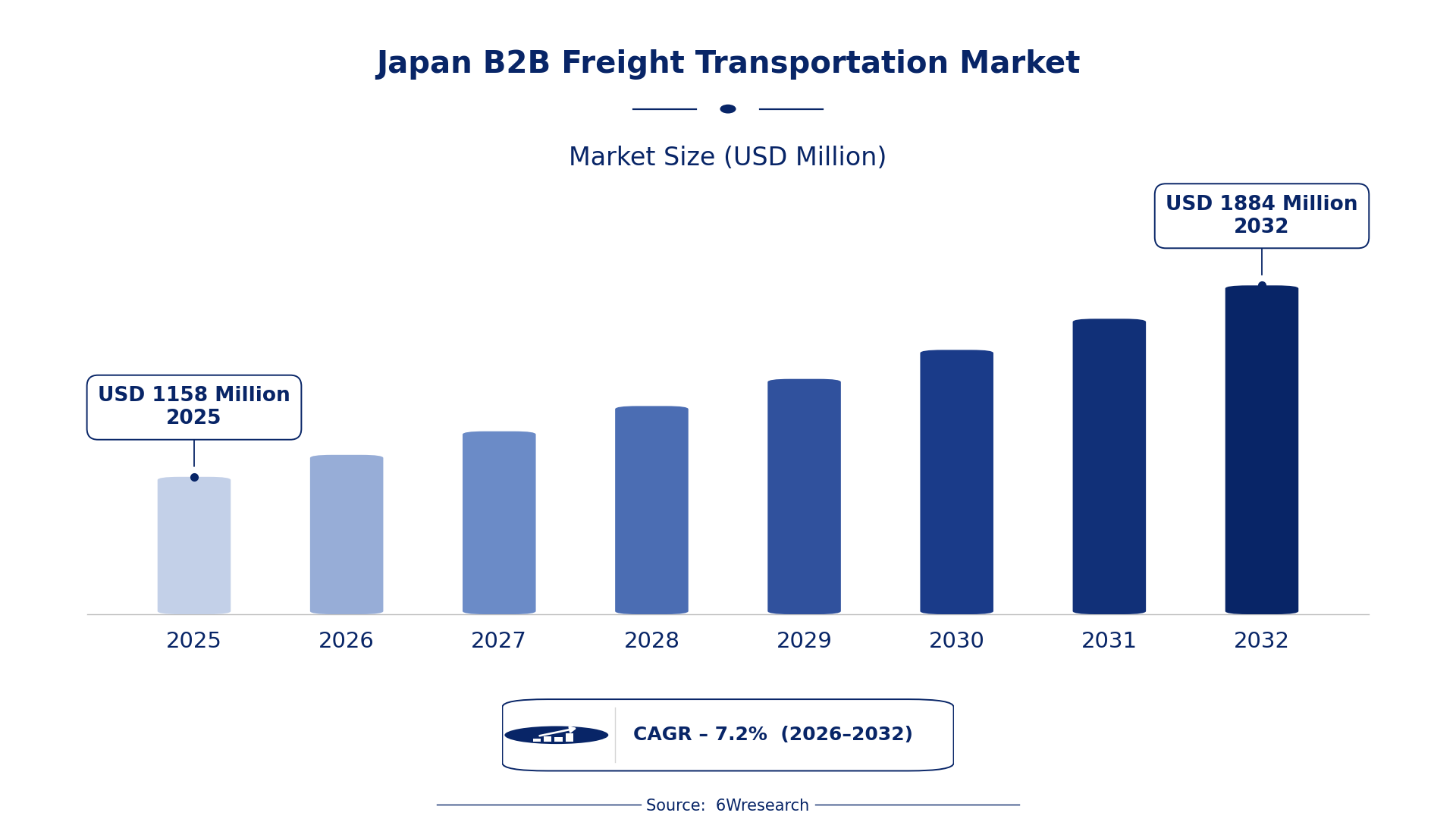
According to 6Wresearch internal database and industry insights, the Japan B2B Freight Transportation Market was valued at USD 1,158 Million in 2025 and is projected to reach USD 1,884 Million by 2032, growing at a CAGR of approximately 7.2% during 2026–2032.
Japan B2B Freight Transportation Market Highlights
| Report Metric | Details |
| Report Name | Japan B2B Freight Transportation Market (2026-2032) |
| Market Size 2025 | USD 1,158 Million |
| Market Size 2032 | USD 1,884 Million |
| Absolute Growth 2025–2032 | USD 726 Million |
| CAGR 2026–2032 | 7.2% |
| Peak Annual Growth | 7.8% in 2026 |
| Forecast Period | 2026–2032 |
| Historical Data | 2022–2025 |
| Base Year | 2025 |
| Leading Product Type, 2025 | Road Freight (35% share) |
| Leading Application, 2025 | Domestic Transportation (49% share) |
| Leading End User, 2025 | Retail and FMCG (40% share) |
| Leading Distribution Channel, 2025 | Third-Party Logistics (34% share) |
| Fastest-Growing Product Type | Intermodal Transportation (10.1% CAGR) |
| Fastest-Growing Application | Mixed Cargo Shipping (9.5% CAGR) |
| Fastest-Growing End User | E-commerce and Retail (10.2% CAGR) |
| Fastest-Growing Distribution Channel | Online Freight Platforms (9.4% CAGR) |
| Growing Sector | E-commerce and Retail |
| Key End Users | Retail, E-commerce, Healthcare, Automotive |
Japan B2B Freight Transportation Market Year-wise Growth Rate and Key Drivers (2022–2032)
This graph illustrates the annual growth rates of the market from 2022 to 2032, highlighting a steady upward trajectory and projected market expansion over the forecast period.
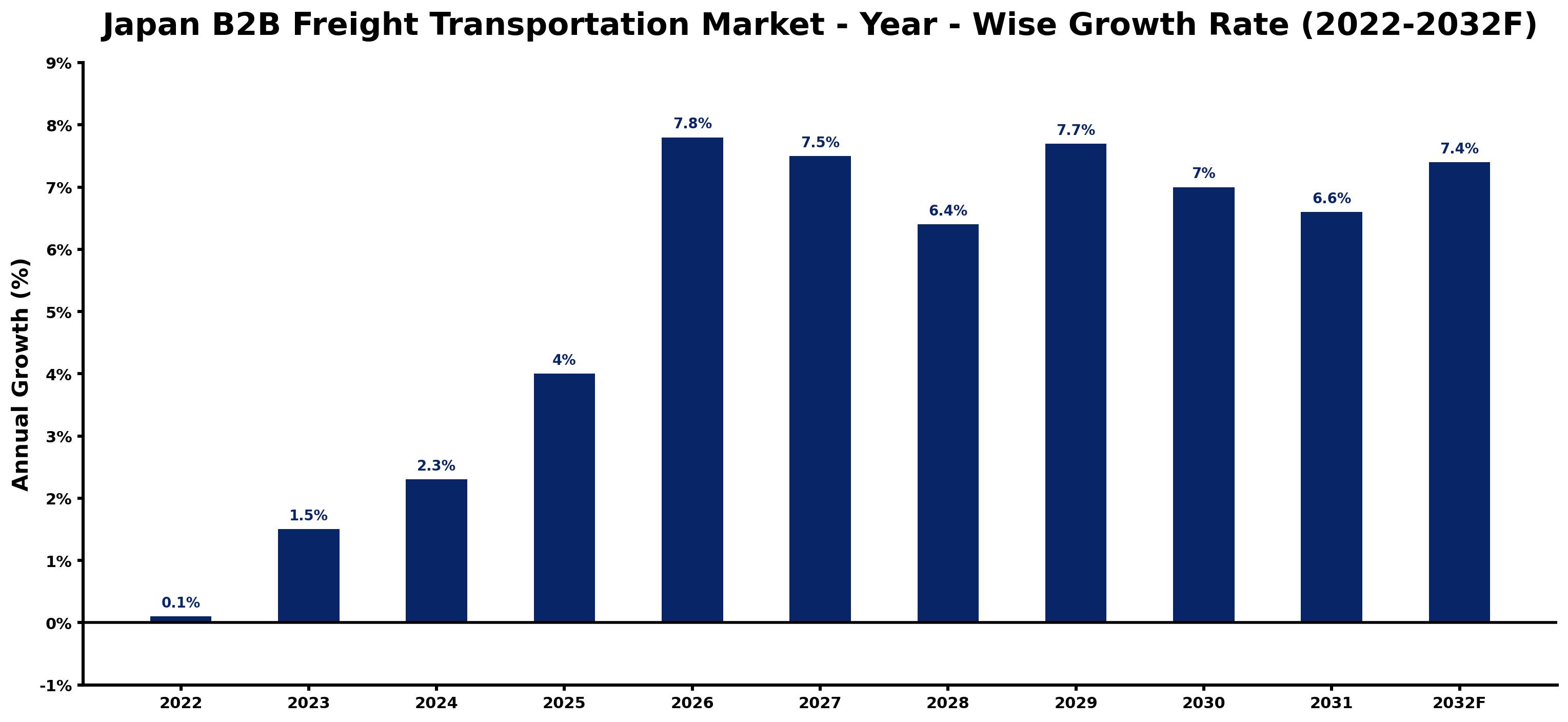
The yearly estimates that follow link every growth rate to its principal driver, so readers can see why the pace changed in each period.
| Year | Estimated Annual Growth (%) | Market Rationale |
| 2022 | 0.1 | The market showed minimal growth due to ongoing supply chain disruptions. |
| 2023 | 1.5 | Demand increased as logistics providers adapted to changing consumer behaviours. |
| 2024 | 2.3 | Growth continued with rising e-commerce activity boosting freight needs. |
| 2025 | 4.0 | The market expanded as domestic transportation became increasingly vital. |
| 2026 | 7.8 | Demand surged due to investments in logistics technologies. |
| 2027 | 7.5 | Growth slowed slightly as the market began to stabilise after rapid expansion. |
| 2028 | 6.4 | A further slowdown occurred as capacity constraints started to impact operations. |
| 2029 | 7.7 | Demand rebounded as e-commerce continued to drive freight volume increases. |
| 2030 | 7.0 | The market experienced another slowdown as operational challenges persisted. |
| 2031 | 6.6 | Growth slowed again as logistics providers faced rising operational costs. |
| 2032 | 7.4 | Demand is expected to increase as infrastructure improvements improve capacity. |
Note: Market size estimations and growth projections presented in this report are based on 6Wresearch's proprietary forecasting methodology, utilizing the latest available industry data, government publications, and primary research inputs.
Japan B2B Freight Transportation Market Synopsis
B2B Freight Transportation in Japan encompasses various modes such as road, rail, air, and ocean freight, primarily facilitated by logistics providers. The Japan B2B Freight Transportation Market is growing due to the booming e-commerce sector, which reached ¥20 trillion in 2022, and the government's investment in logistics efficiency, including a ¥5 billion allocation for port infrastructure improvements in 2023. This expansion is driven by domestic users and international trade, particularly in the retail and healthcare sectors.
Market Dynamics Impact Analysis (2026–2032)
| Factor | Type | Impact | Primary Segment Affected |
| Growing e-commerce activity drives demand for efficient logistics solutions. | Driver | High | Domestic Transportation |
| Investments in logistics technology improve operational efficiency and capacity. | Driver | High | Intermodal Transportation |
| The logistics sector is expanding due to the increasing need for fast delivery services. | Opportunity | High | E-commerce and Retail |
| Enhancements in port infrastructure open new avenues for freight transport. | Opportunity | Medium | International Transportation |
| Capacity constraints limit the ability to meet rising demand. | Restraint | High | Domestic Transportation |
| Regulatory compliance adds complexity and costs to operations. | Restraint | Medium | Logistics Providers |
| Rising operational costs challenge profitability for logistics providers. | Challenge | High | Third-Party Logistics |
| Skilled labour shortages hinder operational efficiency and service delivery. | Challenge | Medium | Logistics Providers |
Evaluation of Drivers in Japan B2B Freight Transportation Market (2026–2032)
Key forces behind demand, with the segment each one moves most, are listed below.
| Drivers | Primary Segment Affected | Why It Matters (Evidence) |
| Increased e-commerce sales boost freight volumes. | Domestic Transportation | The e-commerce market reached ¥20 trillion in 2022, leading to greater demand for logistics services. |
| Technological advancements improve logistics efficiency. | Intermodal Transportation | Investments in technology, such as port upgrades, enhance service delivery. |
| Growing consumer expectations for fast delivery drive demand. | E-commerce and Retail | The average delivery time for domestic freight is approximately 1-2 days, pushing providers to adapt. |
| Government initiatives support infrastructure improvements. | International Transportation | The government allocated ¥5 billion in 2023 for port infrastructure, facilitating smoother logistics operations. |
| Rising international trade increases freight movement. | Bulk Goods Transportation | The need for efficient logistics solutions is critical for handling heavy shipments across borders. |
Most of the extra volume comes from the booming e-commerce sector, which reached ¥20 trillion in 2022, prompting logistics providers to adapt their services. The average delivery time for domestic freight is approximately 1-2 days, compelling providers to enhance their operational efficiency. The logistics workforce is projected to reach 1.5 million by 2025, ensuring sufficient capacity to meet rising demand. These developments encourage logistics companies to innovate and expand their service offerings.
Evaluation of Restraints in Japan B2B Freight Transportation Market
The following restraints limit how fast demand can grow.
| Market Restraint | Primary Segment Affected | Why It Matters (Evidence) |
| Capacity constraints limit service availability during peak demand periods. | Domestic Transportation | The logistics workforce is projected to reach 1.5 million by 2025, but current shortages impact operations. |
| Regulatory compliance increases operational costs and complexity. | Logistics Providers | The PRTR Law requires businesses to report chemical substances, adding administrative burdens. |
| Rising fuel costs affect overall logistics expenses. | Third-Party Logistics | Increased fuel prices have led to higher transportation costs, squeezing profit margins. |
| Infrastructure limitations hinder efficient freight movement. | International Transportation | Aging port facilities can delay shipments, impacting service reliability. |
| Competition among logistics providers pressures pricing strategies. | E-commerce and Retail | Intense competition leads to reduced margins as companies strive to attract customers. |
Japan B2B Freight Transportation Market Challenges
Japan's logistics industry generated approximately ¥18 trillion in 2022, but intense competition among providers leads to price wars that erode profit margins for suppliers. Slow technology adoption results in inefficiencies, causing delivery times to extend by up to 2 days for buyers. Rising operational costs, particularly from fuel price increases, inflate expenses for producers, forcing them to adjust their pricing strategies. Supply chain disruptions, especially in healthcare logistics, create compliance delays that can extend delivery timelines for hospitals by an additional day.
Trends in the Japan B2B Freight Transportation Market
The shifts below are changing how Japan B2B Freight Transportation Market products are bought and supplied.
- Shift in Focus to E-commerce Logistics: Retail and FMCG sectors are increasingly prioritising e-commerce logistics solutions, with the e-commerce market reaching ¥20 trillion in 2022. This shift necessitates faster delivery options and more efficient supply chains.
- Transition from Traditional to Intermodal Transportation: Intermodal transportation is gaining traction as logistics providers seek to optimise routes and reduce costs. With a projected CAGR of 10.1% from 2026 to 2032, this method is becoming essential for efficient freight movement.
- Emergence of Online Freight Platforms: The rise of online freight platforms is transforming how logistics services are accessed. With a CAGR of 9.4% projected from 2026 to 2032, these platforms improve visibility and streamline booking processes.
- Increased Investment in Logistics Technology: The logistics sector is experiencing a surge in technology investments, spurred by government initiatives. In 2023, the government allocated ¥5 billion to improve port infrastructure, facilitating advancements in logistics operations.
Investment Opportunities in the Japan B2B Freight Transportation Market
The openings below show where demand in the Japan B2B Freight Transportation Market is visible and how suppliers can enter.
- Gap in Fast Delivery Services: With the e-commerce sector expected to grow, there is an opportunity to invest in fast delivery logistics. Retail and FMCG sectors are actively seeking partners to enhance their supply chains, particularly in urban areas.
- Entry into Intermodal Transportation: The intermodal transportation segment presents a promising opportunity for investment. Collaborating with logistics providers can facilitate entry into this growing market, projected to expand at a CAGR of 10.1%.
- Investment in Technology Solutions: The logistics industry requires effective technology solutions to improve efficiency. Engaging with logistics providers in the Tokyo metropolitan area can open avenues for investment and collaboration, particularly around automation.
- Enhancing Port Infrastructure: The government's allocation of ¥5 billion for port improvements creates opportunities for infrastructure development. Collaborating with local authorities can facilitate entry into this sector, ensuring compliance with new standards.
Government Initiatives in the Japan B2B Freight Transportation Market
The 2023 programme launched by the Ministry of Land, Infrastructure, Transport and Tourism aims to improve logistics efficiency, building on the existing framework established by the Industrial Safety and Health Act of 1972. This initiative provides funding for technological upgrades and infrastructure improvements, helping logistics providers meet demand and regulatory requirements.
Logistics providers benefit from the funding allocated for port infrastructure improvements. The Ministry of Economy, Trade and Industry supports innovation in logistics technologies, enabling companies to implement new solutions that improve operational efficiency and compliance with safety standards.
Future Insight of the Japan B2B Freight Transportation Market
Retailers will experience notable changes by 2032, as logistics technology advancements will improve operational efficiency. The government's ¥5 billion investment in port infrastructure will enhance turnaround times for suppliers. E-commerce growth will continue to increase demand for rapid freight solutions, compelling logistics firms to innovate their service offerings. By 2025, a workforce of 1.5 million will support the sector, ensuring adequate staffing to meet the rising demands of the market.
Market Segmentation Analysis
Japan B2B Freight Transportation Market report covers a detailed analysis of the following market segments:
By Product Type – Road Freight Leads, Intermodal Transportation Expected to Grow Fastest
According to Vasudha, AM at 6Wresearch, Road Freight held 35% of the Japan B2B Freight Transportation Market by product type in 2025. Road freight dominates the market due to its critical role in transporting goods domestically, particularly in urban areas. The Tokyo metropolitan area exemplifies this reliance, as it accounts for a substantial share of freight volume. The quickest growth will come from Intermodal Transportation, forecast to expand at a CAGR of 10.1% between 2026 and 2032. Intermodal transportation is witnessing rapid growth as it effectively integrates various transport modes, meeting the increasing demand for flexible logistics solutions. The government's initiatives to enhance logistics efficiency are further accelerating this segment's expansion. Suppliers need to adapt their services to meet the rising demand for intermodal transportation solutions.
By Application – Domestic Transportation Leads, Mixed Cargo Shipping Expected to Grow Fastest
With 49% of application revenue in 2025, Domestic Transportation was the largest category. Domestic transportation leads the application segment as it is essential for timely local distribution, supporting the flow of goods across Japan. The logistics industry's revenue of approximately ¥18 trillion in 2022 highlights the significance of domestic transport. Mixed Cargo Shipping is set to record the highest CAGR in this split, 9.5% over 2026–2032. Mixed cargo shipping is the fastest-growing application, catering to a diverse range of goods types and addressing the varied needs of businesses. The growth of the e-commerce sector has notably increased the demand for mixed cargo shipping solutions. Buyers should consider mixed cargo shipping to optimise their logistics operations and meet diverse shipping requirements.
By End User – Retail and FMCG Leads, E-commerce and Retail Expected to Grow Fastest
The largest end user category in 2025 was Retail and FMCG, at 40% of revenue. Retail and FMCG is the leading end user segment, requiring efficient supply chains to meet consumer demands effectively. The anticipated growth of the logistics workforce to 1.5 million by 2025 indicates robust support for this sector's needs. Over 2026–2032, E-commerce and Retail is expected to post the fastest growth, at a CAGR of 10.2%. E-commerce and retail are the fastest-growing end user segments, driven by the increasing demand for quick delivery services. The e-commerce market's value of ¥20 trillion in 2022 underscores its rapid expansion and influence on logistics. Suppliers should focus on e-commerce solutions to leverage the growth opportunities presented by this expanding market.
By Distribution Channel – Third-Party Logistics Leads, Online Freight Platforms Expected to Grow Fastest
Third-Party Logistics took 34% of distribution channel revenue in 2025, more than any other category. Third-party logistics leads the distribution channel segment by offering outsourced logistics solutions, allowing businesses to focus on their core activities. This model has become essential for companies aiming to streamline their logistics operations. Online Freight Platforms are projected to grow fastest, at a CAGR of 9.4% during 2026–2032. Online freight platforms are growing swiftly, enhancing visibility and efficiency in the booking process for shippers. This trend is supported by the ongoing digital transformation within the logistics sector, which is reshaping traditional practices. Buyers should leverage online freight platforms to improve their logistics management and operational efficiency.
Key Attractiveness of the Report
- 10 Years of Market Numbers
- Historical Data Starting from 2022 to 2025
- Base Year 2025
- Forecast Data until 2032
- Key Performance Indicators Impacting the Market
- Major Upcoming Developments and Projects
Key Highlights of the Report:
- Japan B2B Freight Transportation Market Outlook
- Market Size of Japan B2B Freight Transportation Market, 2025
- Forecast of Japan B2B Freight Transportation Market, 2032
- Historical Data and Forecast of Japan B2B Freight Transportation Revenues & Volume for the Period 2022-2032
- Japan B2B Freight Transportation Market Trend Evolution
- Japan B2B Freight Transportation Market Drivers and Challenges
- Japan B2B Freight Transportation Price Trends
- Japan B2B Freight Transportation Porter's Five Forces
- Japan B2B Freight Transportation Industry Life Cycle
- Historical Data and Forecast of Japan B2B Freight Transportation Market Revenues & Volume By Product Type for the Period 2022-2032
- Historical Data and Forecast of Japan B2B Freight Transportation Market Revenues & Volume By Road Freight for the Period 2022-2032
- Historical Data and Forecast of Japan B2B Freight Transportation Market Revenues & Volume By Rail Freight for the Period 2022-2032
- Historical Data and Forecast of Japan B2B Freight Transportation Market Revenues & Volume By Air Freight for the Period 2022-2032
- Historical Data and Forecast of Japan B2B Freight Transportation Market Revenues & Volume By Ocean Freight for the Period 2022-2032
- Historical Data and Forecast of Japan B2B Freight Transportation Market Revenues & Volume By Intermodal Transportation for the Period 2022-2032
- Historical Data and Forecast of Japan B2B Freight Transportation Market Revenues & Volume By Application for the Period 2022-2032
- Historical Data and Forecast of Japan B2B Freight Transportation Market Revenues & Volume By Domestic Transportation for the Period 2022-2032
- Historical Data and Forecast of Japan B2B Freight Transportation Market Revenues & Volume By Bulk Goods Transportation for the Period 2022-2032
- Historical Data and Forecast of Japan B2B Freight Transportation Market Revenues & Volume By International Transportation for the Period 2022-2032
- Historical Data and Forecast of Japan B2B Freight Transportation Market Revenues & Volume By Mixed Cargo Shipping for the Period 2022-2032
- Historical Data and Forecast of Japan B2B Freight Transportation Market Revenues & Volume By End User for the Period 2022-2032
- Historical Data and Forecast of Japan B2B Freight Transportation Market Revenues & Volume By Retail and FMCG for the Period 2022-2032
- Historical Data and Forecast of Japan B2B Freight Transportation Market Revenues & Volume By Automotive and Machinery for the Period 2022-2032
- Historical Data and Forecast of Japan B2B Freight Transportation Market Revenues & Volume By Healthcare and Pharmaceuticals for the Period 2022-2032
- Historical Data and Forecast of Japan B2B Freight Transportation Market Revenues & Volume By Energy and Chemicals for the Period 2022-2032
- Historical Data and Forecast of Japan B2B Freight Transportation Market Revenues & Volume By E-commerce and Retail for the Period 2022-2032
- Historical Data and Forecast of Japan B2B Freight Transportation Market Revenues & Volume By Distribution Channel for the Period 2022-2032
- Historical Data and Forecast of Japan B2B Freight Transportation Market Revenues & Volume By Logistics Providers for the Period 2022-2032
- Historical Data and Forecast of Japan B2B Freight Transportation Market Revenues & Volume By Third-Party Logistics for the Period 2022-2032
- Historical Data and Forecast of Japan B2B Freight Transportation Market Revenues & Volume By Online Freight Platforms for the Period 2022-2032
- Historical Data and Forecast of Japan B2B Freight Transportation Market Revenues & Volume By Freight Brokers for the Period 2022-2032
- Historical Data and Forecast of Japan B2B Freight Transportation Market Revenues & Volume By B2B Marketplaces for the Period 2022-2032
- Japan B2B Freight Transportation Import Export Trade Statistics
- Market Opportunity Assessment By Product Type
- Market Opportunity Assessment By Application
- Market Opportunity Assessment By End User
- Market Opportunity Assessment By Distribution Channel
- Japan B2B Freight Transportation Top Companies Market Share
- Japan B2B Freight Transportation Competitive Benchmarking By Technical and Operational Parameters
- Japan B2B Freight Transportation Company Profiles
- Japan B2B Freight Transportation Key Strategic Recommendations
Market Covered
Segments analysed in this report are listed below.
By Product Type
- Road Freight
- Rail Freight
- Air Freight
- Ocean Freight
- Intermodal Transportation
By Application
- Domestic Transportation
- Bulk Goods Transportation
- International Transportation
- Mixed Cargo Shipping
By End User
- Retail and FMCG
- Automotive and Machinery
- Healthcare and Pharmaceuticals
- Energy and Chemicals
- E-commerce and Retail
By Distribution Channel
- Logistics Providers
- Third-Party Logistics
- Online Freight Platforms
- Freight Brokers
- B2B Marketplaces































