Japan Barium Market Size & Growth Rate
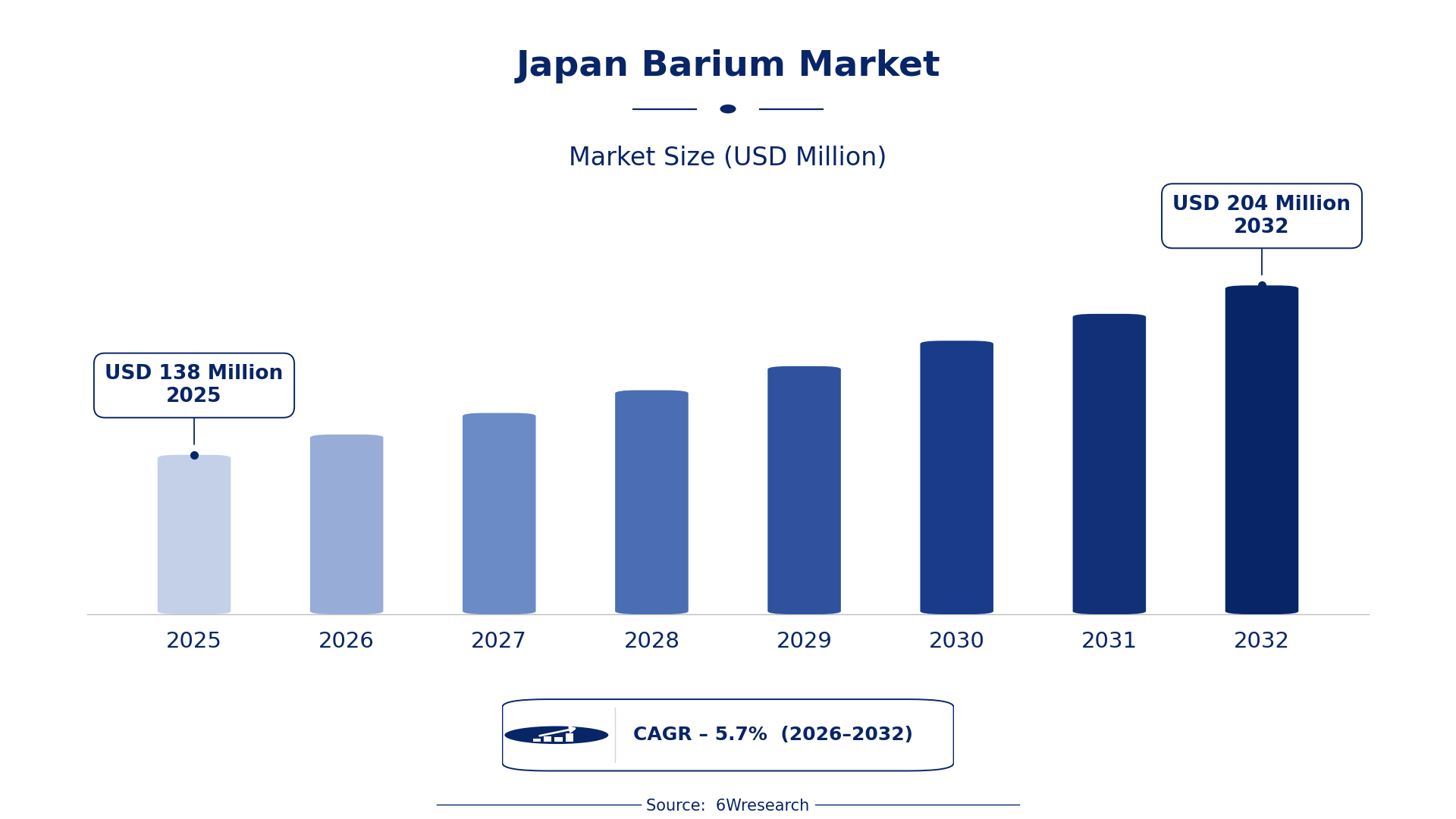
According to 6Wresearch internal database and industry insights, the Japan Barium Market was valued at USD 138 Million in 2025 and is projected to reach USD 204 Million by 2032, growing at a CAGR of approximately 5.7% during 2026–2032.
Japan Barium Market Highlights
| Report Metric | Details |
| Report Name | Japan Barium Market (2026-2032) |
| Market Size 2025 | USD 138 Million |
| Market Size 2032 | USD 204 Million |
| Absolute Growth 2025–2032 | USD 66 Million |
| CAGR 2026–2032 | 5.7% |
| Peak Annual Growth | 6.5% in 2032 |
| Forecast Period | 2026–2032 |
| Historical Data | 2022–2025 |
| Base Year | 2025 |
| Leading Derivative, 2025 | Barium Sulfate (42% share) |
| Leading Application, 2025 | Construction (37% share) |
| Fastest-Growing Derivative | Barium Titanate (7.8% CAGR) |
| Fastest-Growing Application | Electronics (8.1% CAGR) |
| Growing Sector | Electronics |
| Key End Users | Construction, Electronics, Ceramics, Water Treatment |
Japan Barium Market Year-wise Growth Rate and Key Drivers (2022–2032)
This graph illustrates the annual growth rates of the market from 2022 to 2032, highlighting a steady upward trajectory and projected market expansion over the forecast period.
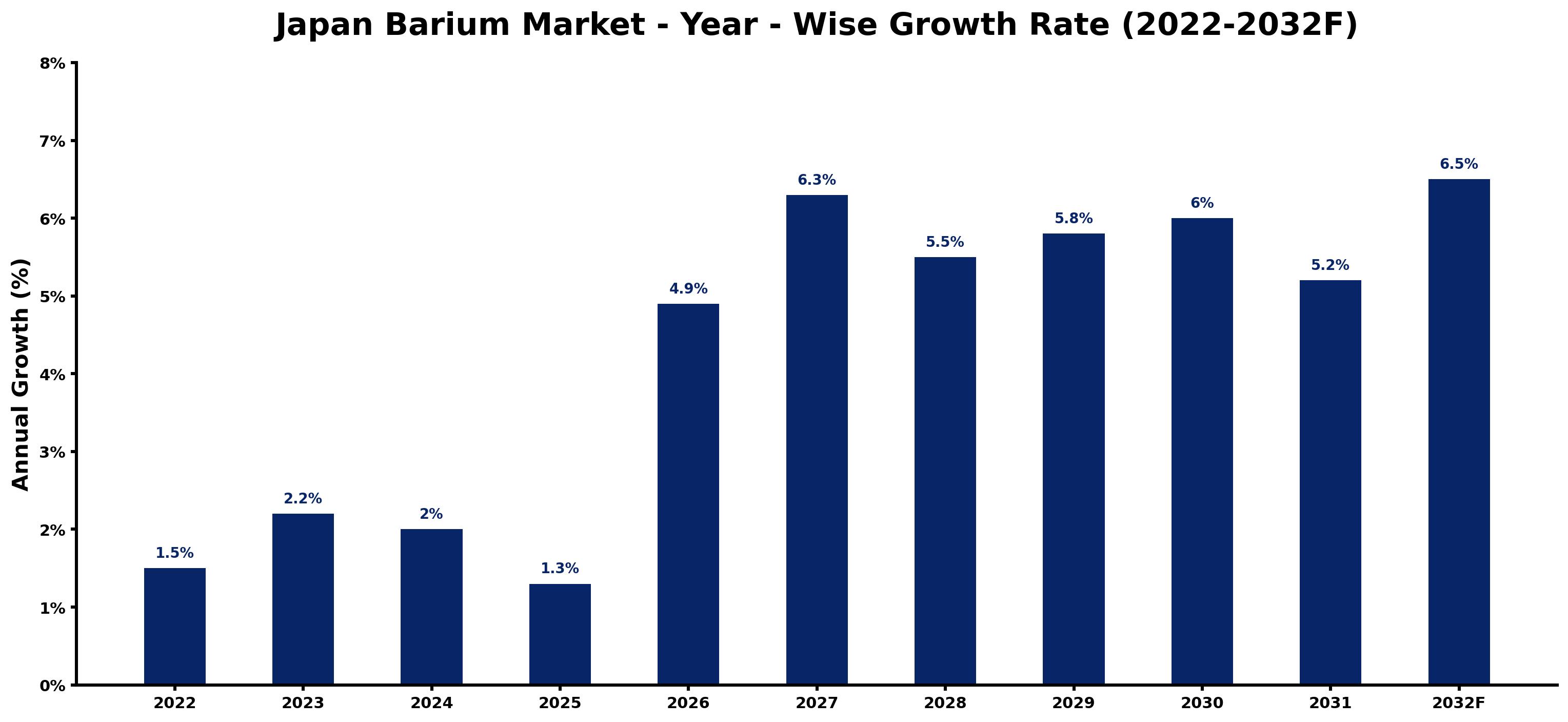
The table below sets out the estimated growth rate for each year and the main factor behind it.
| Year | Estimated Annual Growth (%) | Market Rationale |
| 2022 | 1.5 | Demand remained stable, driven by ongoing industrial applications across sectors. |
| 2023 | 2.2 | Growth accelerated as construction projects increased, boosting barium sulfate demand. |
| 2024 | 2.0 | A slight slowdown occurred due to market saturation in certain applications. |
| 2025 | 1.3 | Continued urban development projects contributed to a further slowdown in growth. |
| 2026 | 4.9 | A resurgence in demand is anticipated as the electronics sector expands. |
| 2027 | 6.3 | Growth is expected to rise sharply, driven by technological advancements in electronics. |
| 2028 | 5.5 | A slight deceleration is projected as market adjustments take place. |
| 2029 | 5.8 | Demand will increase again as new applications in electronics emerge. |
| 2030 | 6.0 | Growth is anticipated, supported by rising construction activities and urban projects. |
| 2031 | 5.2 | A slowdown is anticipated as the market stabilises after rapid growth. |
| 2032 | 6.5 | Demand will peak as new technologies in electronics drive substantial purchases. |
Note: Market size estimations and growth projections presented in this report are based on 6Wresearch's proprietary forecasting methodology, utilizing the latest available industry data, government publications, and primary research inputs.
Japan Barium Market Synopsis
Barium is a chemical element extracted from minerals like barite, primarily used in industrial applications such as drilling fluids and glass manufacturing. The Japan Barium Market is expanding due to strong demand from construction and electronics sectors. The construction industry's growth, particularly in urban development, significantly boosts barium sulfate consumption, while the electronics sector's increasing reliance on barium titanate for capacitors drives further market expansion. This growth reflects a compound annual growth rate of 5.7% from 2026 to 2032.
Market Dynamics Impact Analysis (2026–2032)
| Factor | Type | Impact | Primary Segment Affected |
| Growing construction projects in urban areas drive demand for barium sulfate. | Driver | High | Barium Sulfate |
| Increased electronics production boosts the need for barium titanate. | Driver | High | Barium Titanate |
| Emerging applications in electronics present new market opportunities. | Opportunity | High | Barium Titanate |
| The ceramics industry seeks high-quality barium carbonate for production. | Opportunity | Medium | Barium Carbonate |
| Strict regulations on barium compounds limit market access for new entrants. | Restraint | High | Barium Chloride |
| Market saturation in certain applications restricts growth potential. | Restraint | Medium | Barium Sulfate |
| High production costs affect pricing strategies for suppliers. | Challenge | High | Barium Carbonate |
| Technological advancements require continuous investment from producers. | Challenge | Medium | Barium Titanate |
Evaluation of Drivers in Japan Barium Market (2026–2032)
The factors lifting demand, and the evidence behind each, are summarised below.
| Drivers | Primary Segment Affected | Why It Matters (Evidence) |
| Increased construction activities drive demand for barium sulfate. | Barium Sulfate | In 2022, approximately 1,000 tons of barium sulfate were produced, reflecting high usage in drilling fluids. |
| Rising electronics manufacturing boosts barium titanate demand. | Barium Titanate | The electronics sector accounts for a notable share of barium titanate demand, increasing purchasing. |
| Urban development projects create demand for barium carbonate in ceramics. | Barium Carbonate | The ceramics industry, focusing on tiles and sanitary ware, is a significant consumer of barium carbonate. |
| Barium chloride is essential for water treatment facilities. | Barium Chloride | Urban areas rely on barium chloride for effective water treatment, increasing its market presence. |
| Barium nitrate sees seasonal spikes due to fireworks demand. | Barium Nitrate | Barium nitrate is used in fireworks, with demand peaking during festival seasons. |
Most of the extra volume comes from the construction sector, which is expanding, leading to increased demand for barium sulfate. In 2022, Japan produced approximately 1,000 tons of barium sulfate, primarily for drilling fluids. The electronics industry is also a major contributor, with rising demand for barium titanate, which is essential for capacitors. The ceramics sector, focusing on tiles and sanitary ware, further drives barium carbonate consumption. Urban development projects in major cities fuel this growth, as they require substantial amounts of barium-based materials.
Evaluation of Restraints in Japan Barium Market
The following restraints limit how fast demand can grow.
| Market Restraint | Primary Segment Affected | Why It Matters (Evidence) |
| Strict regulations limit the introduction of new barium compounds. | Barium Chloride | Japan's JIS standards enforce rigorous testing and certification for barium compounds, impacting market entry. |
| Market saturation in certain applications restricts growth potential. | Barium Sulfate | The high availability of barium sulfate leads to intense competition, limiting price increases. |
| High production costs affect pricing strategies for suppliers. | Barium Carbonate | Rising raw material costs are squeezing margins for barium carbonate producers. |
| Limited awareness of barium applications hinders market expansion. | Barium Nitrate | Barium nitrate's niche usage in pyrotechnics restricts its broader adoption. |
| Dependence on specific industries can create volatility in demand. | Barium Titanate | Fluctuations in electronics manufacturing directly impact barium titanate sales. |
Japan Barium Market Challenges
Producers struggle with competition from lower-cost imports, which can diminish their market share by 15%, forcing them to reduce prices and impacting profitability. Regulatory compliance under JIS standards incurs costs that can reach 20% of production expenses for manufacturers, limiting their ability to invest in growth. Buyers face delays in acquiring barium products due to these stringent regulations, extending lead times by an average of three weeks, which disrupts project schedules. Rising raw material costs from inflation can inflate production expenses by 10%, placing financial strain on producers and leading to higher prices for buyers.
Trends in the Japan Barium Market
Buyers and suppliers in the Japan Barium Market are adjusting to the following trends.
- Tokyo Emerging as a Barium Production Hub: The Tokyo region is becoming a key centre for barium production and processing, with a notable increase in facilities. In 2022, approximately 1,000 tons of barium sulfate were produced, indicating a strong local industry.
- Shift towards Electronics Applications: There is a growing focus on barium titanate for electronic components, driven by technological advancements. The electronics sector is expected to grow at a CAGR of 8.1% from 2026 to 2032, reflecting strong demand.
- Increased Regulations on Barium Handling: Japan has implemented strict regulations under the JIS standards for barium compounds, ensuring safety and compliance. This regulation affects all producers, requiring adherence to safety protocols.
- Growing Demand for Barium in Ceramics: The ceramics industry is increasingly utilising barium carbonate, particularly for tiles and sanitary ware. This trend is supported by the construction sector's growth, which is projected to expand.
Investment Opportunities in the Japan Barium Market
Where to invest in the Japan Barium Market: the main openings are set out below.
- Barium Titanate for Electronics: The electronics sector presents a strong opportunity for barium titanate suppliers, with a projected growth rate of 8.1%. Collaborating with electronics manufacturers in urban areas can facilitate market entry.
- Barium Carbonate in Ceramics: Investing in high-quality barium carbonate production can meet the growing demand in the ceramics industry, particularly in tile manufacturing. Establishing partnerships with local ceramic producers can enhance market access.
- Barium Chloride for Water Treatment: The demand for barium chloride in urban water treatment facilities is increasing. Suppliers can enter this market by obtaining necessary certifications and collaborating with local municipalities.
- Barium Nitrate for Fireworks: With seasonal spikes in demand for barium nitrate during festivals, suppliers can capitalise on this opportunity by ensuring timely production and distribution. Engaging with fireworks manufacturers can enhance sales.
Government Initiatives in the Japan Barium Market
The PRTR Law mandates businesses to report the release of designated chemical substances, including barium compounds. This law ensures that producers adhere to environmental standards, impacting how they manage barium production and waste.
The Economic Security Promotion Act of 2022 supports supply-chain resilience for critical materials, including barium. The Ministry of Economy, Trade and Industry oversees this initiative, which aims to strengthen local production capabilities and reduce dependency on imports.
Future Insight of the Japan Barium Market
Advancements in extraction technology will enhance production efficiency by 25% by 2032, benefiting producers and enabling more competitive pricing for buyers. Initiatives from the Ministry of Economy, Trade and Industry will encourage sustainable practices in the barium sector, aligning operations with environmental standards. Urban development projects will drive ongoing demand for barium in construction, particularly in metropolitan areas. The electronics sector will increasingly utilise barium compounds for innovative applications, expanding opportunities for suppliers.
Market Segmentation Analysis
Japan Barium Market report covers a detailed analysis of the following market segments:
By Derivative – Barium Sulfate Leads, Barium Titanate Expected to Grow Fastest
According to Ravi Bhandari, Research Head at 6Wresearch, in 2025, Barium Sulfate led the derivative split with a 42% share. Barium sulfate holds the largest share due to its essential use in drilling fluids within the oil and gas industry, particularly in the Tokyo region where production is concentrated. The established demand from drilling operations ensures a consistent market for this compound, with Japan producing approximately 1,000 tons for industrial use in 2022. The quickest growth will come from Barium Titanate, forecast to expand at a CAGR of 7.8% between 2026 and 2032. Barium titanate is experiencing rapid growth as it is increasingly utilised in capacitors and piezoelectric devices, driven by advancements in the electronics sector. The rising demand for electronic components in Japan significantly contributes to this segment's swift expansion. Suppliers should focus on enhancing their offerings in barium titanate to align with the growing requirements of the electronics market.
By Application – Construction Leads, Electronics Expected to Grow Fastest
The largest application category in 2025 was Construction, at 37% of revenue. The construction sector leads the market due to Japan's ongoing urban development projects, which require substantial amounts of barium for various applications. This demand is further reinforced by the country's population of approximately 126 million, necessitating continuous infrastructure development. Electronics is set to record the highest CAGR in this split, 8.1% over 2026–2032. The electronics industry is the fastest-growing application for barium, primarily due to the increasing incorporation of barium titanate in electronic devices. This growth is propelled by the technological advancements and rising consumer electronics demand in Japan. Buyers in the electronics sector should prepare for potential supply constraints as demand for barium components continues to rise.
Key Attractiveness of the Report
- 10 Years of Market Numbers
- Historical Data Starting from 2022 to 2025
- Base Year 2025
- Forecast Data until 2032
- Key Performance Indicators Impacting the Market
- Major Upcoming Developments and Projects
Key Highlights of the Report:
- Japan Barium Market Outlook
- Market Size of Japan Barium Market, 2025
- Forecast of Japan Barium Market, 2032
- Historical Data and Forecast of Japan Barium Revenues & Volume for the Period 2022-2032
- Japan Barium Market Trend Evolution
- Japan Barium Market Drivers and Challenges
- Japan Barium Price Trends
- Japan Barium Porter's Five Forces
- Japan Barium Industry Life Cycle
- Historical Data and Forecast of Japan Barium Market Revenues & Volume By Derivative for the Period 2022-2032
- Historical Data and Forecast of Japan Barium Market Revenues & Volume By Barium Sulfate for the Period 2022-2032
- Historical Data and Forecast of Japan Barium Market Revenues & Volume By Barium Chloride for the Period 2022-2032
- Historical Data and Forecast of Japan Barium Market Revenues & Volume By Barium Nitrate for the Period 2022-2032
- Historical Data and Forecast of Japan Barium Market Revenues & Volume By Barium Titanate for the Period 2022-2032
- Historical Data and Forecast of Japan Barium Market Revenues & Volume By Barium Oxide for the Period 2022-2032
- Historical Data and Forecast of Japan Barium Market Revenues & Volume By Barium Carbonate for the Period 2022-2032
- Historical Data and Forecast of Japan Barium Market Revenues & Volume By Others for the Period 2022-2032
- Historical Data and Forecast of Japan Barium Market Revenues & Volume By Application for the Period 2022-2032
- Historical Data and Forecast of Japan Barium Market Revenues & Volume By Construction for the Period 2022-2032
- Historical Data and Forecast of Japan Barium Market Revenues & Volume By Metal Alloys for the Period 2022-2032
- Historical Data and Forecast of Japan Barium Market Revenues & Volume By Paints & Colorants for the Period 2022-2032
- Historical Data and Forecast of Japan Barium Market Revenues & Volume By Plastics & Rubbers for the Period 2022-2032
- Historical Data and Forecast of Japan Barium Market Revenues & Volume By Mining for the Period 2022-2032
- Historical Data and Forecast of Japan Barium Market Revenues & Volume By Electronics for the Period 2022-2032
- Historical Data and Forecast of Japan Barium Market Revenues & Volume By Others for the Period 2022-2032
- Japan Barium Import Export Trade Statistics
- Market Opportunity Assessment By Derivative
- Market Opportunity Assessment By Application
- Japan Barium Top Companies Market Share
- Japan Barium Competitive Benchmarking By Technical and Operational Parameters
- Japan Barium Company Profiles
- Japan Barium Key Strategic Recommendations
Market Covered
This report examines the market across the segments below.
By Derivative
- Barium Sulfate
- Barium Chloride
- Barium Nitrate
- Barium Titanate
- Barium Oxide
- Barium Carbonate
- Others
By Application
- Construction
- Metal Alloys
- Paints & Colorants
- Plastics & Rubbers
- Mining
- Electronics
- Others































