Japan Beauty Wellness Market Size & Growth Rate
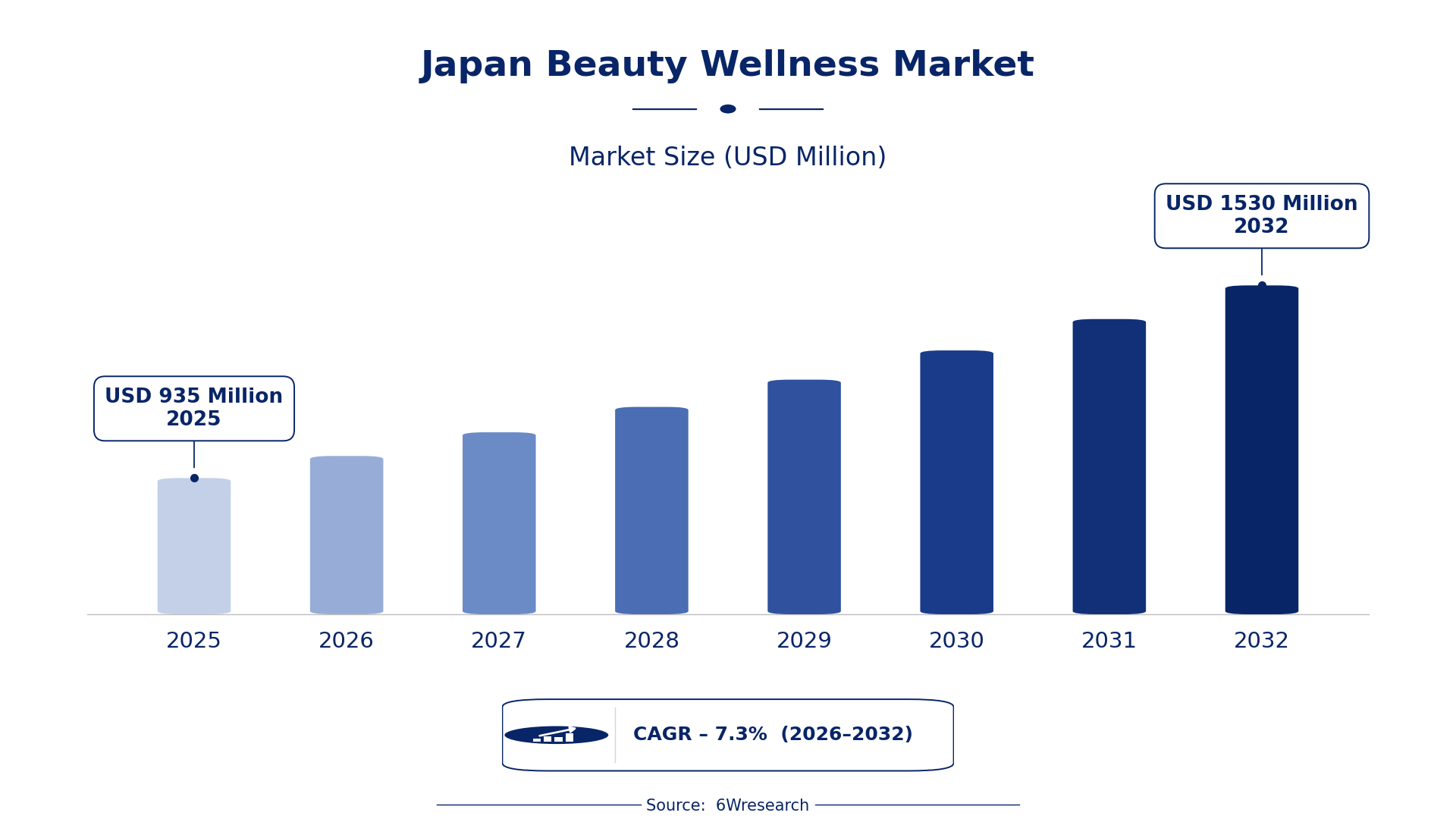
According to 6Wresearch internal database and industry insights, the Japan Beauty Wellness Market was valued at USD 935 Million in 2025 and is projected to reach USD 1,530 Million by 2032, growing at a CAGR of approximately 7.3% during 2026–2032.
Japan Beauty Wellness Market Highlights
| Report Metric | Details |
| Report Name | Japan Beauty Wellness Market (2026-2032) |
| Market Size 2025 | USD 935 Million |
| Market Size 2032 | USD 1,530 Million |
| Absolute Growth 2025–2032 | USD 595 Million |
| CAGR 2026–2032 | 7.3% |
| Peak Annual Growth | 8.2% in 2026 |
| Forecast Period | 2026–2032 |
| Historical Data | 2022–2025 |
| Base Year | 2025 |
| Leading Service Type, 2025 | Skincare (45% share) |
| Leading Functionality, 2025 | Anti-aging (42% share) |
| Leading Application Area, 2025 | Salons & Clinics (48% share) |
| Leading Distribution Channel, 2025 | Direct Sales (52% share) |
| Leading End User, 2025 | Consumers (44% share) |
| Fastest-Growing Service Type | Haircare (9.8% CAGR) |
| Fastest-Growing Functionality | Treatment (9.3% CAGR) |
| Fastest-Growing Application Area | Spas & Salons (8.9% CAGR) |
| Fastest-Growing Distribution Channel | Online Platforms (9.4% CAGR) |
| Fastest-Growing End User | Individuals (9.2% CAGR) |
| Growing Sector | Beauty and Wellness Services |
| Key End Users | Consumers, Individuals, Health Enthusiasts |
Japan Beauty Wellness Market Year-wise Growth Rate and Key Drivers (2022–2032)
This graph illustrates the annual growth rates of the market from 2022 to 2032, highlighting a steady upward trajectory and projected market expansion over the forecast period.
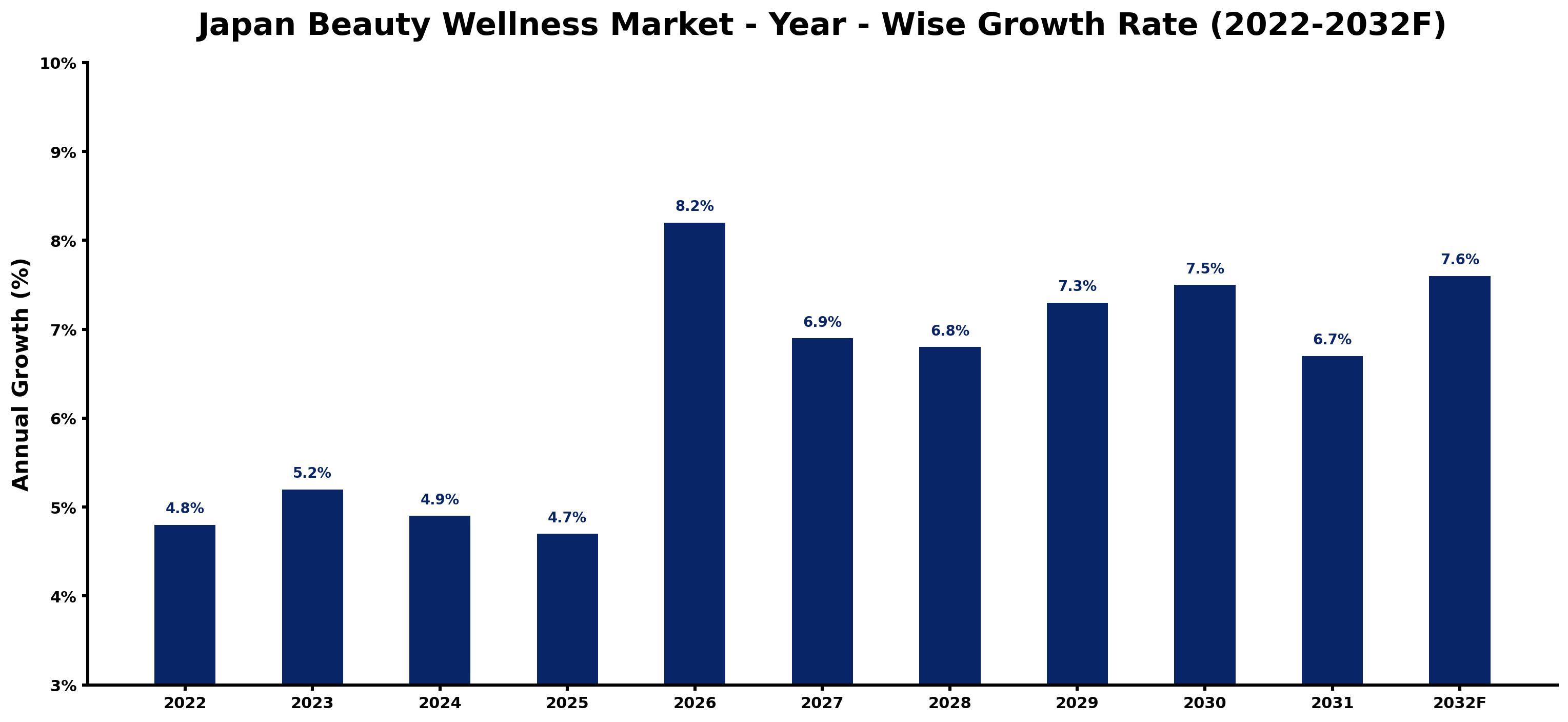
Each row of the following table gives one year's estimated growth and the event or demand shift that explains it.
| Year | Estimated Annual Growth (%) | Market Rationale |
| 2022 | 4.8 | The market experienced steady growth as consumers prioritised personal care routines. |
| 2023 | 5.2 | Demand increased due to heightened interest in skincare and wellness products. |
| 2024 | 4.9 | Growth slowed slightly as consumers became more selective in their purchases. |
| 2025 | 4.7 | Market growth continued to decelerate as competition intensified among brands. |
| 2026 | 8.2 | A surge in demand is anticipated, driven by new product launches and marketing campaigns. |
| 2027 | 6.9 | Growth is projected to slow as market saturation begins to affect new customer acquisition. |
| 2028 | 6.8 | Demand is expected to continue to decelerate as consumers focus on quality over quantity. |
| 2029 | 7.3 | An uptick in health awareness is projected to spur increased spending on wellness products. |
| 2030 | 7.5 | Growth is expected to accelerate again as new technologies improve product efficacy. |
| 2031 | 6.7 | A slowdown is anticipated as consumers become more budget-conscious amid economic changes. |
| 2032 | 7.6 | Demand is projected to rise again as the aging population seeks effective solutions. |
Note: Market size estimations and growth projections presented in this report are based on 6Wresearch's proprietary forecasting methodology, utilizing the latest available industry data, government publications, and primary research inputs.
Japan Beauty Wellness Market Synopsis
Beauty wellness encompasses a variety of products and services aimed at improving physical appearance and overall well-being. The Japan Beauty Wellness Market is currently valued at approximately 1.5 trillion yen, with demand stemming from domestic consumers prioritising health and wellness. Growth is fuelled by advancements in skincare technologies, the increasing number of beauty salons and wellness clinics, and a rising focus on personal care routines, particularly in urban areas like Tokyo and Osaka.
Market Dynamics Impact Analysis (2026–2032)
| Factor | Type | Impact | Primary Segment Affected |
| Growing health awareness among consumers | Driver | High | Fitness & Wellness |
| Rising demand for anti-aging products | Driver | High | Anti-aging |
| Expansion of online sales channels | Opportunity | High | Online Platforms |
| Increasing investment in wellness facilities | Opportunity | High | Salons & Clinics |
| Intense competition leading to price wars | Restraint | High | Skincare |
| Regulatory compliance costs for new products | Restraint | Medium | Haircare |
| Fluctuating consumer spending patterns | Challenge | High | Consumers |
| Limited availability of natural ingredients | Challenge | Medium | Nutraceuticals |
Evaluation of Drivers in Japan Beauty Wellness Market (2026–2032)
The following drivers explain most of the expected growth.
| Drivers | Primary Segment Affected | Why It Matters (Evidence) |
| Increased focus on health and wellness | Fitness & Wellness | The average Japanese consumer spends about 20,000 yen annually on skincare products, driving demand for fitness and wellness services. |
| Aging population seeking effective solutions | Anti-aging | With a large portion of the population over 65, demand for anti-aging products is surging. |
| Growth of urban beauty salons | Salons & Clinics | Tokyo is a major hub with over 30,000 beauty salons, increasing access to beauty services. |
| Rising online sales of beauty products | Online Platforms | Online sales of beauty products increased by 25% last year, attracting tech-savvy consumers. |
| Innovation in skincare technologies | Skincare | The Japanese beauty market is known for its advanced skincare technologies, boosting product appeal. |
Purchasing is picking up as the focus on health and wellness rises among consumers. In 2023, the average Japanese consumer spent approximately 20,000 yen on skincare, which has driven demand for wellness services. A large portion of the population over 65 is increasing the demand for anti-aging products. Urban areas like Tokyo, with over 30,000 beauty salons, are expanding access to beauty services. Online sales of beauty products increased by 25% last year, attracting tech-savvy consumers. Advanced skincare technologies are boosting product appeal, further supporting market growth.
Evaluation of Restraints in Japan Beauty Wellness Market
These restraints slow adoption and weigh on supplier margins.
| Market Restraint | Primary Segment Affected | Why It Matters (Evidence) |
| Intense competition leading to price wars | Skincare | The competitive environment has driven prices down, affecting profit margins for producers. |
| Regulatory compliance costs for new products | Haircare | Compliance with standards like ISO 22716 increases costs for manufacturers, impacting pricing strategies. |
| Fluctuating consumer spending patterns | Consumers | Economic uncertainties have made consumers more cautious about discretionary spending on beauty products. |
| Limited availability of natural ingredients | Nutraceuticals | Sourcing high-quality natural ingredients is becoming increasingly difficult, limiting product development. |
| Market saturation affecting new entrants | Fitness & Wellness | An oversaturated market makes it challenging for new wellness facilities to gain traction. |
Japan Beauty Wellness Market Challenges
Japan's beauty wellness market, valued at approximately 1.5 trillion yen, faces increasing production costs due to higher raw material prices, compelling producers to raise prices and potentially lose customers. Distributors face stiff competition from both local and global brands, necessitating constant innovation and possibly delaying product launches, which can reduce market share. A shortage of skilled professionals in beauty salons impacts service quality, resulting in longer wait times for clients and revenue loss for salon owners. Supply chain disruptions in sourcing natural ingredients can hinder product availability, affecting retailers dependent on timely stock replenishment.
Trends in the Japan Beauty Wellness Market
The trends below show where the Japan Beauty Wellness Market is heading.
- Consumers Shifting Towards Natural Products: A growing health consciousness is leading consumers to favour natural ingredients in beauty products. In 2023, the demand for organic skincare products increased by 30%, reflecting a clear trend towards cleaner formulations.
- Online Platforms Gaining Popularity: Online sales channels are becoming the preferred method for purchasing beauty products. In 2023, online sales rose by 25%, indicating a shift in consumer behaviour towards digital shopping.
- Rise of Anti-aging Treatments: The demand for anti-aging treatments has surged, especially among the aging population. In 2023, anti-aging product sales represented 42% of the market, underscoring the growing focus on age-related beauty solutions.
- Expansion of Wellness Clinics: Wellness clinics are rapidly expanding, particularly in urban areas. In 2023, Tokyo experienced a 15% increase in new wellness clinic openings, responding to heightened health awareness.
Investment Opportunities in the Japan Beauty Wellness Market
Where to invest in the Japan Beauty Wellness Market: the main openings are set out below.
- Gap in Natural Ingredient Supply: With the rising demand for organic skincare products, there is an opportunity for suppliers of natural ingredients. Collaborating with local beauty salons could facilitate market entry.
- Growing Demand for Anti-aging Solutions: As the aging population grows, the market for anti-aging products is expected to expand. Investing in effective anti-aging formulations can attract consumers in urban areas like Tokyo.
- Expansion of Online Sales Channels: With online sales of beauty products on the rise, there is a clear opportunity for e-commerce platforms. Partnering with established online retailers can broaden market reach.
- Investment in Wellness Facilities: The increase in health awareness has led to greater investment in wellness facilities. Concentrating on urban centres like Tokyo can yield high returns for new wellness service providers.
Government Initiatives in the Japan Beauty Wellness Market
Regulations established under the Standards for Cosmetics (2000; MHLW) ensure that cosmetics sold in Japan meet safety and quality standards. Compliance with these regulations is essential for producers to maintain market access and consumer trust. The Long-Term Care Insurance Act (1997, in force 2000; MHLW) promotes health and wellness initiatives by funding services for older people, which indirectly supports the beauty wellness sector.
In 2023, a campaign was launched by the Ministry of Health to promote healthy aging, backed by the Health Japan 21 program. This initiative encourages businesses to develop products that cater to the needs of the aging population, driving innovation in the beauty wellness sector.
Future Insight of the Japan Beauty Wellness Market
Buyers will increasingly favour online sales channels, which surged by 25% last year, changing purchasing behaviours for beauty wellness products. By 2032, advancements in skincare technologies will enable more personalised offerings, improving customer satisfaction. The Health Japan 21 program will promote wellness initiatives, encouraging suppliers to create health-focused products. As the fitness segment expands, suppliers must adapt their product lines to align with the rising health awareness among the population.
Market Segmentation Analysis
Japan Beauty Wellness Market report covers a detailed analysis of the following market segments:
By Service Type – Skincare Leads, Haircare Expected to Grow Fastest
According to Hittika Dhall, Research Associate at 6Wresearch, with 45% of service type revenue in 2025, Skincare was the largest category. Skincare commands the largest share due to its essential role in daily beauty routines, with consumers allocating around 20,000 yen annually for these products. This consistent investment highlights the strong preference for effective skincare solutions among the Japanese population, solidifying its position in the market. Haircare is projected to grow fastest, at a CAGR of 9.8% during 2026–2032. Haircare is experiencing rapid growth as personal grooming becomes increasingly important, with a notable rise in demand for hair treatments. The expansion of beauty salons in urban regions is responding to this heightened interest, further propelling the segment's growth. Suppliers should prioritise enhancing skincare offerings while exploring opportunities in haircare to align with emerging consumer preferences.
By Functionality – Anti-aging Leads, Treatment Expected to Grow Fastest
The largest functionality category in 2025 was Anti-aging, at 42% of revenue. Anti-aging products dominate the market as they cater to the high demand from an aging population concerned about maintaining youthful appearances. This segment's popularity is further supported by various government health initiatives promoting well-being. The quickest growth will come from Treatment, forecast to expand at a CAGR of 9.3% between 2026 and 2032. Treatment solutions are gaining traction due to the increasing focus on addressing specific skin issues, driven by consumer awareness and education about skincare. This trend is likely to continue as more targeted products enter the market. Brands should prioritise the development of anti-aging and treatment products to meet the evolving needs of consumers seeking effective skincare solutions.
By Application Area – Salons & Clinics Lead, Spas & Salons Expected to Grow Fastest
Salons & Clinics held 48% of the Japan Beauty Wellness Market by application area in 2025. Salons and clinics lead the beauty wellness market as primary service providers, attracting a substantial clientele seeking professional treatments. The concentration of over 30,000 beauty salons in major cities like Tokyo illustrates their vital role in delivering these essential services. Spas & Salons are set to record the highest CAGR in this split, 8.9% over 2026–2032. Spas and salons are rapidly growing in popularity as consumers increasingly seek relaxation and beauty services, especially in urban settings. This trend reflects a rising interest in wellness experiences among the Japanese population, driving demand for these services. Service providers should consider diversifying their offerings to include spa services to meet the growing demand for relaxation and beauty treatments.
By Distribution Channel – Direct Sales Leads, Online Platforms Expected to Grow Fastest
Direct Sales took 52% of distribution channel revenue in 2025, more than any other category. Direct sales remain the predominant distribution channel, as many consumers prefer personal interactions when purchasing beauty products. This method fosters trust and loyalty, ensuring sustained engagement within the beauty wellness market. Over 2026–2032, Online Platforms are expected to post the fastest growth, at a CAGR of 9.4%. Online platforms are witnessing significant growth, evidenced by a 25% increase in online sales of beauty products in the past year. This shift indicates a growing consumer preference for convenience and accessibility, positioning online sales as a crucial growth area. Suppliers should focus on strengthening their online presence and investing in e-commerce strategies to effectively reach a wider audience.
By End User – Consumers Lead, Individuals Expected to Grow Fastest
Consumers accounted for 44% of the market by end user in 2025. Consumers represent the largest end-user group, as they are the primary purchasers of beauty and wellness products in Japan. Their engagement in the market is driven by a strong cultural emphasis on personal care and aesthetics. Individuals are projected to grow fastest, at a CAGR of 9.2% during 2026–2032. Individuals are emerging as a fast-growing target market, particularly those seeking personalised beauty solutions tailored to their specific needs. This trend reflects a shift towards more individualised approaches in the beauty wellness sector. Brands should focus on personalised marketing strategies to effectively engage with individual consumers and meet their unique beauty needs.
Key Attractiveness of the Report
- 10 Years of Market Numbers
- Historical Data Starting from 2022 to 2025
- Base Year 2025
- Forecast Data until 2032
- Key Performance Indicators Impacting the Market
- Major Upcoming Developments and Projects
Key Highlights of the Report:
- Japan Beauty Wellness Market Outlook
- Market Size of Japan Beauty Wellness Market, 2025
- Forecast of Japan Beauty Wellness Market, 2032
- Historical Data and Forecast of Japan Beauty Wellness Market Revenues & Volume for the Period 2022-2032F
- Japan Beauty Wellness Market Trend Evolution
- Japan Beauty Wellness Market Drivers and Challenges
- Japan Beauty Wellness Market Price Trends
- Japan Beauty Wellness Market Porter's Five Forces
- Japan Beauty Wellness Market Industry Life Cycle
- Historical Data and Forecast of Japan Beauty Wellness Market Revenues & Volume By Service Type for the Period 2022-2032F
- Historical Data and Forecast of Japan Beauty Wellness Market Revenues & Volume By Skincare for the Period 2022-2032F
- Historical Data and Forecast of Japan Beauty Wellness Market Revenues & Volume By Haircare for the Period 2022-2032F
- Historical Data and Forecast of Japan Beauty Wellness Market Revenues & Volume By Fitness & Wellness for the Period 2022-2032F
- Historical Data and Forecast of Japan Beauty Wellness Market Revenues & Volume By Nutraceuticals for the Period 2022-2032F
- Historical Data and Forecast of Japan Beauty Wellness Market Revenues & Volume By Functionality for the Period 2022-2032F
- Historical Data and Forecast of Japan Beauty Wellness Market Revenues & Volume By Anti-aging for the Period 2022-2032F
- Historical Data and Forecast of Japan Beauty Wellness Market Revenues & Volume By Treatment for the Period 2022-2032F
- Historical Data and Forecast of Japan Beauty Wellness Market Revenues & Volume By Health Monitoring for the Period 2022-2032F
- Historical Data and Forecast of Japan Beauty Wellness Market Revenues & Volume By Supplements for the Period 2022-2032F
- Historical Data and Forecast of Japan Beauty Wellness Market Revenues & Volume By Application Area for the Period 2022-2032F
- Historical Data and Forecast of Japan Beauty Wellness Market Revenues & Volume By Salons & Clinics for the Period 2022-2032F
- Historical Data and Forecast of Japan Beauty Wellness Market Revenues & Volume By Spas & Salons for the Period 2022-2032F
- Historical Data and Forecast of Japan Beauty Wellness Market Revenues & Volume By Fitness Centers for the Period 2022-2032F
- Historical Data and Forecast of Japan Beauty Wellness Market Revenues & Volume By Personal Care for the Period 2022-2032F
- Historical Data and Forecast of Japan Beauty Wellness Market Revenues & Volume By Distribution Channel for the Period 2022-2032F
- Historical Data and Forecast of Japan Beauty Wellness Market Revenues & Volume By Direct Sales for the Period 2022-2032F
- Historical Data and Forecast of Japan Beauty Wellness Market Revenues & Volume By Online Platforms for the Period 2022-2032F
- Historical Data and Forecast of Japan Beauty Wellness Market Revenues & Volume By SaaS for the Period 2022-2032F
- Historical Data and Forecast of Japan Beauty Wellness Market Revenues & Volume By Retail Chains for the Period 2022-2032F
- Historical Data and Forecast of Japan Beauty Wellness Market Revenues & Volume By End User for the Period 2022-2032F
- Historical Data and Forecast of Japan Beauty Wellness Market Revenues & Volume By Consumers for the Period 2022-2032F
- Historical Data and Forecast of Japan Beauty Wellness Market Revenues & Volume By Individuals for the Period 2022-2032F
- Historical Data and Forecast of Japan Beauty Wellness Market Revenues & Volume By End Users for the Period 2022-2032F
- Historical Data and Forecast of Japan Beauty Wellness Market Revenues & Volume By Customers for the Period 2022-2032F
- Japan Beauty Wellness Market Import Export Trade Statistics
- Market Opportunity Assessment By Service Type
- Market Opportunity Assessment By Functionality
- Market Opportunity Assessment By Application Area
- Market Opportunity Assessment By Distribution Channel
- Market Opportunity Assessment By End User
- Japan Beauty Wellness Market Top Companies Market Share
- Japan Beauty Wellness Market Competitive Benchmarking By Technical and Operational Parameters
- Japan Beauty Wellness Market Company Profiles
- Japan Beauty Wellness Market Key Strategic Recommendations
Market Covered
The following segment groups are covered in the report.
By Service Type
- Skincare
- Haircare
- Fitness & Wellness
- Nutraceuticals
By Functionality
- Anti-aging
- Treatment
- Health Monitoring
- Supplements
By Application Area
- Salons & Clinics
- Spas & Salons
- Fitness Centers
- Personal Care
By Distribution Channel
- Direct Sales
- Online Platforms
- SaaS
- Retail Chains
By End User
- Consumers
- Individuals
- End Users
- Customers































