Japan Big Data Analytics in Manufacturing Market Size & Growth Rate
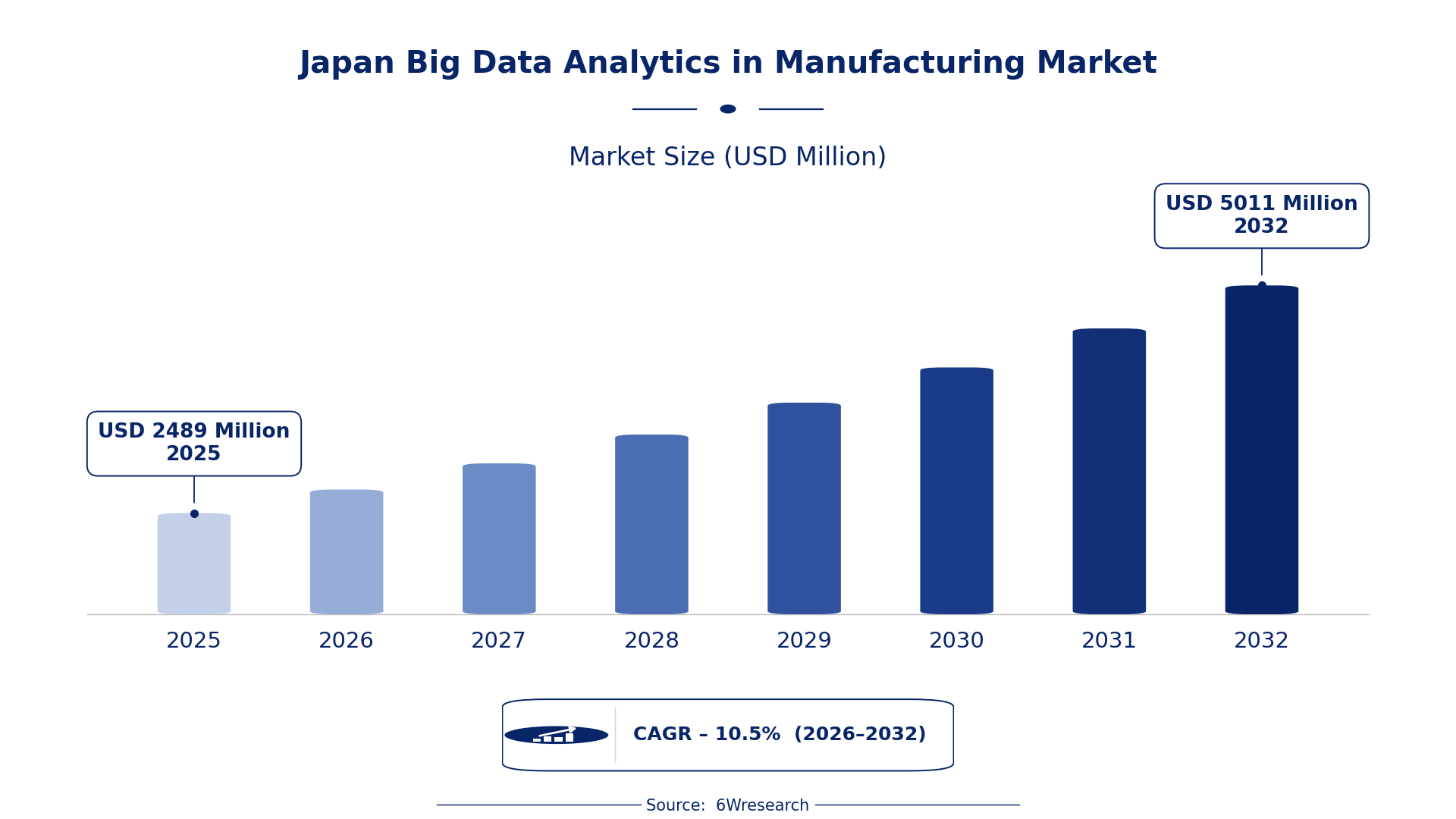
According to 6Wresearch internal database and industry insights, the Japan Big Data Analytics in Manufacturing Market was valued at USD 2,489 Million in 2025 and is projected to reach USD 5,011 Million by 2032, growing at a CAGR of approximately 10.5% during 2026–2032.
Japan Big Data Analytics in Manufacturing Market Highlights
| Report Metric | Details |
| Report Name | Japan Big Data Analytics in Manufacturing Market (2026-2032) |
| Market Size 2025 | USD 2,489 Million |
| Market Size 2032 | USD 5,011 Million |
| Absolute Growth 2025–2032 | USD 2,522 Million |
| CAGR 2026–2032 | 10.5% |
| Peak Annual Growth | 12.2% in 2026 |
| Forecast Period | 2026–2032 |
| Historical Data | 2022–2025 |
| Base Year | 2025 |
| Leading Deployment Mode, 2025 | On-Premises (50% share) |
| Leading Application, 2025 | Predictive Maintenance (55% share) |
| Leading Component, 2025 | Software (44% share) |
| Leading Technology, 2025 | AI & ML (44% share) |
| Leading End User, 2025 | Automotive (44% share) |
| Fastest-Growing Deployment Mode | Cloud-Based (14.8% CAGR) |
| Fastest-Growing Application | Supply Chain Optimization (14.2% CAGR) |
| Fastest-Growing Component | Services (15.0% CAGR) |
| Fastest-Growing Technology | IoT Integration (15.1% CAGR) |
| Fastest-Growing End User | Electronics (12.9% CAGR) |
| Growing Sector | automotive |
| Key End Users | automotive manufacturers, electronics producers, aerospace companies |
Japan Big Data Analytics in Manufacturing Market Year-wise Growth Rate and Key Drivers (2022–2032)
This graph illustrates the annual growth rates of the market from 2022 to 2032, highlighting a steady upward trajectory and projected market expansion over the forecast period.
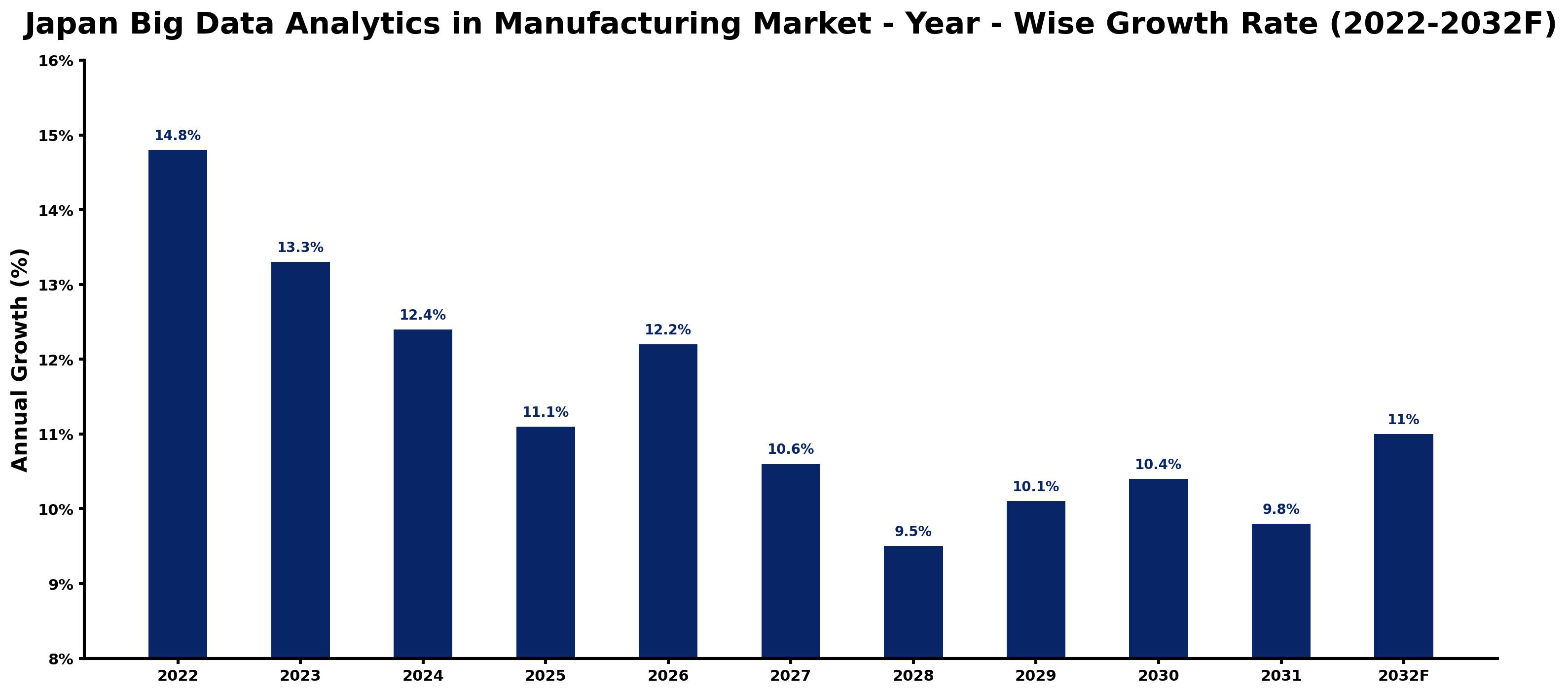
Below, each year's estimated growth is shown next to the factor that most influenced it.
| Year | Estimated Annual Growth (%) | Market Rationale |
| 2022 | 14.8 | The market experienced strong demand due to increased investments in manufacturing technologies. |
| 2023 | 13.3 | Growth slowed as manufacturers adjusted to previous year's rapid advancements in data analytics. |
| 2024 | 12.4 | The market continued to grow, driven by ongoing adoption of predictive maintenance solutions. |
| 2025 | 11.1 | Demand persisted as manufacturers focused on optimising production efficiency through analytics. |
| 2026 | 12.2 | Growth is expected to accelerate with rising investments in cloud-based analytics solutions among manufacturers. |
| 2027 | 10.6 | The market will see a slowdown as companies face challenges in integrating new technologies. |
| 2028 | 9.5 | Growth is projected to continue decelerating, influenced by shifting priorities in manufacturing investments. |
| 2029 | 10.1 | Demand is expected to increase as manufacturers embrace new data analytics tools for efficiency. |
| 2030 | 10.4 | Growth will pick up as companies expand their adoption of AI-driven analytics solutions. |
| 2031 | 9.8 | The market is projected to slow again as manufacturers reassess their data strategies for future investments. |
| 2032 | 11.0 | Growth is expected to accelerate with renewed focus on IoT integration in manufacturing processes. |
Note: Market size estimations and growth projections presented in this report are based on 6Wresearch's proprietary forecasting methodology, utilizing the latest available industry data, government publications, and primary research inputs.
Japan Big Data Analytics in Manufacturing Market Synopsis
Big Data Analytics in Manufacturing employs advanced analytics techniques on extensive datasets to optimise production efficiency and enhance supply chain management. The Japan Big Data Analytics in Manufacturing Market is growing due to substantial investments from the automotive and electronics sectors, with manufacturing contributing approximately 20% to the national GDP. Key initiatives, such as promoting AI integration in manufacturing, are driving demand for analytics solutions, as shown by the increasing adoption of predictive maintenance technologies in 2023.
Market Dynamics Impact Analysis (2026–2032)
| Factor | Type | Impact | Primary Segment Affected |
| Rising investments in predictive maintenance technologies | Driver | High | Predictive Maintenance |
| Increasing adoption of cloud-based analytics solutions | Driver | High | Cloud-Based |
| Growing demand for data analytics tools in the automotive sector | Opportunity | High | Data Analytics Tools |
| Expansion of digital transformation initiatives in manufacturing | Opportunity | Medium | Services |
| Challenges in integrating new technologies into existing systems | Restraint | High | Software |
| Limited awareness of big data benefits among smaller manufacturers | Restraint | Medium | Predictive Maintenance |
| High costs associated with implementing advanced analytics solutions | Challenge | High | Cloud-Based |
| Capacity constraints in data processing infrastructure | Challenge | Medium | On-Premises |
Evaluation of Drivers in Japan Big Data Analytics in Manufacturing Market (2026–2032)
The main growth drivers and the segments they affect most are set out below.
| Drivers | Primary Segment Affected | Why It Matters (Evidence) |
| Increased investments in predictive maintenance | Predictive Maintenance | The automotive industry invested heavily in predictive maintenance technologies, leading to a significant rise in demand. |
| Adoption of cloud-based analytics solutions | Cloud-Based | Manufacturers are shifting to cloud solutions for flexibility, with a notable increase in uptake reported in 2023. |
| Growing need for data analytics tools | Data Analytics Tools | The automotive sector's demand for data analytics tools surged, contributing to a marked increase in software sales. |
| Focus on digital transformation | Services | Digital transformation initiatives in manufacturing led to a substantial rise in demand for analytics services. |
| Integration of AI technologies | AI & ML | The integration of AI technologies in manufacturing processes is driving a considerable increase in analytics capabilities. |
A wider customer base explains much of the growth, as manufacturers increasingly invest in predictive maintenance technologies, particularly in the automotive sector. The shift towards cloud-based analytics solutions is notable, with a reported increase in uptake among manufacturers in 2023. The growing need for data analytics tools is also significant, contributing to a rise in software sales within the automotive industry.
Evaluation of Restraints in Japan Big Data Analytics in Manufacturing Market
The table below lists the restraints and the evidence behind each.
| Market Restraint | Primary Segment Affected | Why It Matters (Evidence) |
| High costs of implementing advanced analytics solutions | Cloud-Based | Manufacturers face substantial costs, with implementation expenses averaging 25% of total project budgets. |
| Integration challenges with existing systems | Software | Many manufacturers encounter difficulties integrating new analytics tools, causing delays in adoption and operational efficiency. |
| Limited awareness of big data benefits | Predictive Maintenance | Smaller manufacturers often lack knowledge about big data advantages, which slows their adoption rates. |
| Insufficient data processing infrastructure capacity | On-Premises | Many facilities experience capacity constraints, restricting their ability to process large datasets effectively. |
| Regulatory compliance issues | Services | Manufacturers must navigate complex regulations, which can hinder the implementation of analytics solutions. |
Japan Big Data Analytics in Manufacturing Market Challenges
High operational costs arise from outdated technologies, limiting buyers' ability to invest in big data analytics and hindering production efficiency. Intense competition from countries with lower production costs pressures local manufacturers to reduce prices, shrinking profit margins for suppliers by an estimated 15%. A shortage of skilled workers in data analytics prevents clinics and plants from fully utilising big data, causing project delays of up to six months. Compliance with standards like ISO 50001 incurs financial burdens on producers, potentially resulting in project cancellations worth millions of yen.
Trends in the Japan Big Data Analytics in Manufacturing Market
Four trends stand out in the Japan Big Data Analytics in Manufacturing Market.
- Shift to Cloud-Based Solutions: Manufacturers are increasingly adopting cloud-based analytics, driven by the need for flexibility. In 2023, the uptake of cloud solutions rose by 30%, reflecting a shift in operational strategies.
- Predictive Maintenance Gains Priority: Predictive maintenance is becoming a key focus for manufacturers, particularly in the automotive sector. This trend has prompted a notable increase in investments aimed at reducing equipment downtime and improving operational efficiency.
- Integration of AI Technologies Accelerates: The integration of AI technologies in manufacturing processes is gaining traction, with a reported increase in analytics capabilities. This shift is apparent in sectors like automotive, where advanced analytics tools are being widely adopted.
- Focus on Digital Transformation Initiatives: Digital transformation initiatives are reshaping the manufacturing sector, with substantial investments in analytics solutions. In 2023, the Japanese government launched a programme to enhance digital transformation, further driving demand for analytics.
Investment Opportunities in the Japan Big Data Analytics in Manufacturing Market
The following opportunities in the Japan Big Data Analytics in Manufacturing Market pair current demand with a clear way in.
- Gap in Predictive Maintenance Adoption: With a notable increase in demand for predictive maintenance technologies, there is a pressing opportunity for suppliers to invest in this area. Automotive manufacturers are actively seeking solutions to improve operational efficiency.
- Rising Demand for Cloud-Based Solutions: The growing adoption of cloud-based analytics solutions presents a promising opportunity, with an increase in uptake reported. Manufacturers in regions like Tokyo are looking for flexible data analytics options.
- Expansion of Digital Transformation Initiatives: The ongoing digital transformation in manufacturing creates a need for analytics services, with an increase in demand. Collaborating with local partners in Aichi Prefecture could facilitate market entry.
- Investment in AI-Driven Analytics Tools: With a marked increase in analytics capabilities due to AI integration, there is a pressing need for advanced analytics tools. Suppliers can target the automotive sector to meet this demand.
Government Initiatives in the Japan Big Data Analytics in Manufacturing Market
The AI Promotion Act, established in 2025, provides a national framework for the research, development, and use of AI in manufacturing. This law encourages manufacturers to adopt AI technologies, improving their production processes and analytics capabilities. Additionally, the Next-Generation Medical Infrastructure Act from 2017 allows for the anonymisation of medical data, promoting data-driven innovations in manufacturing. The Digital Agency, created in September 2021, oversees the implementation of digital transformation initiatives, ensuring that manufacturers comply with common system standards and benefit from government support.
Manufacturers in the automotive sector leverage the government's digital transformation programme to enhance their operational efficiency. This initiative supports projects aimed at integrating big data analytics and AI technologies into production processes. The Ministry of Economy, Trade and Industry (METI) funds various programmes to promote the adoption of IoT technologies, aiming for a 30% increase in IoT integration by 2025. Industry associations also play a role in facilitating collaboration between manufacturers and technology providers, ensuring effective implementation of analytics solutions.
Future Insight of the Japan Big Data Analytics in Manufacturing Market
Advancements in IoT technologies will transform manufacturing processes, enabling real-time data analysis and improving operational efficiency for buyers. The government's digital transformation programme will promote the integration of analytics solutions, encouraging better collaboration among suppliers. Predictive maintenance will reduce downtime, increasing production reliability for buyers. With the installed base of manufacturing analytics software projected to grow by over 30% by 2032, suppliers will encounter new opportunities to innovate and meet evolving market demands.
Market Segmentation Analysis
Japan Big Data Analytics in Manufacturing Market report covers a detailed analysis of the following market segments:
By Deployment Mode – On-Premises Lead, Cloud-Based Expected to Grow Fastest
According to Sachin Kumar Rai, Senior Research Analyst at 6Wresearch, On-Premises took 50% of deployment mode revenue in 2025, more than any other category. On-Premises holds the largest share as it is preferred for processing sensitive data on-site, particularly in industries where data security is paramount. For instance, automotive manufacturers often rely on this mode to adhere to strict data protection regulations. Cloud-Based is set to record the highest CAGR in this split, 14.8% over 2026–2032. Cloud-Based is rapidly gaining traction due to its flexibility and scalability, appealing to manufacturers looking to optimise their analytics processes. The trend is evident as more firms transition to cloud solutions to enhance operational efficiency. Suppliers should focus on developing robust cloud-based solutions to meet the growing demand from manufacturers.
By Application – Predictive Maintenance Leads, Supply Chain Optimization Expected to Grow Fastest
The largest application category in 2025 was Predictive Maintenance, at 55% of revenue. Predictive Maintenance leads the market as it is essential for anticipating equipment failures, thereby minimising downtime and boosting production efficiency. This application is particularly critical in the automotive sector, where maintaining operational reliability is vital for competitiveness. Over 2026–2032, Supply Chain Optimization is expected to post the fastest growth, at a CAGR of 14.2%. Supply Chain Optimization is the fastest-growing application, driven by the need for improved logistics and inventory management in an ever-changing market. The complexity of modern supply chains necessitates advanced analytics to enhance efficiency and responsiveness. Buyers should prioritise investments in solutions that improve supply chain visibility and operational efficiency.
By Component – Software Leads, Services Expected to Grow Fastest
Software accounted for 44% of the market by component in 2025. Software dominates the market as it is crucial for data analysis and visualisation, enabling manufacturers to derive actionable insights from large datasets. The consistent growth of the installed base of manufacturing analytics software highlights its role in facilitating operational improvements. Services are projected to grow fastest, at a CAGR of 15.0% during 2026–2032. Services are witnessing rapid growth as manufacturers increasingly seek support and implementation for their analytics solutions, ensuring effective use of software. The rising need for expert guidance in integrating analytics into operations is driving this segment forward. Providers should enhance service offerings to support manufacturers in their analytics initiatives.
By Technology – AI & ML Leads, IoT Integration Expected to Grow Fastest
AI & ML held 44% of the Japan Big Data Analytics in Manufacturing Market by technology in 2025. AI & ML is the leading technology because it improves analytics capabilities, allowing manufacturers to gain deeper insights from their data. Its application in predictive maintenance and operational efficiency is particularly valued in sectors like automotive. The quickest growth will come from IoT Integration, forecast to expand at a CAGR of 15.1% between 2026 and 2032. IoT Integration is the fastest-growing technology, enabling data collection from diverse sources and supporting real-time analytics. As manufacturers adopt more IoT devices, the demand for effective integration solutions is rapidly increasing. Suppliers must focus on IoT integration capabilities to align with evolving market needs.
By End User – Automotive Leads, Electronics Expected to Grow Fastest
With 44% of end user revenue in 2025, Automotive was the largest category. The Automotive sector holds the largest share as it is critical for improving manufacturing processes and ensuring high-quality production. With Japan's automotive industry being a major consumer of big data analytics, this segment's significance cannot be overstated. Electronics is set to record the highest CAGR in this split, 12.9% over 2026–2032. Electronics is the fastest-growing end user, driven by the need for optimised production efficiency in a highly competitive market. The substantial investments in predictive maintenance technologies within this sector are indicative of its growth potential. Manufacturers in the electronics sector should focus on analytics to maintain competitiveness and efficiency.
Key Attractiveness of the Report
- 10 Years of Market Numbers
- Historical Data Starting from 2022 to 2025
- Base Year 2025
- Forecast Data until 2032
- Key Performance Indicators Impacting the Market
- Major Upcoming Developments and Projects
Key Highlights of the Report:
- Japan Big Data Analytics in Manufacturing Market Outlook
- Market Size of Japan Big Data Analytics in Manufacturing Market,2025
- Forecast of Japan Big Data Analytics in Manufacturing Market, 2032
- Historical Data and Forecast of Japan Big Data Analytics in Manufacturing Revenues & Volume for the Period 2022-2032
- Japan Big Data Analytics in Manufacturing Market Trend Evolution
- Japan Big Data Analytics in Manufacturing Market Drivers and Challenges
- Japan Big Data Analytics in Manufacturing Price Trends
- Japan Big Data Analytics in Manufacturing Porter's Five Forces
- Japan Big Data Analytics in Manufacturing Industry Life Cycle
- Historical Data and Forecast of Japan Big Data Analytics in Manufacturing Market Revenues & Volume By Deployment Mode for the Period 2022-2032
- Historical Data and Forecast of Japan Big Data Analytics in Manufacturing Market Revenues & Volume By On-Premises for the Period 2022-2032
- Historical Data and Forecast of Japan Big Data Analytics in Manufacturing Market Revenues & Volume By Cloud-Based for the Period 2022-2032
- Historical Data and Forecast of Japan Big Data Analytics in Manufacturing Market Revenues & Volume By Hybrid for the Period 2022-2032
- Historical Data and Forecast of Japan Big Data Analytics in Manufacturing Market Revenues & Volume By Application for the Period 2022-2032
- Historical Data and Forecast of Japan Big Data Analytics in Manufacturing Market Revenues & Volume By Predictive Maintenance for the Period 2022-2032
- Historical Data and Forecast of Japan Big Data Analytics in Manufacturing Market Revenues & Volume By Supply Chain Optimization for the Period 2022-2032
- Historical Data and Forecast of Japan Big Data Analytics in Manufacturing Market Revenues & Volume By Process Automation for the Period 2022-2032
- Historical Data and Forecast of Japan Big Data Analytics in Manufacturing Market Revenues & Volume By Component for the Period 2022-2032
- Historical Data and Forecast of Japan Big Data Analytics in Manufacturing Market Revenues & Volume By Software for the Period 2022-2032
- Historical Data and Forecast of Japan Big Data Analytics in Manufacturing Market Revenues & Volume By Services for the Period 2022-2032
- Historical Data and Forecast of Japan Big Data Analytics in Manufacturing Market Revenues & Volume By Data Analytics Tools for the Period 2022-2032
- Historical Data and Forecast of Japan Big Data Analytics in Manufacturing Market Revenues & Volume By Technology for the Period 2022-2032
- Historical Data and Forecast of Japan Big Data Analytics in Manufacturing Market Revenues & Volume By AI & ML for the Period 2022-2032
- Historical Data and Forecast of Japan Big Data Analytics in Manufacturing Market Revenues & Volume By IoT Integration for the Period 2022-2032
- Historical Data and Forecast of Japan Big Data Analytics in Manufacturing Market Revenues & Volume By Cloud Computing for the Period 2022-2032
- Historical Data and Forecast of Japan Big Data Analytics in Manufacturing Market Revenues & Volume By End User for the Period 2022-2032
- Historical Data and Forecast of Japan Big Data Analytics in Manufacturing Market Revenues & Volume By Automotive for the Period 2022-2032
- Historical Data and Forecast of Japan Big Data Analytics in Manufacturing Market Revenues & Volume By Electronics for the Period 2022-2032
- Historical Data and Forecast of Japan Big Data Analytics in Manufacturing Market Revenues & Volume By Aerospace for the Period 2022-2032
- Japan Big Data Analytics in Manufacturing Import Export Trade Statistics
- Market Opportunity Assessment By Deployment Mode
- Market Opportunity Assessment By Application
- Market Opportunity Assessment By Component
- Market Opportunity Assessment By Technology
- Market Opportunity Assessment By End User
- Japan Big Data Analytics in Manufacturing Top Companies Market Share
- Japan Big Data Analytics in Manufacturing Competitive Benchmarking By Technical and Operational Parameters
- Japan Big Data Analytics in Manufacturing Company Profiles
- Japan Big Data Analytics in Manufacturing Key Strategic Recommendations
Market Covered
The following segment groups are covered in the report.
By Deployment Mode
- On-Premises
- Cloud-Based
- Hybrid
By Application
- Predictive Maintenance
- Supply Chain Optimization
- Process Automation
By Component
- Software
- Services
- Data Analytics Tools
By Technology
- AI & ML
- IoT Integration
- Cloud Computing
By End User
- Automotive
- Electronics
- Aerospace































