Japan Biodegradable Polymers Market Size & Growth Rate
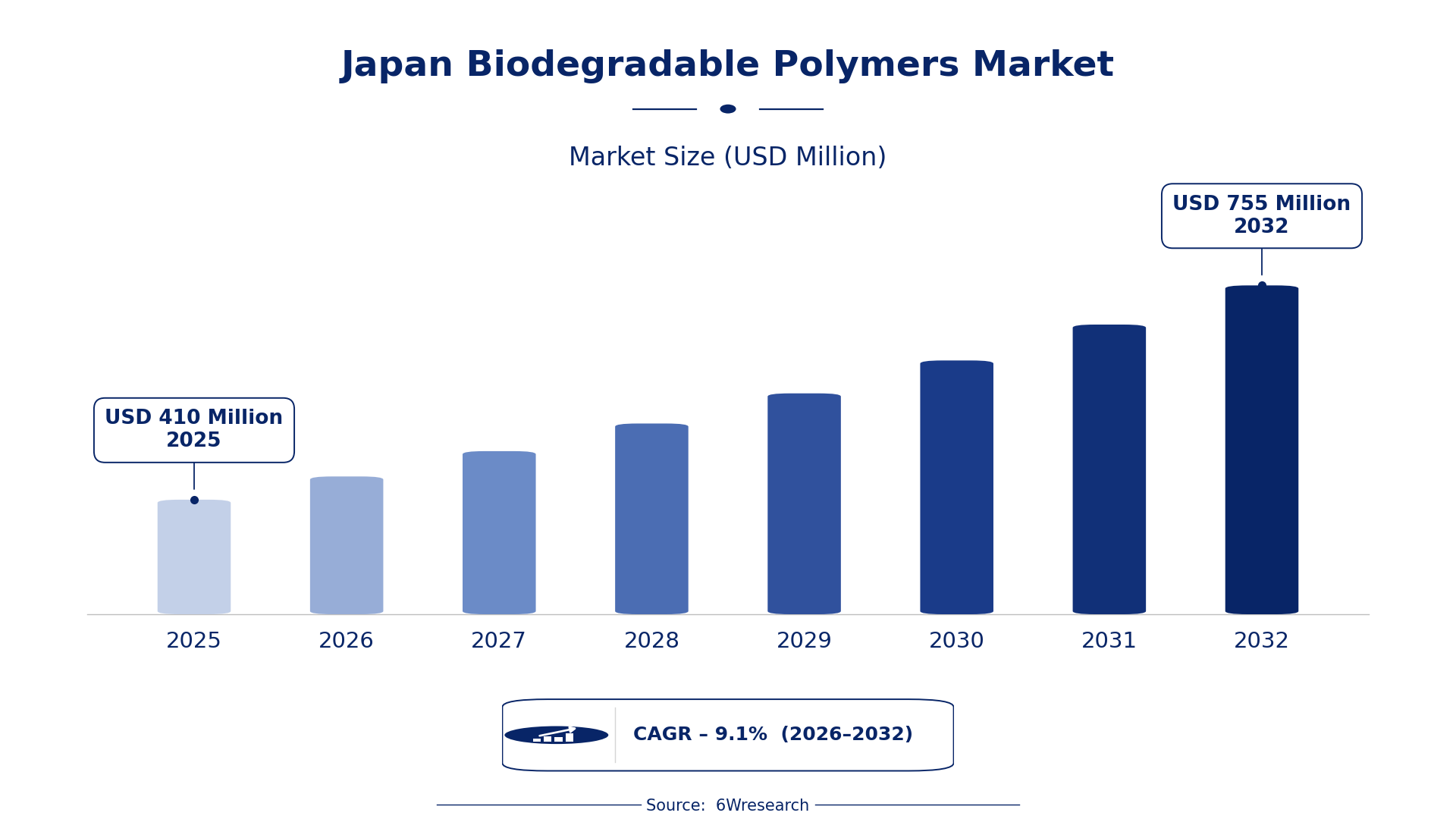
According to 6Wresearch internal database and industry insights, the Japan Biodegradable Polymers Market was valued at USD 410 Million in 2025 and is projected to reach USD 755 Million by 2032, growing at a CAGR of approximately 9.1% during 2026–2032.
Japan Biodegradable Polymers Market Highlights
| Report Metric | Details |
| Report Name | Japan Biodegradable Polymers Market (2026-2032) |
| Market Size 2025 | USD 410 Million |
| Market Size 2032 | USD 755 Million |
| Absolute Growth 2025–2032 | USD 345 Million |
| CAGR 2026–2032 | 9.1% |
| Peak Annual Growth | 9.8% in 2032 |
| Forecast Period | 2026–2032 |
| Historical Data | 2022–2025 |
| Base Year | 2025 |
| Leading Type, 2025 | PLA (38% share) |
| Leading Substrate, 2025 | Paper & Paperboard (66% share) |
| Leading Application, 2025 | Rigid Packaging (53% share) |
| Fastest-Growing Type | Starch (12.6% CAGR) |
| Fastest-Growing Substrate | Cellulose Films (11.5% CAGR) |
| Fastest-Growing Application | Flexible Packaging (11.9% CAGR) |
| Growing Sector | Biodegradable Polymers |
| Key End Users | Packaging manufacturers, agricultural producers, medical facilities, consumers |
Japan Biodegradable Polymers Market Year-wise Growth Rate and Key Drivers (2022–2032)
This graph illustrates the annual growth rates of the market from 2022 to 2032, highlighting a steady upward trajectory and projected market expansion over the forecast period.
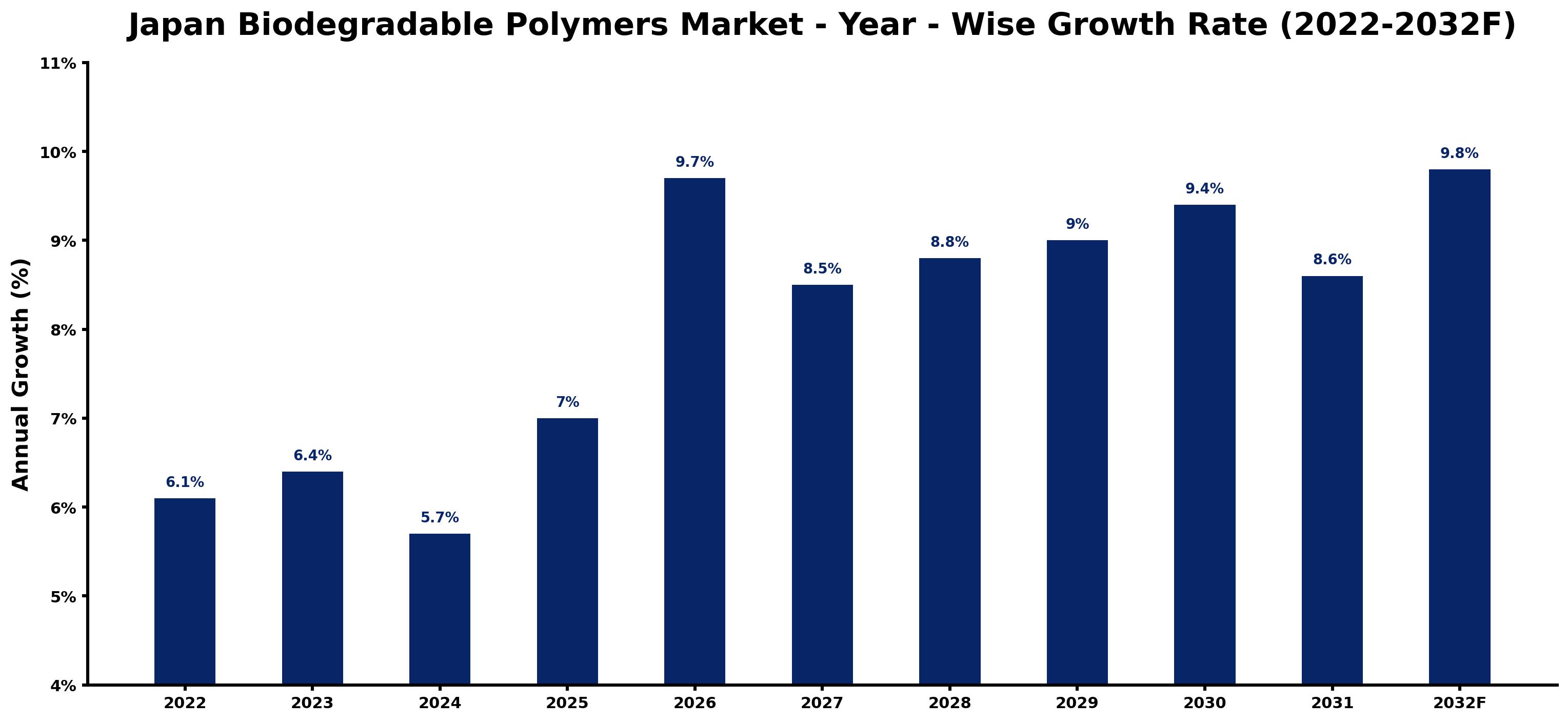
The table below sets out the estimated growth rate for each year and the main factor behind it.
| Year | Estimated Annual Growth (%) | Market Rationale |
| 2022 | 6.1 | The market showed steady growth due to increasing awareness of environmental issues. |
| 2023 | 6.4 | Demand rose as more consumers preferred biodegradable options in packaging. |
| 2024 | 5.7 | Growth slowed slightly as supply chain challenges affected production rates. |
| 2025 | 7.0 | The introduction of new biodegradable materials spurred faster growth. |
| 2026 | 9.7 | Investment in biodegradable technology is expected to increase demand. |
| 2027 | 8.5 | Growth is projected to moderate as market saturation influences purchasing patterns. |
| 2028 | 8.8 | Rising consumer preferences for eco-friendly products will boost demand again. |
| 2029 | 9.0 | The expansion of biodegradable film applications is expected to further increase market activity. |
| 2030 | 9.4 | Growing regulations on plastic waste will support continued market growth. |
| 2031 | 8.6 | A slight slowdown is projected as competition intensifies among producers. |
| 2032 | 9.8 | The market is expected to peak with advancements in biodegradable polymer technology. |
Note: Market size estimations and growth projections presented in this report are based on 6Wresearch's proprietary forecasting methodology, utilizing the latest available industry data, government publications, and primary research inputs.
Japan Biodegradable Polymers Market Synopsis
Biodegradable polymers are environmentally friendly materials derived from renewable resources like corn starch and sugarcane. They are produced through fermentation or polymerization and are primarily used in packaging, agricultural films, and disposable items. The Japan Biodegradable Polymers Market is growing due to rising consumer preference for sustainable packaging, with 40% of consumers opting for biodegradable options in 2023. Government initiatives aim to reduce plastic waste by 25% by 2030, driving further demand for these materials. The agricultural sector's increasing adoption of biodegradable films also supports market expansion.
Market Dynamics Impact Analysis (2026–2032)
| Factor | Type | Impact | Primary Segment Affected |
| Increased consumer preference for eco-friendly packaging drives demand for biodegradable polymers, particularly in packaging applications. | Driver | High | Rigid Packaging |
| Growing agricultural sector adoption of biodegradable films creates new opportunities for suppliers in the market. | Opportunity | High | Biodegradable Films |
| Intense competition from traditional plastic manufacturers pressures pricing strategies for biodegradable polymer suppliers. | Restraint | High | PLA |
| Shortage of skilled workers in polymer processing limits production capabilities for suppliers, affecting timely delivery. | Challenge | Medium | Starch |
| Government initiatives to reduce plastic waste are increasing demand for biodegradable alternatives in various sectors. | Driver | High | Paper & Paperboard |
| Rising costs of renewable raw materials are constraining margins for producers, complicating market dynamics. | Restraint | Medium | Cellulose Films |
| Technological advancements in production processes are creating opportunities for innovation in biodegradable materials. | Opportunity | High | PHA |
| Regulatory compliance requirements for biodegradable materials can delay market entry for new suppliers. | Challenge | Medium | PBS |
Evaluation of Drivers in Japan Biodegradable Polymers Market (2026–2032)
These are the developments adding the most demand over the forecast period.
| Drivers | Primary Segment Affected | Why It Matters (Evidence) |
| Increased consumer preference for eco-friendly packaging | Rigid Packaging | 40% of Japanese consumers preferred biodegradable packaging in 2023, leading to higher purchases by packaging manufacturers. |
| Government initiatives promoting biodegradable materials | Starch | Japan aims to reduce plastic waste by 25% by 2030, encouraging agricultural sectors to adopt biodegradable films. |
| Technological advancements in biodegradable polymer production | PLA | Japan produced 30,000 tons of PLA in 2022, enabling packaging companies to meet rising demand. |
| Investment in research and development for biodegradable materials | Cellulose Films | The government allocated 1 billion yen for research in 2023, enhancing production capabilities. |
| Growing awareness of environmental issues among consumers | Flexible Packaging | The biodegradable film market is projected to reach 15,000 tons by 2025, reflecting increased demand. |
The strongest pull on demand comes from increased consumer preference for eco-friendly packaging, with 40% of consumers choosing biodegradable options in 2023. Technological advancements in production processes enabled Japan to produce 30,000 tons of PLA in 2022, meeting the needs of packaging manufacturers. Investment in research and development, supported by 1 billion yen allocated in 2023, improves production capabilities for biodegradable materials. Awareness of environmental issues among consumers is reflected in the projected growth of the biodegradable film market to 15,000 tons by 2025, indicating a shift towards more sustainable practices in packaging.
Evaluation of Restraints in Japan Biodegradable Polymers Market
Several factors work against faster growth; the main ones are summarised below.
| Market Restraint | Primary Segment Affected | Why It Matters (Evidence) |
| Higher production costs limiting the adoption of certain biodegradable polymers | PHA | Production costs for PHA remain high, restricting its use in mainstream applications. |
| Limited awareness among some sectors about biodegradable options | Rigid Packaging | Some packaging manufacturers are still unaware of the benefits of biodegradable materials. |
| Regulatory hurdles in the approval of new biodegradable materials | PLA | Strict regulations can delay the introduction of new biodegradable products. |
| Competition from traditional plastic materials affecting market share | Starch | Traditional plastics are often cheaper, making it difficult for biodegradable options to compete. |
| Supply chain challenges impacting production timelines | Cellulose Films | Disruptions in supply chains can delay the availability of raw materials for production. |
Japan Biodegradable Polymers Market Challenges
Buyers in the biodegradable polymer market face delays due to outdated production technology, which limits efficiency and extends lead times for packaging applications. Suppliers encounter intense competition from traditional plastic manufacturers, leading to price wars that erode profit margins. Rising costs of renewable raw materials have increased production expenses, complicating pricing strategies for producers. A shortage of skilled workers in polymer processing has constrained production capabilities, causing delays in project timelines and affecting supply reliability for buyers in various sectors.
Trends in the Japan Biodegradable Polymers Market
The shifts below are changing how Japan Biodegradable Polymers Market products are bought and supplied.
- Shift towards Sustainable Packaging: The Japan Bioplastics Association is promoting biodegradable materials, with 40% of consumers preferring biodegradable packaging in 2023. This trend indicates a growing shift in consumer behaviour towards sustainability.
- Increase in Agricultural Use of Biodegradable Films: The agricultural sector in Japan is increasingly adopting biodegradable films for crop protection, with the market projected to reach 15,000 tons by 2025. This shift reflects a commitment to sustainable agricultural practices.
- Expansion of Biodegradable Options in Healthcare: Over 500 hospitals in Japan are using biodegradable polymers for medical disposables, highlighting a trend towards environmentally friendly practices in healthcare. This adoption is driven by increasing awareness of sustainability.
- Emergence of New Biodegradable Materials: The introduction of new biodegradable materials is reshaping the market, with Japan producing 30,000 tons of PLA in 2022. This development is important for meeting rising consumer demand for sustainable packaging.
Investment Opportunities in the Japan Biodegradable Polymers Market
The following areas offer the clearest openings for investors and suppliers in the Japan Biodegradable Polymers Market.
- 1 Billion Yen Investment in Biodegradable Research: The government allocated 1 billion yen for research on biodegradable materials in 2023, creating opportunities for innovation in production processes. Collaborating with local research institutions can support market entry.
- Growing Demand for Biodegradable Films: With the biodegradable film market projected to reach 15,000 tons by 2025, there is an opportunity for producers to invest in this segment. Focusing on agricultural applications can yield high returns.
- Expansion of Biodegradable Packaging in Urban Areas: Urban regions like Tokyo are increasingly adopting biodegradable packaging solutions, driven by consumer preferences. Entering this market through partnerships with local distributors can facilitate growth.
- Rising Consumer Awareness of Sustainability: The trend of 40% of consumers preferring biodegradable packaging presents a clear opportunity for suppliers. Engaging in marketing campaigns that highlight environmental benefits can attract more buyers.
Government Initiatives in the Japan Biodegradable Polymers Market
The Plastic Resource Circulation Act, enacted in 2021, promotes the reduction, reuse, and recycling of plastics while supporting alternatives like biodegradable plastics. This law requires producers to adopt more sustainable practices, directly impacting the biodegradable polymers market. The Chemical Substances Control Law, established in 1973, mandates the evaluation and control of chemical substances in manufacturing, ensuring safety and compliance in biodegradable polymer production.
In 2023, the government allocated 1 billion yen for research on biodegradable materials, administered by the Ministry of the Environment. This funding supports innovation and the development of new biodegradable products, benefiting producers and buyers alike.
Future Insight of the Japan Biodegradable Polymers Market
By 2032, advancements in fermentation technology will enhance the efficiency of biodegradable polymer production, potentially lowering costs for suppliers. Government initiatives will encourage the use of biodegradable materials, as Japan aims to reduce plastic waste by 25% by 2030. Stricter environmental standards will drive hospitals to adopt biodegradable medical disposables, increasing demand. With Japan producing 30,000 tons of PLA in 2022, buyers can expect a wider range of sustainable packaging solutions to become available.
Market Segmentation Analysis
Japan Biodegradable Polymers Market report covers a detailed analysis of the following market segments:
By Type – PLA Leads, Starch Expected to Grow Fastest
According to Sumit Sagar, AM at 6Wresearch, the largest type category in 2025 was PLA, at 38% of revenue. PLA holds the largest share in Japan's biodegradable polymers market due to its extensive application in packaging, which is crucial for meeting consumer demand for sustainable options. The production of 30,000 tons of PLA in 2022 highlights its established presence and reliability in this sector. Starch is projected to grow fastest, at a CAGR of 12.6% during 2026–2032. Starch is witnessing rapid growth as it is increasingly used in various applications such as films and containers, aligning with the heightened focus on sustainability. The government's target to reduce plastic waste by 25% by 2030 is a key factor driving this segment's growth. Suppliers must focus on advancing starch-based products to align with the growing market demand.
By Substrate – Paper & Paperboard Leads, Cellulose Films Expected to Grow Fastest
In 2025, Paper & Paperboard led the substrate split with a 66% share. Paper & Paperboard leads the substrate segment due to its critical role in sustainable packaging solutions, appealing to both consumers and businesses focused on environmental responsibility. Its widespread adoption across various sectors reinforces its dominant position in the market. Cellulose Films are set to record the highest CAGR in this split, 11.5% over 2026–2032. Cellulose Films are growing rapidly as they are increasingly favoured for food packaging, reflecting consumer trends towards biodegradable materials. The ongoing shift towards sustainable packaging solutions is a key factor driving this growth. Buyers can expect an expanded selection of sustainable packaging options as cellulose films gain popularity.
By Application – Rigid Packaging Leads, Flexible Packaging Expected to Grow Fastest
Rigid Packaging took 53% of application revenue in 2025, more than any other category. Rigid Packaging leads in the application segment, primarily due to its extensive use for containers and boxes in various industries, ensuring product safety and longevity. This widespread adoption reflects the strong demand for durable and sustainable packaging solutions. Over 2026–2032, Flexible Packaging is expected to post the fastest growth, at a CAGR of 11.9%. Flexible Packaging is growing rapidly as it becomes the preferred choice for bags and wraps, driven by consumer convenience and sustainability trends. The increasing use of biodegradable materials in this application is expected to further accelerate its growth. Suppliers should invest in flexible packaging innovations to meet the rising demand for eco-friendly alternatives.
Key Attractiveness of the Report
- 10 Years of Market Numbers
- Historical Data Starting from 2022 to 2025
- Base Year 2025
- Forecast Data until 2032
- Key Performance Indicators Impacting the Market
- Major Upcoming Developments and Projects
Key Highlights of the Report:
- Japan Biodegradable Polymers Market Outlook
- Market Size of Japan Biodegradable Polymers Market, 2025
- Forecast of Japan Biodegradable Polymers Market, 2032
- Historical Data and Forecast of Japan Biodegradable Polymers Revenues & Volume for the Period 2022-2032
- Japan Biodegradable Polymers Market Trend Evolution
- Japan Biodegradable Polymers Market Drivers and Challenges
- Japan Biodegradable Polymers Price Trends
- Japan Biodegradable Polymers Porter's Five Forces
- Japan Biodegradable Polymers Industry Life Cycle
- Historical Data and Forecast of Japan Biodegradable Polymers Market Revenues & Volume By Type for the Period 2022-2032
- Historical Data and Forecast of Japan Biodegradable Polymers Market Revenues & Volume By PLA for the Period 2022-2032
- Historical Data and Forecast of Japan Biodegradable Polymers Market Revenues & Volume By Starch for the Period 2022-2032
- Historical Data and Forecast of Japan Biodegradable Polymers Market Revenues & Volume By PBS for the Period 2022-2032
- Historical Data and Forecast of Japan Biodegradable Polymers Market Revenues & Volume By PHA for the Period 2022-2032
- Historical Data and Forecast of Japan Biodegradable Polymers Market Revenues & Volume By Substrate for the Period 2022-2032
- Historical Data and Forecast of Japan Biodegradable Polymers Market Revenues & Volume By Paper & Paperboard for the Period 2022-2032
- Historical Data and Forecast of Japan Biodegradable Polymers Market Revenues & Volume By Cellulose Films for the Period 2022-2032
- Historical Data and Forecast of Japan Biodegradable Polymers Market Revenues & Volume By Application for the Period 2022-2032
- Historical Data and Forecast of Japan Biodegradable Polymers Market Revenues & Volume By Rigid Packaging for the Period 2022-2032
- Historical Data and Forecast of Japan Biodegradable Polymers Market Revenues & Volume By Flexible Packaging for the Period 2022-2032
- Historical Data and Forecast of Japan Biodegradable Polymers Market Revenues & Volume By Liquid Packaging for the Period 2022-2032
- Japan Biodegradable Polymers Import Export Trade Statistics
- Market Opportunity Assessment By Type
- Market Opportunity Assessment By Substrate
- Market Opportunity Assessment By Application
- Japan Biodegradable Polymers Top Companies Market Share
- Japan Biodegradable Polymers Competitive Benchmarking By Technical and Operational Parameters
- Japan Biodegradable Polymers Company Profiles
- Japan Biodegradable Polymers Key Strategic Recommendations
Market Covered
Segments analysed in this report are listed below.
By Type
- PLA
- Starch
- PBS
- PHA
By Substrate
- Paper & Paperboard
- Cellulose Films
By Application
- Rigid Packaging
- Flexible Packaging
- Liquid Packaging































