Japan Biometric-as-a-Service Market Size & Growth Rate
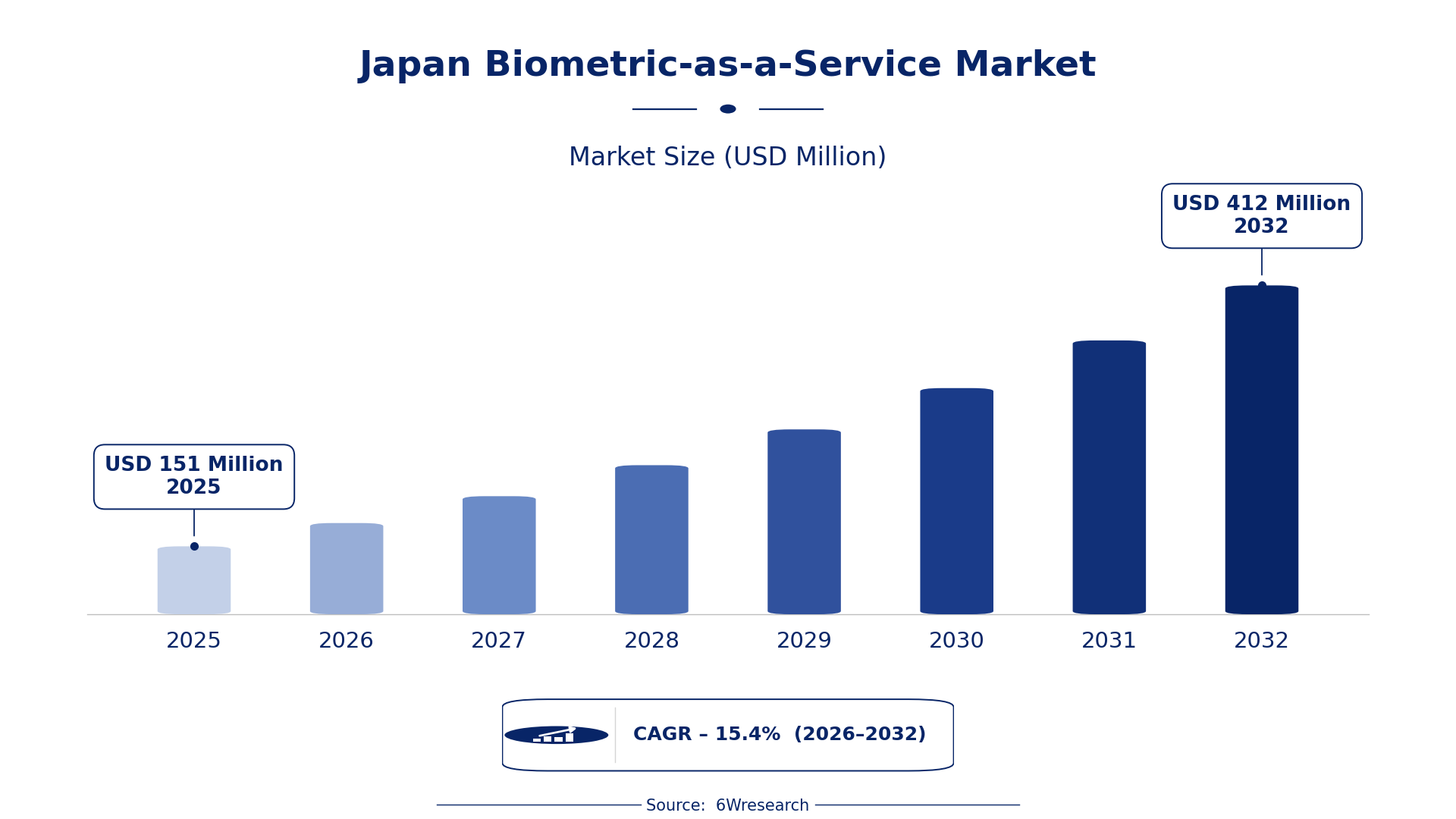
According to 6Wresearch internal database and industry insights, the Japan Biometric-as-a-Service Market was valued at USD 151 Million in 2025 and is projected to reach USD 412 Million by 2032, growing at a CAGR of approximately 15.4% during 2026–2032.
Japan Biometric-as-a-Service Market Highlights
| Report Metric | Details |
| Report Name | Japan Biometric-as-a-Service Market (2026-2032) |
| Market Size 2025 | USD 151 Million |
| Market Size 2032 | USD 412 Million |
| Absolute Growth 2025–2032 | USD 261 Million |
| CAGR 2026–2032 | 15.4% |
| Peak Annual Growth | 16.7% in 2026 |
| Forecast Period | 2026–2032 |
| Historical Data | 2022–2025 |
| Base Year | 2025 |
| Leading Applications, 2025 | Site Application Control (43% share) |
| Leading Scanner Type, 2025 | Fingerprint Recognition (32% share) |
| Leading End-users, 2025 | Government (37% share) |
| Fastest-Growing Applications | Mobile Application (20.9% CAGR) |
| Fastest-Growing Scanner Type | Palm Recognition (21.5% CAGR) |
| Fastest-Growing End-users | Retail (20.2% CAGR) |
| Growing Sector | Healthcare |
| Key End Users | Government, Healthcare, Retail, BFSI |
Japan Biometric-as-a-Service Market Year-wise Growth Rate and Key Drivers (2022–2032)
This graph illustrates the annual growth rates of the market from 2022 to 2032, highlighting a steady upward trajectory and projected market expansion over the forecast period.
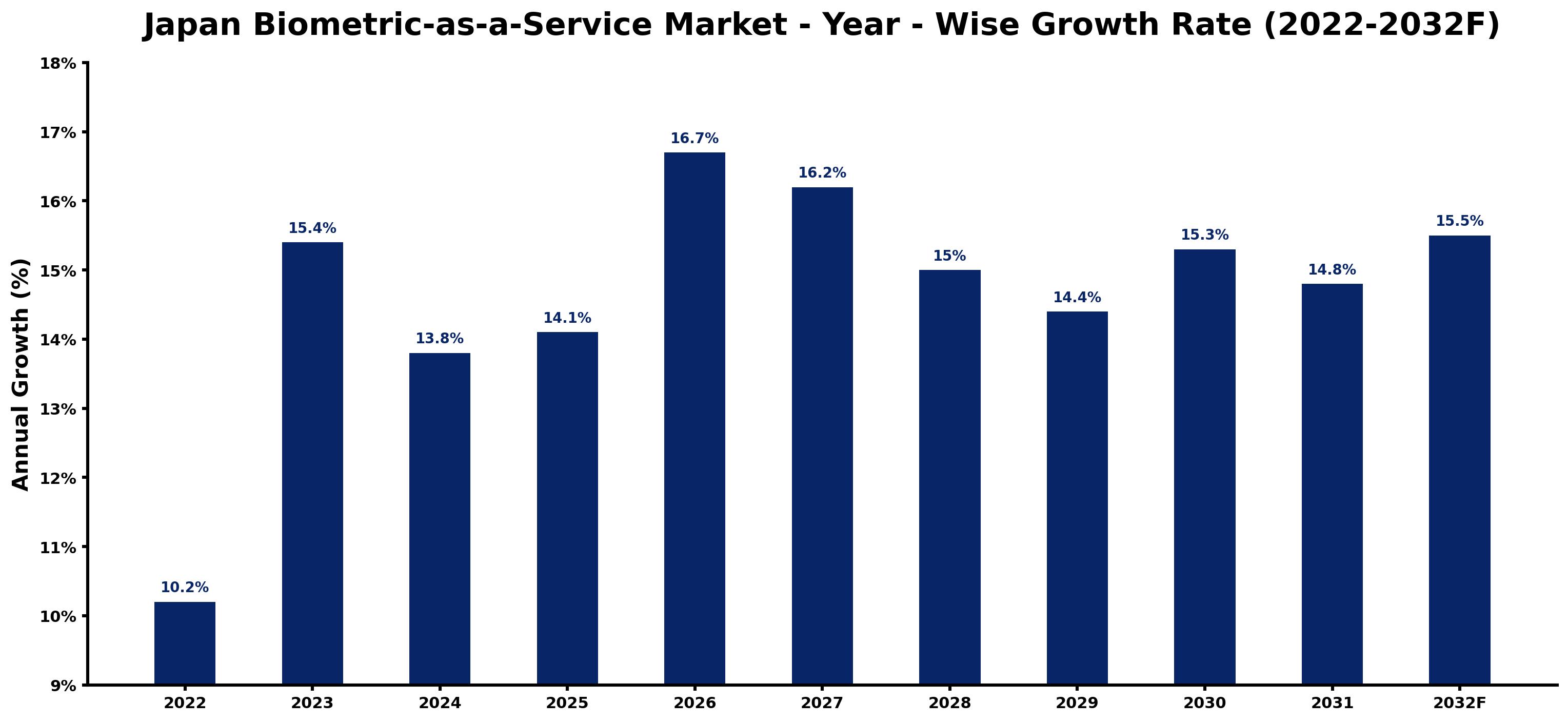
For each year, the table pairs the estimated growth rate with the leading influence on demand, showing how the drivers changed across the period.
| Year | Estimated Annual Growth (%) | Market Rationale |
| 2022 | 10.2 | The market showed a solid foundation with increasing user adoption. |
| 2023 | 15.4 | Growth accelerated as biometric solutions gained traction across sectors. |
| 2024 | 13.8 | A slight slowdown occurred as market saturation began to influence growth. |
| 2025 | 14.1 | Demand surged again with new applications emerging in various industries. |
| 2026 | 16.7 | The market is expected to peak with heightened investments in security technologies. |
| 2027 | 16.2 | Growth will moderate slightly as the market stabilises after rapid expansion. |
| 2028 | 15.0 | The trend will continue with a gradual decrease in growth rate. |
| 2029 | 14.4 | Demand will remain strong, but growth will slow as competition intensifies. |
| 2030 | 15.3 | A resurgence in growth is projected due to new regulatory requirements. |
| 2031 | 14.8 | The market will experience a slowdown as maturity sets in for many solutions. |
| 2032 | 15.5 | Growth is expected to pick up again as innovation in biometric solutions revitalises interest. |
Note: Market size estimations and growth projections presented in this report are based on 6Wresearch's proprietary forecasting methodology, utilizing the latest available industry data, government publications, and primary research inputs.
Japan Biometric-as-a-Service Market Synopsis
Biometric-as-a-Service (BaaS) integrates biometric technologies into cloud-based platforms, providing security for access control, identity verification, and time tracking. The Japan Biometric-as-a-Service Market is driven by sectors such as government, healthcare, and finance, with the government targeting implementation in all public offices by 2025. Tokyo accounts for 40% of the demand, indicating growth potential in the coming years as the market adapts to evolving security needs.
Market Dynamics Impact Analysis (2026–2032)
| Factor | Type | Impact | Primary Segment Affected |
| Increasing adoption of biometric solutions in public offices | Driver | High | Site Application Control |
| Rising demand for secure transactions in retail and finance | Driver | High | Mobile Application |
| Growing investment in biometric technologies by the retail sector | Opportunity | High | Retail |
| Expansion of biometric applications in healthcare for patient identification | Opportunity | Medium | Healthcare |
| Regulatory compliance costs for biometric data management | Restraint | High | Site Application Control |
| Market saturation in certain segments leading to slower growth | Restraint | Medium | Site Application Control |
| Limited integration capabilities with existing IT infrastructure | Challenge | High | Site Application Control |
| Competition from alternative identification technologies | Challenge | Medium | Site Application Control |
Evaluation of Drivers in Japan Biometric-as-a-Service Market (2026–2032)
The following drivers explain most of the expected growth.
| Drivers | Primary Segment Affected | Why It Matters (Evidence) |
| Government initiatives promoting biometric systems | Site Application Control | The government aims to implement biometric systems in all public offices by 2025, driving demand for secure access solutions. |
| Healthcare sector's need for secure patient identification | Healthcare | With Japan's national medical care expenditure at JPY 46.7 trillion, healthcare facilities are investing in biometric solutions for secure patient identification. |
| Growing number of hospitals adopting biometric systems | Healthcare | Japan had about 8,100 hospitals in 2023, many of which are integrating biometric solutions for patient data security. |
| ISO/IEC 19794-5 standard adoption | Site Application Control | Widespread adoption of this standard ensures interoperability, increasing demand for compliant biometric solutions. |
| Retail sector's investment in biometric technologies | Retail | The retail sector is expected to invest 200 million yen in biometric technologies by 2024 to improve customer experience. |
Several shifts outside the market lift sales. The healthcare sector's need for secure patient identification drives demand, with Japan's national medical care expenditure reaching JPY 46.7 trillion. Japan's 8,100 hospitals are increasingly adopting biometric systems for better data security, fuelling market growth. Retail investments in biometric technologies are projected to reach 200 million yen by 2024, improving customer experience.
Evaluation of Restraints in Japan Biometric-as-a-Service Market
These restraints slow adoption and weigh on supplier margins.
| Market Restraint | Primary Segment Affected | Why It Matters (Evidence) |
| High costs associated with biometric system implementation | Site Application Control | Implementation costs can deter smaller businesses from adopting biometric solutions, limiting market reach. |
| Regulatory compliance challenges for data management | Site Application Control | Strict regulations on biometric data can complicate implementation, leading to delays and increased costs. |
| Market saturation in established sectors | Site Application Control | As certain segments mature, growth rates slow, impacting overall market expansion. |
| Integration difficulties with legacy systems | Site Application Control | Existing IT infrastructure may not support new biometric technologies, hindering adoption. |
| Competition from alternative identification methods | Site Application Control | Emerging technologies may divert investment away from biometric solutions, affecting market growth. |
Japan Biometric-as-a-Service Market Challenges
Public offices encounter project delays due to regulations from the Ministry of Internal Affairs and Communications, which can extend timelines for buyers by up to six months. Implementation costs for advanced biometric technologies can exceed JPY 1 billion for hospitals, straining budgets and limiting adoption. Intense competition among suppliers drives aggressive pricing strategies, which may compromise service quality for buyers in critical sectors. Supply chain disruptions for biometric components can delay project rollouts, forcing clinics to operate without essential security measures for extended periods, impacting patient safety and operational efficiency.
Trends in the Japan Biometric-as-a-Service Market
The trends below show where the Japan Biometric-as-a-Service Market is heading.
- Tokyo Leading Biometric Adoption: Tokyo accounts for 40% of biometric service demand in Japan, reflecting a concentrated push towards secure identification methods. This trend indicates a growing urban reliance on biometric solutions for both security and convenience.
- Shift Towards Facial Recognition in Retail: Facial recognition technology is increasingly used in over 500 retail stores across Japan, improving security and customer experience. This shift highlights the retail sector's commitment to integrating advanced biometric solutions.
- Healthcare Sector Embracing Biometric Solutions: The healthcare sector is exploring biometric solutions for patient identification, with 30% of applications dedicated to this purpose. This trend underscores the importance of secure access to patient data in medical facilities.
- Rise of Mobile Applications in Biometric Services: Mobile applications are becoming a focal point in biometric services, with a projected CAGR of 20.9%. This growth indicates a shift towards portable solutions that improve user identification and transaction security.
Investment Opportunities in the Japan Biometric-as-a-Service Market
The following areas offer the clearest openings for investors and suppliers in the Japan Biometric-as-a-Service Market.
- Partnerships for Biometric Integration: Local partnerships can facilitate the integration of biometric solutions in various sectors. With the retail sector projected to invest 200 million yen in biometric technologies by 2024, collaboration can support market entry.
- Investment in Healthcare Biometric Systems: The healthcare sector's increasing focus on secure patient identification presents an investment opportunity. With 30% of applications in healthcare, suppliers can target hospitals and clinics for biometric solutions.
- Supply of Mobile Biometric Solutions: The growing demand for mobile applications in biometric services indicates a need for innovative solutions. Collaborating with IT firms can help develop these applications for various sectors.
- Approval Pathways for Biometric Technologies: Navigating regulatory approval pathways is essential for entering the biometric market. Engaging with local agencies can streamline the certification process for new technologies.
Government Initiatives in the Japan Biometric-as-a-Service Market
Japan's regulatory framework for biometric services is shaped by several laws, including the PMD Act, which governs medical devices and pharmaceuticals, and the Next-Generation Medical Infrastructure Act of 2017. These laws ensure that biometric systems meet safety and quality standards, facilitating their adoption across various sectors, including healthcare and government.
In 2023, Japan launched a program to improve biometric security in public transportation, overseen by the Ministry of Internal Affairs and Communications. This initiative aims to improve safety and efficiency, promoting the integration of biometric technologies in public services.
Future Insight of the Japan Biometric-as-a-Service Market
A national programme for biometric security in public transportation will launch in 2024, improving safety for commuters. By 2032, hospitals will increasingly adopt biometric solutions for patient identification, streamlining processes and reducing errors. Retailers are set to invest 200 million yen in biometric technologies, enhancing customer service. The integration of biometric systems into 70% of new IT infrastructure projects will facilitate secure identification methods across various sectors, making them more efficient and accessible.
Market Segmentation Analysis
Japan Biometric-as-a-Service Market report covers a detailed analysis of the following market segments:
By Applications – Site Application Control Leads, Mobile Application Expected to Grow Fastest
According to Ravi Bhandari, Research Head at 6Wresearch, in 2025, Site Application Control led the applications split with a 43% share. Site Application Control holds the largest share as it is crucial for securing access to physical locations, particularly in government facilities. The government's initiative to implement biometric systems in all public offices by 2025 demonstrates the robust demand for this application. Mobile Application is projected to grow fastest, at a CAGR of 20.9% during 2026–2032. Mobile Application is growing rapidly as it supports secure transactions and user identification, reflecting the increasing reliance on mobile devices for everyday activities. The retail sector's substantial investment in biometric technologies, including the adoption of facial recognition in over 500 stores, further fuels this growth. Suppliers should focus on developing mobile biometric solutions to meet the rising demand across various sectors.
By Scanner Type – Fingerprint Recognition Leads, Palm Recognition Expected to Grow Fastest
The largest scanner type category in 2025 was Fingerprint Recognition, at 32% of revenue. Fingerprint Recognition leads the market due to its widespread use for personal identification and security, making it the preferred choice for many organisations. Its integration into 70% of new IT infrastructure projects in Japan highlights its established role in the sector. The quickest growth will come from Palm Recognition, forecast to expand at a CAGR of 21.5% between 2026 and 2032. Palm Recognition is experiencing the fastest growth, particularly in secure environments, as it is currently being tested in select government facilities for access control. This trend indicates a growing interest in alternative biometric methods for enhanced security measures. Buyers should explore incorporating emerging technologies like palm recognition into their biometric systems to remain competitive.
By End-users – Government Leads, Retail Expected to Grow Fastest
With 37% of end-users revenue in 2025, Government was the largest category. Government is the primary end-user of biometric solutions, primarily for national identification and security purposes, reflecting its commitment to enhancing public safety. The ongoing implementation of biometric systems in public offices illustrates the government's significant investment in this area. Retail is set to record the highest CAGR in this split, 20.2% over 2026–2032. Retail is the fastest-growing end-user segment as it enhances customer experience and security, with biometric solutions becoming essential to modern retail operations. The expected investment of 200 million yen in biometric technologies by the retail sector showcases this trend. Suppliers must tailor their offerings to address the specific needs of the retail sector, capitalising on its growth potential.
Key Attractiveness of the Report
- 10 Years of Market Numbers
- Historical Data Starting from 2022 to 2025
- Base Year 2025
- Forecast Data until 2032
- Key Performance Indicators Impacting the Market
- Major Upcoming Developments and Projects
Key Highlights of the Report:
- Japan Biometric-as-a-Service Market Outlook
- Market Size of Japan Biometric-as-a-Service Market, 2025
- Forecast of Japan Biometric-as-a-Service Market, 2032
- Historical Data and Forecast of Japan Biometric-as-a-Service Revenues & Volume for the Period 2022-2032
- Japan Biometric-as-a-Service Market Trend Evolution
- Japan Biometric-as-a-Service Market Drivers and Challenges
- Japan Biometric-as-a-Service Price Trends
- Japan Biometric-as-a-Service Porter's Five Forces
- Japan Biometric-as-a-Service Industry Life Cycle
- Historical Data and Forecast of Japan Biometric-as-a-Service Market Revenues & Volume By Applications for the Period 2022-2032
- Historical Data and Forecast of Japan Biometric-as-a-Service Market Revenues & Volume By Site Application Control for the Period 2022-2032
- Historical Data and Forecast of Japan Biometric-as-a-Service Market Revenues & Volume By Mobile Application for the Period 2022-2032
- Historical Data and Forecast of Japan Biometric-as-a-Service Market Revenues & Volume By Time Recording for the Period 2022-2032
- Historical Data and Forecast of Japan Biometric-as-a-Service Market Revenues & Volume By Web and Workplace for the Period 2022-2032
- Historical Data and Forecast of Japan Biometric-as-a-Service Market Revenues & Volume By Scanner Type for the Period 2022-2032
- Historical Data and Forecast of Japan Biometric-as-a-Service Market Revenues & Volume By Fingerprint Recognition for the Period 2022-2032
- Historical Data and Forecast of Japan Biometric-as-a-Service Market Revenues & Volume By Palm Recognition for the Period 2022-2032
- Historical Data and Forecast of Japan Biometric-as-a-Service Market Revenues & Volume By Iris Recognition for the Period 2022-2032
- Historical Data and Forecast of Japan Biometric-as-a-Service Market Revenues & Volume By Facial Recognition for the Period 2022-2032
- Historical Data and Forecast of Japan Biometric-as-a-Service Market Revenues & Volume By Voice Recognition for the Period 2022-2032
- Historical Data and Forecast of Japan Biometric-as-a-Service Market Revenues & Volume By Others for the Period 2022-2032
- Historical Data and Forecast of Japan Biometric-as-a-Service Market Revenues & Volume By End-users for the Period 2022-2032
- Historical Data and Forecast of Japan Biometric-as-a-Service Market Revenues & Volume By Government for the Period 2022-2032
- Historical Data and Forecast of Japan Biometric-as-a-Service Market Revenues & Volume By Retail for the Period 2022-2032
- Historical Data and Forecast of Japan Biometric-as-a-Service Market Revenues & Volume By IT and Telecom for the Period 2022-2032
- Historical Data and Forecast of Japan Biometric-as-a-Service Market Revenues & Volume By Healthcare for the Period 2022-2032
- Historical Data and Forecast of Japan Biometric-as-a-Service Market Revenues & Volume By BFSI for the Period 2022-2032
- Historical Data and Forecast of Japan Biometric-as-a-Service Market Revenues & Volume By Others for the Period 2022-2032
- Japan Biometric-as-a-Service Import Export Trade Statistics
- Market Opportunity Assessment By Applications
- Market Opportunity Assessment By Scanner Type
- Market Opportunity Assessment By End-users
- Japan Biometric-as-a-Service Top Companies Market Share
- Japan Biometric-as-a-Service Competitive Benchmarking By Technical and Operational Parameters
- Japan Biometric-as-a-Service Company Profiles
- Japan Biometric-as-a-Service Key Strategic Recommendations
Market Covered
This report examines the market across the segments below.
By Applications
- Site Application Control
- Mobile Application
- Time Recording
- Web and Workplace
By Scanner Type
- Fingerprint Recognition
- Palm Recognition
- Iris Recognition
- Facial Recognition
- Voice Recognition
- Others
By End-users
- Government
- Retail
- IT and Telecom
- Healthcare
- BFSI
- Others































