Japan Bioplastics Market Size & Growth Rate
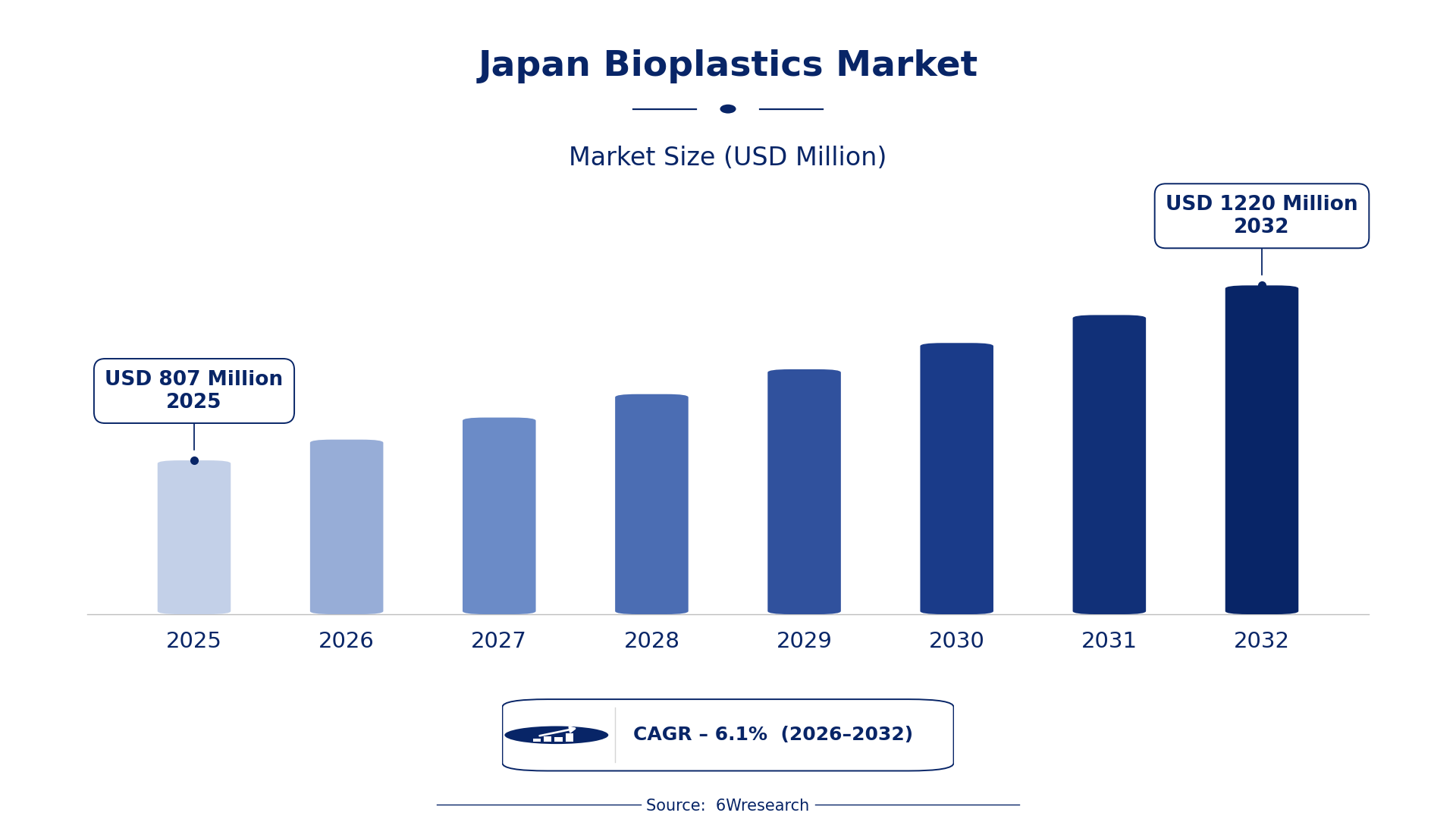
According to 6Wresearch internal database and industry insights, the Japan Bioplastics Market was valued at USD 807 Million in 2025 and is projected to reach USD 1,220 Million by 2032, growing at a CAGR of approximately 6.1% during 2026–2032.
Japan Bioplastics Market Highlights
| Report Metric | Details |
| Report Name | Japan Bioplastics Market (2026-2032) |
| Market Size 2025 | USD 807 Million |
| Market Size 2032 | USD 1,220 Million |
| Absolute Growth 2025–2032 | USD 413 Million |
| CAGR 2026–2032 | 6.1% |
| Peak Annual Growth | 6.9% in 2026 |
| Forecast Period | 2026–2032 |
| Historical Data | 2022–2025 |
| Base Year | 2025 |
| Leading Type, 2025 | Biodegradable Plastic (62% share) |
| Leading Application, 2025 | Packaging (42% share) |
| Fastest-Growing Type | Non-biodegradable Plastic (8.6% CAGR) |
| Fastest-Growing Application | Agriculture (8.1% CAGR) |
| Growing Sector | Packaging |
| Key End Users | Agriculture, Food Industry, Consumer Goods, Medical Sector |
Japan Bioplastics Market Year-wise Growth Rate and Key Drivers (2022–2032)
This graph illustrates the annual growth rates of the market from 2022 to 2032, highlighting a steady upward trajectory and projected market expansion over the forecast period.
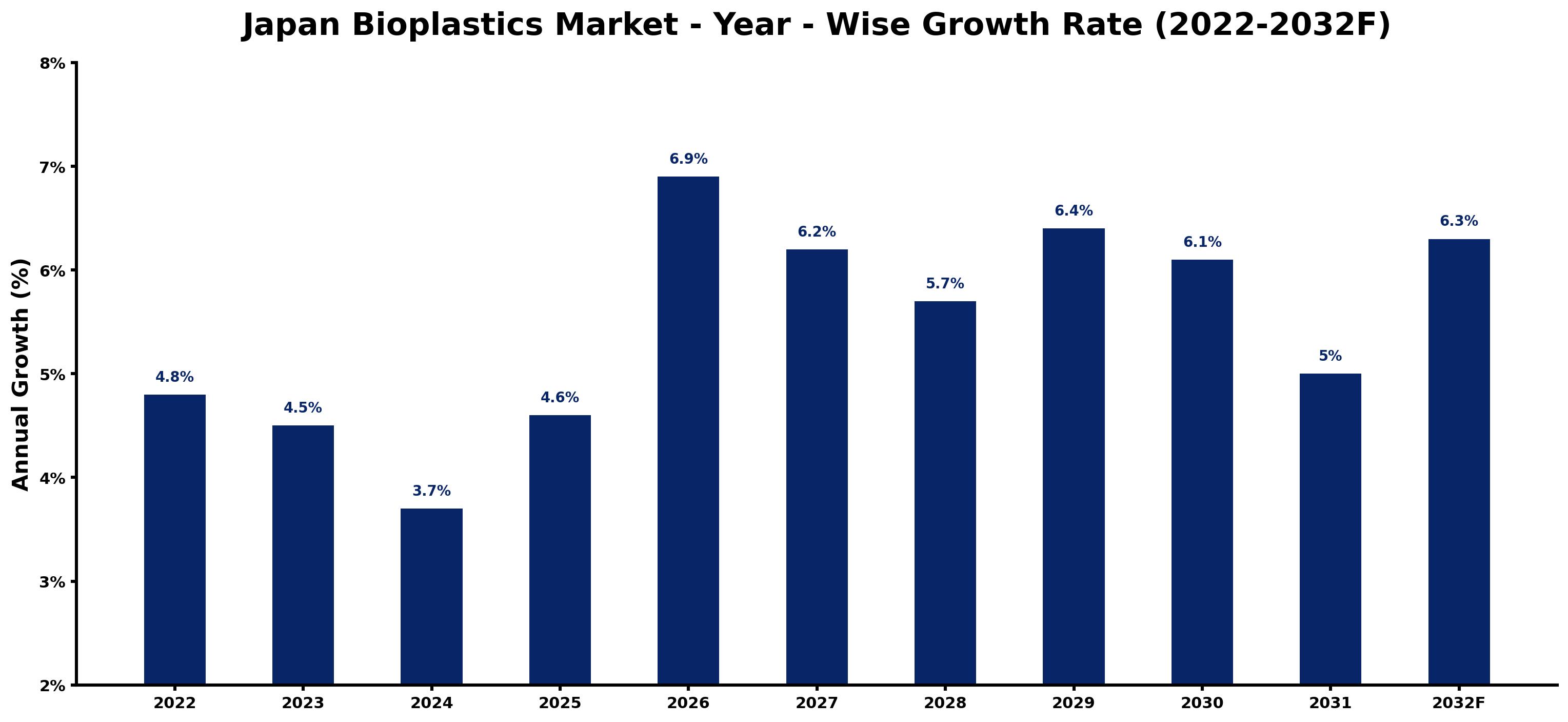
The table below sets out the estimated growth rate for each year and the main factor behind it.
| Year | Estimated Annual Growth (%) | Market Rationale |
| 2022 | 4.8 | The market experienced steady growth driven by rising environmental awareness among consumers. |
| 2023 | 4.5 | Growth slowed slightly as the market adjusted to increased competition and supply chain challenges. |
| 2024 | 3.7 | Market growth continued to decelerate due to a temporary saturation in the packaging sector. |
| 2025 | 4.6 | Demand accelerated again as new agricultural applications for bioplastics gained traction. |
| 2026 | 6.9 | Growth is expected to peak as investments in biodegradable plastics surge, particularly in packaging. |
| 2027 | 6.2 | Market growth is projected to slow as the focus shifts towards improving production efficiency. |
| 2028 | 5.7 | Demand is expected to decelerate slightly as the market matures and competition intensifies. |
| 2029 | 6.4 | Growth will rebound with renewed interest in sustainable packaging solutions. |
| 2030 | 6.1 | Market growth is projected to slow again as regulatory frameworks begin to stabilise. |
| 2031 | 5.0 | Demand is expected to continue decelerating as the market reaches a more mature phase. |
| 2032 | 6.3 | Growth is expected to rise again as new bioplastic applications emerge. |
Note: Market size estimations and growth projections presented in this report are based on 6Wresearch's proprietary forecasting methodology, utilizing the latest available industry data, government publications, and primary research inputs.
Japan Bioplastics Market Synopsis
Bioplastics are derived from renewable biomass sources, produced through fermentation and polymerization processes. They are primarily used in packaging, agricultural films, and consumer products. The Japan Bioplastics Market is experiencing growth driven by increasing environmental awareness and government initiatives promoting sustainable materials. The biodegradable plastics segment, accounting for approximately 60% of the market, is particularly influential, with a target to increase bioplastic usage in packaging by 30% by 2025. Major regions for production include Tokyo and Osaka, where demand is increasing.
Market Dynamics Impact Analysis (2026–2032)
| Factor | Type | Impact | Primary Segment Affected |
| Growing environmental awareness among consumers | Driver | High | Biodegradable Plastic |
| Government initiatives promoting bioplastics | Driver | High | Biodegradable Plastic |
| Increasing demand for sustainable packaging solutions | Opportunity | High | Packaging |
| Expansion of agricultural bioplastics applications | Opportunity | High | Agriculture |
| High production costs of bioplastics | Restraint | Medium | Biodegradable Plastic |
| Limited consumer awareness of bioplastics | Restraint | Medium | Biodegradable Plastic |
| Competition from traditional plastics | Challenge | High | Non-biodegradable Plastic |
| Technological barriers in production processes | Challenge | Medium | Non-biodegradable Plastic |
Evaluation of Drivers in Japan Bioplastics Market (2026–2032)
Key forces behind demand, with the segment each one moves most, are listed below.
| Drivers | Primary Segment Affected | Why It Matters (Evidence) |
| Increased consumer demand for eco-friendly products | Biodegradable Plastic | This demand drives manufacturers to invest in bioplastics, with 15% of packaging materials reported as bioplastics in 2022. |
| Government regulations supporting bioplastics adoption | Biodegradable Plastic | The Plastic Resource Circulation Act promotes the use of bioplastics, contributing to a 30% increase in production. |
| Rising agricultural productivity needs | Agriculture | The agricultural sector's use of bioplastics for mulch films improves crop yield by 20%, fostering demand. |
| Technological advancements in bioplastics production | Biodegradable Plastic | Improvements in production processes have led to better quality bioplastics, attracting more buyers by 25%. |
| Growing investment in bioplastics research | Biodegradable Plastic | The Japanese government is investing JPY 5 billion in R&D programs, promoting new bioplastic applications. |
Volumes grow on the back of rising consumer demand for eco-friendly products, with 15% of packaging materials reported as bioplastics in 2022. The agricultural sector's need for improved productivity drives the use of bioplastics for mulch films, enhancing crop yield by 20%. Technological advancements in production processes lead to better quality bioplastics, attracting more buyers. Overall, the combination of consumer preferences and agricultural needs is stimulating market growth.
Evaluation of Restraints in Japan Bioplastics Market
Below are the constraints most often cited by buyers and suppliers, with the segment each affects.
| Market Restraint | Primary Segment Affected | Why It Matters (Evidence) |
| High production costs limit market expansion | Biodegradable Plastic | Production costs for bioplastics remain high, with an average increase of 15% compared to traditional plastics. |
| Limited consumer awareness hampers adoption | Biodegradable Plastic | Many consumers remain unaware of bioplastics' benefits, with only 15% of consumers familiar with them. |
| Competition from traditional plastics impacts sales | Non-biodegradable Plastic | Traditional plastics are often cheaper and more readily available, limiting bioplastic market share by 20%. |
| Technological barriers hinder production efficiency | Non-biodegradable Plastic | Challenges in scaling production processes for bioplastics can delay market entry by up to six months. |
| Regulatory compliance costs can deter new entrants | Biodegradable Plastic | Compliance with standards like ISO 14855 adds costs for manufacturers, estimated at 10% of production expenses. |
Japan Bioplastics Market Challenges
Buyers are confronted with inflated costs as competition from traditional plastics raises bioplastic prices by 15% for packaging materials. Suppliers face delays due to the JIS K 6954 standard, potentially extending product launch timelines by six months, which affects their responsiveness to market needs. Buyers experience uncertainty since only 15% of packaging materials were bioplastics in 2022, compelling them to maintain larger inventories and incurring higher storage expenses. Limited domestic production capacity leads to supply chain disruptions, causing delays in fulfilling orders for hospitals and clinics, ultimately impacting patient care.
Trends in the Japan Bioplastics Market
Buyers and suppliers in the Japan Bioplastics Market are adjusting to the following trends.
- Shift towards Sustainable Packaging Solutions: A noticeable shift is occurring towards sustainable packaging solutions in Japan. In 2023, the Bioplastics Conference in Tokyo highlighted this trend, showcasing innovations in biodegradable materials, with 15% of packaging materials reported as bioplastics.
- Increase in Bioplastic Usage in Food Packaging: In 2022, 15% of packaging materials were reported to be bioplastics, reflecting a growing trend in food packaging. This shift is driven by consumer demand for environmentally friendly options, particularly in urban areas.
- Rising Adoption of Bioplastics in Agriculture: The agricultural sector is increasingly utilising bioplastics for mulch films, with a growth rate of 8.1% projected in this application. This trend is particularly evident in regions like Osaka, where crop yields are being enhanced.
- Expansion of Bioplastics in Medical Applications: Bioplastics are being integrated into medical applications, such as sutures and drug delivery systems. This trend is supported by the Japanese government's investment in bioplastics research, aiming for 50% of single-use plastics to be biodegradable by 2030.
Investment Opportunities in the Japan Bioplastics Market
The following opportunities in the Japan Bioplastics Market pair current demand with a clear way in.
- Agricultural Sector Seeking Bioplastic Solutions: The agricultural sector needs sustainable solutions, with a projected growth of 8.1% in bioplastics usage. Farmers in regions like Hokkaido are increasingly adopting bioplastics for improved crop yields.
- Market Gap for Biodegradable Packaging: With 15% of packaging materials being bioplastics, there is a gap for growth. Companies in Tokyo can invest in bioplastic production to meet rising demand, projected to increase by 30%.
- Entry through Joint Ventures in Bioplastics: Collaborating with local producers can facilitate entry into the bioplastics market. Partnerships in Osaka can provide access to established distribution channels, enhancing market presence.
- Investment in Research and Development: The Japanese government is investing JPY 5 billion in bioplastics research, aiming for innovative applications. Companies can partner with research institutions to develop new bioplastic products.
Government Initiatives in the Japan Bioplastics Market
The Plastic Resource Circulation Act, implemented in 2021, impacts bioplastics producers by promoting the reduction, reuse, and recycling of plastics. This act encourages manufacturers to transition towards biomass and biodegradable plastics, creating a more sustainable production environment with compliance essential for producers. In 2023, the government allocated JPY 5 billion to support bioplastics initiatives, enhancing research and development efforts.
In 2023, the Ministry of the Environment oversees the funding of JPY 5 billion for bioplastics research and development programs. This funding aims to support innovative projects that enhance bioplastic production and application, ensuring that Japan remains at the forefront of sustainable materials development.
Future Insight of the Japan Bioplastics Market
By 2032, new bioplastics production facilities will emerge, driven by government subsidies and research initiatives. Enhanced biodegradability testing standards will boost product credibility and foster buyer acceptance. Rising environmental awareness will encourage consumers to choose bioplastics, aiming for 50% of single-use plastics to be biodegradable by 2030. The expansion of bioplastics in medical applications will yield effective solutions for drug delivery systems and sutures, improving healthcare outcomes.
Market Segmentation Analysis
Japan Bioplastics Market report covers a detailed analysis of the following market segments:
By Type – Biodegradable Plastic Leads, Non-biodegradable Plastic Expected to Grow Fastest
According to Summon Dutta, Assistant Manager at 6Wresearch, Biodegradable Plastic held 62% of the Japan Bioplastics Market by type in 2025. The biodegradable plastic segment holds the largest share due to its extensive use in packaging and agricultural applications, aligning with Japan's environmental goals. For instance, the government aims for 50% of single-use plastics to be biodegradable by 2030, which significantly increases demand in this area. Over 2026–2032, Non-biodegradable Plastic is expected to post the fastest growth, at a CAGR of 8.6%. The non-biodegradable plastic segment is growing rapidly as it serves specific durable goods, appealing to manufacturers seeking high-performance materials. This trend is likely to continue as industries pursue alternatives that meet rigorous performance criteria. Suppliers should focus on developing biodegradable products to satisfy regulatory requirements and consumer preferences.
By Application – Packaging Leads, Agriculture Expected to Grow Fastest
Packaging took 42% of application revenue in 2025, more than any other category. Packaging is the dominant application for bioplastics, capturing the largest market share as it addresses the increasing consumer demand for sustainable solutions. In 2022, bioplastics represented 15% of packaging materials, indicating strong market integration. Agriculture is projected to grow fastest, at a CAGR of 8.1% during 2026–2032. Agriculture is the fastest-growing application for bioplastics, especially for biodegradable films and mulch that improve crop yield. This growth is fuelled by the agricultural sector's dedication to sustainability and enhanced production methods. Buyers in agriculture should consider bioplastic solutions to enhance sustainability and adhere to new regulations.
Key Attractiveness of the Report
- 10 Years of Market Numbers
- Historical Data Starting from 2022 to 2025
- Base Year 2025
- Forecast Data until 2032
- Key Performance Indicators Impacting the Market
- Major Upcoming Developments and Projects
Key Highlights of the Report:
- Japan Bioplastics Market Outlook
- Market Size of Japan Bioplastics Market, 2025
- Forecast of Japan Bioplastics Market, 2032
- Historical Data and Forecast of Japan Bioplastics Revenues & Volume for the Period 2022-2032
- Japan Bioplastics Market Trend Evolution
- Japan Bioplastics Market Drivers and Challenges
- Japan Bioplastics Price Trends
- Japan Bioplastics Porter's Five Forces
- Japan Bioplastics Industry Life Cycle
- Historical Data and Forecast of Japan Bioplastics Market Revenues & Volume By Type for the Period 2022-2032
- Historical Data and Forecast of Japan Bioplastics Market Revenues & Volume By Biodegradable Plastic for the Period 2022-2032
- Historical Data and Forecast of Japan Bioplastics Market Revenues & Volume By Non-biodegradable Plastic for the Period 2022-2032
- Historical Data and Forecast of Japan Bioplastics Market Revenues & Volume By Application for the Period 2022-2032
- Historical Data and Forecast of Japan Bioplastics Market Revenues & Volume By Packaging for the Period 2022-2032
- Historical Data and Forecast of Japan Bioplastics Market Revenues & Volume By Agriculture for the Period 2022-2032
- Historical Data and Forecast of Japan Bioplastics Market Revenues & Volume By Consumer Durables for the Period 2022-2032
- Historical Data and Forecast of Japan Bioplastics Market Revenues & Volume By Textile for the Period 2022-2032
- Historical Data and Forecast of Japan Bioplastics Market Revenues & Volume By Others for the Period 2022-2032
- Japan Bioplastics Import Export Trade Statistics
- Market Opportunity Assessment By Type
- Market Opportunity Assessment By Application
- Japan Bioplastics Top Companies Market Share
- Japan Bioplastics Competitive Benchmarking By Technical and Operational Parameters
- Japan Bioplastics Company Profiles
- Japan Bioplastics Key Strategic Recommendations
Market Covered
The following segment groups are covered in the report.
By Type
- Biodegradable Plastic
- Non-biodegradable Plastic
By Application
- Packaging
- Agriculture
- Consumer Durables
- Textile
- Others































