Japan Biotechnology Reagents Market Size & Growth Rate
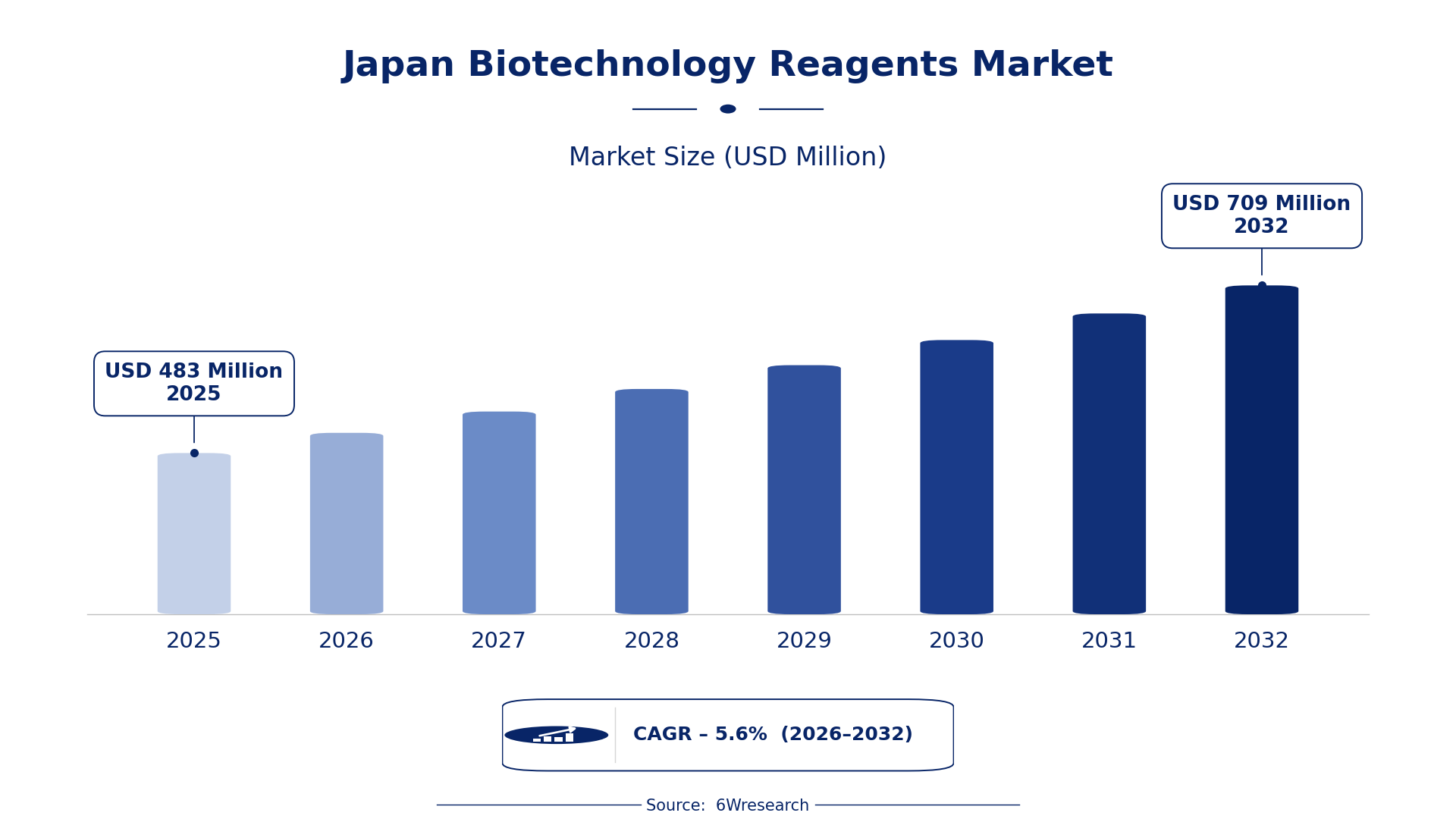
According to 6Wresearch internal database and industry insights, the Japan Biotechnology Reagents Market was valued at USD 483 Million in 2025 and is projected to reach USD 709 Million by 2032, growing at a CAGR of approximately 5.6% during 2026–2032.
Japan Biotechnology Reagents Market Highlights
| Report Metric | Details |
| Report Name | Japan Biotechnology Reagents Market (2026-2032) |
| Market Size 2025 | USD 483 Million |
| Market Size 2032 | USD 709 Million |
| Absolute Growth 2025–2032 | USD 226 Million |
| CAGR 2026–2032 | 5.6% |
| Peak Annual Growth | 6.3% in 2028 |
| Forecast Period | 2026–2032 |
| Historical Data | 2022–2025 |
| Base Year | 2025 |
| Leading Application, 2025 | DNA & RNA analysis (40% share) |
| Leading Technology, 2025 | Life Science Reagents (48% share) |
| Fastest-Growing Application | Gene expression (8.0% CAGR) |
| Fastest-Growing Technology | Cell-based (7.7% CAGR) |
| Growing Sector | biotechnology research |
| Key End Users | research institutions, pharmaceutical companies, healthcare providers, universities |
Japan Biotechnology Reagents Market Year-wise Growth Rate and Key Drivers (2022–2032)
This graph illustrates the annual growth rates of the market from 2022 to 2032, highlighting a steady upward trajectory and projected market expansion over the forecast period.
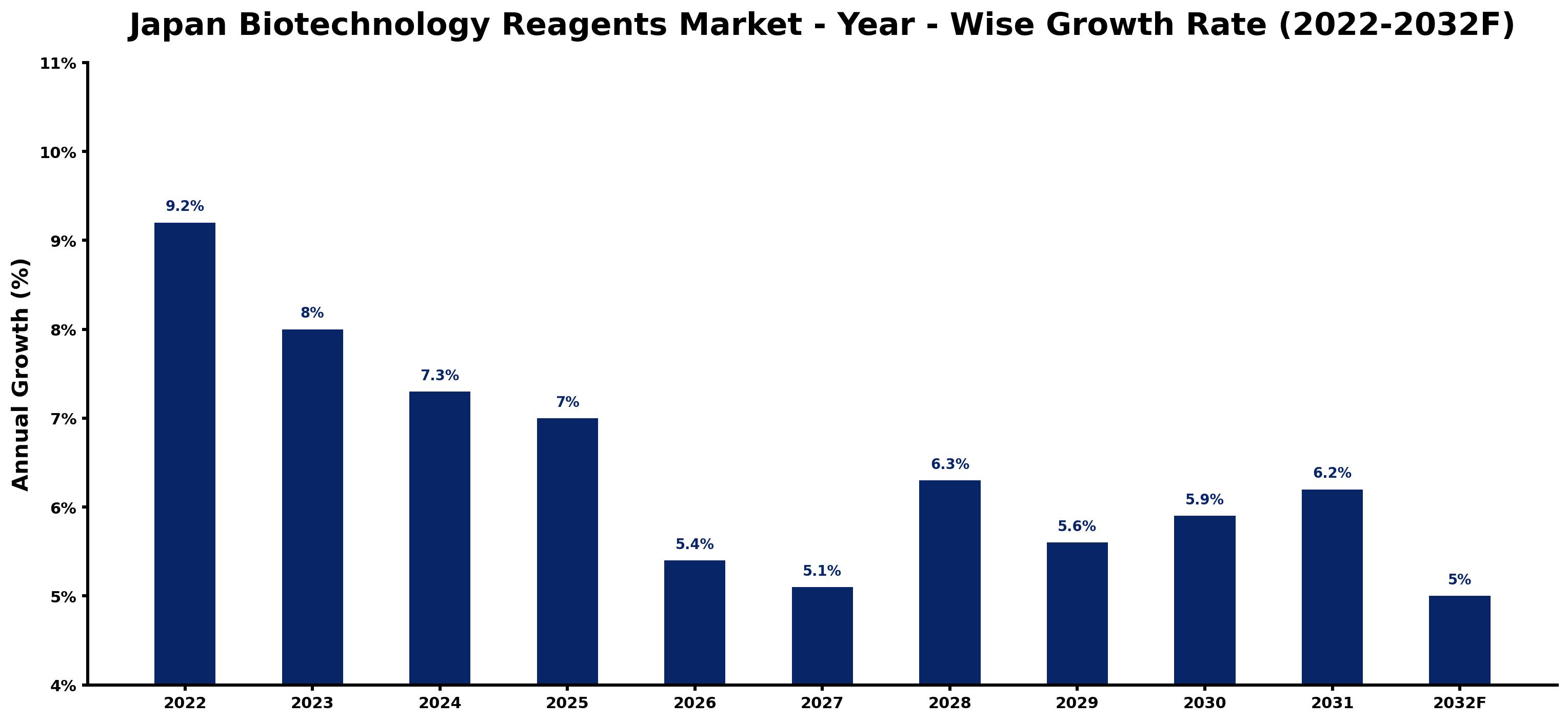
Annual growth estimates for each year appear below with the principal reason behind them, explaining the shifts that set the pace of the market.
| Year | Estimated Annual Growth (%) | Market Rationale |
| 2022 | 9.2 | The market experienced strong growth due to heightened research activities in biotechnology. |
| 2023 | 8.0 | Demand moderated as the market adjusted to previous high levels of activity. |
| 2024 | 7.3 | A continued slowdown occurred as firms focused on consolidating gains from prior investments. |
| 2025 | 7.0 | Steady growth was maintained as research institutions increased funding for biotechnology. |
| 2026 | 5.4 | Growth is expected to slow further as firms face challenges in scaling production capacity. |
| 2027 | 5.1 | A slight slowdown is projected to continue as the market stabilises after prior peaks in demand. |
| 2028 | 6.3 | Growth is expected to accelerate again as new technologies in biotechnology emerge. |
| 2029 | 5.6 | The market will see a slowdown as firms adjust to changing regulatory environments. |
| 2030 | 5.9 | Growth is projected to pick up as investment in biotechnology research and development increases. |
| 2031 | 6.2 | A further rise in growth is expected due to expanding applications in healthcare. |
| 2032 | 5.0 | Growth will slow as the market matures and competition intensifies. |
Note: Market size estimations and growth projections presented in this report are based on 6Wresearch's proprietary forecasting methodology, utilizing the latest available industry data, government publications, and primary research inputs.
Japan Biotechnology Reagents Market Synopsis
Biotechnology reagents are essential chemical substances used in biological research and development, produced through chemical synthesis and biological processes. Their primary applications include drug testing, protein synthesis, and DNA analysis. The Japan Biotechnology Reagents Market is expanding, driven by increasing demand from research institutions and pharmaceutical companies, supported by a biotechnology sector valued at approximately 4 trillion yen and over 1,000 active firms in the country. The number of clinical trials reached 2,500 in 2023, further stimulating market growth.
Market Dynamics Impact Analysis (2026–2032)
| Factor | Type | Impact | Primary Segment Affected |
| Rising investment in biotechnology research and development | Driver | High | Drug testing |
| Growing number of clinical trials in Japan | Driver | High | DNA & RNA analysis |
| Increasing demand for therapeutic proteins | Opportunity | Medium | Protein synthesis & purification |
| Expansion of biotechnology firms in urban centres | Opportunity | Medium | Life Science Reagents |
| Challenges in regulatory compliance for new products | Restraint | High | Analytical reagents |
| High production costs associated with advanced reagents | Restraint | Medium | Bead-based |
| Limited capacity for scaling production | Challenge | High | Cell-based |
| Compliance with stringent quality standards | Challenge | Medium | Life Science Reagents |
Evaluation of Drivers in Japan Biotechnology Reagents Market (2026–2032)
The factors lifting demand, and the evidence behind each, are summarised below.
| Drivers | Primary Segment Affected | Why It Matters (Evidence) |
| Increased funding for biotechnology research | Drug testing | Japan's national medical care expenditure was about JPY 46.7 trillion in fiscal 2022, driving demand for drug testing reagents. |
| Rising number of clinical trials | DNA & RNA analysis | The number of clinical trials in Japan reached 2,500 in 2023, boosting demand for DNA analysis reagents. |
| Growing therapeutic protein market | Protein synthesis & purification | The biotechnology sector's value at approximately 4 trillion yen indicates strong demand for protein synthesis. |
| Urban biotechnology hubs like Tokyo and Osaka | Life Science Reagents | Tokyo and Osaka host over 1,000 active biotechnology firms, increasing demand for life science reagents. |
| Adoption of ISO 9001 standards | Analytical reagents | Compliance with ISO 9001 enhances quality assurance in reagent production, increasing market confidence. |
Purchasing is picking up as funding for biotechnology research drives demand for reagents. Japan's national medical care expenditure reached about JPY 46.7 trillion in fiscal 2022, boosting the drug testing segment. The number of clinical trials in Japan climbed to 2,500 in 2023, increasing the need for DNA and RNA analysis reagents. Urban biotechnology hubs support a vibrant market, with over 1,000 active firms. The adoption of ISO 9001 standards improves quality assurance, raising buyer confidence in analytical reagents.
Evaluation of Restraints in Japan Biotechnology Reagents Market
Below are the constraints most often cited by buyers and suppliers, with the segment each affects.
| Market Restraint | Primary Segment Affected | Why It Matters (Evidence) |
| Regulatory compliance challenges for new products | Analytical reagents | The Pharmaceuticals and Medical Devices Agency outlines strict regulatory guidelines, complicating market entry for new analytical reagents. |
| High production costs for advanced reagents | Bead-based | The complexity of manufacturing bead-based reagents raises production costs, limiting market growth. |
| Limited capacity for scaling production | Cell-based | Production facilities face challenges in expanding capacity to meet rising demand for cell-based reagents. |
| Stringent quality standards compliance | Life Science Reagents | Compliance with rigorous quality standards increases operational costs for life science reagent manufacturers. |
| Market saturation in certain applications | Protein synthesis & purification | The high number of existing products in the protein synthesis market limits opportunities for new entrants. |
Japan Biotechnology Reagents Market Challenges
Increased regulatory scrutiny raises compliance costs for biotechnology firms, causing delays in product launches that can surpass six months for producers. Buyers encounter rising prices due to competition among over 1,000 active biotechnology firms, which can inflate procurement budgets by up to 15%. Limited access to advanced technology hampers research efficiency, potentially delaying critical drug development timelines for hospitals and research institutions. The ageing population, with 29.3% aged 65 or older, intensifies demand for effective healthcare solutions, pressuring suppliers to scale up production rapidly without compromising quality.
Trends in the Japan Biotechnology Reagents Market
The trends below show where the Japan Biotechnology Reagents Market is heading.
- Next-Generation Medical Infrastructure Act Implementation: The Next-Generation Medical Infrastructure Act, enacted in 2017, promotes the anonymisation of medical data for research. This shift allows for more efficient product development and research collaboration, improving the market for biotechnology reagents.
- Transition from Traditional to Advanced Drug Testing: Japan is moving towards advanced drug testing methodologies that require new reagents. The increasing number of clinical trials, reaching 2,500 in 2023, indicates a shift in focus towards more sophisticated testing processes.
- Growing Demand for Gene Expression Analysis: Research institutions are prioritising gene expression analysis, with the fastest-growing segment projected to grow at 8.0% CAGR. This trend reflects the increasing importance of genetic research in healthcare innovations.
- Shift Towards Sustainable Biotechnology Practices: The biotechnology sector is increasingly adopting sustainable practices, with a focus on reducing environmental impact. This shift is evident in initiatives by the Japan Bioindustry Association, promoting eco-friendly standards.
Investment Opportunities in the Japan Biotechnology Reagents Market
Investors looking at the Japan Biotechnology Reagents Market should consider the following areas.
- Gap in Advanced Drug Testing Reagents: With Japan's national medical care expenditure at JPY 46.7 trillion, there is a gap in advanced drug testing reagents. Research institutions are seeking new solutions to enhance testing accuracy.
- Growing Demand from Pharmaceutical Companies: Pharmaceutical companies in Japan are increasingly investing in biotechnology, creating opportunities for suppliers of protein synthesis reagents. Partnerships with local firms can facilitate market entry.
- Expansion of Gene Expression Research: The growing focus on gene expression analysis presents a lucrative opportunity for suppliers. Collaborating with universities conducting biotechnology research can enhance market penetration.
- Entry through Joint Ventures in Biotechnology: The biotechnology sector's growth encourages joint ventures with local firms. Establishing partnerships can streamline entry into the market, especially in urban biotechnology hubs like Tokyo.
Government Initiatives in the Japan Biotechnology Reagents Market
The Next-Generation Medical Infrastructure Act, enacted in 2017, improves data anonymisation for research, building on the Clinical Trials Act of 2017. This measure facilitates smoother product development by allowing researchers to access anonymised medical data, thus improving the efficiency of biotechnology research.
In 2023, the government allocated 500 million yen for biotechnology research grants, administered by the Japan Agency for Medical Research and Development. This funding supports innovative projects and boosts the overall research capacity of the biotechnology sector.
Future Insight of the Japan Biotechnology Reagents Market
The integration of advanced technologies will reshape the production of biotechnology reagents, lowering costs and enhancing quality for buyers. By 2032, the adoption of automation in laboratories will streamline workflows, allowing suppliers to meet increasing demand more efficiently. Government funding for biotechnology research grants will encourage innovation and expedite product development. Collaborative initiatives between universities and research institutions will drive breakthroughs in healthcare solutions, ensuring a robust pipeline of new therapies.
Market Segmentation Analysis
Japan Biotechnology Reagents Market report covers a detailed analysis of the following market segments:
By Application – DNA & RNA analysis Leads, Gene expression Expected to Grow Fastest
According to Bhawna Singh, Assistant Manager at 6Wresearch, with 40% of application revenue in 2025, DNA & RNA analysis was the largest category. DNA and RNA analysis commands the largest market share as it is fundamental for genetic research and diagnostics. This application is extensively used across Japan's over 100 universities and numerous research institutions, driving its widespread adoption. Gene expression is projected to grow fastest, at a CAGR of 8.0% during 2026–2032. The rapid growth of gene expression stems from its critical role in understanding gene function, particularly in relation to various diseases. The increase in clinical trials, which reached 2,500 in 2023, is propelling demand for this specific application. Suppliers must focus on enhancing their gene expression product lines to capitalise on the growing market opportunities.
By Technology – Life Science Reagents Lead, Cell-based Expected to Grow Fastest
Life Science Reagents accounted for 48% of the market by technology in 2025. Life Science Reagents dominate the market as they are widely used in various biological experiments across hospitals and research institutions in Japan. Their versatility makes them a staple in the biotechnology sector, which is valued at approximately 4 trillion yen. Over 2026–2032, Cell-based is expected to post the fastest growth, at a CAGR of 7.7%. Cell-based technology is growing quickly due to its importance in specialised research applications, particularly in drug discovery and development. The increasing investment in biotechnology research grants, amounting to 500 million yen in 2023, supports this trend. Buyers may need to adapt their procurement strategies to include more cell-based technologies as demand increases.
Key Attractiveness of the Report
- 10 Years of Market Numbers
- Historical Data Starting from 2022 to 2025
- Base Year 2025
- Forecast Data until 2032
- Key Performance Indicators Impacting the Market
- Major Upcoming Developments and Projects
Key Highlights of the Report:
- Japan Biotechnology Reagents Market Outlook
- Market Size of Japan Biotechnology Reagents Market, 2025
- Forecast of Japan Biotechnology Reagents Market, 2032
- Historical Data and Forecast of Japan Biotechnology Reagents Revenues & Volume for the Period 2022-2032
- Japan Biotechnology Reagents Market Trend Evolution
- Japan Biotechnology Reagents Market Drivers and Challenges
- Japan Biotechnology Reagents Price Trends
- Japan Biotechnology Reagents Porter's Five Forces
- Japan Biotechnology Reagents Industry Life Cycle
- Historical Data and Forecast of Japan Biotechnology Reagents Market Revenues & Volume By Application for the Period 2022-2032
- Historical Data and Forecast of Japan Biotechnology Reagents Market Revenues & Volume By Drug testing for the Period 2022-2032
- Historical Data and Forecast of Japan Biotechnology Reagents Market Revenues & Volume By Protein synthesis & purification for the Period 2022-2032
- Historical Data and Forecast of Japan Biotechnology Reagents Market Revenues & Volume By DNA & RNA analysis for the Period 2022-2032
- Historical Data and Forecast of Japan Biotechnology Reagents Market Revenues & Volume By Gene expression for the Period 2022-2032
- Historical Data and Forecast of Japan Biotechnology Reagents Market Revenues & Volume By Technology for the Period 2022-2032
- Historical Data and Forecast of Japan Biotechnology Reagents Market Revenues & Volume By Life Science Reagents for the Period 2022-2032
- Historical Data and Forecast of Japan Biotechnology Reagents Market Revenues & Volume By Analytical reagents for the Period 2022-2032
- Historical Data and Forecast of Japan Biotechnology Reagents Market Revenues & Volume By Bead-based for the Period 2022-2032
- Historical Data and Forecast of Japan Biotechnology Reagents Market Revenues & Volume By Cell-based for the Period 2022-2032
- Japan Biotechnology Reagents Import Export Trade Statistics
- Market Opportunity Assessment By Application
- Market Opportunity Assessment By Technology
- Japan Biotechnology Reagents Top Companies Market Share
- Japan Biotechnology Reagents Competitive Benchmarking By Technical and Operational Parameters
- Japan Biotechnology Reagents Company Profiles
- Japan Biotechnology Reagents Key Strategic Recommendations
Market Covered
The study includes the following segmentation.
By Application
- Drug testing
- Protein synthesis & purification
- DNA & RNA analysis
- Gene expression
By Technology
- Life Science Reagents
- Analytical reagents
- Bead-based
- Cell-based






































