Japan Building Insulation Materials Market Size & Growth Rate
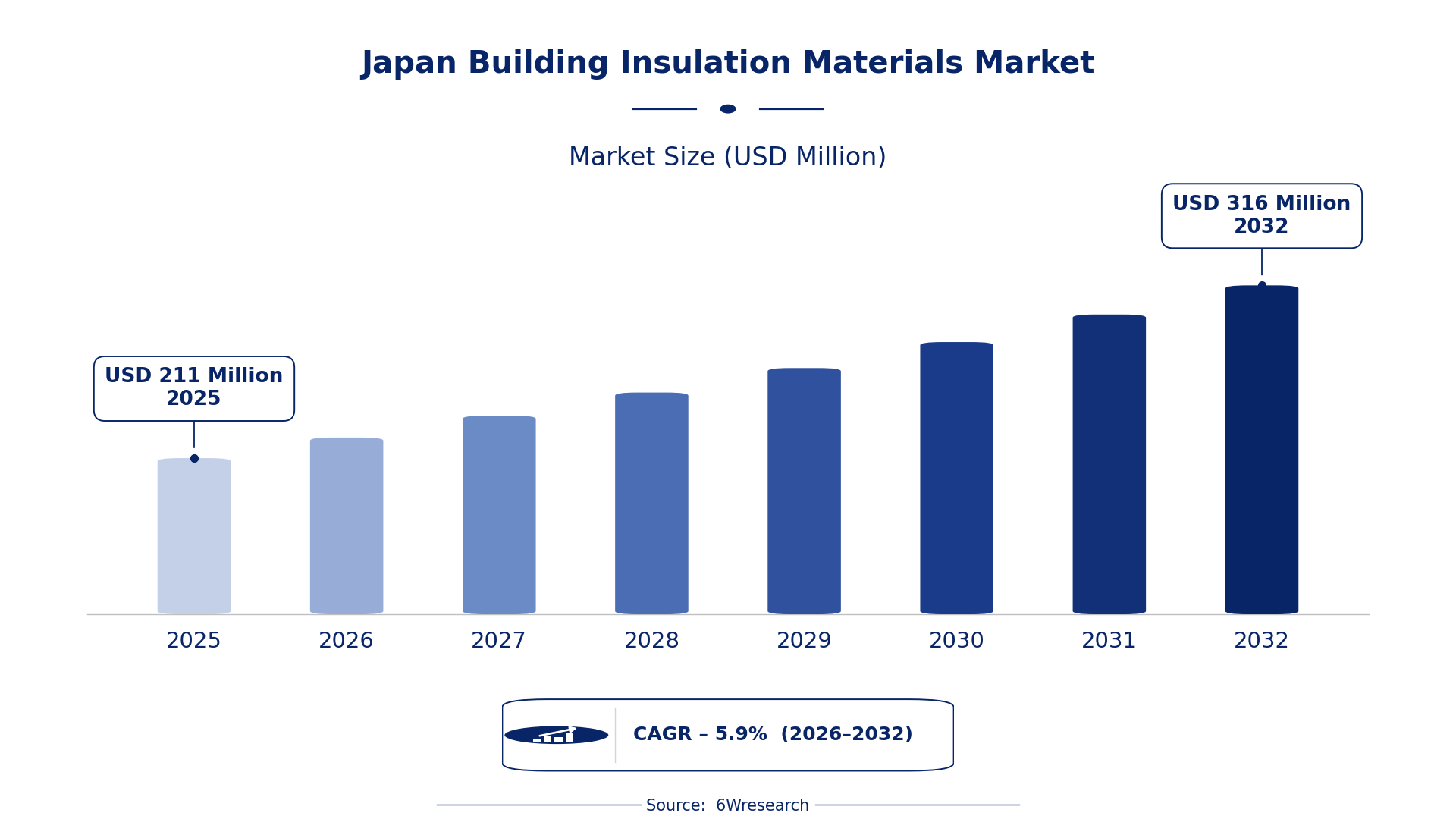
According to 6Wresearch internal database and industry insights, the Japan Building Insulation Materials Market was valued at USD 211 Million in 2025 and is projected to reach USD 316 Million by 2032, growing at a CAGR of approximately 5.9% during 2026–2032.
Japan Building Insulation Materials Market Highlights
| Report Metric | Details |
| Report Name | Japan Building Insulation Materials Market (2026-2032) |
| Market Size 2025 | USD 211 Million |
| Market Size 2032 | USD 316 Million |
| Absolute Growth 2025–2032 | USD 105 Million |
| CAGR 2026–2032 | 5.9% |
| Peak Annual Growth | 7.0% in 2032 |
| Forecast Period | 2026–2032 |
| Historical Data | 2022–2025 |
| Base Year | 2025 |
| Leading Material Type, 2025 | Fiberglass (40% share) |
| Leading Application, 2025 | Wall (47% share) |
| Leading End User, 2025 | Residential (68% share) |
| Fastest-Growing Material Type | Cellulose (8.6% CAGR) |
| Fastest-Growing Application | Roof and Ceiling (8.1% CAGR) |
| Fastest-Growing End User | Non-Residential (7.4% CAGR) |
| Growing Sector | Residential |
| Key End Users | Homeowners, construction firms, commercial developers, architects |
Japan Building Insulation Materials Market Year-wise Growth Rate and Key Drivers (2022–2032)
This graph illustrates the annual growth rates of the market from 2022 to 2032, highlighting a steady upward trajectory and projected market expansion over the forecast period.
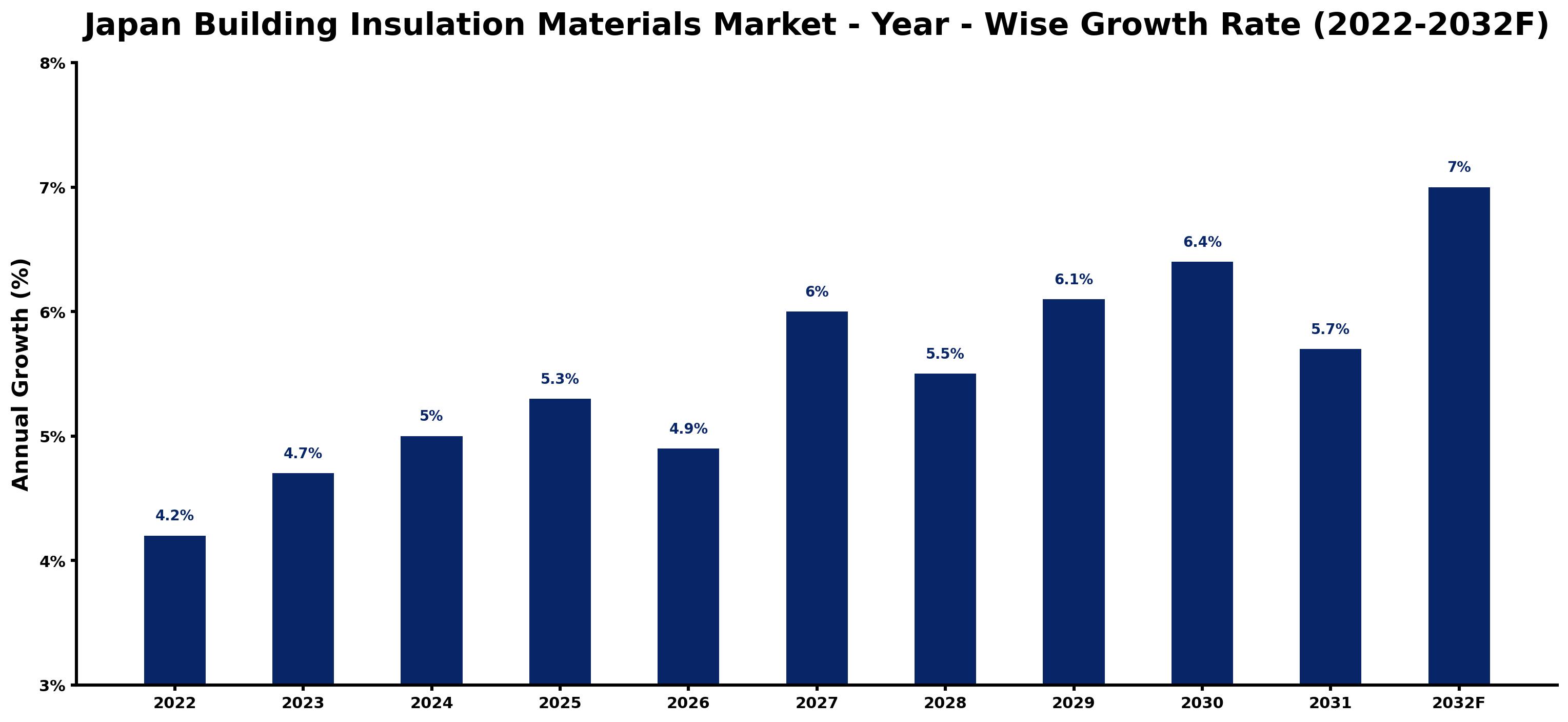
Annual growth estimates for each year appear below with the principal reason behind them, explaining the shifts that set the pace of the market.
| Year | Estimated Annual Growth (%) | Market Rationale |
| 2022 | 4.2 | The market experienced steady growth due to ongoing construction projects and energy efficiency regulations. |
| 2023 | 4.7 | Demand for insulation materials grew as energy efficiency initiatives gained traction across various sectors. |
| 2024 | 5.0 | The market continued to expand, driven by rising awareness of energy-efficient building practices. |
| 2025 | 5.3 | Growth accelerated as the residential sector showed strong investment in insulation materials. |
| 2026 | 4.9 | The market is expected to see a slowdown as growth rates stabilise following previous high demand. |
| 2027 | 6.0 | Demand will increase again due to stricter building codes and energy efficiency standards. |
| 2028 | 5.5 | Growth is projected to moderate as the market adjusts to new regulations and consumer preferences. |
| 2029 | 6.1 | The market will rebound with increased insulation use in non-residential buildings due to compliance needs. |
| 2030 | 6.4 | Demand is expected to strengthen as investments in energy efficiency reach new heights across sectors. |
| 2031 | 5.7 | Growth will slow slightly as the market begins to stabilise after several years of rapid expansion. |
| 2032 | 7.0 | The market is projected to peak as insulation materials become essential for new constructions. |
Note: Market size estimations and growth projections presented in this report are based on 6Wresearch's proprietary forecasting methodology, utilizing the latest available industry data, government publications, and primary research inputs.
Japan Building Insulation Materials Market Synopsis
Building insulation materials are essential products that reduce heat transfer in buildings, made from materials like fiberglass, mineral wool, and foam. The Japan Building Insulation Materials Market is expanding due to rising demand from the residential sector, which accounts for approximately 60% of usage, and the introduction of energy efficiency regulations. Japan aims for a 46% reduction in greenhouse gas emissions by 2030, driving investments in energy-efficient building practices and boosting the insulation market. The ongoing shift towards sustainable construction methods further fuels this growth.
Market Dynamics Impact Analysis (2026–2032)
| Factor | Type | Impact | Primary Segment Affected |
| Rising energy efficiency regulations | Driver | High | Residential |
| Increased construction activity | Driver | High | Non-Residential |
| Growing demand for eco-friendly materials | Opportunity | High | Cellulose |
| Investment in energy-efficient building practices | Opportunity | High | Polyurethane/Polyisocyanurate Foam |
| High costs of raw materials | Restraint | Medium | Fiberglass |
| Limited awareness of insulation benefits | Restraint | Medium | Mineral Wool |
| Compliance with evolving regulations | Challenge | High | Wall |
| Capacity constraints in production | Challenge | Medium | Roof and Ceiling |
Evaluation of Drivers in Japan Building Insulation Materials Market (2026–2032)
The table below links each growth driver to the segment it affects and the evidence for it.
| Drivers | Primary Segment Affected | Why It Matters (Evidence) |
| Increased energy efficiency regulations | Residential | These regulations drive demand for insulation materials, with the residential sector accounting for approximately 60% of usage. |
| Rising construction activity | Non-Residential | Growing construction projects in urban areas like Tokyo boost the need for insulation materials, increasing market demand. |
| Investment in energy-efficient building practices | Polyurethane/Polyisocyanurate Foam | Japan's energy efficiency investment reached 1 trillion yen in 2023, significantly increasing insulation demand across sectors. |
| Growing awareness of insulation benefits | Cellulose | Eco-friendly cellulose insulation is gaining traction, particularly in sustainable construction projects, enhancing its market presence. |
| Stricter building codes | Mineral Wool | Updated regulations require fire-resistant materials, increasing demand for mineral wool insulation in various building types. |
In 2023, Japan's energy efficiency investment reached 1 trillion yen, impacting insulation material demand significantly. Urban construction projects in Tokyo and Osaka are driving demand for high-performance materials like polyurethane foam. The focus on eco-friendly construction is also boosting cellulose insulation adoption, as builders seek sustainable alternatives to traditional materials.
Evaluation of Restraints in Japan Building Insulation Materials Market
The following restraints limit how fast demand can grow.
| Market Restraint | Primary Segment Affected | Why It Matters (Evidence) |
| High costs of raw materials | Fiberglass | The increasing prices of raw materials limit the affordability of fiberglass insulation, affecting buyer decisions. |
| Limited awareness of insulation benefits | Mineral Wool | Many builders remain unaware of the advantages of mineral wool, hindering its market penetration. |
| Compliance with evolving regulations | Wall | Constantly changing regulations require ongoing adjustments, increasing costs for manufacturers and buyers. |
| Production capacity constraints | Roof and Ceiling | Manufacturers face challenges in scaling production to meet rising demand, delaying supply. |
| Competition from alternative materials | Polyurethane/Polyisocyanurate Foam | The emergence of new insulation technologies poses a threat to traditional insulation materials. |
Japan Building Insulation Materials Market Challenges
Producers encounter difficulties in sourcing high-performance insulation materials, as only 30% of urban residential buildings comply with current insulation standards. This issue arises from Japan's stringent energy efficiency regulations, which restrict the variety of compliant products available, compelling producers to either compromise on quality or raise production costs. Importers face delays due to regulatory compliance enforced by the Ministry of the Environment, which can prolong lead times and increase costs, affecting their ability to deliver timely solutions to customers. Buyers experience intensified competition among suppliers, leading to price fluctuations that can influence their purchasing choices.
Trends in the Japan Building Insulation Materials Market
These developments are changing demand patterns in the Japan Building Insulation Materials Market.
- Shift from Traditional to Eco-Friendly Insulation: Since 2023, there has been a noticeable shift towards eco-friendly insulation materials like cellulose. This trend is reflected in construction projects across Japan, where sustainable building practices are becoming standard.
- Transition from Fiberglass to Mineral Wool: Starting in 2022, builders are increasingly favouring mineral wool for its fire-resistant properties. This shift is particularly prominent in non-residential buildings, where safety regulations demand higher performance.
- Increase in Energy Efficiency Standards: In 2022, the Building Energy Efficiency Act was amended, leading to stricter insulation requirements. This change is driving demand for high-performance insulation materials across all building types.
- Rising Adoption of Polyurethane Foam: In 2023, polyurethane foam gained traction due to its superior thermal resistance. This trend is particularly strong in urban areas, where energy efficiency is a top priority.
Investment Opportunities in the Japan Building Insulation Materials Market
The openings below show where demand in the Japan Building Insulation Materials Market is visible and how suppliers can enter.
- Timing for Eco-Friendly Investments: With Japan targeting a 46% reduction in greenhouse gas emissions by 2030, there is an opportunity for suppliers of cellulose insulation. Collaborating with construction firms focusing on sustainable practices can facilitate market entry.
- Growing Demand from Non-Residential Sector: The non-residential sector is projected to see increased insulation use due to stricter building codes. Suppliers can target commercial developers in urban areas to meet this growing need.
- Gap in High-Performance Insulation: As energy efficiency investments reach 1 trillion yen, there is a gap in high-performance insulation materials. Suppliers can enter the market by partnering with local construction firms to provide tailored solutions.
- Entry through Local Partnerships: Establishing joint ventures with local manufacturers can facilitate market entry for new insulation products. This strategy is particularly effective in regions like Tokyo and Osaka, where demand is high.
Government Initiatives in the Japan Building Insulation Materials Market
The Building Energy Efficiency Act, amended in 2022, mandates that all new buildings meet specific energy standards by April 2025. This law compels producers to ensure their insulation materials comply with these standards, driving demand for compliant products.
The Ministry of the Environment oversees the implementation of energy efficiency regulations and funds initiatives aimed at promoting sustainable building practices. Their support for projects that improve insulation standards is vital for market growth.
Future Insight of the Japan Building Insulation Materials Market
By 2032, the residential sector will undergo a shift towards improved thermal performance due to updated insulation standards from the Building Energy Efficiency Act. Public and private investments in decarbonisation are projected to reach JPY 150 trillion, stimulating demand for advanced insulation materials. Suppliers are likely to embrace new technologies that enhance insulation effectiveness, while the non-residential sector will see increased insulation adoption as building codes tighten. Energy-efficient building practices will become standard, reshaping the market.
Market Segmentation Analysis
Japan Building Insulation Materials Market report covers a detailed analysis of the following market segments:
By Material Type – Fiberglass Leads, Cellulose Expected to Grow Fastest
According to Vasudha, AM at 6Wresearch, in 2025, Fiberglass led the material type split with a 40% share. Fiberglass holds the largest share in Japan's building insulation market due to its widespread application in residential and commercial buildings, primarily for thermal insulation. Its cost-effectiveness and availability make it the preferred choice among builders and homeowners, particularly in urban areas like Tokyo. Cellulose is set to record the highest CAGR in this split, 8.6% over 2026–2032. Cellulose insulation is experiencing rapid growth as eco-friendly construction projects gain popularity, reflecting a shift towards sustainable building practices. The increasing awareness of environmental issues is driving demand for cellulose, which aligns with Japan's decarbonisation goals. Suppliers should focus on promoting the benefits of cellulose insulation to tap into the growing eco-conscious market.
By Application – Wall Leads, Roof and Ceiling Expected to Grow Fastest
Wall took 47% of application revenue in 2025, more than any other category. The wall application segment holds the largest share due to its essential role in maintaining energy efficiency within building envelopes. This is particularly evident in the residential sector, where insulation usage is substantial, accounting for around 60% of total demand. Roof and Ceiling is projected to grow fastest, at a CAGR of 8.1% during 2026–2032. The roof and ceiling segment is witnessing rapid growth as updated building codes emphasise energy efficiency. This is especially crucial in urban areas, where effective management of heat gain and loss is vital. Suppliers must align their products with the increasing regulatory focus on roof and ceiling insulation to remain competitive.
By End User – Residential Leads, Non-Residential Expected to Grow Fastest
With 68% of end user revenue in 2025, Residential was the largest category. The residential sector leads the market, driven by strong demand from homeowners seeking energy-efficient solutions amid rising energy costs. This sector's significance is underscored by its approximate 60% share of insulation material usage. The quickest growth will come from Non-Residential, forecast to expand at a CAGR of 7.4% between 2026 and 2032. The non-residential sector is projected to grow quickly as commercial buildings adapt to updated building codes and energy efficiency regulations. This trend indicates a shift towards sustainability in the commercial construction sector. Suppliers should direct their strategies towards non-residential solutions to leverage the expected growth in this segment.
Key Attractiveness of the Report
- 10 Years of Market Numbers
- Historical Data Starting from 2022 to 2025
- Base Year 2025
- Forecast Data until 2032
- Key Performance Indicators Impacting the Market
- Major Upcoming Developments and Projects
Key Highlights of the Report:
- Japan Building Insulation Materials Market Outlook
- Market Size of Japan Building Insulation Materials Market, 2025
- Forecast of Japan Building Insulation Materials Market, 2032
- Historical Data and Forecast of Japan Building Insulation Materials Revenues & Volume for the Period 2022-2032
- Japan Building Insulation Materials Market Trend Evolution
- Japan Building Insulation Materials Market Drivers and Challenges
- Japan Building Insulation Materials Price Trends
- Japan Building Insulation Materials Porter's Five Forces
- Japan Building Insulation Materials Industry Life Cycle
- Historical Data and Forecast of Japan Building Insulation Materials Market Revenues & Volume By Material Type for the Period 2022-2032
- Historical Data and Forecast of Japan Building Insulation Materials Market Revenues & Volume By Fiberglass for the Period 2022-2032
- Historical Data and Forecast of Japan Building Insulation Materials Market Revenues & Volume By Mineral Wool for the Period 2022-2032
- Historical Data and Forecast of Japan Building Insulation Materials Market Revenues & Volume By Cellulose for the Period 2022-2032
- Historical Data and Forecast of Japan Building Insulation Materials Market Revenues & Volume By Polyurethane/Polyisocyanurate Foam for the Period 2022-2032
- Historical Data and Forecast of Japan Building Insulation Materials Market Revenues & Volume By Polystyrene for the Period 2022-2032
- Historical Data and Forecast of Japan Building Insulation Materials Market Revenues & Volume By Application for the Period 2022-2032
- Historical Data and Forecast of Japan Building Insulation Materials Market Revenues & Volume By Floor and Basement for the Period 2022-2032
- Historical Data and Forecast of Japan Building Insulation Materials Market Revenues & Volume By Wall for the Period 2022-2032
- Historical Data and Forecast of Japan Building Insulation Materials Market Revenues & Volume By Roof and Ceiling for the Period 2022-2032
- Historical Data and Forecast of Japan Building Insulation Materials Market Revenues & Volume By End User for the Period 2022-2032
- Historical Data and Forecast of Japan Building Insulation Materials Market Revenues & Volume By Residential for the Period 2022-2032
- Historical Data and Forecast of Japan Building Insulation Materials Market Revenues & Volume By Non-Residential for the Period 2022-2032
- Japan Building Insulation Materials Import Export Trade Statistics
- Market Opportunity Assessment By Material Type
- Market Opportunity Assessment By Application
- Market Opportunity Assessment By End User
- Japan Building Insulation Materials Top Companies Market Share
- Japan Building Insulation Materials Competitive Benchmarking By Technical and Operational Parameters
- Japan Building Insulation Materials Company Profiles
- Japan Building Insulation Materials Key Strategic Recommendations
Market Covered
This report examines the market across the segments below.
By Material Type
- Fiberglass
- Mineral Wool
- Cellulose
- Polyurethane/Polyisocyanurate Foam
- Polystyrene
By Application
- Floor and Basement
- Wall
- Roof and Ceiling
By End User
- Residential
- Non-Residential































